Presented By:-
Ketan Pitrubhakta
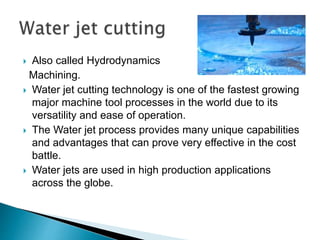
 Also called Hydrodynamics
Machining.
 Water jet cutting technology is one of the fastest growing
major machine tool processes in the world due to its
versatility and ease of operation.
 The Water jet process provides many unique capabilities
and advantages that can prove very effective in the cost
battle.
 Water jets are used in high production applications
across the globe.
 Generally it is categorized in two types
1. Pure water jet cutting
 High pressurized water is used as cutting media
2. Abrasive water jet cutting
 Fine particles of granite or alumina are used along with
high speed water stream
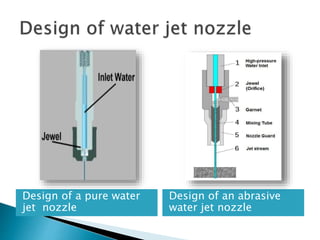
 They use the technology of high-pressure water being
forced through a small hole (typically called the “orifice”
or “jewel”) to concentrate an extreme amount of energy
in a small area.
 The inlet water for a pure water jet pressurized between
20,000 and 60,000 Pounds Per Square Inch (PSI) (1300
to 6200 bar.)
 This is forced through a tiny hole in the jewel, which is
typically 0.007” to 0.0020” in diameter (0.18 to 0.4 mm).
 Travelling as close to the speed of sound (about 600
mph or 960 km/hr)
Design of a pure water
jet nozzle
Design of an abrasive
water jet nozzle
 In abrasive water jet cutting abrasive particles are added
along with the high speed water stream.
 The beam of water accelerates abrasive particles to
speeds fast enough to cut through much harder
materials.
 The forces of the water and abrasive erodes the material
 The cutting action is greatly enhanced if the abrasive jet
stream is moved across the material.
 The ideal speed of movement depends on
1. The material
2. The shape of the part
3. The water pressure and the type of abrasive.
 Controlling the speed of the abrasive jet nozzle is
crucial to efficient and economical machining.
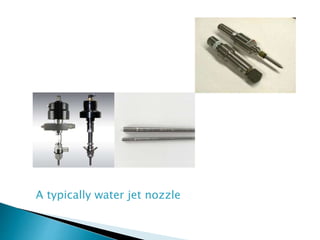
A typically water jet nozzle
 Fast setup and programming
 Almost no heat generated on your part
 No mechanical stresses
 Are very safe
 Environmentally friendly
 This process is suitable for cutting all materials. Even
diamond can be cut by using diamond powder as
abrasive.
 Due to low velocity of particles, the rate of impact is
negligible. Thus, very thin and brittle materials can be
cut without any risk of breaking.
 Cutting hard metals such as tool steel seriously affects
the cutting speed, therefore water jet cutting is not an
efficient method of machining these hardened materials.
 Cutting thick materials results in a taper down the cut
resulting from the water jet widening as it get further
away from the nozzle. This means dimensional accuracy
in thick cuts becomes a problem.
 Architectural
 Aerospace
 Manufacturing
 Automotive
 Electronics
 Relatively new technology has caught on quickly and is
replacing century-old methods for machining.
 Used not only in typical machining applications, but food
and soft-goods industries
 As material and pump technology advances faster
cutting rates, longer component life and tighter
tolerances will be achievable
 Gave us the way for new machining processes that
embrace simplicity and have a small environmental
impact
Presentation on manufacturing

Presentation on manufacturing

  • 1.
  • 2.
     Also calledHydrodynamics Machining.  Water jet cutting technology is one of the fastest growing major machine tool processes in the world due to its versatility and ease of operation.  The Water jet process provides many unique capabilities and advantages that can prove very effective in the cost battle.  Water jets are used in high production applications across the globe.
  • 3.
     Generally itis categorized in two types 1. Pure water jet cutting  High pressurized water is used as cutting media 2. Abrasive water jet cutting  Fine particles of granite or alumina are used along with high speed water stream
  • 4.
     They usethe technology of high-pressure water being forced through a small hole (typically called the “orifice” or “jewel”) to concentrate an extreme amount of energy in a small area.  The inlet water for a pure water jet pressurized between 20,000 and 60,000 Pounds Per Square Inch (PSI) (1300 to 6200 bar.)  This is forced through a tiny hole in the jewel, which is typically 0.007” to 0.0020” in diameter (0.18 to 0.4 mm).  Travelling as close to the speed of sound (about 600 mph or 960 km/hr)
  • 5.
    Design of apure water jet nozzle Design of an abrasive water jet nozzle
  • 6.
     In abrasivewater jet cutting abrasive particles are added along with the high speed water stream.  The beam of water accelerates abrasive particles to speeds fast enough to cut through much harder materials.
  • 7.
     The forcesof the water and abrasive erodes the material  The cutting action is greatly enhanced if the abrasive jet stream is moved across the material.  The ideal speed of movement depends on 1. The material 2. The shape of the part 3. The water pressure and the type of abrasive.  Controlling the speed of the abrasive jet nozzle is crucial to efficient and economical machining.
  • 8.
  • 9.
     Fast setupand programming  Almost no heat generated on your part  No mechanical stresses  Are very safe  Environmentally friendly  This process is suitable for cutting all materials. Even diamond can be cut by using diamond powder as abrasive.  Due to low velocity of particles, the rate of impact is negligible. Thus, very thin and brittle materials can be cut without any risk of breaking.
  • 10.
     Cutting hardmetals such as tool steel seriously affects the cutting speed, therefore water jet cutting is not an efficient method of machining these hardened materials.  Cutting thick materials results in a taper down the cut resulting from the water jet widening as it get further away from the nozzle. This means dimensional accuracy in thick cuts becomes a problem.
  • 12.
     Architectural  Aerospace Manufacturing  Automotive  Electronics
  • 13.
     Relatively newtechnology has caught on quickly and is replacing century-old methods for machining.  Used not only in typical machining applications, but food and soft-goods industries  As material and pump technology advances faster cutting rates, longer component life and tighter tolerances will be achievable  Gave us the way for new machining processes that embrace simplicity and have a small environmental impact