X-Ray
Photolithography
Contents
Lithography
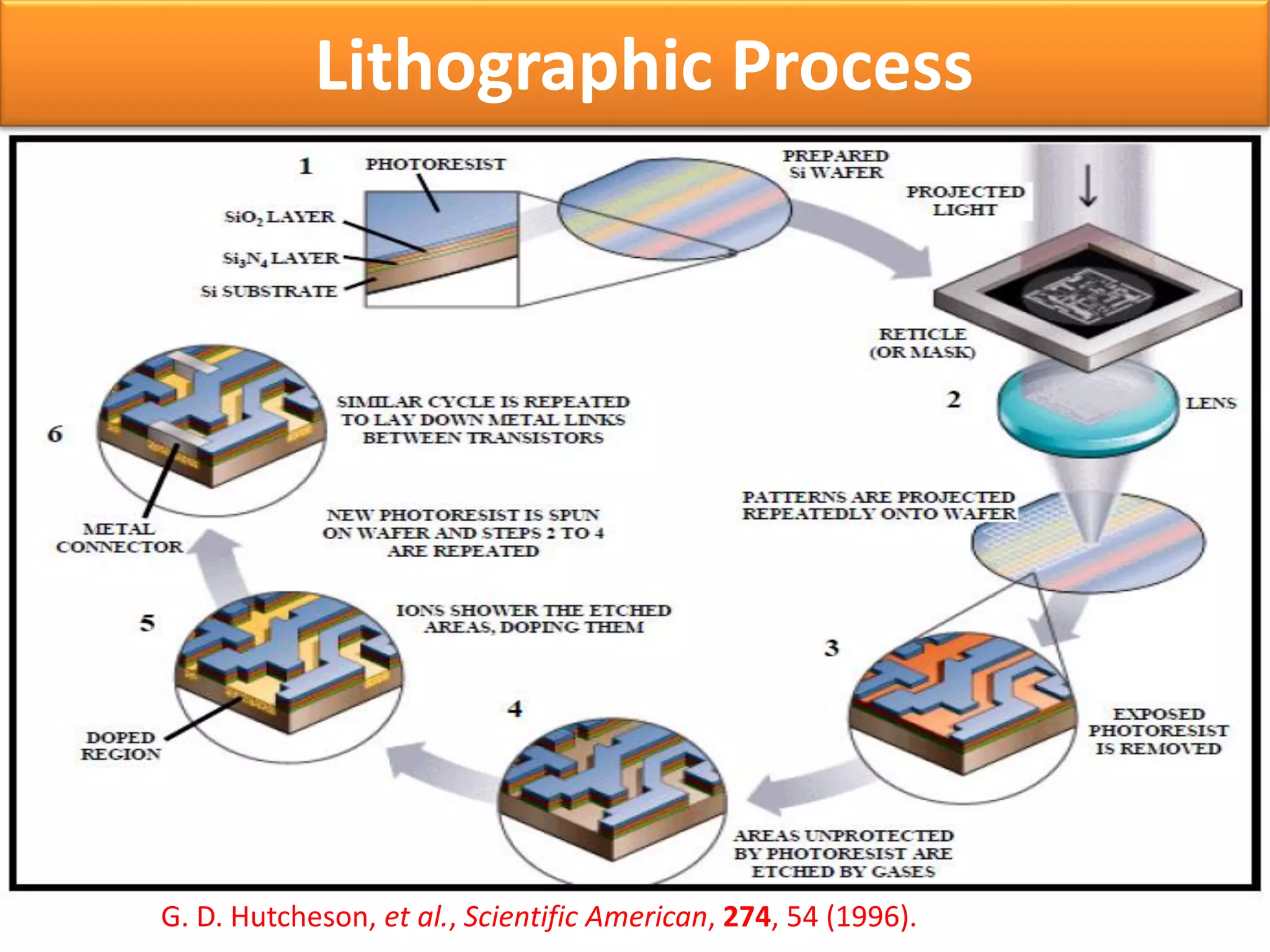
 Lithographic Process
X-Ray Photolithography
Sources of X-Rays
i) Electron Impact X-Ray Sources
ii) Synchrotron X-ray source
Procedure of X-Ray Photolithography
Advantages
Applications
Limitations
Lithography is the process of printing
patterns onto a thin film called resist, using
localized interaction between this layer and
the particle beam.
What Is Lithography
G. D. Hutcheson, et al., Scientific American, 274, 54 (1996).
Lithographic Process
X-Ray Photolithography is a process
which uses X-rays to transfer a geometric
pattern from a mask to the resist on the
substrate.
X-ray Photolithography
Sources of X-rays
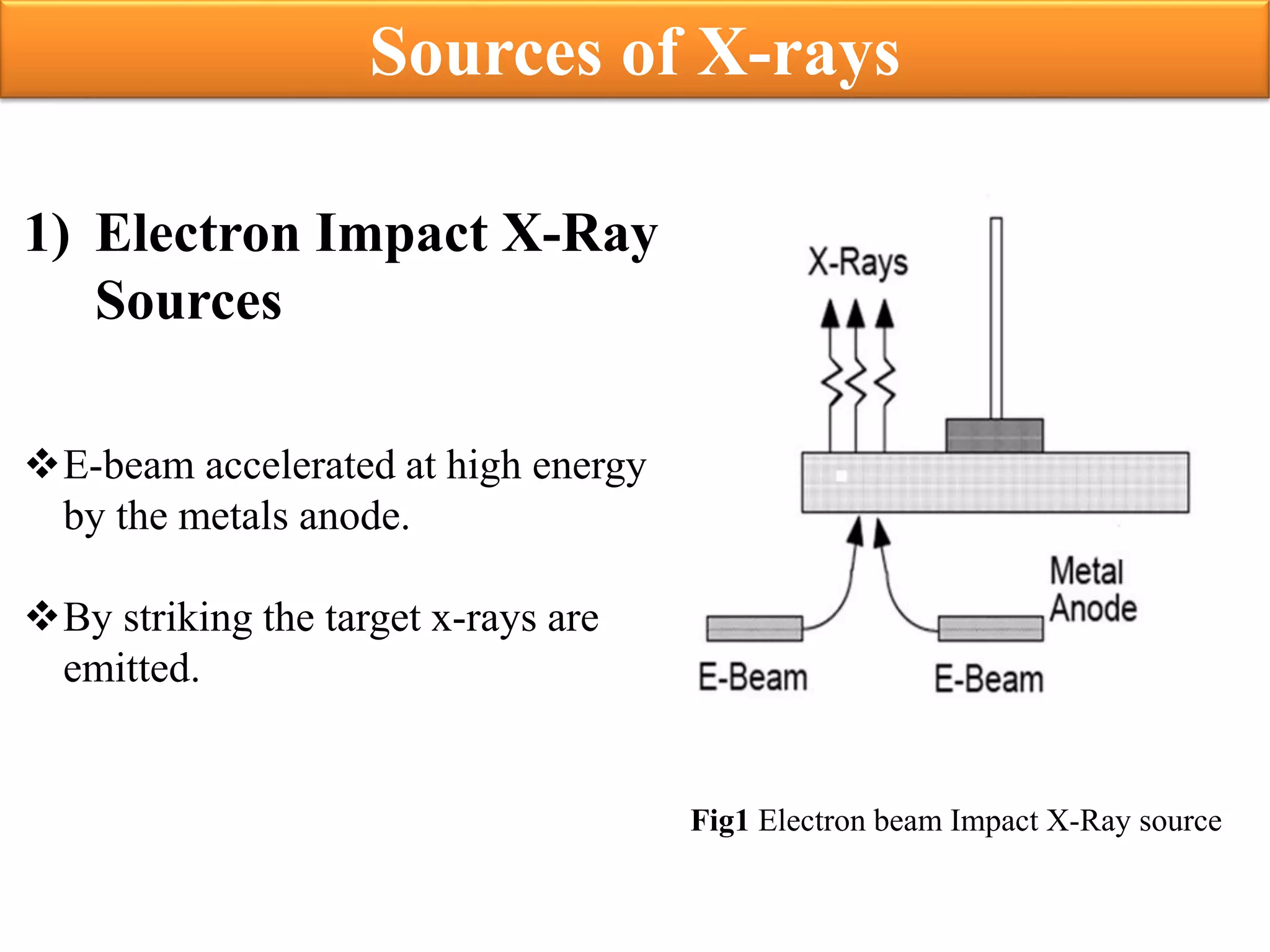
1) Electron Impact X-Ray
Sources
E-beam accelerated at high energy
by the metals anode.
By striking the target x-rays are
emitted.
Fig1 Electron beam Impact X-Ray source
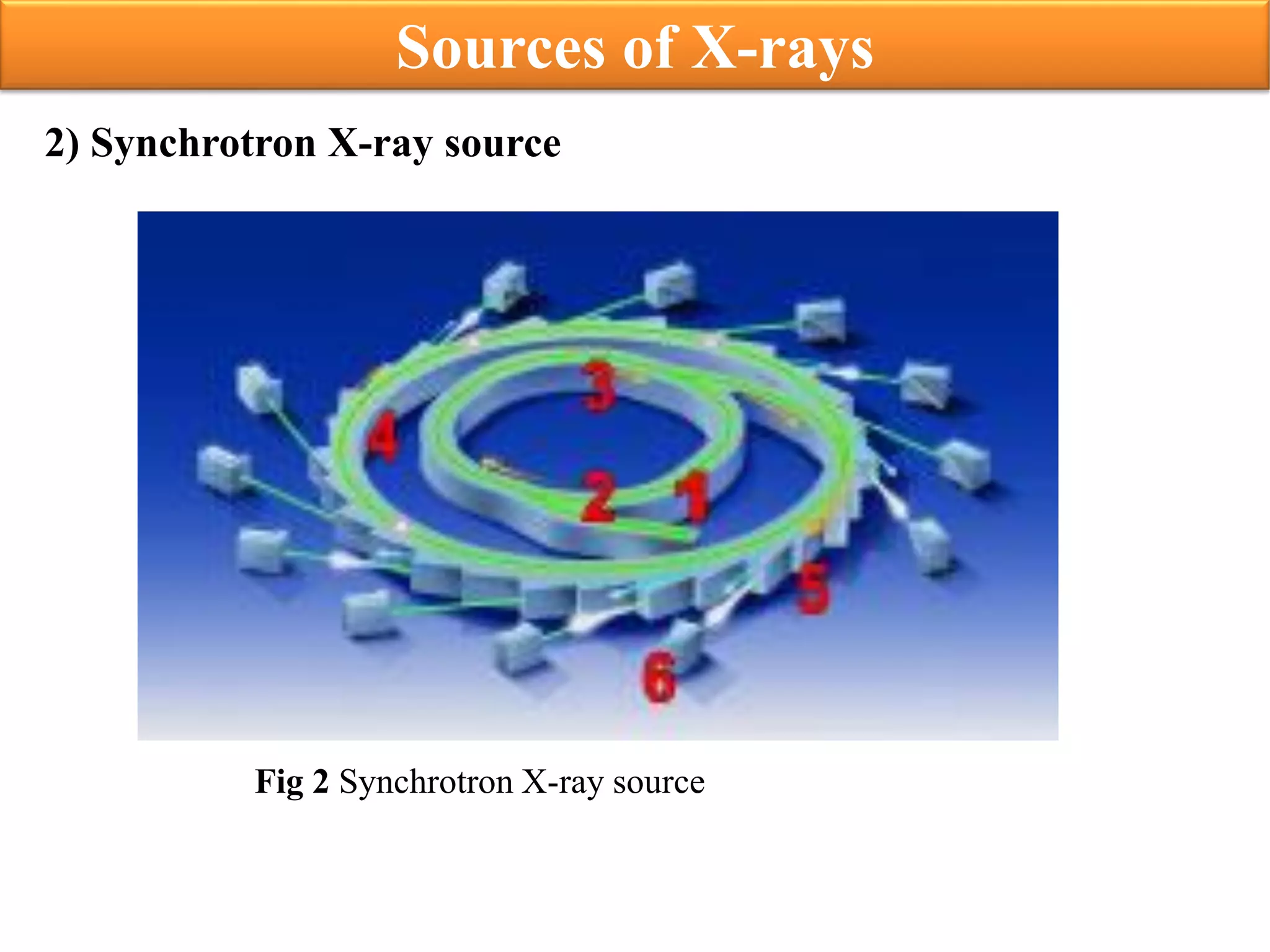
2) Synchrotron X-ray source
Fig 2 Synchrotron X-ray source
Sources of X-rays
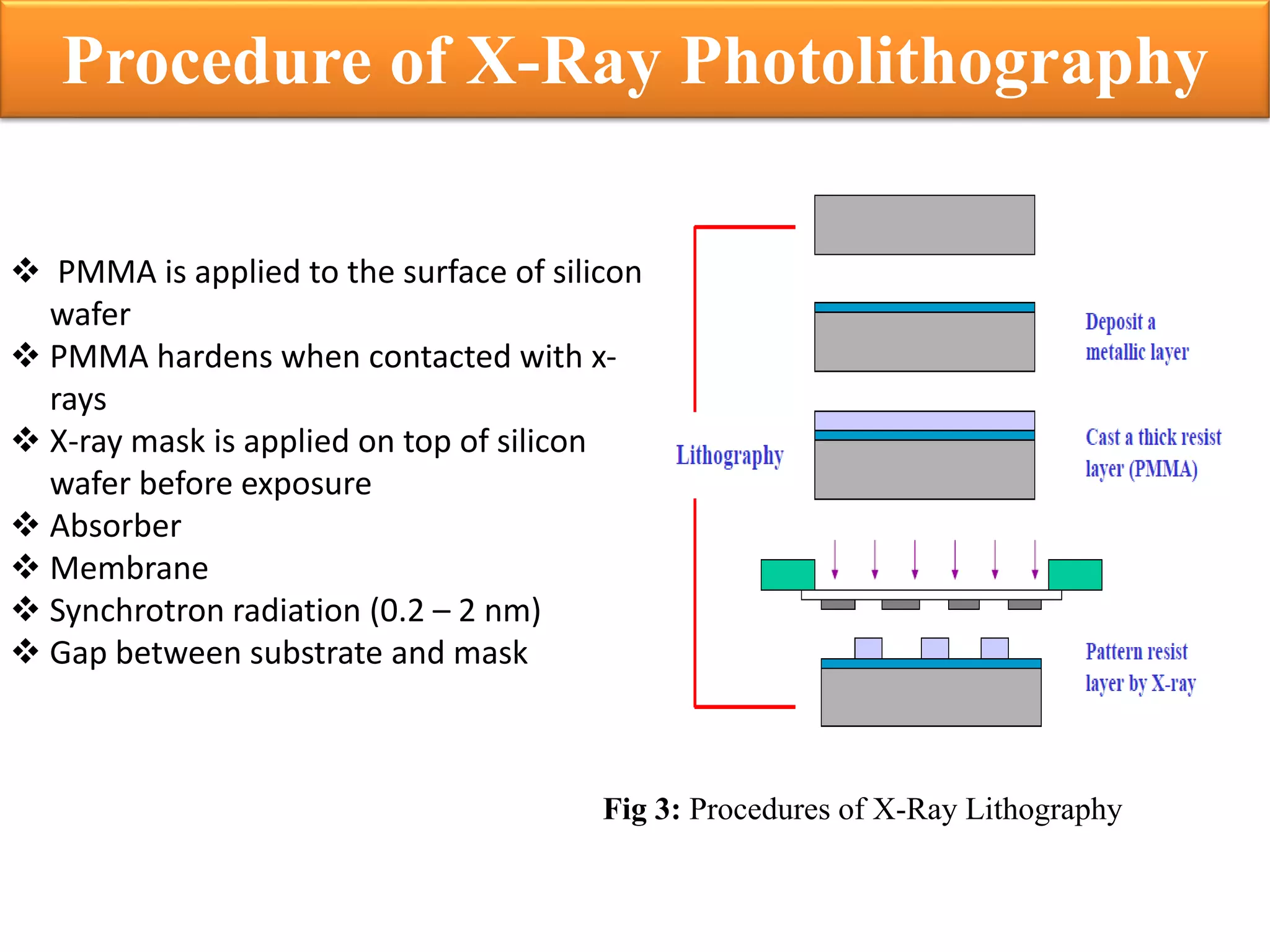
Procedure of X-Ray Photolithography
 PMMA is applied to the surface of silicon
wafer
 PMMA hardens when contacted with x-
rays
 X-ray mask is applied on top of silicon
wafer before exposure
 Absorber
 Membrane
 Synchrotron radiation (0.2 – 2 nm)
 Gap between substrate and mask
Fig 3: Procedures of X-Ray Lithography
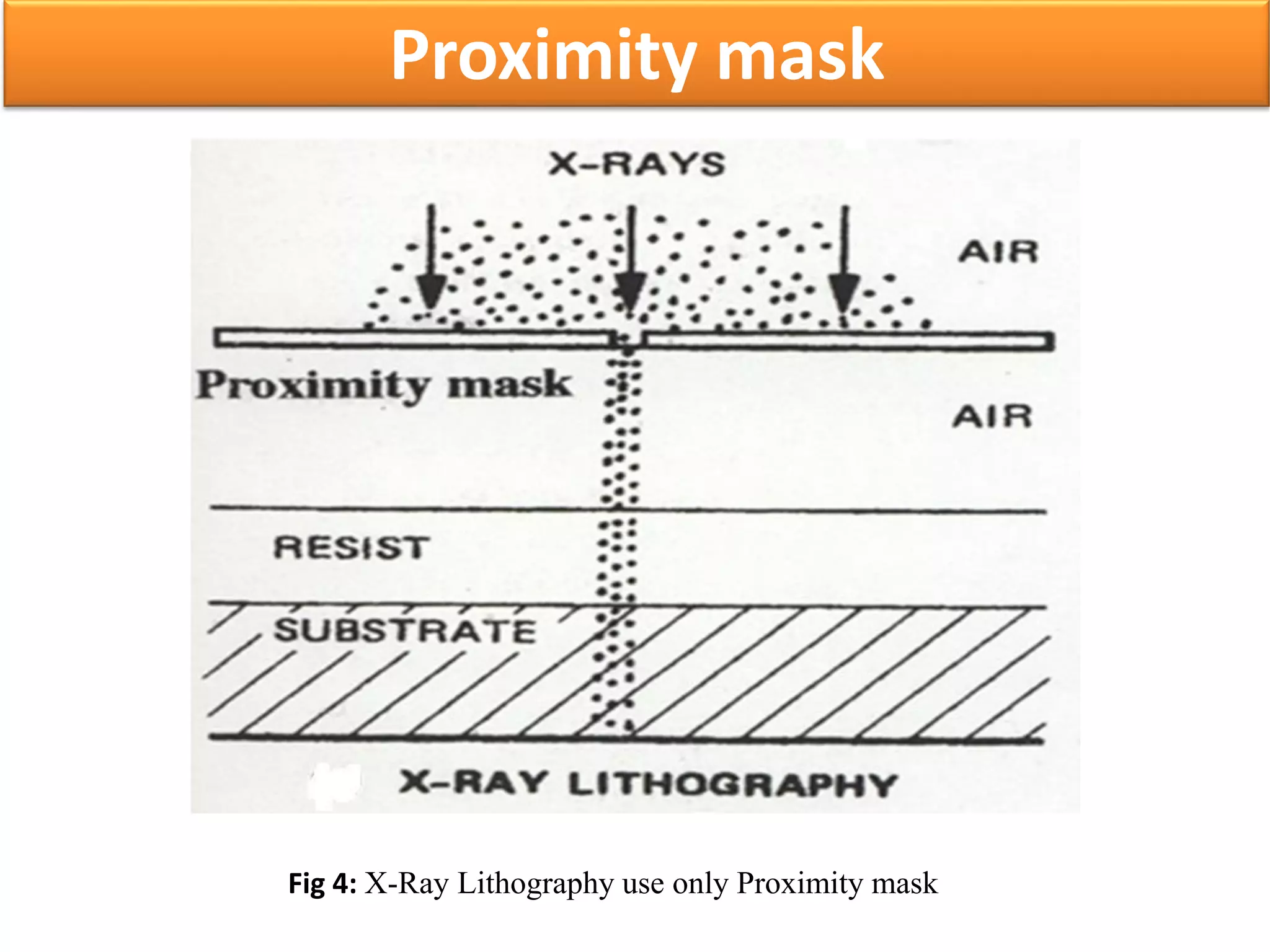
Proximity mask
Fig 4: X-Ray Lithography use only Proximity mask
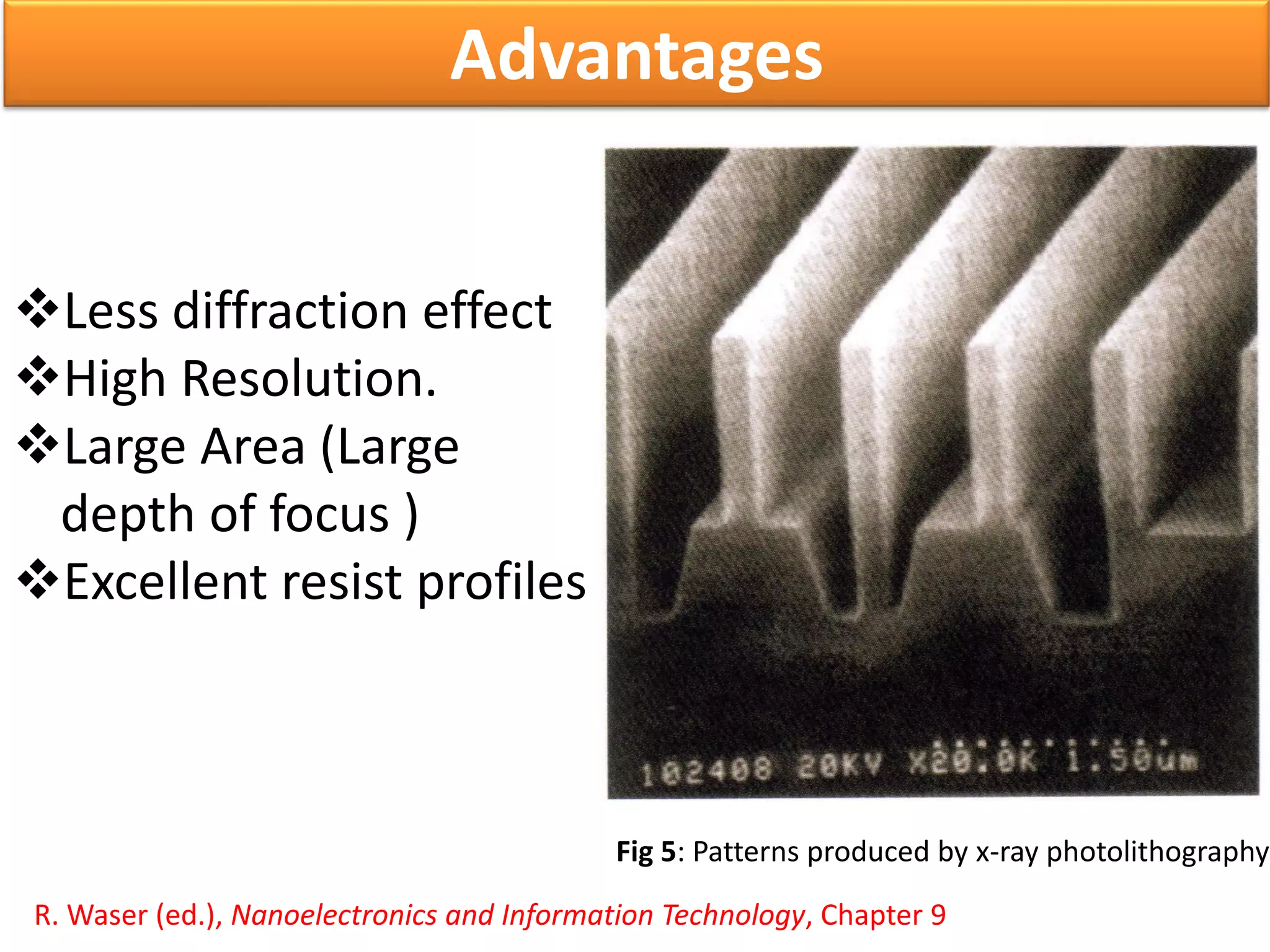
Less diffraction effect
High Resolution.
Large Area (Large
depth of focus )
Excellent resist profiles
R. Waser (ed.), Nanoelectronics and Information Technology, Chapter 9
Advantages
Fig 5: Patterns produced by x-ray photolithography
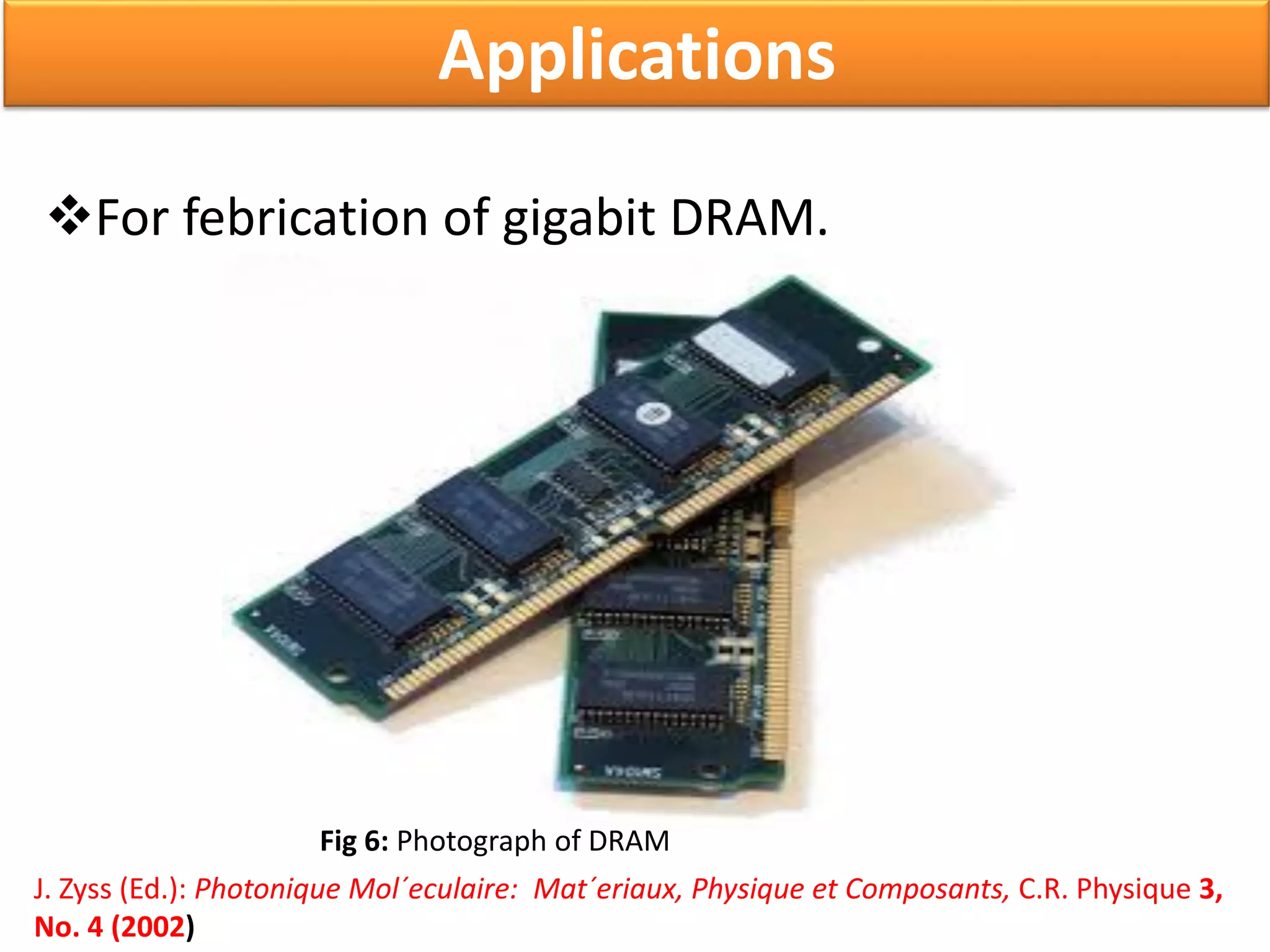
For febrication of gigabit DRAM.
Applications
Fig 6: Photograph of DRAM
J. Zyss (Ed.): Photonique Mol´eculaire: Mat´eriaux, Physique et Composants, C.R. Physique 3,
No. 4 (2002)
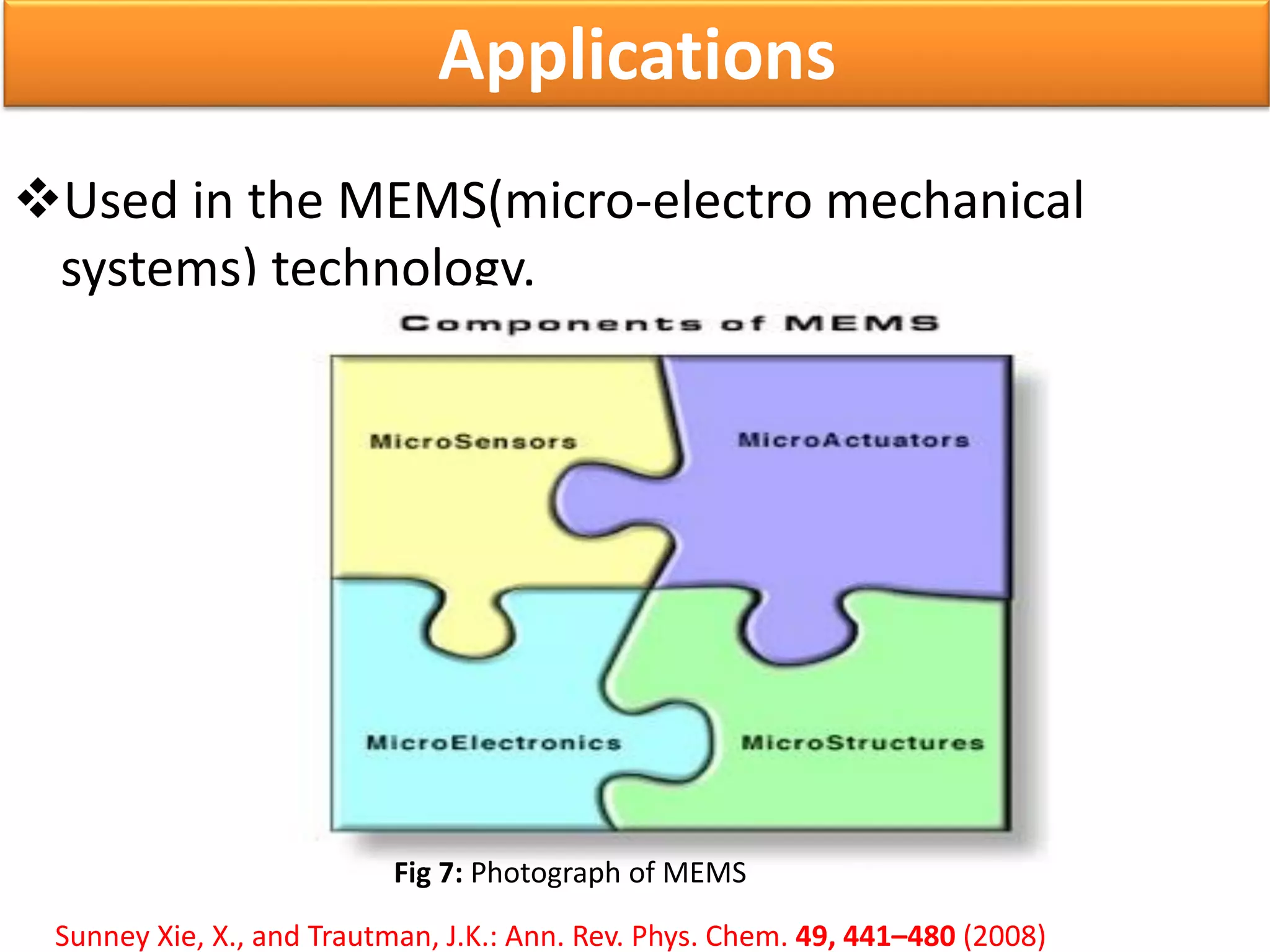
Used in the MEMS(micro-electro mechanical
systems) technology.
Fig 7: Photograph of MEMS
Applications
Sunney Xie, X., and Trautman, J.K.: Ann. Rev. Phys. Chem. 49, 441–480 (2008)
 Thin Lens
Distortion in absorber
Cannot be focused through lens
Masks are expensive to produce
Limitations
Thanxxx…..

X rays lithography

  • 1.
  • 2.
    Contents Lithography  Lithographic Process X-RayPhotolithography Sources of X-Rays i) Electron Impact X-Ray Sources ii) Synchrotron X-ray source Procedure of X-Ray Photolithography Advantages Applications Limitations
  • 3.
    Lithography is theprocess of printing patterns onto a thin film called resist, using localized interaction between this layer and the particle beam. What Is Lithography
  • 4.
    G. D. Hutcheson,et al., Scientific American, 274, 54 (1996). Lithographic Process
  • 5.
    X-Ray Photolithography isa process which uses X-rays to transfer a geometric pattern from a mask to the resist on the substrate. X-ray Photolithography
  • 6.
    Sources of X-rays 1)Electron Impact X-Ray Sources E-beam accelerated at high energy by the metals anode. By striking the target x-rays are emitted. Fig1 Electron beam Impact X-Ray source
  • 7.
    2) Synchrotron X-raysource Fig 2 Synchrotron X-ray source Sources of X-rays
  • 8.
    Procedure of X-RayPhotolithography  PMMA is applied to the surface of silicon wafer  PMMA hardens when contacted with x- rays  X-ray mask is applied on top of silicon wafer before exposure  Absorber  Membrane  Synchrotron radiation (0.2 – 2 nm)  Gap between substrate and mask Fig 3: Procedures of X-Ray Lithography
  • 9.
    Proximity mask Fig 4:X-Ray Lithography use only Proximity mask
  • 10.
    Less diffraction effect HighResolution. Large Area (Large depth of focus ) Excellent resist profiles R. Waser (ed.), Nanoelectronics and Information Technology, Chapter 9 Advantages Fig 5: Patterns produced by x-ray photolithography
  • 11.
    For febrication ofgigabit DRAM. Applications Fig 6: Photograph of DRAM J. Zyss (Ed.): Photonique Mol´eculaire: Mat´eriaux, Physique et Composants, C.R. Physique 3, No. 4 (2002)
  • 12.
    Used in theMEMS(micro-electro mechanical systems) technology. Fig 7: Photograph of MEMS Applications Sunney Xie, X., and Trautman, J.K.: Ann. Rev. Phys. Chem. 49, 441–480 (2008)
  • 13.
     Thin Lens Distortionin absorber Cannot be focused through lens Masks are expensive to produce Limitations
  • 14.