Ion implantation
KIRUBAKARAN
20304011
PONDICHERRY UNIVERSITY
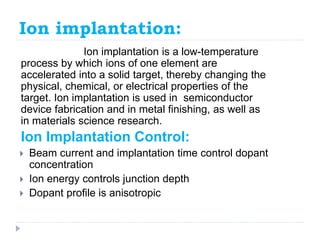
Ion implantation:
Ion implantation is a low-temperature
process by which ions of one element are
accelerated into a solid target, thereby changing the
physical, chemical, or electrical properties of the
target. Ion implantation is used in semiconductor
device fabrication and in metal finishing, as well as
in materials science research.
Ion Implantation Control:
 Beam current and implantation time control dopant
concentration
 Ion energy controls junction depth
 Dopant profile is anisotropic
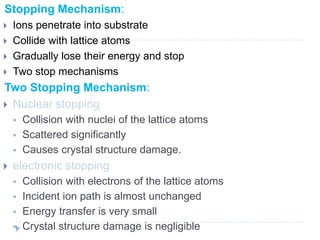
Stopping Mechanism:
 Ions penetrate into substrate
 Collide with lattice atoms
 Gradually lose their energy and stop
 Two stop mechanisms
Two Stopping Mechanism:
 Nuclear stopping
 Collision with nuclei of the lattice atoms
 Scattered significantly
 Causes crystal structure damage.
 electronic stopping
 Collision with electrons of the lattice atoms
 Incident ion path is almost unchanged
 Energy transfer is very small
 Crystal structure damage is negligible
Implantation Processes:
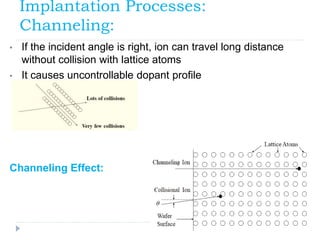
Channeling:
• If the incident angle is right, ion can travel long distance
without collision with lattice atoms
• It causes uncontrollable dopant profile
Channeling Effect:
• Ways to avoid channeling effect
 Tilt wafer, 7° is most commonly used
 Screen oxide
 Pre-amorphous implantation, Germanium
• Shadowing effect
 Ion blocked by structures
• Rotate wafer and post-implantation diffusion
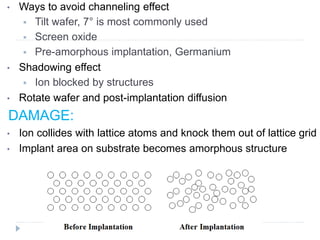
DAMAGE:
• Ion collides with lattice atoms and knock them out of lattice grid
• Implant area on substrate becomes amorphous structure
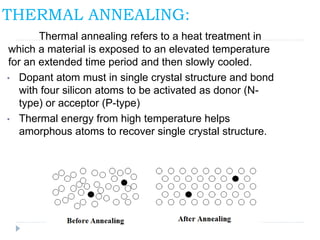
THERMAL ANNEALING:
Thermal annealing refers to a heat treatment in
which a material is exposed to an elevated temperature
for an extended time period and then slowly cooled.
• Dopant atom must in single crystal structure and bond
with four silicon atoms to be activated as donor (N-
type) or acceptor (P-type)
• Thermal energy from high temperature helps
amorphous atoms to recover single crystal structure.
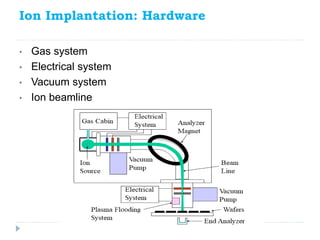
Ion Implantation: Hardware
• Gas system
• Electrical system
• Vacuum system
• Ion beamline
 Gas System:
• Special gas deliver system to handle hazardous gases
• Special training needed to change gases bottles
• Argon is used for purge and beam calibration
 Electrical System:
• High voltage system
– Determine ion energy that controls junction depth
• High voltage system
– Determine ion energy that controls junction depth
• RF system
– Some ion sources use RF to generate ions
Vacuum System:
• Need high vacuum to accelerate ions and reduce collision
• MFP >> beamline length
• 10-5 to 10-7 Torr
• Turbo pump and Cryo pump
• Exhaust system
• Control System:
• Ion energy, beam current, and ion species.
• Mechanical parts for loading and unloading
• Wafer movement to get uniform beam scan
• CPU board control boards
– Control boards collect data from the systems, send
it to CPU board to process,
– CPU sends instructions back to the systems
through the control board
Ion Source:
• Hot tungsten filament emits thermal electron
• Electrons collide with source gas molecules to dissociate
and ionize
• Ions are extracted out of source chamber and accelerated to
the beamline
• RF and microwave power can also be used to ionize source
gas
• Extraction:
• Extraction electrode accelerates ions up to 50 keV
• High energy is required for analyzer magnet to select right
ion species
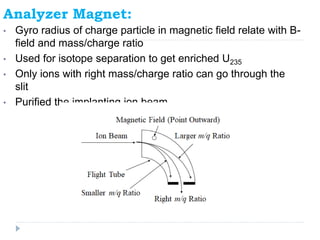
Analyzer Magnet:
• Gyro radius of charge particle in magnetic field relate with B-
field and mass/charge ratio
• Used for isotope separation to get enriched U235
• Only ions with right mass/charge ratio can go through the
slit
• Purified the implanting ion beam
Safety:
One of most hazardous process tools in semiconductor
industry
• Chemical
• Electro-magnetic
• Mechanical
Chemical Safety:
Most dopant materials are highly toxic, flammable and explosive.
• Poisonous and explosive: AsH3 , PH3 , B2H6
• Corrosive: BF3
• Toxic: P, B, As, Sb
Electro-magnetic Safety:
High voltage: from facility 208 V to acceleration electrode up to
50 kV.
• Ground strip
• Lock & tag
• Magnetic field: pacemaker, etc
Radiation Safety:
• High energy ions cause strong X-ray
radiation
• Normally well shield.
Mechanical Safety:
Moving parts, doors, valves and robots
• Spin wheel
ADVANTAGE:
 Precise control of dose, depth profile and area
uniformity.
 Excellent reproducibility.
 Wide choice of masks.
 Low temperature process.
 Small lateral spread of dopants.
 Vacuum cleanliness.
DISADVANTAGE:
 Expensive & complicated equipment.
 Very deep and very shallow profiles are difficult.
 Not all the damage can be corrected by annealing.
 Typically has higher impurity content than does
diffusion.
 Often uses extremely toxic gas sources such as
arsine (AsH3), and phosphine (PH3).

Ion implantation

  • 1.
  • 2.
    Ion implantation: Ion implantationis a low-temperature process by which ions of one element are accelerated into a solid target, thereby changing the physical, chemical, or electrical properties of the target. Ion implantation is used in semiconductor device fabrication and in metal finishing, as well as in materials science research. Ion Implantation Control:  Beam current and implantation time control dopant concentration  Ion energy controls junction depth  Dopant profile is anisotropic
  • 3.
    Stopping Mechanism:  Ionspenetrate into substrate  Collide with lattice atoms  Gradually lose their energy and stop  Two stop mechanisms Two Stopping Mechanism:  Nuclear stopping  Collision with nuclei of the lattice atoms  Scattered significantly  Causes crystal structure damage.  electronic stopping  Collision with electrons of the lattice atoms  Incident ion path is almost unchanged  Energy transfer is very small  Crystal structure damage is negligible
  • 4.
    Implantation Processes: Channeling: • Ifthe incident angle is right, ion can travel long distance without collision with lattice atoms • It causes uncontrollable dopant profile Channeling Effect:
  • 5.
    • Ways toavoid channeling effect  Tilt wafer, 7° is most commonly used  Screen oxide  Pre-amorphous implantation, Germanium • Shadowing effect  Ion blocked by structures • Rotate wafer and post-implantation diffusion DAMAGE: • Ion collides with lattice atoms and knock them out of lattice grid • Implant area on substrate becomes amorphous structure
  • 6.
    THERMAL ANNEALING: Thermal annealingrefers to a heat treatment in which a material is exposed to an elevated temperature for an extended time period and then slowly cooled. • Dopant atom must in single crystal structure and bond with four silicon atoms to be activated as donor (N- type) or acceptor (P-type) • Thermal energy from high temperature helps amorphous atoms to recover single crystal structure.
  • 7.
    Ion Implantation: Hardware •Gas system • Electrical system • Vacuum system • Ion beamline
  • 8.
     Gas System: •Special gas deliver system to handle hazardous gases • Special training needed to change gases bottles • Argon is used for purge and beam calibration  Electrical System: • High voltage system – Determine ion energy that controls junction depth • High voltage system – Determine ion energy that controls junction depth • RF system – Some ion sources use RF to generate ions Vacuum System: • Need high vacuum to accelerate ions and reduce collision • MFP >> beamline length • 10-5 to 10-7 Torr
  • 9.
    • Turbo pumpand Cryo pump • Exhaust system • Control System: • Ion energy, beam current, and ion species. • Mechanical parts for loading and unloading • Wafer movement to get uniform beam scan • CPU board control boards – Control boards collect data from the systems, send it to CPU board to process, – CPU sends instructions back to the systems through the control board
  • 10.
    Ion Source: • Hottungsten filament emits thermal electron • Electrons collide with source gas molecules to dissociate and ionize • Ions are extracted out of source chamber and accelerated to the beamline • RF and microwave power can also be used to ionize source gas • Extraction: • Extraction electrode accelerates ions up to 50 keV • High energy is required for analyzer magnet to select right ion species
  • 11.
    Analyzer Magnet: • Gyroradius of charge particle in magnetic field relate with B- field and mass/charge ratio • Used for isotope separation to get enriched U235 • Only ions with right mass/charge ratio can go through the slit • Purified the implanting ion beam
  • 12.
    Safety: One of mosthazardous process tools in semiconductor industry • Chemical • Electro-magnetic • Mechanical Chemical Safety: Most dopant materials are highly toxic, flammable and explosive. • Poisonous and explosive: AsH3 , PH3 , B2H6 • Corrosive: BF3 • Toxic: P, B, As, Sb
  • 13.
    Electro-magnetic Safety: High voltage:from facility 208 V to acceleration electrode up to 50 kV. • Ground strip • Lock & tag • Magnetic field: pacemaker, etc Radiation Safety: • High energy ions cause strong X-ray radiation • Normally well shield. Mechanical Safety: Moving parts, doors, valves and robots • Spin wheel
  • 14.
    ADVANTAGE:  Precise controlof dose, depth profile and area uniformity.  Excellent reproducibility.  Wide choice of masks.  Low temperature process.  Small lateral spread of dopants.  Vacuum cleanliness.
  • 15.
    DISADVANTAGE:  Expensive &complicated equipment.  Very deep and very shallow profiles are difficult.  Not all the damage can be corrected by annealing.  Typically has higher impurity content than does diffusion.  Often uses extremely toxic gas sources such as arsine (AsH3), and phosphine (PH3).