ELECTRON BEAM LITHOGRAPHY
E.KAROLINEKERSIN
ASSISTANT PROFESSOR
E Beam lithography
Electron beam lithography (often abbreviated as e-beam lithography or EBL)
is the process of transferring a pattern onto the surface of a substrate by first
scanning a thin layer of organic film (called resist) on the surface by a tightly
focused and precisely controlled electron beam (exposure)and then
selectively removing the exposed ornonexposed regions of the resist in a
solvent(developing).
2
E Beam lithography
• Electron beam lithography provides excellent resolution due to the small
wavelength and a small probe size, whereas the resolution in optical
lithography starts to become limited by the wavelength of the light that is
used for exposure.
• The process allows patterning of very small features, often with the
dimensions of submicrometer down to a few nanometers, either covering
the selected areas of the surface by the resist or exposing otherwise
resist-covered areas.
• The exposed areas could be further processed for etching or thin-film
deposition while the covered parts are protected during these processes.
3
Contd..
• The advantage of e-beam lithography stems from the shorter wavelength
of accelerated electrons compared to the wavelength of ultraviolet (UV)
light used in photolithography, which allows defining much smaller
diffraction-limited features.
• On the other hand, direct writing of patterns by scanning electron beam
is a slow process and results in low throughput.
• Therefore, EBL is used for preparing photomasks for photolithography or
for direct writing of small-area, low-volume patterns for research
purposes.
4
Contd..
• The basic idea behind electron beam lithography is identical to
optical lithography.
• The substrate is coated with a thin layer of resist, which is
chemically changed under exposure to the electron beam, so that
the exposed/non-exposed areas can be dissolved in a specific
solvent.
• Electron beam lithography is the most power full tool for the
fabrication of feathers as small as 3nm to 5 nm
5
Contd..
There are two driving forces for the development of electron beam
lithography and other patterning technologies (e.g., X-ray
lithography) as potential alternatives to the conventional UV-based
photolithography
• higher resolution (smaller feature size)
• cost.
6
COMPONENTS OF ELECTRON BEAM
LITHOGRAPHY
7
ELECTRON SOURCE
• Electron source is the most essential part of any electron beam
system.
• This is where the electrons are generated, which will eventually
reach the resist on the sample and expose it.
• An ideal electron source should have a high intensity (brightness),
high uniformity, small spot size, good stability, and long life.
8
Contd.
• In an electron source, electrons are removed from cathode of the
gun either by heating the cathode or by applying a large electric
field.
• The first process is called thermionic emission and the latter is
called field emission .
• A combination of two, which is called thermal field–aided emission,
is also sometimes employed.
9
Thermi ionic emision
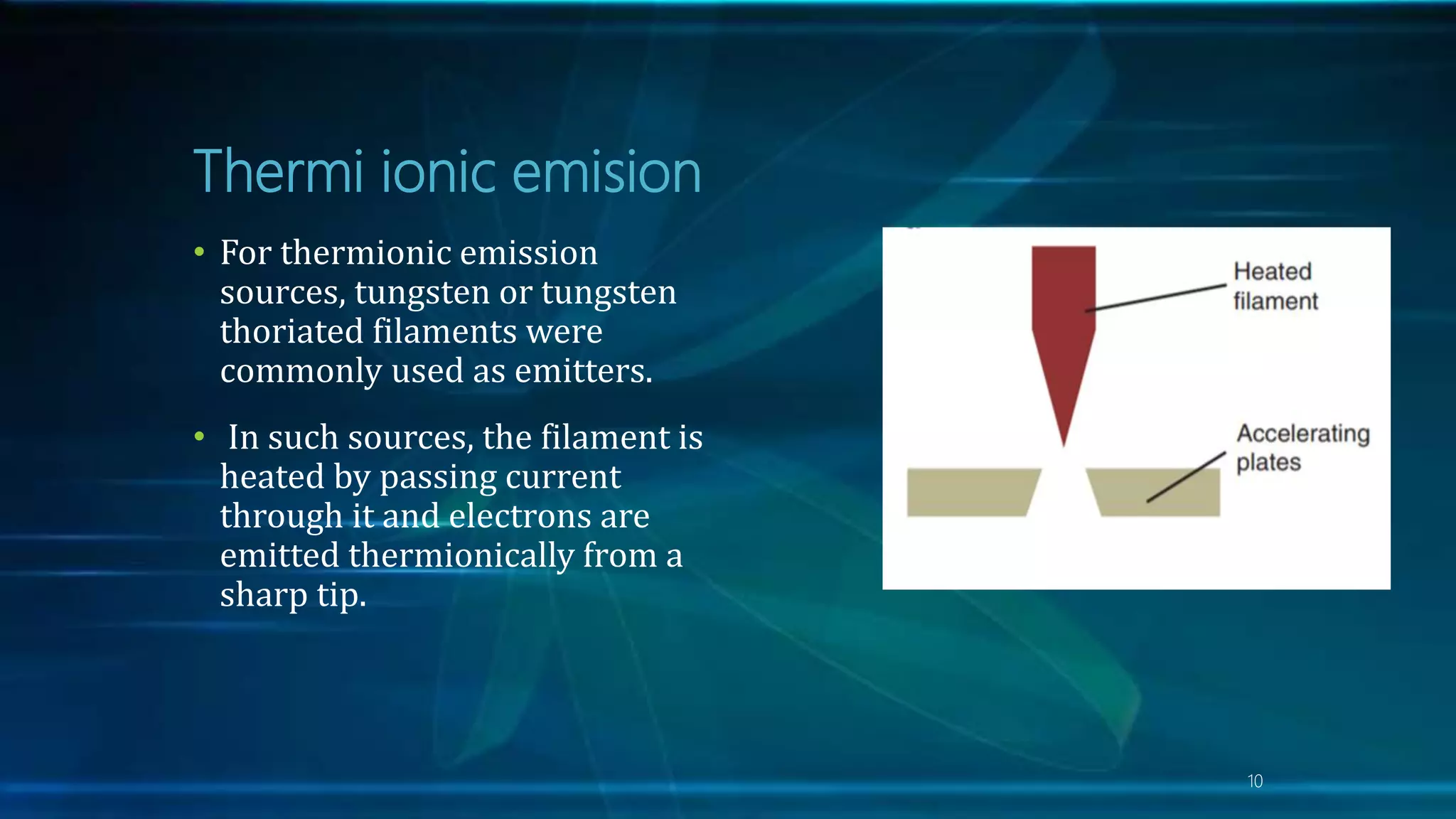
• For thermionic emission
sources, tungsten or tungsten
thoriated filaments were
commonly used as emitters.
• In such sources, the filament is
heated by passing current
through it and electrons are
emitted thermionically from a
sharp tip.
10
Field emission
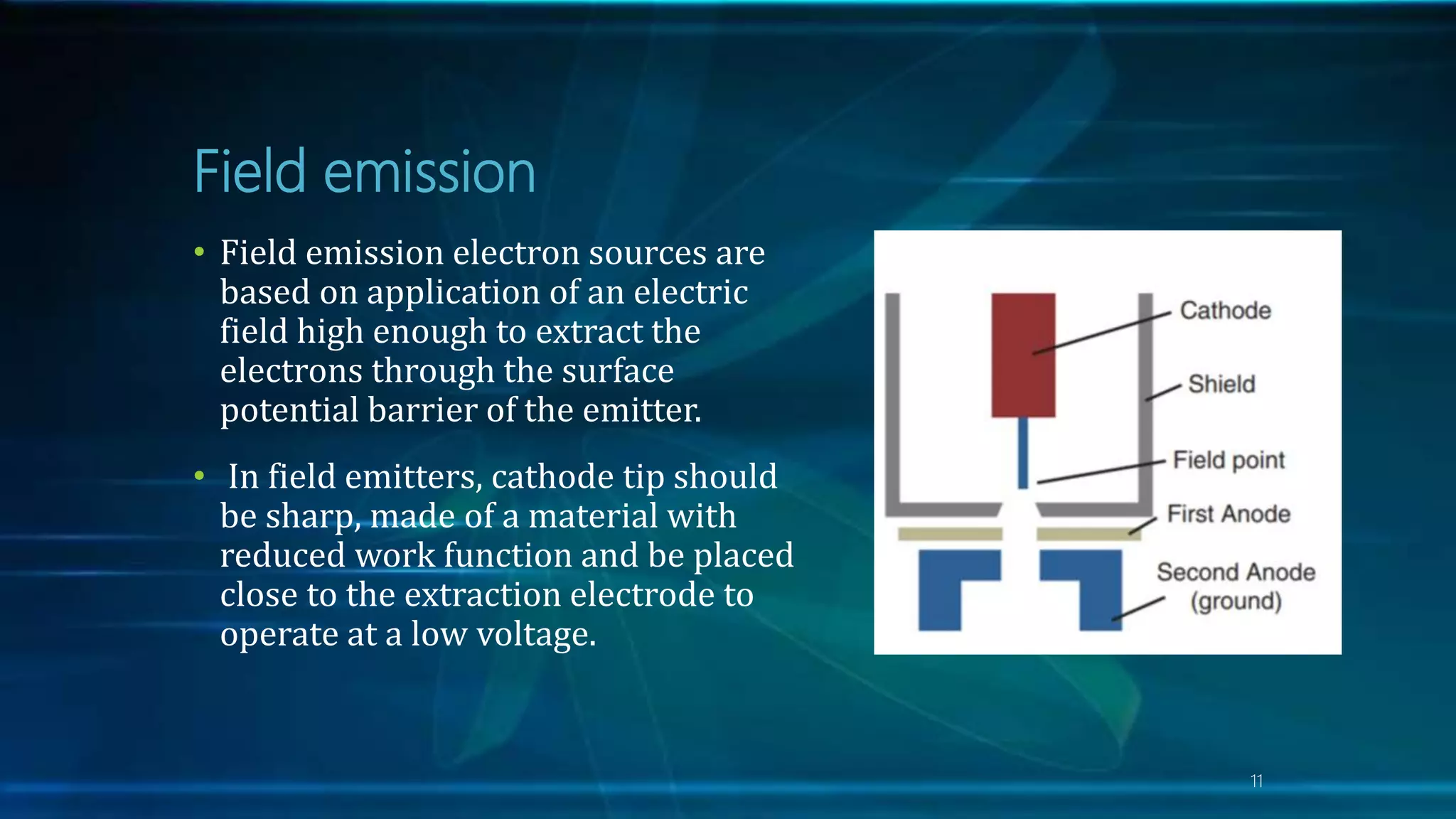
• Field emission electron sources are
based on application of an electric
field high enough to extract the
electrons through the surface
potential barrier of the emitter.
• In field emitters, cathode tip should
be sharp, made of a material with
reduced work function and be placed
close to the extraction electrode to
operate at a low voltage.
11
Contd..
• Tungsten tips provide the extremely high fields necessary for
electron extraction.
• Two anodes are normally used.
• The first anode is the extraction electrode, and is used to extract
the electrons from the cathode tip, and the second is used to
accelerate the electrons to their full potential.
• The shield electrode is used to prevent thermally generated
electrons from entering the beam. Thus, electrons are only emitted
from the tungsten tip
12
STIGMATOR
• A stigmator is a special type of lens used for
the alignment of e-beam.
• Stigmators may be either electrostatic or
magnetic and consist of four or more poles.
• The stigmator system is responsible for
correcting beam shape to be circular again.
• It consists of four or eight poles that
surround the optical axis. Adjustment is
performed by the balance of electrical
signal of the poles
13
ELECTRON LENSES
• The physical principles of electromagnetic lenses can be described
by using the basic laws of electromagnetism.
• Electron motion can be modeled as EM waves, which implies that it
can be focused and manipulated analogous to the classical optics
systems (geometric optics).
• At the same time, electrons maintain the characteristic properties
of classical charged particles.
• Electron lenses can be made only to converge, not diverge.
Electrons can be focused either by electrostatic forces or magnetic
forces.
14
15
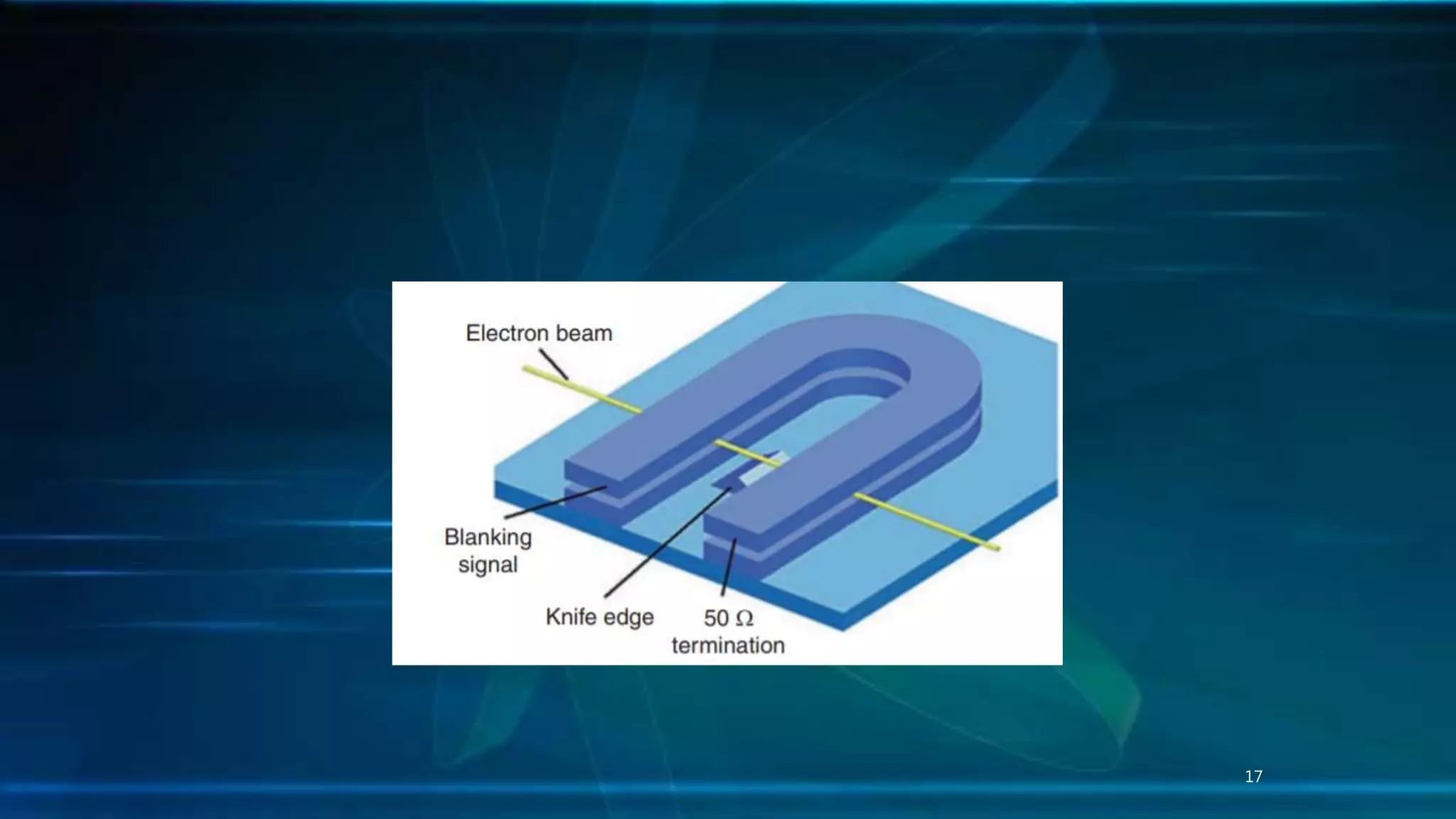
BEAM BLANKERS
• Beam blankers are used to turn off or “blank” the beam. This is
necessary when doing vector scanning and the beam needs to be
moved from one part of the wafer to another.
• The beam must be blanked in a time, which is very small
compared to the time it takes to illuminate one pixel on the array,
and the beam cannot move along the substrate while it is being
blanked.
• It works by applying a voltage to the upper plate, which deflects
the electron beam away from the center of the column
16
17
APERTURES
• There are a few different types of apertures, blanking apertures,
and beam-limiting apertures.
• Blanking apertures deflect the beam by deflecting the beam away
from the aperture hole.
• Beamlimiting apertures set the beam convergence angle, a, (the
angle between the beam trajectory and the normal line to the
target) which controls the effect of lens aberrations and resolution
but also limits the beam current.
18
SAMPLE STAGE
• Stage EBL patterning is performed in a high vacuum chamber.
• The sample is fixed on a sample holder by screws, spring-loaded
mechanisms, doublesided tapes, or silver paint.
• Wafer holders usually contain a set of test standards for calibration
focusing and position
19
POSITIVE RESISTS
• Polymethyl methacrylate (PMMA) was one of the first resists
developed for EBL and remains the most commonly used positive
resist.
• PMMA has extremely high resolution, and its ultimate resolution
has been demonstrated to be less than 10 nm
20
NEGATIVE RESISTS
• A number of negative EBL resists are also available.
• These resists have components on the polymer chain that enhance
the cross-linking.
• Typical cross-linking components include chloromethyl styrene,
epoxies, and vinyl groups.
• Negative resists tend to have less bias but they have problems with
scum and swelling during development and bridging between
features.
21
WORKING
• Typical electron beam lithography machines use electron beams
with 10–100 keV energy per electron.
• Therefore, the free path of an electron is 10 mm or more, which is
at least an order of magnitude more than the resist thickness.
• Thus, the electrons can easily penetrate the resist layer and reach
the substrate.
• When an electron beam hits the surface of a resist deposited on a
substrate, it experiences elastic and inelastic collisions with
22
the resist and substrate atoms and molecules.
• Elastic collisions result in backward scattering whereas inelastic
collisions create small angle forward scattering .
• The energetic transfer in the resist mainly causes the resist
exposure, whereas interaction with the substrate underneath is
manifested as heating and creates more backscattered electrons.
23
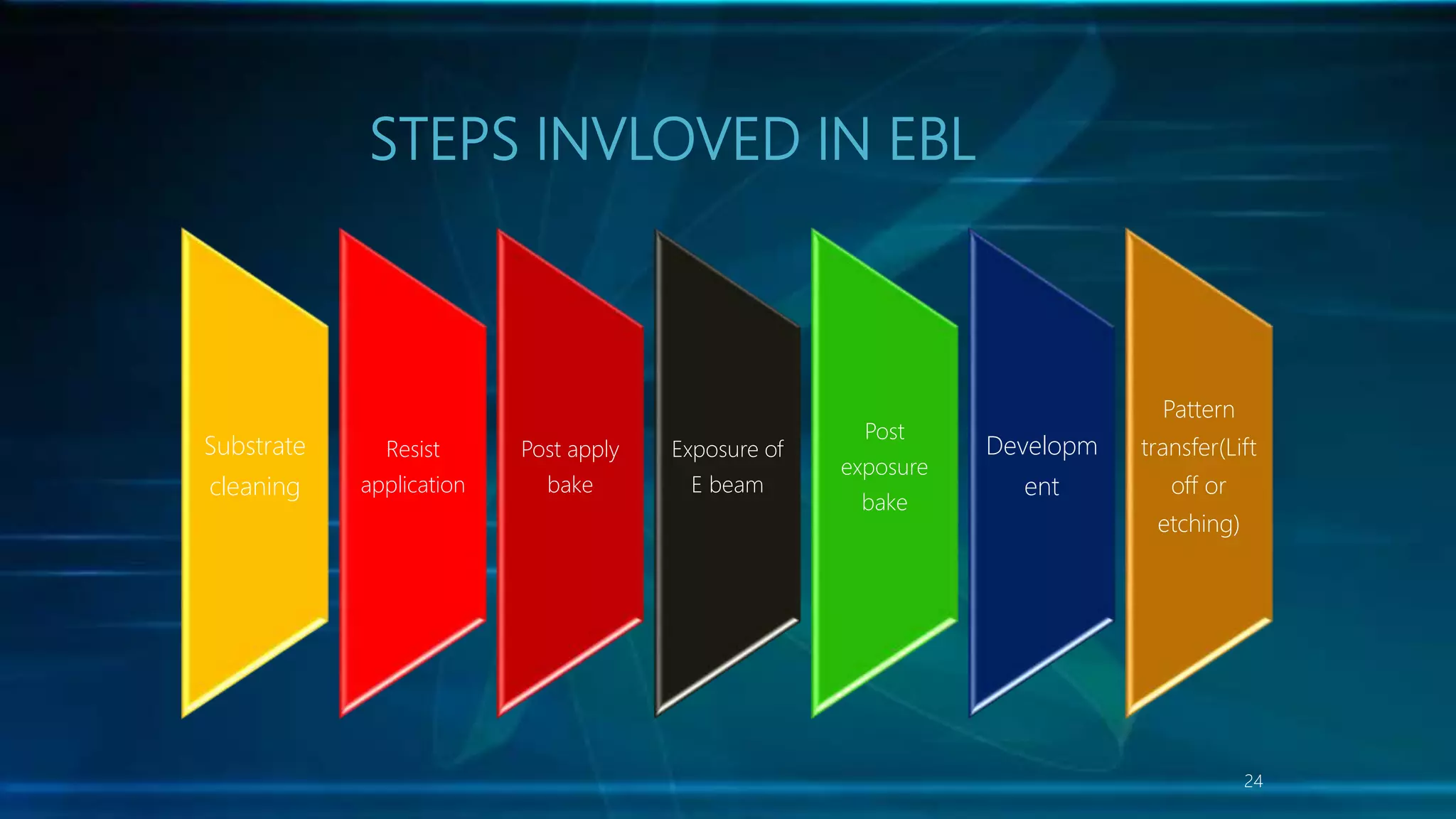
STEPS INVLOVED IN EBL
Substrate
cleaning
Resist
application
Post apply
bake
Exposure of
E beam
Post
exposure
bake
Developm
ent
Pattern
transfer(Lift
off or
etching)
24
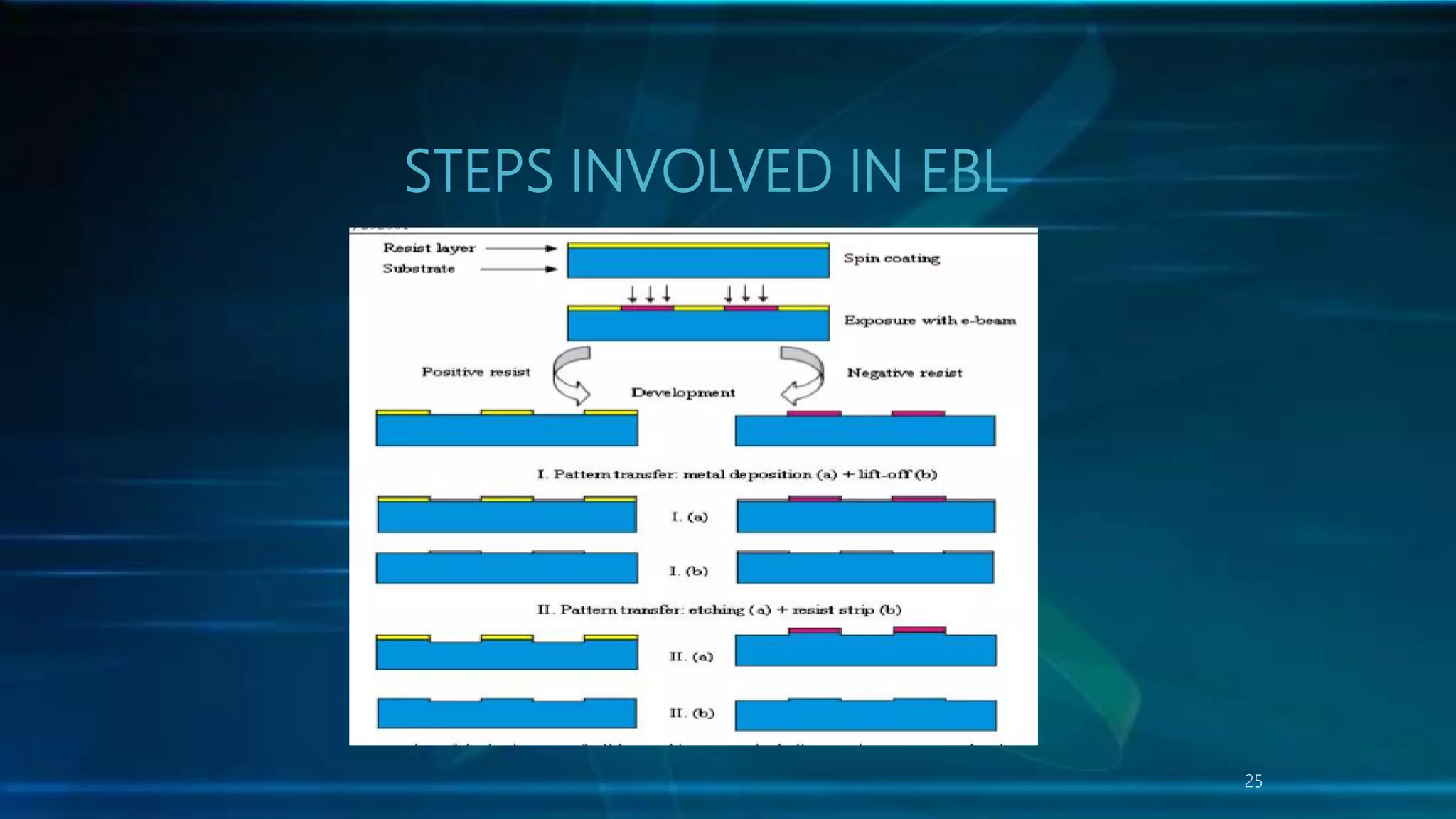
STEPS INVOLVED IN EBL
25
Substrate Cleaning
First, the substrate (often silicon) is
cleaned using chemical baths or
plasma procedures in order to remove
contaminants which may lead to poor
adhesion or defect formation in the
resist layer.
Barrier Layer Formation:
After cleaning, silicon dioxide, which
serves as a barrier layer, is deposited
on the surface of the wafer.
26
Resist Application
A resist layer (usually an organic polymer) is spin
coated onto the substrate from a solution
containing the resist dissolved in an appropriate
casting solvent.
Thinner resist layers can be obtained by using
solutions with a higher dilution rate
27
Post apply bake
• After this, the sample is baked on a hotplate in order to remove the
excess solvent from the resist and to thermally anneal residual
stress in the resist built up during the spinning session
28
Exposure of E beam
• The sample is irradiated by e-beam causing
chemical changes in the exposed area
which influence the solubility of the
exposed area relative to the unexposed
area of the resist in a developing solvent
29
Post exposure bake
• The sample is baked again to either thermally anneal the exposed
regions, in order to reduce unwanted chemical changes that might
have been caused within the resist layer during the exposure, or to
promote further chemical changes in the exposed or unexposed
area.
• This step is referred to as a post-exposure-bake
30
Development
• Subsequently, the sample is developed
through spray, puddle or immersion
methods.
• A resist can have a negative or positive tone
depending on whether the unexposed or the
exposed regions are removed from the
substrate during the development process
31
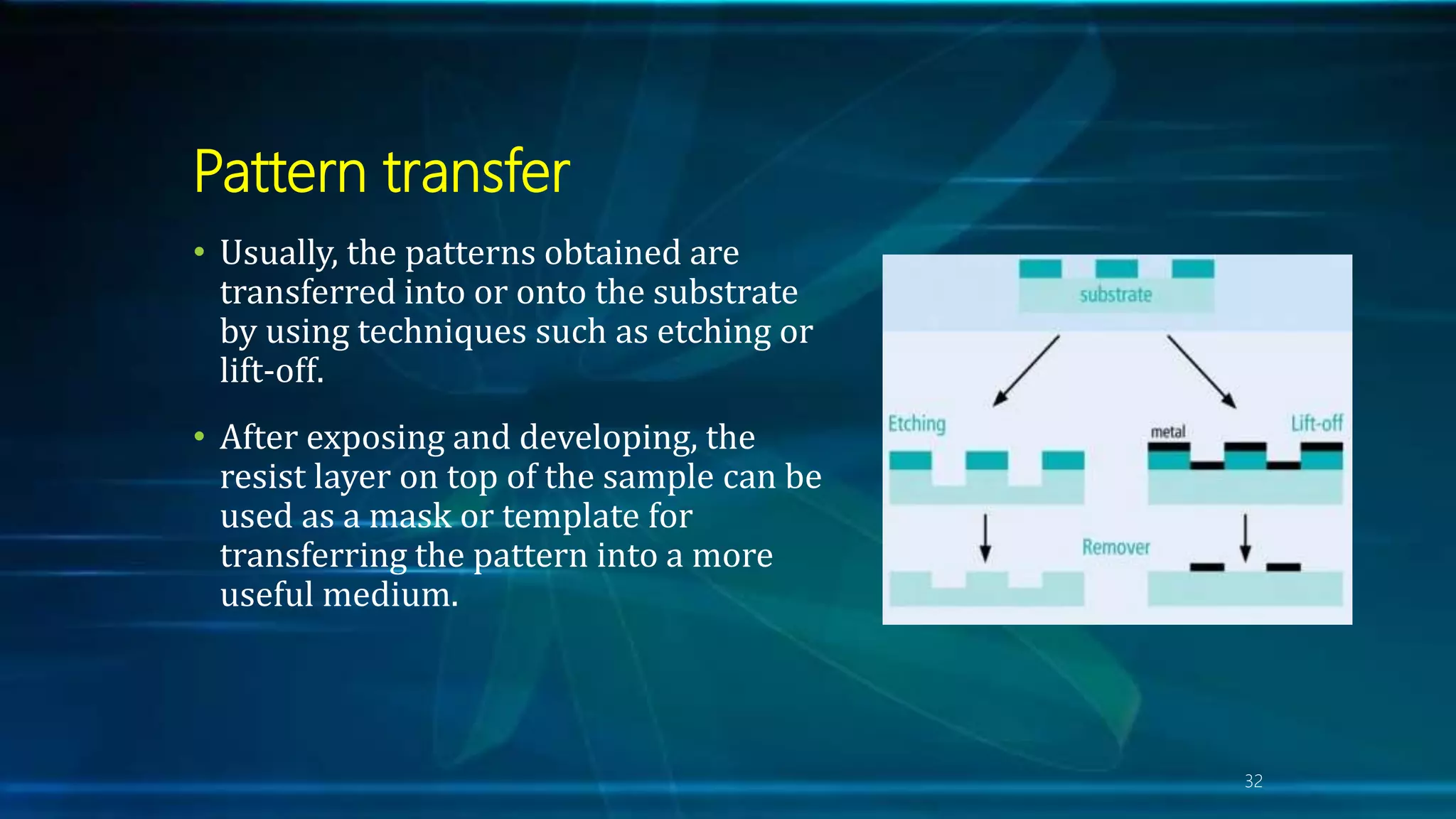
Pattern transfer
• Usually, the patterns obtained are
transferred into or onto the substrate
by using techniques such as etching or
lift-off.
• After exposing and developing, the
resist layer on top of the sample can be
used as a mask or template for
transferring the pattern into a more
useful medium.
32
Contd..
• There are two main pattern transfer techniques that can be
applied.
• The first involves etching material away underneath the voids in
the resist layer.
• The second involves depositing a layer or material (usually metal)
all over the sample and dissolving away the remaining resist to
‘lift-off’ the deposited material on top.
• This leaves the deposited material only in the areas where there
was no resist present.
33
Metal deposition and Lift off
• Lift-off is used when the pattern transfer is fulfilled by
depositing a material, therefore it is an additive process
and requires positive resist .
• After the deposition a solvent is used to remove the resist.
• The positive resist has an undercut after developing. The
undercut will make sure that a small opening is
available after the material deposition.
• Through this opening the solvent will enter and dissolve
the resist enabling lift-off of the material deposited on top
of the resist, leaving only material deposited on the
substrate completing the pattern transfer.
34
Etching and resist strip
• A negative resist is used for etching based pattern transfer .
• when a negative resist is used the exposed regions of
the resist will be intact after the development and unexposed
regions will dissolve.
• The intact resist will protect the material underneath it during
the etching process.
• The unprotected region will be etched away, therefore this is a
subtractive process
• Etching is stopped according to the requirements.
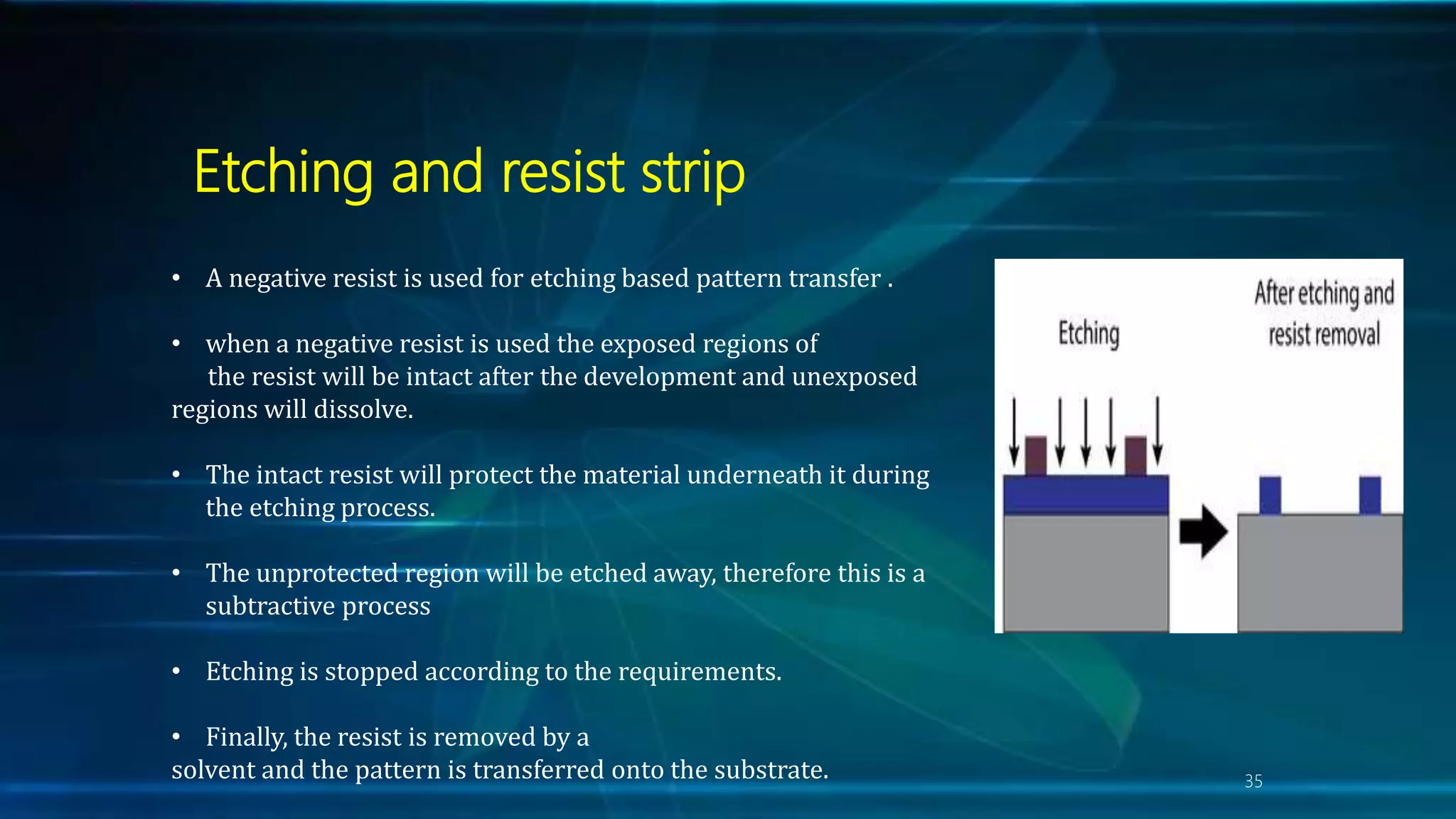
• Finally, the resist is removed by a
solvent and the pattern is transferred onto the substrate. 35
ADVANTAGES
Print complex patterns directly on wafers
Eliminates the diffraction problem
High resolution up to 20 nm (photolithography ~50nm)
Flexible technique
High speed for complex patterns
36
DISADVANTAGES
Slower than optical lithography (approximately 5
wafers / hour at less than 0.1 µ resolution).
Expensive and complicated
Forward scattering
Backward scattering
Secondary electrons
37
APPLICATION
Nanostructured devices Electronic devices, Opto-electronic devices Quantum structures,
Metamaterials,
Transport mechanism
studies of
semiconductor/
superconductor
interfaces,
Microelectromechanical
systems,
Optical, and photonic
devices
Mask making
Direct writing on non
planar substrate
38

Electron beam lithography

  • 1.
  • 2.
    E Beam lithography Electronbeam lithography (often abbreviated as e-beam lithography or EBL) is the process of transferring a pattern onto the surface of a substrate by first scanning a thin layer of organic film (called resist) on the surface by a tightly focused and precisely controlled electron beam (exposure)and then selectively removing the exposed ornonexposed regions of the resist in a solvent(developing). 2
  • 3.
    E Beam lithography •Electron beam lithography provides excellent resolution due to the small wavelength and a small probe size, whereas the resolution in optical lithography starts to become limited by the wavelength of the light that is used for exposure. • The process allows patterning of very small features, often with the dimensions of submicrometer down to a few nanometers, either covering the selected areas of the surface by the resist or exposing otherwise resist-covered areas. • The exposed areas could be further processed for etching or thin-film deposition while the covered parts are protected during these processes. 3
  • 4.
    Contd.. • The advantageof e-beam lithography stems from the shorter wavelength of accelerated electrons compared to the wavelength of ultraviolet (UV) light used in photolithography, which allows defining much smaller diffraction-limited features. • On the other hand, direct writing of patterns by scanning electron beam is a slow process and results in low throughput. • Therefore, EBL is used for preparing photomasks for photolithography or for direct writing of small-area, low-volume patterns for research purposes. 4
  • 5.
    Contd.. • The basicidea behind electron beam lithography is identical to optical lithography. • The substrate is coated with a thin layer of resist, which is chemically changed under exposure to the electron beam, so that the exposed/non-exposed areas can be dissolved in a specific solvent. • Electron beam lithography is the most power full tool for the fabrication of feathers as small as 3nm to 5 nm 5
  • 6.
    Contd.. There are twodriving forces for the development of electron beam lithography and other patterning technologies (e.g., X-ray lithography) as potential alternatives to the conventional UV-based photolithography • higher resolution (smaller feature size) • cost. 6
  • 7.
    COMPONENTS OF ELECTRONBEAM LITHOGRAPHY 7
  • 8.
    ELECTRON SOURCE • Electronsource is the most essential part of any electron beam system. • This is where the electrons are generated, which will eventually reach the resist on the sample and expose it. • An ideal electron source should have a high intensity (brightness), high uniformity, small spot size, good stability, and long life. 8
  • 9.
    Contd. • In anelectron source, electrons are removed from cathode of the gun either by heating the cathode or by applying a large electric field. • The first process is called thermionic emission and the latter is called field emission . • A combination of two, which is called thermal field–aided emission, is also sometimes employed. 9
  • 10.
    Thermi ionic emision •For thermionic emission sources, tungsten or tungsten thoriated filaments were commonly used as emitters. • In such sources, the filament is heated by passing current through it and electrons are emitted thermionically from a sharp tip. 10
  • 11.
    Field emission • Fieldemission electron sources are based on application of an electric field high enough to extract the electrons through the surface potential barrier of the emitter. • In field emitters, cathode tip should be sharp, made of a material with reduced work function and be placed close to the extraction electrode to operate at a low voltage. 11
  • 12.
    Contd.. • Tungsten tipsprovide the extremely high fields necessary for electron extraction. • Two anodes are normally used. • The first anode is the extraction electrode, and is used to extract the electrons from the cathode tip, and the second is used to accelerate the electrons to their full potential. • The shield electrode is used to prevent thermally generated electrons from entering the beam. Thus, electrons are only emitted from the tungsten tip 12
  • 13.
    STIGMATOR • A stigmatoris a special type of lens used for the alignment of e-beam. • Stigmators may be either electrostatic or magnetic and consist of four or more poles. • The stigmator system is responsible for correcting beam shape to be circular again. • It consists of four or eight poles that surround the optical axis. Adjustment is performed by the balance of electrical signal of the poles 13
  • 14.
    ELECTRON LENSES • Thephysical principles of electromagnetic lenses can be described by using the basic laws of electromagnetism. • Electron motion can be modeled as EM waves, which implies that it can be focused and manipulated analogous to the classical optics systems (geometric optics). • At the same time, electrons maintain the characteristic properties of classical charged particles. • Electron lenses can be made only to converge, not diverge. Electrons can be focused either by electrostatic forces or magnetic forces. 14
  • 15.
  • 16.
    BEAM BLANKERS • Beamblankers are used to turn off or “blank” the beam. This is necessary when doing vector scanning and the beam needs to be moved from one part of the wafer to another. • The beam must be blanked in a time, which is very small compared to the time it takes to illuminate one pixel on the array, and the beam cannot move along the substrate while it is being blanked. • It works by applying a voltage to the upper plate, which deflects the electron beam away from the center of the column 16
  • 17.
  • 18.
    APERTURES • There area few different types of apertures, blanking apertures, and beam-limiting apertures. • Blanking apertures deflect the beam by deflecting the beam away from the aperture hole. • Beamlimiting apertures set the beam convergence angle, a, (the angle between the beam trajectory and the normal line to the target) which controls the effect of lens aberrations and resolution but also limits the beam current. 18
  • 19.
    SAMPLE STAGE • StageEBL patterning is performed in a high vacuum chamber. • The sample is fixed on a sample holder by screws, spring-loaded mechanisms, doublesided tapes, or silver paint. • Wafer holders usually contain a set of test standards for calibration focusing and position 19
  • 20.
    POSITIVE RESISTS • Polymethylmethacrylate (PMMA) was one of the first resists developed for EBL and remains the most commonly used positive resist. • PMMA has extremely high resolution, and its ultimate resolution has been demonstrated to be less than 10 nm 20
  • 21.
    NEGATIVE RESISTS • Anumber of negative EBL resists are also available. • These resists have components on the polymer chain that enhance the cross-linking. • Typical cross-linking components include chloromethyl styrene, epoxies, and vinyl groups. • Negative resists tend to have less bias but they have problems with scum and swelling during development and bridging between features. 21
  • 22.
    WORKING • Typical electronbeam lithography machines use electron beams with 10–100 keV energy per electron. • Therefore, the free path of an electron is 10 mm or more, which is at least an order of magnitude more than the resist thickness. • Thus, the electrons can easily penetrate the resist layer and reach the substrate. • When an electron beam hits the surface of a resist deposited on a substrate, it experiences elastic and inelastic collisions with 22
  • 23.
    the resist andsubstrate atoms and molecules. • Elastic collisions result in backward scattering whereas inelastic collisions create small angle forward scattering . • The energetic transfer in the resist mainly causes the resist exposure, whereas interaction with the substrate underneath is manifested as heating and creates more backscattered electrons. 23
  • 24.
    STEPS INVLOVED INEBL Substrate cleaning Resist application Post apply bake Exposure of E beam Post exposure bake Developm ent Pattern transfer(Lift off or etching) 24
  • 25.
  • 26.
    Substrate Cleaning First, thesubstrate (often silicon) is cleaned using chemical baths or plasma procedures in order to remove contaminants which may lead to poor adhesion or defect formation in the resist layer. Barrier Layer Formation: After cleaning, silicon dioxide, which serves as a barrier layer, is deposited on the surface of the wafer. 26
  • 27.
    Resist Application A resistlayer (usually an organic polymer) is spin coated onto the substrate from a solution containing the resist dissolved in an appropriate casting solvent. Thinner resist layers can be obtained by using solutions with a higher dilution rate 27
  • 28.
    Post apply bake •After this, the sample is baked on a hotplate in order to remove the excess solvent from the resist and to thermally anneal residual stress in the resist built up during the spinning session 28
  • 29.
    Exposure of Ebeam • The sample is irradiated by e-beam causing chemical changes in the exposed area which influence the solubility of the exposed area relative to the unexposed area of the resist in a developing solvent 29
  • 30.
    Post exposure bake •The sample is baked again to either thermally anneal the exposed regions, in order to reduce unwanted chemical changes that might have been caused within the resist layer during the exposure, or to promote further chemical changes in the exposed or unexposed area. • This step is referred to as a post-exposure-bake 30
  • 31.
    Development • Subsequently, thesample is developed through spray, puddle or immersion methods. • A resist can have a negative or positive tone depending on whether the unexposed or the exposed regions are removed from the substrate during the development process 31
  • 32.
    Pattern transfer • Usually,the patterns obtained are transferred into or onto the substrate by using techniques such as etching or lift-off. • After exposing and developing, the resist layer on top of the sample can be used as a mask or template for transferring the pattern into a more useful medium. 32
  • 33.
    Contd.. • There aretwo main pattern transfer techniques that can be applied. • The first involves etching material away underneath the voids in the resist layer. • The second involves depositing a layer or material (usually metal) all over the sample and dissolving away the remaining resist to ‘lift-off’ the deposited material on top. • This leaves the deposited material only in the areas where there was no resist present. 33
  • 34.
    Metal deposition andLift off • Lift-off is used when the pattern transfer is fulfilled by depositing a material, therefore it is an additive process and requires positive resist . • After the deposition a solvent is used to remove the resist. • The positive resist has an undercut after developing. The undercut will make sure that a small opening is available after the material deposition. • Through this opening the solvent will enter and dissolve the resist enabling lift-off of the material deposited on top of the resist, leaving only material deposited on the substrate completing the pattern transfer. 34
  • 35.
    Etching and resiststrip • A negative resist is used for etching based pattern transfer . • when a negative resist is used the exposed regions of the resist will be intact after the development and unexposed regions will dissolve. • The intact resist will protect the material underneath it during the etching process. • The unprotected region will be etched away, therefore this is a subtractive process • Etching is stopped according to the requirements. • Finally, the resist is removed by a solvent and the pattern is transferred onto the substrate. 35
  • 36.
    ADVANTAGES Print complex patternsdirectly on wafers Eliminates the diffraction problem High resolution up to 20 nm (photolithography ~50nm) Flexible technique High speed for complex patterns 36
  • 37.
    DISADVANTAGES Slower than opticallithography (approximately 5 wafers / hour at less than 0.1 µ resolution). Expensive and complicated Forward scattering Backward scattering Secondary electrons 37
  • 38.
    APPLICATION Nanostructured devices Electronicdevices, Opto-electronic devices Quantum structures, Metamaterials, Transport mechanism studies of semiconductor/ superconductor interfaces, Microelectromechanical systems, Optical, and photonic devices Mask making Direct writing on non planar substrate 38