Group 2: Trần Phúc Thành.
Cao Văn Phước.
Tống Văn Khoa.
 Introduction.
 Why E-beam lithography?
 Schematic of e-beam lithography.
 Lithography Process
 Advantages and disadvantages.
 Summary.
 References.
- Electron beam lithography (often abbreviated as e-beam
lithography) is the practice of emitting a beam of electrons in
a patterned fashion across a surface covered with a film (called
the resist), ("exposing" the resist) and of selectively removing
either exposed or non-exposed regions of the resist
("developing").
- The purpose, as with photolithography, is to create very small
structures in the resist that can subsequently be transferred to
the substrate material, often by etching. It was developed for
manufacturing integrated circuits, and is also used for
creating nanotechnology architectures.
Lower resolution
systems can
use thermionic
sources, which are
usually formed from
LaB6. However,
systems with higher
resolution
requirements need to
use field electron
emission sources,
such as heated
W/ZrO2 for lower
energy spread and
enhanced brightness.
A magnetic lens is
a device for the
focusing or
deflection of
moving charged
particles, such
as electrons or ions
, by use of the
magnetic Lorentz
force. Its strength
can often be varied
by usage
of electromagnets.
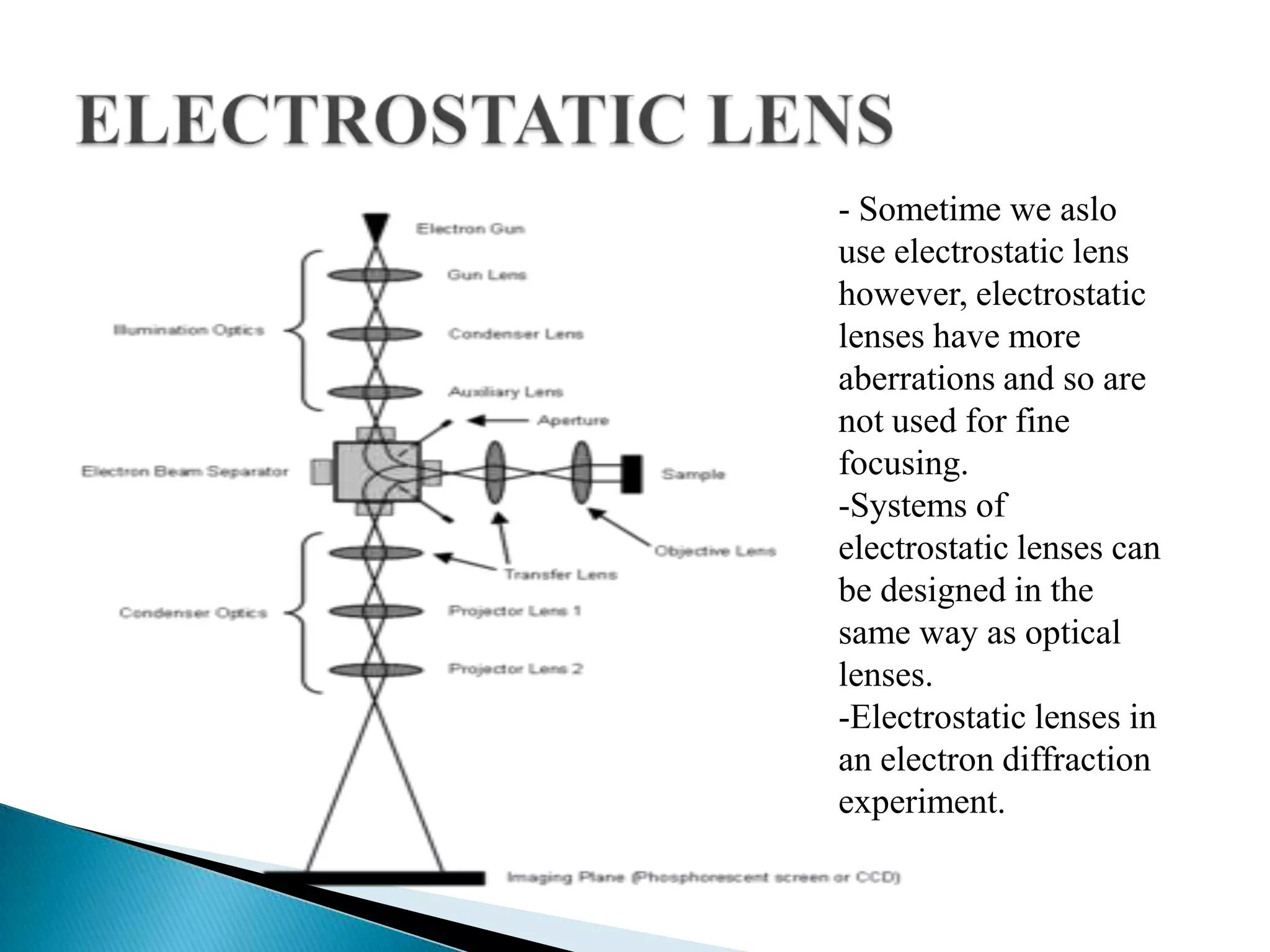
- Sometime we aslo
use electrostatic lens
however, electrostatic
lenses have more
aberrations and so are
not used for fine
focusing.
-Systems of
electrostatic lenses can
be designed in the
same way as optical
lenses.
-Electrostatic lenses in
an electron diffraction
experiment.
 Clean sample
◦ Remove
oils, organics, etc
(Acetone, IPA, ultraso
nic)
 Spin coating of
photoresist on
surface of film
(positive or negative
resist) substrate
Deposited film
Photoresist
 E-beam lithography
and develop
 Etching
 (multi-step
processes)
 Evaporate metal
contacts
substrate
film
substrate
Deposited film
substrate
film
substrate
film
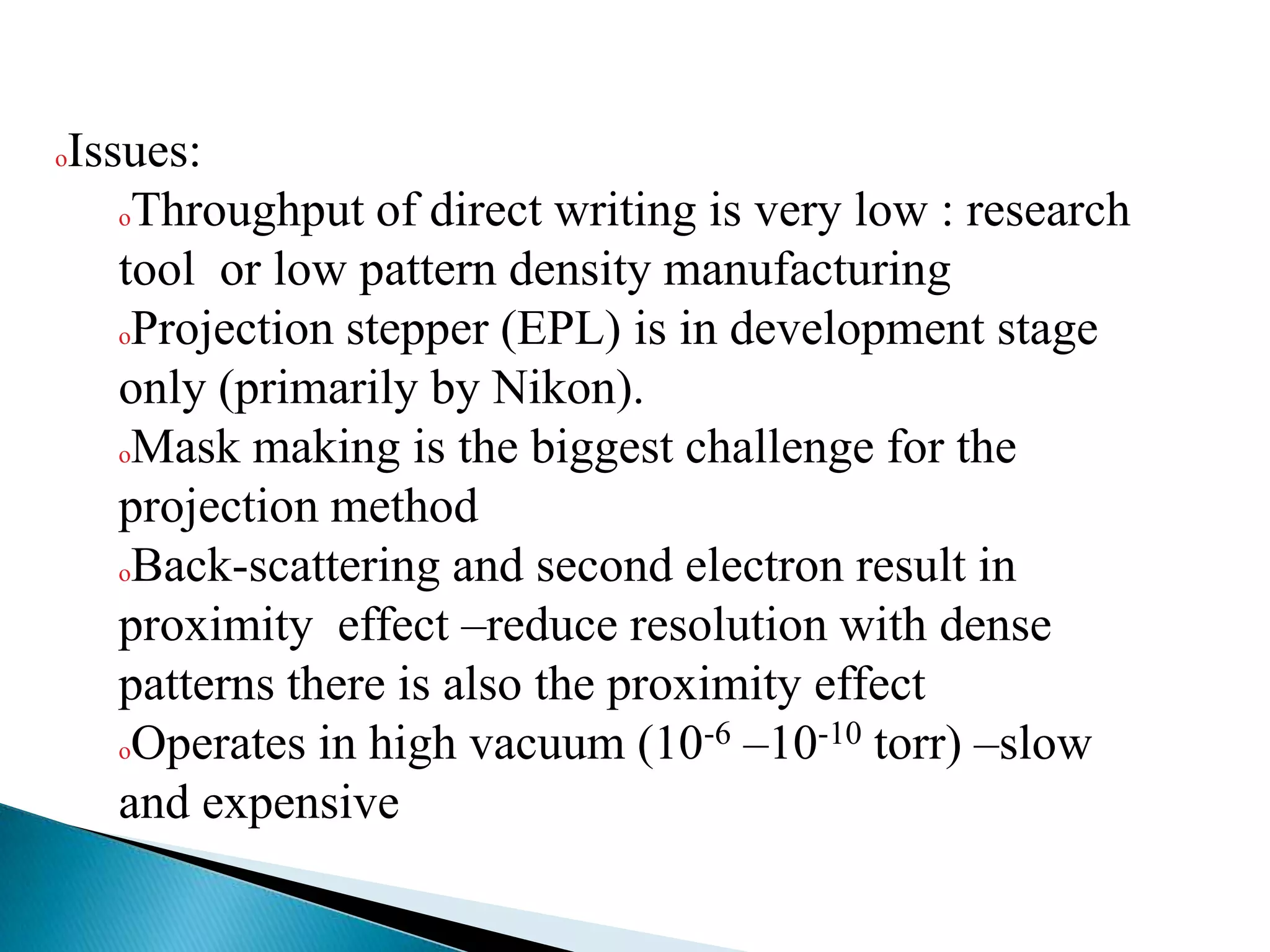
Direct writing with narrow beam
Electron projection lithography using a mask
:EPL
oIssues:
oThroughput of direct writing is very low : research
tool or low pattern density manufacturing
oProjection stepper (EPL) is in development stage
only (primarily by Nikon).
oMask making is the biggest challenge for the
projection method
oBack-scattering and second electron result in
proximity effect –reduce resolution with dense
patterns there is also the proximity effect
oOperates in high vacuum (10-6 –10-10 torr) –slow
and expensive
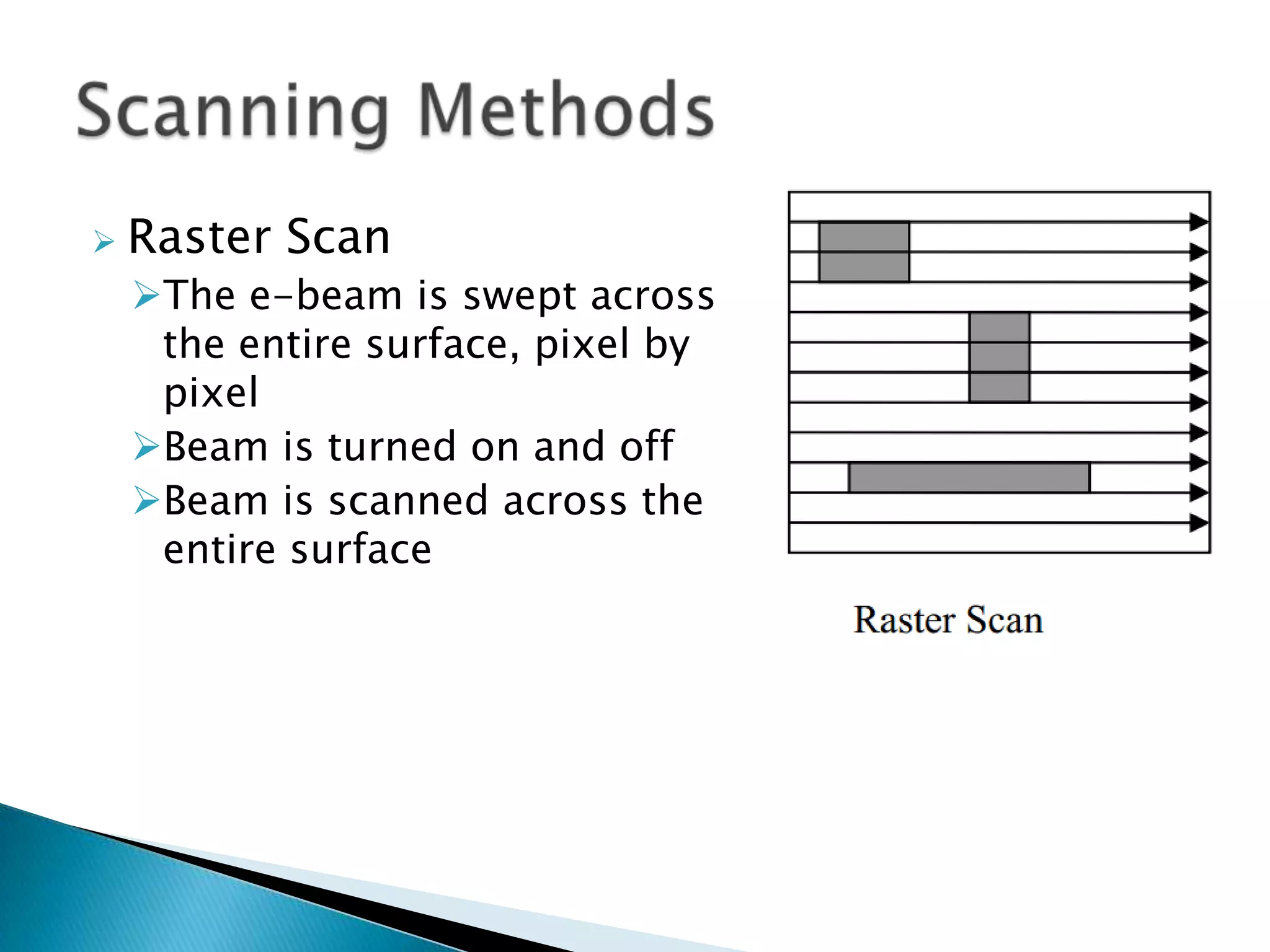
 Raster Scan
The e-beam is swept across
the entire surface, pixel by
pixel
Beam is turned on and off
Beam is scanned across the
entire surface
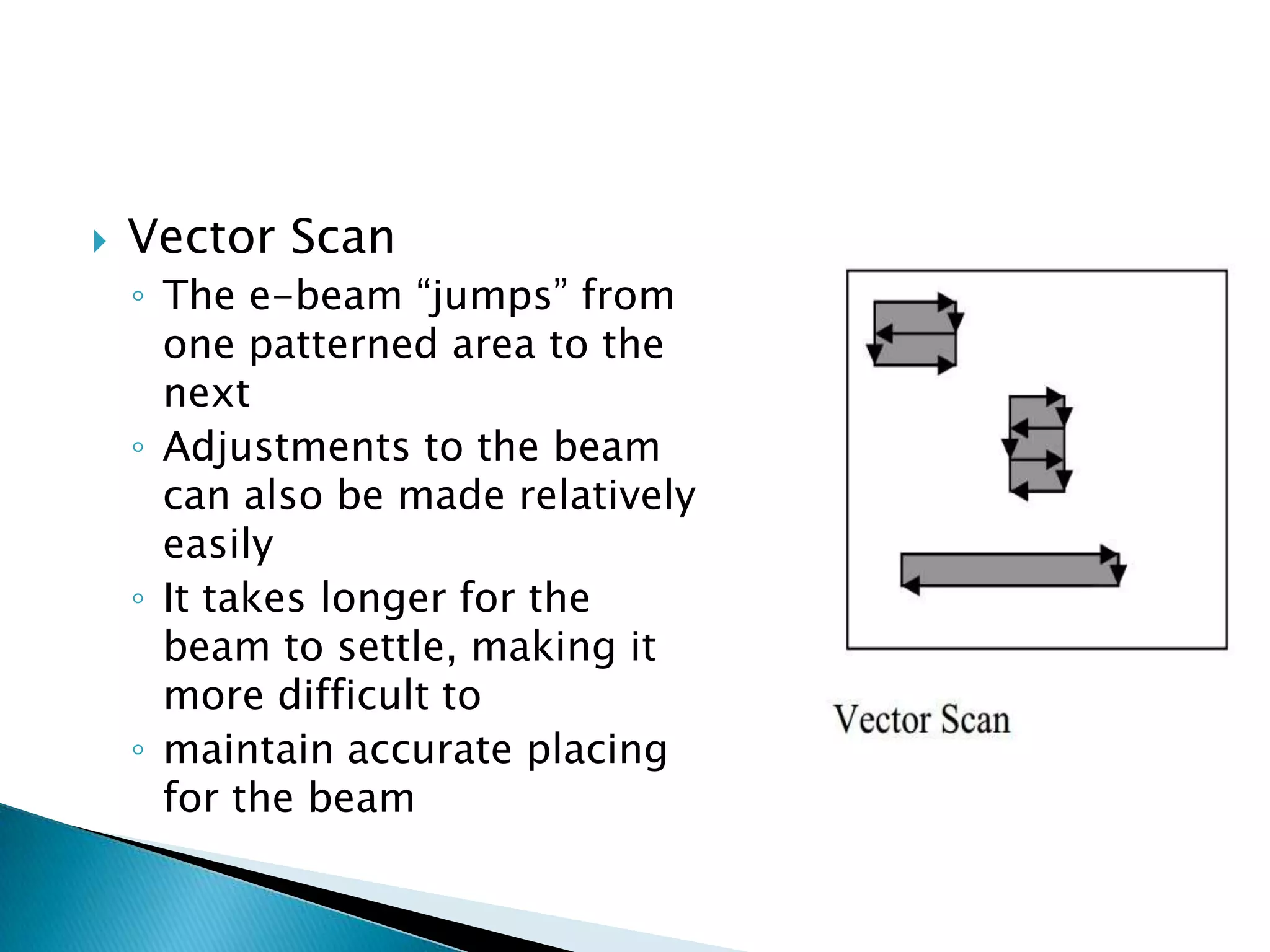
 Vector Scan
◦ The e-beam “jumps” from
one patterned area to the
next
◦ Adjustments to the beam
can also be made relatively
easily
◦ It takes longer for the
beam to settle, making it
more difficult to
◦ maintain accurate placing
for the beam
15
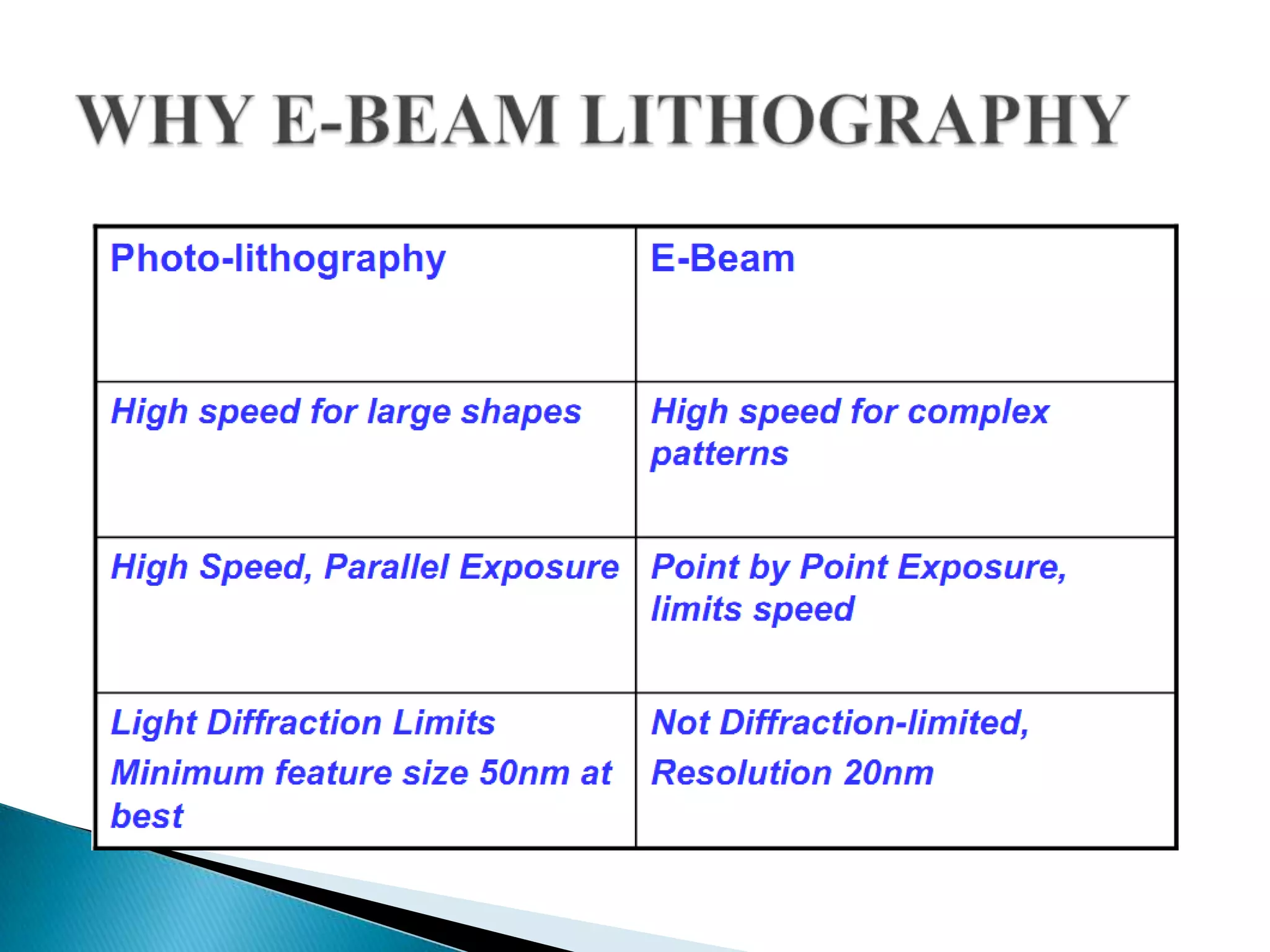
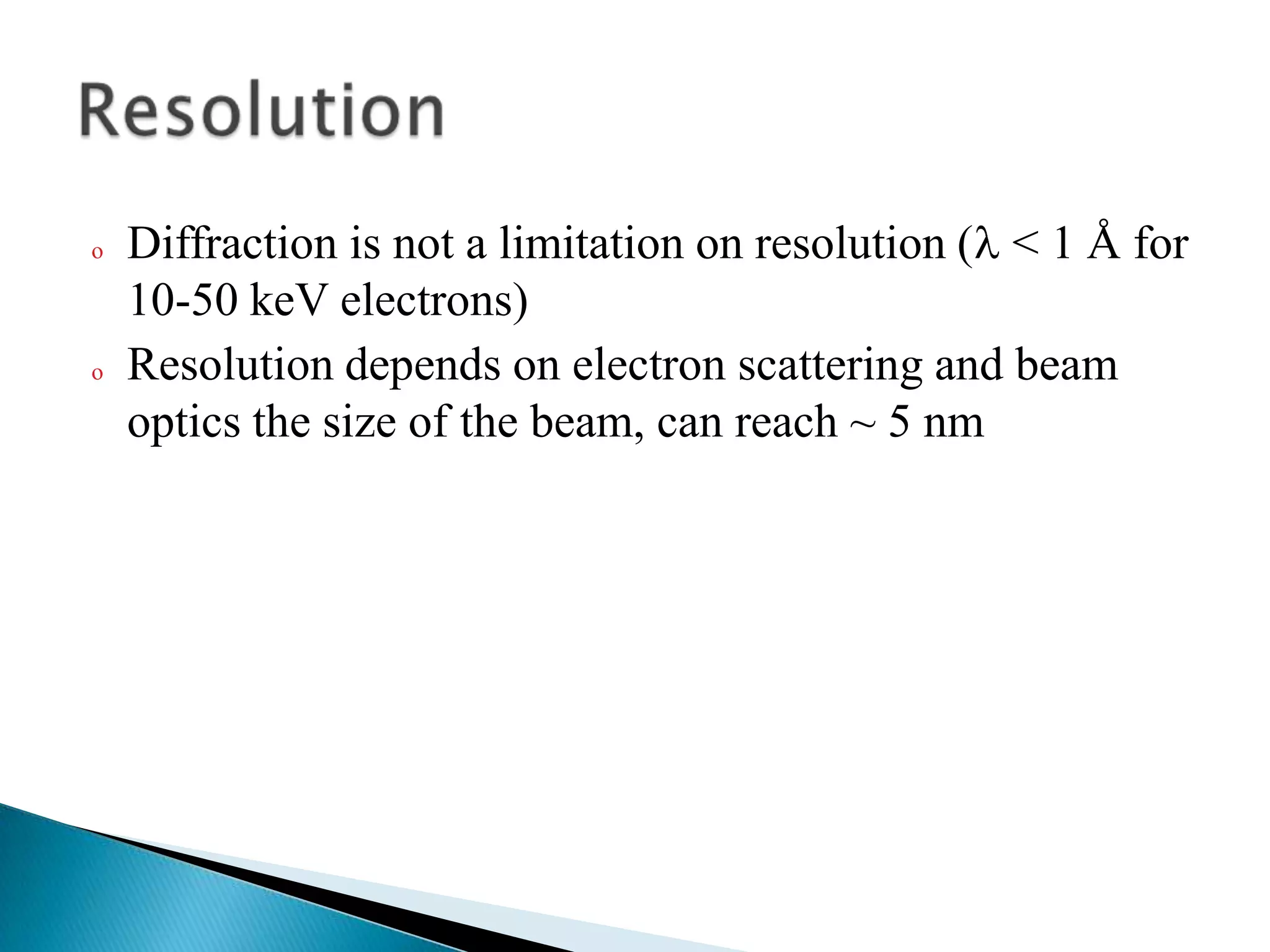
o Diffraction is not a limitation on resolution ( < 1 Å for
10-50 keV electrons)
o Resolution depends on electron scattering and beam
optics the size of the beam, can reach ~ 5 nm
17
 In EBL the resolution is not
limited by diffraction
 In EBL backscattering
causes the electron beam
to broaden and expose a
large volume of resist then
expected.
 The proximity effect places
a limit on the minimum
spacing between pattern
feature.
 • The pattern is written directly onto the
 electron-sensitive resist (no mask is used)
 • More precise than photolithography or X-
Ray lithography
 • Used to make high-resolution masks for
 photolithography and X-Ray lithography
 • Beats the diffraction limit of light,
 minimum feature size around 5 nm
 Very slow. Takes over 10 hours to scan
 across the entire surface of a wafer
 • Very costly. One e-beam system costs
 upwards of 5 to 10 MILLION dollars
 • Potential problems with electron
 scattering:
 –Electron energy: 100eV -> very slow,
 inefficient, damage the substrate
 –Electron energy: 10eV -> lower
 penetration depth and lower resolution
 S.M. Sze, Semiconductor Devices, Physics and
Technology, Willey, 2002.
 C.Y. Chang and S.M. Sze, Eds., ULSI
Technology, McGraw-Hill, 1996.
 S.M. Sze, Ed., VLSI Technology, McGraw-Hill,
1988.
 Nguyễn Đức Chiến, Nguyễn Văn Hiếu, Công
nghệ chế tạo mạch vi điện tử, NXB Bách khoa,
2007.

E beam lithography

E beam lithography

  • 1.
    Group 2: TrầnPhúc Thành. Cao Văn Phước. Tống Văn Khoa.
  • 2.
     Introduction.  WhyE-beam lithography?  Schematic of e-beam lithography.  Lithography Process  Advantages and disadvantages.  Summary.  References.
  • 3.
    - Electron beamlithography (often abbreviated as e-beam lithography) is the practice of emitting a beam of electrons in a patterned fashion across a surface covered with a film (called the resist), ("exposing" the resist) and of selectively removing either exposed or non-exposed regions of the resist ("developing"). - The purpose, as with photolithography, is to create very small structures in the resist that can subsequently be transferred to the substrate material, often by etching. It was developed for manufacturing integrated circuits, and is also used for creating nanotechnology architectures.
  • 6.
    Lower resolution systems can usethermionic sources, which are usually formed from LaB6. However, systems with higher resolution requirements need to use field electron emission sources, such as heated W/ZrO2 for lower energy spread and enhanced brightness.
  • 7.
    A magnetic lensis a device for the focusing or deflection of moving charged particles, such as electrons or ions , by use of the magnetic Lorentz force. Its strength can often be varied by usage of electromagnets.
  • 8.
    - Sometime weaslo use electrostatic lens however, electrostatic lenses have more aberrations and so are not used for fine focusing. -Systems of electrostatic lenses can be designed in the same way as optical lenses. -Electrostatic lenses in an electron diffraction experiment.
  • 9.
     Clean sample ◦Remove oils, organics, etc (Acetone, IPA, ultraso nic)  Spin coating of photoresist on surface of film (positive or negative resist) substrate Deposited film Photoresist
  • 10.
     E-beam lithography anddevelop  Etching  (multi-step processes)  Evaporate metal contacts substrate film substrate Deposited film substrate film substrate film
  • 11.
    Direct writing withnarrow beam Electron projection lithography using a mask :EPL
  • 12.
    oIssues: oThroughput of directwriting is very low : research tool or low pattern density manufacturing oProjection stepper (EPL) is in development stage only (primarily by Nikon). oMask making is the biggest challenge for the projection method oBack-scattering and second electron result in proximity effect –reduce resolution with dense patterns there is also the proximity effect oOperates in high vacuum (10-6 –10-10 torr) –slow and expensive
  • 13.
     Raster Scan Thee-beam is swept across the entire surface, pixel by pixel Beam is turned on and off Beam is scanned across the entire surface
  • 14.
     Vector Scan ◦The e-beam “jumps” from one patterned area to the next ◦ Adjustments to the beam can also be made relatively easily ◦ It takes longer for the beam to settle, making it more difficult to ◦ maintain accurate placing for the beam
  • 15.
  • 16.
    o Diffraction isnot a limitation on resolution ( < 1 Å for 10-50 keV electrons) o Resolution depends on electron scattering and beam optics the size of the beam, can reach ~ 5 nm
  • 17.
    17  In EBLthe resolution is not limited by diffraction  In EBL backscattering causes the electron beam to broaden and expose a large volume of resist then expected.  The proximity effect places a limit on the minimum spacing between pattern feature.
  • 18.
     • Thepattern is written directly onto the  electron-sensitive resist (no mask is used)  • More precise than photolithography or X- Ray lithography  • Used to make high-resolution masks for  photolithography and X-Ray lithography  • Beats the diffraction limit of light,  minimum feature size around 5 nm
  • 19.
     Very slow.Takes over 10 hours to scan  across the entire surface of a wafer  • Very costly. One e-beam system costs  upwards of 5 to 10 MILLION dollars  • Potential problems with electron  scattering:  –Electron energy: 100eV -> very slow,  inefficient, damage the substrate  –Electron energy: 10eV -> lower  penetration depth and lower resolution
  • 20.
     S.M. Sze,Semiconductor Devices, Physics and Technology, Willey, 2002.  C.Y. Chang and S.M. Sze, Eds., ULSI Technology, McGraw-Hill, 1996.  S.M. Sze, Ed., VLSI Technology, McGraw-Hill, 1988.  Nguyễn Đức Chiến, Nguyễn Văn Hiếu, Công nghệ chế tạo mạch vi điện tử, NXB Bách khoa, 2007. 