Test-Taking Skills
Dr Mohammed Haroon Rashid
First & Foremost…
 Put the test in perspective.
 Of course, you want to do your best,
but remember:
 This test is not the end of the world, all
you are doing is putting marks on a
piece of paper or on a computer screen.
 Be prepared. Relax.
 Know that you will pass the test with
flying colors.
Planning Your Approach
 Prepare physically for the exam.
 Prepare mentally for the exam.
 Find out about the test.
 Know what is expected of you.
 Design an exam plan.
 Join a study group.
 Use tutoring and other campus support
resources.
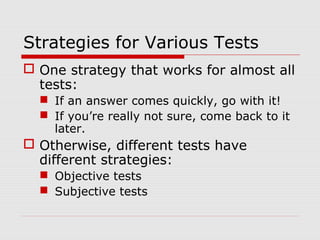
Strategies for Various Tests
 One strategy that works for almost all
tests:
 If an answer comes quickly, go with it!
 If you’re really not sure, come back to it
later.
 Otherwise, different tests have
different strategies:
 Objective tests
 Subjective tests
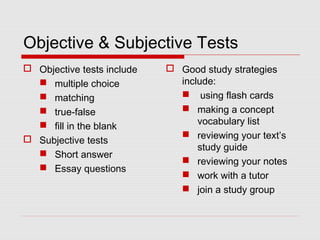
Objective & Subjective Tests
 Objective tests include
 multiple choice
 matching
 true-false
 fill in the blank
 Subjective tests
 Short answer
 Essay questions
 Good study strategies
include:
 using flash cards
 making a concept
vocabulary list
 reviewing your text’s
study guide
 reviewing your notes
 work with a tutor
 join a study group
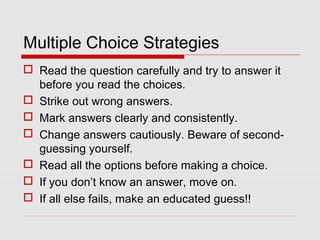
Multiple Choice Strategies
 Read the question carefully and try to answer it
before you read the choices.
 Strike out wrong answers.
 Mark answers clearly and consistently.
 Change answers cautiously. Beware of second-
guessing yourself.
 Read all the options before making a choice.
 If you don’t know an answer, move on.
 If all else fails, make an educated guess!!
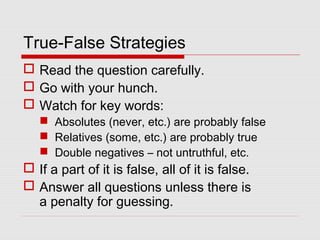
True-False Strategies
 Read the question carefully.
 Go with your hunch.
 Watch for key words:
 Absolutes (never, etc.) are probably false
 Relatives (some, etc.) are probably true
 Double negatives – not untruthful, etc.
 If a part of it is false, all of it is false.
 Answer all questions unless there is
a penalty for guessing.
Fill-in-the-Blank Strategies
 Read thoroughly to be sure what is being
asked.
 Be brief and specific.
 Give an answer for every blank.
 Short blanks may have long answers and
vice versa. Don’t assume anything.
 Remember an “a” before a blank wants a
consonant word and “an” a vowel word.
 Watch for key “trigger” words.
Essay Question Strategies
 Read the question
carefully.
 What is the question
asking for?
 Outline the key ideas.
 Refer specifically to the
question in your opening
sentence.
 Make a clear, coherent
thesis statement.
 Develop the main body of
the essay to support your
thesis statement.
 Conclude by summarizing
how your thesis is
supported.
 Watch grammar, spelling
and punctuation.
 Use humor if it fits in.
 Be sure you have
completely answered the
question.
 Write legibly.
 Proofread your work.
Okay, you flunked it!
Now recover your balance.
 Don’t let yourself become undone by one
failure.
 Use the disappointment to critically think
about
 the causes of the poor performance
 crafting new strategies to improve your
situation.
 Begin by reviewing your test results.
 Talk to your instructor or a tutor.
Tempted to cheat?
Resist the Impulse
Cheating can have ugly consequences:
 Cheaters struggle with a nagging conscience, self-doubt,
dissatisfaction, and guilt.
 Humiliation results if you get caught.
 You may, at least, receive a “0” on your exam, or possibly be
expelled from the college or university.
 Professors who catch you cheating may spread the word and
refuse to write letters of recommendation, ruining chances for
graduate study or participation in special programs.
 And remember the person you cheat the most is yourself.
Finally, one more time:
The Big Three
Be prepared!
Relax!
Know you can do it!
Thank You!Thank You!

Test taking skills

  • 1.
  • 2.
    First & Foremost… Put the test in perspective.  Of course, you want to do your best, but remember:  This test is not the end of the world, all you are doing is putting marks on a piece of paper or on a computer screen.  Be prepared. Relax.  Know that you will pass the test with flying colors.
  • 3.
    Planning Your Approach Prepare physically for the exam.  Prepare mentally for the exam.  Find out about the test.  Know what is expected of you.  Design an exam plan.  Join a study group.  Use tutoring and other campus support resources.
  • 4.
    Strategies for VariousTests  One strategy that works for almost all tests:  If an answer comes quickly, go with it!  If you’re really not sure, come back to it later.  Otherwise, different tests have different strategies:  Objective tests  Subjective tests
  • 5.
    Objective & SubjectiveTests  Objective tests include  multiple choice  matching  true-false  fill in the blank  Subjective tests  Short answer  Essay questions  Good study strategies include:  using flash cards  making a concept vocabulary list  reviewing your text’s study guide  reviewing your notes  work with a tutor  join a study group
  • 6.
    Multiple Choice Strategies Read the question carefully and try to answer it before you read the choices.  Strike out wrong answers.  Mark answers clearly and consistently.  Change answers cautiously. Beware of second- guessing yourself.  Read all the options before making a choice.  If you don’t know an answer, move on.  If all else fails, make an educated guess!!
  • 7.
    True-False Strategies  Readthe question carefully.  Go with your hunch.  Watch for key words:  Absolutes (never, etc.) are probably false  Relatives (some, etc.) are probably true  Double negatives – not untruthful, etc.  If a part of it is false, all of it is false.  Answer all questions unless there is a penalty for guessing.
  • 8.
    Fill-in-the-Blank Strategies  Readthoroughly to be sure what is being asked.  Be brief and specific.  Give an answer for every blank.  Short blanks may have long answers and vice versa. Don’t assume anything.  Remember an “a” before a blank wants a consonant word and “an” a vowel word.  Watch for key “trigger” words.
  • 9.
    Essay Question Strategies Read the question carefully.  What is the question asking for?  Outline the key ideas.  Refer specifically to the question in your opening sentence.  Make a clear, coherent thesis statement.  Develop the main body of the essay to support your thesis statement.  Conclude by summarizing how your thesis is supported.  Watch grammar, spelling and punctuation.  Use humor if it fits in.  Be sure you have completely answered the question.  Write legibly.  Proofread your work.
  • 10.
    Okay, you flunkedit! Now recover your balance.  Don’t let yourself become undone by one failure.  Use the disappointment to critically think about  the causes of the poor performance  crafting new strategies to improve your situation.  Begin by reviewing your test results.  Talk to your instructor or a tutor.
  • 11.
    Tempted to cheat? Resistthe Impulse Cheating can have ugly consequences:  Cheaters struggle with a nagging conscience, self-doubt, dissatisfaction, and guilt.  Humiliation results if you get caught.  You may, at least, receive a “0” on your exam, or possibly be expelled from the college or university.  Professors who catch you cheating may spread the word and refuse to write letters of recommendation, ruining chances for graduate study or participation in special programs.  And remember the person you cheat the most is yourself.
  • 12.
    Finally, one moretime: The Big Three Be prepared! Relax! Know you can do it!
  • 13.