The immune systemBy: Jedi master harrison
The body’s defense systemNONSPECIFIC MECHANISMS (general barriers to infection)LAYERS OF DEFENSE:SKINMUCOUS MEMBRANEINTERACTING MECHANISMSPHAGOCYTOSISANTIMICROBIAL PROTEINSTHE INFLAMMATORY RESPONSEFIRST LINE OF DEFENSESECOND LINE OF DEFENSE
skinThe skin covers the entire bodyIt can’t normally be penetrated by bacteria or viruses
Cuts or abrasions can allow potentially harmful bacteria or viruses to enter the body.The skin is like a force field around the body. It keeps unwanted invaders out!
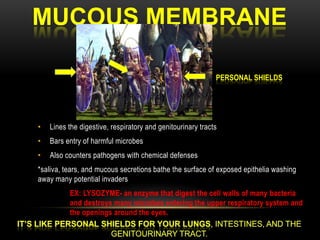
Mucous membranePERSONAL SHIELDSLines the digestive, respiratory and genitourinary tractsBars entry of harmful microbesAlso counters pathogens with chemical defenses*saliva, tears, and mucous secretions bathe the surface of exposed epithelia washing away many potential invadersEX: LYSOZYME- an enzyme that digest the cell walls of many bacteria 	and destroys many microbes entering the upper respiratory system and 	the openings around the eyes.It’s like personal shields for your LUNGS, INTESTINES, AND THE GENITOURINARY TRACT.
Mucous membrane at workEXAMPLES OF THE MUCOUS MEMBRANE AT WORK:Mucus: the viscous fluid secreted by cells of the mucous membranes; it traps particles that contact it.Lining the trachea are specialized epithelial cells equipped with cilia that sweep  out microbes and other particles trapped by the mucus, which keeps them from entering the lungs.If microbes in food or that are trapped in mucus are swallowed, it must pass through the highly acidic gastric juice produced by the stomach lining. This destroys most of the microbes before they can enter the intestinal tract.
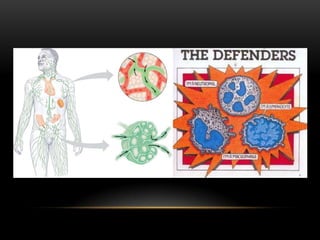
Internal defense mechanisms that are nonspecific depend mainly on PHAGOCYTOSIS:* PHAGOCYTOSIS is the ingestion of invading particles by certain types of white blood cells *Neutrophils comprise about 60% to 70% of all white blood cells
Attracted by chemical signals, neutrophils can leave the blood and enter infected tissue by amoeboid movement.
Once there they can DESTROY the microbes!!!(this migration of a chemical attractant is called chemotaxis)**Neutrophils tend to self-destruct as they destroy foreign invaders so they’re average life is only about  a few days.Monocytes (only make up about 5% of the WBC) strengthen phagocytic defense
Monocytes mature into MACROPHAGESNeutrophils are like SUICIDE BOMBERS!Macrophages continued on next slide The second line of defense
THE SECOND LineOFDEFENSEMACROPHAGES: The largest phagocytic cellsMacrophages are amoeboid cells that move through tissue fibers and engulf and digest cellular debris and pathogens by phagocytosis
They also stimulate lymphocytes and other immune cells to respond to pathogens
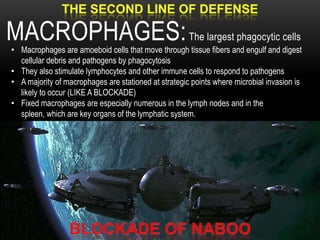
A majority of macrophages are stationed at strategic points where microbial invasion is likely to occur (LIKE A BLOCKADE)
Fixed macrophages are especially numerous in the lymph nodes and in the spleen, which are key organs of the lymphatic system.Blockade of Naboo
EOSINOPHILSAbout 1.5% of the white cells Their defend against larger parasitic invaders such as worms Don’t attack microorganisms directlyDestroy the body’s own infected cells, especially cells harboring virusesAlso attack cells that could form tumorsThe attack is not by phagocytosis but an attack on the membrane of the target cellThis causes the cell to break openNatural killer cells
The most important antimicrobial proteins in the blood and tissues are interferons and the complement system.INTERFERONS: proteins secreted by virus-infected cells that inhibit neighboring cells from making new virusesCOMPLEMENT PROTEINS: involved in nonspecific and specific defenseCan lyse a cell target by combining with antibodiesA local inflammatory responseis triggered by tissue damage. Injured cells release histamine, a chemical signal that dilates blood vessels and increases capillary permeability allowing large numbers of phagocytic white blood cells to enter the interstitial fluid.Antimicrobial proteins
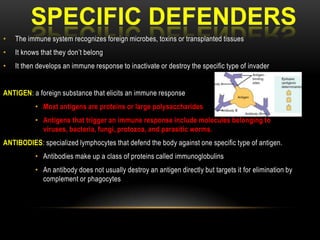
Specific defendersThe immune system recognizes foreign microbes, toxins or transplanted tissues It knows that they don’t belongIt then develops an immune response to inactivate or destroy the specific type of invaderANTIGEN: a foreign substance that elicits an immune responseMost antigens are proteins or large polysaccharidesAntigens that trigger an immune response include molecules belonging to viruses, bacteria, fungi, protozoa, and parasitic worms.ANTIBODIES: specialized lymphocytes that defend the body against one specific type of antigen.Antibodies make up a class of proteins called immunoglobulinsAn antibody does not usually destroy an antigen directly but targets it for elimination by complement or phagocytes
IMMUNITYImmunity is the result of the immune system’s enhanced response to a previously encountered pathogen.ACTIVE IMMUNITY:  acquired by exposure to an actual disease or to a vaccine that simulates a disease.PASSIVE IMMUNITY: acquired by administering antibodies formed in others, or it can be passed from mother to child via the placenta and milk.
HUMORAL IMMUNITY: based on circulation of antibodies in the blood and lymph, and defends against free viruses, bacteria, and other extracellular threats. CELL-MEDIATED IMMUNITY: reacts against transplanted tissue and cancer cells.Two main functional branches of immunityIt’s not a joke!
LYMPHOCYTES=main cells of the immune systemLYMPHOCYTES:Originate in bone marrowB LYMPHOCYTES: mature in the bone marrow and function in humoral immunity.B cells defend against pathogens in body fluids by generating specific antibodiesT LYMPHOCYTES: mature in the thymus and function mainly in cell-mediated immunity.T cells defend against intracellular pathogens

The immune system final

  • 1.
    The immune systemBy:Jedi master harrison
  • 2.
    The body’s defensesystemNONSPECIFIC MECHANISMS (general barriers to infection)LAYERS OF DEFENSE:SKINMUCOUS MEMBRANEINTERACTING MECHANISMSPHAGOCYTOSISANTIMICROBIAL PROTEINSTHE INFLAMMATORY RESPONSEFIRST LINE OF DEFENSESECOND LINE OF DEFENSE
  • 3.
    skinThe skin coversthe entire bodyIt can’t normally be penetrated by bacteria or viruses
  • 4.
    Cuts or abrasionscan allow potentially harmful bacteria or viruses to enter the body.The skin is like a force field around the body. It keeps unwanted invaders out!
  • 5.
    Mucous membranePERSONAL SHIELDSLinesthe digestive, respiratory and genitourinary tractsBars entry of harmful microbesAlso counters pathogens with chemical defenses*saliva, tears, and mucous secretions bathe the surface of exposed epithelia washing away many potential invadersEX: LYSOZYME- an enzyme that digest the cell walls of many bacteria and destroys many microbes entering the upper respiratory system and the openings around the eyes.It’s like personal shields for your LUNGS, INTESTINES, AND THE GENITOURINARY TRACT.
  • 6.
    Mucous membrane atworkEXAMPLES OF THE MUCOUS MEMBRANE AT WORK:Mucus: the viscous fluid secreted by cells of the mucous membranes; it traps particles that contact it.Lining the trachea are specialized epithelial cells equipped with cilia that sweep out microbes and other particles trapped by the mucus, which keeps them from entering the lungs.If microbes in food or that are trapped in mucus are swallowed, it must pass through the highly acidic gastric juice produced by the stomach lining. This destroys most of the microbes before they can enter the intestinal tract.
  • 7.
    Internal defense mechanismsthat are nonspecific depend mainly on PHAGOCYTOSIS:* PHAGOCYTOSIS is the ingestion of invading particles by certain types of white blood cells *Neutrophils comprise about 60% to 70% of all white blood cells
  • 8.
    Attracted by chemicalsignals, neutrophils can leave the blood and enter infected tissue by amoeboid movement.
  • 9.
    Once there theycan DESTROY the microbes!!!(this migration of a chemical attractant is called chemotaxis)**Neutrophils tend to self-destruct as they destroy foreign invaders so they’re average life is only about a few days.Monocytes (only make up about 5% of the WBC) strengthen phagocytic defense
  • 10.
    Monocytes mature intoMACROPHAGESNeutrophils are like SUICIDE BOMBERS!Macrophages continued on next slide The second line of defense
  • 11.
    THE SECOND LineOFDEFENSEMACROPHAGES:The largest phagocytic cellsMacrophages are amoeboid cells that move through tissue fibers and engulf and digest cellular debris and pathogens by phagocytosis
  • 12.
    They also stimulatelymphocytes and other immune cells to respond to pathogens
  • 13.
    A majority ofmacrophages are stationed at strategic points where microbial invasion is likely to occur (LIKE A BLOCKADE)
  • 14.
    Fixed macrophages areespecially numerous in the lymph nodes and in the spleen, which are key organs of the lymphatic system.Blockade of Naboo
  • 15.
    EOSINOPHILSAbout 1.5% ofthe white cells Their defend against larger parasitic invaders such as worms Don’t attack microorganisms directlyDestroy the body’s own infected cells, especially cells harboring virusesAlso attack cells that could form tumorsThe attack is not by phagocytosis but an attack on the membrane of the target cellThis causes the cell to break openNatural killer cells
  • 16.
    The most importantantimicrobial proteins in the blood and tissues are interferons and the complement system.INTERFERONS: proteins secreted by virus-infected cells that inhibit neighboring cells from making new virusesCOMPLEMENT PROTEINS: involved in nonspecific and specific defenseCan lyse a cell target by combining with antibodiesA local inflammatory responseis triggered by tissue damage. Injured cells release histamine, a chemical signal that dilates blood vessels and increases capillary permeability allowing large numbers of phagocytic white blood cells to enter the interstitial fluid.Antimicrobial proteins
  • 17.
    Specific defendersThe immunesystem recognizes foreign microbes, toxins or transplanted tissues It knows that they don’t belongIt then develops an immune response to inactivate or destroy the specific type of invaderANTIGEN: a foreign substance that elicits an immune responseMost antigens are proteins or large polysaccharidesAntigens that trigger an immune response include molecules belonging to viruses, bacteria, fungi, protozoa, and parasitic worms.ANTIBODIES: specialized lymphocytes that defend the body against one specific type of antigen.Antibodies make up a class of proteins called immunoglobulinsAn antibody does not usually destroy an antigen directly but targets it for elimination by complement or phagocytes
  • 18.
    IMMUNITYImmunity is theresult of the immune system’s enhanced response to a previously encountered pathogen.ACTIVE IMMUNITY: acquired by exposure to an actual disease or to a vaccine that simulates a disease.PASSIVE IMMUNITY: acquired by administering antibodies formed in others, or it can be passed from mother to child via the placenta and milk.
  • 19.
    HUMORAL IMMUNITY: basedon circulation of antibodies in the blood and lymph, and defends against free viruses, bacteria, and other extracellular threats. CELL-MEDIATED IMMUNITY: reacts against transplanted tissue and cancer cells.Two main functional branches of immunityIt’s not a joke!
  • 20.
    LYMPHOCYTES=main cells ofthe immune systemLYMPHOCYTES:Originate in bone marrowB LYMPHOCYTES: mature in the bone marrow and function in humoral immunity.B cells defend against pathogens in body fluids by generating specific antibodiesT LYMPHOCYTES: mature in the thymus and function mainly in cell-mediated immunity.T cells defend against intracellular pathogens