The lymphatic system and immunity
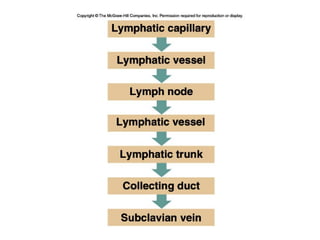
A circulatory system for fluids
returns fluid to the blood
removes antigens from the body
exposes antigens to the immune system
How is fluid moved?
Contraction of skeletal muscles against
lymphatic vessels
Smooth muscle contraction
Valves in lymphatic vessels
Breathing
Obstruction of system leads to edema
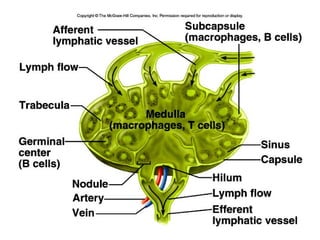
Lymph nodes
Grouped together at various parts of the body
Filtration
“Immune surveillance”
immune cells are concentrated there
(as is antigen)
Lymphocytes develop in lymph nodes (after
they are formed in the bone marrow)
T cells develop in the thymus and then enter
the circulation
Macrophages and dendritic cells “present”
antigen in the lymph nodes
What are the major organs/tissues of the
lymphatic system?
How do the cells get there?
Thymus
T cell development: cells migrate from bone
marrow and differentiate into T cells
T helper cells
Cytotoxic T cells
Thymus gets progressively smaller (and less
active) through life
Spleen
Filters blood, while lymph nodes filter lymph
White pulp- concentration of lymphocytes
(around arteries)
Red pulp- red cells are filtered too
Macrophages are plentiful throughout
B and T lymphocytes confer “specific immunity”
Body also has “non-specific” responses to
infection
Barriers- skin, mucosa, chemical barriers
Inflammation
redness, swelling, heat, pain
Phagocytes
Fever
Cells of inflammation
Neutrophils- leave blood and enter site of
injury- kill and phagocytose microbes
Macrophages- also phagocytes
Mast cells- release inflammatory substances
Complement proteins- contribute to
inflammation
Lymphocytes may be activated, too
What about specific immunity?
Arises when barriers (first line of defense)
and inflammation (second line) do not
control the infection
Is directed against specific antigens
What is an antigen?
What are the cells of specific immunity?
B lymphocytes (produce antibodies)
T lymphocytes (helper, cytotoxic)
Helper T cells regulate the immune response
Cytotoxic T cells kill altered cells
infected with viruses
tumor cells
What do these cells do, when exposed to
antigen?
Proliferate (divide rapidly)
Produce “effector molecules”
B cells- antibodies
helper T cells- cytokines
cytotoxic T cells- cytotoxic granules
Macrophages, dendritic cells- present antigen
to T cells
What do antibodies do? (five classes)
Ig (immunoglobulin) G- active in blood against
bacteria and viruses
helps activate complement
helps phagocytes eliminate antigens
most common antibody in the blood
IgM- reacts with certain antigens, usually on
first exposure
IgA- most common in mucosa
IgD and IgE are rare in blood
IgE is involved in allergic reactions
sticks to mast cells, which release
inflammatory substances
IgD is usually found on B cells (not released)
may be involved in B cell activation
When the body is exposed to an antigen for the
first time, antibody production is slow and
at low levels. Usually IgM
If exposed to the same antigen again, the
antibody response is much more rapid
and intense (IgG)
(Most antibody in the blood stream is IgG)
Vaccination
• Exposure to antigen will produce an
immune response
• Repeated exposure will produce
memory
• Vaccine-produce the memory response
without getting the disease
• Why are vaccine produced to protect
against some diseases but not others?
Immune system protects against infection,
but also against other antigens
Blood group antigens
Tissue antigens (i.e., graft rejection)
For successful organ graft, immune system
must be suppressed
Transplanted tissue must be cleared of immune
cells, too
What if there is an immune response against
the “wrong” antigens?
Allergies- antigen that is otherwise harmless
(hypersensitivity)
Immediate type is mediated by IgE
Delayed-type is caused by T cells
Autoimmunity
Normally immune system does NOT react to
“self” antigens
Autoimmunity occurs when it does
disease can be localized (to kidneys,
joints, thyroid, etc.) or can be systemic
(lupus)
Treatment usually requires some form of
immunosuppression
Immune deficiency
Primary- lack of development of all or part of
the immune system
SCID- severe combined immune deficiency
DiGeorge syndrome- lack of a thymus, etc.
Secondary- due to disease
AIDS
can also be temporary
Summary
The lymphatic system helps maintain homeostasis
of fluids, and also helps remove antigen from
the body
The immune system consists of barriers (physical
and chemical) and specific and nonspecific
mechanisms to eliminate antigen
“Immune cells” are blood cells. Some circulate in
the blood and can then migrate into tissues
at site of injury. These include neutrophils
and macrophages.
All blood cells arise in the bone marrow.
B lymphocytes initially develop in the bone
marrow and then migrate to lymphoid
tissues (esp. lymph nodes and spleen)
T lymphocytes develop in the thymus.
B cells produce antibodies, which interact with
antigen to help eliminate it.
Helper T cells regulate the immune response;
cytotoxic T cells kill virus-infected cells
and probably tumor cells. (They also are
responsible for transplant rejection.)
B and T cell response is antigen-specific and
has “memory” (second response is faster
and stronger than the first)
Immune system can be overly responsive to
antigens (hypersensitivity/allergy) or can
mistakenly be directed against self antigen
(autoimmunity)
Immune deficiencies leave people vulnerable
to infection

lymphatic

  • 1.
    The lymphatic systemand immunity A circulatory system for fluids returns fluid to the blood removes antigens from the body exposes antigens to the immune system
  • 4.
    How is fluidmoved? Contraction of skeletal muscles against lymphatic vessels Smooth muscle contraction Valves in lymphatic vessels Breathing Obstruction of system leads to edema
  • 5.
    Lymph nodes Grouped togetherat various parts of the body Filtration “Immune surveillance” immune cells are concentrated there (as is antigen)
  • 8.
    Lymphocytes develop inlymph nodes (after they are formed in the bone marrow) T cells develop in the thymus and then enter the circulation Macrophages and dendritic cells “present” antigen in the lymph nodes What are the major organs/tissues of the lymphatic system? How do the cells get there?
  • 10.
    Thymus T cell development:cells migrate from bone marrow and differentiate into T cells T helper cells Cytotoxic T cells Thymus gets progressively smaller (and less active) through life
  • 11.
    Spleen Filters blood, whilelymph nodes filter lymph White pulp- concentration of lymphocytes (around arteries) Red pulp- red cells are filtered too Macrophages are plentiful throughout
  • 13.
    B and Tlymphocytes confer “specific immunity” Body also has “non-specific” responses to infection Barriers- skin, mucosa, chemical barriers Inflammation redness, swelling, heat, pain Phagocytes Fever
  • 14.
    Cells of inflammation Neutrophils-leave blood and enter site of injury- kill and phagocytose microbes Macrophages- also phagocytes Mast cells- release inflammatory substances Complement proteins- contribute to inflammation Lymphocytes may be activated, too
  • 15.
    What about specificimmunity? Arises when barriers (first line of defense) and inflammation (second line) do not control the infection Is directed against specific antigens What is an antigen?
  • 16.
    What are thecells of specific immunity? B lymphocytes (produce antibodies) T lymphocytes (helper, cytotoxic) Helper T cells regulate the immune response Cytotoxic T cells kill altered cells infected with viruses tumor cells
  • 17.
    What do thesecells do, when exposed to antigen? Proliferate (divide rapidly) Produce “effector molecules” B cells- antibodies helper T cells- cytokines cytotoxic T cells- cytotoxic granules Macrophages, dendritic cells- present antigen to T cells
  • 19.
    What do antibodiesdo? (five classes) Ig (immunoglobulin) G- active in blood against bacteria and viruses helps activate complement helps phagocytes eliminate antigens most common antibody in the blood IgM- reacts with certain antigens, usually on first exposure IgA- most common in mucosa
  • 20.
    IgD and IgEare rare in blood IgE is involved in allergic reactions sticks to mast cells, which release inflammatory substances IgD is usually found on B cells (not released) may be involved in B cell activation
  • 21.
    When the bodyis exposed to an antigen for the first time, antibody production is slow and at low levels. Usually IgM If exposed to the same antigen again, the antibody response is much more rapid and intense (IgG) (Most antibody in the blood stream is IgG)
  • 23.
    Vaccination • Exposure toantigen will produce an immune response • Repeated exposure will produce memory • Vaccine-produce the memory response without getting the disease • Why are vaccine produced to protect against some diseases but not others?
  • 24.
    Immune system protectsagainst infection, but also against other antigens Blood group antigens Tissue antigens (i.e., graft rejection) For successful organ graft, immune system must be suppressed Transplanted tissue must be cleared of immune cells, too
  • 25.
    What if thereis an immune response against the “wrong” antigens? Allergies- antigen that is otherwise harmless (hypersensitivity) Immediate type is mediated by IgE Delayed-type is caused by T cells
  • 26.
    Autoimmunity Normally immune systemdoes NOT react to “self” antigens Autoimmunity occurs when it does disease can be localized (to kidneys, joints, thyroid, etc.) or can be systemic (lupus) Treatment usually requires some form of immunosuppression
  • 27.
    Immune deficiency Primary- lackof development of all or part of the immune system SCID- severe combined immune deficiency DiGeorge syndrome- lack of a thymus, etc. Secondary- due to disease AIDS can also be temporary
  • 28.
    Summary The lymphatic systemhelps maintain homeostasis of fluids, and also helps remove antigen from the body The immune system consists of barriers (physical and chemical) and specific and nonspecific mechanisms to eliminate antigen “Immune cells” are blood cells. Some circulate in the blood and can then migrate into tissues at site of injury. These include neutrophils and macrophages.
  • 29.
    All blood cellsarise in the bone marrow. B lymphocytes initially develop in the bone marrow and then migrate to lymphoid tissues (esp. lymph nodes and spleen) T lymphocytes develop in the thymus. B cells produce antibodies, which interact with antigen to help eliminate it. Helper T cells regulate the immune response; cytotoxic T cells kill virus-infected cells and probably tumor cells. (They also are responsible for transplant rejection.)
  • 30.
    B and Tcell response is antigen-specific and has “memory” (second response is faster and stronger than the first) Immune system can be overly responsive to antigens (hypersensitivity/allergy) or can mistakenly be directed against self antigen (autoimmunity) Immune deficiencies leave people vulnerable to infection