Blood and Immune system
Acquired Immunity
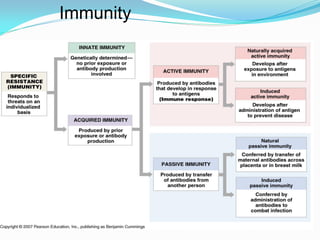
Immunity
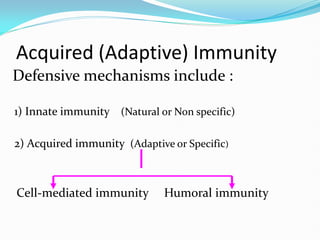
Acquired (Adaptive) Immunity
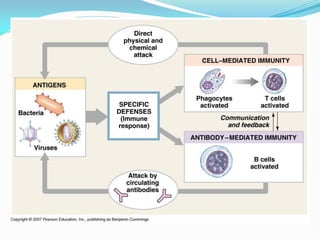
Defensive mechanisms include :
1) Innate immunity (Natural or Non specific)
2) Acquired immunity (Adaptive or Specific)
Cell-mediated immunity Humoral immunity
Active Immunity
I. Humoral (Antibody-Mediated) Immunity
 Involves production of antibodies against foreign
antigens.
 Antibodies are produced by a subset of lymphocytes
called B cells.
 B cells that are stimulated will actively secrete antibodies
and are called plasma cells.
 Antibodies are found in extracellular fluids (blood
plasma, lymph, mucus, etc.) and the surface of B cells.
 Defense against bacteria, bacterial toxins, and viruses
that circulate freely in body fluids, before they enter cells.
 Also cause certain reactions against transplanted tissue.
II. Cell Mediated Immunity
Involves specialized set of lymphocytes called T
cells that recognize foreign antigens on the surface
of cells, organisms, or tissues:
•Helper T cells
•Cytotoxic T cells
•Memory T Cells
•T Suppressor (Ts) Cells
T cells regulate proliferation and activity of other
cells of the immune system: B cells, macrophages,
neutrophils, etc.
Defense against:
•Bacteria and viruses that are inside host cells
and are inaccessible to antibodies.
•Fungi, protozoa, and helminths
•Cancer cells
•Transplanted tissue
Antigens
Most are proteins or large polysaccharides from a
foreign organism.
 Microbes: Capsules, cell walls, toxins, viral
capsids, flagella, etc.
 Nonmicrobes: Pollen, egg white , red blood cell
surface molecules, serum proteins, and surface
molecules from transplanted tissue.
Lipids and nucleic acids are only antigenic when
combined with proteins or polysaccharides.
Molecular weight of 10,000 or higher.
 Hapten: Small foreign molecule that is not antigenic. Must
be coupled to a carrier molecule to be antigenic. Once
antibodies are formed they will recognize hapten.
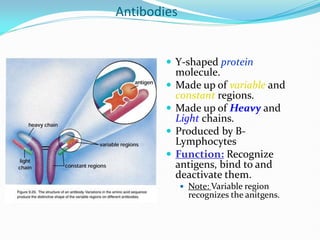
Antibodies
 Y-shaped protein
molecule.
 Made up of variable and
constant regions.
 Made up of Heavy and
Light chains.
 Produced by B-
Lymphocytes
 Function: Recognize
antigens, bind to and
deactivate them.
 Note: Variable region
recognizes the anitgens.
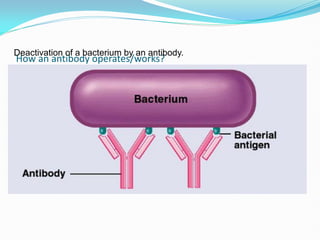
How an antibody operates/works?
Deactivation of a bacterium by an antibody.
Immunoglobulin Classes
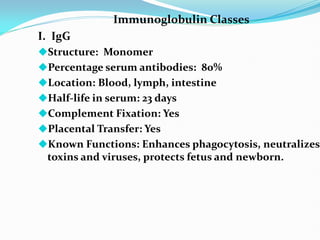
I. IgG
Structure: Monomer
Percentage serum antibodies: 80%
Location: Blood, lymph, intestine
Half-life in serum: 23 days
Complement Fixation: Yes
Placental Transfer: Yes
Known Functions: Enhances phagocytosis, neutralizes
toxins and viruses, protects fetus and newborn.
Immunoglobulin Classes
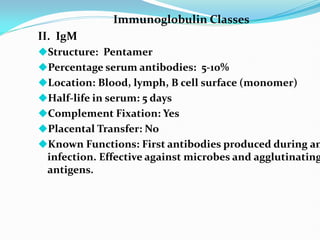
II. IgM
Structure: Pentamer
Percentage serum antibodies: 5-10%
Location: Blood, lymph, B cell surface (monomer)
Half-life in serum: 5 days
Complement Fixation: Yes
Placental Transfer: No
Known Functions: First antibodies produced during an
infection. Effective against microbes and agglutinating
antigens.
Immunoglobulin Classes
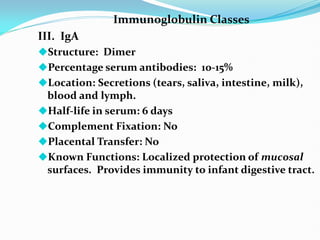
III. IgA
Structure: Dimer
Percentage serum antibodies: 10-15%
Location: Secretions (tears, saliva, intestine, milk),
blood and lymph.
Half-life in serum: 6 days
Complement Fixation: No
Placental Transfer: No
Known Functions: Localized protection of mucosal
surfaces. Provides immunity to infant digestive tract.
Immunoglobulin Classes
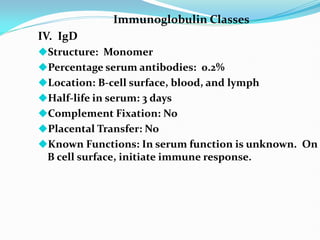
IV. IgD
Structure: Monomer
Percentage serum antibodies: 0.2%
Location: B-cell surface, blood, and lymph
Half-life in serum: 3 days
Complement Fixation: No
Placental Transfer: No
Known Functions: In serum function is unknown. On
B cell surface, initiate immune response.
Immunoglobulin Classes
V. IgE
Structure: Monomer
Percentage serum antibodies: 0.002%
Location: Bound to mast cells and basophils
throughout body. Blood.
Half-life in serum: 2 days
Complement Fixation: No
Placental Transfer: No
Known Functions: Allergic reactions. Possibly lysis of
worms.
How Do B Cells Produce Antibodies?
 B cells develop from stem cells in the bone marrow of
adults (liver of fetuses).
 After maturation B cells migrate to lymphoid organs
(lymph node or spleen).
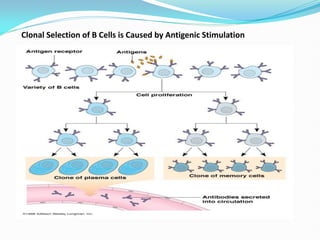
 Clonal Selection: When a B cell encounters an
antigen it recognizes, it is stimulated and divides into
many clones called plasma cells, which actively
secrete antibodies.
 Each B cell produces antibodies that will recognize
only one antigenic determinant.
Clonal Selection of B Cells is Caused by Antigenic Stimulation
Apoptosis
 Programmed cell death (“Falling away”).
 Human body makes 100 million lymphocytes every
day. If an equivalent number doesn’t die, will develop
leukemia.
 B cells that do not encounter stimulating antigen will
self-destruct and send signals to phagocytes to
dispose of their remains.
 Many virus infected cells will undergo apoptosis, to
help prevent spread of the infection.
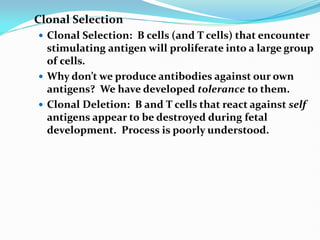
Clonal Selection
 Clonal Selection: B cells (and T cells) that encounter
stimulating antigen will proliferate into a large group
of cells.
 Why don’t we produce antibodies against our own
antigens? We have developed tolerance to them.
 Clonal Deletion: B and T cells that react against self
antigens appear to be destroyed during fetal
development. Process is poorly understood.
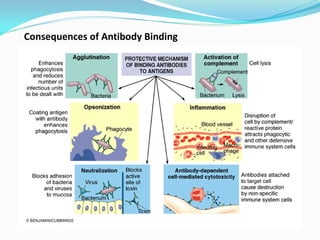
Consequences of Antibody Binding
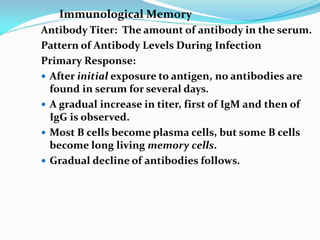
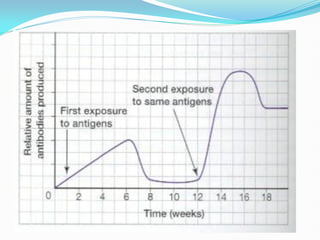
Immunological Memory
Antibody Titer: The amount of antibody in the serum.
Pattern of Antibody Levels During Infection
Primary Response:
 After initial exposure to antigen, no antibodies are
found in serum for several days.
 A gradual increase in titer, first of IgM and then of
IgG is observed.
 Most B cells become plasma cells, but some B cells
become long living memory cells.
 Gradual decline of antibodies follows.
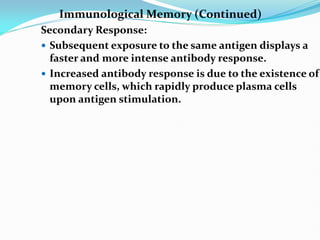
Immunological Memory (Continued)
Secondary Response:
 Subsequent exposure to the same antigen displays a
faster and more intense antibody response.
 Increased antibody response is due to the existence of
memory cells, which rapidly produce plasma cells
upon antigen stimulation.
Primary .vs. Secondary Immune Response
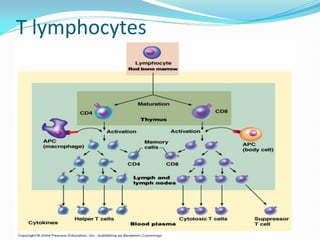
T lymphocytes
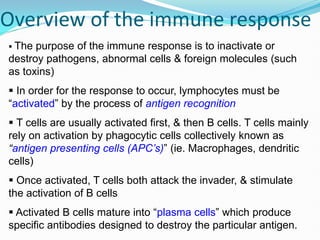
Overview of the immune response
 The purpose of the immune response is to inactivate or
destroy pathogens, abnormal cells & foreign molecules (such
as toxins)
 In order for the response to occur, lymphocytes must be
“activated” by the process of antigen recognition
 T cells are usually activated first, & then B cells. T cells mainly
rely on activation by phagocytic cells collectively known as
“antigen presenting cells (APC’s)” (ie. Macrophages, dendritic
cells)
 Once activated, T cells both attack the invader, & stimulate
the activation of B cells
 Activated B cells mature into “plasma cells” which produce
specific antibodies designed to destroy the particular antigen.
Cell Mediated (a.k.a. Cellular) Immunity
 In order for T cells to respond, they must first be activated by
exposure to an antigen, which is bound to membrane receptors of
phagocytic antigen presenting cells (APC’s) (“antigen recognition”)
 These membrane receptors on cells are called “MHC proteins”
(major histocompatibility complex proteins), & are genetically
determined (i.e. differ among individuals)
 Antigens bound to MHC proteins “tell” the T lymphocyte what the
specific foreign invader is (i.e. a specific bacteria) so that the
lymphocytes can mount a cellular defense
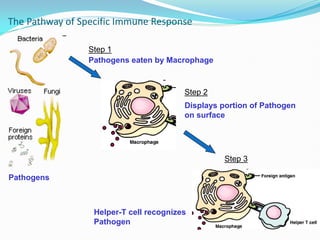
The Pathway of Specific Immune Response
Pathogens
Pathogens eaten by Macrophage
Displays portion of Pathogen
on surface
Helper-T cell recognizes
Pathogen
Step 1
Step 2
Step 3
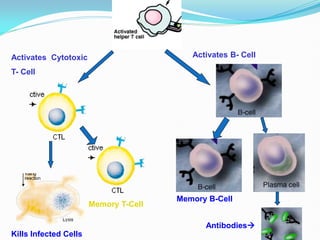
Activates B- Cell
Activates Cytotoxic
T- Cell
Memory B-Cell
Memory T-Cell
Kills Infected Cells
Antibodies
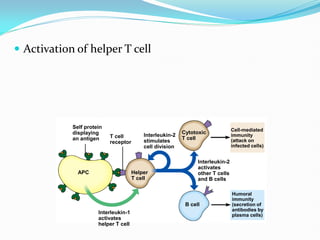
 Activation of helper T cell
Self protein
displaying
an antigen T cell
receptor
Interleukin-2
stimulates
cell division
Cytotoxic
T cell
Interleukin-2
activates
other T cells
and B cells
Cell-mediated
immunity
(attack on
infected cells)
Humoral
immunity
(secretion of
antibodies by
plasma cells)
B cell
Helper
T cell
APC
Interleukin-1
activates
helper T cell
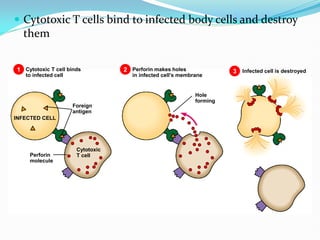
 Cytotoxic T cells bind to infected body cells and destroy
them
Cytotoxic T cell binds
to infected cell
1 2 3
Perforin makes holes
in infected cell’s membrane
Infected cell is destroyed
INFECTED CELL
Perforin
molecule
Cytotoxic
T cell
Foreign
antigen
Hole
forming
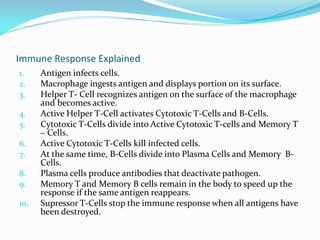
Immune Response Explained
1. Antigen infects cells.
2. Macrophage ingests antigen and displays portion on its surface.
3. Helper T- Cell recognizes antigen on the surface of the macrophage
and becomes active.
4. Active Helper T-Cell activates Cytotoxic T-Cells and B-Cells.
5. Cytotoxic T-Cells divide into Active Cytotoxic T-cells and Memory T
– Cells.
6. Active Cytotoxic T-Cells kill infected cells.
7. At the same time, B-Cells divide into Plasma Cells and Memory B-
Cells.
8. Plasma cells produce antibodies that deactivate pathogen.
9. Memory T and Memory B cells remain in the body to speed up the
response if the same antigen reappears.
10. Supressor T-Cells stop the immune response when all antigens have
been destroyed.
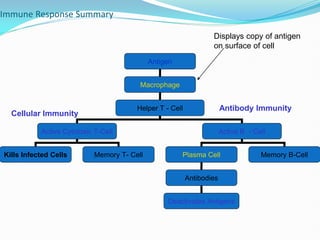
Immune Response Summary
Antigen
Macrophage
Helper T - Cell
Active Cytotoxic T-Cell Active B - Cell
Kills Infected Cells Memory T- Cell Plasma Cell Memory B-Cell
Antibodies
Deactivates Antigens
Displays copy of antigen
on surface of cell
Cellular Immunity
Antibody Immunity
Autoimmune Disease
 Autoimmune diseases are diseases where the immune
system begins to attack itself.
 Ex:
 Rheumatoid Arthritis – crippling disease of the joints.
 Lupus – disease of blood and organs.
 Multiple Sclerosis – disease of nervous system
 Myasthenia Gravis
 Cause(s): unknown
 Cures/Treatments: No known cures. Usually treated with
drugs.
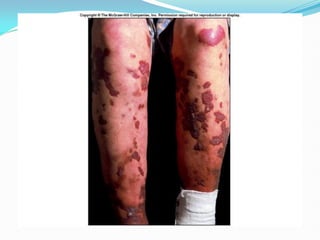
HIV/AIDS
Human immunodeficiency virus
Attacks helper T cells
Without production of IL-2, there is no
second signal, and humoral and cell
mediated immunity are shut off.
See increase in rare diseases:
TB, Kaposi sarcoma, etc.
Allergies
Allergy
- An exaggerated response by the immune system to an allergen.
Allergen: a normally harmless substance that causes an allergic
reaction.
ex: dust, pollen, mould, food, insect stings
Types of Allergic reactions
There are two types of allergic reactions.
a. Immediate – occurs within seconds and normally lasts for about 30
mins.
b. Delayed – takes longer to react and can last for a much longer time.
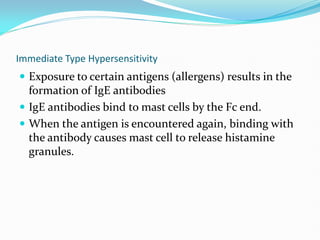
What happens during an allergic reaction?
 During an allergic reaction antibodies cause histamines to be
released from certain cells.
Histamines cause:
a. Swelling of tissues
b. Release of fluids (runny noses and eyes)
c. muscle spasms (some cases)
Anaphylaxis or anaphylactic shock:
This is the sudden and severe allergic reaction to a substance that
can cause death.
Treatments for Allergies
1. Avoidance of material – especially food.
2. Epinephrine –
3. Antihistamines
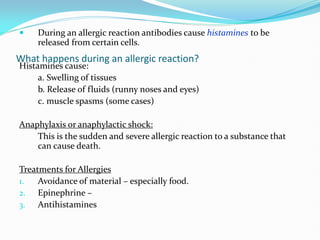
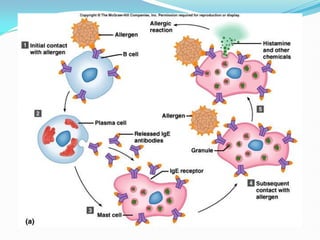
Immediate Type Hypersensitivity
 Exposure to certain antigens (allergens) results in the
formation of IgE antibodies
 IgE antibodies bind to mast cells by the Fc end.
 When the antigen is encountered again, binding with
the antibody causes mast cell to release histamine
granules.
Delayed Hypersensitivity
A type of cell mediated immunity.
T cell – requires usual two signals
Second time antigen is encountered, T cell
produces several cytokines that attract and
activate macrophages, resulting in an
inflammatory reaction.
Further reading:
 Review of Medical Physiology. By W.F. Ganong, Lange
Medical Book. Prentice-Hall International.
 Textbook of Medical Physiology, Indu Khurana,
Elsevier

acquiredimmunity11102018.pdf.explaining on

  • 1.
    Blood and Immunesystem Acquired Immunity
  • 2.
  • 3.
    Acquired (Adaptive) Immunity Defensivemechanisms include : 1) Innate immunity (Natural or Non specific) 2) Acquired immunity (Adaptive or Specific) Cell-mediated immunity Humoral immunity
  • 4.
    Active Immunity I. Humoral(Antibody-Mediated) Immunity  Involves production of antibodies against foreign antigens.  Antibodies are produced by a subset of lymphocytes called B cells.  B cells that are stimulated will actively secrete antibodies and are called plasma cells.  Antibodies are found in extracellular fluids (blood plasma, lymph, mucus, etc.) and the surface of B cells.  Defense against bacteria, bacterial toxins, and viruses that circulate freely in body fluids, before they enter cells.  Also cause certain reactions against transplanted tissue.
  • 5.
    II. Cell MediatedImmunity Involves specialized set of lymphocytes called T cells that recognize foreign antigens on the surface of cells, organisms, or tissues: •Helper T cells •Cytotoxic T cells •Memory T Cells •T Suppressor (Ts) Cells T cells regulate proliferation and activity of other cells of the immune system: B cells, macrophages, neutrophils, etc. Defense against: •Bacteria and viruses that are inside host cells and are inaccessible to antibodies. •Fungi, protozoa, and helminths •Cancer cells •Transplanted tissue
  • 6.
    Antigens Most are proteinsor large polysaccharides from a foreign organism.  Microbes: Capsules, cell walls, toxins, viral capsids, flagella, etc.  Nonmicrobes: Pollen, egg white , red blood cell surface molecules, serum proteins, and surface molecules from transplanted tissue. Lipids and nucleic acids are only antigenic when combined with proteins or polysaccharides. Molecular weight of 10,000 or higher.  Hapten: Small foreign molecule that is not antigenic. Must be coupled to a carrier molecule to be antigenic. Once antibodies are formed they will recognize hapten.
  • 7.
    Antibodies  Y-shaped protein molecule. Made up of variable and constant regions.  Made up of Heavy and Light chains.  Produced by B- Lymphocytes  Function: Recognize antigens, bind to and deactivate them.  Note: Variable region recognizes the anitgens.
  • 8.
    How an antibodyoperates/works? Deactivation of a bacterium by an antibody.
  • 9.
    Immunoglobulin Classes I. IgG Structure:Monomer Percentage serum antibodies: 80% Location: Blood, lymph, intestine Half-life in serum: 23 days Complement Fixation: Yes Placental Transfer: Yes Known Functions: Enhances phagocytosis, neutralizes toxins and viruses, protects fetus and newborn.
  • 10.
    Immunoglobulin Classes II. IgM Structure:Pentamer Percentage serum antibodies: 5-10% Location: Blood, lymph, B cell surface (monomer) Half-life in serum: 5 days Complement Fixation: Yes Placental Transfer: No Known Functions: First antibodies produced during an infection. Effective against microbes and agglutinating antigens.
  • 11.
    Immunoglobulin Classes III. IgA Structure:Dimer Percentage serum antibodies: 10-15% Location: Secretions (tears, saliva, intestine, milk), blood and lymph. Half-life in serum: 6 days Complement Fixation: No Placental Transfer: No Known Functions: Localized protection of mucosal surfaces. Provides immunity to infant digestive tract.
  • 12.
    Immunoglobulin Classes IV. IgD Structure:Monomer Percentage serum antibodies: 0.2% Location: B-cell surface, blood, and lymph Half-life in serum: 3 days Complement Fixation: No Placental Transfer: No Known Functions: In serum function is unknown. On B cell surface, initiate immune response.
  • 13.
    Immunoglobulin Classes V. IgE Structure:Monomer Percentage serum antibodies: 0.002% Location: Bound to mast cells and basophils throughout body. Blood. Half-life in serum: 2 days Complement Fixation: No Placental Transfer: No Known Functions: Allergic reactions. Possibly lysis of worms.
  • 14.
    How Do BCells Produce Antibodies?  B cells develop from stem cells in the bone marrow of adults (liver of fetuses).  After maturation B cells migrate to lymphoid organs (lymph node or spleen).  Clonal Selection: When a B cell encounters an antigen it recognizes, it is stimulated and divides into many clones called plasma cells, which actively secrete antibodies.  Each B cell produces antibodies that will recognize only one antigenic determinant.
  • 15.
    Clonal Selection ofB Cells is Caused by Antigenic Stimulation
  • 16.
    Apoptosis  Programmed celldeath (“Falling away”).  Human body makes 100 million lymphocytes every day. If an equivalent number doesn’t die, will develop leukemia.  B cells that do not encounter stimulating antigen will self-destruct and send signals to phagocytes to dispose of their remains.  Many virus infected cells will undergo apoptosis, to help prevent spread of the infection.
  • 17.
    Clonal Selection  ClonalSelection: B cells (and T cells) that encounter stimulating antigen will proliferate into a large group of cells.  Why don’t we produce antibodies against our own antigens? We have developed tolerance to them.  Clonal Deletion: B and T cells that react against self antigens appear to be destroyed during fetal development. Process is poorly understood.
  • 18.
  • 19.
    Immunological Memory Antibody Titer:The amount of antibody in the serum. Pattern of Antibody Levels During Infection Primary Response:  After initial exposure to antigen, no antibodies are found in serum for several days.  A gradual increase in titer, first of IgM and then of IgG is observed.  Most B cells become plasma cells, but some B cells become long living memory cells.  Gradual decline of antibodies follows.
  • 20.
    Immunological Memory (Continued) SecondaryResponse:  Subsequent exposure to the same antigen displays a faster and more intense antibody response.  Increased antibody response is due to the existence of memory cells, which rapidly produce plasma cells upon antigen stimulation.
  • 21.
    Primary .vs. SecondaryImmune Response
  • 22.
  • 23.
    Overview of theimmune response  The purpose of the immune response is to inactivate or destroy pathogens, abnormal cells & foreign molecules (such as toxins)  In order for the response to occur, lymphocytes must be “activated” by the process of antigen recognition  T cells are usually activated first, & then B cells. T cells mainly rely on activation by phagocytic cells collectively known as “antigen presenting cells (APC’s)” (ie. Macrophages, dendritic cells)  Once activated, T cells both attack the invader, & stimulate the activation of B cells  Activated B cells mature into “plasma cells” which produce specific antibodies designed to destroy the particular antigen.
  • 25.
    Cell Mediated (a.k.a.Cellular) Immunity  In order for T cells to respond, they must first be activated by exposure to an antigen, which is bound to membrane receptors of phagocytic antigen presenting cells (APC’s) (“antigen recognition”)  These membrane receptors on cells are called “MHC proteins” (major histocompatibility complex proteins), & are genetically determined (i.e. differ among individuals)  Antigens bound to MHC proteins “tell” the T lymphocyte what the specific foreign invader is (i.e. a specific bacteria) so that the lymphocytes can mount a cellular defense
  • 26.
    The Pathway ofSpecific Immune Response Pathogens Pathogens eaten by Macrophage Displays portion of Pathogen on surface Helper-T cell recognizes Pathogen Step 1 Step 2 Step 3
  • 27.
    Activates B- Cell ActivatesCytotoxic T- Cell Memory B-Cell Memory T-Cell Kills Infected Cells Antibodies
  • 28.
     Activation ofhelper T cell Self protein displaying an antigen T cell receptor Interleukin-2 stimulates cell division Cytotoxic T cell Interleukin-2 activates other T cells and B cells Cell-mediated immunity (attack on infected cells) Humoral immunity (secretion of antibodies by plasma cells) B cell Helper T cell APC Interleukin-1 activates helper T cell
  • 29.
     Cytotoxic Tcells bind to infected body cells and destroy them Cytotoxic T cell binds to infected cell 1 2 3 Perforin makes holes in infected cell’s membrane Infected cell is destroyed INFECTED CELL Perforin molecule Cytotoxic T cell Foreign antigen Hole forming
  • 30.
    Immune Response Explained 1.Antigen infects cells. 2. Macrophage ingests antigen and displays portion on its surface. 3. Helper T- Cell recognizes antigen on the surface of the macrophage and becomes active. 4. Active Helper T-Cell activates Cytotoxic T-Cells and B-Cells. 5. Cytotoxic T-Cells divide into Active Cytotoxic T-cells and Memory T – Cells. 6. Active Cytotoxic T-Cells kill infected cells. 7. At the same time, B-Cells divide into Plasma Cells and Memory B- Cells. 8. Plasma cells produce antibodies that deactivate pathogen. 9. Memory T and Memory B cells remain in the body to speed up the response if the same antigen reappears. 10. Supressor T-Cells stop the immune response when all antigens have been destroyed.
  • 31.
    Immune Response Summary Antigen Macrophage HelperT - Cell Active Cytotoxic T-Cell Active B - Cell Kills Infected Cells Memory T- Cell Plasma Cell Memory B-Cell Antibodies Deactivates Antigens Displays copy of antigen on surface of cell Cellular Immunity Antibody Immunity
  • 32.
    Autoimmune Disease  Autoimmunediseases are diseases where the immune system begins to attack itself.  Ex:  Rheumatoid Arthritis – crippling disease of the joints.  Lupus – disease of blood and organs.  Multiple Sclerosis – disease of nervous system  Myasthenia Gravis  Cause(s): unknown  Cures/Treatments: No known cures. Usually treated with drugs.
  • 33.
    HIV/AIDS Human immunodeficiency virus Attackshelper T cells Without production of IL-2, there is no second signal, and humoral and cell mediated immunity are shut off. See increase in rare diseases: TB, Kaposi sarcoma, etc.
  • 35.
    Allergies Allergy - An exaggeratedresponse by the immune system to an allergen. Allergen: a normally harmless substance that causes an allergic reaction. ex: dust, pollen, mould, food, insect stings Types of Allergic reactions There are two types of allergic reactions. a. Immediate – occurs within seconds and normally lasts for about 30 mins. b. Delayed – takes longer to react and can last for a much longer time.
  • 36.
    What happens duringan allergic reaction?  During an allergic reaction antibodies cause histamines to be released from certain cells. Histamines cause: a. Swelling of tissues b. Release of fluids (runny noses and eyes) c. muscle spasms (some cases) Anaphylaxis or anaphylactic shock: This is the sudden and severe allergic reaction to a substance that can cause death. Treatments for Allergies 1. Avoidance of material – especially food. 2. Epinephrine – 3. Antihistamines
  • 37.
    Immediate Type Hypersensitivity Exposure to certain antigens (allergens) results in the formation of IgE antibodies  IgE antibodies bind to mast cells by the Fc end.  When the antigen is encountered again, binding with the antibody causes mast cell to release histamine granules.
  • 39.
    Delayed Hypersensitivity A typeof cell mediated immunity. T cell – requires usual two signals Second time antigen is encountered, T cell produces several cytokines that attract and activate macrophages, resulting in an inflammatory reaction.
  • 40.
    Further reading:  Reviewof Medical Physiology. By W.F. Ganong, Lange Medical Book. Prentice-Hall International.  Textbook of Medical Physiology, Indu Khurana, Elsevier