PRESENTED BY:
REHNUMA K. GHORI
IMMUNOLOGY
T-CELL:
TCR,DIFFERENTIATION
AND IMPORTANCE
Type of blood cell
 Belong to a group of white blood cells (WBCs) called
lymphocytes.WBCs protect the body from infection.
 The main job of T-cells is to fight infection.
 There are a number of different types of T-cells that act
in many ways to identify, directly attack and destroy
infectious agents.
 Along with other WBCs, they play a major role in the
immune system, which guards the body against infection.
T- CELL
 Two types of lymphocytes
◦ B lymphocytes – oversee humoral immunity
◦ T lymphocytes – non-antibody-producing cells
that constitute the cell-mediated arm of
immunity
 Antigen-presenting cells (APCs):
◦ Do not respond to specific antigens
◦ Play essential auxiliary roles in immunity
Lymphocytes
 Immature lymphocytes released from
bone marrow are essentially identical
 Whether a lymphocyte matures into a B
cell or a T cell depends on where in the
body it becomes immune competent
◦ B cells mature in the bone marrow
◦ T cells mature in the thymus
Thymus
•The thymus is an organ located in
the upper chest.
•Immature lymphocytes leave the
bone marrow and find their way to
the thymus where they are
“educated” to become mature T-
lymphocytes.
8
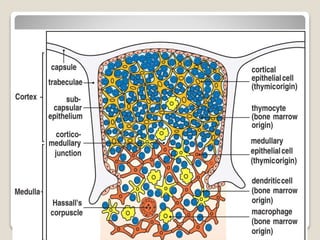
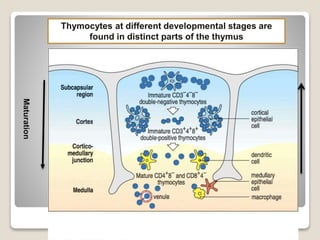
Thymocytes at different developmental stages are
found in distinct parts of the thymus
Maturation
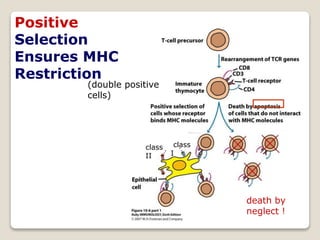
Positive
Selection
Ensures MHC
Restriction
death by
neglect !
(double positive
cells)
class
I
class
II
Negative
Selection
Ensures
Self-tolerance
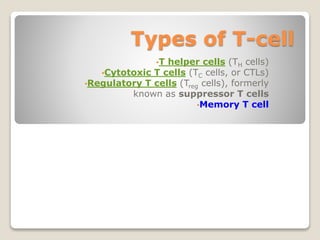
Types of T-cell
•T helper cells (TH cells)
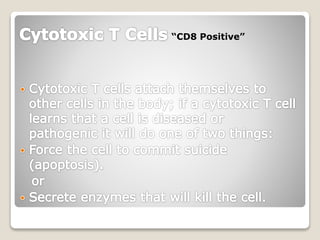
•Cytotoxic T cells (TC cells, or CTLs)
•Regulatory T cells (Treg cells), formerly
known as suppressor T cells
•Memory T cell
“CD4 positive”
“CD8 Positive”
T-cell receptor
The T cell receptor or TCR is a
molecule found on the surface
of T lymphocytes (or T cells)
that is responsible for
recognizing antigens bound to
major histocompatibility
complex (MHC) molecules.
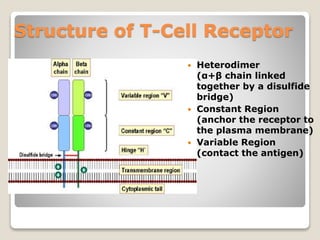
Structure of T-Cell Receptor
 Heterodimer
(α+β chain linked
together by a disulfide
bridge)
 Constant Region
(anchor the receptor to
the plasma membrane)
 Variable Region
(contact the antigen)
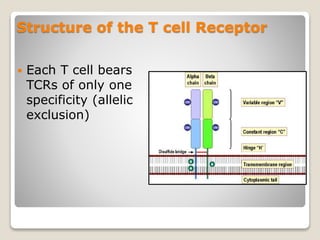
Structure of the T cell Receptor
 Each T cell bears
TCRs of only one
specificity (allelic
exclusion)
Structure of the T cell Receptor
 Both α and β chains
have a variable (V)
and constant (C)
region
 V regions of the α
and β chains contain
hyper variable
regions that
determine the
specificity for
antigen
Major Histocompatibility
Complex (MHC)
 There were three kinds of molecules
encoded by the MHC
◦ Class I
◦ Class II
◦ Class III
 Class I MHC molecules are found on all
nucleated cells (not RBCs)
 Class II MHC molecules are found on APC
◦ Dendritic cells, Macrophages, B cells, other cells
Class I MHC
Class II
MHC
RBCs
APCs
Nucleated cells
THE ROLE OF THE MHC
 In infected cells, MHC molecules bind and transport
antigen fragments to the cell surface, a process called
antigen presentation.
 A nearby T cell can then detect the antigen fragment
displayed on the cell’s surface
 Depending on their source, peptide antigens are
handled by different classes of MHC molecules:
 Class I MHC molecules are found on almost all
nucleated cells of the body
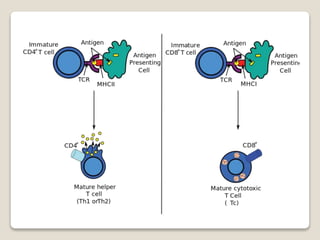
 They display peptide antigens to cytotoxic T cells
 Class II MHC molecules are located mainly on dendritic
cells, macrophages, and B cells
 Dendritic cells, macrophages, and B cells are antigen-
presenting cells that display antigens to cytotoxic T
cells and helper T cells.
Infected cell
Antigen
fragment
Class I MHC
molecule
T cell
receptor
(a)
Antigen
associates
with MHC
molecule
T cell
recognizes
combination
Cytotoxic T cell (b) Helper T cell
T cell
receptor
Class II MHC
molecule
Antigen
fragment
Antigen-
presenting
cell
Microbe
1
1
1
2
2
2
Key Steps in T cell Activation
 APC must process and present peptides to T cells
 T cells must receive a costimulatory signal
 Accessory adhesion molecules help to stabilize
binding of T cell and APC
 Signal from cell surface is transmitted to nucleus
 Cytokines produced to help drive cell division
◦ IL-2 and others
REFERENCE
 http://lymphoma.about.com/od/glossary/g/tcells.htm
 http://www.tcells.org/beginners/tcells/
 http://en.wikipedia.org/wiki/T_cell
http://www.nobelprize.org/educational/medicine/immunity/immu
ne-detail.html
 https://www.britannica.com/nobelprize/article-215578
 https://www.google.co.in/imghp
T-cell

T-cell

  • 1.
  • 2.
  • 3.
    Type of bloodcell  Belong to a group of white blood cells (WBCs) called lymphocytes.WBCs protect the body from infection.  The main job of T-cells is to fight infection.  There are a number of different types of T-cells that act in many ways to identify, directly attack and destroy infectious agents.  Along with other WBCs, they play a major role in the immune system, which guards the body against infection. T- CELL
  • 5.
     Two typesof lymphocytes ◦ B lymphocytes – oversee humoral immunity ◦ T lymphocytes – non-antibody-producing cells that constitute the cell-mediated arm of immunity  Antigen-presenting cells (APCs): ◦ Do not respond to specific antigens ◦ Play essential auxiliary roles in immunity
  • 6.
    Lymphocytes  Immature lymphocytesreleased from bone marrow are essentially identical  Whether a lymphocyte matures into a B cell or a T cell depends on where in the body it becomes immune competent ◦ B cells mature in the bone marrow ◦ T cells mature in the thymus
  • 7.
    Thymus •The thymus isan organ located in the upper chest. •Immature lymphocytes leave the bone marrow and find their way to the thymus where they are “educated” to become mature T- lymphocytes.
  • 8.
  • 9.
    Thymocytes at differentdevelopmental stages are found in distinct parts of the thymus Maturation
  • 10.
    Positive Selection Ensures MHC Restriction death by neglect! (double positive cells) class I class II
  • 11.
  • 12.
    Types of T-cell •Thelper cells (TH cells) •Cytotoxic T cells (TC cells, or CTLs) •Regulatory T cells (Treg cells), formerly known as suppressor T cells •Memory T cell
  • 13.
  • 14.
  • 15.
    T-cell receptor The Tcell receptor or TCR is a molecule found on the surface of T lymphocytes (or T cells) that is responsible for recognizing antigens bound to major histocompatibility complex (MHC) molecules.
  • 16.
    Structure of T-CellReceptor  Heterodimer (α+β chain linked together by a disulfide bridge)  Constant Region (anchor the receptor to the plasma membrane)  Variable Region (contact the antigen)
  • 17.
    Structure of theT cell Receptor  Each T cell bears TCRs of only one specificity (allelic exclusion)
  • 18.
    Structure of theT cell Receptor  Both α and β chains have a variable (V) and constant (C) region  V regions of the α and β chains contain hyper variable regions that determine the specificity for antigen
  • 19.
  • 20.
     There werethree kinds of molecules encoded by the MHC ◦ Class I ◦ Class II ◦ Class III  Class I MHC molecules are found on all nucleated cells (not RBCs)  Class II MHC molecules are found on APC ◦ Dendritic cells, Macrophages, B cells, other cells
  • 21.
    Class I MHC ClassII MHC RBCs APCs Nucleated cells
  • 23.
    THE ROLE OFTHE MHC  In infected cells, MHC molecules bind and transport antigen fragments to the cell surface, a process called antigen presentation.  A nearby T cell can then detect the antigen fragment displayed on the cell’s surface  Depending on their source, peptide antigens are handled by different classes of MHC molecules:  Class I MHC molecules are found on almost all nucleated cells of the body  They display peptide antigens to cytotoxic T cells  Class II MHC molecules are located mainly on dendritic cells, macrophages, and B cells  Dendritic cells, macrophages, and B cells are antigen- presenting cells that display antigens to cytotoxic T cells and helper T cells.
  • 24.
    Infected cell Antigen fragment Class IMHC molecule T cell receptor (a) Antigen associates with MHC molecule T cell recognizes combination Cytotoxic T cell (b) Helper T cell T cell receptor Class II MHC molecule Antigen fragment Antigen- presenting cell Microbe 1 1 1 2 2 2
  • 25.
    Key Steps inT cell Activation  APC must process and present peptides to T cells  T cells must receive a costimulatory signal  Accessory adhesion molecules help to stabilize binding of T cell and APC  Signal from cell surface is transmitted to nucleus  Cytokines produced to help drive cell division ◦ IL-2 and others
  • 27.
    REFERENCE  http://lymphoma.about.com/od/glossary/g/tcells.htm  http://www.tcells.org/beginners/tcells/ http://en.wikipedia.org/wiki/T_cell http://www.nobelprize.org/educational/medicine/immunity/immu ne-detail.html  https://www.britannica.com/nobelprize/article-215578  https://www.google.co.in/imghp