DEPRESSION
By: SATHISH Rajamani,
       Lecturer
What is Depression?
Everyone occasionally feels blue or
 sad. But these feelings are usually
 short-lived and pass within a
 couple of days. When you have
 depression, it interferes with daily
 life and causes pain for both you
 and those who care about you.
 Depression is a common but
 serious illness.
DEFINITION

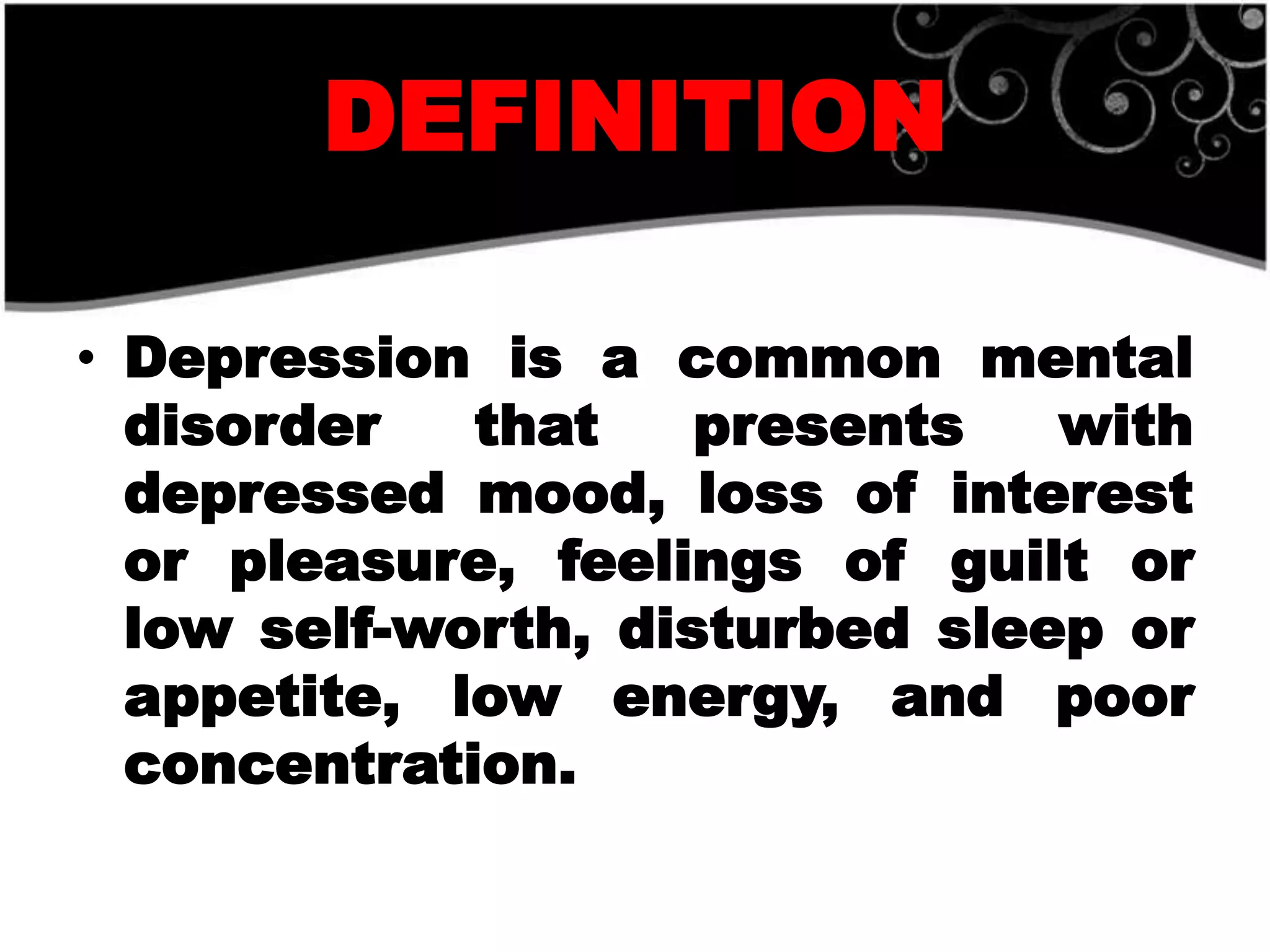
• Depression is a common mental
  disorder   that    presents   with
  depressed mood, loss of interest
  or pleasure, feelings of guilt or
  low self-worth, disturbed sleep or
  appetite, low energy, and poor
  concentration.
• Depression is the leading cause of
  disability as measured and the
  4th leading contributor to the global
  burden of disease (DALYs) in 2000. By
  the year 2020, depression is projected
  to reach 2nd place of the ranking of
  DALYs calculated for all ages, both
  sexes. Today, depression is already
  the 2nd cause of DALYs in the age
  category 15-44 years for both sexes
  combined.
PREVALENECE
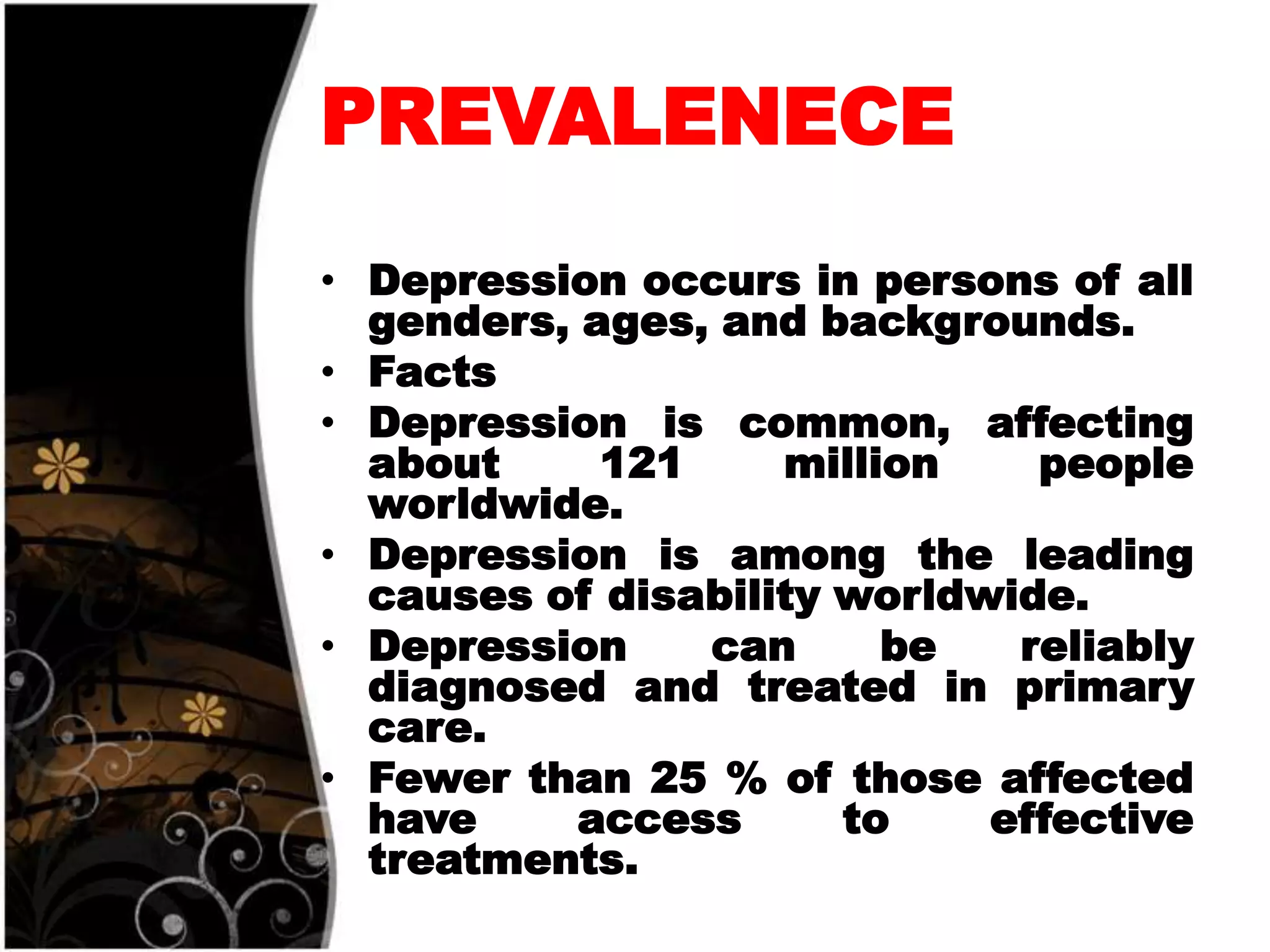
• Depression occurs in persons of all
  genders, ages, and backgrounds.
• Facts
• Depression is common, affecting
  about     121     million    people
  worldwide.
• Depression is among the leading
  causes of disability worldwide.
• Depression    can      be   reliably
  diagnosed and treated in primary
  care.
• Fewer than 25 % of those affected
  have     access      to    effective
  treatments.
•
What are the different forms of
             depression?
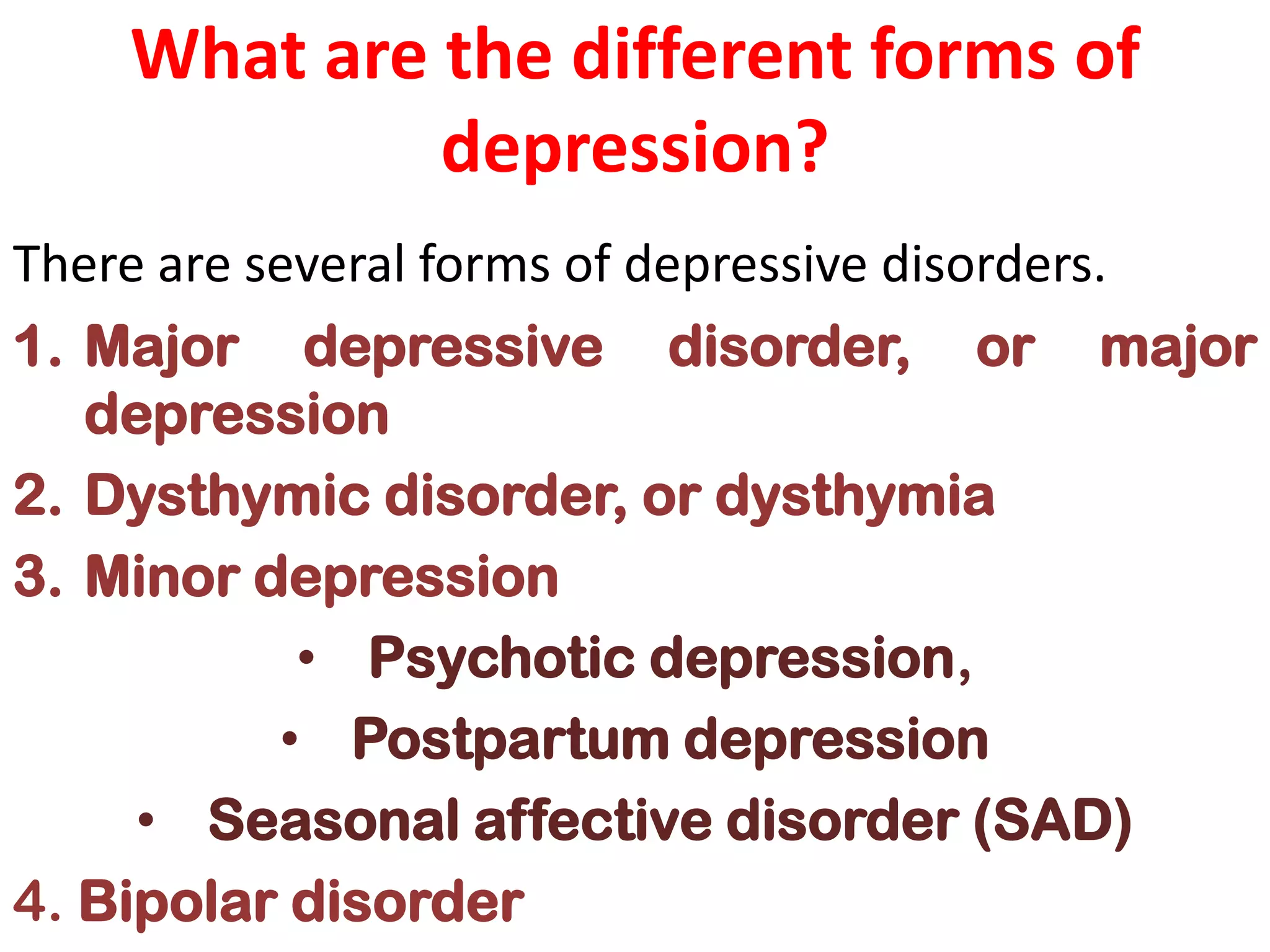
There are several forms of depressive disorders.
1. Major depressive disorder, or major
   depression
2. Dysthymic disorder, or dysthymia
3. Minor depression
            • Psychotic depression,
           • Postpartum depression
     • Seasonal affective disorder (SAD)
4. Bipolar disorder
Signs And Symptoms Of
           Depression
 Persistent sad, anxious, or "empty"
  feelings
 Feelings of hopelessness or pessimism
 Feelings of        guilt, worthlessness, or
  helplessness
 Irritability, restlessness
 Loss of interest in activities or hobbies
  once pleasurable, including sex
 Fatigue and decreased energy
S&S Cont….
 Difficulty   concentrating,    remembering
  details, and making decisions
 Insomnia, early-morning wakefulness, or
  excessive sleeping
 Overeating, or appetite loss
 Thoughts of suicide, suicide attempts
 Aches or pains, headaches, cramps, or
  digestive problems that do not ease even
  with treatment.
?

Post-traumatic stress disorder (PTSD)
Obsessive-compulsive disorder
Panic disorder
social phobia
Generalized anxiety disorder
Depression also may occur with other serious
 medical illnesses such as heart disease, stroke,
 cancer, HIV/AIDS, diabetes, and Parkinson's
 disease
CAUSES OF DEPRESSION
1. Genetic or Hereditary
2.   Biological   / Biochemical    /
  Medication
3. Dietary
4. Environmental
5.    Socio   Cultural   Factors   /
  Situations    /  Relationships   /
  Personality
DIAGNOSIS
•History Collection
•Mental Status
 Examination
•ICD – 10 Criteria
Management

• Antidepressants primarily
  work on brain chemicals
  called neurotransmitters,
  especially serotonin and
  norepinephrine. Other
  antidepressants work on
  the neurotransmitter
  dopamine.
ANTI DEPRESSANTS

• Selective   serotonin     reuptake
  inhibitors  (SSRIs).    Fluoxetine
  (Prozac),    sertraline    (Zoloft),
  escitalopram             (Lexapro),
  paroxetine (Paxil), and citalopram
  (Celexa) are some of the most
  commonly prescribed SSRIs for
  depression.
ANTI DEPRESSANTS

• Tricyclics        are        older
  antidepressants. Tricyclics are
  powerful, but they are not used as
  much     today    because     their
  potential side effects are more
  serious.
Examples:       Imipramine       and
  Nortriptyline
ANTI DEPRESSANTS

• Monoamine        oxidase      inhibitors
  (MAOIs) are the oldest class of
  antidepressant medications. They
  can be especially effective in
  cases of “atypical" depression.
• People who take MAOIs must avoid certain
  foods and beverages (including cheese and
  red wine) that contain a substance called
  tyramine.
PSYCHOTHERAPY

• Cognitive - behavioral therapy (CBT)
CBT helps people with depression
  restructure     negative     thought
  patterns.
• Interpersonal therapy (IPT)
IPT helps people understand and work
  through troubled relationships that
  may cause their depression
ELECTROCONVULSIVE
         THERAPY

• For cases in which medication
  and/or psychotherapy does not
  help relieve a person's treatment-
  resistant              depression,
  electroconvulsive therapy (ECT)
  may be useful.
Depression

Depression

  • 1.
  • 3.
    What is Depression? Everyoneoccasionally feels blue or sad. But these feelings are usually short-lived and pass within a couple of days. When you have depression, it interferes with daily life and causes pain for both you and those who care about you. Depression is a common but serious illness.
  • 4.
    DEFINITION • Depression isa common mental disorder that presents with depressed mood, loss of interest or pleasure, feelings of guilt or low self-worth, disturbed sleep or appetite, low energy, and poor concentration.
  • 5.
    • Depression isthe leading cause of disability as measured and the 4th leading contributor to the global burden of disease (DALYs) in 2000. By the year 2020, depression is projected to reach 2nd place of the ranking of DALYs calculated for all ages, both sexes. Today, depression is already the 2nd cause of DALYs in the age category 15-44 years for both sexes combined.
  • 6.
    PREVALENECE • Depression occursin persons of all genders, ages, and backgrounds. • Facts • Depression is common, affecting about 121 million people worldwide. • Depression is among the leading causes of disability worldwide. • Depression can be reliably diagnosed and treated in primary care. • Fewer than 25 % of those affected have access to effective treatments. •
  • 7.
    What are thedifferent forms of depression? There are several forms of depressive disorders. 1. Major depressive disorder, or major depression 2. Dysthymic disorder, or dysthymia 3. Minor depression • Psychotic depression, • Postpartum depression • Seasonal affective disorder (SAD) 4. Bipolar disorder
  • 9.
    Signs And SymptomsOf Depression  Persistent sad, anxious, or "empty" feelings  Feelings of hopelessness or pessimism  Feelings of guilt, worthlessness, or helplessness  Irritability, restlessness  Loss of interest in activities or hobbies once pleasurable, including sex  Fatigue and decreased energy
  • 10.
    S&S Cont….  Difficulty concentrating, remembering details, and making decisions  Insomnia, early-morning wakefulness, or excessive sleeping  Overeating, or appetite loss  Thoughts of suicide, suicide attempts  Aches or pains, headaches, cramps, or digestive problems that do not ease even with treatment.
  • 11.
    ? Post-traumatic stress disorder(PTSD) Obsessive-compulsive disorder Panic disorder social phobia Generalized anxiety disorder Depression also may occur with other serious medical illnesses such as heart disease, stroke, cancer, HIV/AIDS, diabetes, and Parkinson's disease
  • 12.
    CAUSES OF DEPRESSION 1.Genetic or Hereditary 2. Biological / Biochemical / Medication 3. Dietary 4. Environmental 5. Socio Cultural Factors / Situations / Relationships / Personality
  • 13.
    DIAGNOSIS •History Collection •Mental Status Examination •ICD – 10 Criteria
  • 14.
    Management • Antidepressants primarily work on brain chemicals called neurotransmitters, especially serotonin and norepinephrine. Other antidepressants work on the neurotransmitter dopamine.
  • 15.
    ANTI DEPRESSANTS • Selective serotonin reuptake inhibitors (SSRIs). Fluoxetine (Prozac), sertraline (Zoloft), escitalopram (Lexapro), paroxetine (Paxil), and citalopram (Celexa) are some of the most commonly prescribed SSRIs for depression.
  • 16.
    ANTI DEPRESSANTS • Tricyclics are older antidepressants. Tricyclics are powerful, but they are not used as much today because their potential side effects are more serious. Examples: Imipramine and Nortriptyline
  • 17.
    ANTI DEPRESSANTS • Monoamine oxidase inhibitors (MAOIs) are the oldest class of antidepressant medications. They can be especially effective in cases of “atypical" depression. • People who take MAOIs must avoid certain foods and beverages (including cheese and red wine) that contain a substance called tyramine.
  • 18.
    PSYCHOTHERAPY • Cognitive -behavioral therapy (CBT) CBT helps people with depression restructure negative thought patterns. • Interpersonal therapy (IPT) IPT helps people understand and work through troubled relationships that may cause their depression
  • 19.
    ELECTROCONVULSIVE THERAPY • For cases in which medication and/or psychotherapy does not help relieve a person's treatment- resistant depression, electroconvulsive therapy (ECT) may be useful.