Effective Note-Taking
Presenter: Dr Mohammed Haroon
Rashid
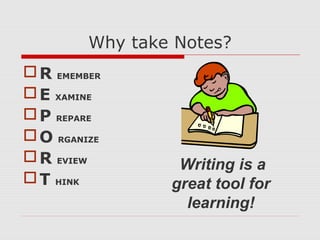
Why take Notes?
R EMEMBER
E XAMINE
P REPARE
O RGANIZE
R EVIEW
T HINK
Writing is a
great tool for
learning!
5 C’s of Note-Taking
 Take Charge of Your Lectures
 Concentrate and Focus on the
Material
 Listen Critically
 Connect and Capture Key Ideas
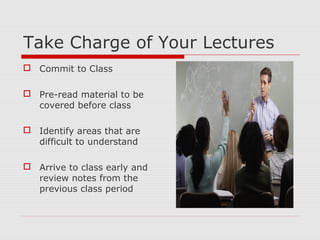
Take Charge of Your Lectures
 Commit to Class
 Pre-read material to be
covered before class
 Identify areas that are
difficult to understand
 Arrive to class early and
review notes from the
previous class period
CONCENTRATE
and focus on the material!!!
Beware of Distractions
 Talking
 Daydreaming & Doodling
 Worrying
Listen Critically
 Be Ready for the Message
 Listen to Main Concepts
 Listen for New Ideas
 Ask Questions
Connect and Capture Key Ideas
 Identify key words, themes and main points
 Relate Details to the Main Point
 Listen for Clues
 Note when a topic comes up more than once
 Transition words signal the change in topics or new key
points
“In contrast to”
“Let’s move on”
“This will be on the next exam”
“You will see this again”
This one for sure!This one for sure!
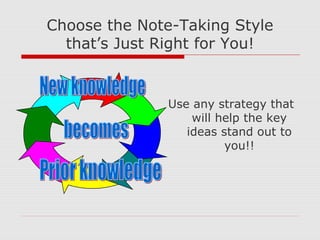
Choose the Note-Taking Style
that’s Just Right for You!
Use any strategy that
will help the key
ideas stand out to
you!!
Note-Taking Styles
 Outline Method
 The Cornell Method
 Paragraph (Summarizing) Method
 Fishbone Diagram (Listing) Method
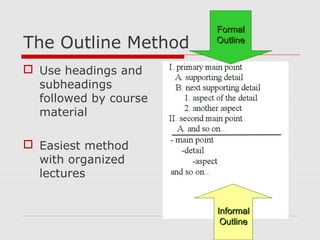
The Outline Method
 Use headings and
subheadings
followed by course
material
 Easiest method
with organized
lectures
FormalFormal
OutlineOutline
InformalInformal
OutlineOutline
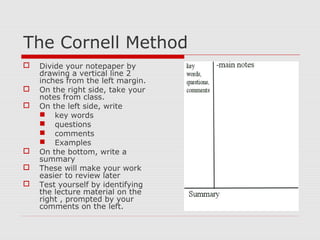
The Cornell Method
 Divide your notepaper by
drawing a vertical line 2
inches from the left margin.
 On the right side, take your
notes from class.
 On the left side, write
 key words
 questions
 comments
 Examples
 On the bottom, write a
summary
 These will make your work
easier to review later
 Test yourself by identifying
the lecture material on the
right , prompted by your
comments on the left.
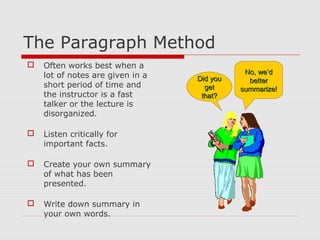
The Paragraph Method
 Often works best when a
lot of notes are given in a
short period of time and
the instructor is a fast
talker or the lecture is
disorganized.
 Listen critically for
important facts.
 Create your own summary
of what has been
presented.
 Write down summary in
your own words.
Did youDid you
getget
that?that?
No, we’dNo, we’d
betterbetter
summarize!summarize!
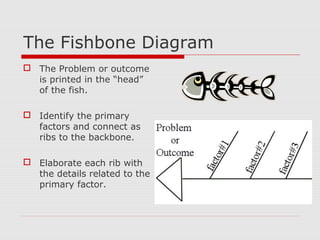
The Fishbone Diagram
 The Problem or outcome
is printed in the “head”
of the fish.
 Identify the primary
factors and connect as
ribs to the backbone.
 Elaborate each rib with
the details related to the
primary factor.
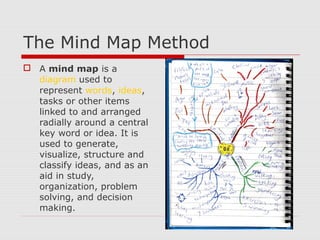
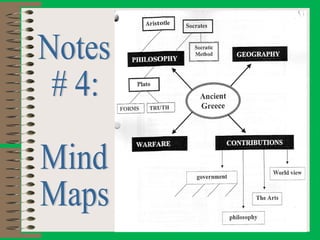
The Mind Map Method
 A mind map is a
diagram used to
represent words, ideas,
tasks or other items
linked to and arranged
radially around a central
key word or idea. It is
used to generate,
visualize, structure and
classify ideas, and as an
aid in study,
organization, problem
solving, and decision
making.
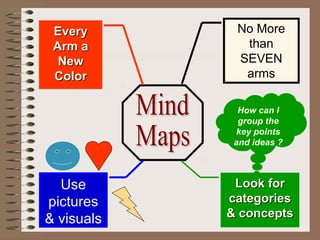
No More
than
SEVEN
arms
EveryEvery
Arm aArm a
NewNew
ColorColor
Use
pictures
& visuals
Look forLook for
categoriescategories
& concepts& concepts
How can I
group the
key points
and ideas ?
Other Note-Taking Tips
 Always date your notes!
 Paraphrase your notes!
 For Lectures with fast talkers, consider
writing in cursive or tape recording.
 Use Abbreviations!
 Be Organized!
 Evaluate your note-taking style strategy
regularly!
Note taking

Note taking

  • 1.
  • 2.
    Why take Notes? REMEMBER E XAMINE P REPARE O RGANIZE R EVIEW T HINK Writing is a great tool for learning!
  • 3.
    5 C’s ofNote-Taking  Take Charge of Your Lectures  Concentrate and Focus on the Material  Listen Critically  Connect and Capture Key Ideas
  • 4.
    Take Charge ofYour Lectures  Commit to Class  Pre-read material to be covered before class  Identify areas that are difficult to understand  Arrive to class early and review notes from the previous class period
  • 5.
    CONCENTRATE and focus onthe material!!! Beware of Distractions  Talking  Daydreaming & Doodling  Worrying
  • 6.
    Listen Critically  BeReady for the Message  Listen to Main Concepts  Listen for New Ideas  Ask Questions
  • 7.
    Connect and CaptureKey Ideas  Identify key words, themes and main points  Relate Details to the Main Point  Listen for Clues  Note when a topic comes up more than once  Transition words signal the change in topics or new key points “In contrast to” “Let’s move on” “This will be on the next exam” “You will see this again” This one for sure!This one for sure!
  • 8.
    Choose the Note-TakingStyle that’s Just Right for You! Use any strategy that will help the key ideas stand out to you!!
  • 9.
    Note-Taking Styles  OutlineMethod  The Cornell Method  Paragraph (Summarizing) Method  Fishbone Diagram (Listing) Method
  • 10.
    The Outline Method Use headings and subheadings followed by course material  Easiest method with organized lectures FormalFormal OutlineOutline InformalInformal OutlineOutline
  • 11.
    The Cornell Method Divide your notepaper by drawing a vertical line 2 inches from the left margin.  On the right side, take your notes from class.  On the left side, write  key words  questions  comments  Examples  On the bottom, write a summary  These will make your work easier to review later  Test yourself by identifying the lecture material on the right , prompted by your comments on the left.
  • 12.
    The Paragraph Method Often works best when a lot of notes are given in a short period of time and the instructor is a fast talker or the lecture is disorganized.  Listen critically for important facts.  Create your own summary of what has been presented.  Write down summary in your own words. Did youDid you getget that?that? No, we’dNo, we’d betterbetter summarize!summarize!
  • 13.
    The Fishbone Diagram The Problem or outcome is printed in the “head” of the fish.  Identify the primary factors and connect as ribs to the backbone.  Elaborate each rib with the details related to the primary factor.
  • 14.
    The Mind MapMethod  A mind map is a diagram used to represent words, ideas, tasks or other items linked to and arranged radially around a central key word or idea. It is used to generate, visualize, structure and classify ideas, and as an aid in study, organization, problem solving, and decision making.
  • 16.
    No More than SEVEN arms EveryEvery Arm aArma NewNew ColorColor Use pictures & visuals Look forLook for categoriescategories & concepts& concepts How can I group the key points and ideas ?
  • 17.
    Other Note-Taking Tips Always date your notes!  Paraphrase your notes!  For Lectures with fast talkers, consider writing in cursive or tape recording.  Use Abbreviations!  Be Organized!  Evaluate your note-taking style strategy regularly!