 Introduction
 History
 Structure   of insulin
 Biosynthesis
 Transport and catabolism
 Degradation
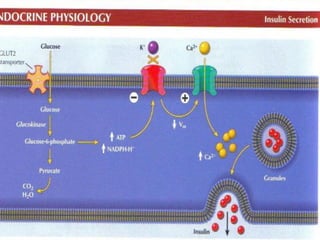
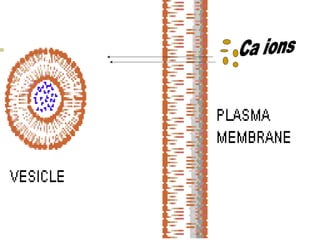
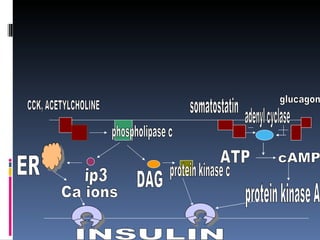
 Release of insulin
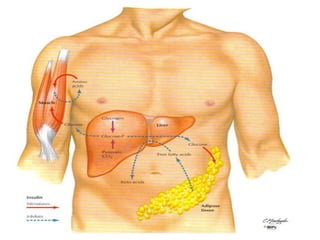
 Effects of insulin
 Clinical coorelations
INTRODUCTION
Insulin
   > protein hormone
   > by islets of langerhans
   > pancreas
Anabolic hormone
   > growth & development
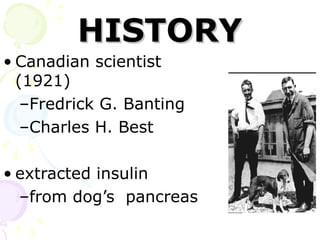
HISTORY
• Canadian scientist
  (1921)
   –Fredrick G. Banting
   –Charles H. Best

• extracted insulin
  –from dog’s pancreas
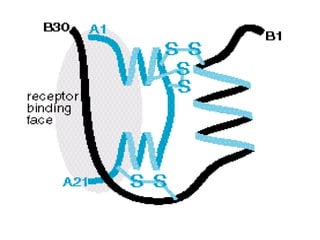
STRUCTURE OF INSULIN
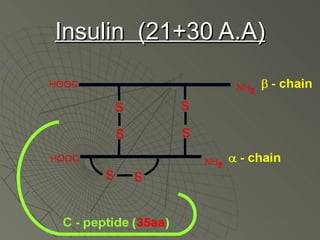
• Insulin
   – Polypeptide hormone
   – 51 amino acids
   – Two chains
      • A chain 21 a.a.
      • B chain 30 a.a.
• Held by interchange disulfide
  bridges
BIOSYNTHESIS OF
     INSULIN
   Synthesis of Preproinsulin.

   Conversion of preproinsulin to
    proinsulin.

   Conversion of proinsulin to insulin.
GENETICS OF INSULIN SYNTHESIS


   The proinsulin precursor of
    insulin is encoded by the INS
    gene
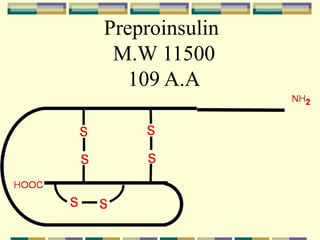
Preproinsulin
 M.W 11500
   109 A.A
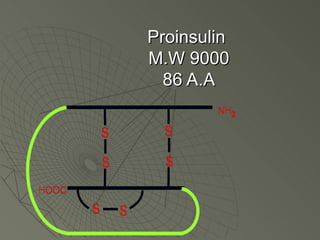
Proinsulin
M.W 9000
  86 A.A
Insulin (21+30 A.A)
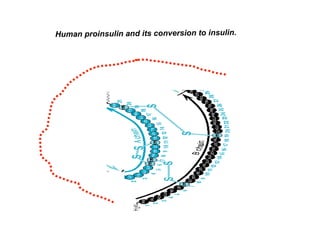
Human proinsulin and its conversion to insulin.
CATABOLISM OF
    INSULIN
 Half life: 3-5 minutes
 Major organs of degradation
       > Liver.
       >Kidney.
       >Placenta.
 50% of insulin removed in a single pass through
  liver. 
MECHANISM :
 Insulin specific protease.
 Glutathione insulin transhydrogenase (Insulinase
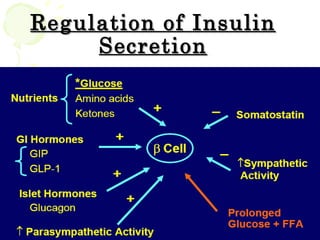
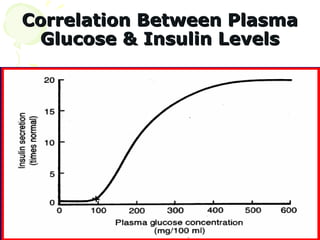
Regulation of Insulin
     Secretion
Correlation Between Plasma
 Glucose & Insulin Levels
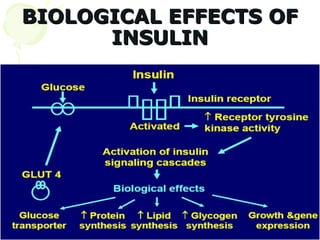
BIOLOGICAL EFFECTS OF
      INSULIN
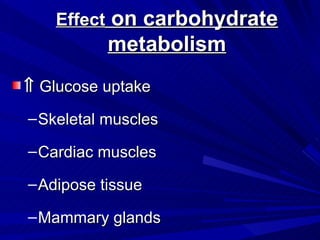
Effect on carbohydrate
           metabolism
⇑ Glucose uptake
– Skeletal muscles

– Cardiac muscles

– Adipose tissue

– Mammary glands
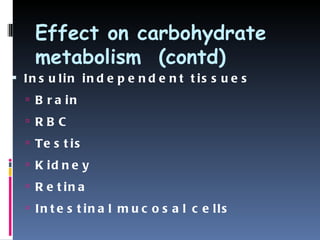
Effect on carbohydrate
    metabolism (contd)
 In s u lin in d e p e n d e n t t is s u e s
   B r a in

   RB C

   Te s t i s

   K id n e y

   R e t in a

   In t e s t in a l m u c o s a l c e lls
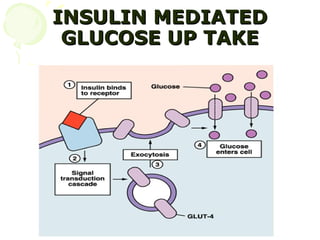
INSULIN MEDIATED
 GLUCOSE UP TAKE
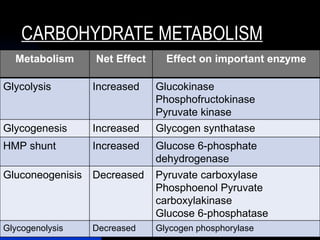
CARBOHYDRATE METABOLISM
  Metabolism      Net Effect     Effect on important enzyme

Glycolysis        Increased    Glucokinase
                               Phosphofructokinase
                               Pyruvate kinase
Glycogenesis      Increased    Glycogen synthatase
HMP shunt         Increased    Glucose 6-phosphate
                               dehydrogenase
Gluconeogenisis   Decreased    Pyruvate carboxylase
                               Phosphoenol Pyruvate
                               carboxylakinase
                               Glucose 6-phosphatase
Glycogenolysis    Decreased    Glycogen phosphorylase
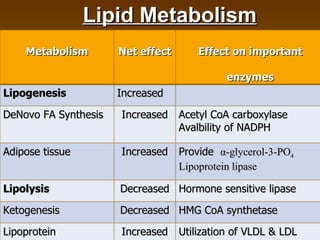
Lipid Metabolism
    Metabolism        Net effect     Effect on important

                                          enzymes
Lipogenesis           Increased

DeNovo FA Synthesis   Increased Acetyl CoA carboxylase
                                Avalbility of NADPH

Adipose tissue        Increased Provide α-glycerol-3-PO4
                                Lipoprotein lipase

Lipolysis             Decreased Hormone sensitive lipase

Ketogenesis           Decreased HMG CoA synthetase

Lipoprotein           Increased Utilization of VLDL & LDL
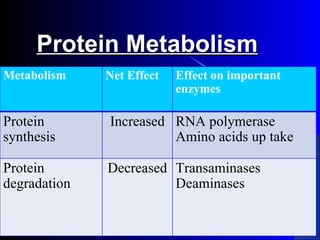
Protein Metabolism
Metabolism    Net Effect   Effect on important
                           enzymes

Protein       Increased RNA polymerase
synthesis               Amino acids up take

Protein       Decreased Transaminases
degradation             Deaminases
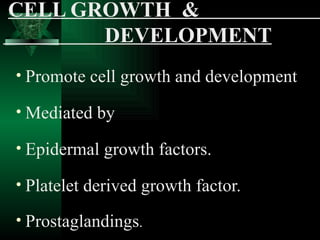
CELL GROWTH &
       DEVELOPMENT
• Promote cell growth and development

• Mediated by

• Epidermal growth factors.

• Platelet derived growth factor.

• Prostaglandings.
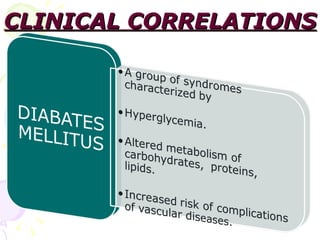
CLINICAL CORRELATIONS
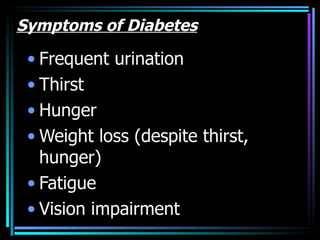
Symptoms of Diabetes

 • Frequent urination
 • Thirst
 • Hunger
 • Weight loss (despite thirst,
   hunger)
 • Fatigue
 • Vision impairment
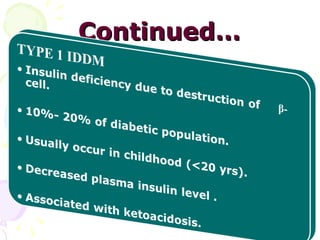
Continued…
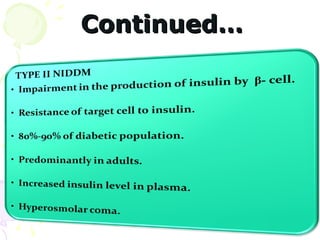
Continued…
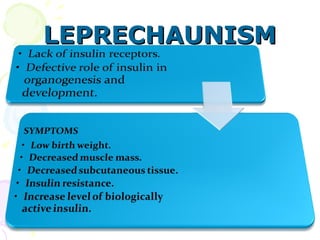
LEPRECHAUNISM
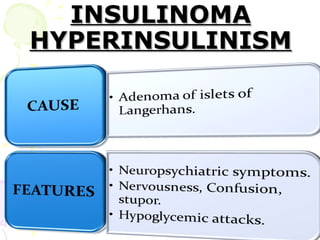
INSULINOMA
HYPERINSULINISM
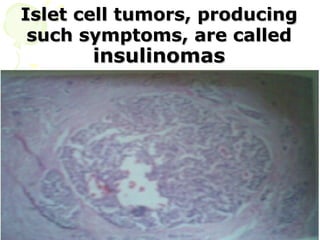
Islet cell tumors, producing
 such symptoms, are called
       insulinomas
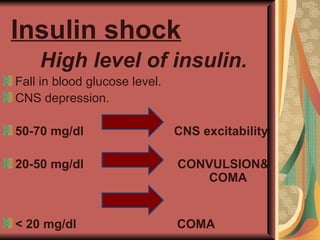
Insulin shock
    High level of insulin.
Fall in blood glucose level.
CNS depression.

50-70 mg/dl                    CNS excitability

20-50 mg/dl                    CONVULSION&
                                  COMA


< 20 mg/dl                     COMA
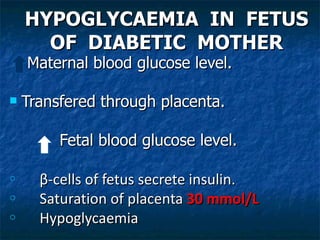
HYPOGLYCAEMIA IN FETUS
      OF DIABETIC MOTHER
    Maternal blood glucose level.

   Transfered through placenta.

         Fetal blood glucose level.

o     β-cells of fetus secrete insulin.
o     Saturation of placenta 30 mmol/L
o     Hypoglycaemia
REFERENCES
• Lectures on “Endocrinology” by C.J.Baired
  MD/PhD
• www.dtu.ox.ac.uk/4-T
• Lectures on “Signaling Through Insulin
  Receptors” by Oksana Matveinko
• Wikipedia
• Arthur C.Guyton, John E.Hall, “Textbook Of
  Medical Physiology” 11th edition Ch: 78
  Page:961-970
• Lectures By MA Hussain & ND Theise “ Stem-Cell
  Therapy For Diabetes Mellitus”
Contd.

• Robert K.Murray, Daryl K.Granner, Victor
  W.Rodwell, “Harper’s Illustrated Biochemistry” 27TH
  edition Ch:41 Page: 457
• John T.Hensen, Bruce M.Koeppen, “Netter’s Atlas
  Of Physiology” 5th edition Ch:8 Fig. 8.19,8.20
• Robert B.Dunn “Kaplan Medical Physiology USMLE
  Step 1 Lecture Notes” Section:9 Ch: 5 Page:
  407-413
• Insulin by Dr. Dana Armstrong and
  Dr. Allen Bennett King
Acknowledgements
• Almighty Allah for giving me
    audacity for my each step to its triumphant
                                     completion
 My Parents
 Head of Biochemistry Department
   Dr. Shafqat Nazir
   All teachers of biochemistry department
   My Friends
   Library staff
   Projectionist
43