INSULIN AND
ANTIDIABETIC DRUGS
BY
DR VISHAL KR KANDHWAY
JNMC, SAWANGI (MEGHE), WARDHA
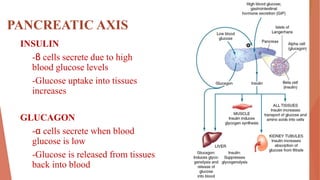
PANCREATIC AXIS
INSULIN
-β cells secrete due to high
blood glucose levels
-Glucose uptake into tissues
increases
GLUCAGON
-α cells secrete when blood
glucose is low
-Glucose is released from tissues
back into blood
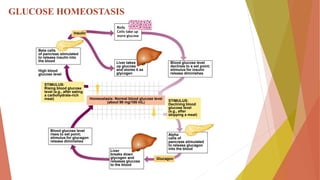
GLUCOSE HOMEOSTASIS
Body
Cells take up
more glucose
Liver takes
up glucose
and stores it as
glycogen
Blood glucose level
declines to a set point;
stimulus for insulin
release diminishes
Homeostasis: Normal blood glucose level
(about 90 mg/100 mL)
STIMULUS:
Rising blood glucose
level (e.g., after eating
a carbohydrate-rich
meal)
Beta cells
of pancreas stimulated
to release insulin into
the blood
High blood
glucose level
Blood glucose level
rises to set point;
stimulus for glucagon
release diminishes
Liver
breaks down
glycogen and
releases glucose
to the blood
Glucagon
Alpha
cells of
pancreas stimulated
to release glucagon
into the blood
STIMULUS:
Declining blood
glucose level
(e.g., after
skipping a meal)
Insulin
NORMAL GLUCOSE CONTROL
 Post-absorptive period - normal individual-low basal levels of
circulating insulin maintained through constant β cell secretion-
suppression of lipolysis, proteolysis and glycogenolysis.
 After ingesting a meal-burst of insulin secretion in response to
elevated glucose and amino acid levels.
 When glucose levels return to basal levels- insulin secretion
returns to its basal level.
DIABETES MELLITUS
-Definition- Diabetes is a heterogeneous group of syndromes
characterized by the elevation of glucose levels due to a relative
or absolute deficiency of insulin.
-It is characterized by-
1. High level of glucose in urine and fasting blood
2. Polyuria
3. Polydypsia
4. Fatigue
5. Constant hunger
TYPES
 Type 1 DM:
- “Childhood” diabetes (sudden onset, before age 15)
- Lack of functional pancreatic β-cells (T cell-mediated autoimmune response
destroys beta cells)
- Lack of functional β-cells prevents mitigation of elevated glucose levels and
associated insulin responses.
- Controlled by insulin injections.
 Type 2 DM:
- “Adult” diabetes (after age 40, obese individuals)
- Insulin levels are normal or elevated but there is either a decrease in number of
insulin receptors or the cells cannot take it up.
- Actual insulin levels may be normal or supra-normal but it is ineffective
(insulin resistance).
- Controlled by dietary changes and regular exercise.
TREATMENT
 Type I DM :
- Depend on exogenous insulin to prevent hyperglycemia and avoid
ketoacidosis.
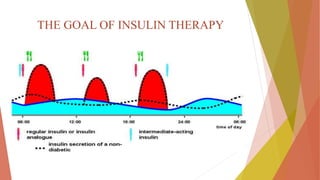
- The goal of therapy is to mimic both the basal and reactive secretion of insulin
in response to glucose levels avoiding both hyper- and hypo-glycemic
episodes.
 Type II DM:
- The goal of treatment is to maintain glucose concentrations within normal
limits to prevent long term complications.
- Weight reduction, exercise and dietary modification decrease insulin resistance
- essential steps in the treatment regimen.
- Addition of hypoglycemic agents is often required, often insulin therapy is
also required.
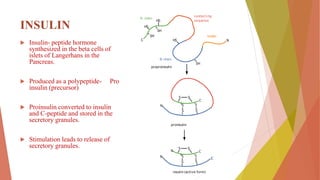
INSULIN
 Insulin- peptide hormone
synthesized in the beta cells of
islets of Langerhans in the
Pancreas.
 Produced as a polypeptide- Pro
insulin (precursor)
 Proinsulin converted to insulin
and C-peptide and stored in the
secretory granules.
 Stimulation leads to release of
secretory granules.
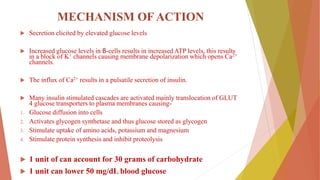
MECHANISM OF ACTION
 Secretion elicited by elevated glucose levels
 Increased glucose levels in β-cells results in increased ATP levels, this results
in a block of K+ channels causing membrane depolarization which opens Ca2+
channels.
 The influx of Ca2+ results in a pulsatile secretion of insulin.
 Many insulin stimulated cascades are activated mainly translocation of GLUT
4 glucose transporters to plasma membranes causing-
1. Glucose diffusion into cells
2. Activates glycogen synthetase and thus glucose stored as glycogen
3. Stimulate uptake of amino acids, potassium and magnesium
4. Stimulate protein synthesis and inhibit proteolysis
 1 unit of can account for 30 grams of carbohydrate
 1 unit can lower 50 mg/dL blood glucose
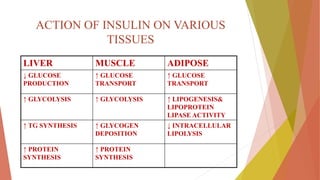
ACTION OF INSULIN ON VARIOUS
TISSUES
LIVER MUSCLE ADIPOSE
↓ GLUCOSE
PRODUCTION
↑ GLUCOSE
TRANSPORT
↑ GLUCOSE
TRANSPORT
↑ GLYCOLYSIS ↑ GLYCOLYSIS ↑ LIPOGENESIS&
LIPOPROTEIN
LIPASE ACTIVITY
↑ TG SYNTHESIS ↑ GLYCOGEN
DEPOSITION
↓ INTRACELLULAR
LIPOLYSIS
↑ PROTEIN
SYNTHESIS
↑ PROTEIN
SYNTHESIS
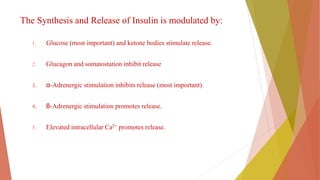
The Synthesis and Release of Insulin is modulated by:
1. Glucose (most important) and ketone bodies stimulate release.
2. Glucagon and somatostation inhibit release
3. α-Adrenergic stimulation inhibits release (most important).
4. β-Adrenergic stimulation promotes release.
5. Elevated intracellular Ca2+ promotes release.
PHARMACOKINETICS
 Elimination t ½ of IV insulin- 5 to 10 minutes
 Metabolized by kidneys and liver
 Insulin tightly bound to tissue receptors- so even though rapid clearance,
pharmacologic effects remain till 30-60 minutes.
 Insulin secreted into portal venous system at rate of 1 unit/hour
 Daily secretion of insulin is 40 units.
 Insulin response to glucose is greater for oral ingestion than for iv infusion.
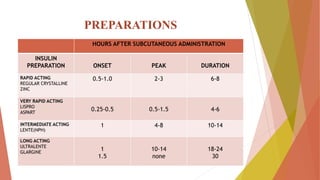
PREPARATIONS
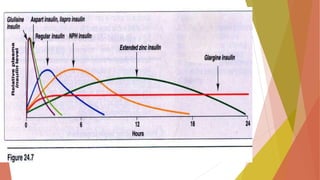
HOURS AFTER SUBCUTANEOUS ADMINISTRATION
INSULIN
PREPARATION ONSET PEAK DURATION
RAPID ACTING
REGULAR CRYSTALLINE
ZINC
0.5-1.0 2-3 6-8
VERY RAPID ACTING
LISPRO
ASPART
0.25-0.5 0.5-1.5 4-6
INTERMEDIATE ACTING
LENTE(NPH)
1 4-8 10-14
LONG ACTING
ULTRALENTE
GLARGINE
1
1.5
10-14
none
18-24
30
THE GOAL OF INSULIN THERAPY
PREPARATIONS
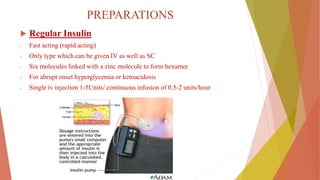
 Regular Insulin
- Fast acting (rapid acting)
- Only type which can be given IV as well as SC
- Six molecules linked with a zinc molecule to form hexamer
- For abrupt onset hyperglycemia or ketoacidosis
- Single iv injection 1-5Units/ continuous infusion of 0.5-2 units/hour
 VERY RAPID ACTING- LISPRO/ INSULIN ASPART/ GLULISINE-
(ultrashort acting)
- More rapid than regular insulin and shorter duration
- Less Associated hypoglycemia but recurrent hyperglycemia before next meal due
to shorter duration of action.
- Given just 15 minutes prior to meals
- Provides a postprandial plasma insulin concentration like normal insulin.
 INTERMEDIATE ACTING- LENTE (NPH)
- Absorption delayed due to conjugation with protamine(0.005mg/unit)
 LONG ACTING- ULTRALENTE, GLARGINE
- Given as single bedtime injection
- Lesser nocturnal hypoglycemia
ADVERSE EFFECTS OF INSULIN
 Hypoglycemia
 Allergic reactions
 Lipodystrophy
 Insulin resistance
 Hypokalemia
 Weight gain
ORAL HYPOGLYCEMICS
 These agents are useful in the treatment of Type 2 DM who do not respond
adequately to non-medical interventions (diet, exercise and weight loss).
 Newly diagnosed Type 2 DM (less than 5 years) often respond well to oral
agents
 Patients with long standing disease (often diagnosed late) require a
combination of agents with or without insulin.
 The progressive decline in β-cell function often necessitates the addition of
insulin at some time in Type II DM. Oral agents are never indicated for Type I
DM.
SULFONYLUREAS
 Promote the release of insulin from β-cells (secretogogues)
 Mechanism of action:
 These agents require functioning β-cells, they stimulate release by blocking
ATP-sensitive K+ channels resulting in depolarization with Ca2+ influx
which promotes insulin secretion.
 They also reduce glucagon secretion and increase the binding of insulin to
target tissues.
 They may also increase the number of insulin receptors
-Adverse Effects: Weight gain, Hyperinsulinemia and Hypoglycemia. Hepatic or
renal insufficiency causes accumulation of these agents promoting the risk of
hypoglycemia.
 Tolbutamide is asociated with a 2.5 times rise in cardiovascular mortality.
Onset and Duration
 Short acting: Tolbutamide
 Intermediate acting: Glipizide ,Glyburide
 Long acting: Chloropropamide, Glimepride
MEGLITINIDES
 Agents -Repaglinide and Nateglinide act as Secretogogues.
 Prompt peak effect (1 hour) and shorter duration of action (about 4 hours)
 Taken 15-30 mins before meals
 Decreases risk of prolonged hypoglycemia due to short duration of action.
 When used in combination with other oral agents they produce better control
than any monotherapy.
BIGUANIDES
 METFORMIN
- Classified as an insulin sensitizer- increases glucose uptake and utilization by target
tissues
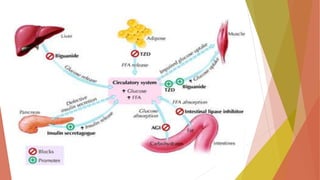
- Mechanism of action : Reduces plasma glucose levels by inhibiting hepatic
gluconeogenesis.
- It also reduces hyperlipidemia (↓LDL and VLDL cholesterol and ↑ HDL). Lipid
lowering requires 4-6 weeks of treatment.
- Metformin also decreases appetite.
- It is the only oral hypoglycemic shown to reduce cardiovascular mortality.
- Adverse effects: Hypoglycemia occurs only when combined with other agents.
Rarely severe lactic acidosis is associated with metformin use particularly in
diabetics with CHF. Drug interactions with cimetidine, furosemide, nifedipine and
others have been identified.
THIAZOLIDINEDIONES (GLITAZONES)
 PIOGLITAZONE and ROSIGLITAZONE
 These agents are insulin sensitizers
 They do not promote insulin secretion from β-cells but insulin is necessary for
them to be effective
 Act principally at adipose tissue and skeletal muscles to decrease insulin
resistance
 Clinical effect takes 4-12 weeks to be evident
 SIDE EFFECTS- Weight gain, can induce hepatic dysfunction
ΑLPHA-GLUCOSIDASE INHIBITORS
 Acarbose and miglitol are two agents of this class used for type 2 diabetes
Mechanism of action: These agents are oligosaccharide derivatives taken at the
beginning of a meal ; delay carbohydrate digestion by competitively inhibiting
α-glucosidase, a membrane bound enzyme of the intestinal brush border.
Adverse Effects: Flatulence, diarrhea, cramping.
Metformin bioavailability is severely decreased when used concomitantly.
These agents should not be used in diabetics with intestinal pathology.
REFERENCES
 Stoelting’s pharmacology and physiology in anaesthetic
practice

Insulin and antidiabetics

  • 1.
    INSULIN AND ANTIDIABETIC DRUGS BY DRVISHAL KR KANDHWAY JNMC, SAWANGI (MEGHE), WARDHA
  • 2.
    PANCREATIC AXIS INSULIN -β cellssecrete due to high blood glucose levels -Glucose uptake into tissues increases GLUCAGON -α cells secrete when blood glucose is low -Glucose is released from tissues back into blood
  • 3.
    GLUCOSE HOMEOSTASIS Body Cells takeup more glucose Liver takes up glucose and stores it as glycogen Blood glucose level declines to a set point; stimulus for insulin release diminishes Homeostasis: Normal blood glucose level (about 90 mg/100 mL) STIMULUS: Rising blood glucose level (e.g., after eating a carbohydrate-rich meal) Beta cells of pancreas stimulated to release insulin into the blood High blood glucose level Blood glucose level rises to set point; stimulus for glucagon release diminishes Liver breaks down glycogen and releases glucose to the blood Glucagon Alpha cells of pancreas stimulated to release glucagon into the blood STIMULUS: Declining blood glucose level (e.g., after skipping a meal) Insulin
  • 4.
    NORMAL GLUCOSE CONTROL Post-absorptive period - normal individual-low basal levels of circulating insulin maintained through constant β cell secretion- suppression of lipolysis, proteolysis and glycogenolysis.  After ingesting a meal-burst of insulin secretion in response to elevated glucose and amino acid levels.  When glucose levels return to basal levels- insulin secretion returns to its basal level.
  • 5.
    DIABETES MELLITUS -Definition- Diabetesis a heterogeneous group of syndromes characterized by the elevation of glucose levels due to a relative or absolute deficiency of insulin. -It is characterized by- 1. High level of glucose in urine and fasting blood 2. Polyuria 3. Polydypsia 4. Fatigue 5. Constant hunger
  • 6.
    TYPES  Type 1DM: - “Childhood” diabetes (sudden onset, before age 15) - Lack of functional pancreatic β-cells (T cell-mediated autoimmune response destroys beta cells) - Lack of functional β-cells prevents mitigation of elevated glucose levels and associated insulin responses. - Controlled by insulin injections.  Type 2 DM: - “Adult” diabetes (after age 40, obese individuals) - Insulin levels are normal or elevated but there is either a decrease in number of insulin receptors or the cells cannot take it up. - Actual insulin levels may be normal or supra-normal but it is ineffective (insulin resistance). - Controlled by dietary changes and regular exercise.
  • 7.
    TREATMENT  Type IDM : - Depend on exogenous insulin to prevent hyperglycemia and avoid ketoacidosis. - The goal of therapy is to mimic both the basal and reactive secretion of insulin in response to glucose levels avoiding both hyper- and hypo-glycemic episodes.  Type II DM: - The goal of treatment is to maintain glucose concentrations within normal limits to prevent long term complications. - Weight reduction, exercise and dietary modification decrease insulin resistance - essential steps in the treatment regimen. - Addition of hypoglycemic agents is often required, often insulin therapy is also required.
  • 8.
    INSULIN  Insulin- peptidehormone synthesized in the beta cells of islets of Langerhans in the Pancreas.  Produced as a polypeptide- Pro insulin (precursor)  Proinsulin converted to insulin and C-peptide and stored in the secretory granules.  Stimulation leads to release of secretory granules.
  • 9.
    MECHANISM OF ACTION Secretion elicited by elevated glucose levels  Increased glucose levels in β-cells results in increased ATP levels, this results in a block of K+ channels causing membrane depolarization which opens Ca2+ channels.  The influx of Ca2+ results in a pulsatile secretion of insulin.  Many insulin stimulated cascades are activated mainly translocation of GLUT 4 glucose transporters to plasma membranes causing- 1. Glucose diffusion into cells 2. Activates glycogen synthetase and thus glucose stored as glycogen 3. Stimulate uptake of amino acids, potassium and magnesium 4. Stimulate protein synthesis and inhibit proteolysis  1 unit of can account for 30 grams of carbohydrate  1 unit can lower 50 mg/dL blood glucose
  • 10.
    ACTION OF INSULINON VARIOUS TISSUES LIVER MUSCLE ADIPOSE ↓ GLUCOSE PRODUCTION ↑ GLUCOSE TRANSPORT ↑ GLUCOSE TRANSPORT ↑ GLYCOLYSIS ↑ GLYCOLYSIS ↑ LIPOGENESIS& LIPOPROTEIN LIPASE ACTIVITY ↑ TG SYNTHESIS ↑ GLYCOGEN DEPOSITION ↓ INTRACELLULAR LIPOLYSIS ↑ PROTEIN SYNTHESIS ↑ PROTEIN SYNTHESIS
  • 11.
    The Synthesis andRelease of Insulin is modulated by: 1. Glucose (most important) and ketone bodies stimulate release. 2. Glucagon and somatostation inhibit release 3. α-Adrenergic stimulation inhibits release (most important). 4. β-Adrenergic stimulation promotes release. 5. Elevated intracellular Ca2+ promotes release.
  • 12.
    PHARMACOKINETICS  Elimination t½ of IV insulin- 5 to 10 minutes  Metabolized by kidneys and liver  Insulin tightly bound to tissue receptors- so even though rapid clearance, pharmacologic effects remain till 30-60 minutes.  Insulin secreted into portal venous system at rate of 1 unit/hour  Daily secretion of insulin is 40 units.  Insulin response to glucose is greater for oral ingestion than for iv infusion.
  • 13.
    PREPARATIONS HOURS AFTER SUBCUTANEOUSADMINISTRATION INSULIN PREPARATION ONSET PEAK DURATION RAPID ACTING REGULAR CRYSTALLINE ZINC 0.5-1.0 2-3 6-8 VERY RAPID ACTING LISPRO ASPART 0.25-0.5 0.5-1.5 4-6 INTERMEDIATE ACTING LENTE(NPH) 1 4-8 10-14 LONG ACTING ULTRALENTE GLARGINE 1 1.5 10-14 none 18-24 30
  • 14.
    THE GOAL OFINSULIN THERAPY
  • 15.
    PREPARATIONS  Regular Insulin -Fast acting (rapid acting) - Only type which can be given IV as well as SC - Six molecules linked with a zinc molecule to form hexamer - For abrupt onset hyperglycemia or ketoacidosis - Single iv injection 1-5Units/ continuous infusion of 0.5-2 units/hour
  • 16.
     VERY RAPIDACTING- LISPRO/ INSULIN ASPART/ GLULISINE- (ultrashort acting) - More rapid than regular insulin and shorter duration - Less Associated hypoglycemia but recurrent hyperglycemia before next meal due to shorter duration of action. - Given just 15 minutes prior to meals - Provides a postprandial plasma insulin concentration like normal insulin.  INTERMEDIATE ACTING- LENTE (NPH) - Absorption delayed due to conjugation with protamine(0.005mg/unit)  LONG ACTING- ULTRALENTE, GLARGINE - Given as single bedtime injection - Lesser nocturnal hypoglycemia
  • 18.
    ADVERSE EFFECTS OFINSULIN  Hypoglycemia  Allergic reactions  Lipodystrophy  Insulin resistance  Hypokalemia  Weight gain
  • 19.
    ORAL HYPOGLYCEMICS  Theseagents are useful in the treatment of Type 2 DM who do not respond adequately to non-medical interventions (diet, exercise and weight loss).  Newly diagnosed Type 2 DM (less than 5 years) often respond well to oral agents  Patients with long standing disease (often diagnosed late) require a combination of agents with or without insulin.  The progressive decline in β-cell function often necessitates the addition of insulin at some time in Type II DM. Oral agents are never indicated for Type I DM.
  • 20.
    SULFONYLUREAS  Promote therelease of insulin from β-cells (secretogogues)  Mechanism of action:  These agents require functioning β-cells, they stimulate release by blocking ATP-sensitive K+ channels resulting in depolarization with Ca2+ influx which promotes insulin secretion.  They also reduce glucagon secretion and increase the binding of insulin to target tissues.  They may also increase the number of insulin receptors -Adverse Effects: Weight gain, Hyperinsulinemia and Hypoglycemia. Hepatic or renal insufficiency causes accumulation of these agents promoting the risk of hypoglycemia.  Tolbutamide is asociated with a 2.5 times rise in cardiovascular mortality.
  • 21.
    Onset and Duration Short acting: Tolbutamide  Intermediate acting: Glipizide ,Glyburide  Long acting: Chloropropamide, Glimepride
  • 22.
    MEGLITINIDES  Agents -Repaglinideand Nateglinide act as Secretogogues.  Prompt peak effect (1 hour) and shorter duration of action (about 4 hours)  Taken 15-30 mins before meals  Decreases risk of prolonged hypoglycemia due to short duration of action.  When used in combination with other oral agents they produce better control than any monotherapy.
  • 23.
    BIGUANIDES  METFORMIN - Classifiedas an insulin sensitizer- increases glucose uptake and utilization by target tissues - Mechanism of action : Reduces plasma glucose levels by inhibiting hepatic gluconeogenesis. - It also reduces hyperlipidemia (↓LDL and VLDL cholesterol and ↑ HDL). Lipid lowering requires 4-6 weeks of treatment. - Metformin also decreases appetite. - It is the only oral hypoglycemic shown to reduce cardiovascular mortality. - Adverse effects: Hypoglycemia occurs only when combined with other agents. Rarely severe lactic acidosis is associated with metformin use particularly in diabetics with CHF. Drug interactions with cimetidine, furosemide, nifedipine and others have been identified.
  • 24.
    THIAZOLIDINEDIONES (GLITAZONES)  PIOGLITAZONEand ROSIGLITAZONE  These agents are insulin sensitizers  They do not promote insulin secretion from β-cells but insulin is necessary for them to be effective  Act principally at adipose tissue and skeletal muscles to decrease insulin resistance  Clinical effect takes 4-12 weeks to be evident  SIDE EFFECTS- Weight gain, can induce hepatic dysfunction
  • 25.
    ΑLPHA-GLUCOSIDASE INHIBITORS  Acarboseand miglitol are two agents of this class used for type 2 diabetes Mechanism of action: These agents are oligosaccharide derivatives taken at the beginning of a meal ; delay carbohydrate digestion by competitively inhibiting α-glucosidase, a membrane bound enzyme of the intestinal brush border. Adverse Effects: Flatulence, diarrhea, cramping. Metformin bioavailability is severely decreased when used concomitantly. These agents should not be used in diabetics with intestinal pathology.
  • 27.
    REFERENCES  Stoelting’s pharmacologyand physiology in anaesthetic practice