INSULIN
ANALOGUES

Dr Divya Krishnan
Calicut medical
college
CONTENTS
Introduction
 Classification
 Rationale for development
 Individual analogues
Special features
 Merits of analogues over standard insulins
 Drawbacks of analogues
 Popular regimes using analogues
 Novel delivery systems using analogues
 Summary

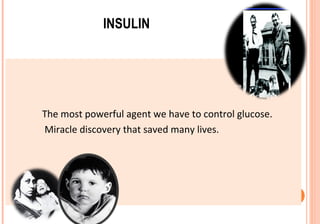
INSULIN

The most powerful agent we have to control glucose.
Miracle discovery that saved many lives.
ANALOGUES……………..
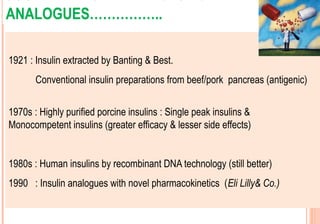
1921 : Insulin extracted by Banting & Best.
Conventional insulin preparations from beef/pork pancreas (antigenic)
1970s : Highly purified porcine insulins : Single peak insulins &
Monocompetent insulins (greater efficacy & lesser side effects)

1980s : Human insulins by recombinant DNA technology (still better)
1990 : Insulin analogues with novel pharmacokinetics (Eli Lilly& Co.)
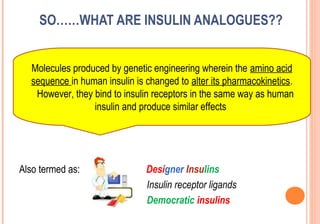
SO……WHAT ARE INSULIN ANALOGUES??
Molecules produced by genetic engineering wherein the amino acid
sequence in human insulin is changed to alter its pharmacokinetics.
However, they bind to insulin receptors in the same way as human
insulin and produce similar effects

Also termed as:

Designer Insulins
Insulin receptor ligands
Democratic insulins
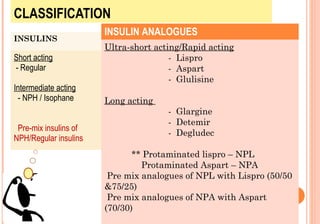
CLASSIFICATION
INSULINS

Short acting
- Regular
Intermediate acting
- NPH / Isophane
Pre-mix insulins of
NPH/Regular insulins

INSULIN ANALOGUES
Ultra-short acting/Rapid acting
- Lispro
- Aspart
- Glulisine
Long acting
- Glargine
- Detemir
- Degludec
** Protaminated lispro – NPL
Protaminated Aspart – NPA
Pre mix analogues of NPL with Lispro (50/50
&75/25)
Pre mix analogues of NPA with Aspart
(70/30)
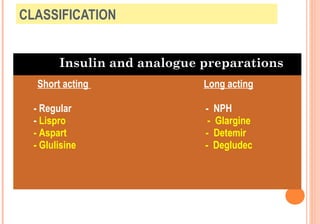
CLASSIFICATION
Insulin and analogue preparations
Short acting
- Regular
- Lispro
- Aspart
- Glulisine

Long acting
- NPH
- Glargine
- Detemir
- Degludec
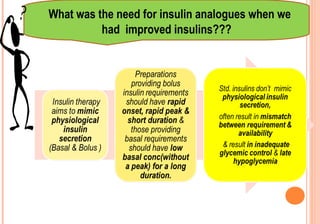
What was the need for insulin analogues when we
had improved insulins???
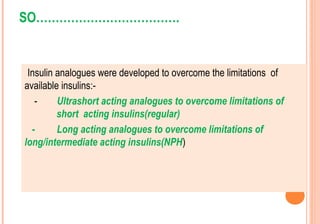
SO……………………………….

Insulin analogues were developed to overcome the limitations of
available insulins:Ultrashort acting analogues to overcome limitations of
short acting insulins(regular)
Long acting analogues to overcome limitations of
long/intermediate acting insulins(NPH)
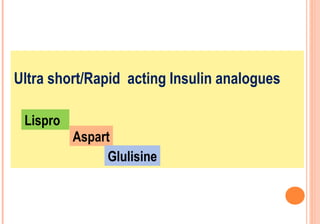
Ultra short/Rapid acting Insulin analogues
Lispro
Aspart
Glulisine
LIMITATIONS OF REGULAR
INSULINS


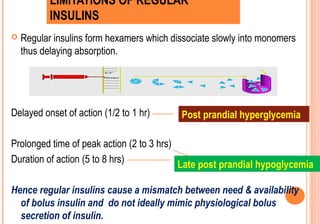
Regular insulins form hexamers which dissociate slowly into monomers
thus delaying absorption.

Delayed onset of action (1/2 to 1 hr)

Post prandial hyperglycemia

Prolonged time of peak action (2 to 3 hrs)
Duration of action (5 to 8 hrs)
Late post prandial hypoglycemia
Hence regular insulins cause a mismatch between need & availability
of bolus insulin and do not ideally mimic physiological bolus
secretion of insulin.
OTHER LIMITATIONS OF REGULAR
INSULINS


Regular insulin has to be administered 30-45mins before meal - dose of
insulin cannot be adjusted according to size of meals.



Time of onset, peak action & duration of action is dose dependent
(increases with dose)



Absorption varies with injection site & exercise (variability of absorption
as much as 25%)
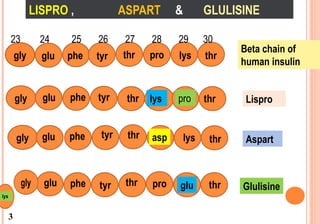
LISPRO ,
23

24

gly

glu

ASPART

25

26

phe

tyr

27
thr

&

GLULISINE

28
pro

29

30

lys

thr

lys

pro

asp

phe
lys

3

Beta chain of
human insulin
Lispro

Aspart

glu

Glulisine
ANALOGUES


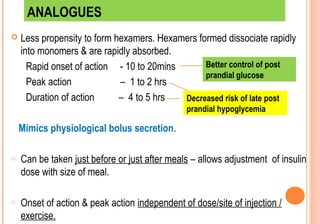
Less propensity to form hexamers. Hexamers formed dissociate rapidly
into monomers & are rapidly absorbed.
Better control of post
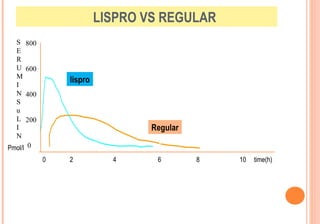
Rapid onset of action - 10 to 20mins
prandial glucose
Peak action
– 1 to 2 hrs
Duration of action
– 4 to 5 hrs
Decreased risk of late post
prandial hypoglycemia

Mimics physiological bolus secretion.
o

Can be taken just before or just after meals – allows adjustment of insulin
dose with size of meal.

o

Onset of action & peak action independent of dose/site of injection /
exercise.
LISPRO VS REGULAR
S
E
R
U
M
I
N
S
u
L
I
N

800

600

lispro
400

200

Regular

Pmol/l 0
0

2

4

6

8

10

time(h)
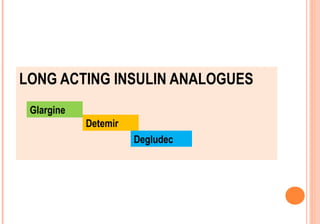
LONG ACTING INSULIN ANALOGUES
Glargine
Detemir
Degludec
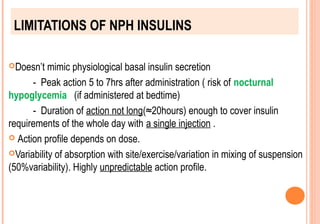
LIMITATIONS OF NPH INSULINS
Doesn’t

mimic physiological basal insulin secretion
- Peak action 5 to 7hrs after administration ( risk of nocturnal
hypoglycemia (if administered at bedtime)
- Duration of action not long(≈20hours) enough to cover insulin
requirements of the whole day with a single injection .
 Action profile depends on dose.
Variability of absorption with site/exercise/variation in mixing of suspension
(50%variability). Highly unpredictable action profile.
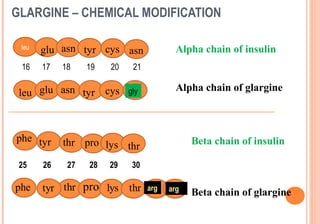
GLARGINE – CHEMICAL MODIFICATION
leu

glu asn tyr cys asn

16

17

18

19

20

Alpha chain of insulin

21

Alpha chain of glargine

leu glu asn tyr cys gly

phe tyr
25

26

Beta chain of insulin

thr pro lys thr
27

28

29

30
arg

arg

Beta chain of glargine
GLARGINE


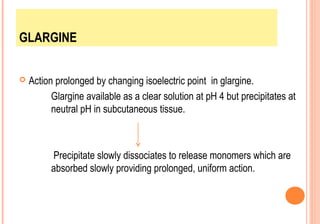
Action prolonged by changing isoelectric point in glargine.
Glargine available as a clear solution at pH 4 but precipitates at
neutral pH in subcutaneous tissue.

Precipitate slowly dissociates to release monomers which are
absorbed slowly providing prolonged, uniform action.
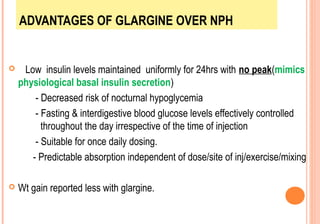
ADVANTAGES OF GLARGINE OVER NPH



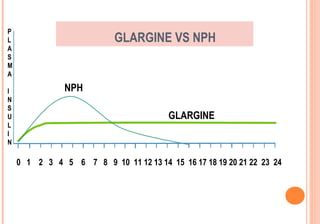
Low insulin levels maintained uniformly for 24hrs with no peak(mimics
physiological basal insulin secretion)
- Decreased risk of nocturnal hypoglycemia
- Fasting & interdigestive blood glucose levels effectively controlled
throughout the day irrespective of the time of injection
- Suitable for once daily dosing.
- Predictable absorption independent of dose/site of inj/exercise/mixing



Wt gain reported less with glargine.
P
L
A
S
M
A
I
N
S
U
L
I
N

GLARGINE VS NPH

NPH
GLARGINE

0 1 2 3 4 5 6 7 8 9 10 11 12 13 14 15 16 17 18 19 20 21 22 23 24
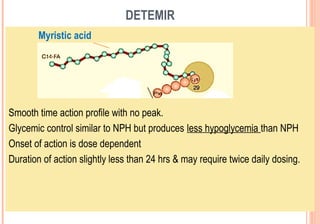
DETEMIR
Myristic acid

Smooth time action profile with no peak.
Glycemic control similar to NPH but produces less hypoglycemia than NPH
Onset of action is dose dependent
Duration of action slightly less than 24 hrs & may require twice daily dosing.
DEGLUDEC
Ultralong acting insulin analogue in the process of development.
 Suitable for thrice weekly administration

INSULIN REGIMES WITH INSULIN ANALOGUES
Basal regime : Glargine once daily at bedtime or Detemir twice daily .
- May be used when starting insulin in type 2 DM (along with OHA)
- Used when there is dependence on others for injection.
 Conventional split dose regimes : Pre-mix analogues injected twice a
day (pre-breakfast & pre-evening meal).
-Type 1 & 2 diabetes
-Simplify dosing & decreases no. of injections.
 Basal bolus regimen (intensive regimes): Glargine at bedtime to cover
basal insulin secretion + short acting analogue to cover mealtime
- Type 1 usually (Type 2 at times)
Analogues preferred in intensive regimes due to decreased risk of
hypoglycemia with their use.

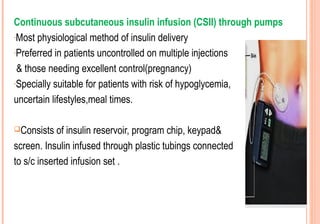
Continuous subcutaneous insulin infusion (CSII) through pumps
-Most physiological method of insulin delivery
-Preferred in patients uncontrolled on multiple injections
& those needing excellent control(pregnancy)
-Specially suitable for patients with risk of hypoglycemia,
uncertain lifestyles,meal times.
Consists

of insulin reservoir, program chip, keypad&
screen. Insulin infused through plastic tubings connected
to s/c inserted infusion set .
INSULIN DELIVERY – short acting insulin analogues like Aspart(lispro) used.
Provides constant basal infusion of insulin & patient can activate pre-meal
boluses.
Pumps can be discontinued for short periods for activities like exercise
Pump can be pre-programmed to compensate for nocturnal & early morning
glucose fluctuation.
Advantages
- Rate of insulin absorption more predictable than multiple injections
- Risk of hypoglycemia less
Drawbacks
-Pump failure -ketoacidosis
-Injection site abscess
-Only motivated & commited patients can use it.
INSULIN ANALOGUES IN SPECIAL SITUATIONS
Diabetic ketoacidosis – Lispro (i.v)
 Pregnancy
Lispro & Aspart demonstrated efficacy&safety (Cat B)
Long acting analogues not studied.
 Children
Data on insulin analogues is limited.
 Elderly (at risk of hypoglycemia)
Insulin analogues preferred.

NEW DELIVERY SYSTEMS USING ANALOGUES


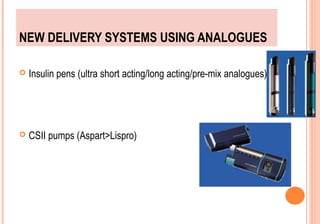
Insulin pens (ultra short acting/long acting/pre-mix analogues)



CSII pumps (Aspart>Lispro)
SUMMING UP THE MERITS OF INSULIN
ANALOGUES…….
Better mimicking of physiological insulin secretion.
 Better control of post prandial blood glucose levels
 Better control of glucose levels in the fasting, interdigestive period.
 Lesser risk of hypoglycemia.
 Action profile independent of dose/site of inj/exercise- more predictable
action.
 Greater flexibility with short acting analogues as they can be given at
meal times.

DEMERITS
No significantly different adverse effects when compared to std insulins.
 Worsening Retinopathy with Lispro (homologous to IGF-1)
 ???Carcinogenicity: Concerns over Glargine carcinogenicity ( FDA
considers Glargine as a Black triangle drug)




COST
Analogue (1000 u/vial)

Insulin (1000u/vial)

Lispro - $ 105
Aspart - $ 105
Glulisine - $ 95

Regular - $45

Glargine - $95
Detemir - $95

NPH - $45
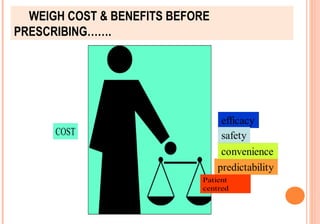
WEIGH COST & BENEFITS BEFORE
PRESCRIBING…….
SO………INSULIN ANALOGUES ARE
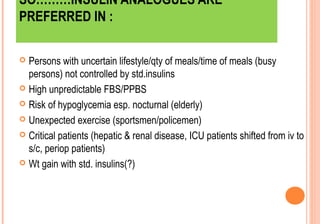
PREFERRED IN :
Persons with uncertain lifestyle/qty of meals/time of meals (busy
persons) not controlled by std.insulins
 High unpredictable FBS/PPBS
 Risk of hypoglycemia esp. nocturnal (elderly)
 Unexpected exercise (sportsmen/policemen)
 Critical patients (hepatic & renal disease, ICU patients shifted from iv to
s/c, periop patients)
 Wt gain with std. insulins(?)

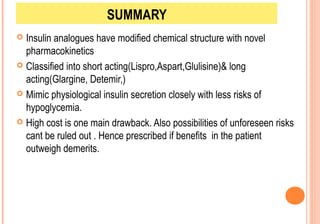
SUMMARY
Insulin analogues have modified chemical structure with novel
pharmacokinetics
 Classified into short acting(Lispro,Aspart,Glulisine)& long
acting(Glargine, Detemir,)
 Mimic physiological insulin secretion closely with less risks of
hypoglycemia.
 High cost is one main drawback. Also possibilities of unforeseen risks
cant be ruled out . Hence prescribed if benefits in the patient
outweigh demerits.

CONCLUSION
INSULIN ANALOGUES
So far seem to be fulfilling the promise of Recombinant DNA
technology
with
Better Bolus insulin
Better Basal insulin
Better Blood glucose
However, more years of experience needed before we can fully trust them for
our patients !!!
Thank You

Insulin analogues ppt

  • 1.
  • 2.
    CONTENTS Introduction  Classification  Rationalefor development  Individual analogues Special features  Merits of analogues over standard insulins  Drawbacks of analogues  Popular regimes using analogues  Novel delivery systems using analogues  Summary 
  • 3.
    INSULIN The most powerfulagent we have to control glucose. Miracle discovery that saved many lives.
  • 4.
    ANALOGUES…………….. 1921 : Insulinextracted by Banting & Best. Conventional insulin preparations from beef/pork pancreas (antigenic) 1970s : Highly purified porcine insulins : Single peak insulins & Monocompetent insulins (greater efficacy & lesser side effects) 1980s : Human insulins by recombinant DNA technology (still better) 1990 : Insulin analogues with novel pharmacokinetics (Eli Lilly& Co.)
  • 5.
    SO……WHAT ARE INSULINANALOGUES?? Molecules produced by genetic engineering wherein the amino acid sequence in human insulin is changed to alter its pharmacokinetics. However, they bind to insulin receptors in the same way as human insulin and produce similar effects Also termed as: Designer Insulins Insulin receptor ligands Democratic insulins
  • 6.
    CLASSIFICATION INSULINS Short acting - Regular Intermediateacting - NPH / Isophane Pre-mix insulins of NPH/Regular insulins INSULIN ANALOGUES Ultra-short acting/Rapid acting - Lispro - Aspart - Glulisine Long acting - Glargine - Detemir - Degludec ** Protaminated lispro – NPL Protaminated Aspart – NPA Pre mix analogues of NPL with Lispro (50/50 &75/25) Pre mix analogues of NPA with Aspart (70/30)
  • 7.
    CLASSIFICATION Insulin and analoguepreparations Short acting - Regular - Lispro - Aspart - Glulisine Long acting - NPH - Glargine - Detemir - Degludec
  • 8.
    What was theneed for insulin analogues when we had improved insulins???
  • 9.
    SO………………………………. Insulin analogues weredeveloped to overcome the limitations of available insulins:Ultrashort acting analogues to overcome limitations of short acting insulins(regular) Long acting analogues to overcome limitations of long/intermediate acting insulins(NPH)
  • 10.
    Ultra short/Rapid actingInsulin analogues Lispro Aspart Glulisine
  • 11.
    LIMITATIONS OF REGULAR INSULINS  Regularinsulins form hexamers which dissociate slowly into monomers thus delaying absorption. Delayed onset of action (1/2 to 1 hr) Post prandial hyperglycemia Prolonged time of peak action (2 to 3 hrs) Duration of action (5 to 8 hrs) Late post prandial hypoglycemia Hence regular insulins cause a mismatch between need & availability of bolus insulin and do not ideally mimic physiological bolus secretion of insulin.
  • 12.
    OTHER LIMITATIONS OFREGULAR INSULINS  Regular insulin has to be administered 30-45mins before meal - dose of insulin cannot be adjusted according to size of meals.  Time of onset, peak action & duration of action is dose dependent (increases with dose)  Absorption varies with injection site & exercise (variability of absorption as much as 25%)
  • 13.
  • 14.
    ANALOGUES  Less propensity toform hexamers. Hexamers formed dissociate rapidly into monomers & are rapidly absorbed. Better control of post Rapid onset of action - 10 to 20mins prandial glucose Peak action – 1 to 2 hrs Duration of action – 4 to 5 hrs Decreased risk of late post prandial hypoglycemia Mimics physiological bolus secretion. o Can be taken just before or just after meals – allows adjustment of insulin dose with size of meal. o Onset of action & peak action independent of dose/site of injection / exercise.
  • 15.
  • 16.
    LONG ACTING INSULINANALOGUES Glargine Detemir Degludec
  • 17.
    LIMITATIONS OF NPHINSULINS Doesn’t mimic physiological basal insulin secretion - Peak action 5 to 7hrs after administration ( risk of nocturnal hypoglycemia (if administered at bedtime) - Duration of action not long(≈20hours) enough to cover insulin requirements of the whole day with a single injection .  Action profile depends on dose. Variability of absorption with site/exercise/variation in mixing of suspension (50%variability). Highly unpredictable action profile.
  • 18.
    GLARGINE – CHEMICALMODIFICATION leu glu asn tyr cys asn 16 17 18 19 20 Alpha chain of insulin 21 Alpha chain of glargine leu glu asn tyr cys gly phe tyr 25 26 Beta chain of insulin thr pro lys thr 27 28 29 30 arg arg Beta chain of glargine
  • 19.
    GLARGINE  Action prolonged bychanging isoelectric point in glargine. Glargine available as a clear solution at pH 4 but precipitates at neutral pH in subcutaneous tissue. Precipitate slowly dissociates to release monomers which are absorbed slowly providing prolonged, uniform action.
  • 20.
    ADVANTAGES OF GLARGINEOVER NPH  Low insulin levels maintained uniformly for 24hrs with no peak(mimics physiological basal insulin secretion) - Decreased risk of nocturnal hypoglycemia - Fasting & interdigestive blood glucose levels effectively controlled throughout the day irrespective of the time of injection - Suitable for once daily dosing. - Predictable absorption independent of dose/site of inj/exercise/mixing  Wt gain reported less with glargine.
  • 21.
    P L A S M A I N S U L I N GLARGINE VS NPH NPH GLARGINE 01 2 3 4 5 6 7 8 9 10 11 12 13 14 15 16 17 18 19 20 21 22 23 24
  • 22.
    DETEMIR Myristic acid Smooth timeaction profile with no peak. Glycemic control similar to NPH but produces less hypoglycemia than NPH Onset of action is dose dependent Duration of action slightly less than 24 hrs & may require twice daily dosing.
  • 23.
    DEGLUDEC Ultralong acting insulinanalogue in the process of development.  Suitable for thrice weekly administration 
  • 24.
    INSULIN REGIMES WITHINSULIN ANALOGUES Basal regime : Glargine once daily at bedtime or Detemir twice daily . - May be used when starting insulin in type 2 DM (along with OHA) - Used when there is dependence on others for injection.  Conventional split dose regimes : Pre-mix analogues injected twice a day (pre-breakfast & pre-evening meal). -Type 1 & 2 diabetes -Simplify dosing & decreases no. of injections.  Basal bolus regimen (intensive regimes): Glargine at bedtime to cover basal insulin secretion + short acting analogue to cover mealtime - Type 1 usually (Type 2 at times) Analogues preferred in intensive regimes due to decreased risk of hypoglycemia with their use. 
  • 25.
    Continuous subcutaneous insulininfusion (CSII) through pumps -Most physiological method of insulin delivery -Preferred in patients uncontrolled on multiple injections & those needing excellent control(pregnancy) -Specially suitable for patients with risk of hypoglycemia, uncertain lifestyles,meal times. Consists of insulin reservoir, program chip, keypad& screen. Insulin infused through plastic tubings connected to s/c inserted infusion set .
  • 26.
    INSULIN DELIVERY –short acting insulin analogues like Aspart(lispro) used. Provides constant basal infusion of insulin & patient can activate pre-meal boluses. Pumps can be discontinued for short periods for activities like exercise Pump can be pre-programmed to compensate for nocturnal & early morning glucose fluctuation. Advantages - Rate of insulin absorption more predictable than multiple injections - Risk of hypoglycemia less Drawbacks -Pump failure -ketoacidosis -Injection site abscess -Only motivated & commited patients can use it.
  • 27.
    INSULIN ANALOGUES INSPECIAL SITUATIONS Diabetic ketoacidosis – Lispro (i.v)  Pregnancy Lispro & Aspart demonstrated efficacy&safety (Cat B) Long acting analogues not studied.  Children Data on insulin analogues is limited.  Elderly (at risk of hypoglycemia) Insulin analogues preferred. 
  • 28.
    NEW DELIVERY SYSTEMSUSING ANALOGUES  Insulin pens (ultra short acting/long acting/pre-mix analogues)  CSII pumps (Aspart>Lispro)
  • 29.
    SUMMING UP THEMERITS OF INSULIN ANALOGUES……. Better mimicking of physiological insulin secretion.  Better control of post prandial blood glucose levels  Better control of glucose levels in the fasting, interdigestive period.  Lesser risk of hypoglycemia.  Action profile independent of dose/site of inj/exercise- more predictable action.  Greater flexibility with short acting analogues as they can be given at meal times. 
  • 30.
    DEMERITS No significantly differentadverse effects when compared to std insulins.  Worsening Retinopathy with Lispro (homologous to IGF-1)  ???Carcinogenicity: Concerns over Glargine carcinogenicity ( FDA considers Glargine as a Black triangle drug)   COST Analogue (1000 u/vial) Insulin (1000u/vial) Lispro - $ 105 Aspart - $ 105 Glulisine - $ 95 Regular - $45 Glargine - $95 Detemir - $95 NPH - $45
  • 31.
    WEIGH COST &BENEFITS BEFORE PRESCRIBING…….
  • 32.
    SO………INSULIN ANALOGUES ARE PREFERREDIN : Persons with uncertain lifestyle/qty of meals/time of meals (busy persons) not controlled by std.insulins  High unpredictable FBS/PPBS  Risk of hypoglycemia esp. nocturnal (elderly)  Unexpected exercise (sportsmen/policemen)  Critical patients (hepatic & renal disease, ICU patients shifted from iv to s/c, periop patients)  Wt gain with std. insulins(?) 
  • 33.
    SUMMARY Insulin analogues havemodified chemical structure with novel pharmacokinetics  Classified into short acting(Lispro,Aspart,Glulisine)& long acting(Glargine, Detemir,)  Mimic physiological insulin secretion closely with less risks of hypoglycemia.  High cost is one main drawback. Also possibilities of unforeseen risks cant be ruled out . Hence prescribed if benefits in the patient outweigh demerits. 
  • 34.
    CONCLUSION INSULIN ANALOGUES So farseem to be fulfilling the promise of Recombinant DNA technology with Better Bolus insulin Better Basal insulin Better Blood glucose However, more years of experience needed before we can fully trust them for our patients !!!
  • 35.