Pancreatic Hormone
INSULIN
Presented to :
$ir I$LAM
Content
• Definition of hormone.
• Pancreas.
• Introduction of insulin
• Chemistry.
• Biosynthesis.
• Action of insulin.
• Factors Effect insulin secretion.
• Disorders.
• Brand name of insulin in market.
Hormones
• Definition:
“These are chemical messengers needed in small
amount to accelerate or inhibit the metabolic
activities of target organ.”
• Human body secretes about 50 different types of
hormones.
• Hormones can be classified on the basis of their nature
e.g. Proteins/polypeptides,steroid,Amino acids hormones
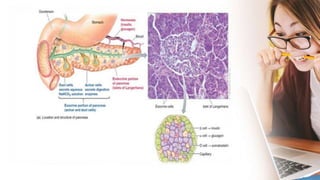
Pancreas:
• PANCREAS contains both exocrine &
endocrine cells.
• Roughly 99% of the cells of the
pancreas are arranged in clusters called
ACINER CELLS.
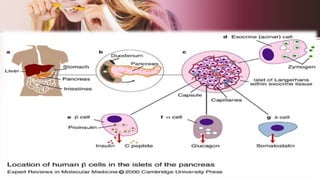
• Endocrine cells → ISLETS OF
LANGERHANS,1-2% of pancreatic
tissues.
ISLETS OF LANGERHANS:
• Also termed as ISLAND OF
LANGERHANS.
• Irregular shaped patches of endocrine
tissues present in pancreas.
• Named for German Physician PAUL
LANGERHAN…discovered in 1969.
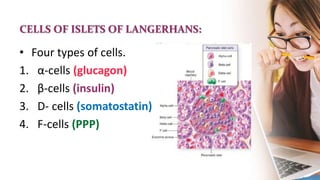
CELLS OF ISLETS OF LANGERHANS:
• Four types of cells.
1. α-cells (glucagon)
2. β-cells (insulin)
3. D- cells (somatostatin))
4. F-cells (PPP)
Product A
• Feature 1
• Feature 2
• Feature 3
Product B
• Feature 1
• Feature 2
• Feature 3
INSULIN
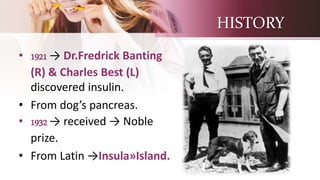
HISTORY
• 1921 → Dr.Fredrick Banting
(R) & Charles Best (L)
discovered insulin.
• From dog’s pancreas.
• 1932 → received → Noble
prize.
• From Latin →Insula»Island.
Characteristics:
• PolyPeptide Hormone.
• Secreted by β-cells in the islets of langerhans
of pancreas.
• Regulates the metabolic activity of
carbohydrates , fats and Proteins.
• Anabolic Hormone.
• 1st hormone » isolated, purified and synthesis.
• 1st hormone to sequence.
• 1st Hormone to be produced By DNA
technology.
Chemistry of
insulin
Chemistry of insulin
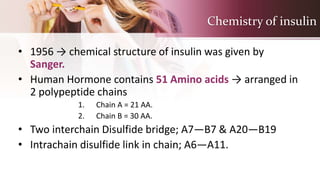
• 1956 → chemical structure of insulin was given by
Sanger.
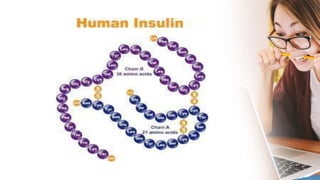
• Human Hormone contains 51 Amino acids → arranged in
2 polypeptide chains
1. Chain A = 21 AA.
2. Chain B = 30 AA.
• Two interchain Disulfide bridge; A7—B7 & A20—B19
• Intrachain disulfide link in chain; A6—A11.
Biosynthesis of
insulin
Biosynthesis of insulin
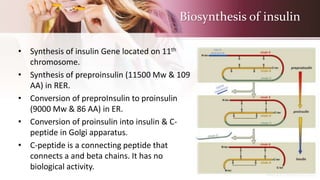
• Synthesis of insulin Gene located on 11th
chromosome.
• Synthesis of preproinsulin (11500 Mw & 109
AA) in RER.
• Conversion of preproInsulin to proinsulin
(9000 Mw & 86 AA) in ER.
• Conversion of proinsulin into insulin & C-
peptide in Golgi apparatus.
• C-peptide is a connecting peptide that
connects a and beta chains. It has no
biological activity.
Amount of insulin secretion:
• About 45–50 Units secreted daily
by human pancreas.
• Normal value 20–30 Units/ml.
Half life of insulin
• Biological half-life of insulin is 5-6
min.
• Insulinase degraded insulin in liver &
kidney by cleavage of S–S bond.
Action of
insulin
Action of insulin
Summary of how insulin works.😏
• Elevated levels of glucose in the blood stimulates cell
of pancreas to ↑ insulin secretion into the blood.
• The insulin circulates the body, within minutes,
stimulates the liver and muscle cells to take up
glucose from the blood, As a result blood glucose
level fall.
Action on insulin
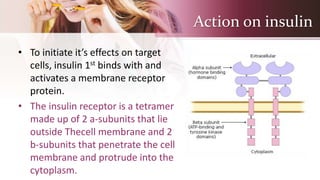
• To initiate it’s effects on target
cells, insulin 1st binds with and
activates a membrane receptor
protein.
• The insulin receptor is a tetramer
made up of 2 a-subunits that lie
outside Thecell membrane and 2
b-subunits that penetrate the cell
membrane and protrude into the
cytoplasm.
Cont’d
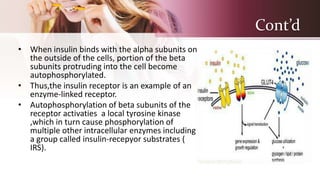
• When insulin binds with the alpha subunits on
the outside of the cells, portion of the beta
subunits protruding into the cell become
autophosphorylated.
• Thus,the insulin receptor is an example of an
enzyme-linked receptor.
• Autophosphorylation of beta subunits of the
receptor activaties a local tyrosine kinase
,which in turn cause phosphorylation of
multiple other intracellular enzymes including
a group called insulin-recepyor substrates (
IRS).
Cont’d
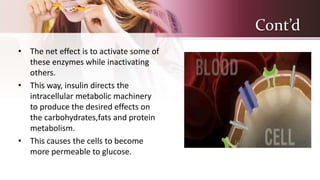
• The net effect is to activate some of
these enzymes while inactivating
others.
• This way, insulin directs the
intracellular metabolic machinery
to produce the desired effects on
the carbohydrates,fats and protein
metabolism.
• This causes the cells to become
more permeable to glucose.
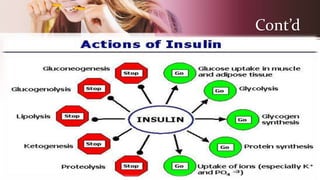
Metabolic effect of insulin
Effect on carbohydrate metabolism:-
a) In liver and muscles insulin increases glycogen
synthesis
b) In muscle and adipose insulin increase glucose
uptake by increasing the number of glucose transporters
(GLUT-4) in the cell membrane
c) In liver insulin inhibits the production of glucose by
inhibiting glucogenolysis and gluconeogenesis
Cont’d
Effect on lipid metabolism:-
a) Insulin reduces fatty acid release by inhibiting activity
of hormone-sensitive lipase.
b) Insulin converts glucose into adipocytes providing
glycerol 3-phosphate substrate for TAG.
c) Expression of gene for lipoprotien lipase increases by
insulin results in fatty acids for esterification of glycerol.
Cont’d
Effect on protein metabolism:-
a) Insulin stimulates entry of amino acids into cells and
protein synthesis through activation of factors required for
translation initiation
Cont’d
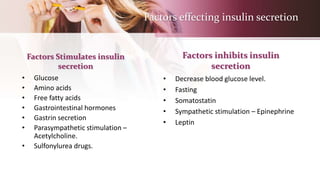
Factors effecting insulin secretion
Factors Stimulates insulin
secretion
• Glucose
• Amino acids
• Free fatty acids
• Gastrointestinal hormones
• Gastrin secretion
• Parasympathetic stimulation –
Acetylcholine.
• Sulfonylurea drugs.
Factors inhibits insulin
secretion
• Decrease blood glucose level.
• Fasting
• Somatostatin
• Sympathetic stimulation – Epinephrine
• Leptin
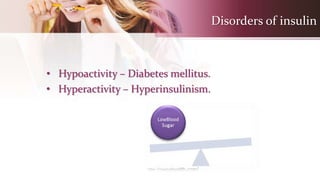
Disorders of insulin
• Hypoactivity – Diabetes mellitus.
• Hyperactivity – Hyperinsulinism.
Diabetes mellitus:
• Definition:
. Metabolic disorder characterzed by
high blood glucose level associated with
another manifestation.
• Diabetes → polyuria
• Mellitus → Honey
• Named coined by Thomas William →
sweetness urine from diabetic in 1675.
• Multi organ damaged → kidney, eyes, blood
vessels..
Types;
• There are two types of diabetes
mellitus.
1. Type I DM
2. Type 2 DM
Type I DM:
• Due to deficiency of insulin
• Cause: destruction of beta cells in islets
of langerhans by T-cells & auto-
antibodies.
• Early onset…… < 20 age → juvenile
diabetes.
• Also know as insulin dependent
diabetes.
Type 2 DM:
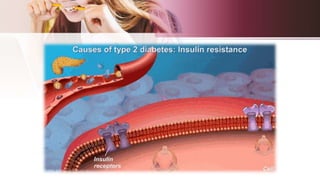
• Due to insulin resistance ( failure of insulin
receptors to give response to insulin).
• Body is unable to use insulin.
• About 90% of diabetic patients have type 2
DM.
• Usually occur < 40 years.
• Also called non-insulin-dependent
diabetes mellitus (NIDDM).
Sign & symptoms
Both types of diabetes , if not controlled
,share many similar symptoms, including:
• Increased thirst.
• Frequent urination.
• Extreme hunger.
• Irritability and other mood changes
• Fatigue & weakness.
• Blurred vision.
Treatment;
• Combination of medication
• Lifestyle changes (diet & exercise)
• Intake of insulin.
Drugs used for diabetes mellitus;
There are so many drugs used for diabetes
mellitus. Some of which are following:-
• Glocophage - metformin HCL.
• Alpha-glucosidase inhibitors - Acarbose.
• Meglitinides - nateglinide.
• Combination of sulfonylureas plus
metformin - known by generic names of
the two drugs
Insulinoma
• Hyper-secretion of insulin.
• Cause: Due to tumors of beta cells in islets of
langerhans.
• Typical cause : insulin resistance → to be linked to
type 2 DM.
Sign & Symptoms;
• Sugar craving
• Unusual weight gain.
• Frequent hunger.
• Extreme tiredness.
• Lack of focus.
• Low blood sugar.
Treatment;
• Combination of medication
• Lifestyle changes (diet & exercise)
• More intake sugar.
Drugs Used For Insulinoma
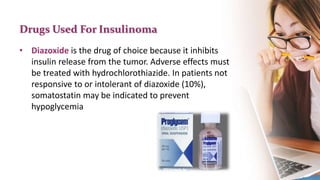
• Diazoxide is the drug of choice because it inhibits
insulin release from the tumor. Adverse effects must
be treated with hydrochlorothiazide. In patients not
responsive to or intolerant of diazoxide (10%),
somatostatin may be indicated to prevent
hypoglycemia
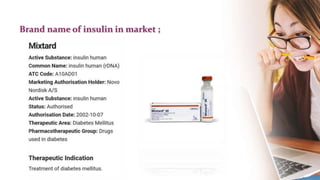
Brand name of insulin in market ;
reference
• Lippincot,s illustrated reviews Bochemistry sixth edition (page #
307)
• Essentials of medical physiology by K.sembulingum $ prema.
sembulingum (page # 415)
• Fox human physiology (page # 419)
• Research papers of Dr.Anaya Mandal (MD) from Google scholar.
• www.wikipedia.com
• www.drugs.com
• www.hormonesphysiology.com
Insulin presentation

Insulin presentation

  • 2.
  • 3.
    Content • Definition ofhormone. • Pancreas. • Introduction of insulin • Chemistry. • Biosynthesis. • Action of insulin. • Factors Effect insulin secretion. • Disorders. • Brand name of insulin in market.
  • 4.
    Hormones • Definition: “These arechemical messengers needed in small amount to accelerate or inhibit the metabolic activities of target organ.” • Human body secretes about 50 different types of hormones. • Hormones can be classified on the basis of their nature e.g. Proteins/polypeptides,steroid,Amino acids hormones
  • 5.
    Pancreas: • PANCREAS containsboth exocrine & endocrine cells. • Roughly 99% of the cells of the pancreas are arranged in clusters called ACINER CELLS. • Endocrine cells → ISLETS OF LANGERHANS,1-2% of pancreatic tissues.
  • 7.
    ISLETS OF LANGERHANS: •Also termed as ISLAND OF LANGERHANS. • Irregular shaped patches of endocrine tissues present in pancreas. • Named for German Physician PAUL LANGERHAN…discovered in 1969.
  • 8.
    CELLS OF ISLETSOF LANGERHANS: • Four types of cells. 1. α-cells (glucagon) 2. β-cells (insulin) 3. D- cells (somatostatin)) 4. F-cells (PPP)
  • 9.
    Product A • Feature1 • Feature 2 • Feature 3 Product B • Feature 1 • Feature 2 • Feature 3
  • 10.
  • 11.
    HISTORY • 1921 →Dr.Fredrick Banting (R) & Charles Best (L) discovered insulin. • From dog’s pancreas. • 1932 → received → Noble prize. • From Latin →Insula»Island.
  • 12.
    Characteristics: • PolyPeptide Hormone. •Secreted by β-cells in the islets of langerhans of pancreas. • Regulates the metabolic activity of carbohydrates , fats and Proteins. • Anabolic Hormone. • 1st hormone » isolated, purified and synthesis. • 1st hormone to sequence. • 1st Hormone to be produced By DNA technology.
  • 13.
  • 14.
    Chemistry of insulin •1956 → chemical structure of insulin was given by Sanger. • Human Hormone contains 51 Amino acids → arranged in 2 polypeptide chains 1. Chain A = 21 AA. 2. Chain B = 30 AA. • Two interchain Disulfide bridge; A7—B7 & A20—B19 • Intrachain disulfide link in chain; A6—A11.
  • 16.
  • 17.
    Biosynthesis of insulin •Synthesis of insulin Gene located on 11th chromosome. • Synthesis of preproinsulin (11500 Mw & 109 AA) in RER. • Conversion of preproInsulin to proinsulin (9000 Mw & 86 AA) in ER. • Conversion of proinsulin into insulin & C- peptide in Golgi apparatus. • C-peptide is a connecting peptide that connects a and beta chains. It has no biological activity.
  • 18.
    Amount of insulinsecretion: • About 45–50 Units secreted daily by human pancreas. • Normal value 20–30 Units/ml.
  • 19.
    Half life ofinsulin • Biological half-life of insulin is 5-6 min. • Insulinase degraded insulin in liver & kidney by cleavage of S–S bond.
  • 20.
  • 21.
    Action of insulin Summaryof how insulin works.😏 • Elevated levels of glucose in the blood stimulates cell of pancreas to ↑ insulin secretion into the blood. • The insulin circulates the body, within minutes, stimulates the liver and muscle cells to take up glucose from the blood, As a result blood glucose level fall.
  • 22.
    Action on insulin •To initiate it’s effects on target cells, insulin 1st binds with and activates a membrane receptor protein. • The insulin receptor is a tetramer made up of 2 a-subunits that lie outside Thecell membrane and 2 b-subunits that penetrate the cell membrane and protrude into the cytoplasm.
  • 23.
    Cont’d • When insulinbinds with the alpha subunits on the outside of the cells, portion of the beta subunits protruding into the cell become autophosphorylated. • Thus,the insulin receptor is an example of an enzyme-linked receptor. • Autophosphorylation of beta subunits of the receptor activaties a local tyrosine kinase ,which in turn cause phosphorylation of multiple other intracellular enzymes including a group called insulin-recepyor substrates ( IRS).
  • 24.
    Cont’d • The neteffect is to activate some of these enzymes while inactivating others. • This way, insulin directs the intracellular metabolic machinery to produce the desired effects on the carbohydrates,fats and protein metabolism. • This causes the cells to become more permeable to glucose.
  • 25.
    Metabolic effect ofinsulin Effect on carbohydrate metabolism:- a) In liver and muscles insulin increases glycogen synthesis b) In muscle and adipose insulin increase glucose uptake by increasing the number of glucose transporters (GLUT-4) in the cell membrane c) In liver insulin inhibits the production of glucose by inhibiting glucogenolysis and gluconeogenesis
  • 26.
    Cont’d Effect on lipidmetabolism:- a) Insulin reduces fatty acid release by inhibiting activity of hormone-sensitive lipase. b) Insulin converts glucose into adipocytes providing glycerol 3-phosphate substrate for TAG. c) Expression of gene for lipoprotien lipase increases by insulin results in fatty acids for esterification of glycerol.
  • 27.
    Cont’d Effect on proteinmetabolism:- a) Insulin stimulates entry of amino acids into cells and protein synthesis through activation of factors required for translation initiation
  • 28.
  • 29.
    Factors effecting insulinsecretion Factors Stimulates insulin secretion • Glucose • Amino acids • Free fatty acids • Gastrointestinal hormones • Gastrin secretion • Parasympathetic stimulation – Acetylcholine. • Sulfonylurea drugs. Factors inhibits insulin secretion • Decrease blood glucose level. • Fasting • Somatostatin • Sympathetic stimulation – Epinephrine • Leptin
  • 30.
    Disorders of insulin •Hypoactivity – Diabetes mellitus. • Hyperactivity – Hyperinsulinism.
  • 31.
    Diabetes mellitus: • Definition: .Metabolic disorder characterzed by high blood glucose level associated with another manifestation. • Diabetes → polyuria • Mellitus → Honey • Named coined by Thomas William → sweetness urine from diabetic in 1675. • Multi organ damaged → kidney, eyes, blood vessels..
  • 32.
    Types; • There aretwo types of diabetes mellitus. 1. Type I DM 2. Type 2 DM
  • 33.
    Type I DM: •Due to deficiency of insulin • Cause: destruction of beta cells in islets of langerhans by T-cells & auto- antibodies. • Early onset…… < 20 age → juvenile diabetes. • Also know as insulin dependent diabetes.
  • 34.
    Type 2 DM: •Due to insulin resistance ( failure of insulin receptors to give response to insulin). • Body is unable to use insulin. • About 90% of diabetic patients have type 2 DM. • Usually occur < 40 years. • Also called non-insulin-dependent diabetes mellitus (NIDDM).
  • 36.
    Sign & symptoms Bothtypes of diabetes , if not controlled ,share many similar symptoms, including: • Increased thirst. • Frequent urination. • Extreme hunger. • Irritability and other mood changes • Fatigue & weakness. • Blurred vision.
  • 37.
    Treatment; • Combination ofmedication • Lifestyle changes (diet & exercise) • Intake of insulin.
  • 38.
    Drugs used fordiabetes mellitus; There are so many drugs used for diabetes mellitus. Some of which are following:- • Glocophage - metformin HCL. • Alpha-glucosidase inhibitors - Acarbose. • Meglitinides - nateglinide. • Combination of sulfonylureas plus metformin - known by generic names of the two drugs
  • 39.
    Insulinoma • Hyper-secretion ofinsulin. • Cause: Due to tumors of beta cells in islets of langerhans. • Typical cause : insulin resistance → to be linked to type 2 DM.
  • 40.
    Sign & Symptoms; •Sugar craving • Unusual weight gain. • Frequent hunger. • Extreme tiredness. • Lack of focus. • Low blood sugar.
  • 41.
    Treatment; • Combination ofmedication • Lifestyle changes (diet & exercise) • More intake sugar.
  • 42.
    Drugs Used ForInsulinoma • Diazoxide is the drug of choice because it inhibits insulin release from the tumor. Adverse effects must be treated with hydrochlorothiazide. In patients not responsive to or intolerant of diazoxide (10%), somatostatin may be indicated to prevent hypoglycemia
  • 43.
    Brand name ofinsulin in market ;
  • 44.
    reference • Lippincot,s illustratedreviews Bochemistry sixth edition (page # 307) • Essentials of medical physiology by K.sembulingum $ prema. sembulingum (page # 415) • Fox human physiology (page # 419) • Research papers of Dr.Anaya Mandal (MD) from Google scholar. • www.wikipedia.com • www.drugs.com • www.hormonesphysiology.com