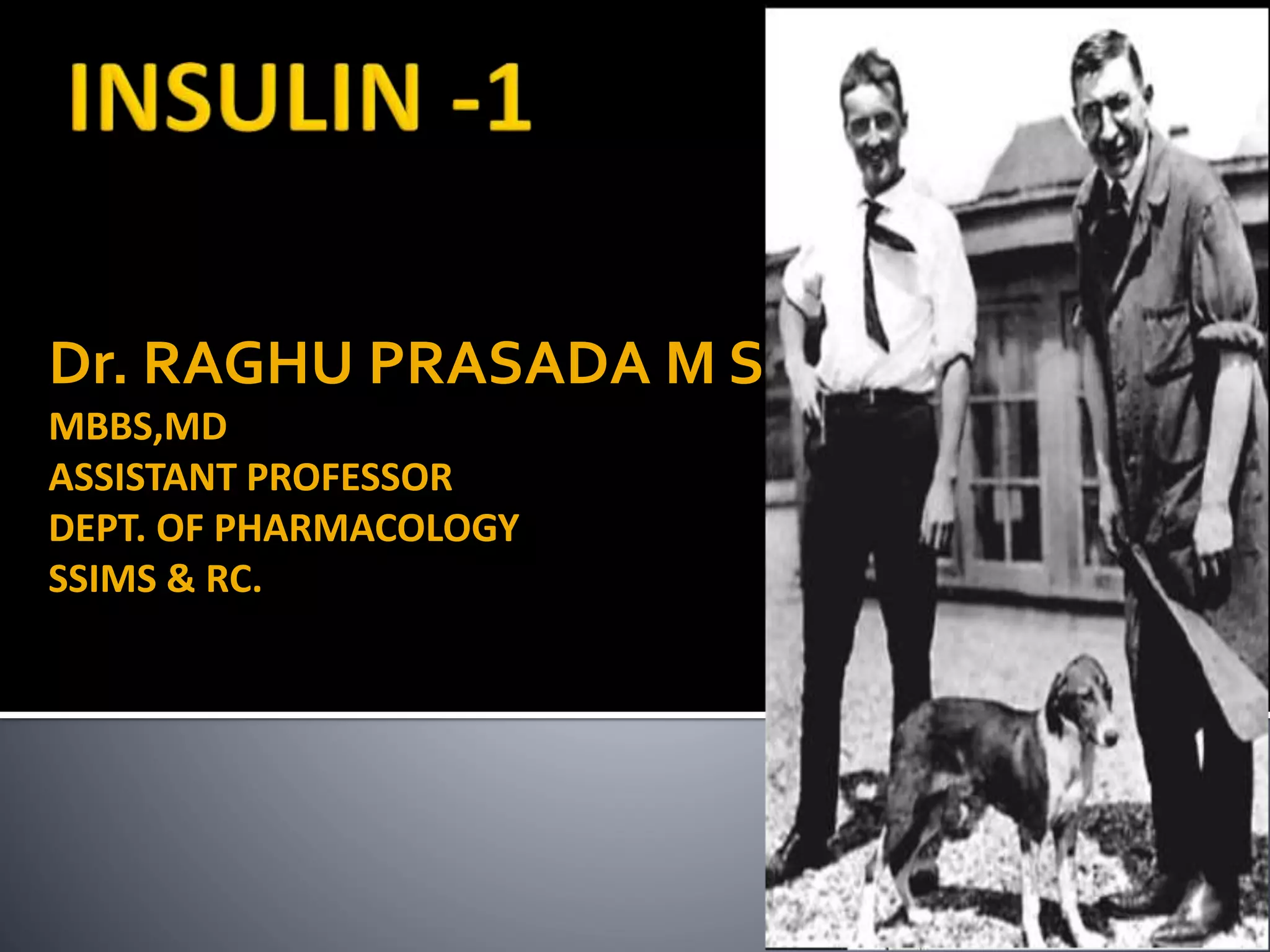

Dr. RAGHU PRASADA M S
MBBS,MD
ASSISTANT PROFESSOR
DEPT. OF PHARMACOLOGY
SSIMS & RC.
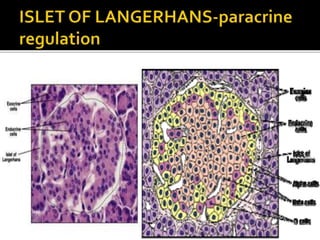
Exocrine, enzymatic
 „Acinar cells
Endocrine, hormonal-ISLET OF LANGERHANS
 Alpha cells- Glucagon
 „Beta cells -Insulin, proinsulin, amylin
 „Delta cells -Somatostatin,
 F cells- pancreatic polypeptide
„Regulation of storage and use of carbohydrates, fats
and protein within liver, muscle and adipose tissue
„Facilitation of cellular storage of nutrients following a
meal
„Release of metabolic substrates during fasting
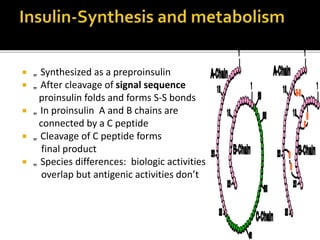
 „ Synthesized as a preproinsulin
 „ After cleavage of signal sequence
proinsulin folds and forms S-S bonds
 „ In proinsulin A and B chains are
connected by a C peptide
 „ Cleavage of C peptide forms
final product
 „ Species differences: biologic activities
overlap but antigenic activities don’t
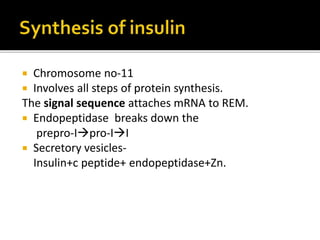
Chromosome no-11
Involves all steps of protein synthesis.
The signal sequence attaches mRNA to Rough
Endoplasmic Reticulum.
Endopeptidase breaks down the prepro-I pro-II
Secretory vesicles-
Insulin+c peptide+ endopeptidase+Zn.
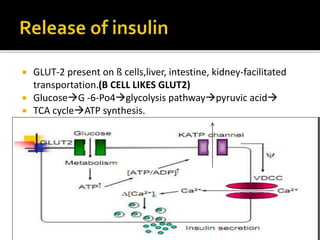
 GLUT-2 present on ß cells, liver, intestine, kidney-facilitated
transportation.(B cell LIKes GLUT2)
 GlucoseG -6-Po4glycolysis pathway pyruvic acid
 TCA cycleATP synthesis.
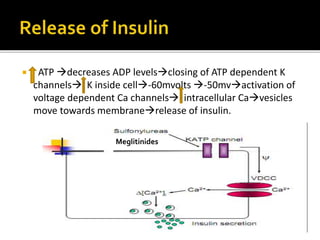
 ATP decreases ADP levels closing of ATP dependent K
channels K inside cell-60mvolts -50mvactivation of
voltage dependent Ca channels intracellular Ca vesicles
move towards membrane release of insulin.
Meglitinides
Polypeptide consisting of an A and B chain
of 21 and 30 aa
„Two chains are linked by a pair of S-S bonds
„An intrachain S-S bond connects 6th and 11th aa
within A chain
„Forms a dimer with 2 Zn ions
Hexameric form
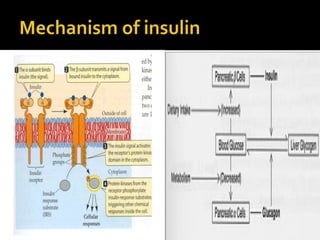
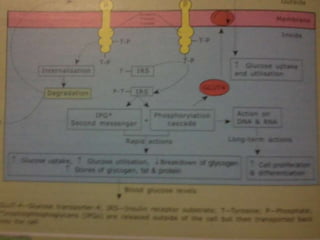
RAPID EFFECT
 Promotes the uptake &
storage of glucose, fats,
& protein-effects on
liver, muscles and
adipose tissue
 Carbohydrate Metb
lipid metabolism
 Protein metabolism
LONGTERM EFFECT
 Gene transcription
 Cell proliferation and
differenciation
 Protein synthesis
 Growth regulation
 Promotes Muscle Glucose Uptake and Metabolism
 Storage of Glycogen in Muscle
 Promotes Liver Uptake, Storage and Use of Glucose
Mechanisms:
 inactivates liver phosphorylase
 causes enhanced uptake of glucose from the blood
by the liver cells -by increasing the activity of the
enzyme glucokinase
Insulin promotes Fat Synthesis and Storage
Synthesis- Insulin promotes glucose transport through
the cell membrane into the fat cells
Storage -Adipose Cells-Insulin inhibits the action of
hormone-sensitive lipase
Insulin deficiency
causes increase metabolic use of fat causing
lipolysis of storage fat and release of free fatty acids
increase plasma cholesterol and phospholipid
excess usage of fats during insulin lack causes
ketosis and acidosis
Insulin promotes protein synthesis and storage
stimulates transport of amino acids into the cells (valine,
leucine, isoleucine, tyrosine, phenylalanine)
increases the translation of messenger RNA, forming
new proteins
increases the rate of transcription of DNA genetic
sequences in cell nuclei
inhibits catabolism of proteins
depresses the rate of gluconeogenesis
Insulin independent glucose utilization-RBC, WBC,
Liver, Brain, Renal medullary cells (mainly GLUT2 )
Insulin dependent glucose utilization – GLUT4 –
activated by insulin present as intracellular pool of
vesicles.
Insulin enhances production of glucokinase, which
helps phosphorylation to form glucose-6-phosphate
It inhibits glycogen degrading enzyme phosphorylase
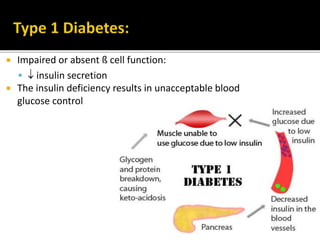
 Impaired or absent ß cell function:
  insulin secretion
 The insulin deficiency results in unacceptable blood
glucose control
 Impaired ß cell function:
  insulin secretion
 Impaired insulin action:
  insulin resistance
 Results in unacceptable blood glucose control
 Minimizing the complications of diabetes requires:
 Early diagnosis and treatment of diabetes
 Maintaining HbA1C level < 7%
 Achieving HbA1C < 7% requires control of post-
prandial and fasting hyperglycemia
 Chronic pancreatitis
 Chronic drug therapy- glucocorticoids, thiazides,
protease inhibitors
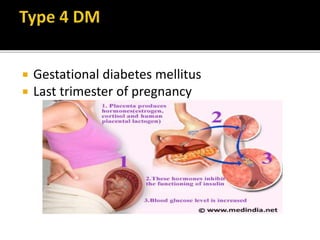
Gestational diabetes mellitus
Last trimester of pregnancy
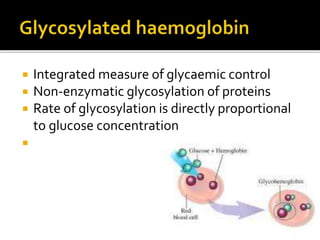
Integrated measure of glycaemic control
Non-enzymatic glycosylation of proteins
Rate of glycosylation is directly proportional to glucose
concentration
Beef insulin
Pork insulin
Insulin by recombinant DNA technology
Human insulin-recombinant DNA technology
E.coli-prb-Pro-Insulin Recombinant Bacterial
yeast-pyr-Precursor Yeast Recombinant
emp-Enzymatic modification of Porcine Insulin
Proinsulin and insulin
High molecular weight polypeptide
Metabolism
„Degraded within the liver and kidneys
„80% metabolized in the liver-H.insulinase
„Half-life of about 5 minutes
„Degraded by hepatic glutathione insulin dehydrogenase
„Enzyme disrupts S-S bonds
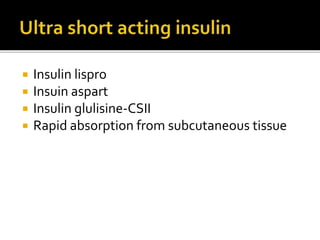
Insulin lispro- produced by reversing proline and lysine
at the corboxy terminal B28 AND b29
Insuin aspart- The proline at B28 is replaced by
aspartic acid
Insulin glulisine-CSII ( for Contineous Subcutanuous-
Insulin infusion) formed by lycine replacing
asparagine
Rapid absorption from subcutaneous tissue
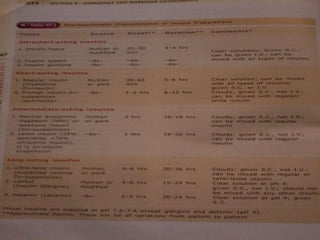
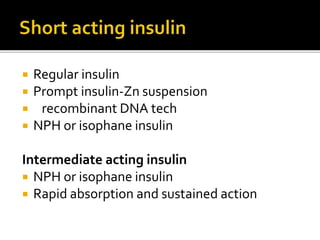
Regular insulin- it is a buffered neutral pH solution of
unmodified insulin stabilized by small amount of zinc.
The insulin molecules self aggregate to form
hexamers around zinc ions. After s.c. injection, insulin
monomers are gradually released by dilution.
peak action occurs by 2-3hrs
Prompt insulin-Zn suspension(Lente Insulin)- two types
Ulta lente- large particles-insolube in water, long acting
Semilente- smaller particles, amorphous shorter acting
NPH or isophane insulin
Intermediate acting insulin
NPH or isophane insulin( Neutral Protamine Hagedorn)
protamne complexes all insulin molecules. Mostly
combined with regular insulin. (70:30) or (50:50)
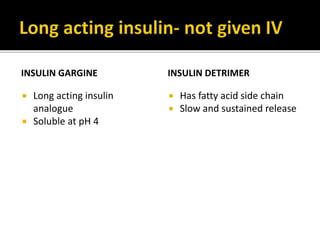
INSULIN GLARGINE
Long acting biosynthetic
insulin analogue
Soluble at pH 4 but
precipitates at neutral pH
Delayed onset of action and
suitable for once daily
administration
Injected at bed time
Lowers night time
hypoglycemia
INSULIN DETRIMER
Has fatty acid side chain
Slow and sustained release
Binds to albumin and released
slowly
Twice daily dosage is needed
Type 1 DM and type 2 DM
Diabetic keto acidosis (Diabetic coma)
Non-ketotic hyperglycemia
Hyperosmolar coma- nonketotic hyperglycemia

Class insulin 2

  • 1.
    Dr. RAGHU PRASADAM S MBBS,MD ASSISTANT PROFESSOR DEPT. OF PHARMACOLOGY SSIMS & RC.
  • 2.
    Exocrine, enzymatic  „Acinarcells Endocrine, hormonal-ISLET OF LANGERHANS  Alpha cells- Glucagon  „Beta cells -Insulin, proinsulin, amylin  „Delta cells -Somatostatin,  F cells- pancreatic polypeptide
  • 3.
    „Regulation of storageand use of carbohydrates, fats and protein within liver, muscle and adipose tissue „Facilitation of cellular storage of nutrients following a meal „Release of metabolic substrates during fasting
  • 5.
     „ Synthesizedas a preproinsulin  „ After cleavage of signal sequence proinsulin folds and forms S-S bonds  „ In proinsulin A and B chains are connected by a C peptide  „ Cleavage of C peptide forms final product  „ Species differences: biologic activities overlap but antigenic activities don’t
  • 6.
    Chromosome no-11 Involves allsteps of protein synthesis. The signal sequence attaches mRNA to Rough Endoplasmic Reticulum. Endopeptidase breaks down the prepro-I pro-II Secretory vesicles- Insulin+c peptide+ endopeptidase+Zn.
  • 7.
     GLUT-2 presenton ß cells, liver, intestine, kidney-facilitated transportation.(B cell LIKes GLUT2)  GlucoseG -6-Po4glycolysis pathway pyruvic acid  TCA cycleATP synthesis.
  • 8.
     ATP decreasesADP levels closing of ATP dependent K channels K inside cell-60mvolts -50mvactivation of voltage dependent Ca channels intracellular Ca vesicles move towards membrane release of insulin. Meglitinides
  • 9.
    Polypeptide consisting ofan A and B chain of 21 and 30 aa „Two chains are linked by a pair of S-S bonds „An intrachain S-S bond connects 6th and 11th aa within A chain „Forms a dimer with 2 Zn ions Hexameric form
  • 12.
    RAPID EFFECT  Promotesthe uptake & storage of glucose, fats, & protein-effects on liver, muscles and adipose tissue  Carbohydrate Metb lipid metabolism  Protein metabolism LONGTERM EFFECT  Gene transcription  Cell proliferation and differenciation  Protein synthesis  Growth regulation
  • 13.
     Promotes MuscleGlucose Uptake and Metabolism  Storage of Glycogen in Muscle  Promotes Liver Uptake, Storage and Use of Glucose Mechanisms:  inactivates liver phosphorylase  causes enhanced uptake of glucose from the blood by the liver cells -by increasing the activity of the enzyme glucokinase
  • 14.
    Insulin promotes FatSynthesis and Storage Synthesis- Insulin promotes glucose transport through the cell membrane into the fat cells Storage -Adipose Cells-Insulin inhibits the action of hormone-sensitive lipase Insulin deficiency causes increase metabolic use of fat causing lipolysis of storage fat and release of free fatty acids increase plasma cholesterol and phospholipid excess usage of fats during insulin lack causes ketosis and acidosis
  • 15.
    Insulin promotes proteinsynthesis and storage stimulates transport of amino acids into the cells (valine, leucine, isoleucine, tyrosine, phenylalanine) increases the translation of messenger RNA, forming new proteins increases the rate of transcription of DNA genetic sequences in cell nuclei inhibits catabolism of proteins depresses the rate of gluconeogenesis
  • 16.
    Insulin independent glucoseutilization-RBC, WBC, Liver, Brain, Renal medullary cells (mainly GLUT2 ) Insulin dependent glucose utilization – GLUT4 – activated by insulin present as intracellular pool of vesicles. Insulin enhances production of glucokinase, which helps phosphorylation to form glucose-6-phosphate It inhibits glycogen degrading enzyme phosphorylase
  • 17.
     Impaired orabsent ß cell function:   insulin secretion  The insulin deficiency results in unacceptable blood glucose control
  • 18.
     Impaired ßcell function:   insulin secretion  Impaired insulin action:   insulin resistance  Results in unacceptable blood glucose control
  • 19.
     Minimizing thecomplications of diabetes requires:  Early diagnosis and treatment of diabetes  Maintaining HbA1C level < 7%  Achieving HbA1C < 7% requires control of post- prandial and fasting hyperglycemia
  • 20.
     Chronic pancreatitis Chronic drug therapy- glucocorticoids, thiazides, protease inhibitors
  • 21.
    Gestational diabetes mellitus Lasttrimester of pregnancy
  • 22.
    Integrated measure ofglycaemic control Non-enzymatic glycosylation of proteins Rate of glycosylation is directly proportional to glucose concentration
  • 23.
    Beef insulin Pork insulin Insulinby recombinant DNA technology Human insulin-recombinant DNA technology E.coli-prb-Pro-Insulin Recombinant Bacterial yeast-pyr-Precursor Yeast Recombinant emp-Enzymatic modification of Porcine Insulin
  • 24.
    Proinsulin and insulin Highmolecular weight polypeptide Metabolism „Degraded within the liver and kidneys „80% metabolized in the liver-H.insulinase „Half-life of about 5 minutes „Degraded by hepatic glutathione insulin dehydrogenase „Enzyme disrupts S-S bonds
  • 26.
    Insulin lispro- producedby reversing proline and lysine at the corboxy terminal B28 AND b29 Insuin aspart- The proline at B28 is replaced by aspartic acid Insulin glulisine-CSII ( for Contineous Subcutanuous- Insulin infusion) formed by lycine replacing asparagine Rapid absorption from subcutaneous tissue
  • 27.
    Regular insulin- itis a buffered neutral pH solution of unmodified insulin stabilized by small amount of zinc. The insulin molecules self aggregate to form hexamers around zinc ions. After s.c. injection, insulin monomers are gradually released by dilution. peak action occurs by 2-3hrs Prompt insulin-Zn suspension(Lente Insulin)- two types Ulta lente- large particles-insolube in water, long acting Semilente- smaller particles, amorphous shorter acting NPH or isophane insulin Intermediate acting insulin NPH or isophane insulin( Neutral Protamine Hagedorn) protamne complexes all insulin molecules. Mostly combined with regular insulin. (70:30) or (50:50)
  • 28.
    INSULIN GLARGINE Long actingbiosynthetic insulin analogue Soluble at pH 4 but precipitates at neutral pH Delayed onset of action and suitable for once daily administration Injected at bed time Lowers night time hypoglycemia INSULIN DETRIMER Has fatty acid side chain Slow and sustained release Binds to albumin and released slowly Twice daily dosage is needed
  • 29.
    Type 1 DMand type 2 DM Diabetic keto acidosis (Diabetic coma) Non-ketotic hyperglycemia Hyperosmolar coma- nonketotic hyperglycemia

Editor's Notes