INSULIN
By
Arijit Chakraborty
M-Pharm (Pharmacology)
09/10/2012
1
Diabetes Mellitus
Diabetes mellitus is a metabolic
disorder characterized by hyperglycemia,
glucosourea, hyperlipaemia, negative nitrogen
balance and sometimes ketonaemia.
Two major types of diabetes mellitus:
i) Insulin-dependent diabetes
mellitus (IDDM).
ii) Non-Insulin-dependent
diabetes mellitus (NIDDM).
Various symptoms are:
Feeling very thirsty and tired,
high level of glucose in urine, constant hunger 2
Insulin-dependent diabetes
mellitus : There is β cell destruction in
pancreatic islets; majority of cases are
autoimmune antibodies that destroy β cell are
detectable in blood, but some are idiopathic,
there are no β cell antibody are found. In all
cases circulating insulin levels are low.
Noninsulin-dependent diabetes
mellitus : There is no loss or moderate
reduction in β cell mass, insulin in circulation is
low, normal or even high, no anti-β-cell antibody
is demonstrable; has a high degree of genetic
predisposition, generally has a late onset. 3
Treatment
IDDM : Insulin must be injected or inhaled
NIDDM : Food control, exercise, medicines:
i) Which increase insulin secretion;
ii) Which increase the sensitivity of
target organs to insulin;
iii) Which decrease glucose absorption.
4
INSULIN
Insulin was the first protein for amino acid
sequence which consists of two peptides chains
(21 and 30 amino acid residues) linked by
disulfide bonds.
Secretion : β-cell in pancreatic islet.
Degradation : Liver & kidney.
Endogenous: Liver (60 %) & kidney
(35 %-40 %)
Exogenous: Liver (35 %-40 %) &
kidney (60 %)
Half life : 3-5 min in plasma. 5
Physiological & pharmacological
actions
Sugar metabolism : Stimulates
glucose uptake & use by cells; inhibits
gluconeogenesis →blood sugar↓
Fatty metabolism : Improves fatty acid
transportation & fat anabolism; inhibits fat
catabolism & fatty acid,
Protein metabolism : Improves a
transportation & protein anabolism; inhibits 6
7
Physiological & pharmacological
actions
Potassium : Stimulates K+ entering cells →
blood K+↓
Long-term action : Improves or inhibits
the synthesis of some enzymes.
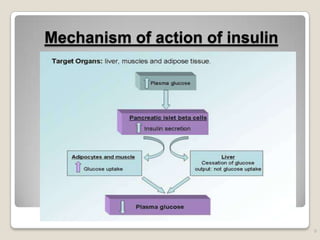
Mechanism of action :
i) Insulin receptor in cell membrane
mediates the effect;
ii) Insulin receptor is consisted by 2α-
subunits, which constitutes the recognition site,
8
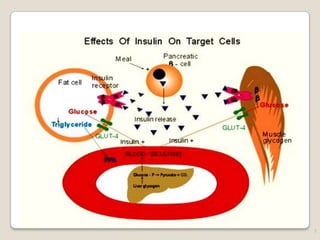
Mechanism of action of insulin
9
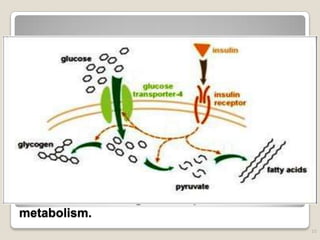
Effect of insulin on glucose uptake and
metabolism.
10
Clinical use
Diabetes mellitus :
Insulin is effective in all forms of
diabetes mellitus and is a must for IDDM cases,
as well as for post pancreatectomy diabetes
and gestational diabetes. Many NIDDM cases
can be controlled by diet, reduction in body
weight and appropriate exercise.
Insulin needed by some such patients:
i) Not controlled by diet and exercise
or when these are not practicable.
ii) Primary or secondary failure of oral
hypoglycemic or when these drugs are not
tolerated. 11
iii) Under weight patients.
iv) Temporarily to tide over infections,
trauma, surgery, pregnancy.
v) Any complication of diabetes, e.g.
Ketoacidosis, nonketotic hyperosmolar coma,
gangrene of extremities.
Other :
i) Hyperkalemia
ii) A component of GIK solution which is
for limiting myocardial infarction & arrhythmias.
12
Adverse reaction
Insulin allergy : Itching, redness, swelling,
anaphylaxis shock Hypoglycemia :
Nausea, hungry, tachycardia, sweating, and
tremulousness.
Insulin resistance :
i) Acute : Diabetic ketoacidoisis,
Nonketotic hyperosmolar coma.
ii) Chronic :
Microvascular disease: impotence &
poor wound healing
Atherosclerosis : Strokes, coronary
heart disease 13
Oral Hypoglycemic Drugs
Classification:
 Sulfonylureas
 Thiazolidinediones
 Biguanides
 α-glucosidase inhibitors
 Meglitinides
14
Sulfonylureas
Representative Drugs:
1st generation:
tolbutamide chlorpropamide
tolazamide
2nd generation:
glybenclamide glyburide
glipizide glymepride
3rd generation:
glyclazipe
15
Pharmacological effects:
1. Hypoglycemic effect:
2. Anti-diuretic effect:
chlorpropamide & glybenclamide
3. Anti-platelete aggregation effect:
glyclazipe
16
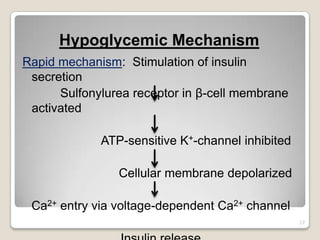
Hypoglycemic Mechanism
Rapid mechanism: Stimulation of insulin
secretion
Sulfonylurea receptor in β-cell membrane
activated
ATP-sensitive K+-channel inhibited
Cellular membrane depolarized
Ca2+ entry via voltage-dependent Ca2+ channel
17
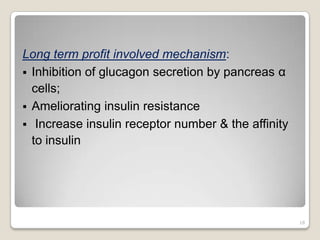
Long term profit involved mechanism:
 Inhibition of glucagon secretion by pancreas α
cells;
 Ameliorating insulin resistance
 Increase insulin receptor number & the affinity
to insulin
18
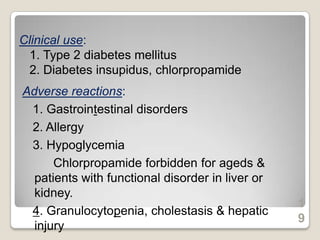
Clinical use:
1. Type 2 diabetes mellitus
2. Diabetes insupidus, chlorpropamide
Adverse reactions:
1. Gastrointestinal disorders
2. Allergy
3. Hypoglycemia
Chlorpropamide forbidden for ageds &
patients with functional disorder in liver or
kidney.
4. Granulocytopenia, cholestasis & hepatic
injury
1
9
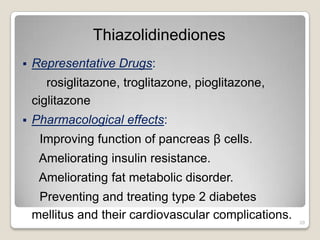
Thiazolidinediones
 Representative Drugs:
rosiglitazone, troglitazone, pioglitazone,
ciglitazone
 Pharmacological effects:
Improving function of pancreas β cells.
Ameliorating insulin resistance.
Ameliorating fat metabolic disorder.
Preventing and treating type 2 diabetes
mellitus and their cardiovascular complications. 20
 Mechanism (possible):
Per-oxisome proliferator-activated receptor-
γ(PPAR-γ) activated
Nuclear genes involved in glucose & lipid
metabolism and adipocyte differentiation
activated
 Clinical use:
Insulin resistance & type 2 diabetes mellitus
21
22

Insulin

  • 1.
  • 2.
    Diabetes Mellitus Diabetes mellitusis a metabolic disorder characterized by hyperglycemia, glucosourea, hyperlipaemia, negative nitrogen balance and sometimes ketonaemia. Two major types of diabetes mellitus: i) Insulin-dependent diabetes mellitus (IDDM). ii) Non-Insulin-dependent diabetes mellitus (NIDDM). Various symptoms are: Feeling very thirsty and tired, high level of glucose in urine, constant hunger 2
  • 3.
    Insulin-dependent diabetes mellitus :There is β cell destruction in pancreatic islets; majority of cases are autoimmune antibodies that destroy β cell are detectable in blood, but some are idiopathic, there are no β cell antibody are found. In all cases circulating insulin levels are low. Noninsulin-dependent diabetes mellitus : There is no loss or moderate reduction in β cell mass, insulin in circulation is low, normal or even high, no anti-β-cell antibody is demonstrable; has a high degree of genetic predisposition, generally has a late onset. 3
  • 4.
    Treatment IDDM : Insulinmust be injected or inhaled NIDDM : Food control, exercise, medicines: i) Which increase insulin secretion; ii) Which increase the sensitivity of target organs to insulin; iii) Which decrease glucose absorption. 4
  • 5.
    INSULIN Insulin was thefirst protein for amino acid sequence which consists of two peptides chains (21 and 30 amino acid residues) linked by disulfide bonds. Secretion : β-cell in pancreatic islet. Degradation : Liver & kidney. Endogenous: Liver (60 %) & kidney (35 %-40 %) Exogenous: Liver (35 %-40 %) & kidney (60 %) Half life : 3-5 min in plasma. 5
  • 6.
    Physiological & pharmacological actions Sugarmetabolism : Stimulates glucose uptake & use by cells; inhibits gluconeogenesis →blood sugar↓ Fatty metabolism : Improves fatty acid transportation & fat anabolism; inhibits fat catabolism & fatty acid, Protein metabolism : Improves a transportation & protein anabolism; inhibits 6
  • 7.
  • 8.
    Physiological & pharmacological actions Potassium: Stimulates K+ entering cells → blood K+↓ Long-term action : Improves or inhibits the synthesis of some enzymes. Mechanism of action : i) Insulin receptor in cell membrane mediates the effect; ii) Insulin receptor is consisted by 2α- subunits, which constitutes the recognition site, 8
  • 9.
    Mechanism of actionof insulin 9
  • 10.
    Effect of insulinon glucose uptake and metabolism. 10
  • 11.
    Clinical use Diabetes mellitus: Insulin is effective in all forms of diabetes mellitus and is a must for IDDM cases, as well as for post pancreatectomy diabetes and gestational diabetes. Many NIDDM cases can be controlled by diet, reduction in body weight and appropriate exercise. Insulin needed by some such patients: i) Not controlled by diet and exercise or when these are not practicable. ii) Primary or secondary failure of oral hypoglycemic or when these drugs are not tolerated. 11
  • 12.
    iii) Under weightpatients. iv) Temporarily to tide over infections, trauma, surgery, pregnancy. v) Any complication of diabetes, e.g. Ketoacidosis, nonketotic hyperosmolar coma, gangrene of extremities. Other : i) Hyperkalemia ii) A component of GIK solution which is for limiting myocardial infarction & arrhythmias. 12
  • 13.
    Adverse reaction Insulin allergy: Itching, redness, swelling, anaphylaxis shock Hypoglycemia : Nausea, hungry, tachycardia, sweating, and tremulousness. Insulin resistance : i) Acute : Diabetic ketoacidoisis, Nonketotic hyperosmolar coma. ii) Chronic : Microvascular disease: impotence & poor wound healing Atherosclerosis : Strokes, coronary heart disease 13
  • 14.
    Oral Hypoglycemic Drugs Classification: Sulfonylureas  Thiazolidinediones  Biguanides  α-glucosidase inhibitors  Meglitinides 14
  • 15.
    Sulfonylureas Representative Drugs: 1st generation: tolbutamidechlorpropamide tolazamide 2nd generation: glybenclamide glyburide glipizide glymepride 3rd generation: glyclazipe 15
  • 16.
    Pharmacological effects: 1. Hypoglycemiceffect: 2. Anti-diuretic effect: chlorpropamide & glybenclamide 3. Anti-platelete aggregation effect: glyclazipe 16
  • 17.
    Hypoglycemic Mechanism Rapid mechanism:Stimulation of insulin secretion Sulfonylurea receptor in β-cell membrane activated ATP-sensitive K+-channel inhibited Cellular membrane depolarized Ca2+ entry via voltage-dependent Ca2+ channel 17
  • 18.
    Long term profitinvolved mechanism:  Inhibition of glucagon secretion by pancreas α cells;  Ameliorating insulin resistance  Increase insulin receptor number & the affinity to insulin 18
  • 19.
    Clinical use: 1. Type2 diabetes mellitus 2. Diabetes insupidus, chlorpropamide Adverse reactions: 1. Gastrointestinal disorders 2. Allergy 3. Hypoglycemia Chlorpropamide forbidden for ageds & patients with functional disorder in liver or kidney. 4. Granulocytopenia, cholestasis & hepatic injury 1 9
  • 20.
    Thiazolidinediones  Representative Drugs: rosiglitazone,troglitazone, pioglitazone, ciglitazone  Pharmacological effects: Improving function of pancreas β cells. Ameliorating insulin resistance. Ameliorating fat metabolic disorder. Preventing and treating type 2 diabetes mellitus and their cardiovascular complications. 20
  • 21.
     Mechanism (possible): Per-oxisomeproliferator-activated receptor- γ(PPAR-γ) activated Nuclear genes involved in glucose & lipid metabolism and adipocyte differentiation activated  Clinical use: Insulin resistance & type 2 diabetes mellitus 21
  • 22.