

ANMOL JILANI
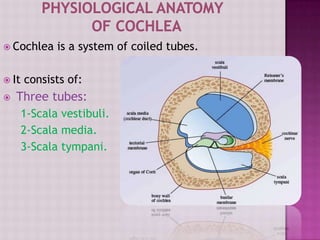
 Cochlea is a system of coiled tubes.
 It consists of:
 Three tubes:
1-Scala vestibuli.
2-Scala media.
3-Scala tympani.
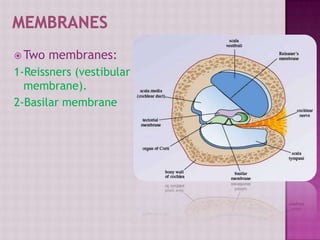
 Two membranes:
1-Reissners (vestibular
membrane).
2-Basilar membrane
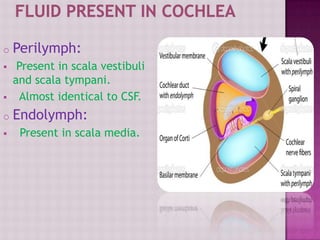
o Perilymph:
 Present in scala vestibuli
and scala tympani.
 Almost identical to CSF.
o Endolymph:
 Present in scala media.
 Contains 20,000 to 30,000 basillar fibers.
 These fibers are stiff,elastic,reed-like
structures that are fixed at their basal ends
in the center of cochlea (modiolus)but not
fixed at their distal ends.
 Length:
 The lenghth of the basilar fibers increase progressively
from the base of cochlea to its apex.
 Diameter:decreases from base to apex of cochlea.
 Frequency:
Base :high frequency.
Apex :low frequency.
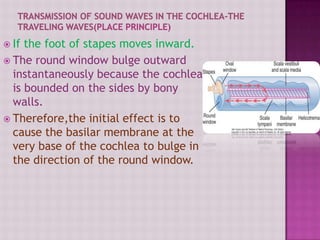
 If the foot of stapes moves inward.
 The round window bulge outward
instantaneously because the cochlea
is bounded on the sides by bony
walls.
 Therefore,the initial effect is to
cause the basilar membrane at the
very base of the cochlea to bulge in
the direction of the round window.
 however,the elastic tension that is built up
in the basilar fibers as they bend toward the
round window initiates a wave that travels
along the basilar membrane toward the
helicotreama.
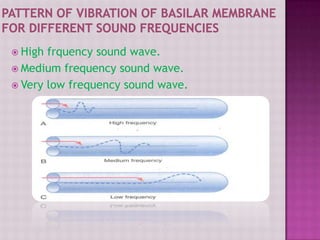
 High frquency sound wave.
 Medium frequency sound wave.
 Very low frequency sound wave.
 Lies on the surface of bassilar membrane.
 Contain mechanically sensitive hair cells
which are receptive end-organs and generate
nerve impulses in response to sound
vibrations.
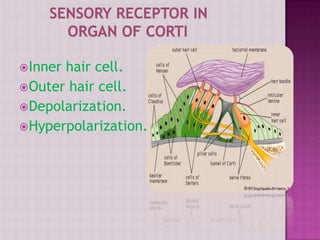
Inner hair cell.
Outer hair cell.
Depolarization.
Hyperpolarization.
 Stereocilia
 Direction toward the longer one
 Rapid K influx to tips of the stereocilia
 Depolarization of cell membrane
 Basilar fiber to scala vestibuli ………
depolarization
 Endocochlear Potential
 Perilymph (Na, K )
 EndoLymph(K, Na )
 +80mv diff. all the time
Cochlea & its functions

Cochlea & its functions

  • 2.
  • 3.
     Cochlea isa system of coiled tubes.  It consists of:  Three tubes: 1-Scala vestibuli. 2-Scala media. 3-Scala tympani.
  • 4.
     Two membranes: 1-Reissners(vestibular membrane). 2-Basilar membrane
  • 5.
    o Perilymph:  Presentin scala vestibuli and scala tympani.  Almost identical to CSF. o Endolymph:  Present in scala media.
  • 6.
     Contains 20,000to 30,000 basillar fibers.  These fibers are stiff,elastic,reed-like structures that are fixed at their basal ends in the center of cochlea (modiolus)but not fixed at their distal ends.
  • 7.
     Length:  Thelenghth of the basilar fibers increase progressively from the base of cochlea to its apex.  Diameter:decreases from base to apex of cochlea.  Frequency: Base :high frequency. Apex :low frequency.
  • 8.
     If thefoot of stapes moves inward.  The round window bulge outward instantaneously because the cochlea is bounded on the sides by bony walls.  Therefore,the initial effect is to cause the basilar membrane at the very base of the cochlea to bulge in the direction of the round window.
  • 9.
     however,the elastictension that is built up in the basilar fibers as they bend toward the round window initiates a wave that travels along the basilar membrane toward the helicotreama.
  • 10.
     High frquencysound wave.  Medium frequency sound wave.  Very low frequency sound wave.
  • 11.
     Lies onthe surface of bassilar membrane.  Contain mechanically sensitive hair cells which are receptive end-organs and generate nerve impulses in response to sound vibrations.
  • 12.
    Inner hair cell. Outerhair cell. Depolarization. Hyperpolarization.
  • 13.
     Stereocilia  Directiontoward the longer one  Rapid K influx to tips of the stereocilia  Depolarization of cell membrane  Basilar fiber to scala vestibuli ……… depolarization  Endocochlear Potential  Perilymph (Na, K )  EndoLymph(K, Na )  +80mv diff. all the time