InsulinFor BNS Ist Year
Dr. Pravin Prasad
Ist Year Resident, MD Clinical Pharmacology
Maharajgunj Medical Campus
5th October, 2015(Asoj 18, 2072); Monday
Insulin: Introduction
Ref: http://www.sedico.net/English/SedicoInformationCenter/DiabetesCenter/Pancreas/insulinoma1_e.htm
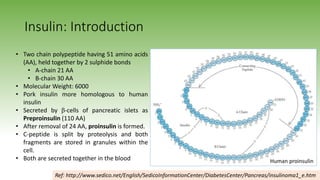
• Two chain polypeptide having 51 amino acids
(AA), held together by 2 sulphide bonds
• A-chain 21 AA
• B-chain 30 AA
• Molecular Weight: 6000
• Pork insulin more homologous to human
insulin
• Secreted by β-cells of pancreatic islets as
Preproinsulin (110 AA)
• After removal of 24 AA, proinsulin is formed.
• C-peptide is split by proteolysis and both
fragments are stored in granules within the
cell.
• Both are secreted together in the blood Human proinsulin
Regulation of Insulin Secretion
• Basal condition ~1U/hr; larger quantity following meals
• Regulated by following Mechanisms:
• Chemical
• Hormonal
• Neural
Chemical Regulation of Insulin Secretion
• Beta cells have glucose sensing mechanism activated by:
• Entry of glucose into beta cells (aegis of glucose transporter GLUT1)
• Phosphorylation of glucose by glucokinase
→Upon activation, it indirectly inhibits the ATP-sensitive K+ channels (K+
ATP)
→Partial depolarization of the β-cells
→Increases Ca2+ availability (increased influx, decreased efflux and release from
intracellular stores)
→Exocytotic release of insulin from storing granules.
• Response varies when nutrients are given orally and parenterally
Hormonal and Neural Regulation of Insulin
Secretion
Hormonal Regulation
• Intra-islet pancreatic interaction
• Growth Hormone,
Corticosteroids and Thyroxine
shows effect in on insulin
release in response to glucose.
Neural Regulation
On stimulation of Insulin Release
Adrenergic alpha2 Decreases
Adrenergic beta2 Increases
Cholinergic
(muscuranic)
(Ach or vagal
mediated)
Increases
Primary Central site of regulation of insulin secretion: Hypothalamus (Ventrolateral
nuclei  and Ventromedial nuclei )
Histology Of Pancreas
Insulin as an Anabolic Hormone: Actions
• Glucose transport across cell membrane
• Expression of glucose transporters into the membrane
• Intracellular utilization of glucose
• Effects on gluconeogenesis
• Effects on Lipid metabolism
• Effect on Very Low Density lipoprotein and Chylomicrons
• Effects on Protein Metabolism
Insulin: How it Acts
Insulin: How it acts
• Binds to alpha subunit of receptor tyrosine kinase (RTK) present in cell
membrane  Activates tyrosine kinase activity of beta subunit 
phosphorylates tyrosine residue present on eachother, Insulin Receptor
Substrate proteins (IRS1, IRS2) Activates a casacade of phosphorylation and
dephosphorylation reactions  Amplification of signals  stimulation and
inhibition of enzymes responsible for rapid action of insulin
• Translocation of glucose transporter GLUT4 to plasma membrane and
expression of genes directing synthesis of GLUT4 is promoted
• Long term effects exerted by generation of transcription factors promoting
proliferation and differentiation of specific cells
Insulin: Its Fate
• Distributed only extracellularly
• Degraded if given orally
• Injected insulin/insulin released from pancreas: metabolised in liver
(kidney and muscles also contributes)
• Biotransformation results into reduction of disulphide bonds: chains
are separated.
Insulin: Its Preparations
• Older commercial preparations: beef and pork insulin, ~1% (10,000
ppm) other proteins (proinsulins, polypeptides, pancreatic proteins,
insulin derivatives)
• Newer preparations: single peak and monocomponent, highly
purified pork/beef insulin, recombinant human insulin/insulin
analouges, <10 ppm proinsulin
Insulin: Its Preparations
• Regular Insulin:
• Soluble, buffered neutral pH of unmodified insulin stabilized by a small
amount of zinc
• Given sub cutaenously, slow absorption, peak activity after 2-3 hrs, lasts for 6-
8 hrs
• Needs to be injected ½ - 1 hr before meal: else risk of early postprandial
hyperglycaemia and late postprandial hypoglycaemia
• Cannot be mixed with insulin glargine/detemir
Insulin: Its preparations
Lente Insulin Neutral Protamine Hagedorn (NPH) Insulin or
Isophane Insulin
Insulin-zinc preparation Insulin- Protamine preparation
Combination of Ultralente (large particles,
crystalline, practically insoluble, long acting)
and semilente (small particles, amorphous,
short acting); Ratio 7:3
Protamine sufficient to complex all insulin
molecules
Neutral pH
Combined with regular insulin in the ratio
70:30 or 50:50
Injected twice daily s.c. before breakfast and
before dinner
Insulin Analouges
• Insulin lispro:
• Weak hexamers, dissociates rapidly
• Quick and more defined peak
• Injected immediately before or even after meal: better control of meal-time
glycaemia and lower incidence of post prandial hypoglycaemia
• Multiple injections, fewer incidence of hypoglycaemia
• Insulin aspart:
• Similar to insulin lispro
• Insulin glulisine:
• Used for continuous subcutaneous insulin infusion (CSII)
Insulin Analouges
• Insulin glargine:
• Remains soluble at pH4, precipitates at neutral pH
• Delayed onset of action, maintained for up to 24hrs: “smooth peakless effect”
• Insulin detemir:
• Binds to albumin and action is prolonged
• Twice daily dose is required
Insulin: Unwanted Efects
• Hypoglycaemia
• Seen more in labile diabetes patients
• Sympathetic symptoms and neuroglucopenic symptoms
• Hypoglycaemic unawareness
• Local Reactions
• Swelling, stinging, erythema; Lipodystrophy
• Allergy
• Utricaria, angioedema, anaphylaxis
• Edema
Uses of Insulin
• Diabetes Milletus:
• Mandatory in Type 1 DM (Insulin Dependent DM), post pancreatectomy
diabetes, gestational diabetes (0.4-0.8 u/Kg/day)
• Some cases of Type 2 DM (Non Insulin dependent DM): not controlled by
diet/exercise, failure of OHA, under weight, temporary situtations, during
complications (0.2-1.6 U/kg/day)
• Given as Split-mix regimen and Basal Bolus regimen
• Diabetes Ketoacidosis
• Regular insulin, 0.1-0.2 U/kg i.v. bolus followed by 0.1U/kg/hr infusion-
adjusted according to the fall in blood glucose levels
• Hyperosmolar (non ketotic) Hyperglycaemic Coma
Insulin Regimens
Split-mixed Regimen Basal Bolus Regimen
Regular insulin with lente or isophane
(30:70 or 50:50)
Long acting insulin (Insulin glargine) and short
acting insulin (lispro/aspart) injected separately
Injected Before Breakfast and Before
Dinner
Long acting insulin (glargine) injected daily
(before breakfast/ before bed time) with 2-3
meal time injections with rapid acting insulin
(lispro/aspart)
Only two daily injections required Better round the clock euglycaemia
• Post lunch glycaemia not adequately
controlled
• Late postprandial hypoglycaemia may
occur
• 3-4 daily injecctions
• More demanding and expensive
• Higher incidence of severe hypoglycaemia
• Best avoided in young and children and
elderly

Insulin

  • 1.
    InsulinFor BNS IstYear Dr. Pravin Prasad Ist Year Resident, MD Clinical Pharmacology Maharajgunj Medical Campus 5th October, 2015(Asoj 18, 2072); Monday
  • 2.
    Insulin: Introduction Ref: http://www.sedico.net/English/SedicoInformationCenter/DiabetesCenter/Pancreas/insulinoma1_e.htm •Two chain polypeptide having 51 amino acids (AA), held together by 2 sulphide bonds • A-chain 21 AA • B-chain 30 AA • Molecular Weight: 6000 • Pork insulin more homologous to human insulin • Secreted by β-cells of pancreatic islets as Preproinsulin (110 AA) • After removal of 24 AA, proinsulin is formed. • C-peptide is split by proteolysis and both fragments are stored in granules within the cell. • Both are secreted together in the blood Human proinsulin
  • 3.
    Regulation of InsulinSecretion • Basal condition ~1U/hr; larger quantity following meals • Regulated by following Mechanisms: • Chemical • Hormonal • Neural
  • 4.
    Chemical Regulation ofInsulin Secretion • Beta cells have glucose sensing mechanism activated by: • Entry of glucose into beta cells (aegis of glucose transporter GLUT1) • Phosphorylation of glucose by glucokinase →Upon activation, it indirectly inhibits the ATP-sensitive K+ channels (K+ ATP) →Partial depolarization of the β-cells →Increases Ca2+ availability (increased influx, decreased efflux and release from intracellular stores) →Exocytotic release of insulin from storing granules. • Response varies when nutrients are given orally and parenterally
  • 5.
    Hormonal and NeuralRegulation of Insulin Secretion Hormonal Regulation • Intra-islet pancreatic interaction • Growth Hormone, Corticosteroids and Thyroxine shows effect in on insulin release in response to glucose. Neural Regulation On stimulation of Insulin Release Adrenergic alpha2 Decreases Adrenergic beta2 Increases Cholinergic (muscuranic) (Ach or vagal mediated) Increases Primary Central site of regulation of insulin secretion: Hypothalamus (Ventrolateral nuclei  and Ventromedial nuclei )
  • 6.
  • 7.
    Insulin as anAnabolic Hormone: Actions • Glucose transport across cell membrane • Expression of glucose transporters into the membrane • Intracellular utilization of glucose • Effects on gluconeogenesis • Effects on Lipid metabolism • Effect on Very Low Density lipoprotein and Chylomicrons • Effects on Protein Metabolism
  • 8.
  • 9.
    Insulin: How itacts • Binds to alpha subunit of receptor tyrosine kinase (RTK) present in cell membrane  Activates tyrosine kinase activity of beta subunit  phosphorylates tyrosine residue present on eachother, Insulin Receptor Substrate proteins (IRS1, IRS2) Activates a casacade of phosphorylation and dephosphorylation reactions  Amplification of signals  stimulation and inhibition of enzymes responsible for rapid action of insulin • Translocation of glucose transporter GLUT4 to plasma membrane and expression of genes directing synthesis of GLUT4 is promoted • Long term effects exerted by generation of transcription factors promoting proliferation and differentiation of specific cells
  • 10.
    Insulin: Its Fate •Distributed only extracellularly • Degraded if given orally • Injected insulin/insulin released from pancreas: metabolised in liver (kidney and muscles also contributes) • Biotransformation results into reduction of disulphide bonds: chains are separated.
  • 11.
    Insulin: Its Preparations •Older commercial preparations: beef and pork insulin, ~1% (10,000 ppm) other proteins (proinsulins, polypeptides, pancreatic proteins, insulin derivatives) • Newer preparations: single peak and monocomponent, highly purified pork/beef insulin, recombinant human insulin/insulin analouges, <10 ppm proinsulin
  • 12.
    Insulin: Its Preparations •Regular Insulin: • Soluble, buffered neutral pH of unmodified insulin stabilized by a small amount of zinc • Given sub cutaenously, slow absorption, peak activity after 2-3 hrs, lasts for 6- 8 hrs • Needs to be injected ½ - 1 hr before meal: else risk of early postprandial hyperglycaemia and late postprandial hypoglycaemia • Cannot be mixed with insulin glargine/detemir
  • 13.
    Insulin: Its preparations LenteInsulin Neutral Protamine Hagedorn (NPH) Insulin or Isophane Insulin Insulin-zinc preparation Insulin- Protamine preparation Combination of Ultralente (large particles, crystalline, practically insoluble, long acting) and semilente (small particles, amorphous, short acting); Ratio 7:3 Protamine sufficient to complex all insulin molecules Neutral pH Combined with regular insulin in the ratio 70:30 or 50:50 Injected twice daily s.c. before breakfast and before dinner
  • 14.
    Insulin Analouges • Insulinlispro: • Weak hexamers, dissociates rapidly • Quick and more defined peak • Injected immediately before or even after meal: better control of meal-time glycaemia and lower incidence of post prandial hypoglycaemia • Multiple injections, fewer incidence of hypoglycaemia • Insulin aspart: • Similar to insulin lispro • Insulin glulisine: • Used for continuous subcutaneous insulin infusion (CSII)
  • 15.
    Insulin Analouges • Insulinglargine: • Remains soluble at pH4, precipitates at neutral pH • Delayed onset of action, maintained for up to 24hrs: “smooth peakless effect” • Insulin detemir: • Binds to albumin and action is prolonged • Twice daily dose is required
  • 16.
    Insulin: Unwanted Efects •Hypoglycaemia • Seen more in labile diabetes patients • Sympathetic symptoms and neuroglucopenic symptoms • Hypoglycaemic unawareness • Local Reactions • Swelling, stinging, erythema; Lipodystrophy • Allergy • Utricaria, angioedema, anaphylaxis • Edema
  • 17.
    Uses of Insulin •Diabetes Milletus: • Mandatory in Type 1 DM (Insulin Dependent DM), post pancreatectomy diabetes, gestational diabetes (0.4-0.8 u/Kg/day) • Some cases of Type 2 DM (Non Insulin dependent DM): not controlled by diet/exercise, failure of OHA, under weight, temporary situtations, during complications (0.2-1.6 U/kg/day) • Given as Split-mix regimen and Basal Bolus regimen • Diabetes Ketoacidosis • Regular insulin, 0.1-0.2 U/kg i.v. bolus followed by 0.1U/kg/hr infusion- adjusted according to the fall in blood glucose levels • Hyperosmolar (non ketotic) Hyperglycaemic Coma
  • 18.
    Insulin Regimens Split-mixed RegimenBasal Bolus Regimen Regular insulin with lente or isophane (30:70 or 50:50) Long acting insulin (Insulin glargine) and short acting insulin (lispro/aspart) injected separately Injected Before Breakfast and Before Dinner Long acting insulin (glargine) injected daily (before breakfast/ before bed time) with 2-3 meal time injections with rapid acting insulin (lispro/aspart) Only two daily injections required Better round the clock euglycaemia • Post lunch glycaemia not adequately controlled • Late postprandial hypoglycaemia may occur • 3-4 daily injecctions • More demanding and expensive • Higher incidence of severe hypoglycaemia • Best avoided in young and children and elderly

Editor's Notes

  • #5 Other nutrients that can evoke insulin release: amino acids, fatty acids and ketone bodies; glucose principal regulator Response for glucose has 2 phases: rapid and brief first phase, delayed and sustained second phase When nutrients are given orally, incretins are generated (Glucagon like peptide-1, Glucose dependent insulinotropic polypeptide GIP, Vasoactive intestinal peptide, pancreozymin-cholecystokinin, etc)
  • #6 Intra-islet pancreatic interaction: Alpha cells – glucagon; Beta cells – insulin; Delta cells – somatostatin; Pancreatic peptide cells Somatostatin inhibits insulin and glucagon; Glucagon stimulates release of insulin and somatostatin; Insulin inhibits glucagon Islet cells richly supplied by sympathothetic and vagal nerves
  • #8 Facilitates glucose transport across cell membrane: skeletal muscles and fat highly sensitive; insulin not required for glucose entry into liver, brain, RBC, WBC and renal medulla cells; ketoacidosis interferes with glucose utilization by brain  diabetic coma; entry of glucose into muscles facilitated by exercise ‘insulin sparing effect’; intracellular pool of vesicles containing glucose transporter glycoproteins 4 (GLUT4) and GLUT1 is in dynamic equilibrium with the GLUT vesicles inserted into the membrane: regulated by insulin (favours translocation); and on long term basis synthesis of GLUT4 is upregulated by insulin Intracellular utilization of glucose: phosphorylation to form glucose-6-phosphate is enhanced by insulin by increasing production of glucokinase; facilitates glycogen synthesis by stimulating glycogen synthase; decreases glycogen degradation by inhibiting phosphorylase Effects on gluconeogenesis: from protein, FFA, glycerol by gene mediated decreased synthesis of phosphoenolpyruvate carboxykinase Effects on Lipid metabolism: inhibits lipolysis in adipose tissue and favours triglyceride formations; diabetes  unchecked activity of lipolytic hormones(Adrenaline, glucagon, thyroxine, etc)  excess of fat broken  increased FFA and glycerol in blood  converted into acetyl-CoA by liver  excess of acetyl-CoA cannot be converted into fatty acids and TG and is converted into ketone bodies (acetone, acetoacetate, β-hydroxyl-butyrate)  released in blood, partly used by muscle and heart, rest causes ketonemia and ketonuria Effect on Very Low Density lipoprotein and Chylomicrons: Insulin enhances vascular endothelial lipoprotein lipase  increased clearance of VLDL and chylomicrons Effects on Protein Metabolism: facilitates AA entry and protein systhesis, inhibits proteolysis
  • #10 RTK receptor: heterotetrameric glycoprotein receptor having 2 alpha and 2 beta subunits linked together by disulphide bonds, alpha subunit is the binding site of insulin, beta subunit is placed across the membrane with inner end having protein kinase activity. Binds to alpha subunit of receptor tyrosine kinase (RTK) present in cell membrane  Internalization of the receptor along with bound insulin molecules  Activates tyrosine kinase activity of beta subunit  phosphorylates tyrosine residue present on eachother  phosphorylation of tyrosine residues of Insulin Receptor Substrate proteins (IRS1, IRS2) occurs  Activates a casacade of phosphorylation and dephosphorylation reactions  Amplification of signals  stimulation and inhibition of enzymes responsible for rapid action of insulin Activation of PI3-kinase  generation of Phosphatidyl inositol triphosphate (PIP3)  action of insulin on metabolic enzymes Translocation of glucose transporter GLUT4 to plasma membrane  increase glucose transport across cell membrane (facilitated by PIP3 and tyrosine phosphorylated guanine nucleotide exchange proteins, esp in skeletal muscles and adipose tissue) Expression of genes directing synthesis of GLUT4 is promoted Regulation of genes responsible for large number of enzymes and carriers  Ras/Raf and MAP-Kinase and phosphorylation casacade Long term effects exerted by generation of transcription factors promoting proliferation and differentiation of specific cells
  • #11 Fate of internalized receptor-insulin complex: Degraded internally (maximum in liver, least in vascular endothelium) Returned to the surface, insulin released extra-cellularly