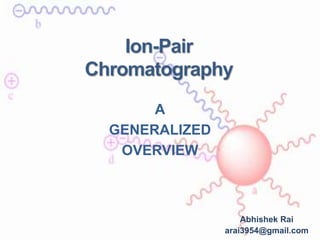
Abhishek Rai
arai3954@gmail.com
A
GENERALIZED
OVERVIEW
Chromatography
• Term chromatography is derived from
Greek word ‘Chroma’ meaning colour and
‘graphein’ meaning to write.
• First used by a russian botanist Mikhail
Tswatt in 1906.
• Group of methods for separating
molecular mixtures.
Chromatography
• According to USP, Chromatography is a
procedure by which solutes are separated
by a differential migration process in a
system consisting of two or more phases
one of which moves continuously in a
given direction and in which individual
substances exhibit different mobilities by
reason of differences in adsorption,
partition, solubility, vapour pressure,
molecular size, or ion charge density.
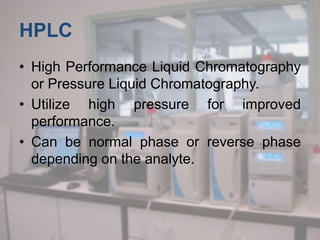
HPLC
• High Performance Liquid Chromatography
or Pressure Liquid Chromatography.
• Utilize high pressure for improved
performance.
• Can be normal phase or reverse phase
depending on the analyte.
Reverse Phase Chromatography
• Have non polar or less polar stationary phase
and polar or more polar mobile phase.
• Polar eluents having high affinity for mobile
phases elute first than the less polar one.
• Columns of stationary phase used are ODS
or C18, C8, C4,macroporus styrene-
divinylbenzene polymers etc.
• Specially useful for pharmaceutical analysis
as most of the drugs are polar in nature.
Ion Pair Chromatography
• Also known as ion interaction or dynamic
ion exchange chromatography.
• Subset of reverse phase chromatography.
• Used to achieve separation of ionized or
ionizable species or a mixture containing
both charged and uncharged analyte.
• Involves the ionic association of a charged
molecule with the opposite charge on the
ion pair reagent.
Ion Pair Chromatography
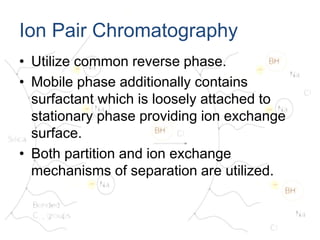
• Utilize common reverse phase.
• Mobile phase additionally contains
surfactant which is loosely attached to
stationary phase providing ion exchange
surface.
• Both partition and ion exchange
mechanisms of separation are utilized.
Ion Pair Chromatography
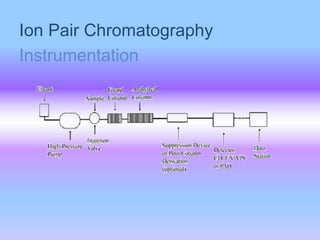
Instrumentation
Ion Pair Chromatography
• Added to mobile phase at low
concentration (usually 0.05M) and is itself
ionized.
• Ion pair reagent are molecules containing
a hydrophobic region and an ionizable
functioality.
• One ion of the reagent is retained by the
stationary phase providing the otherwise
neutral stationary phase with its charge.
Ion Pair Reagent
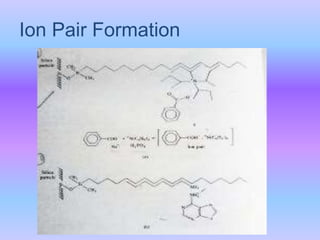
• This charged stationary phase can then
retain and separate organic solute ions of
the opposite charge by forming a
reversible ion pair complex with the
ionized sample. eg
RCOO- + R4N+ --- [R4N+-OOCR] ion pair
Ion Pair Chromatography
Ion Pair Reagent
Mechanism of Ion Pair Chromatography
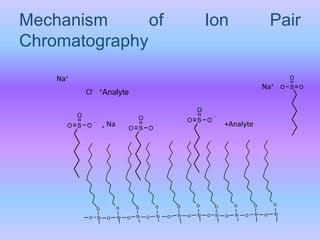
• Two fundamental models.
1. The solute molecule forms an ion pair
with counter ion in the mobile phase. This
uncharged ion pair partitions into the
lipophilic stationary phase.
2. the counterion partitions into the
stationary phase or is loaded onto the
bonded reverse phase packing, with its
ionic group oriented at the surface
generating two possibilities:
OO
SiO SiO
OO
SiO SiO
OO
SiO SiO
OO
SiO SiO
OO
SiO SiO
Na+
+ Na
Na+
SO
O
O
+Analyte
+Analyte
Cl-
S O
O
OS O
O
O
S O
O
O
Mechanism of Ion Pair
Chromatography
Ion Pair Formation
Mechanism of Ion Pair
Chromatography
a) Analyte can be attracted to the
hydrocarbon portion in the usual reverse
phase monomer, or
b) Analyte can interact in an ion exchange
mode.
– True mechanism involves both the
postulates and is further complicated
by adsorption and micelle formation
allowing the unique separation.
Ion Pair Chromatography
• Replace aqueous portion of mobile phase
with water.
• Flush with 5-10 column volumes water.
• Flush with 10-20 column volumes organic
phase.
• Store in 100% organic solvent.
Ion Pair Wash Procedure
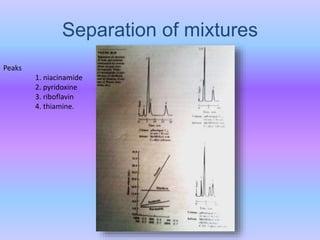
Separation of mixtures
Peaks
1. niacinamide
2. pyridoxine
3. riboflavin
4. thiamine.
Ion Pair Chromatography
• Retention behavior reflects thedistribution
of a solute between the mobile and the
stationary phases ultimately leading to
separation.
• As much difference in the retention
parameters (retention time, retention
volume etc.) of two components so is the
separation.
Retention and influencing factors
Extent of ion pair complex formation.
Binding strength of the ion pair complex
with stationary phase.
pH adjustment.
Selection of counterion and its
concentration.
Relative size of the lipophilic group on the
counterion.
Ion Pair Chromatography
Retention and influencing factors
Advantages of Ion Pair Chromatography
• Overcomes difficulty in handling very
polar, multiply ionized, and/or strongly
basic samples.
• Separates two or more charged
components present in the analyte.
• Better chromatography of large ions (vs.
ion exchange).
• Can separate neutral and charged ions at
the same time.
• Analytes with very high or very low pKa
values which are resistant to separation
based on pH adjustment can be separated.
• Flexibility with repairing agent.
• Better selectivity and capacity than ion
exchange chromatography.
• Suitable for large hydrophobic ions which
show slow mass transfer or secondary
hydrophobic interactions leading to poor
efficiency and resolution.
Advantages of Ion Pair Chromatography
References
• Mayers R.A., Encyclopedia of Analytical
chemistry, 2000, John Wiley and Sons Inc,
New York, USA.
• Settle R.A., Handbook for Instrumental
techniques for Analytical Chemistry, 1997,
Prantice Hall Inc. New Jersy, USA.
• Remington, The Science and Practice of
Pharmacy, vol. 1, edi. 21st, 2006, B.I.
Publications Pvt. Ltd., India.
• Willard H.H., Merritt L.L. Jr., Dean J.A.,
Settle F.A. Jr., Instrumentlal Methods of
Analysis, edi. 7th, 1986, CBS publishers
and Distributors, India.
• www.sepscience.com/techniques/LC/articl
es/705-/HPLC-Solutions-11-washing-IP-
columns .
References
Ion pair chromatography for pharmacy students

Ion pair chromatography for pharmacy students

  • 1.
  • 2.
    Chromatography • Term chromatographyis derived from Greek word ‘Chroma’ meaning colour and ‘graphein’ meaning to write. • First used by a russian botanist Mikhail Tswatt in 1906. • Group of methods for separating molecular mixtures.
  • 3.
    Chromatography • According toUSP, Chromatography is a procedure by which solutes are separated by a differential migration process in a system consisting of two or more phases one of which moves continuously in a given direction and in which individual substances exhibit different mobilities by reason of differences in adsorption, partition, solubility, vapour pressure, molecular size, or ion charge density.
  • 4.
    HPLC • High PerformanceLiquid Chromatography or Pressure Liquid Chromatography. • Utilize high pressure for improved performance. • Can be normal phase or reverse phase depending on the analyte.
  • 5.
    Reverse Phase Chromatography •Have non polar or less polar stationary phase and polar or more polar mobile phase. • Polar eluents having high affinity for mobile phases elute first than the less polar one. • Columns of stationary phase used are ODS or C18, C8, C4,macroporus styrene- divinylbenzene polymers etc. • Specially useful for pharmaceutical analysis as most of the drugs are polar in nature.
  • 6.
    Ion Pair Chromatography •Also known as ion interaction or dynamic ion exchange chromatography. • Subset of reverse phase chromatography. • Used to achieve separation of ionized or ionizable species or a mixture containing both charged and uncharged analyte. • Involves the ionic association of a charged molecule with the opposite charge on the ion pair reagent.
  • 7.
    Ion Pair Chromatography •Utilize common reverse phase. • Mobile phase additionally contains surfactant which is loosely attached to stationary phase providing ion exchange surface. • Both partition and ion exchange mechanisms of separation are utilized.
  • 8.
  • 9.
    Ion Pair Chromatography •Added to mobile phase at low concentration (usually 0.05M) and is itself ionized. • Ion pair reagent are molecules containing a hydrophobic region and an ionizable functioality. • One ion of the reagent is retained by the stationary phase providing the otherwise neutral stationary phase with its charge. Ion Pair Reagent
  • 10.
    • This chargedstationary phase can then retain and separate organic solute ions of the opposite charge by forming a reversible ion pair complex with the ionized sample. eg RCOO- + R4N+ --- [R4N+-OOCR] ion pair Ion Pair Chromatography Ion Pair Reagent
  • 11.
    Mechanism of IonPair Chromatography • Two fundamental models. 1. The solute molecule forms an ion pair with counter ion in the mobile phase. This uncharged ion pair partitions into the lipophilic stationary phase. 2. the counterion partitions into the stationary phase or is loaded onto the bonded reverse phase packing, with its ionic group oriented at the surface generating two possibilities:
  • 12.
    OO SiO SiO OO SiO SiO OO SiOSiO OO SiO SiO OO SiO SiO Na+ + Na Na+ SO O O +Analyte +Analyte Cl- S O O OS O O O S O O O Mechanism of Ion Pair Chromatography
  • 13.
  • 14.
    Mechanism of IonPair Chromatography a) Analyte can be attracted to the hydrocarbon portion in the usual reverse phase monomer, or b) Analyte can interact in an ion exchange mode. – True mechanism involves both the postulates and is further complicated by adsorption and micelle formation allowing the unique separation.
  • 15.
    Ion Pair Chromatography •Replace aqueous portion of mobile phase with water. • Flush with 5-10 column volumes water. • Flush with 10-20 column volumes organic phase. • Store in 100% organic solvent. Ion Pair Wash Procedure
  • 16.
    Separation of mixtures Peaks 1.niacinamide 2. pyridoxine 3. riboflavin 4. thiamine.
  • 17.
    Ion Pair Chromatography •Retention behavior reflects thedistribution of a solute between the mobile and the stationary phases ultimately leading to separation. • As much difference in the retention parameters (retention time, retention volume etc.) of two components so is the separation. Retention and influencing factors
  • 18.
    Extent of ionpair complex formation. Binding strength of the ion pair complex with stationary phase. pH adjustment. Selection of counterion and its concentration. Relative size of the lipophilic group on the counterion. Ion Pair Chromatography Retention and influencing factors
  • 19.
    Advantages of IonPair Chromatography • Overcomes difficulty in handling very polar, multiply ionized, and/or strongly basic samples. • Separates two or more charged components present in the analyte. • Better chromatography of large ions (vs. ion exchange). • Can separate neutral and charged ions at the same time.
  • 20.
    • Analytes withvery high or very low pKa values which are resistant to separation based on pH adjustment can be separated. • Flexibility with repairing agent. • Better selectivity and capacity than ion exchange chromatography. • Suitable for large hydrophobic ions which show slow mass transfer or secondary hydrophobic interactions leading to poor efficiency and resolution. Advantages of Ion Pair Chromatography
  • 21.
    References • Mayers R.A.,Encyclopedia of Analytical chemistry, 2000, John Wiley and Sons Inc, New York, USA. • Settle R.A., Handbook for Instrumental techniques for Analytical Chemistry, 1997, Prantice Hall Inc. New Jersy, USA. • Remington, The Science and Practice of Pharmacy, vol. 1, edi. 21st, 2006, B.I. Publications Pvt. Ltd., India.
  • 22.
    • Willard H.H.,Merritt L.L. Jr., Dean J.A., Settle F.A. Jr., Instrumentlal Methods of Analysis, edi. 7th, 1986, CBS publishers and Distributors, India. • www.sepscience.com/techniques/LC/articl es/705-/HPLC-Solutions-11-washing-IP- columns . References