11 
Bioanalytical Method Development And 
IInnssttiittuuttiioonnaall SSuuppeerrvviissoorr 
MMrr.. PPrraavveeeenn CChhaauuddhhaarryy 
DDeepptttt..ooff QQuuaalliittyy AAssssuurraannccee 
TTeecchhnniiqquueess 
SSGGRRRRIITTSS,, DDeehhrraadduunn 
IInndduussttrriiaall ssuuppeerrvviissoorr-- 
MMrr.. AAjjaayy KKuummaarr SSiinngghh 
GGrroouupp LLeeaaddeerr 
CCPPPP,, RRaannbbaaxxyy RReesseeaarrcchh LLaabb.. 
GGuurrggaaoonn 
Validation 
SSUUBBMMIITTTTEEDD BBYY-- 
RRaahhuull NNaauuddiiyyaall ((MM.. PPHHAARRMM)) 
QQuuaalliittyy AAssssuurraannccee TTeecchhnniiqquueess 
((QQAATT))
 Introduction 
 Objective 
 Method Development 
 Method Validation 
 Validation Parameter 
 Plan of Work 
 Reference 
22
 Bioanalytical Method relates specifically to determine the 
concentration of drug or its metabolite or both in biological 
matrix such as plasma, serum, urine , etc 
 Bioanalytical information used in human clinical 
pharmacology, bioavailablity (BA) and bioequivalence (BE) 
studies requiring pharmacokinetic evaluation 
 Bioanalytical method is also used for non human 
pharmacology/ toxicology studies (preclinical studies)
 LC/MS/MS is a hyphenated technique that combines 
physical separation power of liquid chromatography 
with detection power of Mass spectrometry. 
 LC/MS/MS is a powerful technique used for many 
application which have very high sensitivity and 
specificity 
44
• To develop and validate highly specific, reliable and cost 
effective LC-MS/MS method for determination of drug 
in human plasma 
• The scope of developing and validating the bioanalytical 
method is to get a suitable method which is more 
accurate and precise for the analyte of interest under 
given set of lab condition by using resources available 
55
66 
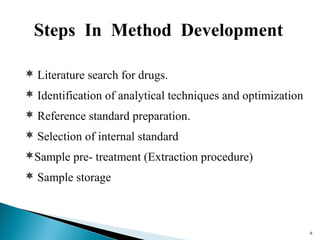
Steps In Method Development 
 Literature search for drugs. 
 Identification of analytical techniques and optimization 
 Reference standard preparation. 
 Selection of internal standard 
Sample pre- treatment (Extraction procedure) 
 Sample storage
77 
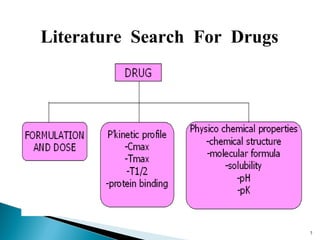
Literature Search For Drugs
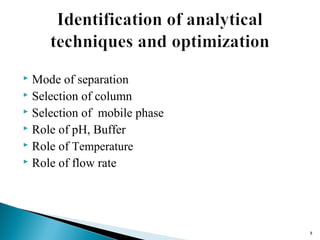
 Mode of separation 
 Selection of column 
 Selection of mobile phase 
 Role of pH, Buffer 
 Role of Temperature 
 Role of flow rate 
88
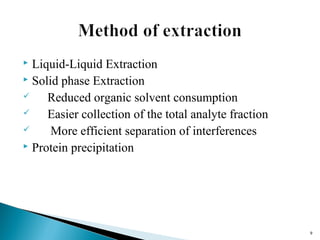
 Liquid-Liquid Extraction 
 Solid phase Extraction 
 Reduced organic solvent consumption 
 Easier collection of the total analyte fraction 
 More efficient separation of interferences 
 Protein precipitation 
99
1100 
Validation 
What is Validation and why should it be done ? 
Validation is the process of determining the suitability 
of a 
given methodology for providing useful analytical data 
Validation is required for any new method to ensure that it 
is capable to give reproducible and reliable results, when 
used by different operators employing the same 
equipment in the same or different laboratories
1111 
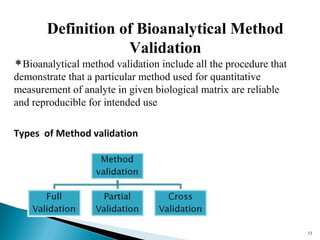
Definition of Bioanalytical Method 
Validation 
Bioanalytical method validation include all the procedure that 
demonstrate that a particular method used for quantitative 
measurement of analyte in given biological matrix are reliable 
and reproducible for intended use 
Types of Method validation
1122 
Validation parameters 
Specificity/selectivity 
 Sensitivity 
Accuracy 
Precision 
Linearity 
Recovery 
 Matrix Effect 
Stability
 Ability of an analytical method to differentiate and 
quantify the analyte in the presence of other 
components in the sample 
 Selectivity is evaluated by injecting extracted 
blank plasma and comparing with the response of 
extracted LLOQ samples processed with internal 
standard. 
1133
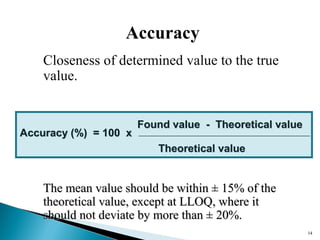
Accuracy 
Closeness of determined value to the true 
value. 
val The mean valuuee sshhoouulldd bbee wwiitthhiinn ±± 1155%% ooff tthhee 
tthheeoorreettiiccaall vvaalluuee,, eexxcceepptt aatt LLLLOOQQ,, wwhheerree iitt 
sshhoouulldd nnoott ddeevviiaattee bbyy mmoorree tthhaann ±± 2200%%.. 
1144 
AAccccuurraaccyy ((%%)) == 110000 xx 
FFoouunndd vvaalluuee -- TThheeoorreettiiccaall vvaalluuee 
TThheeoorreettiiccaall vvaalluuee
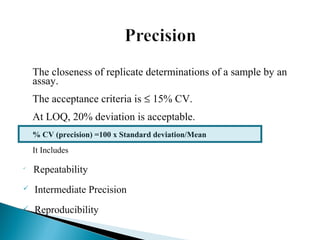
The closeness of replicate determinations of a sample by an 
assay. 
The acceptance criteria is £ 15% CV. 
At LOQ, 20% deviation is acceptable. 
% CV (precision) =100 x Standard deviation/Mean 
It Includes 
 Repeatability 
 Intermediate Precision 
 Reproducibility
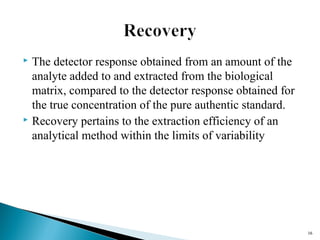
 The detector response obtained from an amount of the 
analyte added to and extracted from the biological 
matrix, compared to the detector response obtained for 
the true concentration of the pure authentic standard. 
 Recovery pertains to the extraction efficiency of an 
analytical method within the limits of variability 
1166
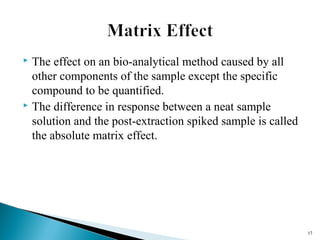
 The effect on an bio-analytical method caused by all 
other components of the sample except the specific 
compound to be quantified. 
 The difference in response between a neat sample 
solution and the post-extraction spiked sample is called 
the absolute matrix effect. 
1177
 Due to ion suppression/enhancement by the others ions 
present in the biological matrix which might get 
ionized during detection and will give false results. 
 Matrix effect studied by comparing the response of 
extracted samples spiked before extraction with 
response of the blank matrix sample to which analyte 
has been added at the same nominal concentration just 
before injection 
1188
1199 
chemical stability of an analyte in a given matrix 
under specific conditions for given time intervals. 
Analyte change in any respect affect the 
chromatographic behavior which may complicate the 
method development the following activities should be 
considered: 
•Analyte and IS stock stability in solvent 
•Short Term Stability in matrix 
•Bench top stability in matrix 
•Freeze-thaw stability in matrix 
•In-injector stability in matrix 
•Long-term stability in matrix
 literature survey 
 Selection of analytical technique. 
 Method Development 
 Method Validation 
 Compilation of data 
 Result & conclusion 
2200
 Food and Drug Administration, FDA, Guidance for Industry: Bioanalytical Method 
Validation, Rockville, MD: US Department of Health and Human Services, Food and Drug 
Administration, Center for Drug Evaluation and Research, 2013. 
 Peters F.T., Review: Bioanalytical method validation – How, how much and why, Department 
of Experimental and Clinical Toxicology, Institute of Experimental and Clinical 
Pharmacology and Toxicology, University of Saarland. 
 Pranay W, Bioanalytical Method Development –Determination of Drugs in Biological Fluids 
2010. 
 Skoog DA, West DM, Holler FJ, Crouch SR. Fundamentals of Analytical chemistry. 18th ed. 
Thomson Asia pvt Ltd. Chapter 1. The nature of analytical chemistry. 2004; 2-5 & 973-996. 
 Chatwal R. G., Anand K. S. Instrumental method of chemical analysis, Himalaya Publishing 
House , Mumbai, 2007, 3rd edition, pp. 2.566 – 2.587, 2.624 – 2.639, 2.272- 2.302. 
 ICH, Validation of analytical procedure, International conference on Harmonization, IFPMA, 
Q2B Validation of Analytical Procedures: Methodology 
2211
2222

Bioanalytical Method Validation

  • 1.
    11 Bioanalytical MethodDevelopment And IInnssttiittuuttiioonnaall SSuuppeerrvviissoorr MMrr.. PPrraavveeeenn CChhaauuddhhaarryy DDeepptttt..ooff QQuuaalliittyy AAssssuurraannccee TTeecchhnniiqquueess SSGGRRRRIITTSS,, DDeehhrraadduunn IInndduussttrriiaall ssuuppeerrvviissoorr-- MMrr.. AAjjaayy KKuummaarr SSiinngghh GGrroouupp LLeeaaddeerr CCPPPP,, RRaannbbaaxxyy RReesseeaarrcchh LLaabb.. GGuurrggaaoonn Validation SSUUBBMMIITTTTEEDD BBYY-- RRaahhuull NNaauuddiiyyaall ((MM.. PPHHAARRMM)) QQuuaalliittyy AAssssuurraannccee TTeecchhnniiqquueess ((QQAATT))
  • 2.
     Introduction Objective  Method Development  Method Validation  Validation Parameter  Plan of Work  Reference 22
  • 3.
     Bioanalytical Methodrelates specifically to determine the concentration of drug or its metabolite or both in biological matrix such as plasma, serum, urine , etc  Bioanalytical information used in human clinical pharmacology, bioavailablity (BA) and bioequivalence (BE) studies requiring pharmacokinetic evaluation  Bioanalytical method is also used for non human pharmacology/ toxicology studies (preclinical studies)
  • 4.
     LC/MS/MS isa hyphenated technique that combines physical separation power of liquid chromatography with detection power of Mass spectrometry.  LC/MS/MS is a powerful technique used for many application which have very high sensitivity and specificity 44
  • 5.
    • To developand validate highly specific, reliable and cost effective LC-MS/MS method for determination of drug in human plasma • The scope of developing and validating the bioanalytical method is to get a suitable method which is more accurate and precise for the analyte of interest under given set of lab condition by using resources available 55
  • 6.
    66 Steps InMethod Development  Literature search for drugs.  Identification of analytical techniques and optimization  Reference standard preparation.  Selection of internal standard Sample pre- treatment (Extraction procedure)  Sample storage
  • 7.
  • 8.
     Mode ofseparation  Selection of column  Selection of mobile phase  Role of pH, Buffer  Role of Temperature  Role of flow rate 88
  • 9.
     Liquid-Liquid Extraction  Solid phase Extraction  Reduced organic solvent consumption  Easier collection of the total analyte fraction  More efficient separation of interferences  Protein precipitation 99
  • 10.
    1100 Validation Whatis Validation and why should it be done ? Validation is the process of determining the suitability of a given methodology for providing useful analytical data Validation is required for any new method to ensure that it is capable to give reproducible and reliable results, when used by different operators employing the same equipment in the same or different laboratories
  • 11.
    1111 Definition ofBioanalytical Method Validation Bioanalytical method validation include all the procedure that demonstrate that a particular method used for quantitative measurement of analyte in given biological matrix are reliable and reproducible for intended use Types of Method validation
  • 12.
    1122 Validation parameters Specificity/selectivity  Sensitivity Accuracy Precision Linearity Recovery  Matrix Effect Stability
  • 13.
     Ability ofan analytical method to differentiate and quantify the analyte in the presence of other components in the sample  Selectivity is evaluated by injecting extracted blank plasma and comparing with the response of extracted LLOQ samples processed with internal standard. 1133
  • 14.
    Accuracy Closeness ofdetermined value to the true value. val The mean valuuee sshhoouulldd bbee wwiitthhiinn ±± 1155%% ooff tthhee tthheeoorreettiiccaall vvaalluuee,, eexxcceepptt aatt LLLLOOQQ,, wwhheerree iitt sshhoouulldd nnoott ddeevviiaattee bbyy mmoorree tthhaann ±± 2200%%.. 1144 AAccccuurraaccyy ((%%)) == 110000 xx FFoouunndd vvaalluuee -- TThheeoorreettiiccaall vvaalluuee TThheeoorreettiiccaall vvaalluuee
  • 15.
    The closeness ofreplicate determinations of a sample by an assay. The acceptance criteria is £ 15% CV. At LOQ, 20% deviation is acceptable. % CV (precision) =100 x Standard deviation/Mean It Includes  Repeatability  Intermediate Precision  Reproducibility
  • 16.
     The detectorresponse obtained from an amount of the analyte added to and extracted from the biological matrix, compared to the detector response obtained for the true concentration of the pure authentic standard.  Recovery pertains to the extraction efficiency of an analytical method within the limits of variability 1166
  • 17.
     The effecton an bio-analytical method caused by all other components of the sample except the specific compound to be quantified.  The difference in response between a neat sample solution and the post-extraction spiked sample is called the absolute matrix effect. 1177
  • 18.
     Due toion suppression/enhancement by the others ions present in the biological matrix which might get ionized during detection and will give false results.  Matrix effect studied by comparing the response of extracted samples spiked before extraction with response of the blank matrix sample to which analyte has been added at the same nominal concentration just before injection 1188
  • 19.
    1199 chemical stabilityof an analyte in a given matrix under specific conditions for given time intervals. Analyte change in any respect affect the chromatographic behavior which may complicate the method development the following activities should be considered: •Analyte and IS stock stability in solvent •Short Term Stability in matrix •Bench top stability in matrix •Freeze-thaw stability in matrix •In-injector stability in matrix •Long-term stability in matrix
  • 20.
     literature survey  Selection of analytical technique.  Method Development  Method Validation  Compilation of data  Result & conclusion 2200
  • 21.
     Food andDrug Administration, FDA, Guidance for Industry: Bioanalytical Method Validation, Rockville, MD: US Department of Health and Human Services, Food and Drug Administration, Center for Drug Evaluation and Research, 2013.  Peters F.T., Review: Bioanalytical method validation – How, how much and why, Department of Experimental and Clinical Toxicology, Institute of Experimental and Clinical Pharmacology and Toxicology, University of Saarland.  Pranay W, Bioanalytical Method Development –Determination of Drugs in Biological Fluids 2010.  Skoog DA, West DM, Holler FJ, Crouch SR. Fundamentals of Analytical chemistry. 18th ed. Thomson Asia pvt Ltd. Chapter 1. The nature of analytical chemistry. 2004; 2-5 & 973-996.  Chatwal R. G., Anand K. S. Instrumental method of chemical analysis, Himalaya Publishing House , Mumbai, 2007, 3rd edition, pp. 2.566 – 2.587, 2.624 – 2.639, 2.272- 2.302.  ICH, Validation of analytical procedure, International conference on Harmonization, IFPMA, Q2B Validation of Analytical Procedures: Methodology 2211
  • 22.