High Performance Liquid Chromatography
(HPLC)
Presented To Ms. Saumya Shukla
By Sachin kumar Vishwakarma
-M.Pharm (Pharm.Chemistry)
CHROMATOGRAPHY
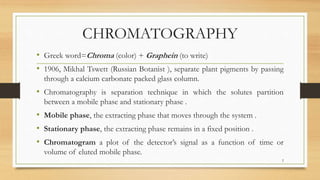
• Greek word=Chroma (color) + Graphein (to write)
• 1906, Mikhal Tswett (Russian Botanist ), separate plant pigments by passing
through a calcium carbonate packed glass column.
• Chromatography is separation technique in which the solutes partition
between a mobile phase and stationary phase .
• Mobile phase, the extracting phase that moves through the system .
• Stationary phase, the extracting phase remains in a fixed position .
• Chromatogram a plot of the detector’s signal as a function of time or
volume of eluted mobile phase.
2
DEFINITION
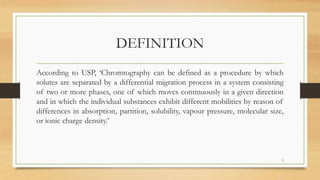
According to USP, ‘Chromtography can be defined as a procedure by which
solutes are separated by a differential migration process in a system consisting
of two or more phases, one of which moves continuously in a given direction
and in which the individual substances exhibit different mobilities by reason of
differences in absorption, partition, solubility, vapour pressure, molecular size,
or ionic charge density.’
3
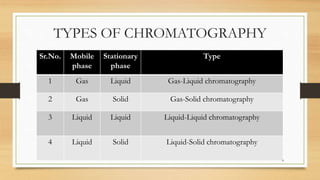
TYPES OF CHROMATOGRAPHY
Sr.No. Mobile
phase
Stationary
phase
Type
1 Gas Liquid Gas-Liquid chromatography
2 Gas Solid Gas-Solid chromatography
3 Liquid Liquid Liquid-Liquid chromatography
4 Liquid Solid Liquid-Solid chromatography
4
LIQUID CHROMATOGRAPHY
• 1941,Martin and Synge, developed the theory of chromatographic
separations, they were awarded the 1952 Nobel prize in chemistry for this
work .
• Liquid chromatography (LC) is a separation technique based on the difference
in the distribution of components between two non-miscible phases in which
liquid mobile phase elutes through a stationary phase in a column.
• The three forms of high performance liquid chromatography most often used
are based on mechanism of partition, adsorption and ion exchange.
5
TYPES OF LIQUID CHROMATOGRAPHY
1. Liquid-solid chromatography (LSC).
2. Liquid-liquid (partition) chromatography (LLC).
3. Bonded-phase chromatography (BPC).
4. Gel permeation (exclusion) chromatography (GPC).
6
HPLC
• Developed by Huber in 1969.
• Principles
‘Separation of mixtures in microgram to gram quantities by passage of the
sample through a column containing a stationary solid by means of a
pressurized flow of a liquid mobile phase; components migrate through the
column at different rates due to different relative affinities for the stationary
and mobile phases base on adsorption, size or charge.’
7
HPLC (Key features)
1. High resolving power;
2. Speed of separation;
3. Continuous monitoring of the column effluent;
4. Accurate quantitative measurement;
5. Repetitive and reproducible analysis using the same column; and
6. Automation of the analytical procedure and data handling.
8
HPLC (Other names)
• High Performance Liquid Chromatography (HPLC)
• High Pressure Liquid Chromatography (HPLC)
• High Price Liquid Chromatography (HPLC)
• High Speed Liquid Chromatography (HSLC)
• High Efficiency Liquid Chromatography (HELC)
9
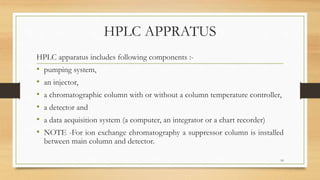
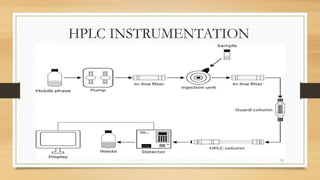
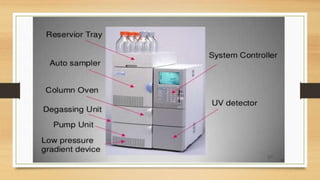
HPLC APPRATUS
HPLC apparatus includes following components :-
• pumping system,
• an injector,
• a chromatographic column with or without a column temperature controller,
• a detector and
• a data acquisition system (a computer, an integrator or a chart recorder)
• NOTE -For ion exchange chromatography a suppressor column is installed
between main column and detector.
10
HPLC INSTRUMENTATION
11
12
HPLC Pumps
Deliver metered amounts of the mobile phase from the solvent reservoirs to
the column through high pressure.
TYPES :-
1. Reciprocating Piston pump
2. Syringe type pump
3. Constant pressure pump
4. Pulse dampers Constant flow pump
13
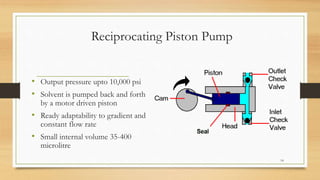
Reciprocating Piston Pump
• Output pressure upto 10,000 psi
• Solvent is pumped back and forth
by a motor driven piston
• Ready adaptability to gradient and
constant flow rate
• Small internal volume 35-400
microlitre
14
HPLC Mixing Unit
Mix the solvents of different proportions .
TYPES :-
1. Low pressure ( use He for degassing of solvents )
2. High pressure (no use of He )
Mixing of solvents is done by two methods :-
1) Static mixer (packed with beads )
2) Dynamic mixer (use a magnetic stirrer and operates at high pressure )
15
Gradient Controller
Device that allows one to create a gradient program so as to alter the nature or
polarity of solvents .
It must form a homogenous mixture before it reaches to column .
TYPES :-
1. Isocratic separation (mobile phase is of same polarity throughout the
process)
2. Gradient elution (the polarity of solvents is gradually increased and hence
the compositions of solvent to be changed )
16
Degassing Devices
Used to remove dissolved gases from solvents .
TYPES :-
1. Vacuum filtration:-which can remove the air bubbles. But is not always
reliable & complete
2. He purging:-by passing He through the solvent. Very effective but He is
expensive
3. Ultrasonication:-which converts ultra high frequency to mechanical
vibrations – this causes the removal of air bubbles
17
HPLC Injectors
Used to introduce the sample into the system .
TYPES :-
1. Septum injectors: injecting through a rubber septum. Not common – has
to withstand high pressure.
2. Stop flow (online): in which the flow of mobile phase is stopped for a
while & the sample is injected through a valve device.
3. Rheodyne injector ( loop valve type): A means for injecting samples in
which the sample is loaded into a short section of tubing and injected onto
the column by redirecting the mobile phase through the loop.
18
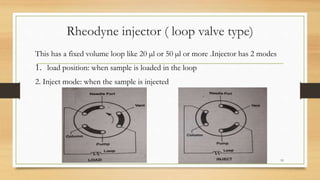
Rheodyne injector ( loop valve type)
This has a fixed volume loop like 20 µl or 50 µl or more .Injector has 2 modes
1. load position: when sample is loaded in the loop
2. Inject mode: when the sample is injected
19
HPLC Columns
Columns works as stationary phase holder in HPLC (heart of HPLC ).
TYPES :-
1. Guard column:-An inexpensive column used to protect a more expensive
analytical column.
2. Analytical column:-The most imp part of the HPLC technology which
decides the efficiency of separation.
• Column length: 5 cm to 30cm
• .Column diameter: 2mm to 50 mm
• Particle size: 1 µ to 20 µ 20
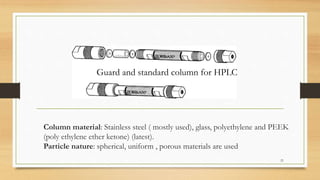
Column material: Stainless steel ( mostly used), glass, polyethylene and PEEK
(poly ethylene ether ketone) (latest).
Particle nature: spherical, uniform , porous materials are used
Guard and standard column for HPLC
21
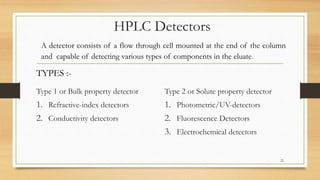
HPLC Detectors
A detector consists of a flow through cell mounted at the end of the column
and capable of detecting various types of components in the eluate.
Type 1 or Bulk property detector
1. Refractive-index detectors
2. Conductivity detectors
TYPES :-
Type 2 or Solute property detector
1. Photometric/UV-detectors
2. Fluorescence Detectors
3. Electrochemical detectors
22
Bulk property detector
Measure the difference in some physical property of the solute in the mobile
phase compared to the mobile phase alone.
Refractive index detector
23
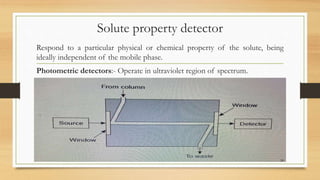
Solute property detector
Respond to a particular physical or chemical property of the solute, being
ideally independent of the mobile phase.
Photometric detectors:- Operate in ultraviolet region of spectrum.
24
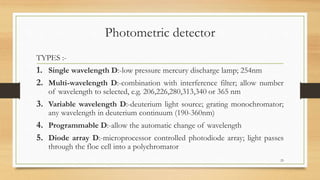
Photometric detector
TYPES :-
1. Single wavelength D:-low pressure mercury discharge lamp; 254nm
2. Multi-wavelength D:-combination with interference filter; allow number
of wavelength to selected, e.g. 206,226,280,313,340 or 365 nm
3. Variable wavelength D:-deuterium light source; grating monochromator;
any wavelength in deuterium continuum (190-360nm)
4. Programmable D:-allow the automatic change of wavelength
5. Diode array D:-microprocessor controlled photodiode array; light passes
through the floe cell into a polychromator
25
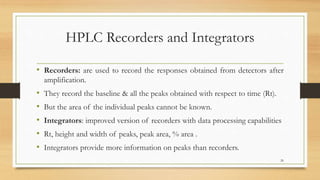
HPLC Recorders and Integrators
• Recorders: are used to record the responses obtained from detectors after
amplification.
• They record the baseline & all the peaks obtained with respect to time (Rt).
• But the area of the individual peaks cannot be known.
• Integrators: improved version of recorders with data processing capabilities
• Rt, height and width of peaks, peak area, % area .
• Integrators provide more information on peaks than recorders.
26
HPLC WORKING
27
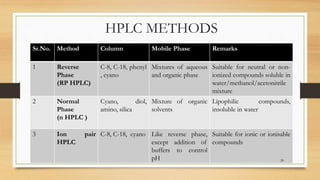
HPLC METHODS
Sr.No. Method Column Mobile Phase Remarks
1 Reverse
Phase
(RP HPLC)
C-8, C-18, phenyl
, cyano
Mixtures of aqueous
and organic phase
Suitable for neutral or non-
ionized compounds soluble in
water/methanol/acetonitrile
mixture
2 Normal
Phase
(n HPLC )
Cyano, diol,
amino, silica
Mixture of organic
solvents
Lipophilic compounds,
insoluble in water
3 Ion pair
HPLC
C-8, C-18, cyano Like reverse phase,
except addition of
buffers to control
pH
Suitable for ionic or ionisable
compounds
28
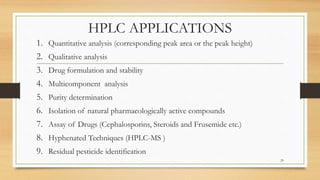
HPLC APPLICATIONS
1. Quantitative analysis (corresponding peak area or the peak height)
2. Qualitative analysis
3. Drug formulation and stability
4. Multicomponent analysis
5. Purity determination
6. Isolation of natural pharmacologically active compounds
7. Assay of Drugs (Cephalosporins, Steroids and Frusemide etc.)
8. Hyphenated Techniques (HPLC-MS )
9. Residual pesticide identification
29
REFERENCES
1. “Indian Pharmacopoeia”; Ministry of health and Family Welfare, Government of India;
Vol I, 2010 .
2. Sethi, P. D.; HPLC
3. Jeffery, G.H. ; Bassett ,J. ; Mendhan ,J. ; “Vogel`s Textbook od Quantitative Chemical
Analysis”; 5th Edition; John Wiley and sons, New York.
4. Harvey, D. ; “Modern Analytical Chemistry”; McGraw Hill; New York.
5. Mullertz , A. ; Perrie , Y. ; “Analytical Techniques in the Pharmaceutical Sciences”; Springer
Nature; New York .
6. Rouessac , F.; Rouessac , A.; “Chemical Analysis”; 2nd Edition; John Wiley and sons, New
York.
7. Naidu, M.P.( Ph.D Research scholar); HPLC .
30
31

High Performance Liquid Chromatography (HPLC)

  • 1.
    High Performance LiquidChromatography (HPLC) Presented To Ms. Saumya Shukla By Sachin kumar Vishwakarma -M.Pharm (Pharm.Chemistry)
  • 2.
    CHROMATOGRAPHY • Greek word=Chroma(color) + Graphein (to write) • 1906, Mikhal Tswett (Russian Botanist ), separate plant pigments by passing through a calcium carbonate packed glass column. • Chromatography is separation technique in which the solutes partition between a mobile phase and stationary phase . • Mobile phase, the extracting phase that moves through the system . • Stationary phase, the extracting phase remains in a fixed position . • Chromatogram a plot of the detector’s signal as a function of time or volume of eluted mobile phase. 2
  • 3.
    DEFINITION According to USP,‘Chromtography can be defined as a procedure by which solutes are separated by a differential migration process in a system consisting of two or more phases, one of which moves continuously in a given direction and in which the individual substances exhibit different mobilities by reason of differences in absorption, partition, solubility, vapour pressure, molecular size, or ionic charge density.’ 3
  • 4.
    TYPES OF CHROMATOGRAPHY Sr.No.Mobile phase Stationary phase Type 1 Gas Liquid Gas-Liquid chromatography 2 Gas Solid Gas-Solid chromatography 3 Liquid Liquid Liquid-Liquid chromatography 4 Liquid Solid Liquid-Solid chromatography 4
  • 5.
    LIQUID CHROMATOGRAPHY • 1941,Martinand Synge, developed the theory of chromatographic separations, they were awarded the 1952 Nobel prize in chemistry for this work . • Liquid chromatography (LC) is a separation technique based on the difference in the distribution of components between two non-miscible phases in which liquid mobile phase elutes through a stationary phase in a column. • The three forms of high performance liquid chromatography most often used are based on mechanism of partition, adsorption and ion exchange. 5
  • 6.
    TYPES OF LIQUIDCHROMATOGRAPHY 1. Liquid-solid chromatography (LSC). 2. Liquid-liquid (partition) chromatography (LLC). 3. Bonded-phase chromatography (BPC). 4. Gel permeation (exclusion) chromatography (GPC). 6
  • 7.
    HPLC • Developed byHuber in 1969. • Principles ‘Separation of mixtures in microgram to gram quantities by passage of the sample through a column containing a stationary solid by means of a pressurized flow of a liquid mobile phase; components migrate through the column at different rates due to different relative affinities for the stationary and mobile phases base on adsorption, size or charge.’ 7
  • 8.
    HPLC (Key features) 1.High resolving power; 2. Speed of separation; 3. Continuous monitoring of the column effluent; 4. Accurate quantitative measurement; 5. Repetitive and reproducible analysis using the same column; and 6. Automation of the analytical procedure and data handling. 8
  • 9.
    HPLC (Other names) •High Performance Liquid Chromatography (HPLC) • High Pressure Liquid Chromatography (HPLC) • High Price Liquid Chromatography (HPLC) • High Speed Liquid Chromatography (HSLC) • High Efficiency Liquid Chromatography (HELC) 9
  • 10.
    HPLC APPRATUS HPLC apparatusincludes following components :- • pumping system, • an injector, • a chromatographic column with or without a column temperature controller, • a detector and • a data acquisition system (a computer, an integrator or a chart recorder) • NOTE -For ion exchange chromatography a suppressor column is installed between main column and detector. 10
  • 11.
  • 12.
  • 13.
    HPLC Pumps Deliver meteredamounts of the mobile phase from the solvent reservoirs to the column through high pressure. TYPES :- 1. Reciprocating Piston pump 2. Syringe type pump 3. Constant pressure pump 4. Pulse dampers Constant flow pump 13
  • 14.
    Reciprocating Piston Pump •Output pressure upto 10,000 psi • Solvent is pumped back and forth by a motor driven piston • Ready adaptability to gradient and constant flow rate • Small internal volume 35-400 microlitre 14
  • 15.
    HPLC Mixing Unit Mixthe solvents of different proportions . TYPES :- 1. Low pressure ( use He for degassing of solvents ) 2. High pressure (no use of He ) Mixing of solvents is done by two methods :- 1) Static mixer (packed with beads ) 2) Dynamic mixer (use a magnetic stirrer and operates at high pressure ) 15
  • 16.
    Gradient Controller Device thatallows one to create a gradient program so as to alter the nature or polarity of solvents . It must form a homogenous mixture before it reaches to column . TYPES :- 1. Isocratic separation (mobile phase is of same polarity throughout the process) 2. Gradient elution (the polarity of solvents is gradually increased and hence the compositions of solvent to be changed ) 16
  • 17.
    Degassing Devices Used toremove dissolved gases from solvents . TYPES :- 1. Vacuum filtration:-which can remove the air bubbles. But is not always reliable & complete 2. He purging:-by passing He through the solvent. Very effective but He is expensive 3. Ultrasonication:-which converts ultra high frequency to mechanical vibrations – this causes the removal of air bubbles 17
  • 18.
    HPLC Injectors Used tointroduce the sample into the system . TYPES :- 1. Septum injectors: injecting through a rubber septum. Not common – has to withstand high pressure. 2. Stop flow (online): in which the flow of mobile phase is stopped for a while & the sample is injected through a valve device. 3. Rheodyne injector ( loop valve type): A means for injecting samples in which the sample is loaded into a short section of tubing and injected onto the column by redirecting the mobile phase through the loop. 18
  • 19.
    Rheodyne injector (loop valve type) This has a fixed volume loop like 20 µl or 50 µl or more .Injector has 2 modes 1. load position: when sample is loaded in the loop 2. Inject mode: when the sample is injected 19
  • 20.
    HPLC Columns Columns worksas stationary phase holder in HPLC (heart of HPLC ). TYPES :- 1. Guard column:-An inexpensive column used to protect a more expensive analytical column. 2. Analytical column:-The most imp part of the HPLC technology which decides the efficiency of separation. • Column length: 5 cm to 30cm • .Column diameter: 2mm to 50 mm • Particle size: 1 µ to 20 µ 20
  • 21.
    Column material: Stainlesssteel ( mostly used), glass, polyethylene and PEEK (poly ethylene ether ketone) (latest). Particle nature: spherical, uniform , porous materials are used Guard and standard column for HPLC 21
  • 22.
    HPLC Detectors A detectorconsists of a flow through cell mounted at the end of the column and capable of detecting various types of components in the eluate. Type 1 or Bulk property detector 1. Refractive-index detectors 2. Conductivity detectors TYPES :- Type 2 or Solute property detector 1. Photometric/UV-detectors 2. Fluorescence Detectors 3. Electrochemical detectors 22
  • 23.
    Bulk property detector Measurethe difference in some physical property of the solute in the mobile phase compared to the mobile phase alone. Refractive index detector 23
  • 24.
    Solute property detector Respondto a particular physical or chemical property of the solute, being ideally independent of the mobile phase. Photometric detectors:- Operate in ultraviolet region of spectrum. 24
  • 25.
    Photometric detector TYPES :- 1.Single wavelength D:-low pressure mercury discharge lamp; 254nm 2. Multi-wavelength D:-combination with interference filter; allow number of wavelength to selected, e.g. 206,226,280,313,340 or 365 nm 3. Variable wavelength D:-deuterium light source; grating monochromator; any wavelength in deuterium continuum (190-360nm) 4. Programmable D:-allow the automatic change of wavelength 5. Diode array D:-microprocessor controlled photodiode array; light passes through the floe cell into a polychromator 25
  • 26.
    HPLC Recorders andIntegrators • Recorders: are used to record the responses obtained from detectors after amplification. • They record the baseline & all the peaks obtained with respect to time (Rt). • But the area of the individual peaks cannot be known. • Integrators: improved version of recorders with data processing capabilities • Rt, height and width of peaks, peak area, % area . • Integrators provide more information on peaks than recorders. 26
  • 27.
  • 28.
    HPLC METHODS Sr.No. MethodColumn Mobile Phase Remarks 1 Reverse Phase (RP HPLC) C-8, C-18, phenyl , cyano Mixtures of aqueous and organic phase Suitable for neutral or non- ionized compounds soluble in water/methanol/acetonitrile mixture 2 Normal Phase (n HPLC ) Cyano, diol, amino, silica Mixture of organic solvents Lipophilic compounds, insoluble in water 3 Ion pair HPLC C-8, C-18, cyano Like reverse phase, except addition of buffers to control pH Suitable for ionic or ionisable compounds 28
  • 29.
    HPLC APPLICATIONS 1. Quantitativeanalysis (corresponding peak area or the peak height) 2. Qualitative analysis 3. Drug formulation and stability 4. Multicomponent analysis 5. Purity determination 6. Isolation of natural pharmacologically active compounds 7. Assay of Drugs (Cephalosporins, Steroids and Frusemide etc.) 8. Hyphenated Techniques (HPLC-MS ) 9. Residual pesticide identification 29
  • 30.
    REFERENCES 1. “Indian Pharmacopoeia”;Ministry of health and Family Welfare, Government of India; Vol I, 2010 . 2. Sethi, P. D.; HPLC 3. Jeffery, G.H. ; Bassett ,J. ; Mendhan ,J. ; “Vogel`s Textbook od Quantitative Chemical Analysis”; 5th Edition; John Wiley and sons, New York. 4. Harvey, D. ; “Modern Analytical Chemistry”; McGraw Hill; New York. 5. Mullertz , A. ; Perrie , Y. ; “Analytical Techniques in the Pharmaceutical Sciences”; Springer Nature; New York . 6. Rouessac , F.; Rouessac , A.; “Chemical Analysis”; 2nd Edition; John Wiley and sons, New York. 7. Naidu, M.P.( Ph.D Research scholar); HPLC . 30
  • 31.