Gas Chromatography
& GC-MS
submitted by: Submitted To:
Himanshu Sachdeva Dr. Rakesh kr.
Marwaha
Roll no.1705 Assistant Professor
Dptt. Of Pharmaceutical Sc. MDU, Rohtak1
Contents:
 Introduction to GC
 Types of GC and Principles
 Instrumentation of GC
 Derivatisation
 Applications of GC
 Introduction to GC-MS
 Interfaces used in GC-MS
 Interpretation
 Application
2
GAS CHROMATOGRAPHY
• Gas chromatography (GC) is a common type of
chromatography used in analytical chemistry for
separating and analyzing compounds that can be
vaporized without decomposition.
• The development of GC as an analytical technique
was discovered by Martin and Synge 1941
3
Gas Chromatography:
• Gas Solid Chromatography (GSC)
• Gas Liquid Chromatography (GLC)
In both cases, gas is used as mobile phase and
solid and liquid is used as stationary phase
respectively.
Gas Solid Chromatography: is not widely used
because limited no of stationary phase
available. GSC is used only in case, where there
is a less solubility of solutes in stationary phase
Principle of separation is ADSORPTION
4
GAS Liquid Chromatography:
Principle:
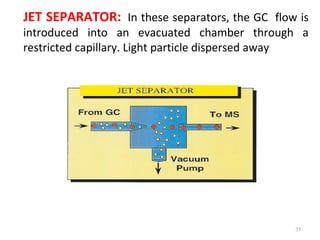
The principle of separation in GLC is PARTITION. Gas is
used as mobile phase and liquid which is coated on a
solid support is used as a stationary phase.
The mixture of components to be separated is
converted to vapour and mixed with gaseous mobile
phase . The component which is more soluble in
stationary phase travel slower and eluted later and
the components which are less soluble travel faster
and eluted first. Hence the components are
separated according to their partition co-efficient.
5
CRITERIA FOR GLC:
1.Volatility: Unless a compound is volatile, it can
not be mixed with mobile phase. So can not be
separate out.
2.Thermostability: The compounds which are in
solid or liquid form, first need to be converted to
gaseous form so they have to be heated to a
higher temperature. At that temperature, the
compound have to be thermostable.
6
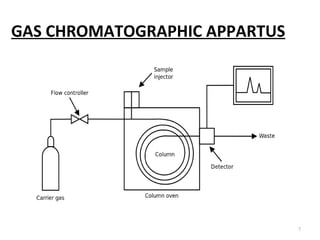
GAS CHROMATOGRAPHIC APPARTUS
7
PRACTICAL REQUIREMENTS
• Carrier gas
• Flow regulator and flow meter
• Injection devices
• Columns
• Temperature control device
• Detectors
• Recorders and Integrators
8
CARRIER GAS:
• The choice of carrier gas determines the
efficacy of chromatographic separation.
Most widely used are hydrogen, helium,
nitrogen and argon.
• The gas must be inert, less expensive,
suitable for detector, high purity, should
not cause the risk of fire.
• As carrier gas is compressible, gases are
stored under high pressure in cylinder and
used when required.
9
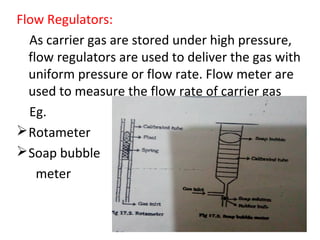
Flow Regulators:
As carrier gas are stored under high pressure,
flow regulators are used to deliver the gas with
uniform pressure or flow rate. Flow meter are
used to measure the flow rate of carrier gas
Eg.
Rotameter
Soap bubble
meter
10
Sample Introduction
• The sample is usually introduced in form of
solution (~0.5 ml) into the injector
• Injector has dual role, provides an inlet for the
sample and vaporizes the sample and mixes it with
mobile phase
• Modes of injection vary according to their types
• Direct Vaporisation injector
• Cold On-Column Injector
• Split/Splitless Injector
11
12
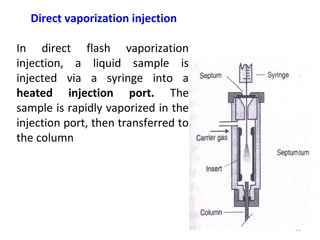
Direct vaporization injection
In direct flash vaporization
injection, a liquid sample is
injected via a syringe into a
heated injection port. The
sample is rapidly vaporized in the
injection port, then transferred to
the column
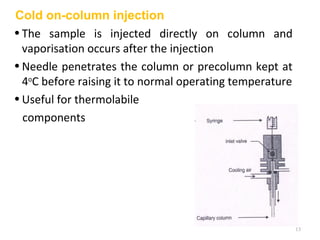
Cold on-column injection
•The sample is injected directly on column and
vaporisation occurs after the injection
•Needle penetrates the column or precolumn kept at
4o
C before raising it to normal operating temperature
•Useful for thermolabile
components
13
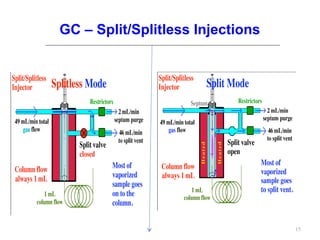
• It is designed to maintain the constant flow of carrier
gas and to control the amount of sample enters into
the column
• If the split vent is closed, via a computer-controlled
split valve, then all of the sample introduced into the
injector vaporizes and goes on (into) the
column(splitless mode). If the split vent is open then
most of the vaporized sample is thrown away to waste
via the split vent and only a small portion of the sample
is introduced to the column.(split mode)
14
GC – Split/Splitless Injections
15
Temperature Control Device
Repeaters: Are used in GC to concert the sample into
vapour form and mix with mobile phase
Thermostatically controlled oven: Since partition
coefficient as well as solubility of a solute depends
upon temperature, temp. maintaining in a column is
highly essential for efficient separation
• Isothermal programming
• Linear programming
16
COLUMNS
Column is one of the important part of GC
which decides the separation efficiency.
Columns are made up of glass and stainless
steel.
Classification of columns:
Depending on its use:
• Analytical column
• Preparative column
Depending on its nature:
17
Column – Types
Packed column: Are available in packed manner
commercially and hence are called as Packed
column. Different columns ranging from non polar
to polar are available.
Open tubular/ Capillary Column: They are made
up of long capillary tubing of 30-90 meters in
length and have diameter of 0.025 to 0.075 cm.
These are made up of stainless steel and are in the
form of a coil. The inner wall of the capillary is
coated with stationary phase liquid in the form of
a thin film.
More sample can not be loaded
18
Support Coated Open Tubular Column: these
columns are made by depositing a micron size
layer of support material on the inner wall of
the capillary column and then coated with a
thin film of liquid phase.
These columns also have low resistance to flow
of carrier gas but offers the advantage of more
sample load or capacity.
19
GC – Detectors
Detectors are most important part of GC instrument
Properties of a good detector:
• Applicable to wide range of sample
• High sensitivity to even small concentration
• Rapidity of response
• Linearity
• Non destructive to sample
• Simple and easy to maintain
TYPES OF DETECTOR
• Thermal conductivity detector
• Flame ionisation detector
• Electron Capture Detector 20
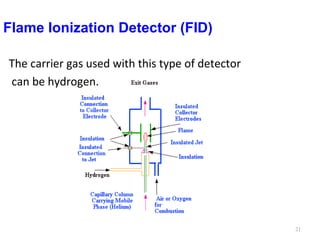
Flame Ionization Detector (FID)
The carrier gas used with this type of detector
can be hydrogen.
21
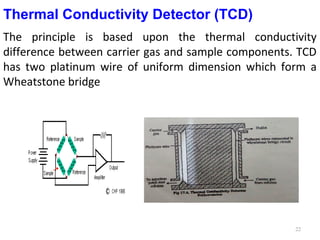
Thermal Conductivity Detector (TCD)
The principle is based upon the thermal conductivity
difference between carrier gas and sample components. TCD
has two platinum wire of uniform dimension which form a
Wheatstone bridge
22
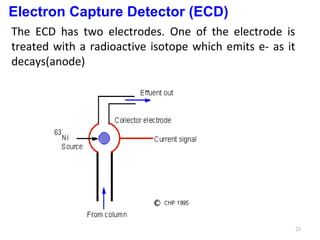
Electron Capture Detector (ECD)
The ECD has two electrodes. One of the electrode is
treated with a radioactive isotope which emits e- as it
decays(anode)
23
Recorders: are used to record the responses
obtained from detector after amplfication. They
record the baseline and all the peaks obtained
with respect to time.
24
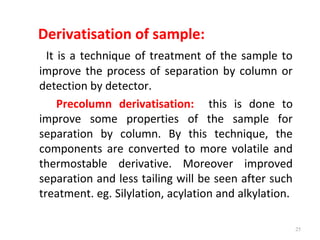
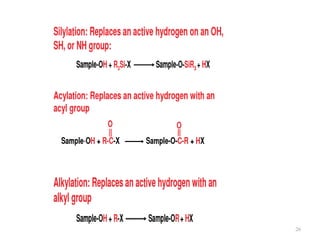
Derivatisation of sample:
It is a technique of treatment of the sample to
improve the process of separation by column or
detection by detector.
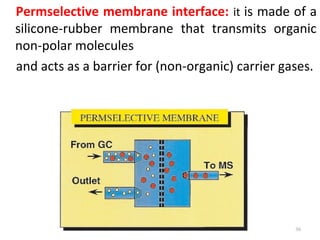
Precolumn derivatisation: this is done to
improve some properties of the sample for
separation by column. By this technique, the
components are converted to more volatile and
thermostable derivative. Moreover improved
separation and less tailing will be seen after such
treatment. eg. Silylation, acylation and alkylation.
25
26
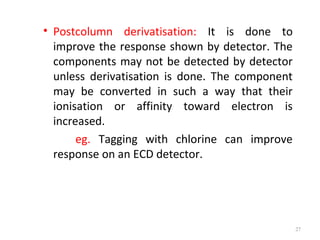
• Postcolumn derivatisation: It is done to
improve the response shown by detector. The
components may not be detected by detector
unless derivatisation is done. The component
may be converted in such a way that their
ionisation or affinity toward electron is
increased.
eg. Tagging with chlorine can improve
response on an ECD detector.
27
Application Of GC:
• Qualitative analysis
• Checking the purity of a compound
• Presence of impurity
• Quantitative analysis
• Isolation of drug or metabolites in urine
• Speed – very fast, minutes
• Sensitivity – high sensitivity, (ppm range)
• Simplicity – simple to operate and understand
• Resolution – high resolution of closely related
compounds
28
29
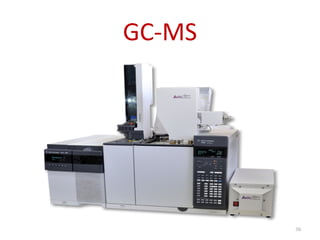
GC-MS
30
GC-MS
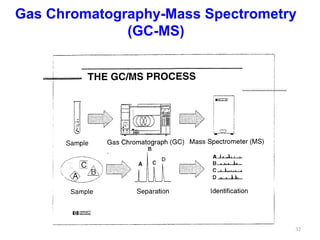
• GC-MS is an advance analytical
instrumental technique that combines the
physical separation capability of GC with
the mass analysing capability of MS.
• Gas chromatography coupled with mass
spectrometry is a versatile tool to separate,
quantify and identify unknown substances.
31
Gas Chromatography-Mass Spectrometry
(GC-MS)
32
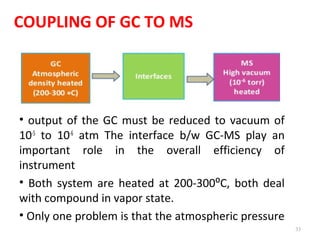
COUPLING OF GC TO MS
• output of the GC must be reduced to vacuum of
10-5
to 10-6
atm The interface b/w GC-MS play an
important role in the overall efficiency of
instrument
• Both system are heated at 200-300⁰C, both deal
with compound in vapor state.
• Only one problem is that the atmospheric pressure
33
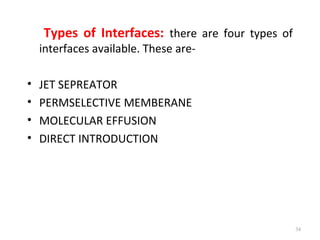
Types of Interfaces: there are four types of
interfaces available. These are-
• JET SEPREATOR
• PERMSELECTIVE MEMBERANE
• MOLECULAR EFFUSION
• DIRECT INTRODUCTION
34
JET SEPARATOR: In these separators, the GC flow is
introduced into an evacuated chamber through a
restricted capillary. Light particle dispersed away
35
Permselective membrane interface: it is made of a
silicone-rubber membrane that transmits organic
non-polar molecules
and acts as a barrier for (non-organic) carrier gases.
36
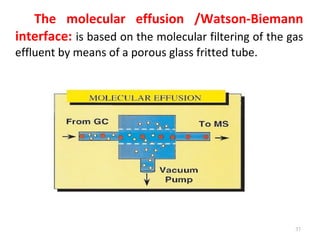
The molecular effusion /Watson-Biemann
interface: is based on the molecular filtering of the gas
effluent by means of a porous glass fritted tube.
37
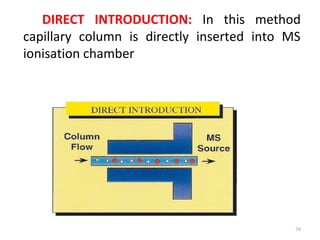
DIRECT INTRODUCTION: In this method
capillary column is directly inserted into MS
ionisation chamber
38
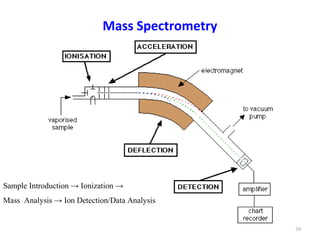
Mass Spectrometry
Sample Introduction → Ionization →
Mass Analysis → Ion Detection/Data Analysis
39
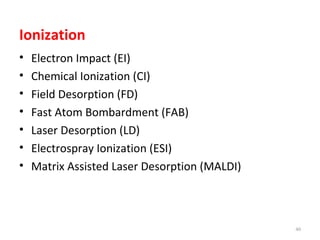
Ionization
• Electron Impact (EI)
• Chemical Ionization (CI)
• Field Desorption (FD)
• Fast Atom Bombardment (FAB)
• Laser Desorption (LD)
• Electrospray Ionization (ESI)
• Matrix Assisted Laser Desorption (MALDI)
40
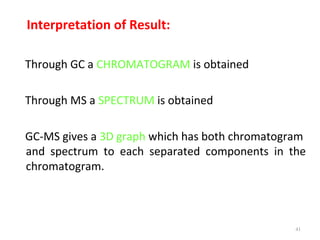
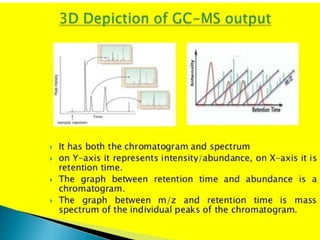
Interpretation of Result:
Through GC a CHROMATOGRAM is obtained
Through MS a SPECTRUM is obtained
GC-MS gives a 3D graph which has both chromatogram
and spectrum to each separated components in the
chromatogram.
41
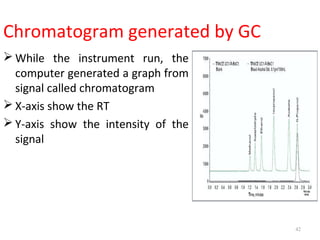
Chromatogram generated by GC
 While the instrument run, the
computer generated a graph from
signal called chromatogram
 X-axis show the RT
 Y-axis show the intensity of the
signal
42
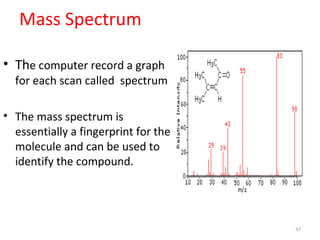
Mass Spectrum
• The computer record a graph
for each scan called spectrum
• The mass spectrum is
essentially a fingerprint for the
molecule and can be used to
identify the compound.
43
44
Application of GC-MS
Environmental monitoring and clean up
Criminal Forensic
Law enforcement
anti doping test
Food, beverages, and perfume analysis
medicines
45
Conclusion:
• Gas chromatography coupled with mass
spectrometry is a versatile tool to separate,
quantify and identify unknown substances.
46
References:
 Braun.R, Introduction To Instrumental Analysis,
Second Edition, PharmaMed Press, Hyderabad, Page
no. 251-270.
 Chatwal.G.R , Anand .S.K, Instrumental method Of
Chemical Analysis, Himalaya Publishing House, Fifth
Edition-2012, New Delhi, Page no. 420-449.
47
48

Gas Chromatography and GCMS

  • 1.
    Gas Chromatography & GC-MS submittedby: Submitted To: Himanshu Sachdeva Dr. Rakesh kr. Marwaha Roll no.1705 Assistant Professor Dptt. Of Pharmaceutical Sc. MDU, Rohtak1
  • 2.
    Contents:  Introduction toGC  Types of GC and Principles  Instrumentation of GC  Derivatisation  Applications of GC  Introduction to GC-MS  Interfaces used in GC-MS  Interpretation  Application 2
  • 3.
    GAS CHROMATOGRAPHY • Gaschromatography (GC) is a common type of chromatography used in analytical chemistry for separating and analyzing compounds that can be vaporized without decomposition. • The development of GC as an analytical technique was discovered by Martin and Synge 1941 3
  • 4.
    Gas Chromatography: • GasSolid Chromatography (GSC) • Gas Liquid Chromatography (GLC) In both cases, gas is used as mobile phase and solid and liquid is used as stationary phase respectively. Gas Solid Chromatography: is not widely used because limited no of stationary phase available. GSC is used only in case, where there is a less solubility of solutes in stationary phase Principle of separation is ADSORPTION 4
  • 5.
    GAS Liquid Chromatography: Principle: Theprinciple of separation in GLC is PARTITION. Gas is used as mobile phase and liquid which is coated on a solid support is used as a stationary phase. The mixture of components to be separated is converted to vapour and mixed with gaseous mobile phase . The component which is more soluble in stationary phase travel slower and eluted later and the components which are less soluble travel faster and eluted first. Hence the components are separated according to their partition co-efficient. 5
  • 6.
    CRITERIA FOR GLC: 1.Volatility:Unless a compound is volatile, it can not be mixed with mobile phase. So can not be separate out. 2.Thermostability: The compounds which are in solid or liquid form, first need to be converted to gaseous form so they have to be heated to a higher temperature. At that temperature, the compound have to be thermostable. 6
  • 7.
  • 8.
    PRACTICAL REQUIREMENTS • Carriergas • Flow regulator and flow meter • Injection devices • Columns • Temperature control device • Detectors • Recorders and Integrators 8
  • 9.
    CARRIER GAS: • Thechoice of carrier gas determines the efficacy of chromatographic separation. Most widely used are hydrogen, helium, nitrogen and argon. • The gas must be inert, less expensive, suitable for detector, high purity, should not cause the risk of fire. • As carrier gas is compressible, gases are stored under high pressure in cylinder and used when required. 9
  • 10.
    Flow Regulators: As carriergas are stored under high pressure, flow regulators are used to deliver the gas with uniform pressure or flow rate. Flow meter are used to measure the flow rate of carrier gas Eg. Rotameter Soap bubble meter 10
  • 11.
    Sample Introduction • Thesample is usually introduced in form of solution (~0.5 ml) into the injector • Injector has dual role, provides an inlet for the sample and vaporizes the sample and mixes it with mobile phase • Modes of injection vary according to their types • Direct Vaporisation injector • Cold On-Column Injector • Split/Splitless Injector 11
  • 12.
    12 Direct vaporization injection Indirect flash vaporization injection, a liquid sample is injected via a syringe into a heated injection port. The sample is rapidly vaporized in the injection port, then transferred to the column
  • 13.
    Cold on-column injection •Thesample is injected directly on column and vaporisation occurs after the injection •Needle penetrates the column or precolumn kept at 4o C before raising it to normal operating temperature •Useful for thermolabile components 13
  • 14.
    • It isdesigned to maintain the constant flow of carrier gas and to control the amount of sample enters into the column • If the split vent is closed, via a computer-controlled split valve, then all of the sample introduced into the injector vaporizes and goes on (into) the column(splitless mode). If the split vent is open then most of the vaporized sample is thrown away to waste via the split vent and only a small portion of the sample is introduced to the column.(split mode) 14 GC – Split/Splitless Injections
  • 15.
  • 16.
    Temperature Control Device Repeaters:Are used in GC to concert the sample into vapour form and mix with mobile phase Thermostatically controlled oven: Since partition coefficient as well as solubility of a solute depends upon temperature, temp. maintaining in a column is highly essential for efficient separation • Isothermal programming • Linear programming 16
  • 17.
    COLUMNS Column is oneof the important part of GC which decides the separation efficiency. Columns are made up of glass and stainless steel. Classification of columns: Depending on its use: • Analytical column • Preparative column Depending on its nature: 17
  • 18.
    Column – Types Packedcolumn: Are available in packed manner commercially and hence are called as Packed column. Different columns ranging from non polar to polar are available. Open tubular/ Capillary Column: They are made up of long capillary tubing of 30-90 meters in length and have diameter of 0.025 to 0.075 cm. These are made up of stainless steel and are in the form of a coil. The inner wall of the capillary is coated with stationary phase liquid in the form of a thin film. More sample can not be loaded 18
  • 19.
    Support Coated OpenTubular Column: these columns are made by depositing a micron size layer of support material on the inner wall of the capillary column and then coated with a thin film of liquid phase. These columns also have low resistance to flow of carrier gas but offers the advantage of more sample load or capacity. 19
  • 20.
    GC – Detectors Detectorsare most important part of GC instrument Properties of a good detector: • Applicable to wide range of sample • High sensitivity to even small concentration • Rapidity of response • Linearity • Non destructive to sample • Simple and easy to maintain TYPES OF DETECTOR • Thermal conductivity detector • Flame ionisation detector • Electron Capture Detector 20
  • 21.
    Flame Ionization Detector(FID) The carrier gas used with this type of detector can be hydrogen. 21
  • 22.
    Thermal Conductivity Detector(TCD) The principle is based upon the thermal conductivity difference between carrier gas and sample components. TCD has two platinum wire of uniform dimension which form a Wheatstone bridge 22
  • 23.
    Electron Capture Detector(ECD) The ECD has two electrodes. One of the electrode is treated with a radioactive isotope which emits e- as it decays(anode) 23
  • 24.
    Recorders: are usedto record the responses obtained from detector after amplfication. They record the baseline and all the peaks obtained with respect to time. 24
  • 25.
    Derivatisation of sample: Itis a technique of treatment of the sample to improve the process of separation by column or detection by detector. Precolumn derivatisation: this is done to improve some properties of the sample for separation by column. By this technique, the components are converted to more volatile and thermostable derivative. Moreover improved separation and less tailing will be seen after such treatment. eg. Silylation, acylation and alkylation. 25
  • 26.
  • 27.
    • Postcolumn derivatisation:It is done to improve the response shown by detector. The components may not be detected by detector unless derivatisation is done. The component may be converted in such a way that their ionisation or affinity toward electron is increased. eg. Tagging with chlorine can improve response on an ECD detector. 27
  • 28.
    Application Of GC: •Qualitative analysis • Checking the purity of a compound • Presence of impurity • Quantitative analysis • Isolation of drug or metabolites in urine • Speed – very fast, minutes • Sensitivity – high sensitivity, (ppm range) • Simplicity – simple to operate and understand • Resolution – high resolution of closely related compounds 28
  • 29.
  • 30.
  • 31.
    GC-MS • GC-MS isan advance analytical instrumental technique that combines the physical separation capability of GC with the mass analysing capability of MS. • Gas chromatography coupled with mass spectrometry is a versatile tool to separate, quantify and identify unknown substances. 31
  • 32.
  • 33.
    COUPLING OF GCTO MS • output of the GC must be reduced to vacuum of 10-5 to 10-6 atm The interface b/w GC-MS play an important role in the overall efficiency of instrument • Both system are heated at 200-300⁰C, both deal with compound in vapor state. • Only one problem is that the atmospheric pressure 33
  • 34.
    Types of Interfaces:there are four types of interfaces available. These are- • JET SEPREATOR • PERMSELECTIVE MEMBERANE • MOLECULAR EFFUSION • DIRECT INTRODUCTION 34
  • 35.
    JET SEPARATOR: Inthese separators, the GC flow is introduced into an evacuated chamber through a restricted capillary. Light particle dispersed away 35
  • 36.
    Permselective membrane interface:it is made of a silicone-rubber membrane that transmits organic non-polar molecules and acts as a barrier for (non-organic) carrier gases. 36
  • 37.
    The molecular effusion/Watson-Biemann interface: is based on the molecular filtering of the gas effluent by means of a porous glass fritted tube. 37
  • 38.
    DIRECT INTRODUCTION: Inthis method capillary column is directly inserted into MS ionisation chamber 38
  • 39.
    Mass Spectrometry Sample Introduction→ Ionization → Mass Analysis → Ion Detection/Data Analysis 39
  • 40.
    Ionization • Electron Impact(EI) • Chemical Ionization (CI) • Field Desorption (FD) • Fast Atom Bombardment (FAB) • Laser Desorption (LD) • Electrospray Ionization (ESI) • Matrix Assisted Laser Desorption (MALDI) 40
  • 41.
    Interpretation of Result: ThroughGC a CHROMATOGRAM is obtained Through MS a SPECTRUM is obtained GC-MS gives a 3D graph which has both chromatogram and spectrum to each separated components in the chromatogram. 41
  • 42.
    Chromatogram generated byGC  While the instrument run, the computer generated a graph from signal called chromatogram  X-axis show the RT  Y-axis show the intensity of the signal 42
  • 43.
    Mass Spectrum • Thecomputer record a graph for each scan called spectrum • The mass spectrum is essentially a fingerprint for the molecule and can be used to identify the compound. 43
  • 44.
  • 45.
    Application of GC-MS Environmentalmonitoring and clean up Criminal Forensic Law enforcement anti doping test Food, beverages, and perfume analysis medicines 45
  • 46.
    Conclusion: • Gas chromatographycoupled with mass spectrometry is a versatile tool to separate, quantify and identify unknown substances. 46
  • 47.
    References:  Braun.R, IntroductionTo Instrumental Analysis, Second Edition, PharmaMed Press, Hyderabad, Page no. 251-270.  Chatwal.G.R , Anand .S.K, Instrumental method Of Chemical Analysis, Himalaya Publishing House, Fifth Edition-2012, New Delhi, Page no. 420-449. 47
  • 48.

Editor's Notes

  • #2 12.03.07, 28.05.07
  • #5 ndlkkaldlkanlkdnccscnlndlv
  • #10 Hydrogen: it has better thermal conductivity, low density. It is useful in case of thermal conductivity detector and flame ionisation detector. The disadvantage is that it react with unsaturated compounds and it is inflammable Helium: it also have excellent thermal conductivity. It is a good carrier gas when used TCD Nitrogen: inexpensive but has reduced sensitivity
  • #11 Rotameter: It is placed conventionally before the column inlet. It has an ordinary glass tube like burrete with a float held on a spring. The level of float is determined by flow rate of carrier gas and is precalibrated. Soap Bubble Meter: it has a glass tube with a inlet tube at the bottom through which gas comes in. A rubber bulb is used to store soap solution. When the bulb is gently pressed a drop of solution is converted into a bubble by the pressure of carrier gas and travel up. The distance travelled upward is measure of flow rate of carrier gas. The graduations are also pecalibrated.
  • #13 One end of injector contains a septum made of silicone rubber and the other end of injector is connected to the head of the column
  • #15 The manufacturers of these systems design them so that the carrier gas flow onto the column is constant--to maintain the chromatographic requirements of the column and yield reproducible retention times for analytes. At the same time, the amount of gas that goes out the split vent controls the amount of sample that enters the column
  • #16 Control overload of sample
  • #22 If the carrier gas is nitrogen or argon it can be mixed with hydrogen and reach up the burner tip made up of platinum,which act as one electrode (cathode). The anode is silver gauze placed little above theburner tip. When pure gas alone passes there is no ionisation and no current flows. But when the sample is present ions are produce because of ionisation by the thermal energy of the flame. This cause a potential difference and cause a flow of current which is amplified and recorded as signal.
  • #23 . Through one of them, pure carrier gas always flow and through the other the effluent of the column passes. When pure carrier gas passes through both of them, there is no difference in temp. or resistance and hence a base line is recorded. When a component emerges from the column, it alter the thermal conductivity and resistance of wire. Hence this produce a difference in resistance and so conductivity b/w two wires, which is amplified and recorded as a signal.
  • #24 These emitted e- are collected by anode and hence current signals are measured when carrier gas alone flows, all electrons are collected by anode and a steady baseline is recorded. Effluent molecules which have affinity for e- , capture these e-. Hence the amount of steady current is reduced. This difference is amplified and recorded as output signal. High sensitivty but can be used only for compunds having e- affinity
  • #29 1.this is done by comparing the Rt of sample as well as standard. Checking the purity of a compound: By comparing the chromatogram of the standard and sample, the purity of compound can be reported. If the additional peaks are obtained, the impurities are present and hence the compound is not pure Qantitative analysis: by peak area comparing of sample and standard. Peak area = peak height* width of peak at half height.
  • #36 At the capillary tip a supersonic expanding jet of analyte and carrier molecules is formed. In an expanding jet, high molecular mass compounds are concentrated in the core flow, whereas the lighter and more diffusive carrier molecules are dispersed away, in part through collisions. Thus, sampling of the core flow produces an enrichment of the analyte.
  • #38 The column effluent passes through a fritted tube situated in a vacuum chamber. Small molecules traverse the microscopic pores in the tube walls and are evacuated whereas high molecular mass molecules are transferred to the ion source.
  • #41 Xe atom of high transitin energy
  • #46 Tracking oganic polution in the environment Forensic toxicology to found drug or poison in body Useful for detection of illegal narcotics and many eventually supplant drug sniffing-dogs GCMS is main tools in sports in anti dopping test for performance enhancer Food and beverages contain numerous compounds such as esters fatty acids alcohols, these are analysed by gcms Inborn error of metabolism and amount of drug in urine even at low concentration