INSTALLING
OPERATING
SYSTEM
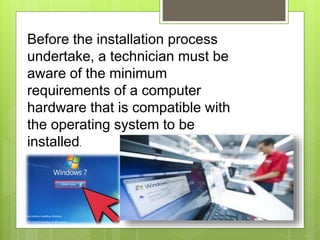
Before the installation process
undertake, a technician must be
aware of the minimum
requirements of a computer
hardware that is compatible with
the operating system to be
installed.
Following the systems’ requirements means an
efficient computer system.
The list below shows the windows XP minimum
requirements for installation:
 Pentium233 Mhz or compatible processor or faster; 300MHZor
faster recommended
 64MB of RAMminimum; 128MBor more recommended
 4.3GBhard harddisk space or more
 CD-ROMor DVD-ROM
 Super VGA(800X600) or higher-resolution monitor
 Keyboard and mouse
Windows XP Installation
Step 1
Insert the Windows XP
CD-ROM and reboot
the computer
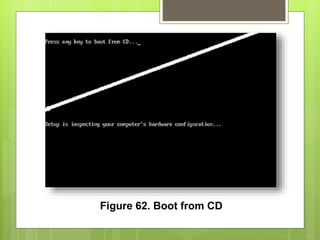
• If you see a message about
press any key to boot the CD,
do so now. Otherwise, you will
see a message about Setup
inspecting your system.
Figure 62. Boot from CD
Step 2
MS-DOS portion
of Setup begins
• In the first stage of setup;
you will see a series of blue
and gray MS-DOS-based
screens.
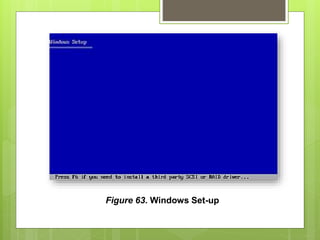
• In the first step, you will be
asked to press F6 if you need
to install any third-party or
RAID drivers.
Figure 63. Windows Set-up
Step 3
Welcome
to Setup
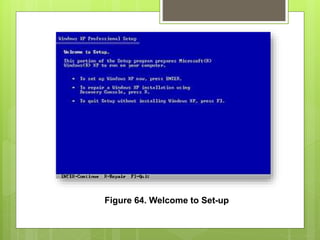
• Finally, Setup begins. In this
step, you can set up XP, launch
the Recovery Console (another,
more complicated system
recovery tool), or quit.
• Press ENTER to continue Setup,
and it will examine your hard
drives and removable disks.
Figure 64. Welcome to Set-up
Step 4
Read the license
agreement
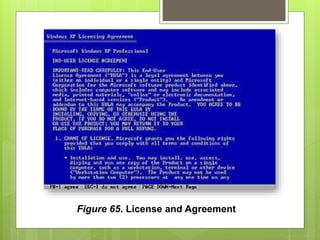
• Next, you'll have to agree to
Microsoft's complex licensing
agreement. Among the
highlights: You don't actually
own Windows XP and you
can only install it on one PC.
• Hit F8 to continue.
Figure 65. License and Agreement
Step 5
Choose an
installation partition
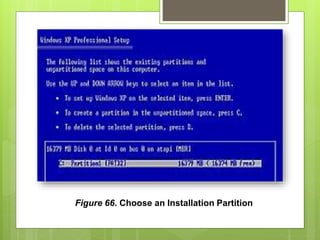
• This crucial step lets you choose where
to install XP.
• On a clean install, you will typically
install to the C: drive, but you might
have other ideas, especially if you plan
to dual-boot with 9x.
• Setup will show you all of your
available disks (in this case, just one)
and let you create and delete partitions
as needed. So, for example, if you have
one disk, but would like to create two
partitions, one for XP and one for your
Figure 66. Choose an Installation Partition
Step 6
Select the file
system
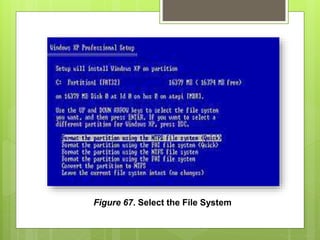
• If you created a new partition, or wish
to change the file system of an existing
partition, you can do so in the next step.
NTFS (New Technology File System) file
system is more secured than FAT (File
Allocation System).
• Regardless of which file system you
choose, be sure to select one of the
"quick" format options (the top two
choices), if you do need to format, since
these will work much more quickly
Figure 67. Select the File System
Step 7
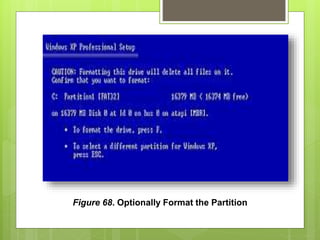
Optionally format
the partition
• If you did choose to change or format the
file system, this will occur next. First, you'll
be asked to verify the format. If you're
installing XP on a system with more than
one partition, especially one that still holds
your data on one of the partitions, be sure
you're formatting the correct partition.
• Hit F to continue, and a yellow progress bar
will indicate the status of the format. When
this is complete, Setup will again examine
your disks, and create a list of files to copy.
Figure 68. Optionally Format the Partition
Step 8
Setup folder copy
phase and reboot
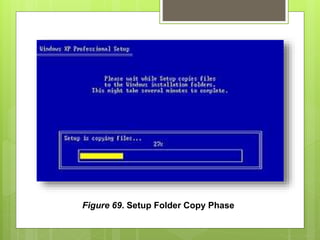
• Setup will now copy system files to the
system/boot partition(s) you just created. This
will allow the PC to boot from the C: drive and
continue Setup in GUI mode.
• When the file copy is complete, Setup will
initialize and save your XP configuration.
• It will then reboot your PC. When the system
reboots, you will probably see the "Press any
key to boot from CD" message again. If this
happens, do not press a key: Setup will now
boot from your C: drive. In the event that you
cannot prevent the CD-based Setup from
reloading, eject the CD and reboot. Setup will
ask for the CD when needed.
Figure 69. Setup Folder Copy Phase
Step 9
GUI Setup begins
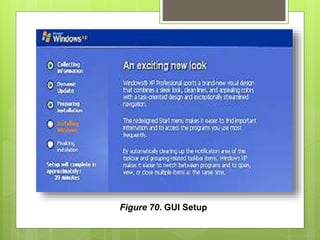
• Once the system reboots, you will be
presented with the GUI Setup phase,
which is much more attractive than
the DOS-mode phase. As you
progress through GUI Setup, you
can read promotional information
on the right side of the screen about
XP.
• Next, your hardware devices are
detected. This could take several
Figure 70. GUI Setup
Step 10
Regional and
language Options
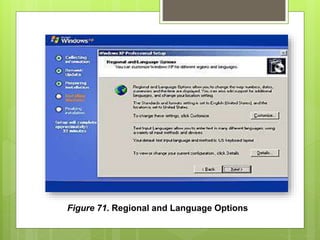
• In the first interactive portion of
GUI Setup, you can choose to
customize the regional and language
settings that will be used by XP, as
well as the text input language you'd
like. Users in the United States will
not normally need to change
anything here.
• Click Next to continue.
Figure 71. Regional and Language Options
Step 11
Personalize your
software
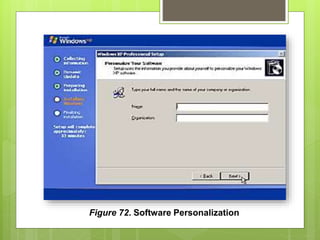
• Now, enter your name and
your company. The name you
enter is not the same as your
user name, incidentally, so you
should enter your real name
here (i.e. Rosalie Lujero or
whatever).
• Click Next to continue.
Figure 72. Software Personalization
Step 12
Enter your product
key
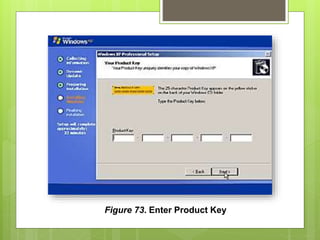
Figure 73. Enter Product Key
• Now you must enter the 25-character
product key that is located on the
orange sticker found on the back of
the CD holder that came with
Windows XP. You cannot install XP
without a valid product key. Later
on, you will be asked to activate and
optionally register your copy of
Windows XP. A product key can be
used to install XP on only one PC.
Step 13
Enter a computer name and
administrator password
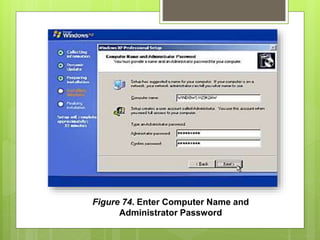
 In the next phase of Setup, you
can create a name for your
computer (which is used to
identify it on a network) and,
optionally in Pro Edition only, a
password for the system
Administrator, the person who
controls the PC (this will
generally be you, of course).
Figure 74. Enter Computer Name and
Administrator Password
Step 14
Supply your date and
time settings
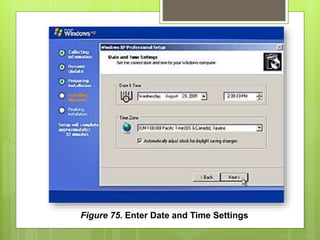
• Next, you can supply the date
and time, which are auto-set
based on information in your
BIOS, and the time zone, which
is irritatingly set to PST, which
is where Microsoft is. Change
these as appropriate.
• Click Next to continue.
Figure 75. Enter Date and Time Settings
Step 15
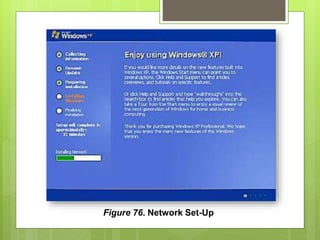
Network setup
 If you have a networking card or
modem, Setup now install the
networking components, which
include the client for Microsoft
networks, File and Print Sharing,
the Quality of Service (QoS)
Packet Scheduler, and the TCP/IP
networking protocol by default.
Figure 76. Network Set-Up
Step 16a
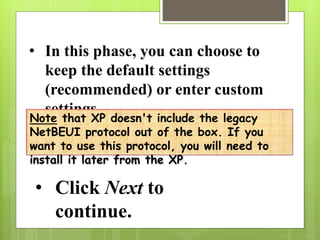
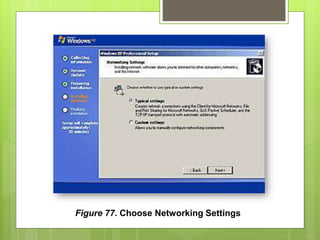
Choose networking
settings
• In this phase, you can choose to
keep the default settings
(recommended) or enter custom
settings.
Note that XP doesn't include the legacy
NetBEUI protocol out of the box. If you
want to use this protocol, you will need to
install it later from the XP.
• Click Next to
continue.
Figure 77. Choose Networking Settings
Windows XP Professional only:
Step 16b
Enter workgroup or domain
information
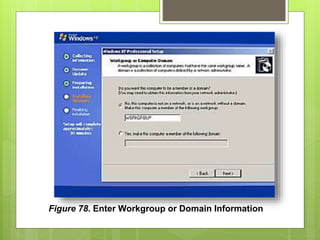
• In Windows XP Professional only,
you will be able to select a
workgroup or domain name next.
Home Edition doesn't work with
Windows domains, however, and
Setup will automatically supply the
workgroup name MSHOME, which
you can change later. The default
workgroup name in XP Pro is,
imaginatively, WORKGROUP.
• Click Next to continue.
Figure 78. Enter Workgroup or Domain Information
Step 17
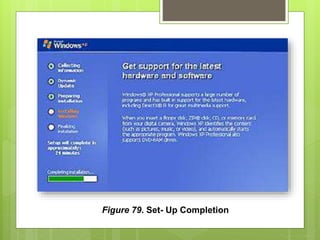
Set-up completion
• From this point on, Setup will continue to
completion without any further need for
interaction. Setup will now copy files,
complete installation, install your Start
Menu items, register system components,
save settings, remove any temporary files
needed by Setup, and then reboot.
• Again, you will probably see the "Press
any key to boot from CD" message on
reboot. If this happens, do not press a key,
and your new XP install will boot up. You
can remove the XP Setup CD now.
Figure 79. Set- Up Completion
Step 18
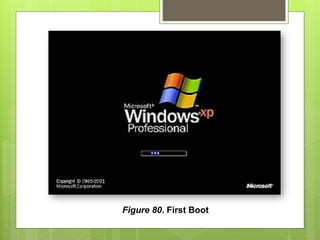
First boot
 You’ll be greeted by the XP
splash screen on first boot
(this actually appears briefly
when you rebooted into GUI
Setup as well).The splash
screens for XP Pro and Home
are subtly different.
Figure 80. First Boot
Step 19
Change display settings
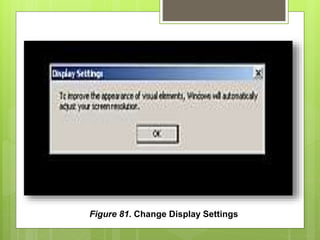
• Users with CRT monitors and some LCDs (such
as laptops and flat panel displays) will see a
Display Settings dialog appear, which asks
whether you'd like XP to automatically set the
resolution. This will generally change the
resolution from 800 x 600 to 1024 x 768 on a CRT
monitor, or to the native resolution of an LCD
display.
• Click OK and let XP change the resolution. Then,
accept the settings if the screen display changes
and can be read. If you can't see the display, it
will time out after 30 seconds and return to the
sub-optimal 800 x 600 resolution.
• Click OK to accept the screen resolution change.
Figure 81. Change Display Settings
Step 20
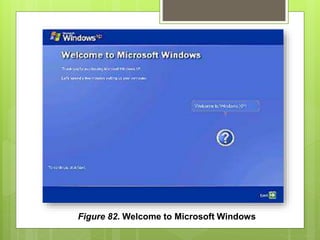
Welcome to Microsoft
Windows
• Now, you are presented
with XP's "Out of Box
Experience," or OOBE,
which presents a silly
wizard to guide you
through the final set up of
your PC.
Figure 82. Welcome to Microsoft Windows
Step 21
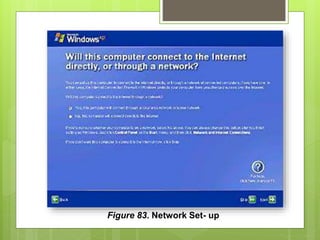
Network setup
• In the opening OOBE phase, you are asked to
set up your network/Internet connection, which
is required for activation and registration. If
you selected the default networking
configuration during Setup and know it will
work (because you're connected directly to a
cable modem, perhaps, or are on a local area
network), then select Yes (the default).
Otherwise, you can select No and then Skip.
• We'll assume that your network is up and
running and select Yes.
• Click Next to continue.
Figure 83. Network Set- up
Step 22
Optionally activate and
register Windows
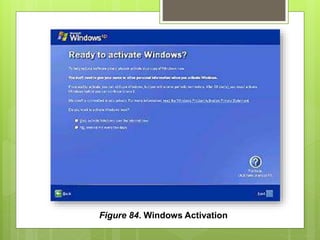
• If you selected Yes in the previous
step, you are asked if you'd like to
activate Windows XP. This will tie
your copy of XP to the current PC
semi-permanently. Activation requires
a connection to the Internet, but you
can perform this step later if you want
(and don't worry, XP will annoyingly
remind you of this fact every time you
boot the machine until you do so).
Figure 84. Windows Activation
Step 23
Set up users
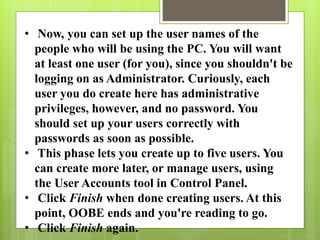
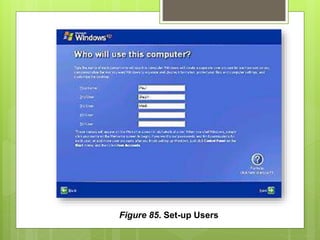
• Now, you can set up the user names of the
people who will be using the PC. You will want
at least one user (for you), since you shouldn't be
logging on as Administrator. Curiously, each
user you do create here has administrative
privileges, however, and no password. You
should set up your users correctly with
passwords as soon as possible.
• This phase lets you create up to five users. You
can create more later, or manage users, using
the User Accounts tool in Control Panel.
• Click Finish when done creating users. At this
point, OOBE ends and you're reading to go.
• Click Finish again.
Figure 85. Set-up Users
Step 24
Log on to Windows XP for
the first time
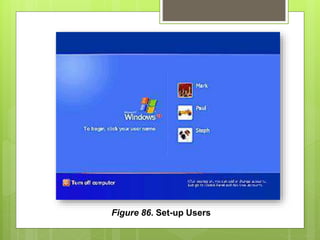
 Click your name, that account
will logon and you'll be presented
with the XP desktop. After you
create passwords, however, you'll
be asked to enter a password before
you can logon.
Figure 86. Set-up Users
Installing Operating System

Installing Operating System

  • 1.
  • 2.
    Before the installationprocess undertake, a technician must be aware of the minimum requirements of a computer hardware that is compatible with the operating system to be installed.
  • 3.
    Following the systems’requirements means an efficient computer system. The list below shows the windows XP minimum requirements for installation:  Pentium233 Mhz or compatible processor or faster; 300MHZor faster recommended  64MB of RAMminimum; 128MBor more recommended  4.3GBhard harddisk space or more  CD-ROMor DVD-ROM  Super VGA(800X600) or higher-resolution monitor  Keyboard and mouse
  • 4.
  • 5.
    Step 1 Insert theWindows XP CD-ROM and reboot the computer
  • 6.
    • If yousee a message about press any key to boot the CD, do so now. Otherwise, you will see a message about Setup inspecting your system.
  • 7.
  • 8.
  • 9.
    • In thefirst stage of setup; you will see a series of blue and gray MS-DOS-based screens. • In the first step, you will be asked to press F6 if you need to install any third-party or RAID drivers.
  • 10.
  • 11.
  • 12.
    • Finally, Setupbegins. In this step, you can set up XP, launch the Recovery Console (another, more complicated system recovery tool), or quit. • Press ENTER to continue Setup, and it will examine your hard drives and removable disks.
  • 13.
  • 14.
    Step 4 Read thelicense agreement
  • 15.
    • Next, you'llhave to agree to Microsoft's complex licensing agreement. Among the highlights: You don't actually own Windows XP and you can only install it on one PC. • Hit F8 to continue.
  • 16.
    Figure 65. Licenseand Agreement
  • 17.
  • 18.
    • This crucialstep lets you choose where to install XP. • On a clean install, you will typically install to the C: drive, but you might have other ideas, especially if you plan to dual-boot with 9x. • Setup will show you all of your available disks (in this case, just one) and let you create and delete partitions as needed. So, for example, if you have one disk, but would like to create two partitions, one for XP and one for your
  • 19.
    Figure 66. Choosean Installation Partition
  • 20.
    Step 6 Select thefile system
  • 21.
    • If youcreated a new partition, or wish to change the file system of an existing partition, you can do so in the next step. NTFS (New Technology File System) file system is more secured than FAT (File Allocation System). • Regardless of which file system you choose, be sure to select one of the "quick" format options (the top two choices), if you do need to format, since these will work much more quickly
  • 22.
    Figure 67. Selectthe File System
  • 23.
  • 24.
    • If youdid choose to change or format the file system, this will occur next. First, you'll be asked to verify the format. If you're installing XP on a system with more than one partition, especially one that still holds your data on one of the partitions, be sure you're formatting the correct partition. • Hit F to continue, and a yellow progress bar will indicate the status of the format. When this is complete, Setup will again examine your disks, and create a list of files to copy.
  • 25.
    Figure 68. OptionallyFormat the Partition
  • 26.
    Step 8 Setup foldercopy phase and reboot
  • 27.
    • Setup willnow copy system files to the system/boot partition(s) you just created. This will allow the PC to boot from the C: drive and continue Setup in GUI mode. • When the file copy is complete, Setup will initialize and save your XP configuration. • It will then reboot your PC. When the system reboots, you will probably see the "Press any key to boot from CD" message again. If this happens, do not press a key: Setup will now boot from your C: drive. In the event that you cannot prevent the CD-based Setup from reloading, eject the CD and reboot. Setup will ask for the CD when needed.
  • 28.
    Figure 69. SetupFolder Copy Phase
  • 29.
  • 30.
    • Once thesystem reboots, you will be presented with the GUI Setup phase, which is much more attractive than the DOS-mode phase. As you progress through GUI Setup, you can read promotional information on the right side of the screen about XP. • Next, your hardware devices are detected. This could take several
  • 31.
  • 32.
  • 33.
    • In thefirst interactive portion of GUI Setup, you can choose to customize the regional and language settings that will be used by XP, as well as the text input language you'd like. Users in the United States will not normally need to change anything here. • Click Next to continue.
  • 34.
    Figure 71. Regionaland Language Options
  • 35.
  • 36.
    • Now, enteryour name and your company. The name you enter is not the same as your user name, incidentally, so you should enter your real name here (i.e. Rosalie Lujero or whatever). • Click Next to continue.
  • 37.
    Figure 72. SoftwarePersonalization
  • 38.
    Step 12 Enter yourproduct key
  • 39.
    Figure 73. EnterProduct Key
  • 40.
    • Now youmust enter the 25-character product key that is located on the orange sticker found on the back of the CD holder that came with Windows XP. You cannot install XP without a valid product key. Later on, you will be asked to activate and optionally register your copy of Windows XP. A product key can be used to install XP on only one PC.
  • 41.
    Step 13 Enter acomputer name and administrator password
  • 42.
     In thenext phase of Setup, you can create a name for your computer (which is used to identify it on a network) and, optionally in Pro Edition only, a password for the system Administrator, the person who controls the PC (this will generally be you, of course).
  • 43.
    Figure 74. EnterComputer Name and Administrator Password
  • 44.
    Step 14 Supply yourdate and time settings
  • 45.
    • Next, youcan supply the date and time, which are auto-set based on information in your BIOS, and the time zone, which is irritatingly set to PST, which is where Microsoft is. Change these as appropriate. • Click Next to continue.
  • 46.
    Figure 75. EnterDate and Time Settings
  • 47.
  • 48.
     If youhave a networking card or modem, Setup now install the networking components, which include the client for Microsoft networks, File and Print Sharing, the Quality of Service (QoS) Packet Scheduler, and the TCP/IP networking protocol by default.
  • 49.
  • 50.
  • 51.
    • In thisphase, you can choose to keep the default settings (recommended) or enter custom settings. Note that XP doesn't include the legacy NetBEUI protocol out of the box. If you want to use this protocol, you will need to install it later from the XP. • Click Next to continue.
  • 52.
    Figure 77. ChooseNetworking Settings
  • 53.
    Windows XP Professionalonly: Step 16b Enter workgroup or domain information
  • 54.
    • In WindowsXP Professional only, you will be able to select a workgroup or domain name next. Home Edition doesn't work with Windows domains, however, and Setup will automatically supply the workgroup name MSHOME, which you can change later. The default workgroup name in XP Pro is, imaginatively, WORKGROUP. • Click Next to continue.
  • 55.
    Figure 78. EnterWorkgroup or Domain Information
  • 56.
  • 57.
    • From thispoint on, Setup will continue to completion without any further need for interaction. Setup will now copy files, complete installation, install your Start Menu items, register system components, save settings, remove any temporary files needed by Setup, and then reboot. • Again, you will probably see the "Press any key to boot from CD" message on reboot. If this happens, do not press a key, and your new XP install will boot up. You can remove the XP Setup CD now.
  • 58.
    Figure 79. Set-Up Completion
  • 59.
  • 60.
     You’ll begreeted by the XP splash screen on first boot (this actually appears briefly when you rebooted into GUI Setup as well).The splash screens for XP Pro and Home are subtly different.
  • 61.
  • 62.
  • 63.
    • Users withCRT monitors and some LCDs (such as laptops and flat panel displays) will see a Display Settings dialog appear, which asks whether you'd like XP to automatically set the resolution. This will generally change the resolution from 800 x 600 to 1024 x 768 on a CRT monitor, or to the native resolution of an LCD display. • Click OK and let XP change the resolution. Then, accept the settings if the screen display changes and can be read. If you can't see the display, it will time out after 30 seconds and return to the sub-optimal 800 x 600 resolution. • Click OK to accept the screen resolution change.
  • 64.
    Figure 81. ChangeDisplay Settings
  • 65.
    Step 20 Welcome toMicrosoft Windows
  • 66.
    • Now, youare presented with XP's "Out of Box Experience," or OOBE, which presents a silly wizard to guide you through the final set up of your PC.
  • 67.
    Figure 82. Welcometo Microsoft Windows
  • 68.
  • 69.
    • In theopening OOBE phase, you are asked to set up your network/Internet connection, which is required for activation and registration. If you selected the default networking configuration during Setup and know it will work (because you're connected directly to a cable modem, perhaps, or are on a local area network), then select Yes (the default). Otherwise, you can select No and then Skip. • We'll assume that your network is up and running and select Yes. • Click Next to continue.
  • 70.
  • 71.
    Step 22 Optionally activateand register Windows
  • 72.
    • If youselected Yes in the previous step, you are asked if you'd like to activate Windows XP. This will tie your copy of XP to the current PC semi-permanently. Activation requires a connection to the Internet, but you can perform this step later if you want (and don't worry, XP will annoyingly remind you of this fact every time you boot the machine until you do so).
  • 73.
  • 74.
  • 75.
    • Now, youcan set up the user names of the people who will be using the PC. You will want at least one user (for you), since you shouldn't be logging on as Administrator. Curiously, each user you do create here has administrative privileges, however, and no password. You should set up your users correctly with passwords as soon as possible. • This phase lets you create up to five users. You can create more later, or manage users, using the User Accounts tool in Control Panel. • Click Finish when done creating users. At this point, OOBE ends and you're reading to go. • Click Finish again.
  • 76.
  • 77.
    Step 24 Log onto Windows XP for the first time
  • 78.
     Click yourname, that account will logon and you'll be presented with the XP desktop. After you create passwords, however, you'll be asked to enter a password before you can logon.
  • 79.