Chapter 2Chapter 2
Electrical Wiring Practices
and Diagrams
MEl
ec-
Ch
2 -
1
OverviewOverview
Safety
Standards
Wiring Considerations
Wire Terminations
Coaxial Cable
Wiring Installations
Wiring Diagrams
MEl
ec-
Ch
2 -
2
SafetySafety
Lethal Current
Safety Precautions
MEl
ec-
Ch
2 -
3
Lethal CurrentLethal Current
Fundamental policy of the USPS is SAFETY
Human Body
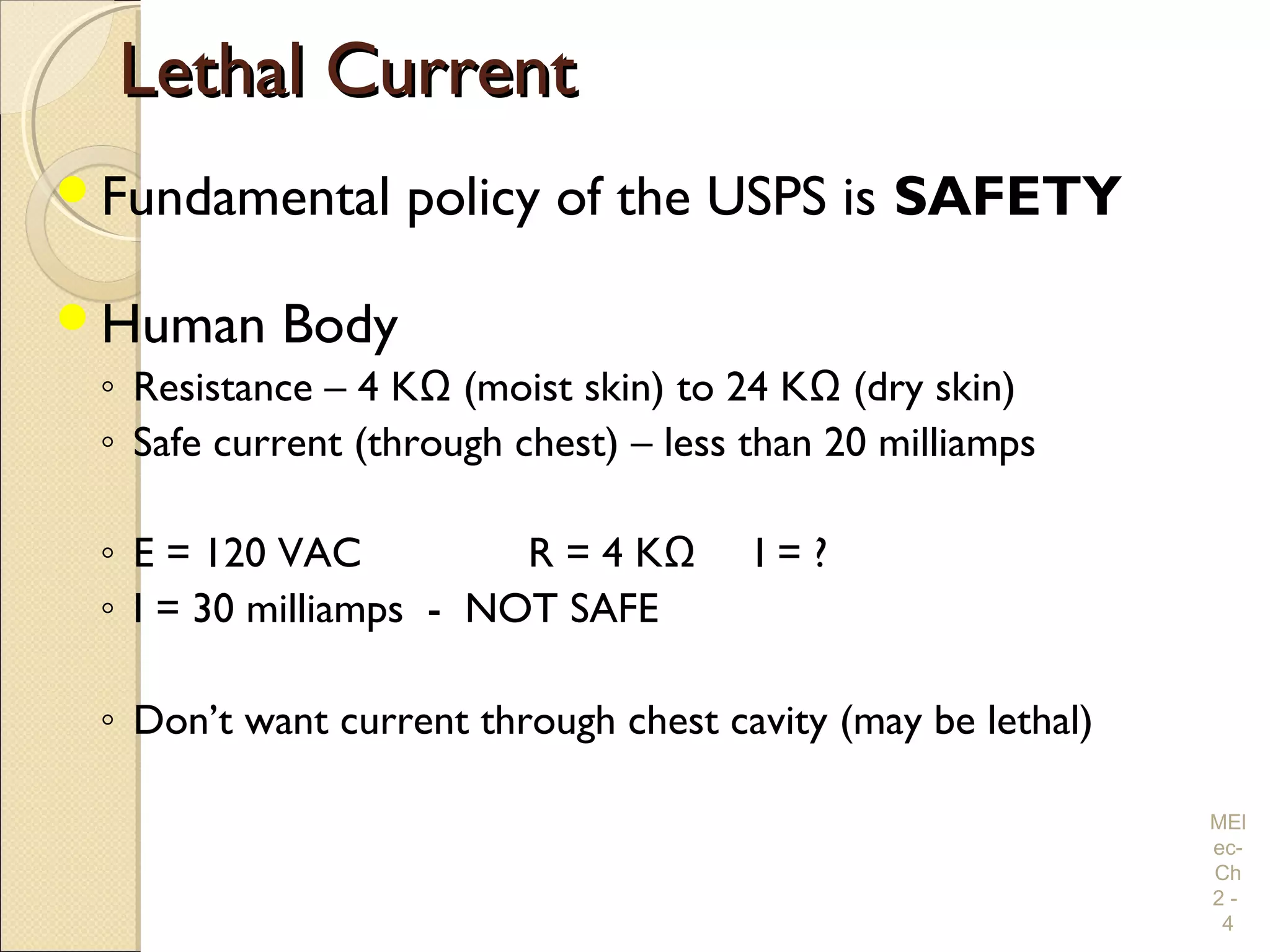
◦ Resistance – 4 KΩ (moist skin) to 24 KΩ (dry skin)
◦ Safe current (through chest) – less than 20 milliamps
◦ E = 120 VAC R = 4 KΩ I = ?
◦ I = 30 milliamps - NOT SAFE
◦ Don’t want current through chest cavity (may be lethal)
MEl
ec-
Ch
2 -
4
Safety PrecautionsSafety Precautions
Turn circuit off
◦ Disconnect service cord
◦ Disconnect negative battery cable
If must work on live AC circuit
◦ Need 2nd
safety person
Remove metal jewelry
Know your boat and its wiring
Use outlet tester on AC outlets
Use 3-wire extension cord from GFI outlet MEl
ec-
Ch
2 -
5
StandardsStandards
American Boat and Yacht Council (ABYC)
◦ AC and DC Electrical Systems is E-11
◦ Minimum standards
 Construction
 Repair
Marine Dept. of Underwriters Laboratory
◦ Test and certify commercial products
◦ Safety, not function
MEl
ec-
Ch
2 -
6
Wiring ConsiderationsWiring Considerations
Conductors
Wire Types
Wire Size
Wire Insulation
Wire Color Code
MEl
ec-
Ch
2 -
7
ConductorsConductors
Connects power sources to power loads
Characteristics
◦ Safe
◦ Dependable
◦ Efficient (minimal voltage drop)
Boat environment
◦ Worse than either house or car
◦ High humidity
◦ Vibration
◦ Corrosive conditions
MEl
ec-
Ch
2 -
8
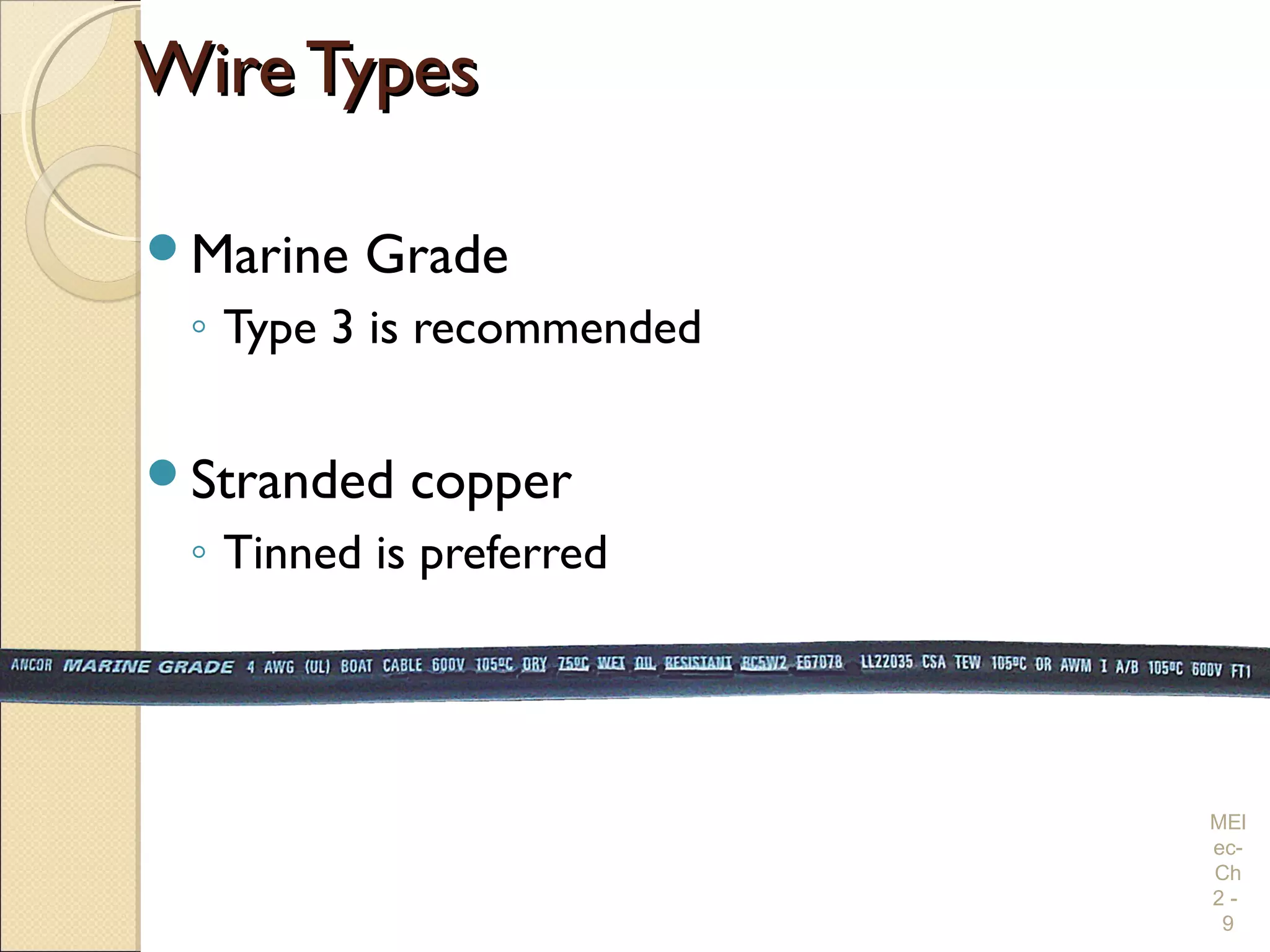
WireTypesWireTypes
Marine Grade
◦ Type 3 is recommended
Stranded copper
◦ Tinned is preferred
MEl
ec-
Ch
2 -
9
Wire SizeWire Size
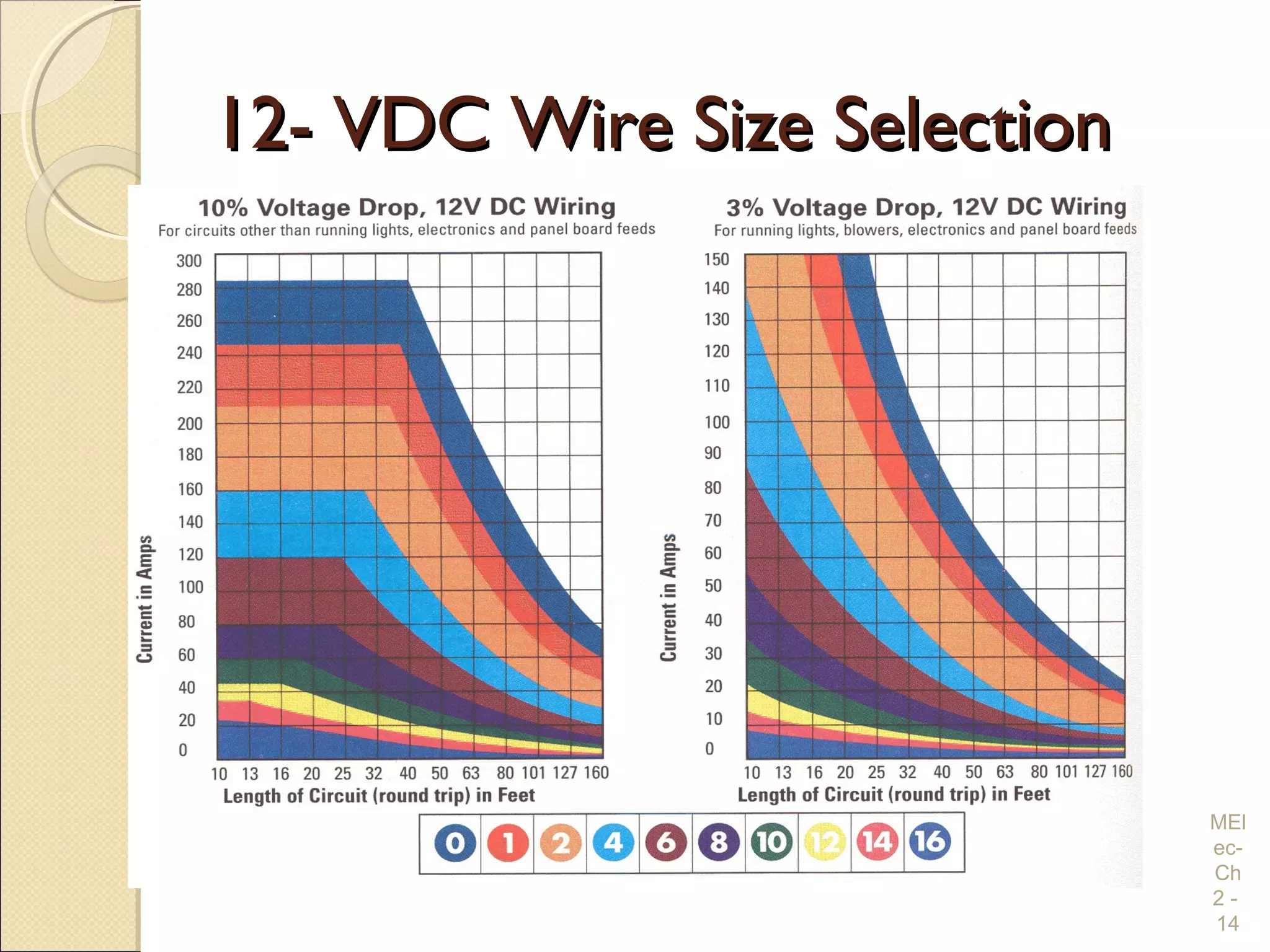
3% voltage drop
◦ Critical circuits (Nav lights)
◦ Electronic Equipment
10% voltage drop
◦ Cabin lights
◦ Motorized Equipment
Minimum size AWG # 16
MEl
ec-
Ch
2 -
10
Wire Has ResistanceWire Has Resistance
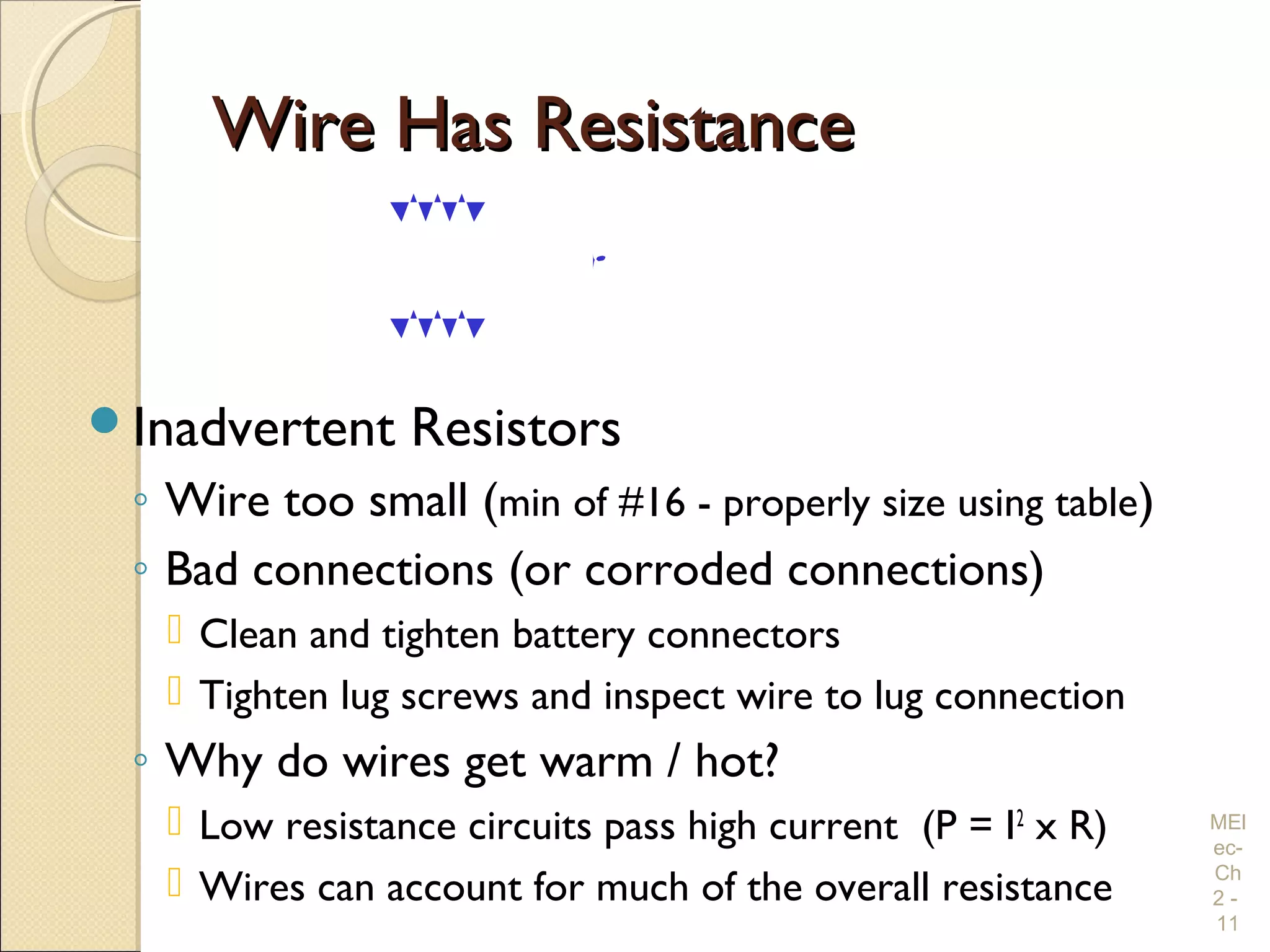
Inadvertent Resistors
◦ Wire too small (min of #16 - properly size using table)
◦ Bad connections (or corroded connections)
 Clean and tighten battery connectors
 Tighten lug screws and inspect wire to lug connection
◦ Why do wires get warm / hot?
 Low resistance circuits pass high current (P = I2
x R)
 Wires can account for much of the overall resistance
MEl
ec-
Ch
2 -
11
V12 VDC
0.1 Ώ
0.1 Ώ
10A What Voltage?
An. 10 VDC
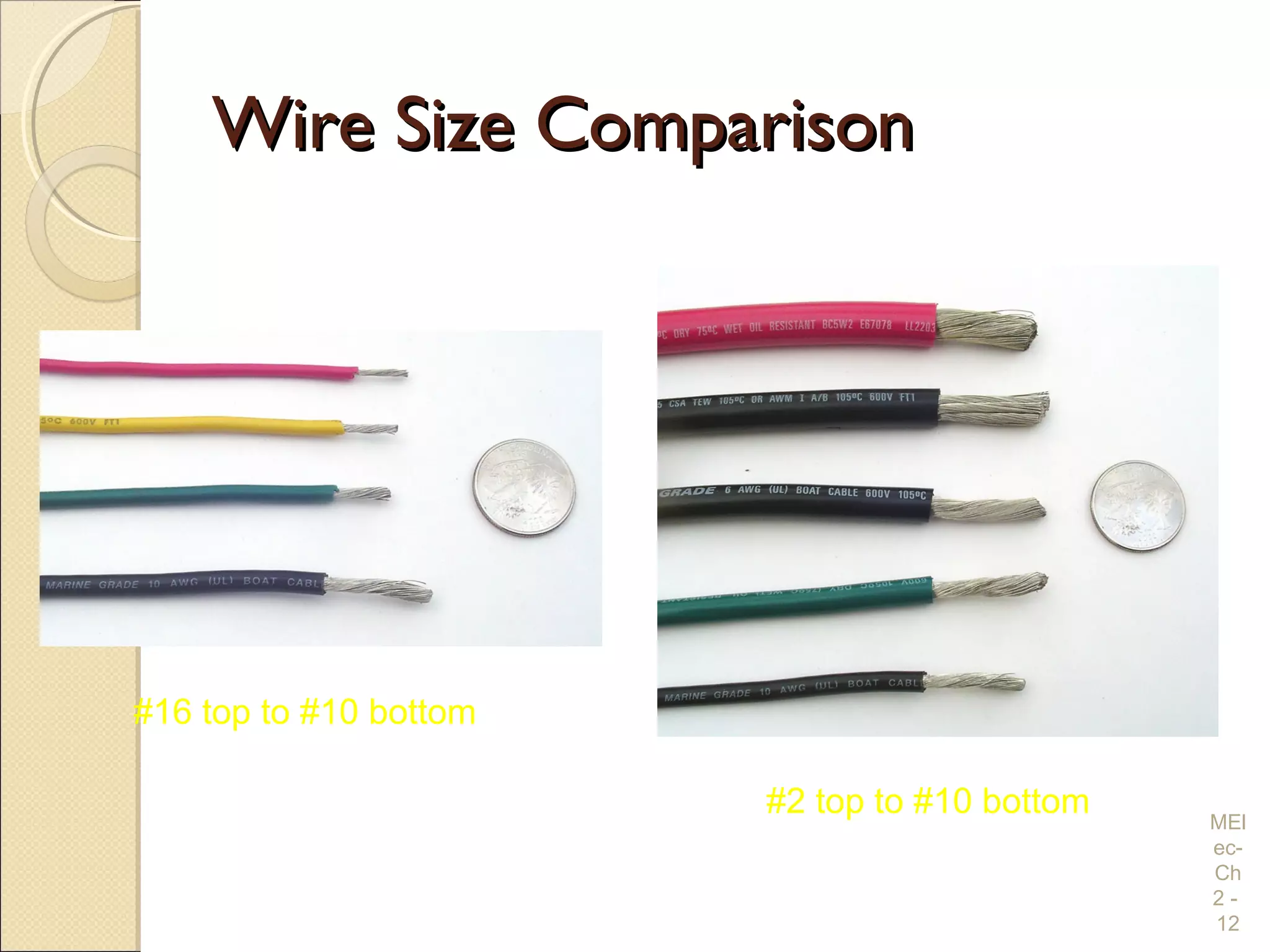
Wire Size ComparisonWire Size Comparison
MEl
ec-
Ch
2 -
12
#16 top to #10 bottom
#2 top to #10 bottom
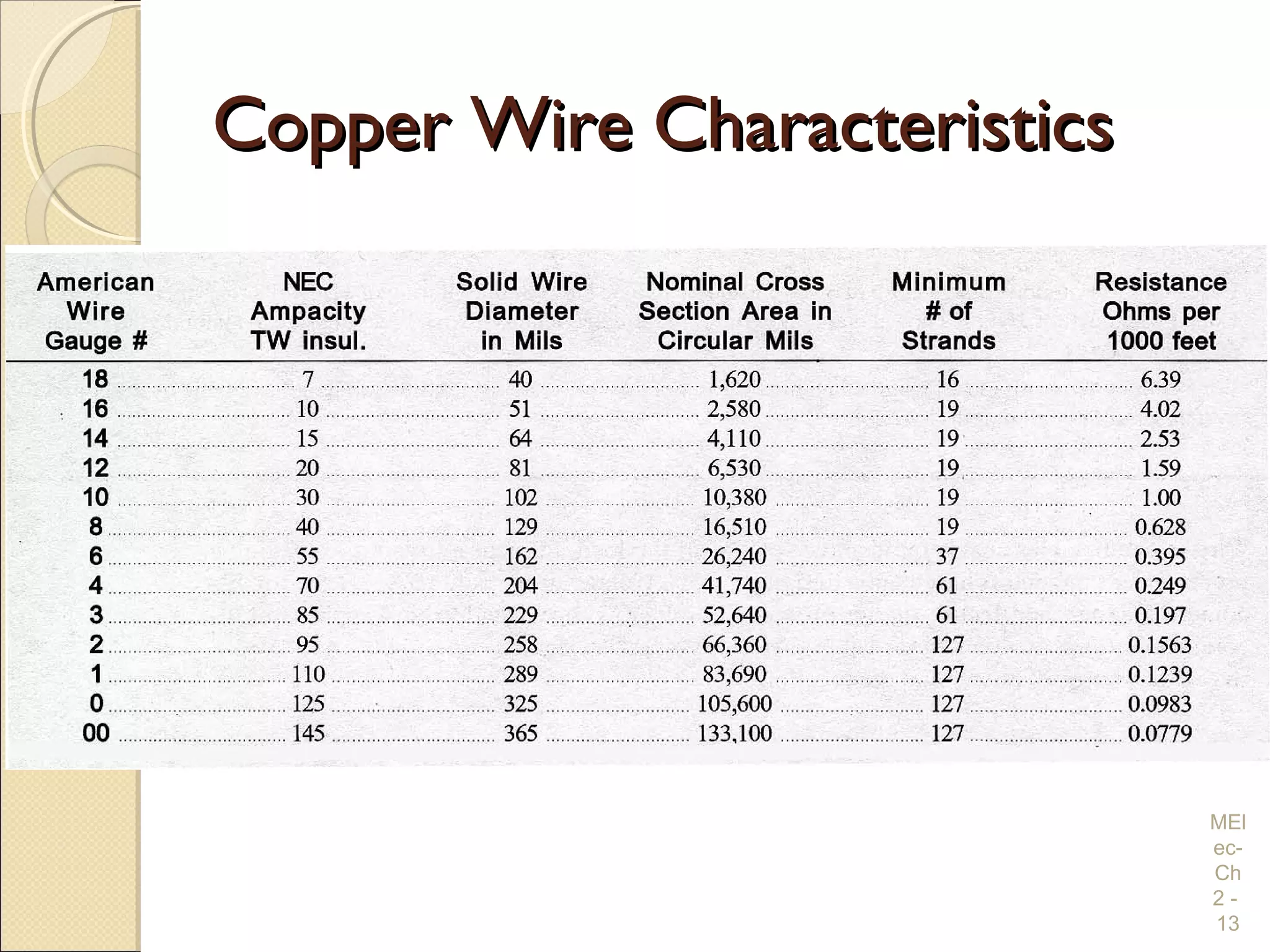
Copper Wire CharacteristicsCopper Wire Characteristics
MEl
ec-
Ch
2 -
13
12- VDC Wire Size Selection12- VDC Wire Size Selection
MEl
ec-
Ch
2 -
14
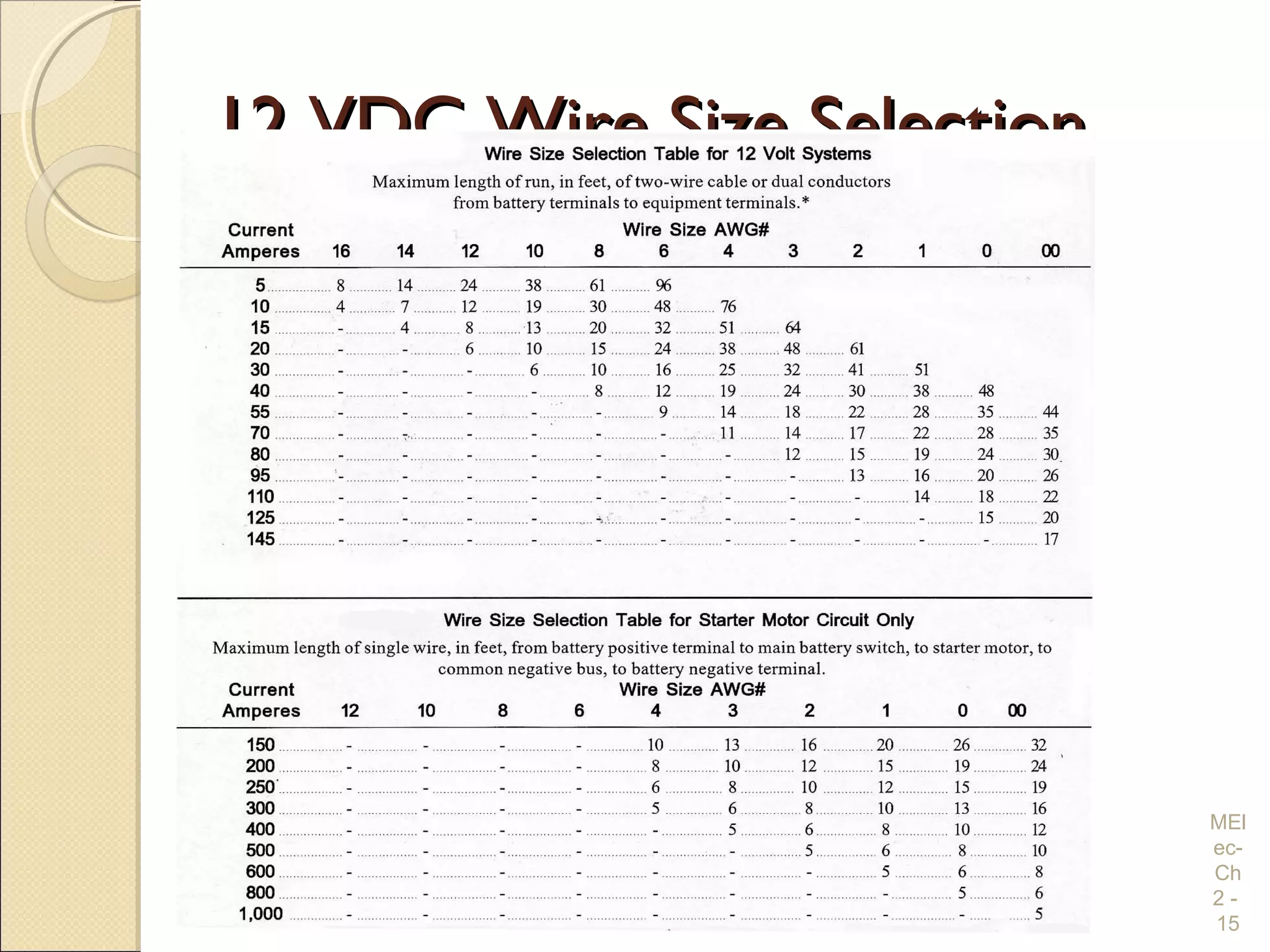
12 VDC Wire Size Selection12 VDC Wire Size Selection
MEl
ec-
Ch
2 -
15
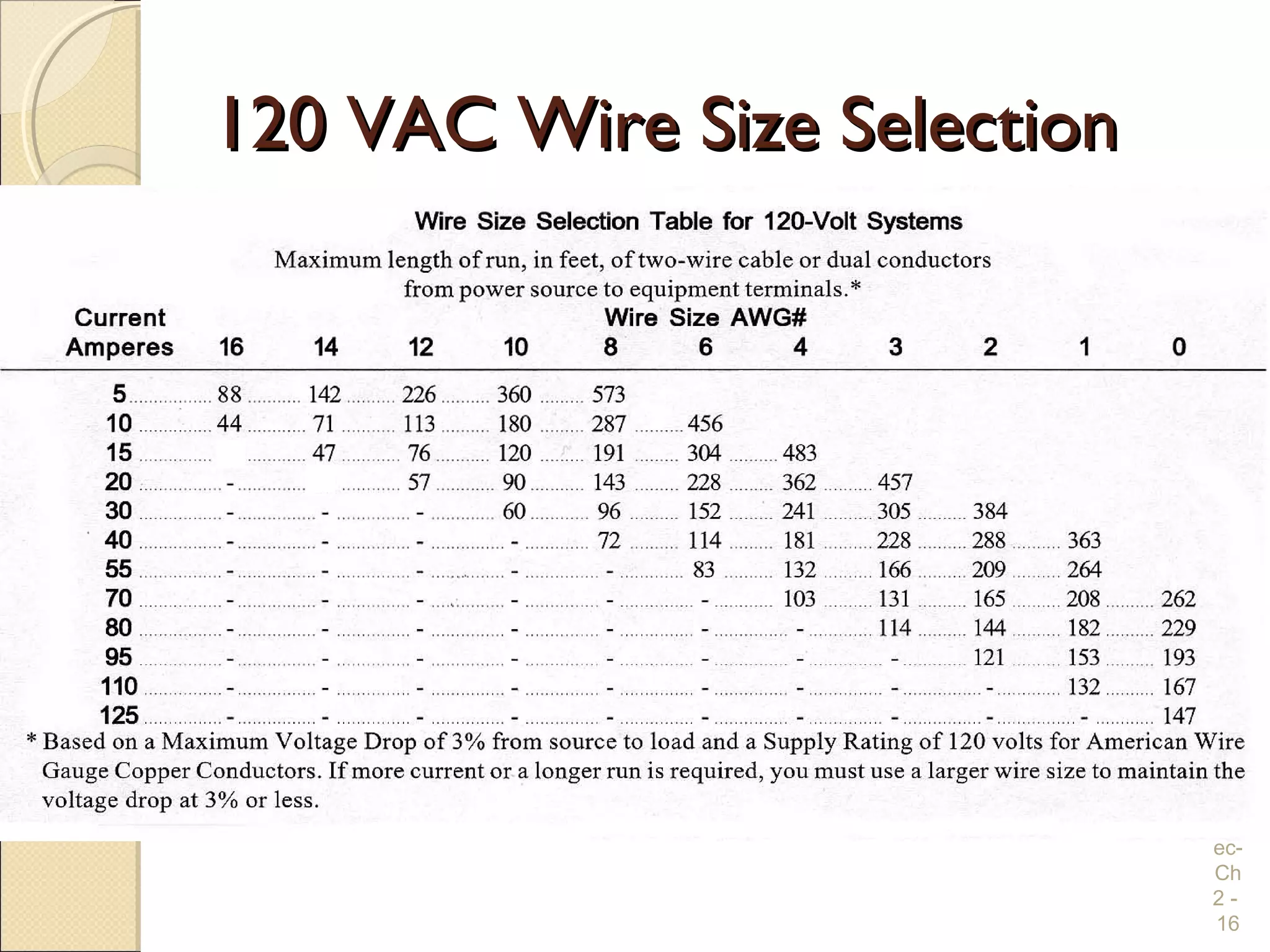
120 VAC Wire Size Selection120 VAC Wire Size Selection
MEl
ec-
Ch
2 -
16
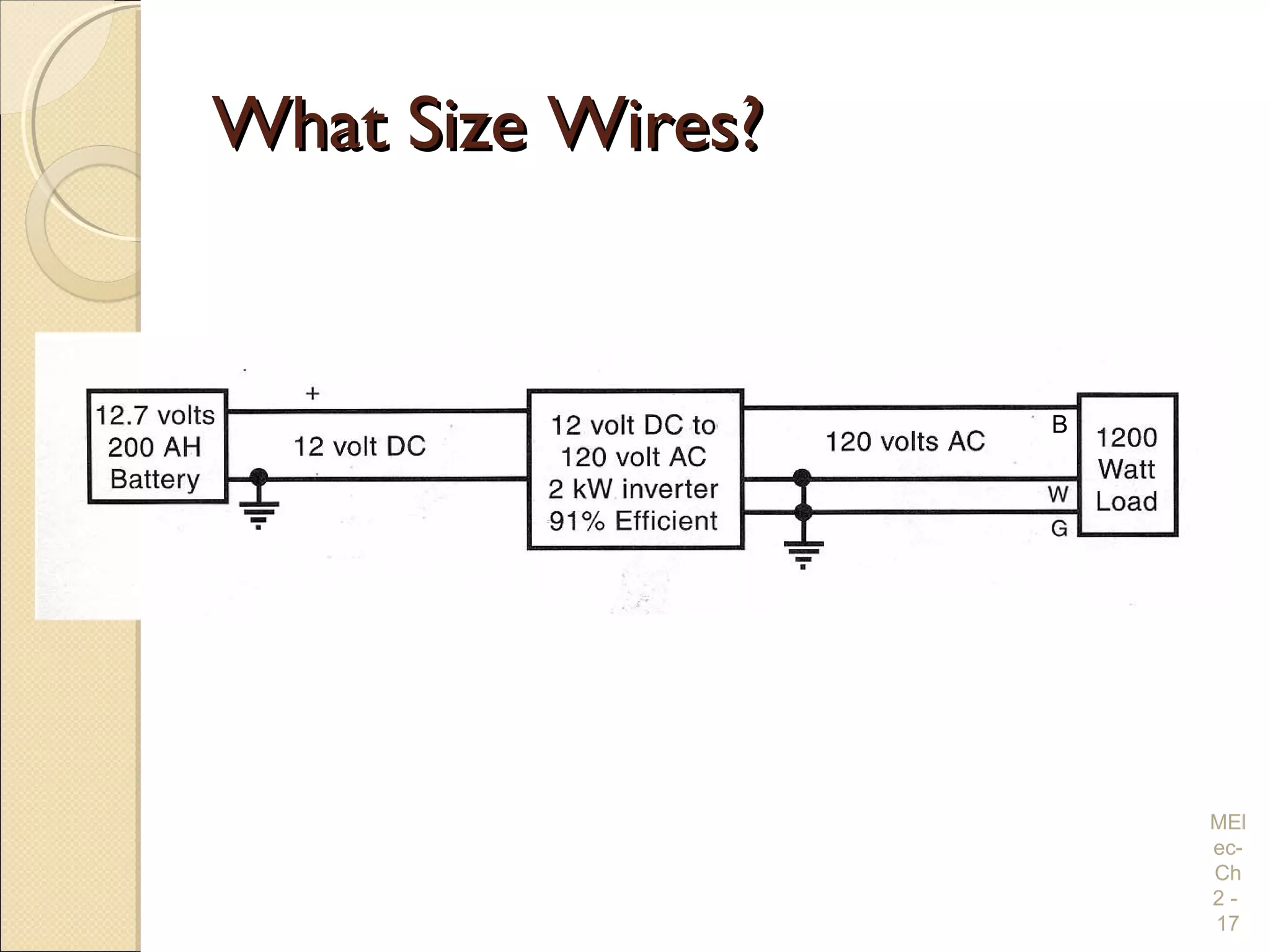
What Size Wires?What Size Wires?
MEl
ec-
Ch
2 -
17
B
Step 1Step 1
MEl
ec-
Ch
2 -
18
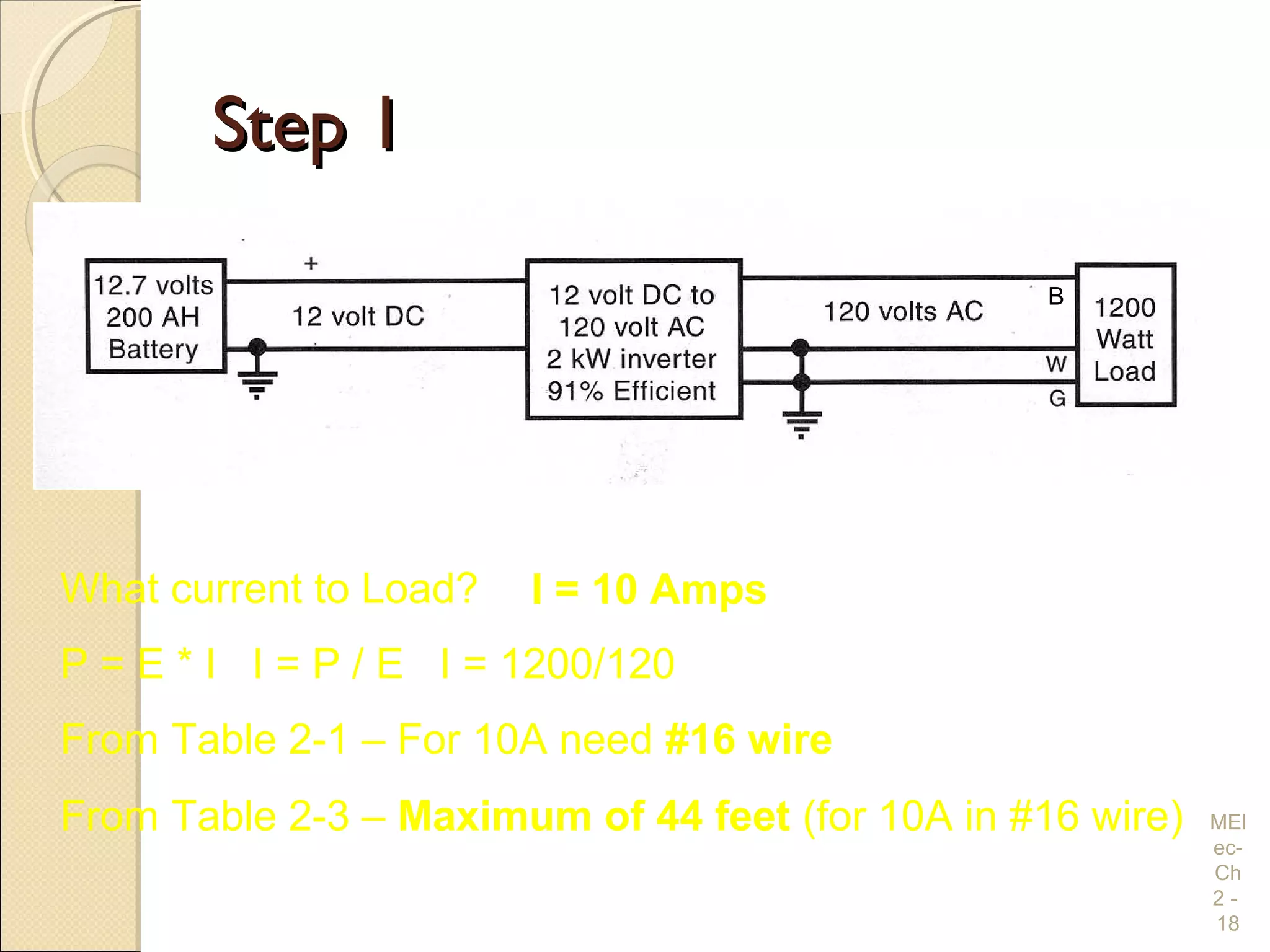
What current to Load?
From Table 2-3 – Maximum of 44 feet (for 10A in #16 wire)
P = E * I I = P / E I = 1200/120
I = 10 Amps
From Table 2-1 – For 10A need #16 wire
B
Step 1 AnswersStep 1 Answers
MEl
ec-
Ch
2 -
19
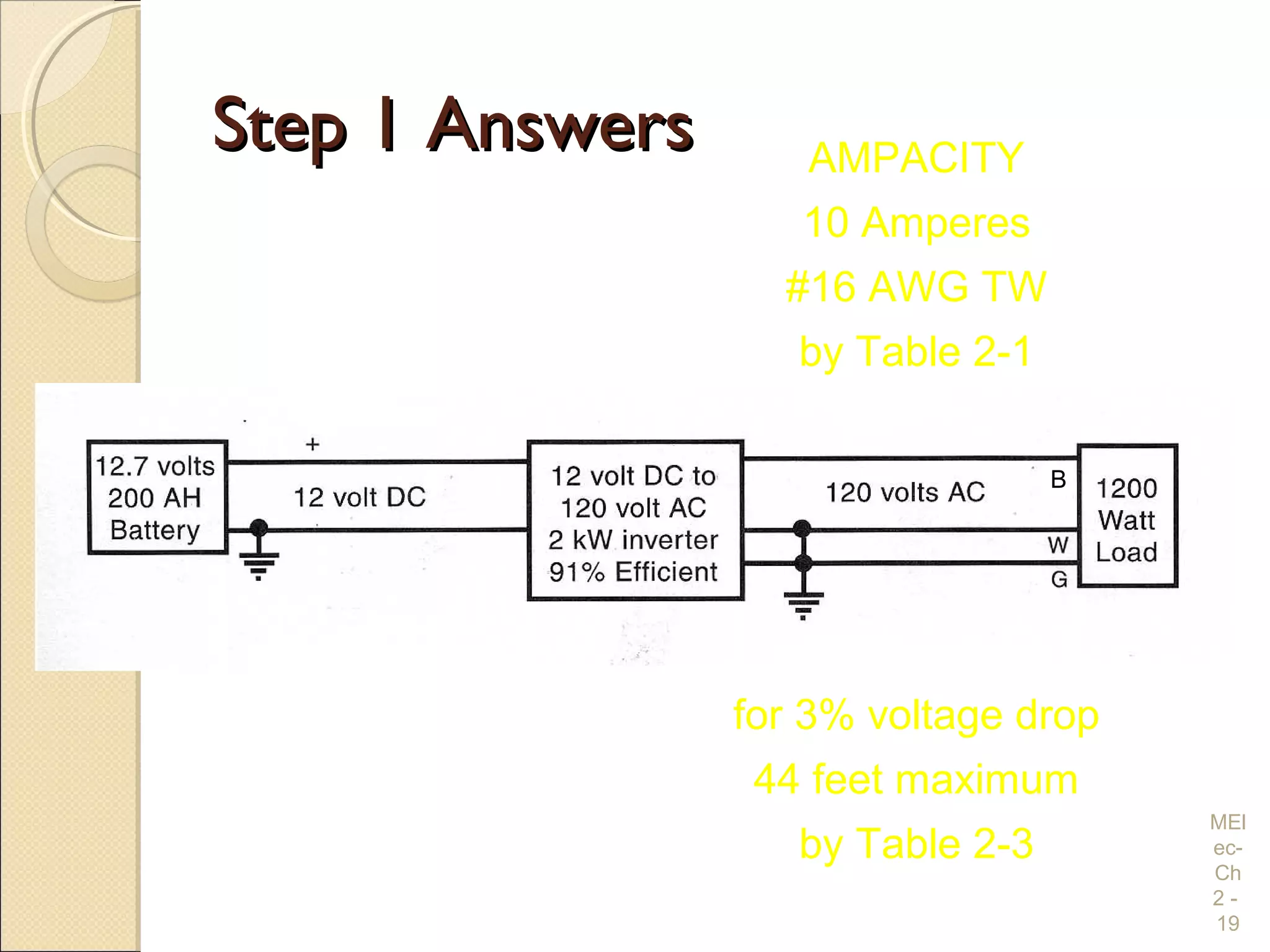
AMPACITY
10 Amperes
#16 AWG TW
by Table 2-1
for 3% voltage drop
44 feet maximum
by Table 2-3
B
Step 2Step 2
MEl
ec-
Ch
2 -
20
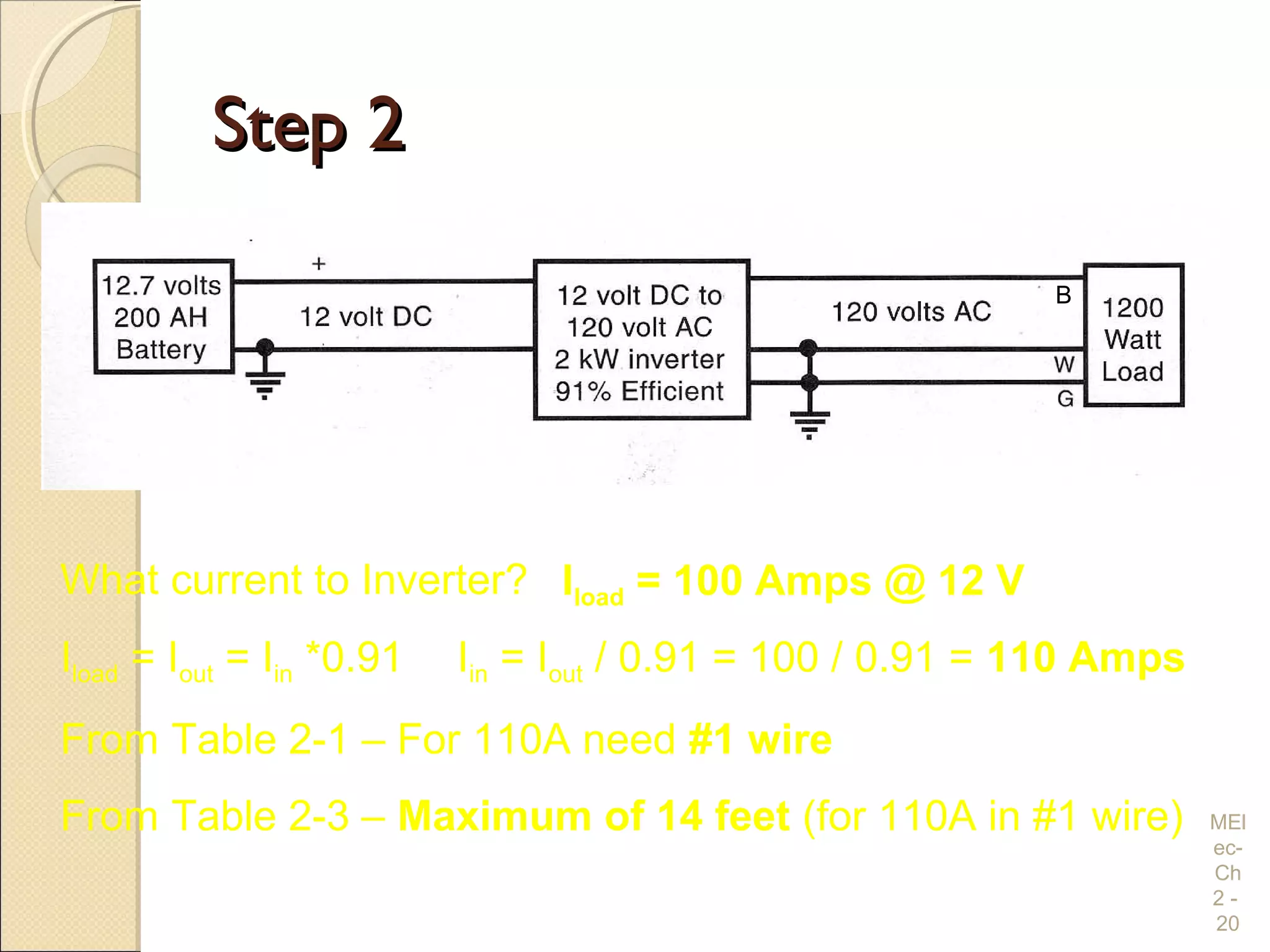
What current to Inverter?
From Table 2-3 – Maximum of 14 feet (for 110A in #1 wire)
Iload = Iout = Iin *0.91 Iin = Iout / 0.91 = 100 / 0.91 = 110 Amps
From Table 2-1 – For 110A need #1 wire
B
Iload = 100 Amps @ 12 V
Step 2 AnswersStep 2 Answers
MEl
ec-
Ch
2 -
21
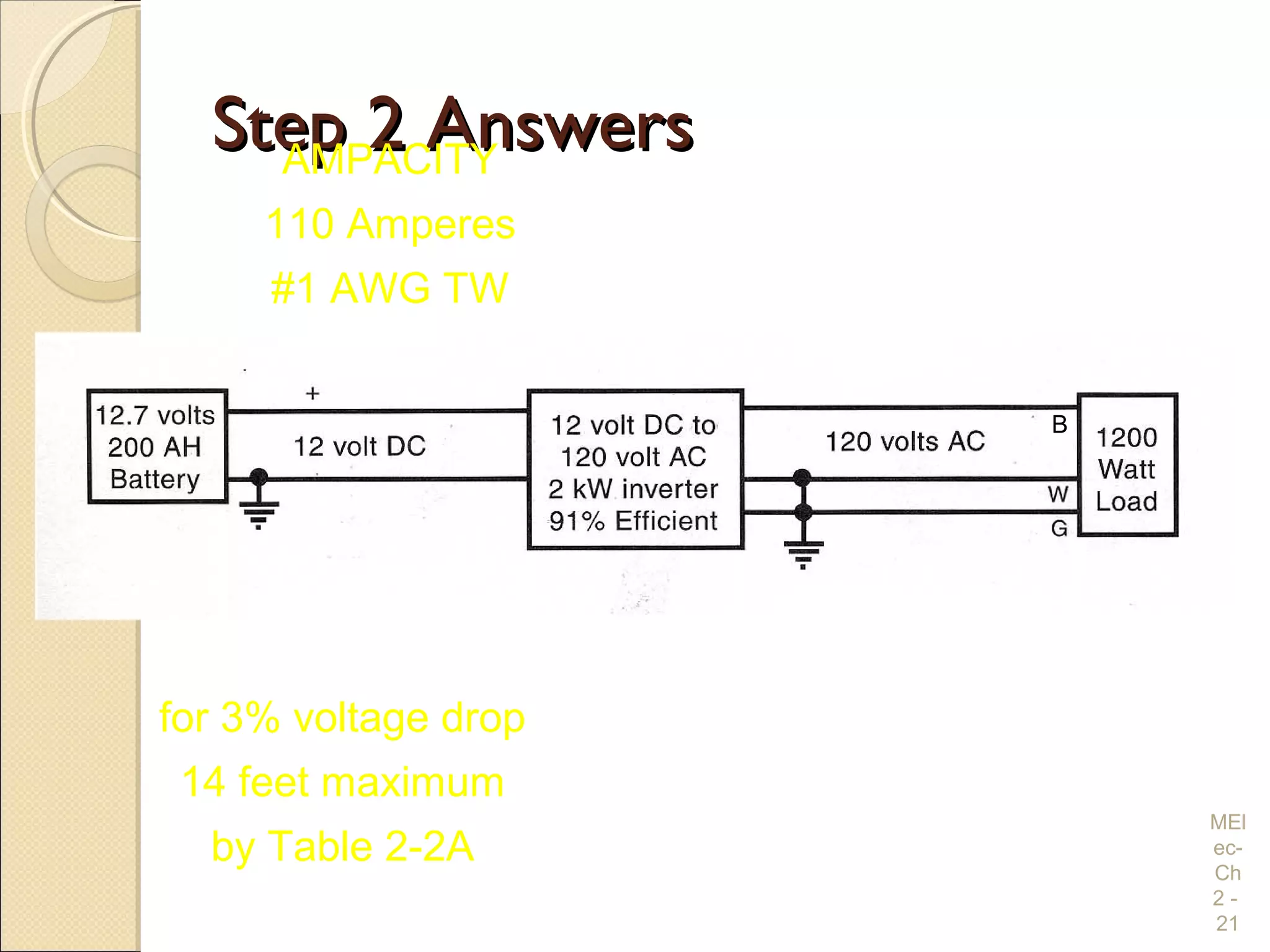
AMPACITY
110 Amperes
#1 AWG TW
by Table 1
for 3% voltage drop
14 feet maximum
by Table 2-2A
B
Wire InsulationWire Insulation
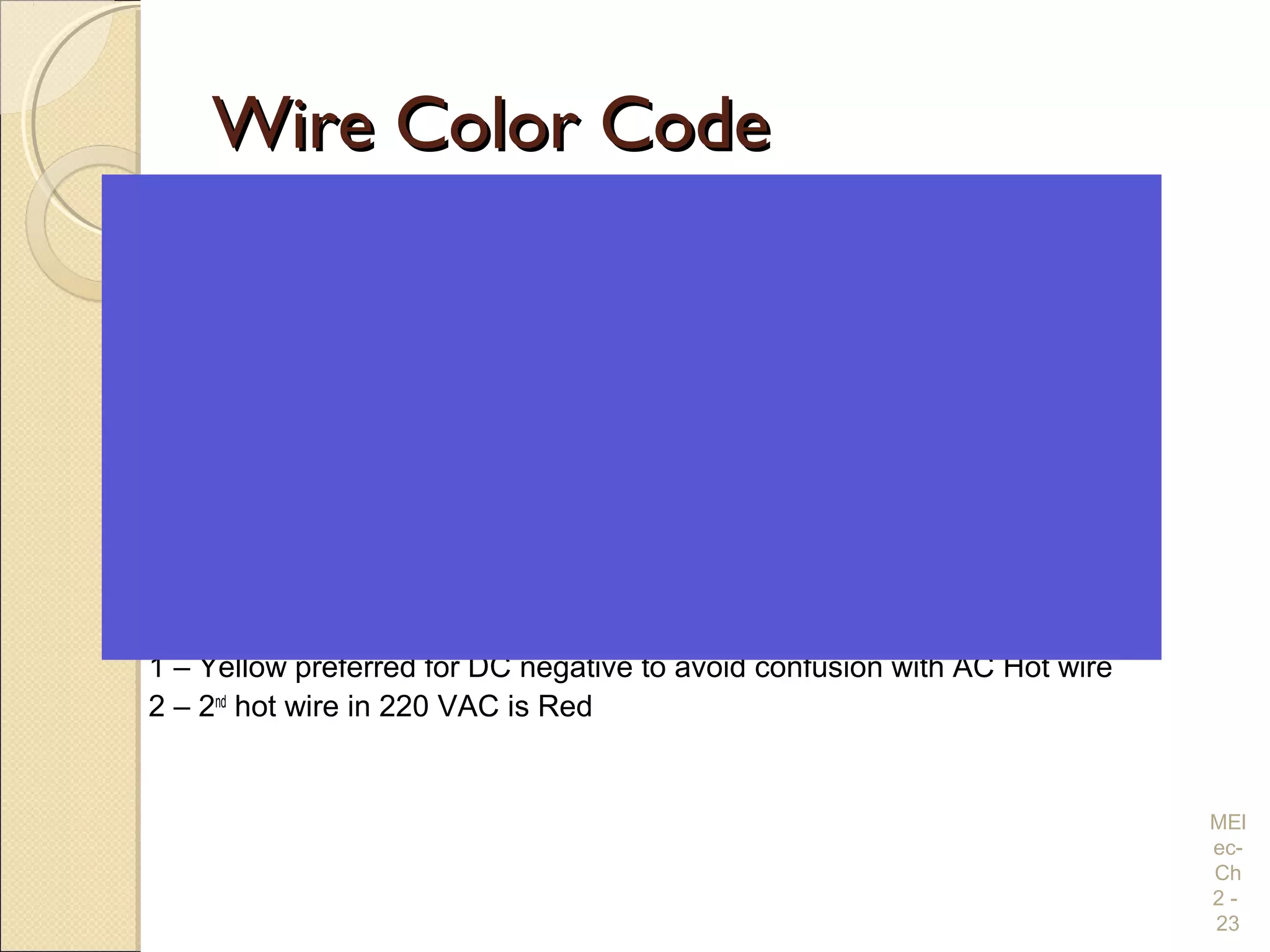
AC cables must be type UL 1426 BC
◦ 600 volt insulation
◦ Gasoline and Oil resistant
◦ Won’t absorb moisture
DC wires & cables must be Marine Grade
◦ 600 volt insulation
◦ Gasoline and Oil resistant
◦ Won’t absorb moisture
Color coded wires MEl
ec-
Ch
2 -
22
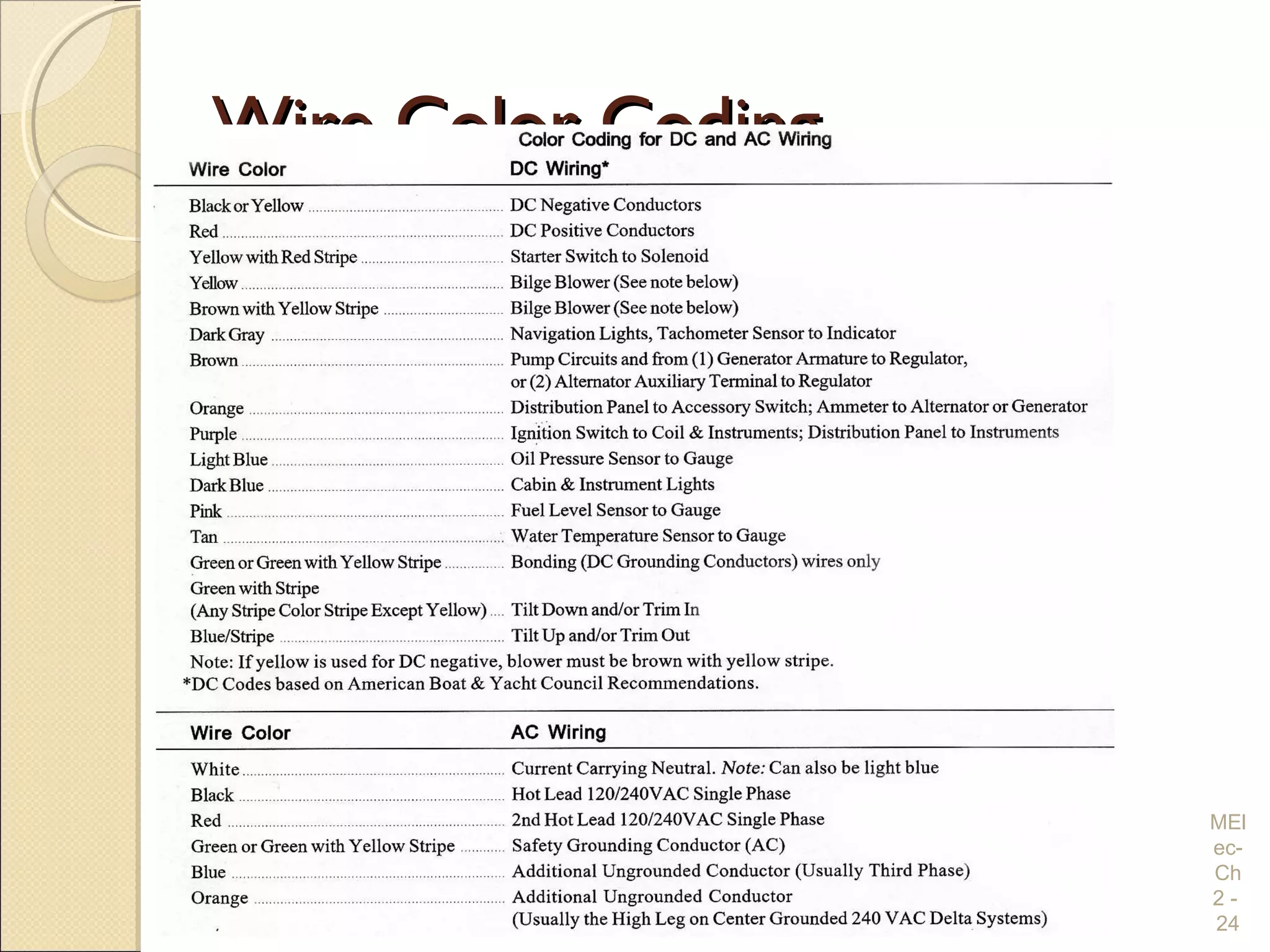
Wire Color CodeWire Color Code
Color AC (Hot) AC (Neut) AC (Gnd) DC + DC -
Black X X1
White X
Green (may have a yellow stripe) X
Red X2
X
Yellow X1
Footnotes:
1 – Yellow preferred for DC negative to avoid confusion with AC Hot wire
2 – 2nd
hot wire in 220 VAC is Red
MEl
ec-
Ch
2 -
23
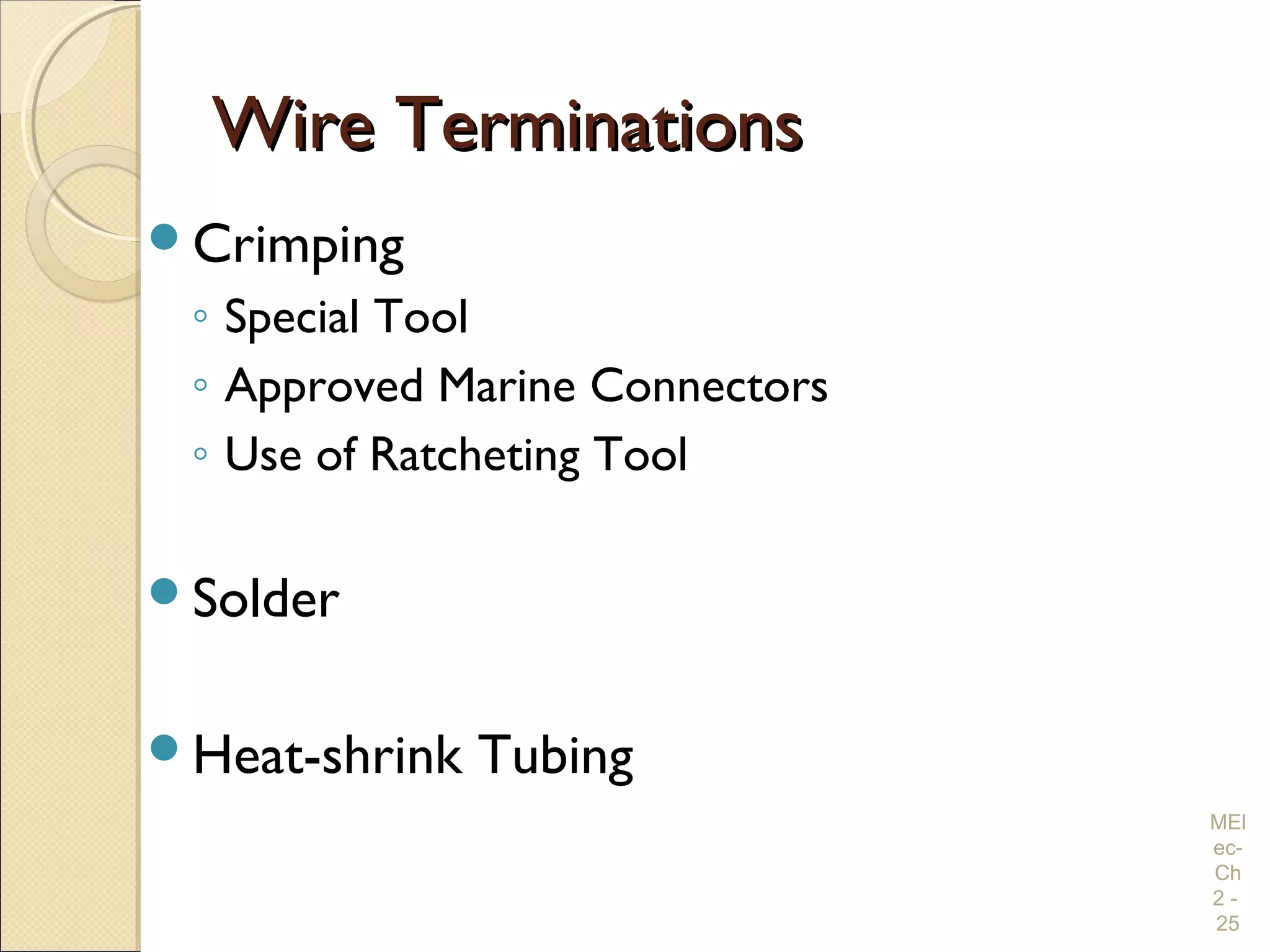
Wire Color CodingWire Color Coding
MEl
ec-
Ch
2 -
24
Wire TerminationsWire Terminations
Crimping
◦ Special Tool
◦ Approved Marine Connectors
◦ Use of Ratcheting Tool
Solder
Heat-shrink Tubing
MEl
ec-
Ch
2 -
25
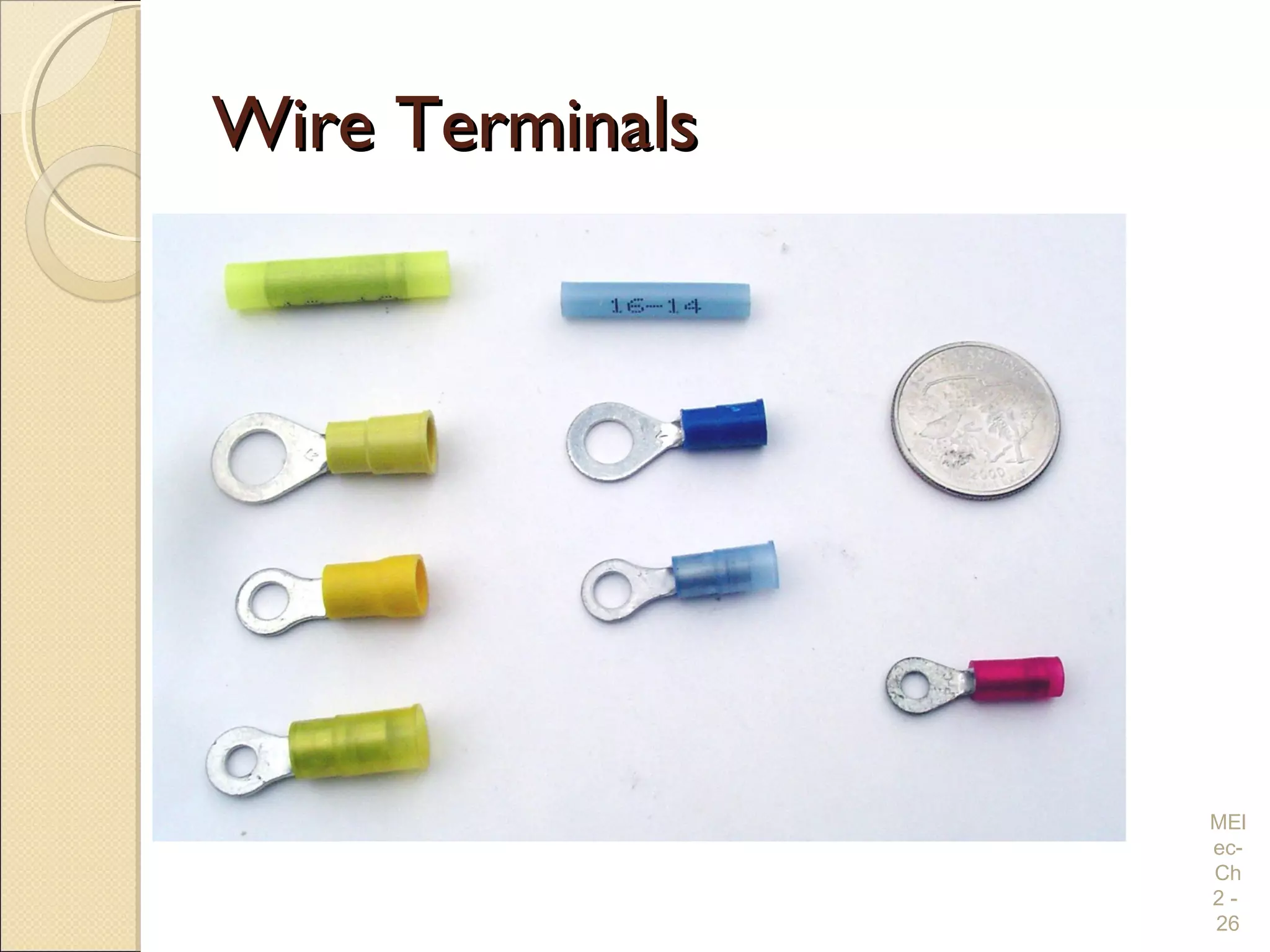
Wire TerminalsWire Terminals
MEl
ec-
Ch
2 -
26
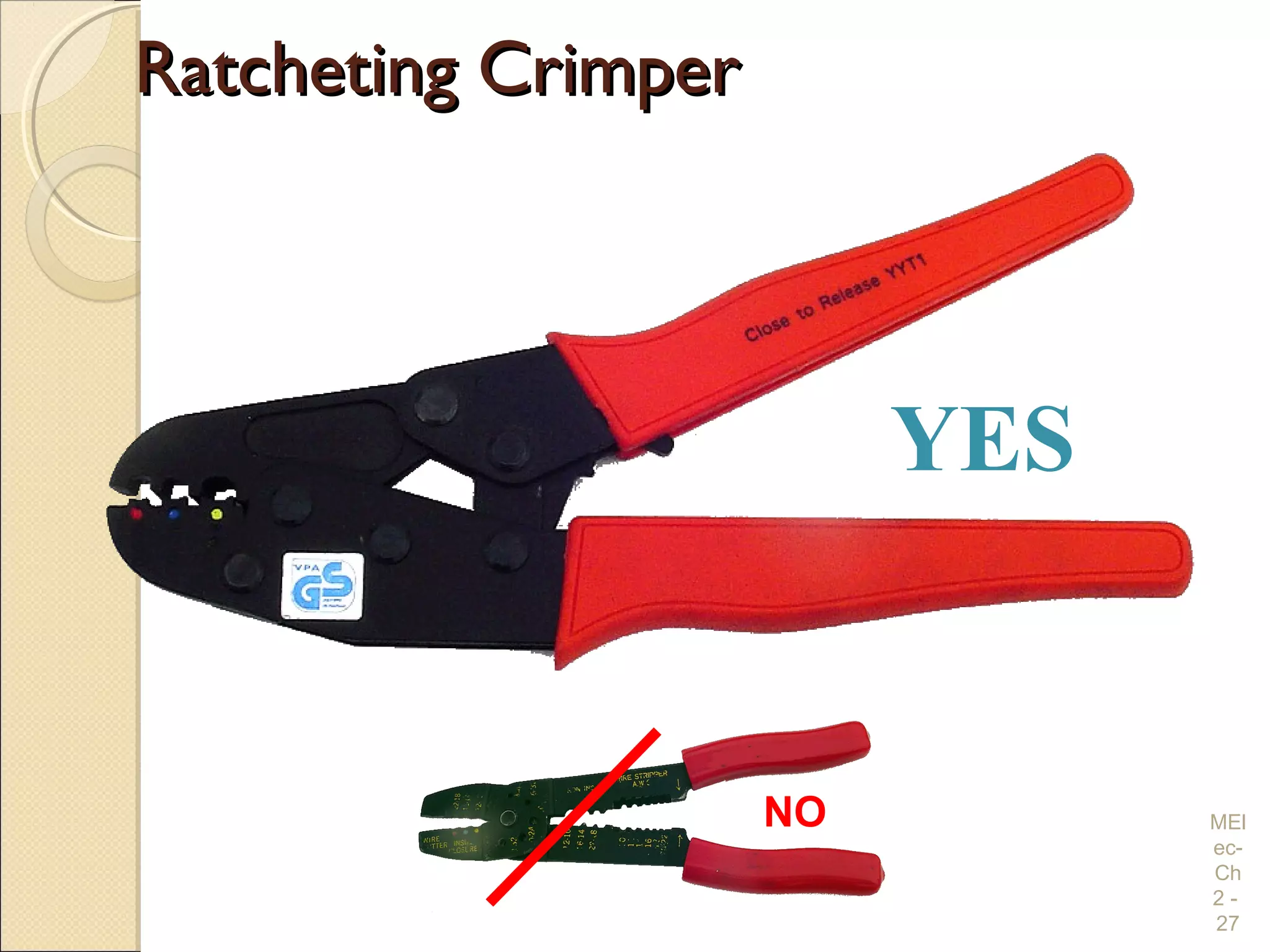
Ratcheting CrimperRatcheting Crimper
MEl
ec-
Ch
2 -
27
YES
NO
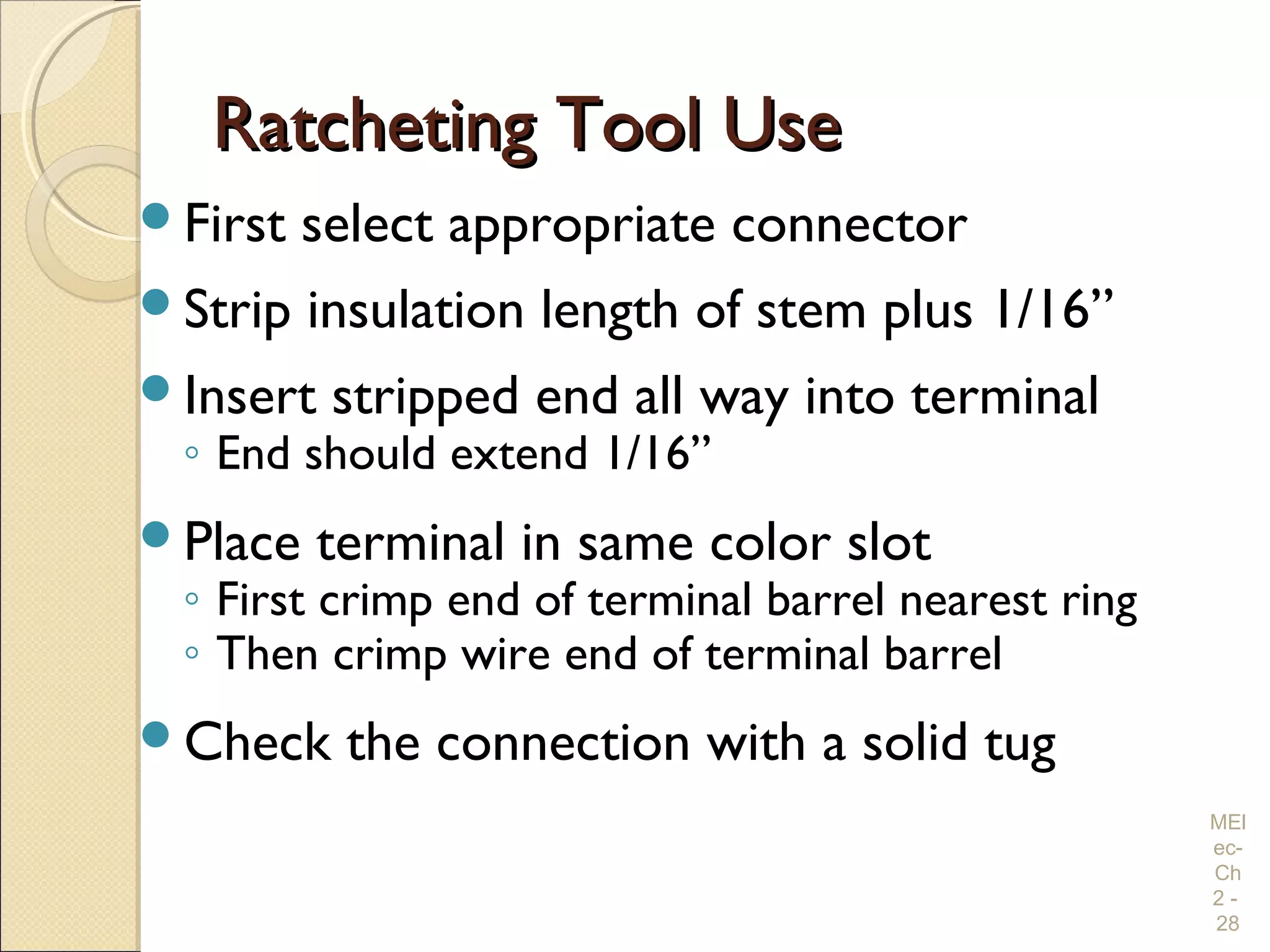
Ratcheting Tool UseRatcheting Tool Use
First select appropriate connector
Strip insulation length of stem plus 1/16”
Insert stripped end all way into terminal
◦ End should extend 1/16”
Place terminal in same color slot
◦ First crimp end of terminal barrel nearest ring
◦ Then crimp wire end of terminal barrel
Check the connection with a solid tug
MEl
ec-
Ch
2 -
28
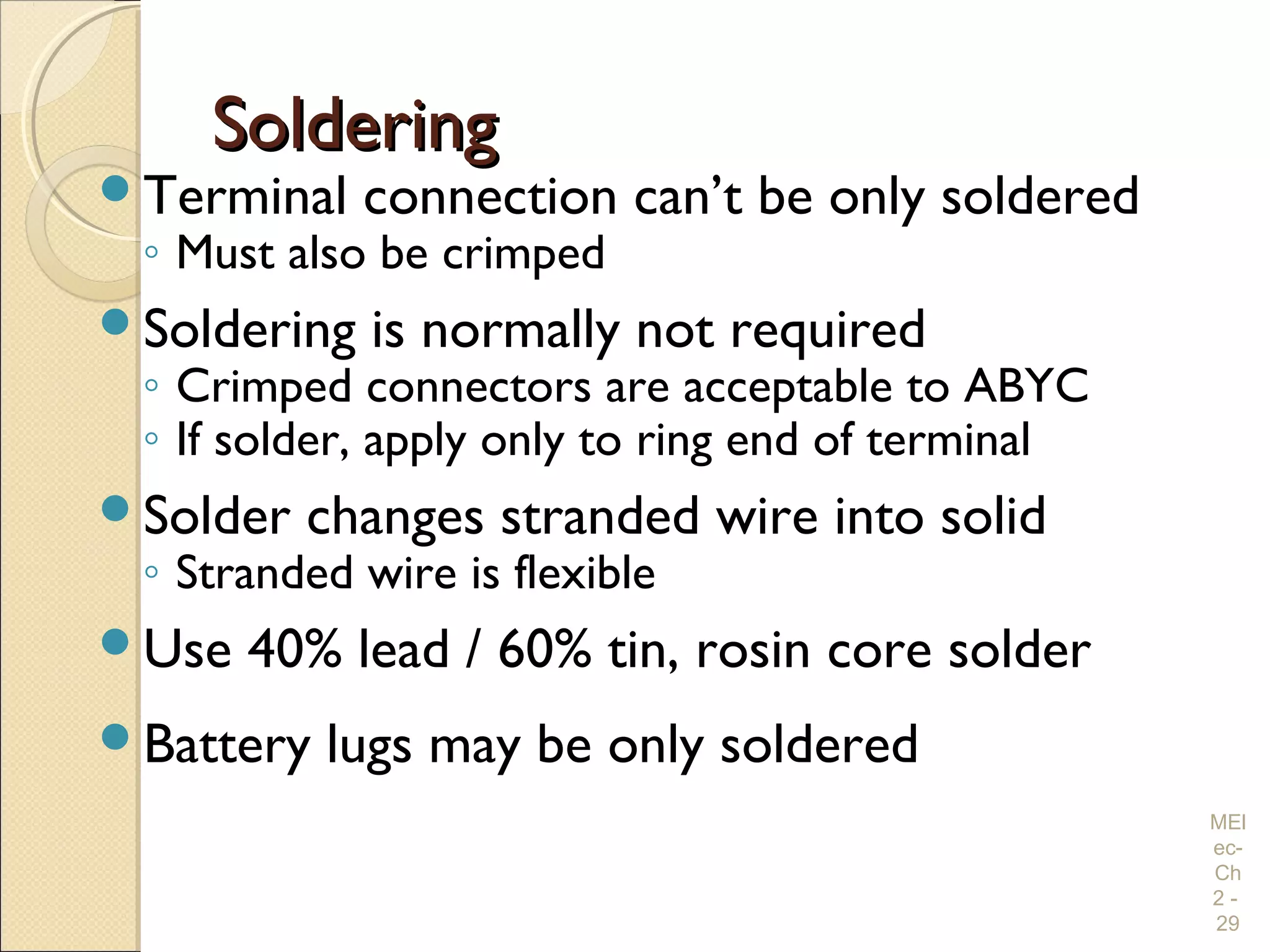
SolderingSoldering
Terminal connection can’t be only soldered
◦ Must also be crimped
Soldering is normally not required
◦ Crimped connectors are acceptable to ABYC
◦ If solder, apply only to ring end of terminal
Solder changes stranded wire into solid
◦ Stranded wire is flexible
Use 40% lead / 60% tin, rosin core solder
Battery lugs may be only soldered
MEl
ec-
Ch
2 -
29
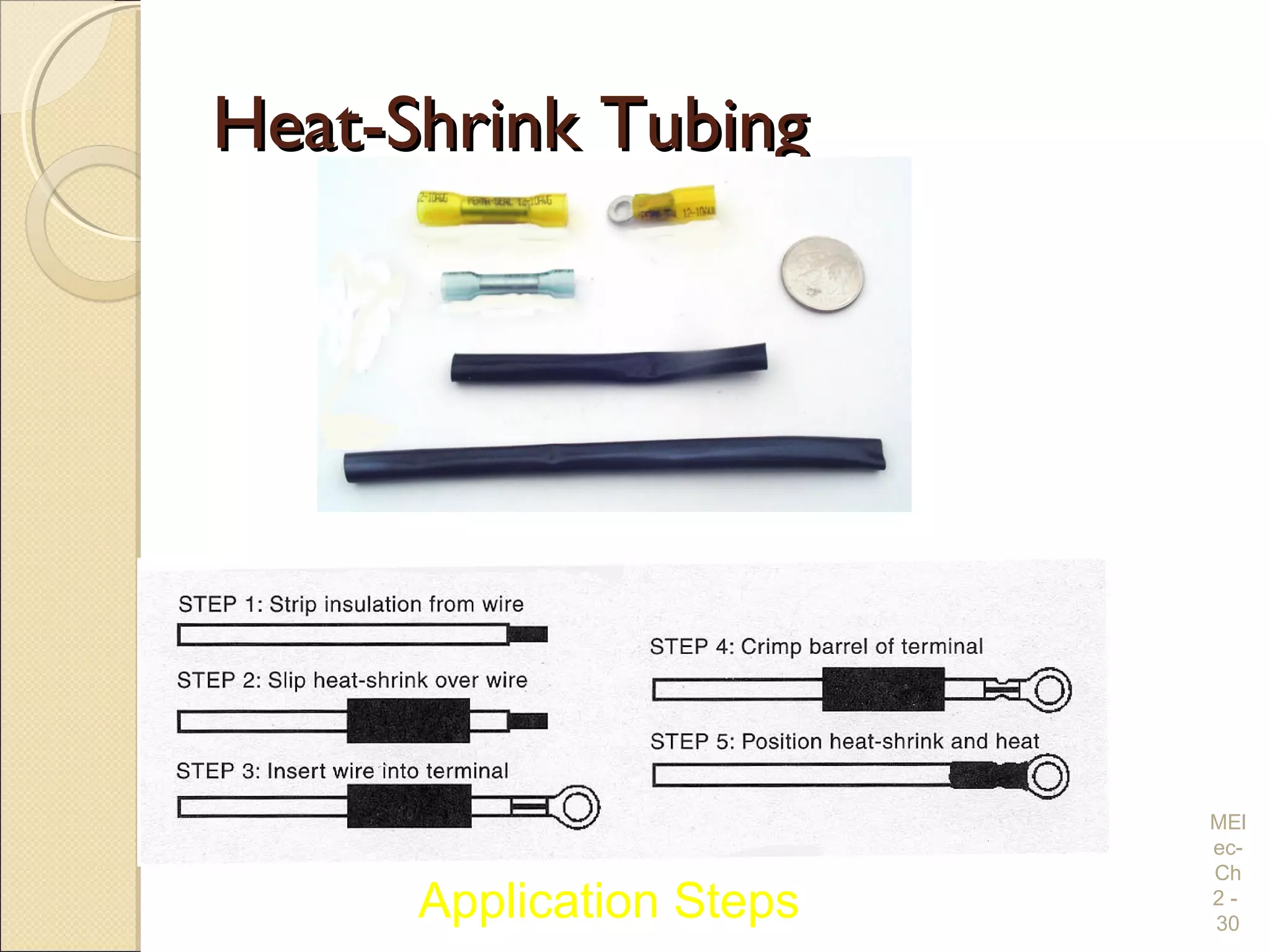
Heat-Shrink TubingHeat-Shrink Tubing
MEl
ec-
Ch
2 -
30
Application Steps
Coaxial CableCoaxial Cable
Antenna cable
Radio coax is 50 ohm with PL-259
Radio cable is cut to length
Want attenuation under 3 db
TV cable is 75 ohm with “F” connectors
GPS cable is not cut to length
◦ Coil excess in 1-foot loops
MEl
ec-
Ch
2 -
31
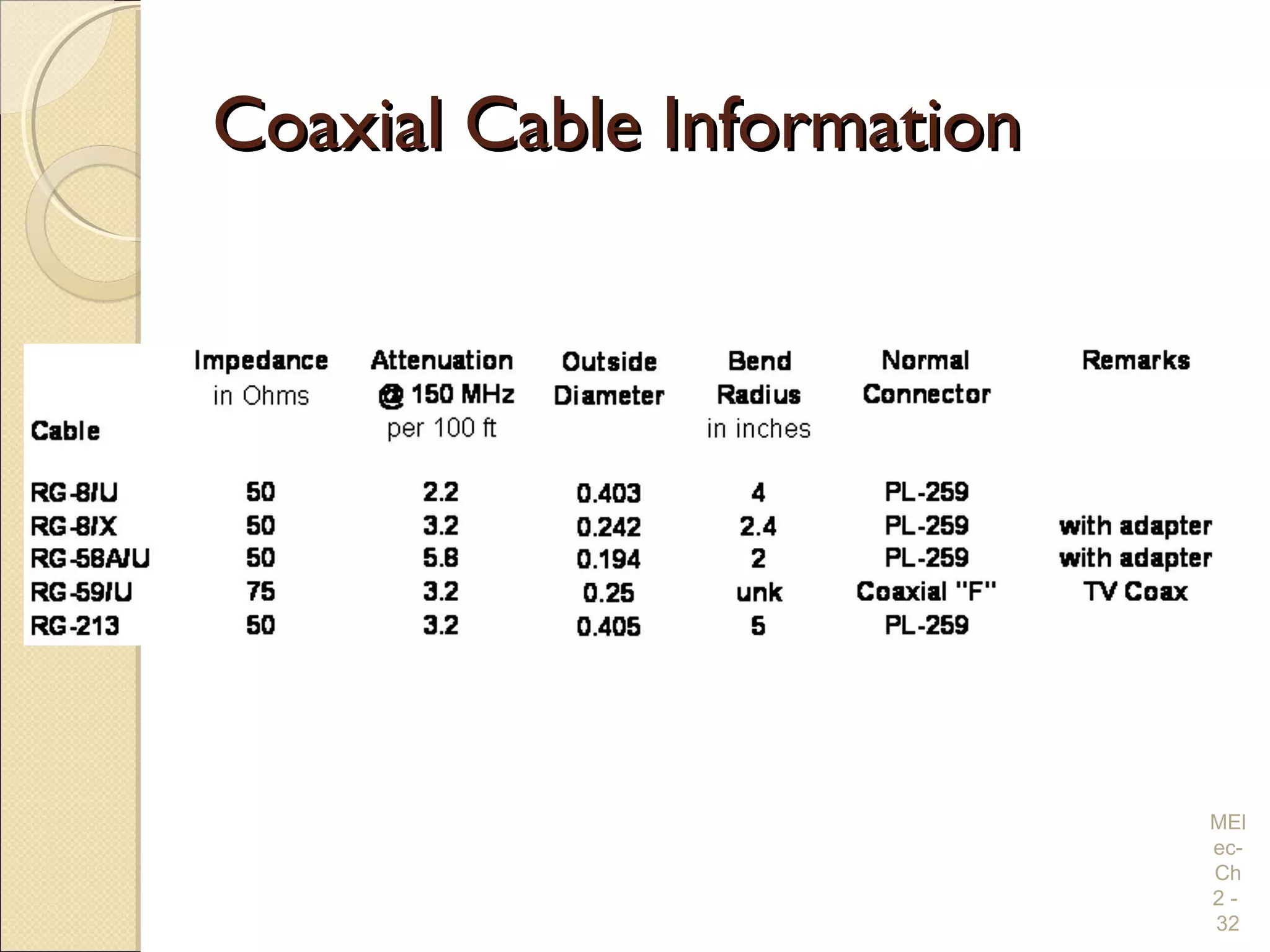
Coaxial Cable InformationCoaxial Cable Information
MEl
ec-
Ch
2 -
32
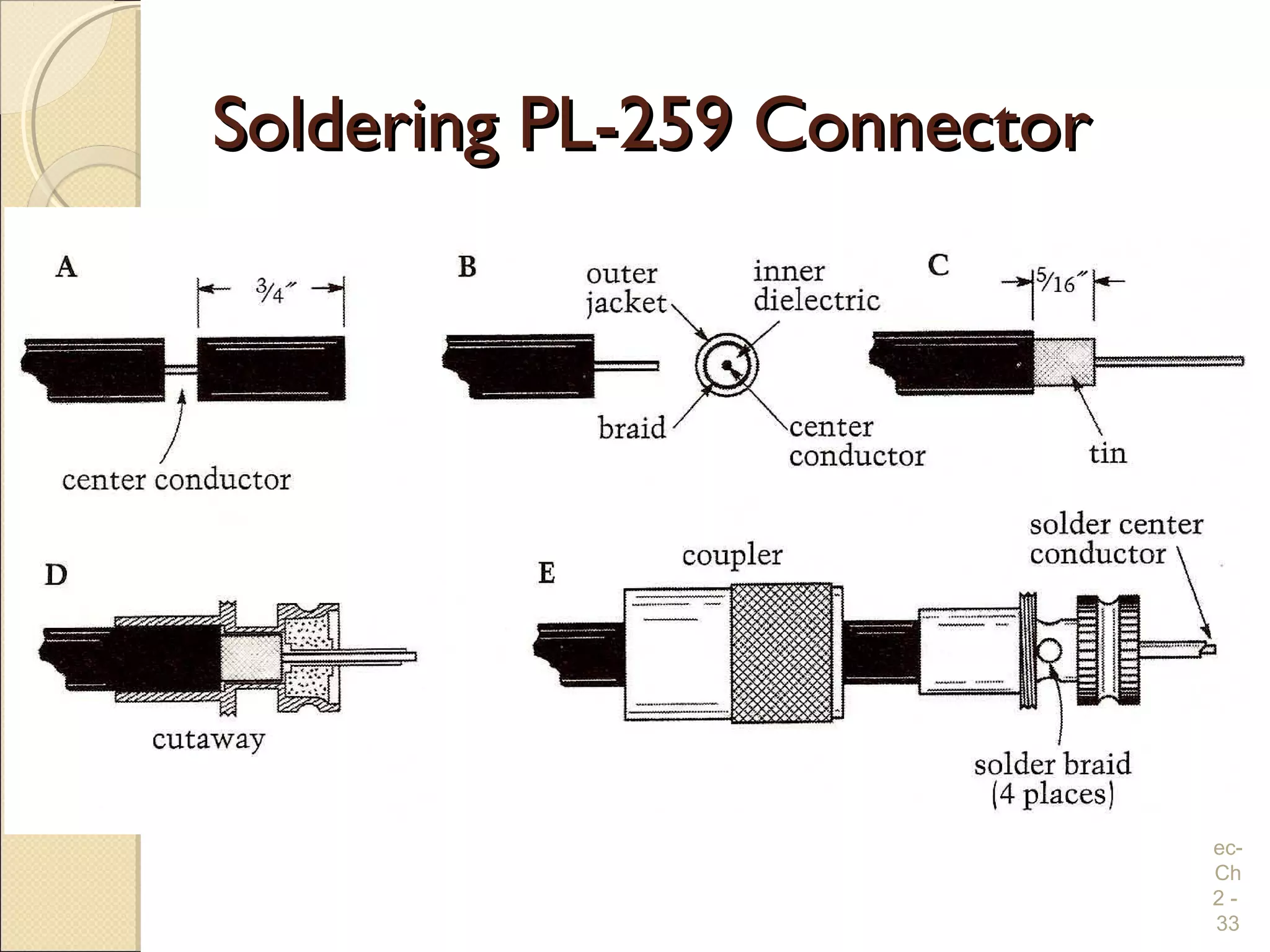
Soldering PL-259 ConnectorSoldering PL-259 Connector
MEl
ec-
Ch
2 -
33
Wiring InstallationWiring Installation
Basic Considerations
Distribution Panel
Fuses / Circuit Breakers
Branch Circuits
◦ Wire
◦ Outlets
◦ Switches
Grounding Systems
Bonding Systems MEl
ec-
Ch
2 -
34
Basic ConsiderationsBasic Considerations
Must have source and return wires
◦ Return wires to a common point
◦ May use feeder wire from power panel for:
 engine, helm console, etc.
Wires above flood level of bilge
◦ Waterproof if in bilge
Insulated support every 18”
Twist DC wires within 1 meter of compass
MEl
ec-
Ch
2 -
35
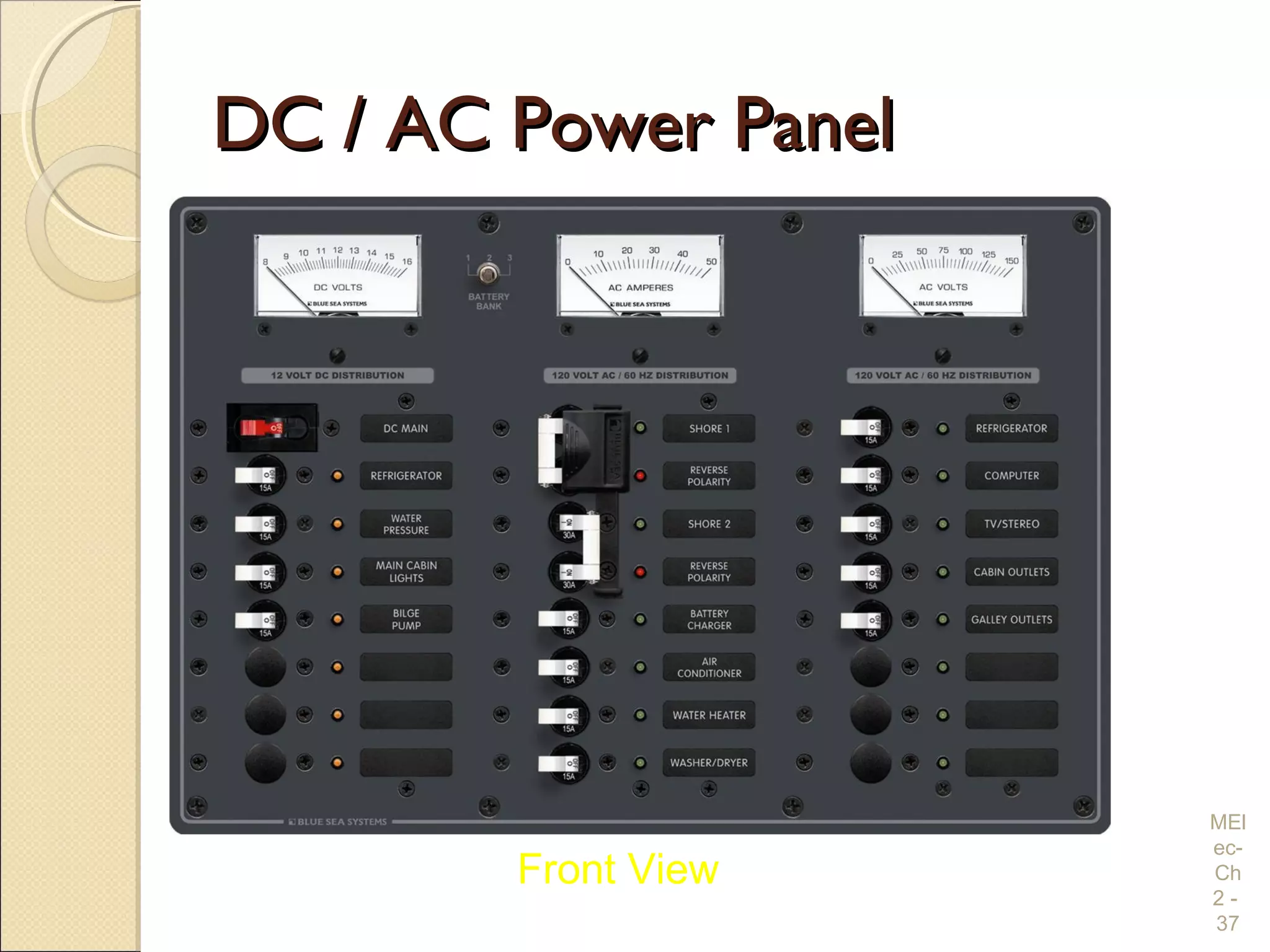
Distribution PanelDistribution Panel
Central location of Circuit Breakers / Fuses
◦ All branch circuits from this location
AC and DC may be combined in one panel
All equipment / circuits should go to panel
◦ Not direct to battery (except bilge pump)
 Noise interference suppression covered in Section 7
MEl
ec-
Ch
2 -
36
DC / AC Power PanelDC / AC Power Panel
MEl
ec-
Ch
2 -
37
Front View
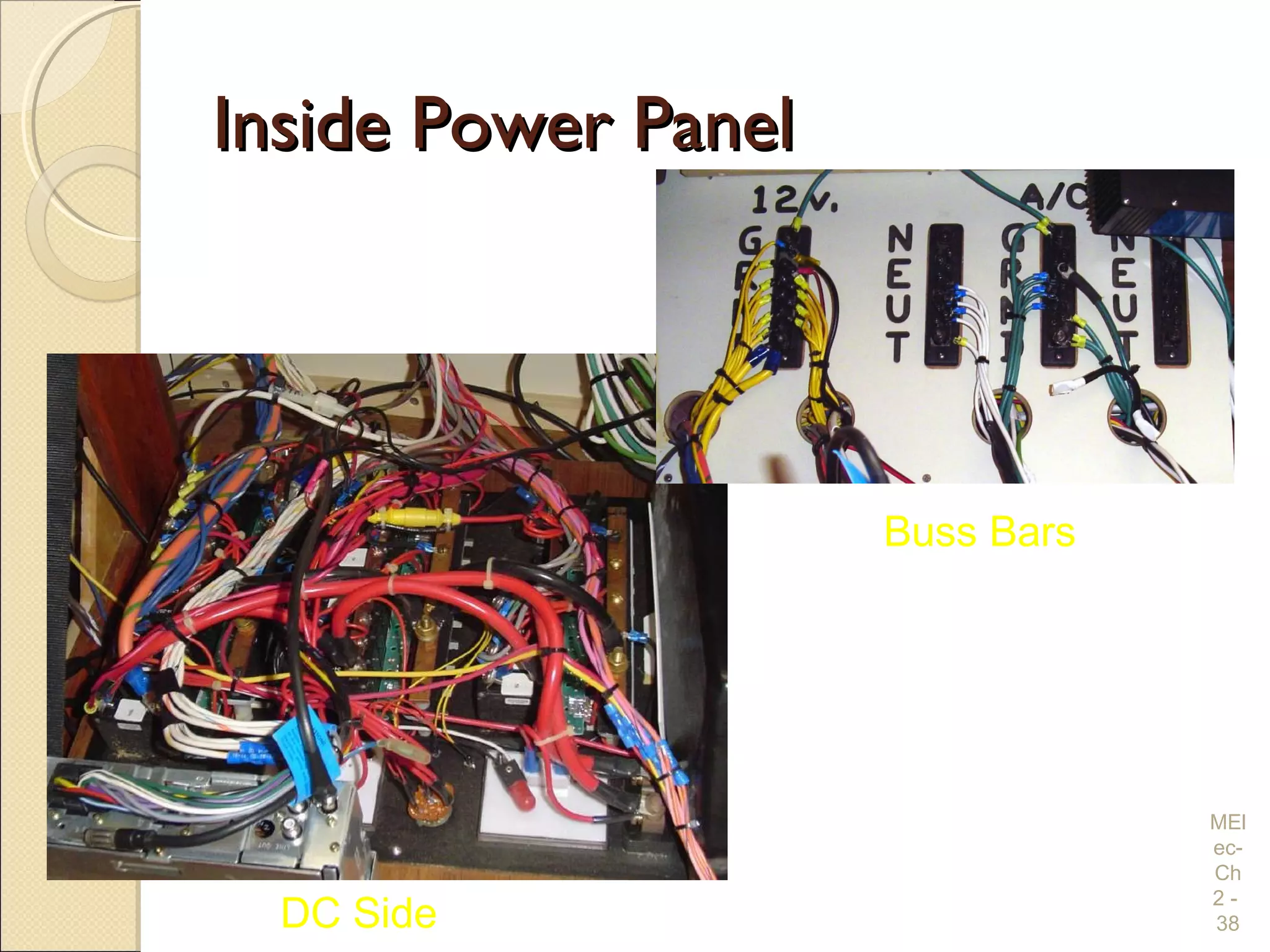
Inside Power PanelInside Power Panel
MEl
ec-
Ch
2 -
38DC Side
Buss Bars
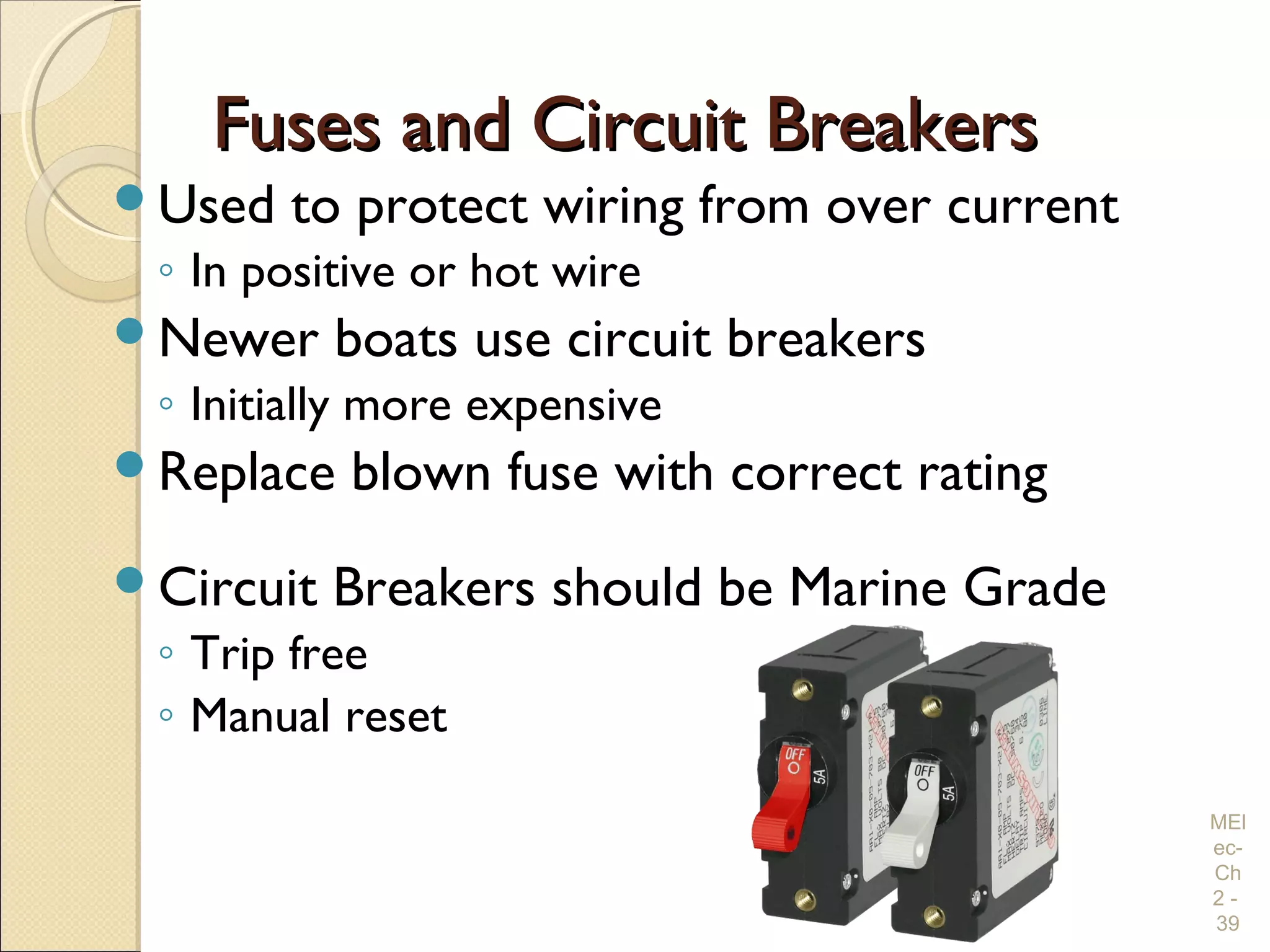
Fuses and Circuit BreakersFuses and Circuit Breakers
Used to protect wiring from over current
◦ In positive or hot wire
Newer boats use circuit breakers
◦ Initially more expensive
Replace blown fuse with correct rating
Circuit Breakers should be Marine Grade
◦ Trip free
◦ Manual reset
MEl
ec-
Ch
2 -
39
Branch Circuits - WiresBranch Circuits - Wires
Minimum size is 16 AWG
◦ See Wire Selection Tables
◦ For AC normally #14 for 15A and #12 for 20A
Must terminate in closed electrical box
Of sufficient length
DC negative returned to DC Panel
◦ May use several negative feeder terminals
AC neutrals returned to AC Panel
Bonding system never used as return wire
MEl
ec-
Ch
2 -
40
Branch Circuits - OutletsBranch Circuits - Outlets
120 VAC outlets must be 3-wire polarized
◦ Black (hot) to brass or copper colored terminal
Outlet wires must have crimp terminals
GFI outlets
◦ Required on weather deck, head, galley and
machinery spaces
◦ Good practice for all AC outlets to be GFI
◦ Trip at 5 milliamps
Different outlets for AC and DC power MEl
ec-
Ch
2 -
41
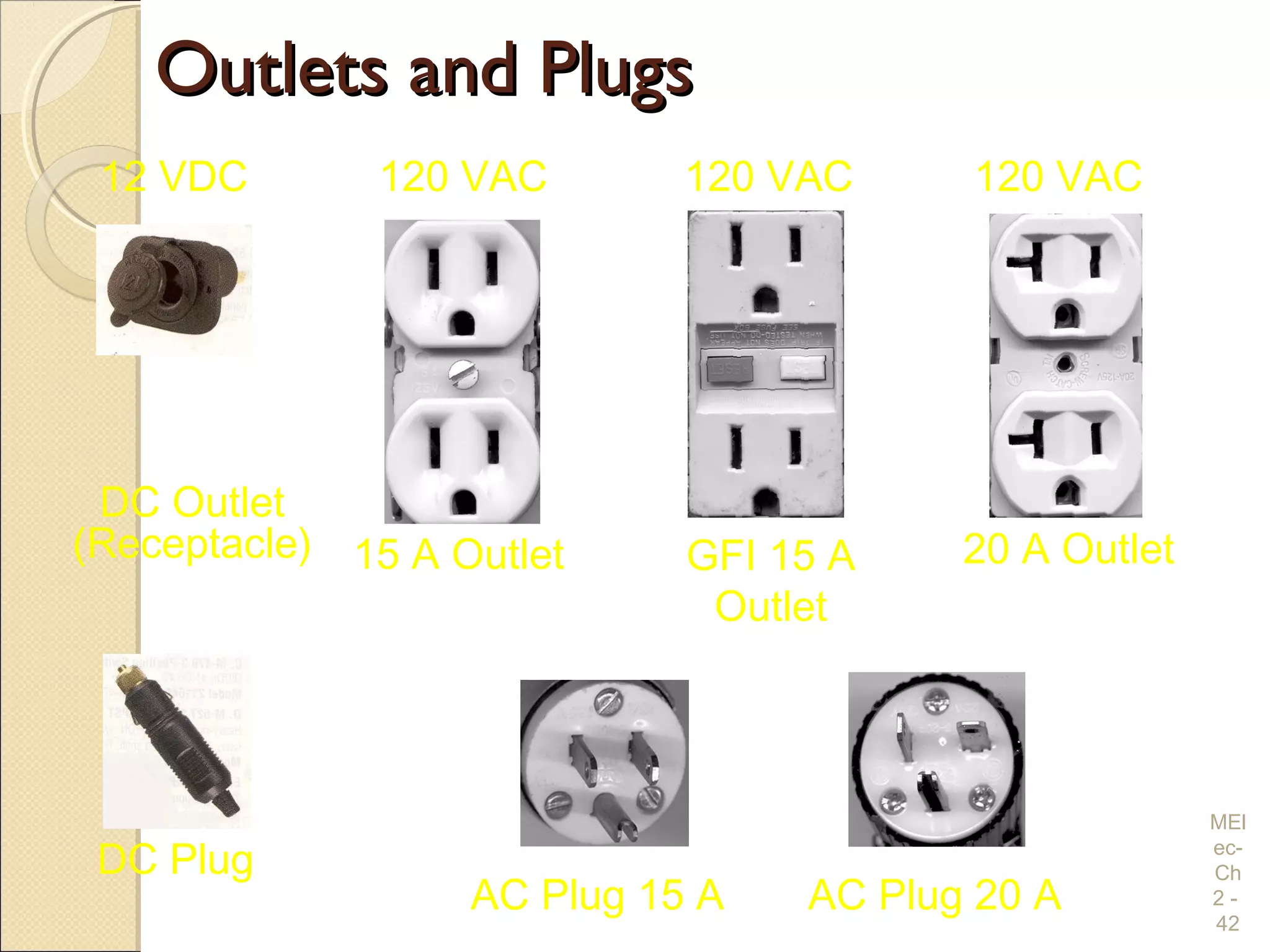
Outlets and PlugsOutlets and Plugs
MEl
ec-
Ch
2 -
42
DC Outlet
(Receptacle)
DC Plug
120 VAC 120 VAC12 VDC 120 VAC
15 A Outlet
AC Plug 15 A AC Plug 20 A
GFI 15 A
Outlet
20 A Outlet
Branch Circuits - SwitchesBranch Circuits - Switches
Modern panels use Circuit Breakers
◦ Which also double as switches
Switches / Circuit Breakers
◦ Must be Marine Grade
◦ Rated for the voltage and current controlled
◦ Interrupt the positive (DC) or hot (AC) leg
Battery Switch
◦ Designed for high current service
◦ Not located in engine or fuel-tank compartments MEl
ec-
Ch
2 -
43
Grounding SystemGrounding System
Ground is potential of water around boat
◦ Or potential of earth’s surface
DC – Ground Battery negative terminal(s)
◦ Also engine block
◦ Wire color is Yellow (or Black)
AC – Transformer center tap on shore
◦ Also connected to ground rod at transformer
◦ Wire color is Green and uninterrupted wire
 Isolation transformers and galvanic isolators are exception
and covered in Chapter 4 on AC
Engine, DC negative & AC ground connected
MEl
ec-
Ch
2 -
44
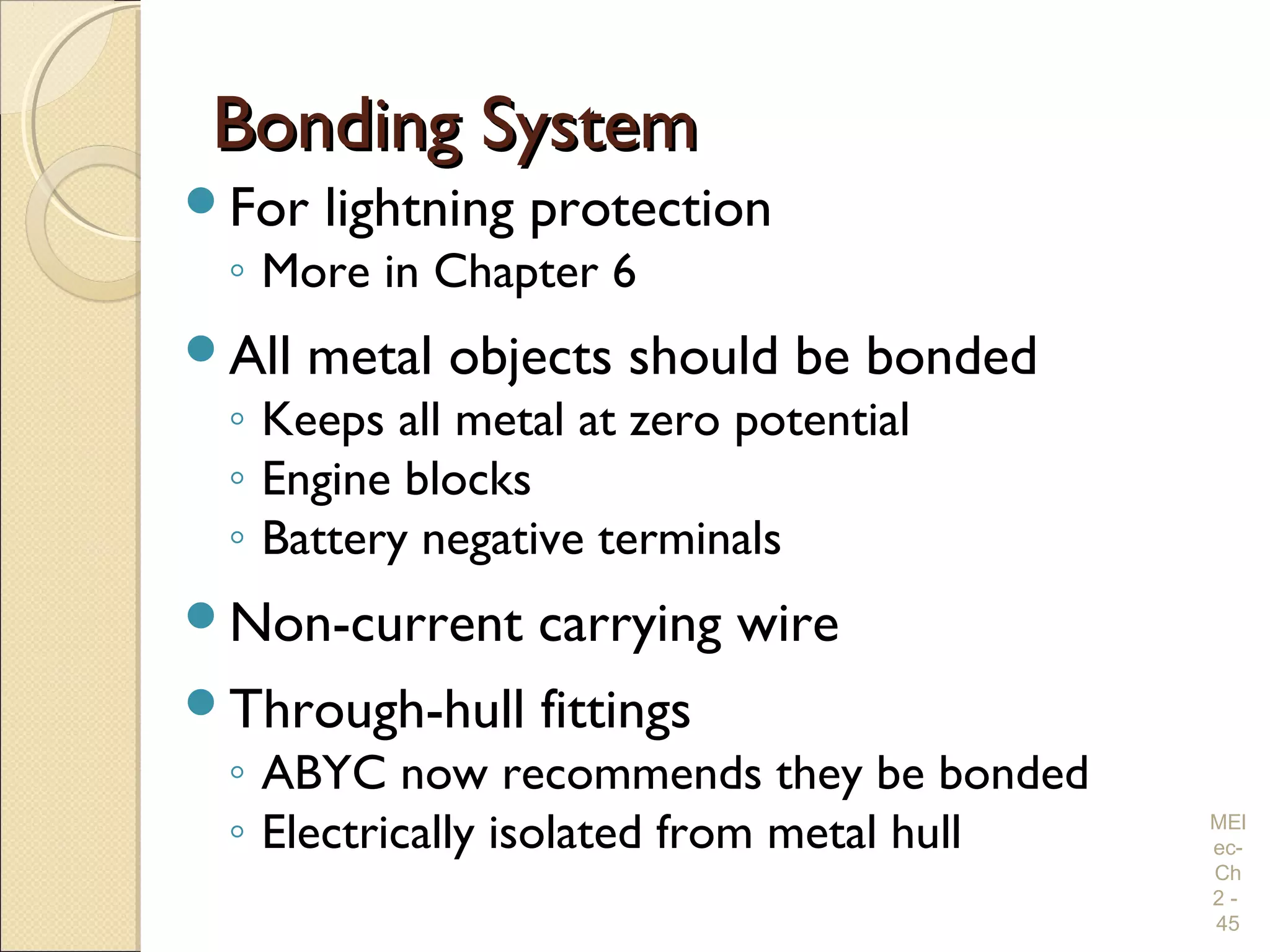
Bonding SystemBonding System
For lightning protection
◦ More in Chapter 6
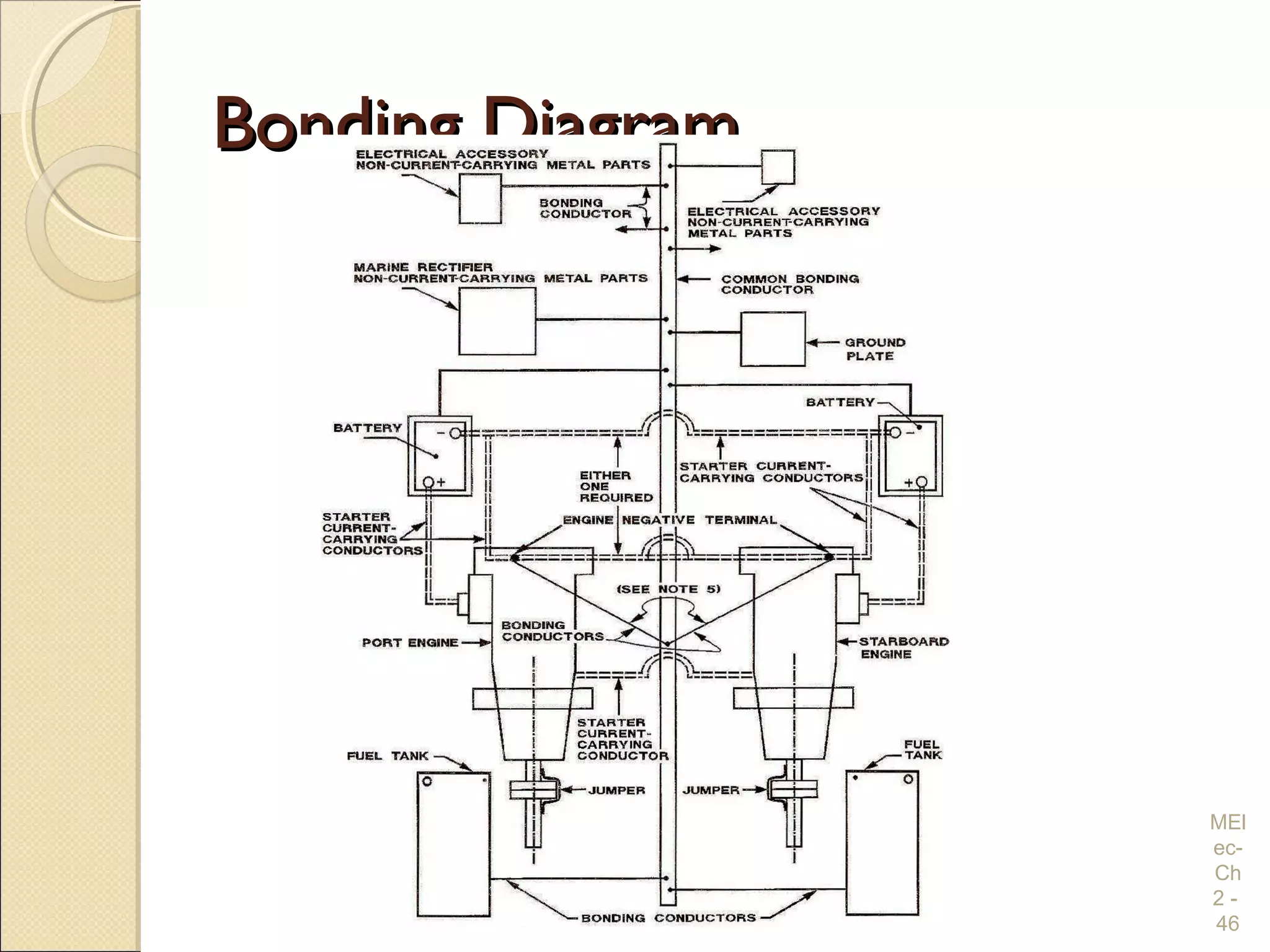
All metal objects should be bonded
◦ Keeps all metal at zero potential
◦ Engine blocks
◦ Battery negative terminals
Non-current carrying wire
Through-hull fittings
◦ ABYC now recommends they be bonded
◦ Electrically isolated from metal hull MEl
ec-
Ch
2 -
45
Bonding DiagramBonding Diagram
MEl
ec-
Ch
2 -
46
Wiring DiagramsWiring Diagrams
Elements of a Good Wiring Diagram
◦ Documents boat’s electrical layout
◦ Should be kept current
◦ Used for troubleshooting
Component Identification
◦ Physical objects to their symbol
◦ Wires are color coded
MEl
ec-
Ch
2 -
47
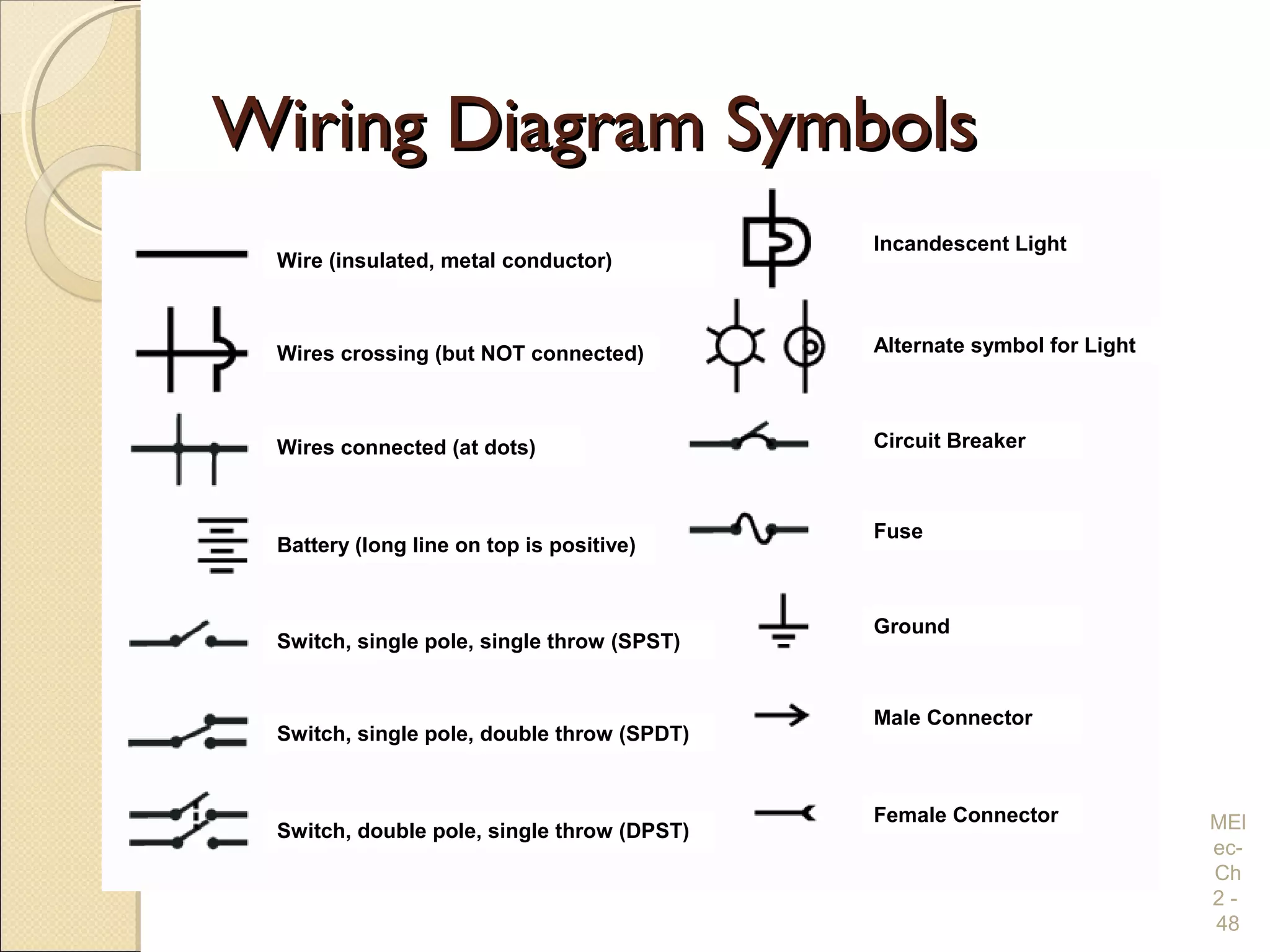
Wiring Diagram SymbolsWiring Diagram Symbols
MEl
ec-
Ch
2 -
48
Switch, double pole, single throw (DPST)
Switch, single pole, single throw (SPST)
Switch, single pole, double throw (SPDT)
Battery (long line on top is positive)
Wires connected (at dots)
Wires crossing (but NOT connected)
Wire (insulated, metal conductor)
Incandescent Light
Alternate symbol for Light
Circuit Breaker
Fuse
Ground
Male Connector
Female Connector
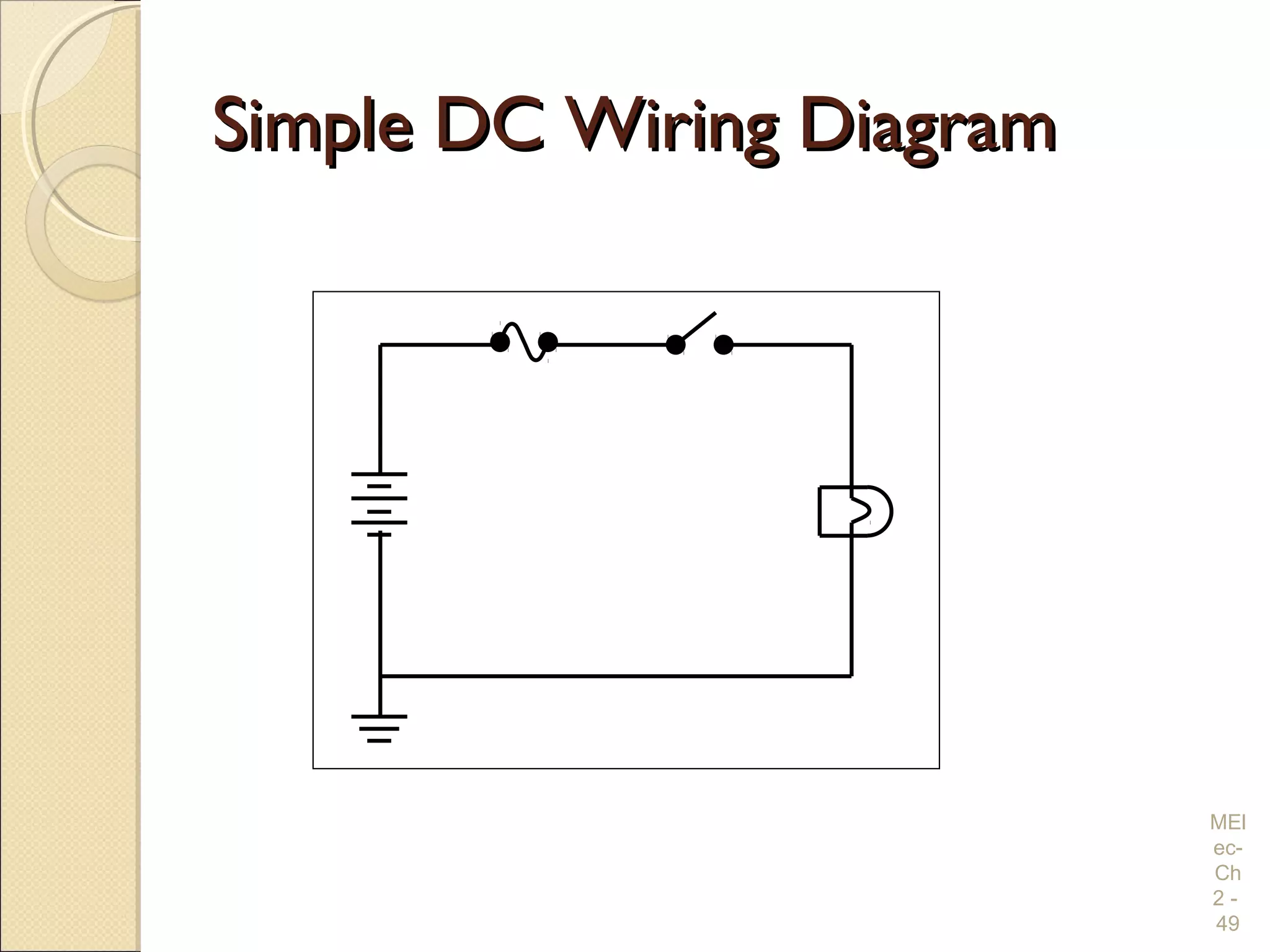
Simple DC Wiring DiagramSimple DC Wiring Diagram
MEl
ec-
Ch
2 -
49
SummarySummary
Circuits should be off when working on them
Use only marine grade properly sized wires
◦ Tables will help determine proper wire size
◦ Minimum wire size is #16 AWG
Use wire terminations and ratcheting crimper
DC circuits are 2 dedicated wires
◦ Waterproof wire connection in bilge
AC circuits are 3 dedicated wires
◦ GFCI in galley, head, machine spaces & weather deck
Separate Grounding & Bonding systems required
Keep wiring diagram current
MEl
ec-
Ch
2 -
50

Electrical Wiring Practices and Diagrams

  • 1.
    Chapter 2Chapter 2 ElectricalWiring Practices and Diagrams MEl ec- Ch 2 - 1
  • 2.
    OverviewOverview Safety Standards Wiring Considerations Wire Terminations CoaxialCable Wiring Installations Wiring Diagrams MEl ec- Ch 2 - 2
  • 3.
  • 4.
    Lethal CurrentLethal Current Fundamentalpolicy of the USPS is SAFETY Human Body ◦ Resistance – 4 KΩ (moist skin) to 24 KΩ (dry skin) ◦ Safe current (through chest) – less than 20 milliamps ◦ E = 120 VAC R = 4 KΩ I = ? ◦ I = 30 milliamps - NOT SAFE ◦ Don’t want current through chest cavity (may be lethal) MEl ec- Ch 2 - 4
  • 5.
    Safety PrecautionsSafety Precautions Turncircuit off ◦ Disconnect service cord ◦ Disconnect negative battery cable If must work on live AC circuit ◦ Need 2nd safety person Remove metal jewelry Know your boat and its wiring Use outlet tester on AC outlets Use 3-wire extension cord from GFI outlet MEl ec- Ch 2 - 5
  • 6.
    StandardsStandards American Boat andYacht Council (ABYC) ◦ AC and DC Electrical Systems is E-11 ◦ Minimum standards  Construction  Repair Marine Dept. of Underwriters Laboratory ◦ Test and certify commercial products ◦ Safety, not function MEl ec- Ch 2 - 6
  • 7.
    Wiring ConsiderationsWiring Considerations Conductors WireTypes Wire Size Wire Insulation Wire Color Code MEl ec- Ch 2 - 7
  • 8.
    ConductorsConductors Connects power sourcesto power loads Characteristics ◦ Safe ◦ Dependable ◦ Efficient (minimal voltage drop) Boat environment ◦ Worse than either house or car ◦ High humidity ◦ Vibration ◦ Corrosive conditions MEl ec- Ch 2 - 8
  • 9.
    WireTypesWireTypes Marine Grade ◦ Type3 is recommended Stranded copper ◦ Tinned is preferred MEl ec- Ch 2 - 9
  • 10.
    Wire SizeWire Size 3%voltage drop ◦ Critical circuits (Nav lights) ◦ Electronic Equipment 10% voltage drop ◦ Cabin lights ◦ Motorized Equipment Minimum size AWG # 16 MEl ec- Ch 2 - 10
  • 11.
    Wire Has ResistanceWireHas Resistance Inadvertent Resistors ◦ Wire too small (min of #16 - properly size using table) ◦ Bad connections (or corroded connections)  Clean and tighten battery connectors  Tighten lug screws and inspect wire to lug connection ◦ Why do wires get warm / hot?  Low resistance circuits pass high current (P = I2 x R)  Wires can account for much of the overall resistance MEl ec- Ch 2 - 11 V12 VDC 0.1 Ώ 0.1 Ώ 10A What Voltage? An. 10 VDC
  • 12.
    Wire Size ComparisonWireSize Comparison MEl ec- Ch 2 - 12 #16 top to #10 bottom #2 top to #10 bottom
  • 13.
    Copper Wire CharacteristicsCopperWire Characteristics MEl ec- Ch 2 - 13
  • 14.
    12- VDC WireSize Selection12- VDC Wire Size Selection MEl ec- Ch 2 - 14
  • 15.
    12 VDC WireSize Selection12 VDC Wire Size Selection MEl ec- Ch 2 - 15
  • 16.
    120 VAC WireSize Selection120 VAC Wire Size Selection MEl ec- Ch 2 - 16
  • 17.
    What Size Wires?WhatSize Wires? MEl ec- Ch 2 - 17 B
  • 18.
    Step 1Step 1 MEl ec- Ch 2- 18 What current to Load? From Table 2-3 – Maximum of 44 feet (for 10A in #16 wire) P = E * I I = P / E I = 1200/120 I = 10 Amps From Table 2-1 – For 10A need #16 wire B
  • 19.
    Step 1 AnswersStep1 Answers MEl ec- Ch 2 - 19 AMPACITY 10 Amperes #16 AWG TW by Table 2-1 for 3% voltage drop 44 feet maximum by Table 2-3 B
  • 20.
    Step 2Step 2 MEl ec- Ch 2- 20 What current to Inverter? From Table 2-3 – Maximum of 14 feet (for 110A in #1 wire) Iload = Iout = Iin *0.91 Iin = Iout / 0.91 = 100 / 0.91 = 110 Amps From Table 2-1 – For 110A need #1 wire B Iload = 100 Amps @ 12 V
  • 21.
    Step 2 AnswersStep2 Answers MEl ec- Ch 2 - 21 AMPACITY 110 Amperes #1 AWG TW by Table 1 for 3% voltage drop 14 feet maximum by Table 2-2A B
  • 22.
    Wire InsulationWire Insulation ACcables must be type UL 1426 BC ◦ 600 volt insulation ◦ Gasoline and Oil resistant ◦ Won’t absorb moisture DC wires & cables must be Marine Grade ◦ 600 volt insulation ◦ Gasoline and Oil resistant ◦ Won’t absorb moisture Color coded wires MEl ec- Ch 2 - 22
  • 23.
    Wire Color CodeWireColor Code Color AC (Hot) AC (Neut) AC (Gnd) DC + DC - Black X X1 White X Green (may have a yellow stripe) X Red X2 X Yellow X1 Footnotes: 1 – Yellow preferred for DC negative to avoid confusion with AC Hot wire 2 – 2nd hot wire in 220 VAC is Red MEl ec- Ch 2 - 23
  • 24.
    Wire Color CodingWireColor Coding MEl ec- Ch 2 - 24
  • 25.
    Wire TerminationsWire Terminations Crimping ◦Special Tool ◦ Approved Marine Connectors ◦ Use of Ratcheting Tool Solder Heat-shrink Tubing MEl ec- Ch 2 - 25
  • 26.
  • 27.
  • 28.
    Ratcheting Tool UseRatchetingTool Use First select appropriate connector Strip insulation length of stem plus 1/16” Insert stripped end all way into terminal ◦ End should extend 1/16” Place terminal in same color slot ◦ First crimp end of terminal barrel nearest ring ◦ Then crimp wire end of terminal barrel Check the connection with a solid tug MEl ec- Ch 2 - 28
  • 29.
    SolderingSoldering Terminal connection can’tbe only soldered ◦ Must also be crimped Soldering is normally not required ◦ Crimped connectors are acceptable to ABYC ◦ If solder, apply only to ring end of terminal Solder changes stranded wire into solid ◦ Stranded wire is flexible Use 40% lead / 60% tin, rosin core solder Battery lugs may be only soldered MEl ec- Ch 2 - 29
  • 30.
  • 31.
    Coaxial CableCoaxial Cable Antennacable Radio coax is 50 ohm with PL-259 Radio cable is cut to length Want attenuation under 3 db TV cable is 75 ohm with “F” connectors GPS cable is not cut to length ◦ Coil excess in 1-foot loops MEl ec- Ch 2 - 31
  • 32.
    Coaxial Cable InformationCoaxialCable Information MEl ec- Ch 2 - 32
  • 33.
    Soldering PL-259 ConnectorSolderingPL-259 Connector MEl ec- Ch 2 - 33
  • 34.
    Wiring InstallationWiring Installation BasicConsiderations Distribution Panel Fuses / Circuit Breakers Branch Circuits ◦ Wire ◦ Outlets ◦ Switches Grounding Systems Bonding Systems MEl ec- Ch 2 - 34
  • 35.
    Basic ConsiderationsBasic Considerations Musthave source and return wires ◦ Return wires to a common point ◦ May use feeder wire from power panel for:  engine, helm console, etc. Wires above flood level of bilge ◦ Waterproof if in bilge Insulated support every 18” Twist DC wires within 1 meter of compass MEl ec- Ch 2 - 35
  • 36.
    Distribution PanelDistribution Panel Centrallocation of Circuit Breakers / Fuses ◦ All branch circuits from this location AC and DC may be combined in one panel All equipment / circuits should go to panel ◦ Not direct to battery (except bilge pump)  Noise interference suppression covered in Section 7 MEl ec- Ch 2 - 36
  • 37.
    DC / ACPower PanelDC / AC Power Panel MEl ec- Ch 2 - 37 Front View
  • 38.
    Inside Power PanelInsidePower Panel MEl ec- Ch 2 - 38DC Side Buss Bars
  • 39.
    Fuses and CircuitBreakersFuses and Circuit Breakers Used to protect wiring from over current ◦ In positive or hot wire Newer boats use circuit breakers ◦ Initially more expensive Replace blown fuse with correct rating Circuit Breakers should be Marine Grade ◦ Trip free ◦ Manual reset MEl ec- Ch 2 - 39
  • 40.
    Branch Circuits -WiresBranch Circuits - Wires Minimum size is 16 AWG ◦ See Wire Selection Tables ◦ For AC normally #14 for 15A and #12 for 20A Must terminate in closed electrical box Of sufficient length DC negative returned to DC Panel ◦ May use several negative feeder terminals AC neutrals returned to AC Panel Bonding system never used as return wire MEl ec- Ch 2 - 40
  • 41.
    Branch Circuits -OutletsBranch Circuits - Outlets 120 VAC outlets must be 3-wire polarized ◦ Black (hot) to brass or copper colored terminal Outlet wires must have crimp terminals GFI outlets ◦ Required on weather deck, head, galley and machinery spaces ◦ Good practice for all AC outlets to be GFI ◦ Trip at 5 milliamps Different outlets for AC and DC power MEl ec- Ch 2 - 41
  • 42.
    Outlets and PlugsOutletsand Plugs MEl ec- Ch 2 - 42 DC Outlet (Receptacle) DC Plug 120 VAC 120 VAC12 VDC 120 VAC 15 A Outlet AC Plug 15 A AC Plug 20 A GFI 15 A Outlet 20 A Outlet
  • 43.
    Branch Circuits -SwitchesBranch Circuits - Switches Modern panels use Circuit Breakers ◦ Which also double as switches Switches / Circuit Breakers ◦ Must be Marine Grade ◦ Rated for the voltage and current controlled ◦ Interrupt the positive (DC) or hot (AC) leg Battery Switch ◦ Designed for high current service ◦ Not located in engine or fuel-tank compartments MEl ec- Ch 2 - 43
  • 44.
    Grounding SystemGrounding System Groundis potential of water around boat ◦ Or potential of earth’s surface DC – Ground Battery negative terminal(s) ◦ Also engine block ◦ Wire color is Yellow (or Black) AC – Transformer center tap on shore ◦ Also connected to ground rod at transformer ◦ Wire color is Green and uninterrupted wire  Isolation transformers and galvanic isolators are exception and covered in Chapter 4 on AC Engine, DC negative & AC ground connected MEl ec- Ch 2 - 44
  • 45.
    Bonding SystemBonding System Forlightning protection ◦ More in Chapter 6 All metal objects should be bonded ◦ Keeps all metal at zero potential ◦ Engine blocks ◦ Battery negative terminals Non-current carrying wire Through-hull fittings ◦ ABYC now recommends they be bonded ◦ Electrically isolated from metal hull MEl ec- Ch 2 - 45
  • 46.
  • 47.
    Wiring DiagramsWiring Diagrams Elementsof a Good Wiring Diagram ◦ Documents boat’s electrical layout ◦ Should be kept current ◦ Used for troubleshooting Component Identification ◦ Physical objects to their symbol ◦ Wires are color coded MEl ec- Ch 2 - 47
  • 48.
    Wiring Diagram SymbolsWiringDiagram Symbols MEl ec- Ch 2 - 48 Switch, double pole, single throw (DPST) Switch, single pole, single throw (SPST) Switch, single pole, double throw (SPDT) Battery (long line on top is positive) Wires connected (at dots) Wires crossing (but NOT connected) Wire (insulated, metal conductor) Incandescent Light Alternate symbol for Light Circuit Breaker Fuse Ground Male Connector Female Connector
  • 49.
    Simple DC WiringDiagramSimple DC Wiring Diagram MEl ec- Ch 2 - 49
  • 50.
    SummarySummary Circuits should beoff when working on them Use only marine grade properly sized wires ◦ Tables will help determine proper wire size ◦ Minimum wire size is #16 AWG Use wire terminations and ratcheting crimper DC circuits are 2 dedicated wires ◦ Waterproof wire connection in bilge AC circuits are 3 dedicated wires ◦ GFCI in galley, head, machine spaces & weather deck Separate Grounding & Bonding systems required Keep wiring diagram current MEl ec- Ch 2 - 50

Editor's Notes

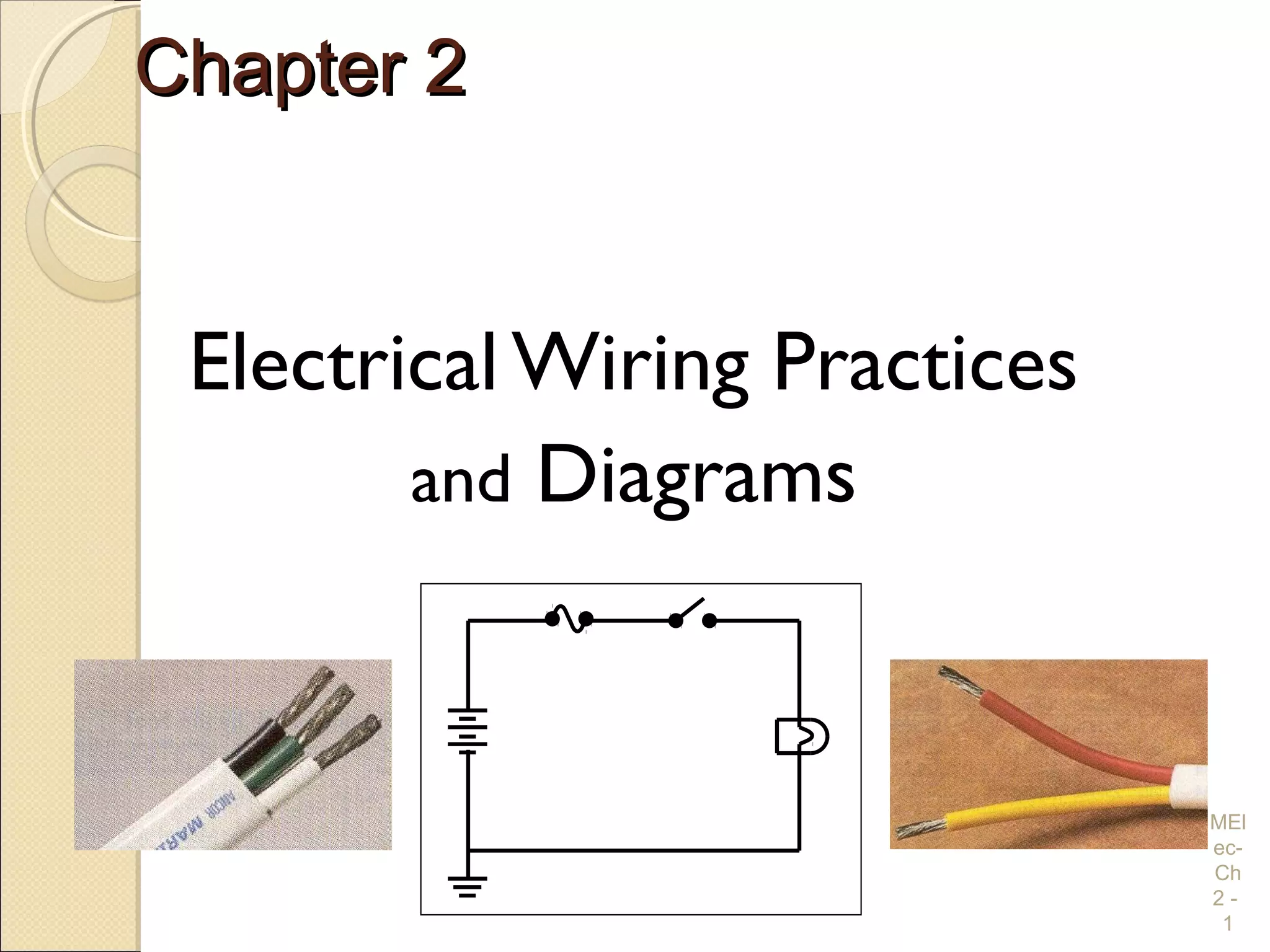
  • #2 PowerPoint slides by Stf/C Harl Porter, SN Marine Electronics [email_address] Rear Commander for Electro-Mechanical Systems is R/C Gene Danko, SN Left is AC boat cable Right is DC boat cable (yellow is new color for negative)
  • #3 Major sections in this chapter
  • #4 Major topics in Safety section
  • #5 Good review of Ohm’s Law
  • #6 Read Student Text section on Personal Safety Practices
  • #7 (No notes)
  • #8 Major topics in Wiring Considerations section
  • #9 (no notes)
  • #10 Type 3 stranded wire has more strands (than type 2) i.e. #12 AWG Type 2 has 19 strands Type 3 has 65 strands Manufacture tinned wire reduces oxidation and corrosion
  • #11 (no notes)
  • #12 Good review of Ohm’s law Note that voltage drop in example exceeds 10% Note the application of Ohm’s Law. P = I x E =I x (I x R) = I^2 x R. As resistance drops, the current goes up as the square – ½ resistance results in 4x current, which leads to heating.
  • #13 Figure 2-1 Coin is a South Carolina quarter Wire sizes on left (top to bottom) 16 14 12 10 Wire sizes on right (top to bottom) 2 4 6 8 10
  • #14 Table 2-1 Table is a reference table – Gives max current per wire size
  • #15 Equivalent to Table 2-3 (from West Marine catalog) Note that distance is round trip distance Given current (side scale) and round trip distance (bottom scale) gives wire size
  • #16 Table 2-2 Same info as previous table Given max DC current and wire length – gives wire size Use of table will be explained in Figure 2-2
  • #17 Table 2-3 Given max AC current and wire length – gives wire size Use of table will be explained in Figure 2-2
  • #18 Problem statement Answers from Tables 2-1, 2-2 and 2-3
  • #19 Start with determining current to load Then given current of 10A from Table 2-2A determine need #16 wire Then given 10 A and #16 wire from Table 2-3 determine maximum length of wires
  • #20 Answers for wires from Inverter to Load
  • #21 Power is power AC current is 10 A DC current if 100% efficiency is 100 A I = P / E = 1200 / 12 = 100 A But inverter is only 91% efficient Therefore DC current is 100 / .91 = 110 A Start with determining current to inverter Then given current of 110A from Table 2-1 determine need #1 wire Then given 110 A and #1 wire from Table 2-3 determine maximum length of wires
  • #22 Note that at this load (110A), the battery must be de-rated and will not deliver 200AH. See Chapter 3.
  • #23 (no notes)
  • #24 (no notes)
  • #25 Figure 2-4
  • #26 Major topics in Wire Terminations section
  • #27 Figure 2-5 Only marine grade nylon ring terminals or nylon flanged connectors (captive spade) are approved by ABYC for wire terminals. Marine grade nylon butt connectors are used to join wires together. Nylon insulation is color coded to indicate wire size. Red is #22 to 16, blue is #16 to 14 and yellow is #12 to 10. Ring hole or spade opening must match the screw or stud diameter. Waterproof connectors are adhesive lined and after crimping are heated to shrink their insulation tight against the wire insulation. Twist-on connectors (wire nuts) are prohibited on boats.
  • #28 Figure 2-4 Specified by ABYC. Will not release until correct amount of crimp is applied. Don’t use inexpensive stripper/crimper as is almost impossible to apply the correct amount of compression. Can be used to strip insulation from wires.
  • #29 Makes good demonstration in class
  • #30 Don’t use acid-core solder for electrical work!
  • #31 Bottom is Figure 2-3B Are waterproof terminal and butt connectors. Heat-Shrink tubing can be used to make non-waterproof terminals and connectors waterproof. Heat is best from a hair dryer on hottest setting.
  • #32 Major section
  • #33 Table 2-5
  • #34 Figure 2-6 Steps in text under Installing Coax Connectors (PL-259 male connectors) Installing TV coaxial “F” male connectors is also covered in text. Would be a good demo in class.
  • #35 Major section
  • #36 (no notes)
  • #37 (no notes)
  • #38 DC Side is on left AC side is on middle and right DC meters are switched to house, starting, or off AC meters are switched to A service cord, B service cord or off Note All branches are protected by circuit breakers
  • #39 DC side of power panel; AC side is covered by insulated cover (at right edge) Note use of wire ties to minimize vibration at termination Return wire buses are located directly behind the power panel
  • #40 Trip free means cannot be held closed
  • #41 Of sufficient length to: Remove stress from connections To permit fan-out and repair Feeder terminals for engine compartment, helm console, fused panel
  • #42 White (neutral) wire to silver terminal Green (ground) wire to green terminal
  • #43 AC Outlets normally installed as illustrated Larger vertical slot (on left) in neutral Smaller vertical slot (on right) in hot Almost-round hole is ground 15A plug will mate with either 15 or 20 amp outlet. 20A plug will only mate with 20 amp outlet.
  • #44 (no notes)
  • #45 Ground system is very important safety feature More in Chapter 4 on AC
  • #46 More on Bonding in Chapter 6 on Lightning
  • #47 Figure 2-7
  • #48 Major section
  • #49 Figure 2-8 Note symbols for crossing (not connected) and connected wires. Are two options for crossing wires Are three options for lights
  • #50 Figure 2-9 Simple Series circuit Point out Battery (top is positive), switch, fuse, light bulb, ground and cable connections Given 12 VDC battery What measure across open switch? An. 12 VDC What measure across closed switch? An. 0 VDC As drawn (switch open), what measure across light bulb? An. 0 VDC With switch closed what measured across light bulb? An. 12 VDC What measured from engine block to “top” of light? An. 12 VDC (Engine block is grounded (connected to battery negative)) What color should wire be from “top” of battery to switch and fuse? An. Either red (generic) positive or Dark Blue (cabin lights) What color should wire be from “bottom” of battery to light? An. Either yellow (new ABYC color for negative) or black (old ABYC color)