INT-100
INSTALLING WINDOWS XPINSTALLING WINDOWS XP
 Installing/Re-installing Windows XP is a relatively
straightforward process providing you have everything
you need to hand.
 To start, you need the following.
Windows XP CD
Windows XP CD Product Code Number
Any relevant drivers - this is not always the case as XP
does have many drivers. However, it may be necessary
to update the driver that XP initially installs. Be
particularly careful with Modem drivers.
 Make sure that your PC can boot from your CD-ROM
INT-100
Step 1Step 1
 Boot up your pc. During
the initial boot cycle
insert the Windows XP
CD into your CD-ROM
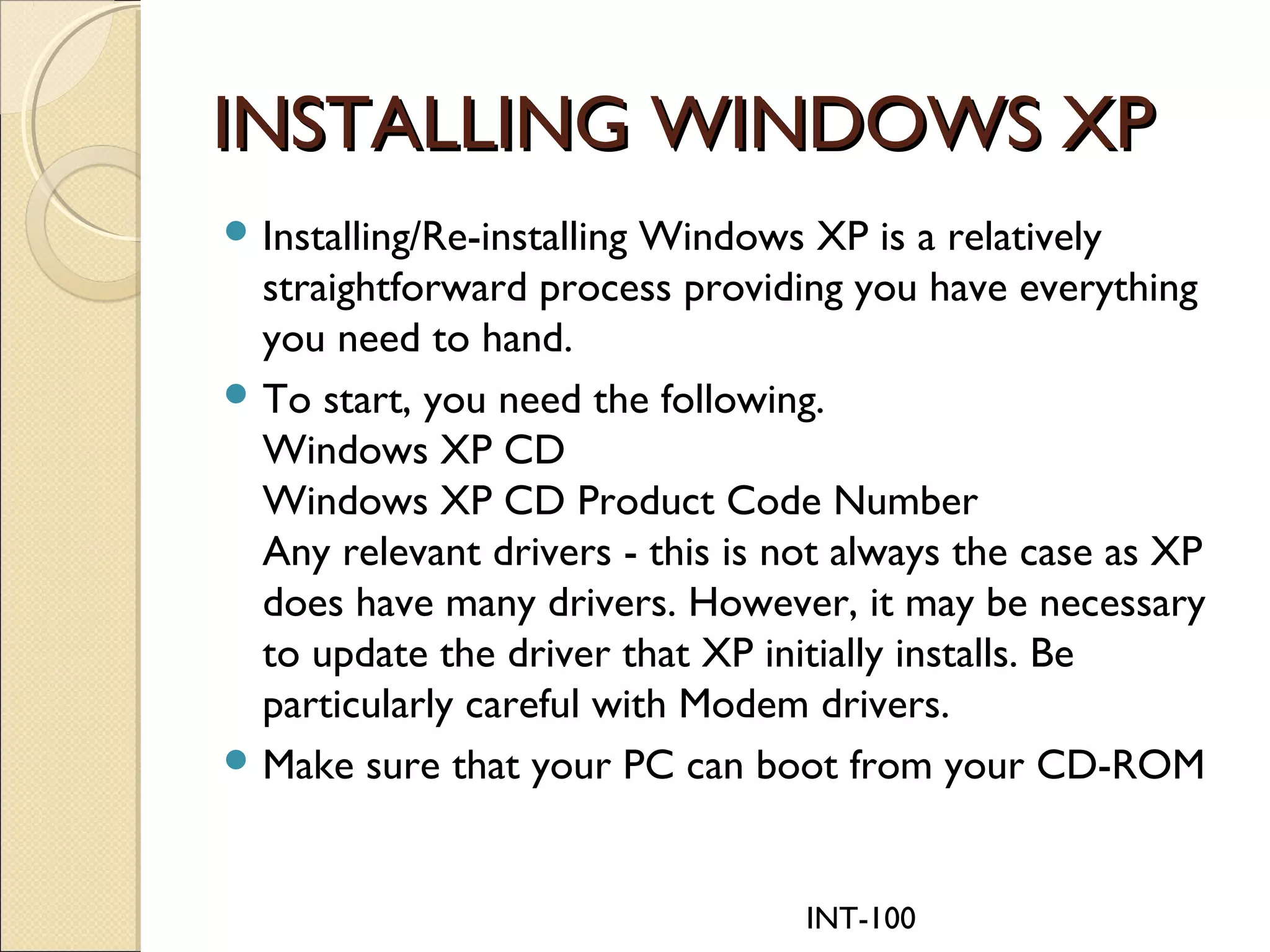
 You will see on your
screen 'Press any key to
boot from CD‘
 At this stage press either
Enter or any other key
 Set up will now
automatically inspect
your computer's
hardware configuration
INT-100
Step 2Step 2
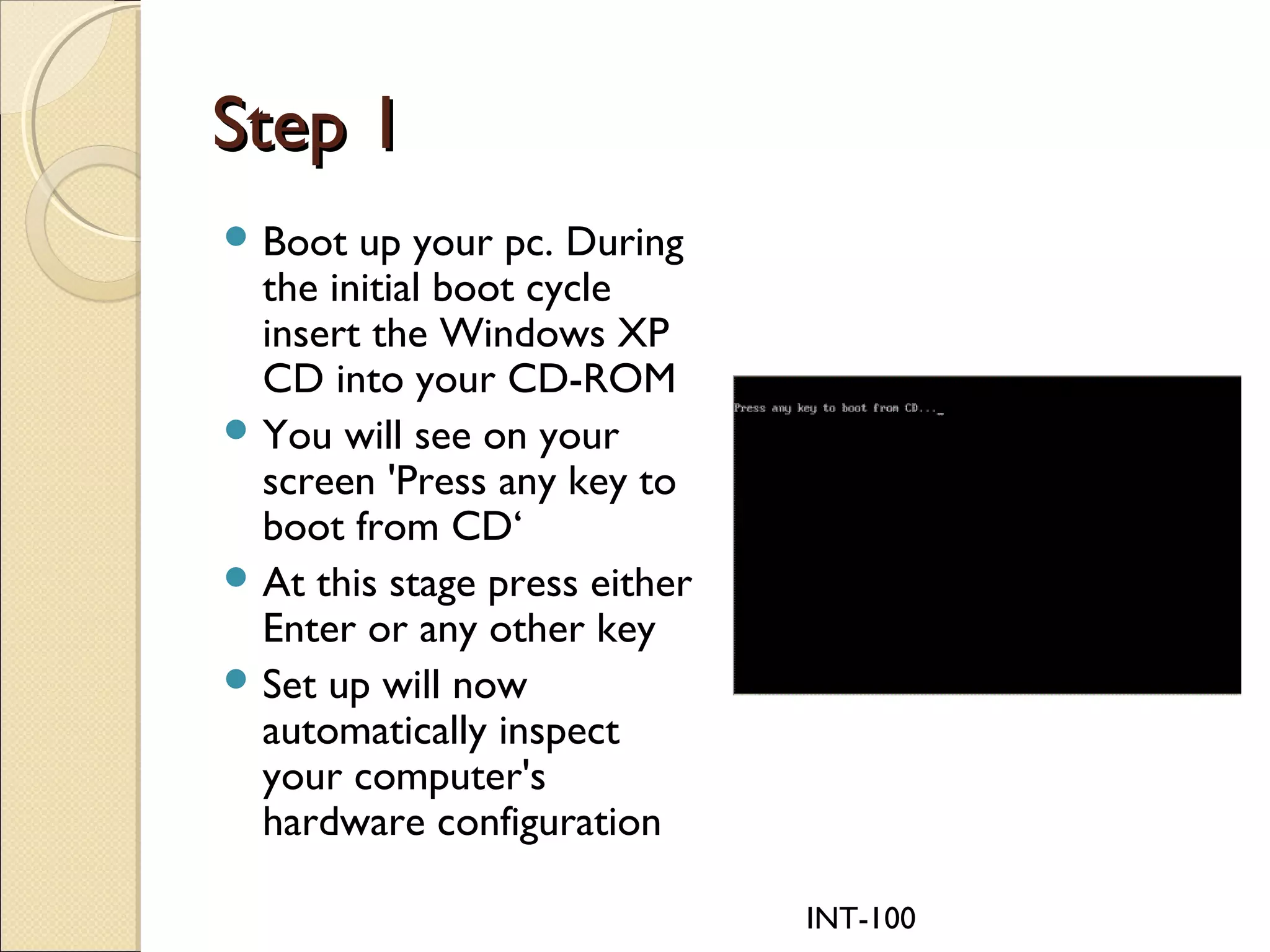
 After set up has checked your
hardware a blue screen will
appear with the words
'Windows set up' in the top
left hand corner.
 At this stage, should you have
a RAID, SCSI or SATA drive,
you will have the option of
pressing F6 to install the third
party drivers for this
hardware. If you do not have
any of this hardware installed
on your pc there is no need
to press F6. XP will now
start loading files into
memory.
INT-100
Step 3Step 3
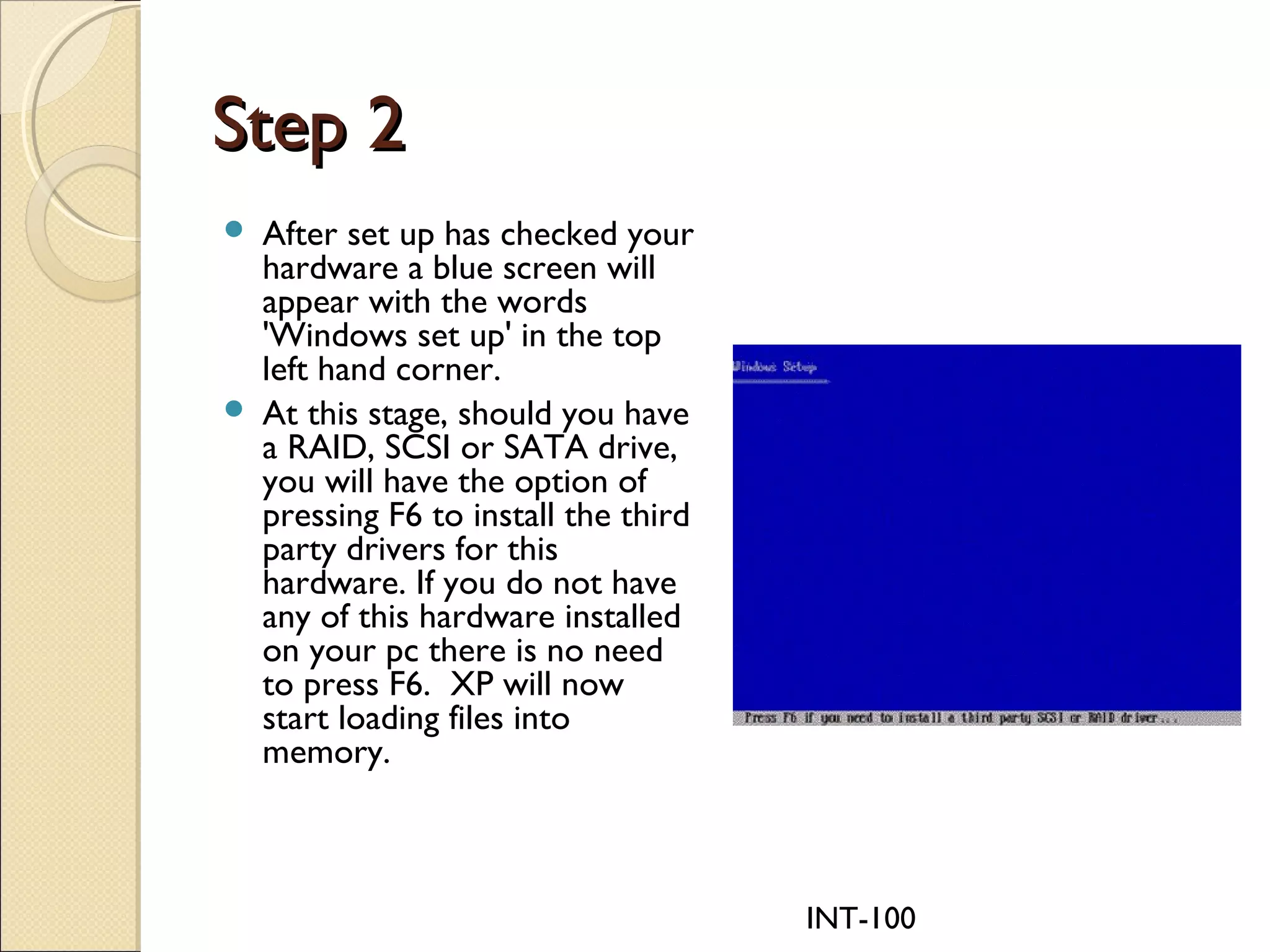
After all the files
have been loaded
into memory the
Welcome To Set
Up Window
appears
To begin installing
XP Press Enter
INT-100
Step 4Step 4
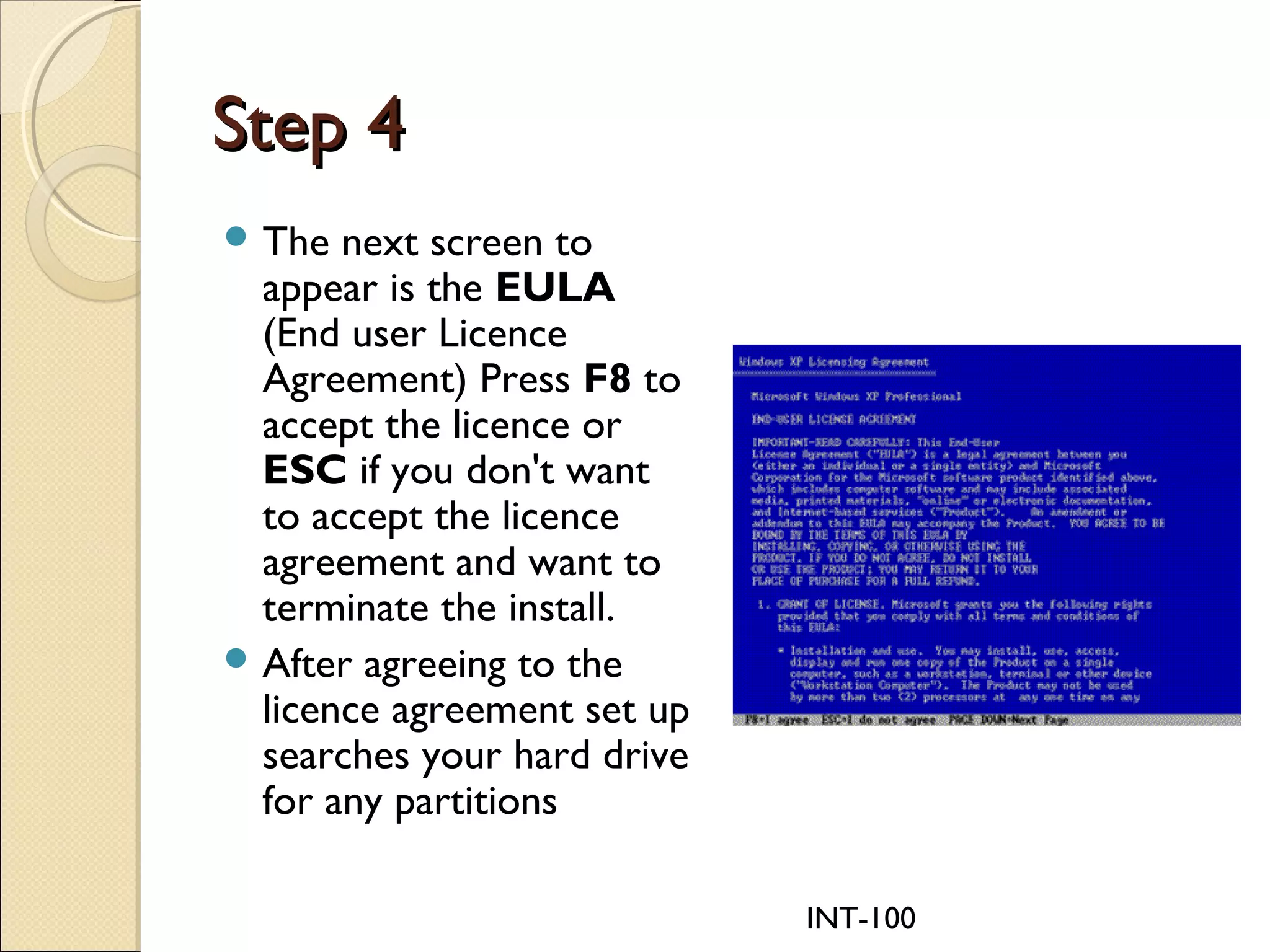
 The next screen to
appear is the EULA
(End user Licence
Agreement) Press F8 to
accept the licence or
ESC if you don't want
to accept the licence
agreement and want to
terminate the install.
 After agreeing to the
licence agreement set up
searches your hard drive
for any partitions
INT-100
Step 5Step 5
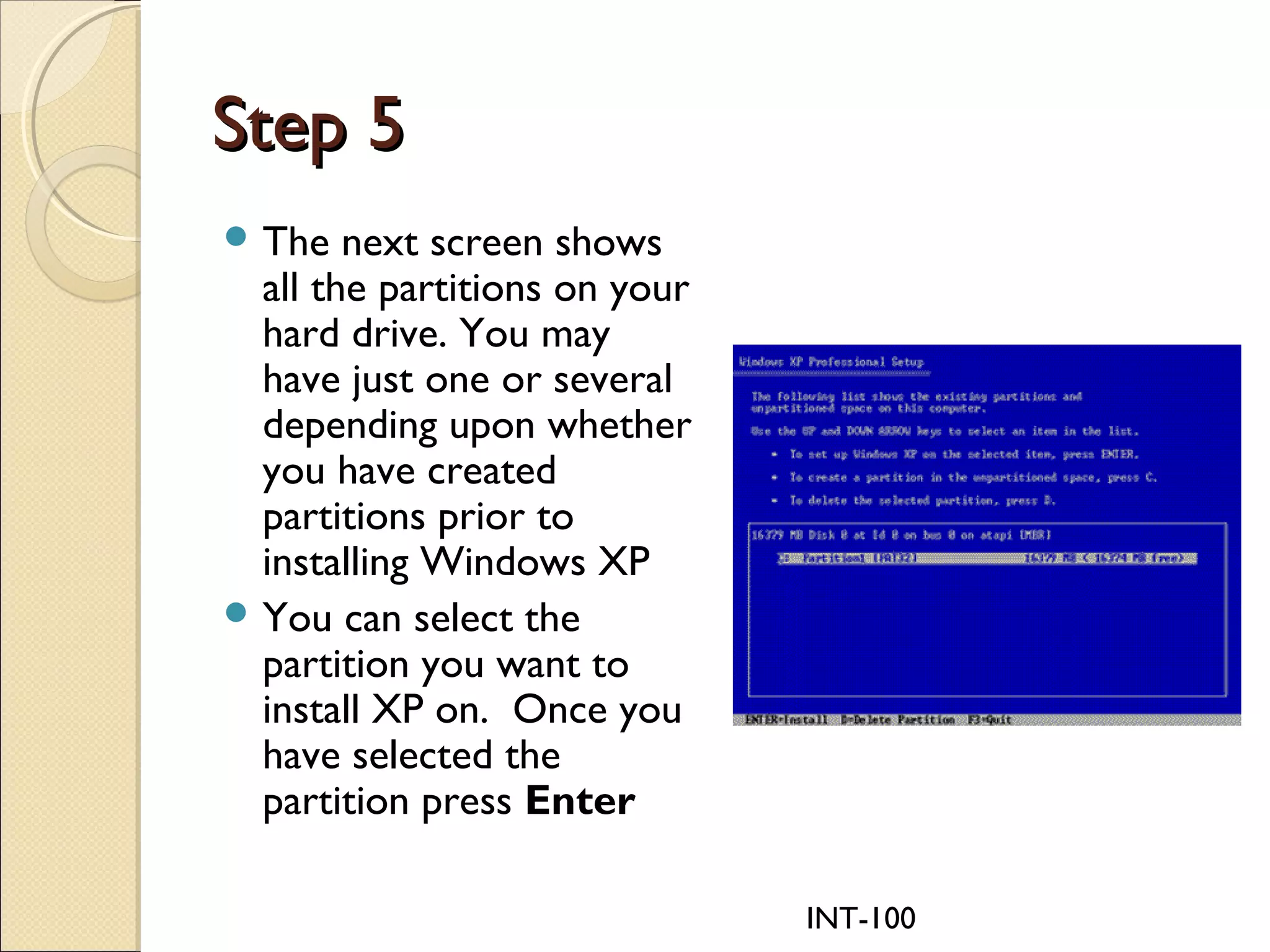
 The next screen shows
all the partitions on your
hard drive. You may
have just one or several
depending upon whether
you have created
partitions prior to
installing Windows XP
 You can select the
partition you want to
install XP on.  Once you
have selected the
partition press Enter
INT-100
Step 6Step 6
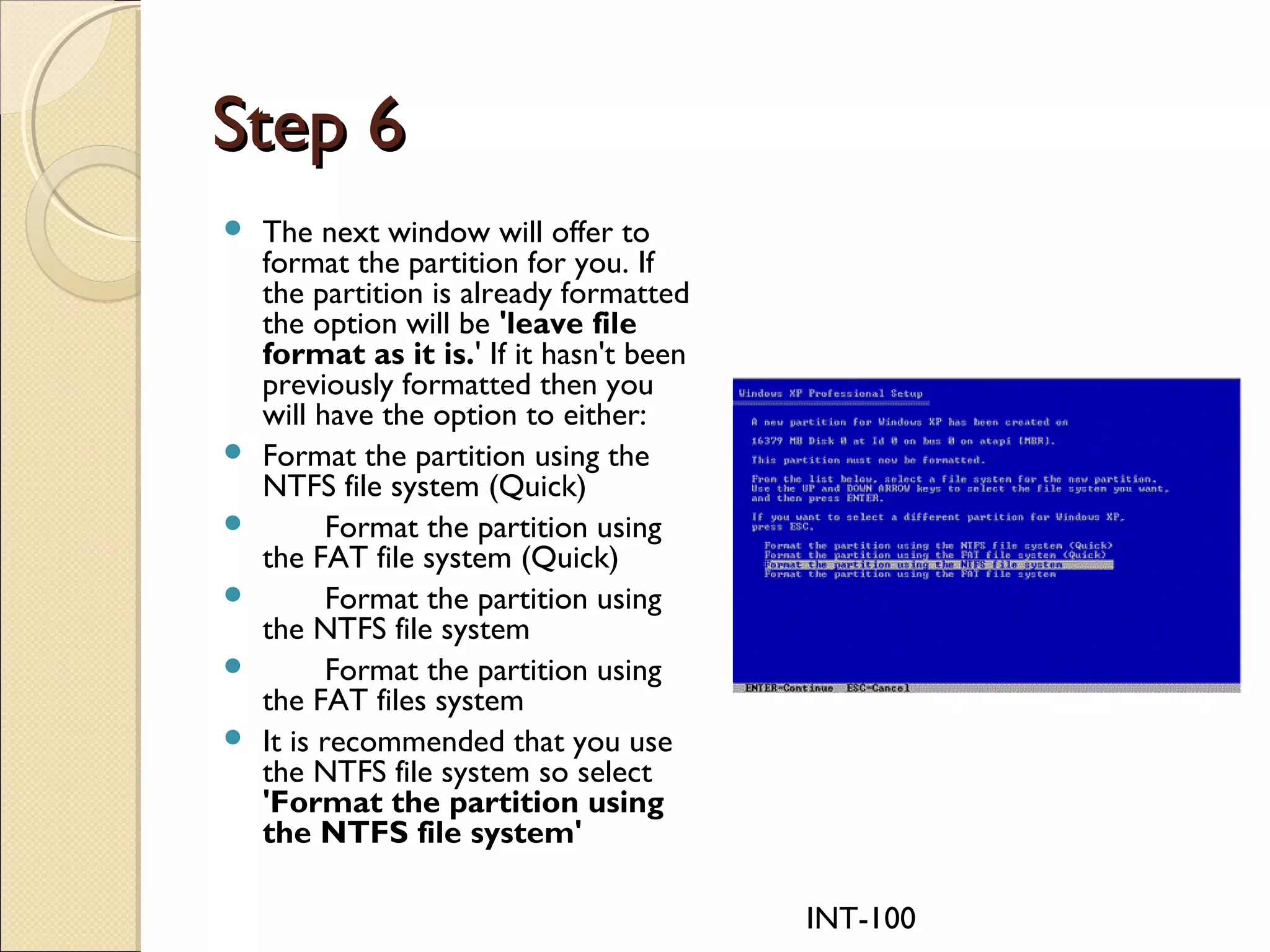
 The next window will offer to
format the partition for you. If
the partition is already formatted
the option will be 'leave file
format as it is.' If it hasn't been
previously formatted then you
will have the option to either:
 Format the partition using the
NTFS file system (Quick)
        Format the partition using
the FAT file system (Quick)
        Format the partition using
the NTFS file system
        Format the partition using
the FAT files system
 It is recommended that you use
the NTFS file system so select
'Format the partition using
the NTFS file system'
INT-100
Step 7Step 7
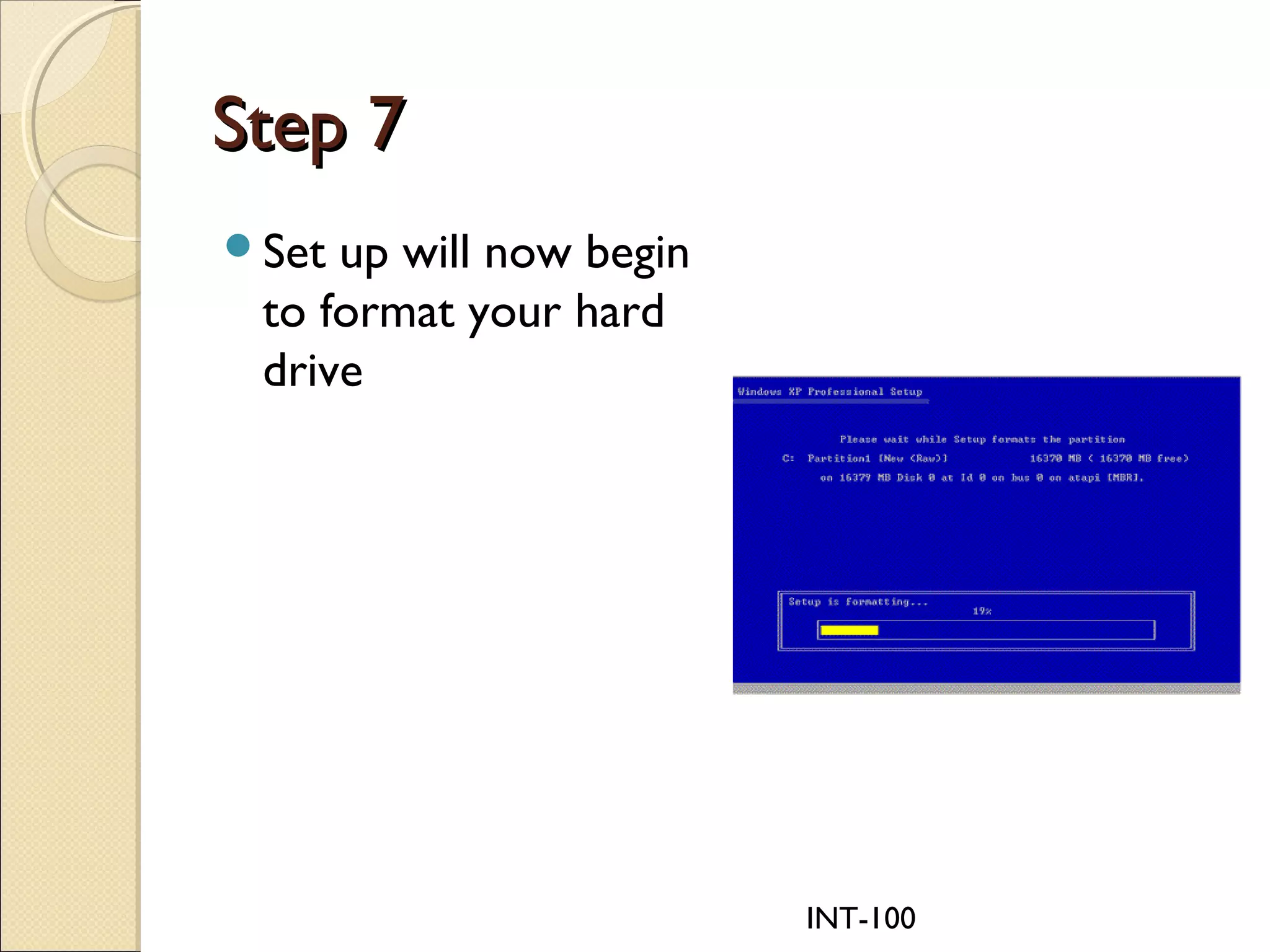
Set up will now begin
to format your hard
drive
INT-100
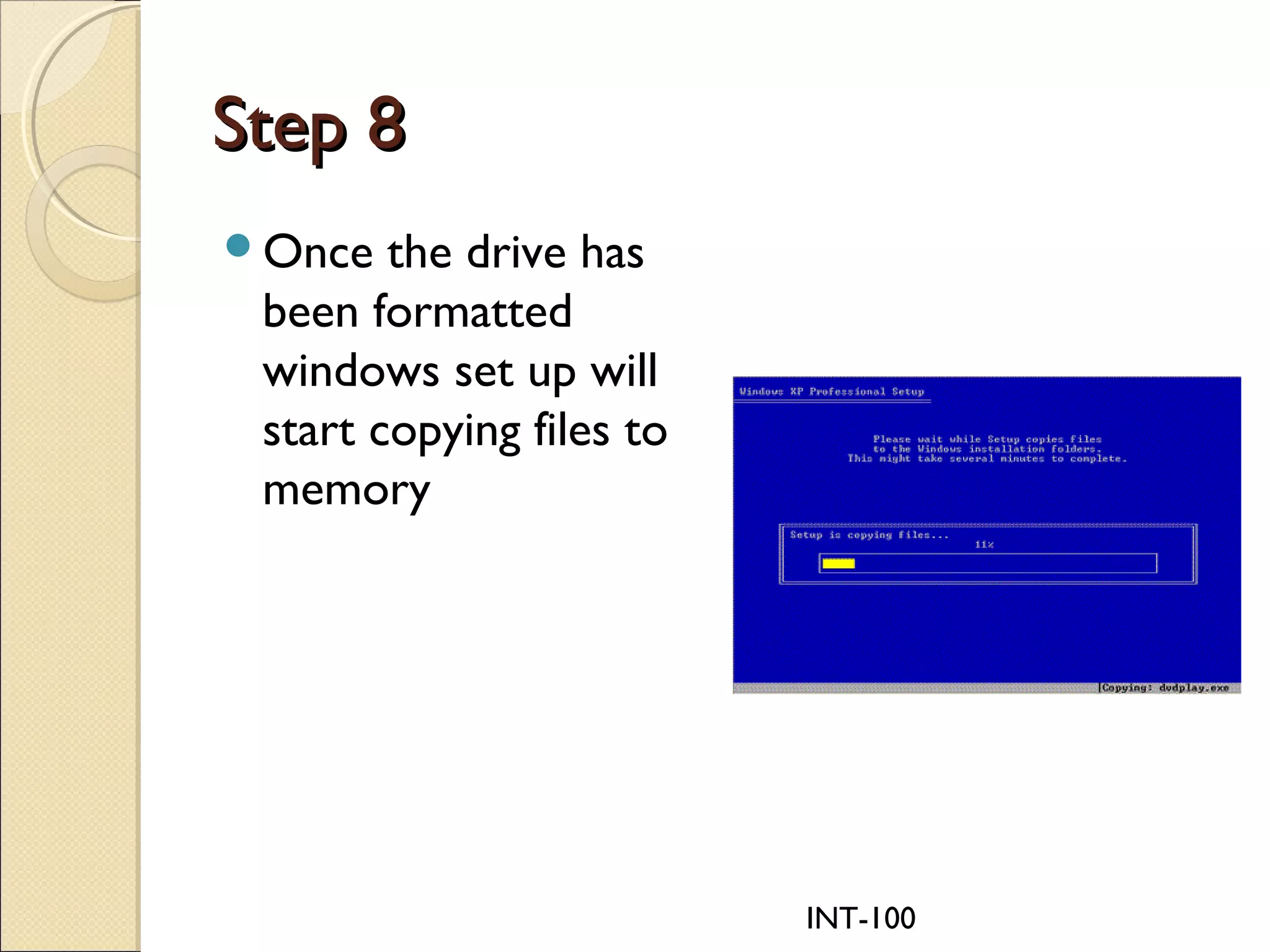
Step 8Step 8
Once the drive has
been formatted
windows set up will
start copying files to
memory
INT-100
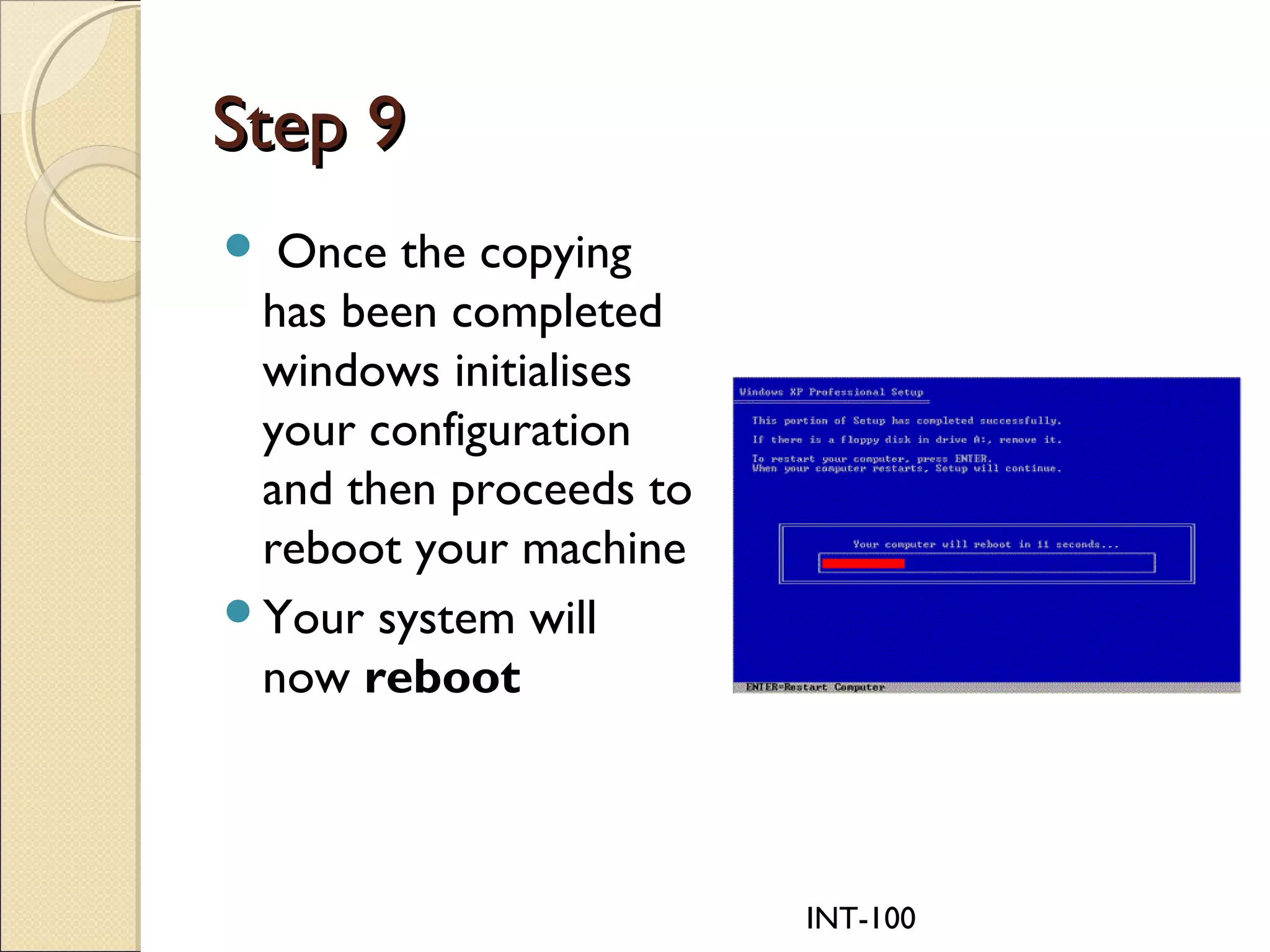
Step 9Step 9
 Once the copying
has been completed
windows initialises
your configuration
and then proceeds to
reboot your machine
Your system will
now reboot
INT-100
Step 10Step 10
 On reboot you will again be presented
with 'Press any key to boot from CD'
On this occasion DO NOT press any
key. Leave well alone. Windows will
then automatically launch. If you press
any key during this process you will
start the set up procedure all over
again.
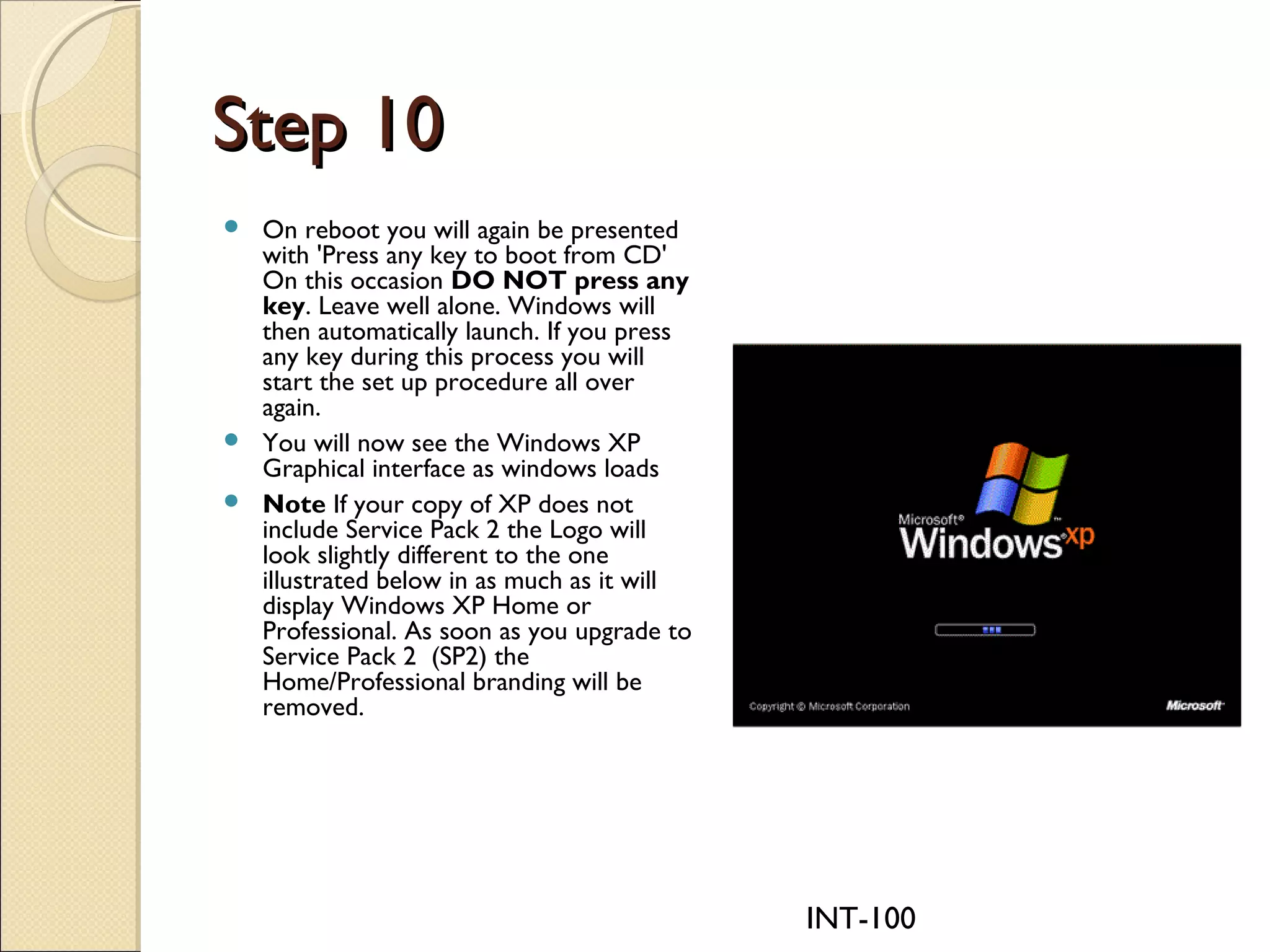
 You will now see the Windows XP
Graphical interface as windows loads
 Note If your copy of XP does not
include Service Pack 2 the Logo will
look slightly different to the one
illustrated below in as much as it will
display Windows XP Home or
Professional. As soon as you upgrade to
Service Pack 2  (SP2) the
Home/Professional branding will be
removed.
INT-100
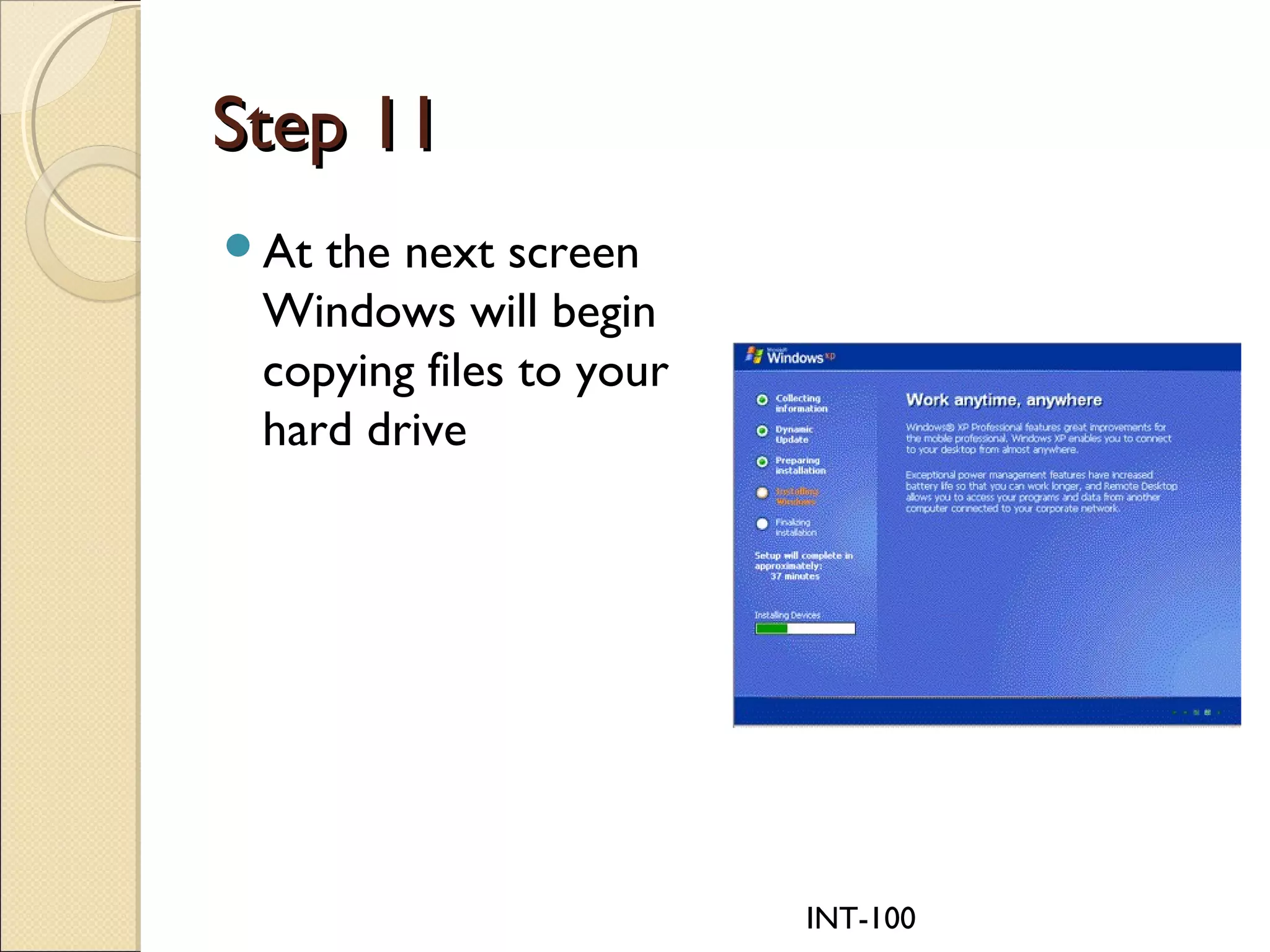
Step 11Step 11
At the next screen
Windows will begin
copying files to your
hard drive
INT-100
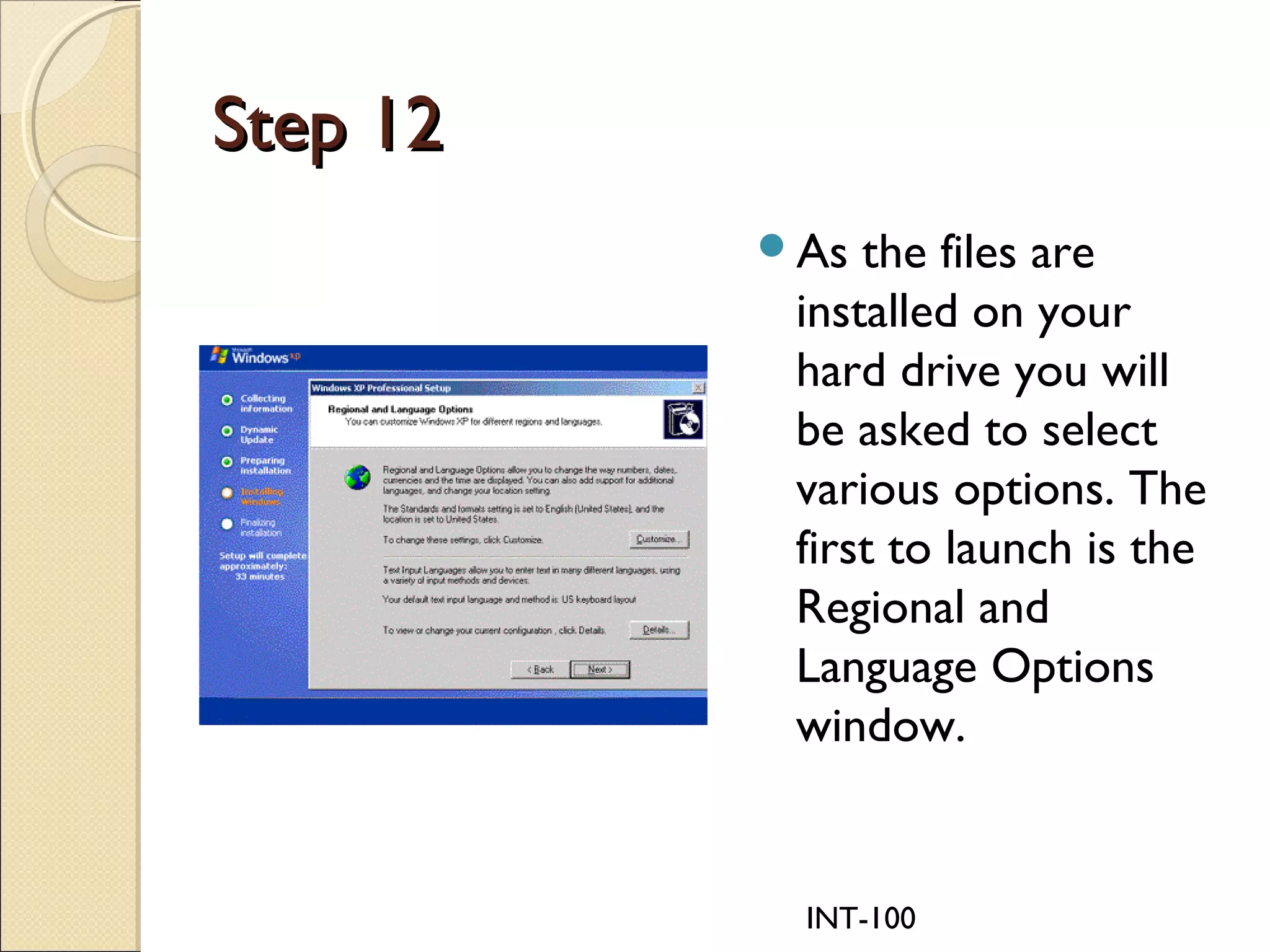
Step 12Step 12
As the files are
installed on your
hard drive you will
be asked to select
various options. The
first to launch is the
Regional and
Language Options
window.
INT-100
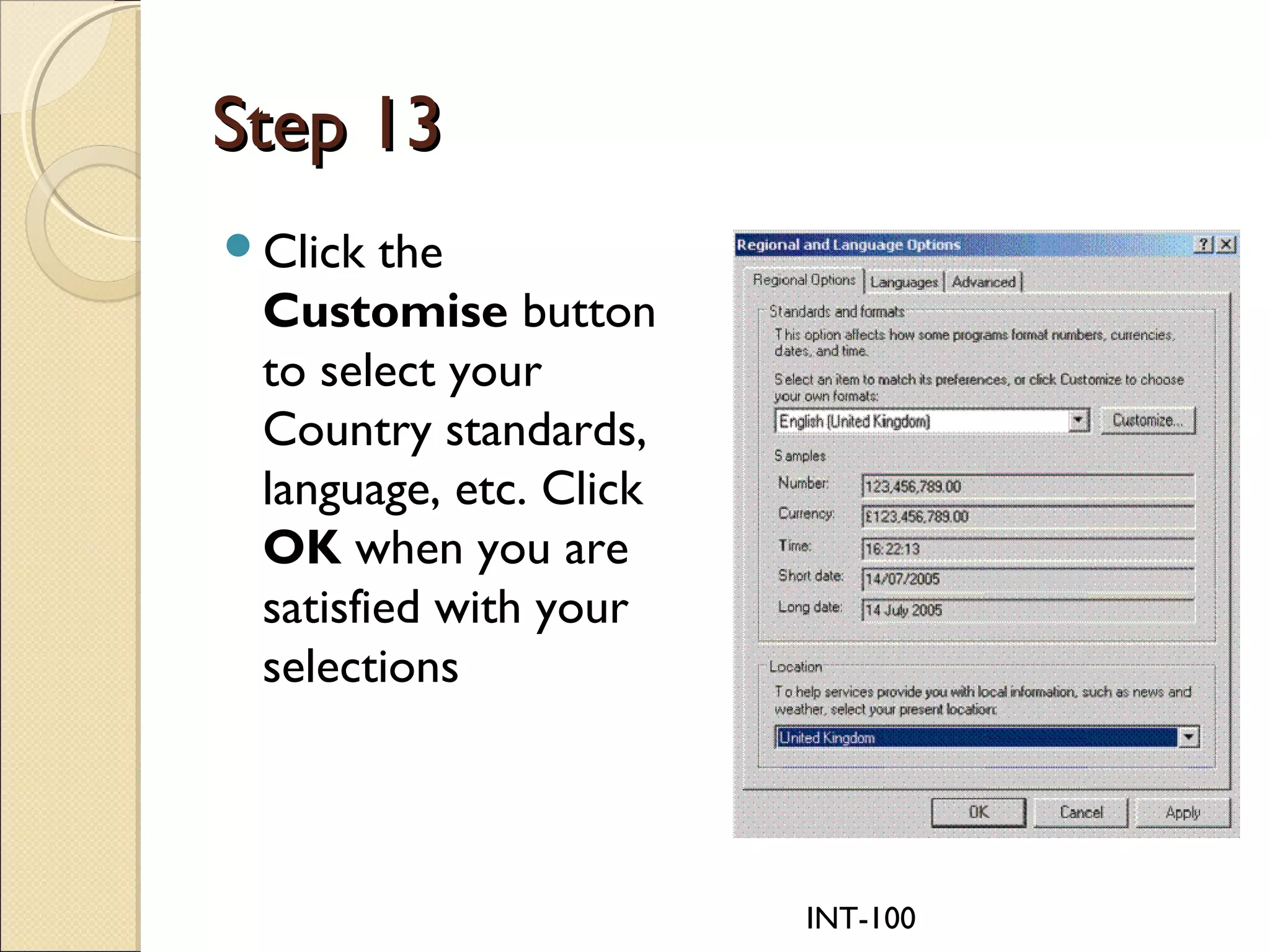
Step 13Step 13
Click the
Customise button
to select your
Country standards,
language, etc. Click
OK when you are
satisfied with your
selections
INT-100
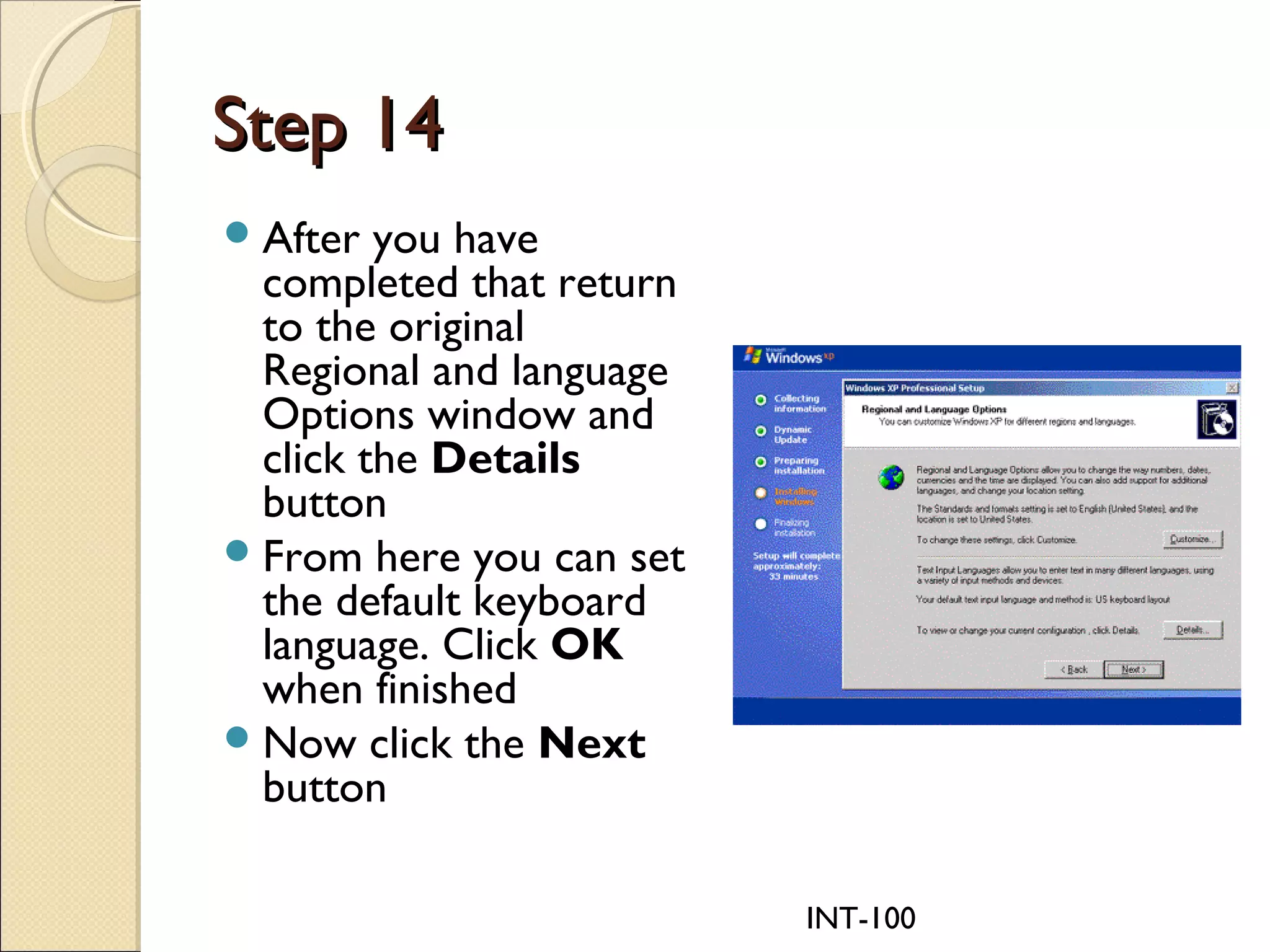
Step 14Step 14
After you have
completed that return
to the original
Regional and language
Options window and
click the Details
button
From here you can set
the default keyboard
language. Click OK
when finished
Now click the Next
button
INT-100
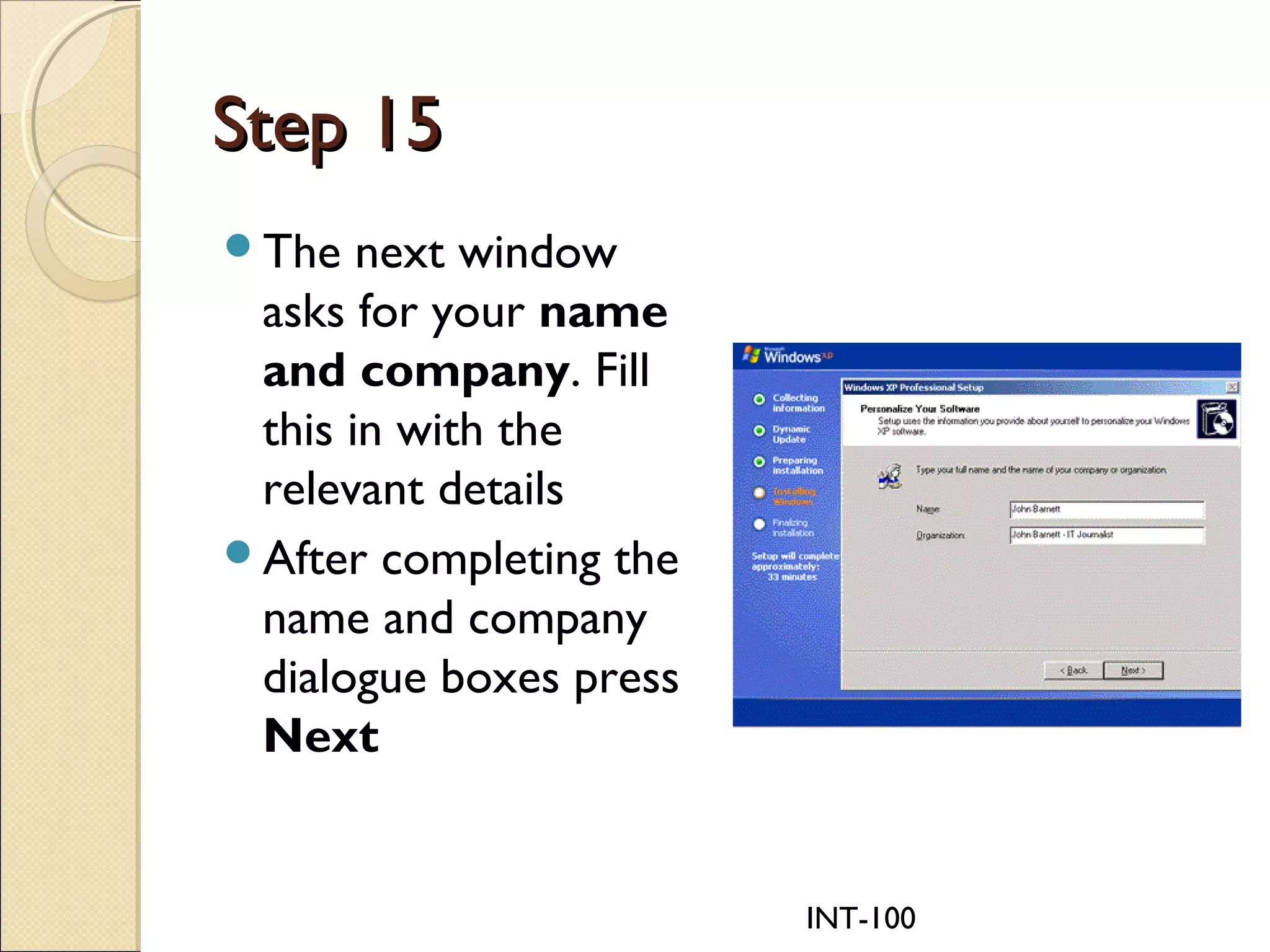
Step 15Step 15
The next window
asks for your name
and company. Fill
this in with the
relevant details
After completing the
name and company
dialogue boxes press
Next
INT-100
Step 16Step 16
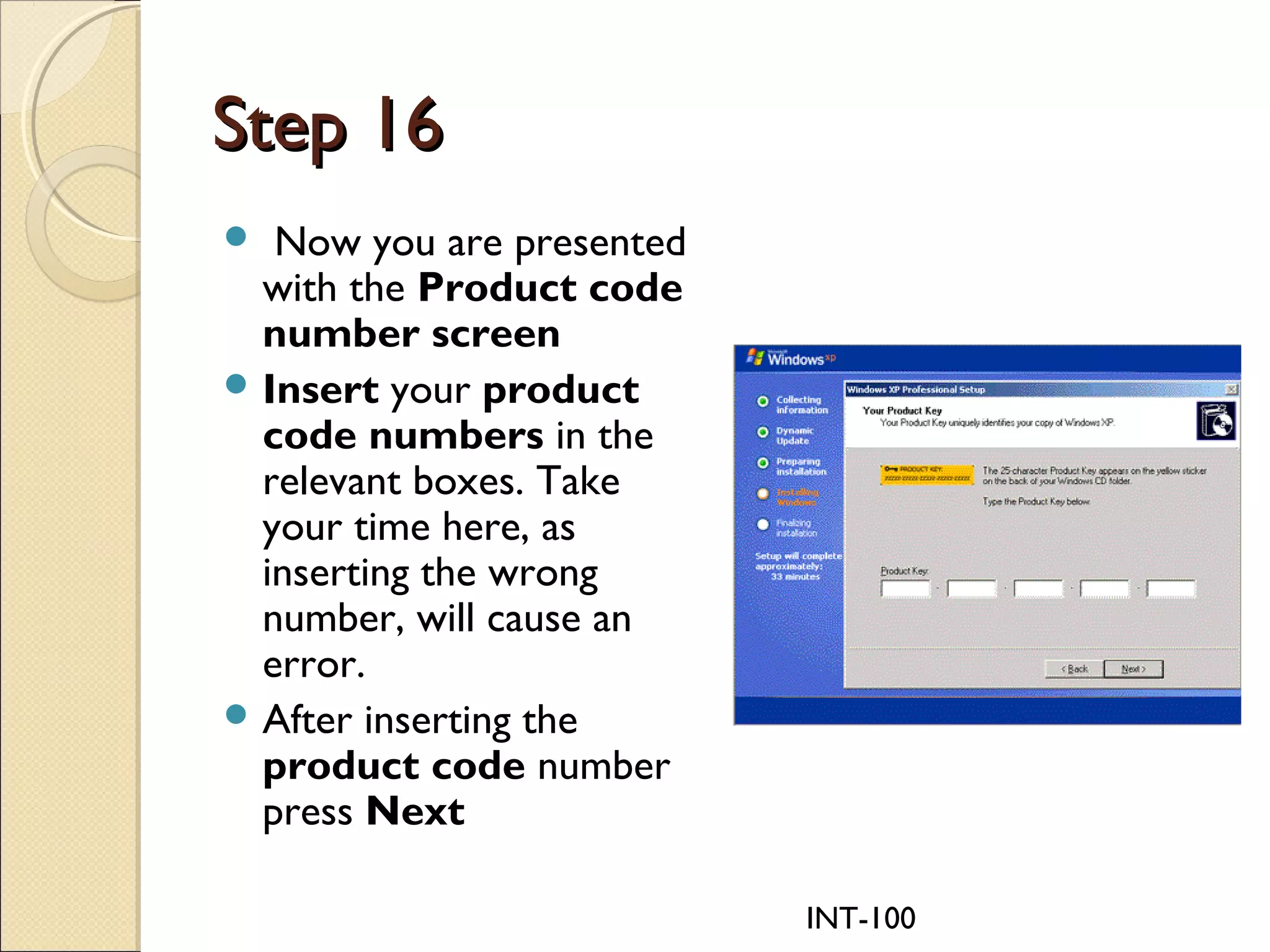
 Now you are presented
with the Product code
number screen
 Insert your product
code numbers in the
relevant boxes. Take
your time here, as
inserting the wrong
number, will cause an
error.
 After inserting the
product code number
press Next
INT-100
Step 17Step 17
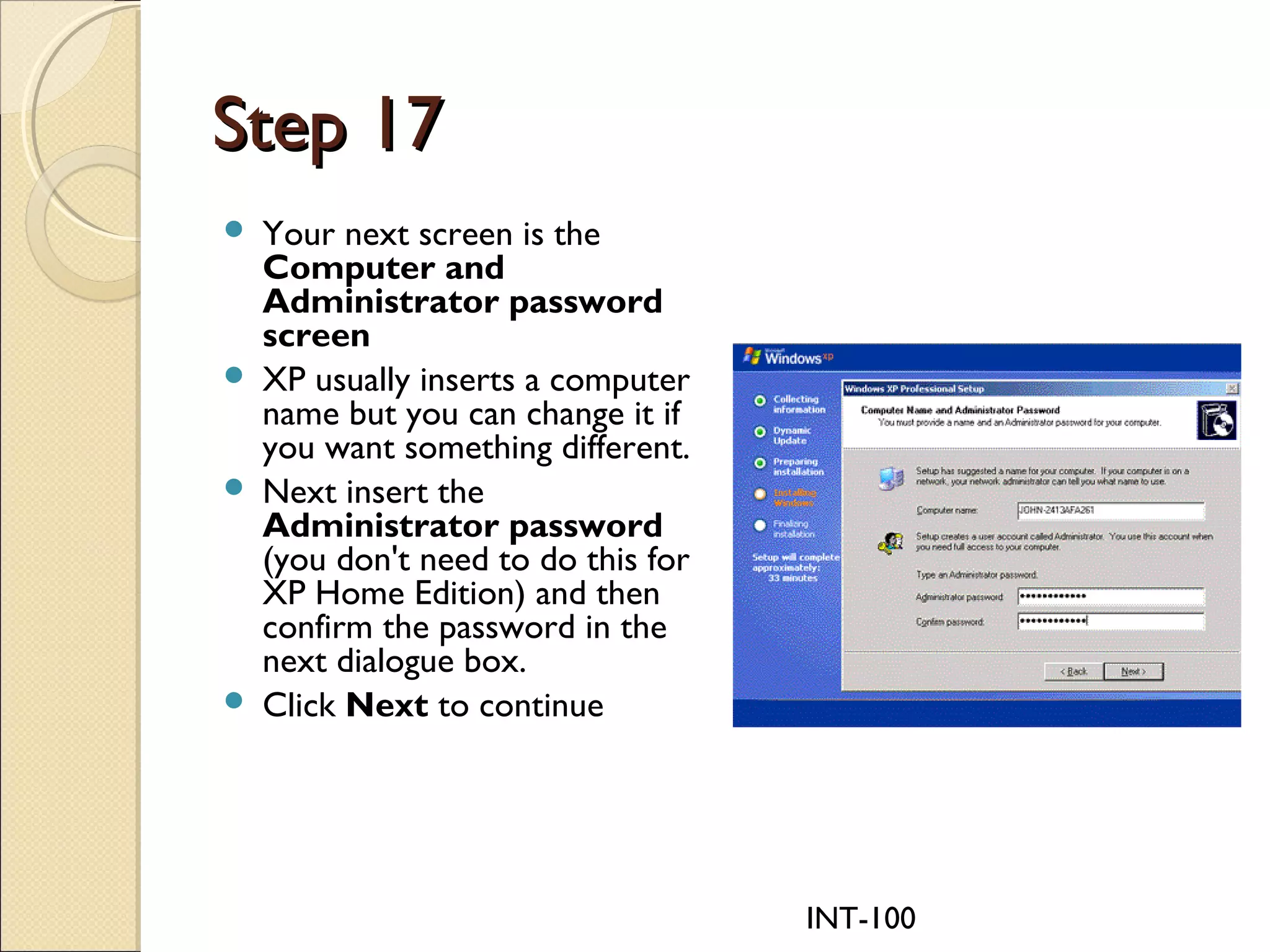
 Your next screen is the
Computer and
Administrator password
screen
 XP usually inserts a computer
name but you can change it if
you want something different.
 Next insert the
Administrator password
(you don't need to do this for
XP Home Edition) and then
confirm the password in the
next dialogue box.
 Click Next to continue
INT-100
Step 18Step 18
If you have a Dial Up Modem installed you will
now be asked for the Country and area code
information. Fill this in as necessary and press Next.
Do Not worry if the Dial Up Modem screen
doesn't appear during set-up. Personally I much
prefer to set-up the Internet Connection after
Windows XP has completed it's installation.
INT-100
Step 19Step 19
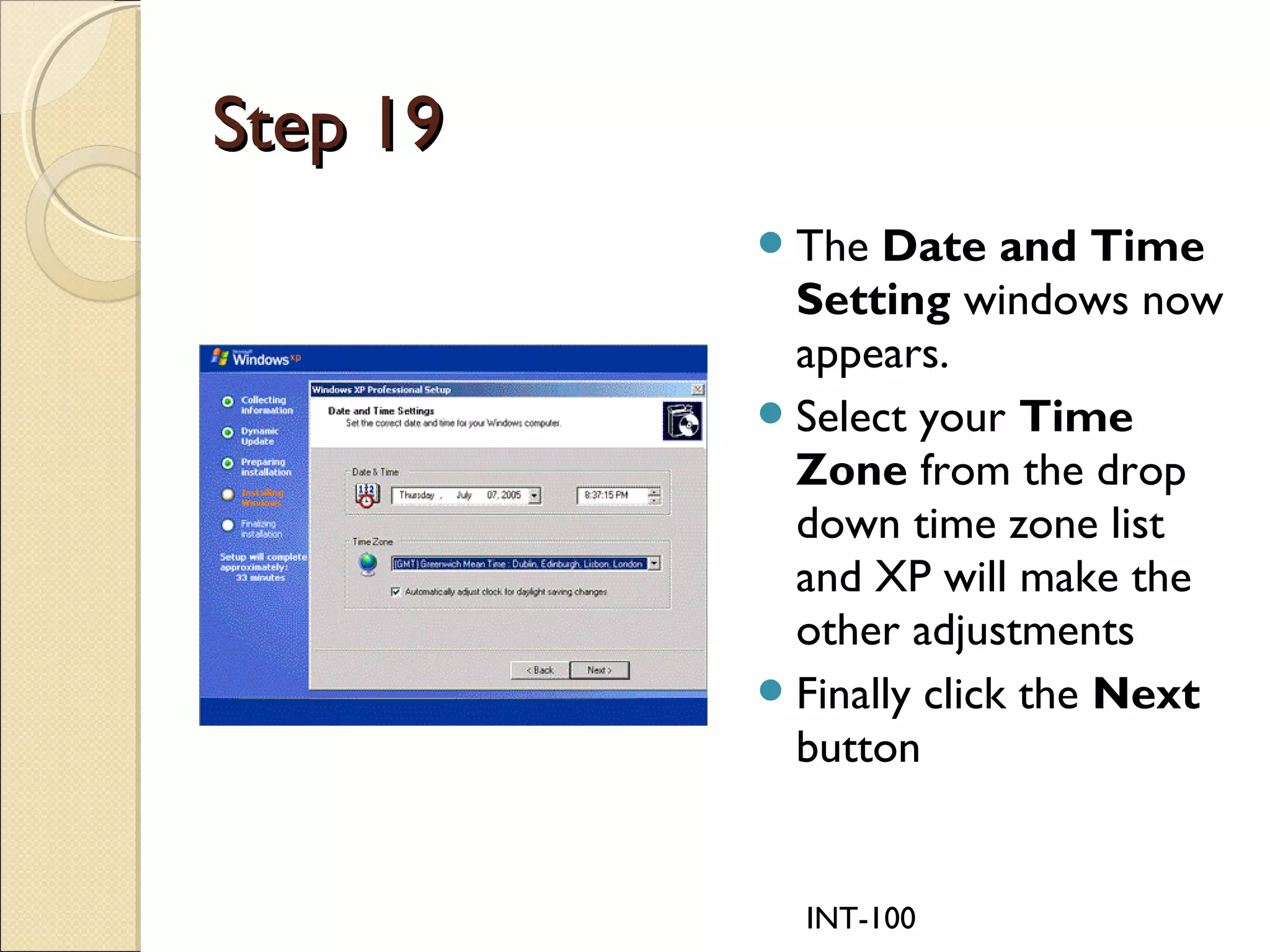
The Date and Time
Setting windows now
appears.
Select your Time
Zone from the drop
down time zone list
and XP will make the
other adjustments
Finally click the Next
button
INT-100
Step 20Step 20
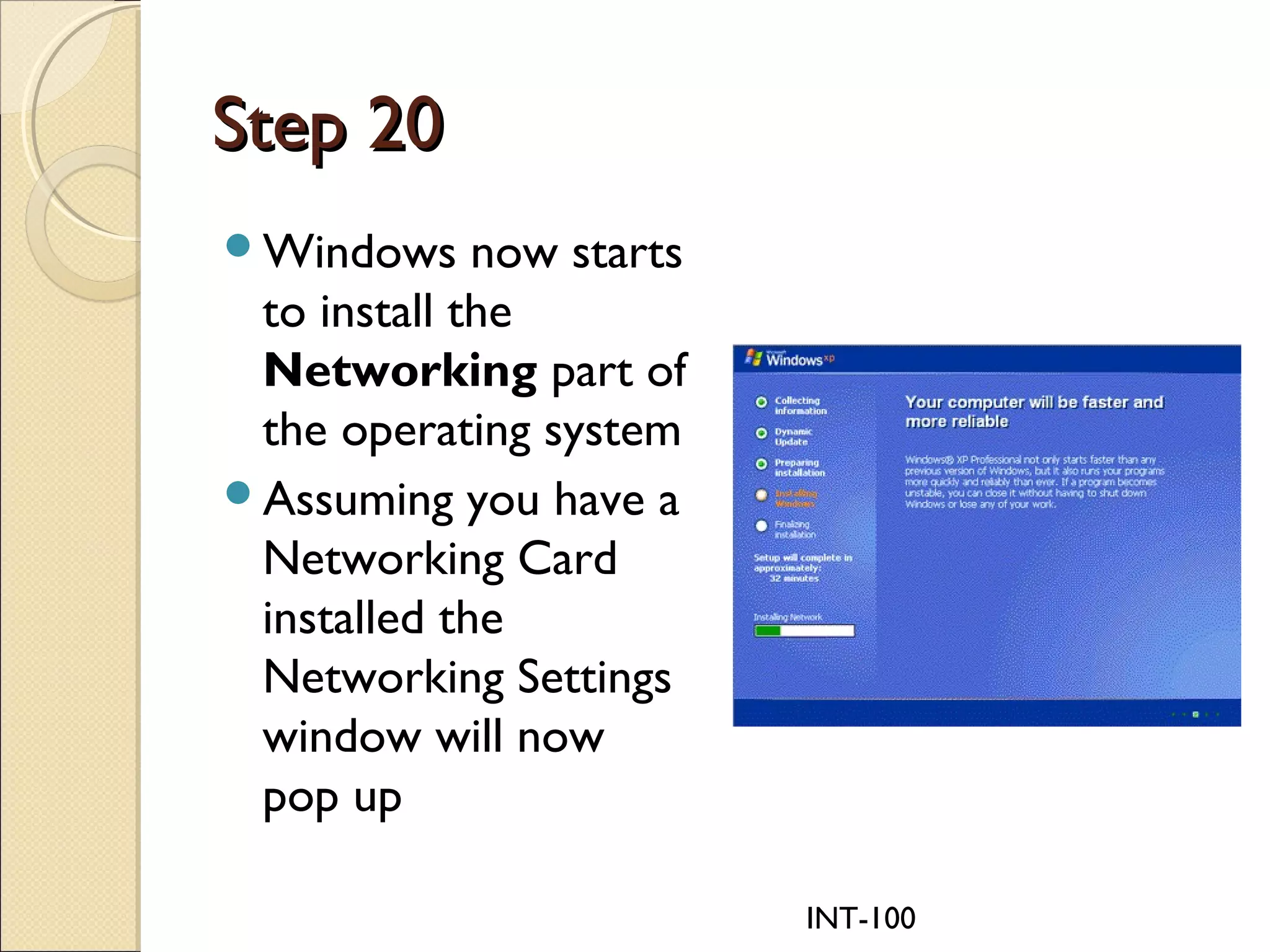
Windows now starts
to install the
Networking part of
the operating system
Assuming you have a
Networking Card
installed the
Networking Settings
window will now
pop up
INT-100
Step 21Step 21
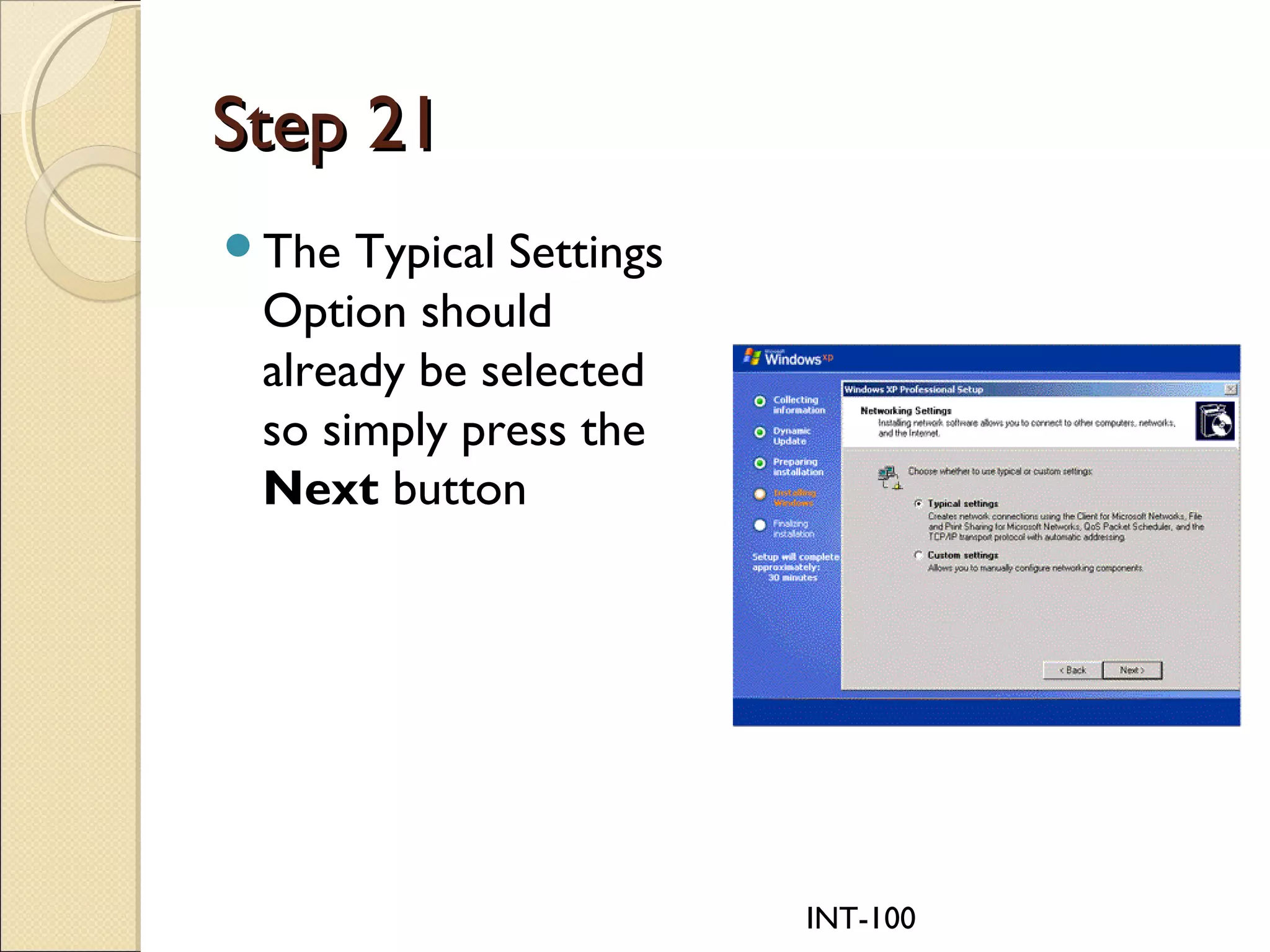
The Typical Settings
Option should
already be selected
so simply press the
Next button
INT-100
Step 22Step 22
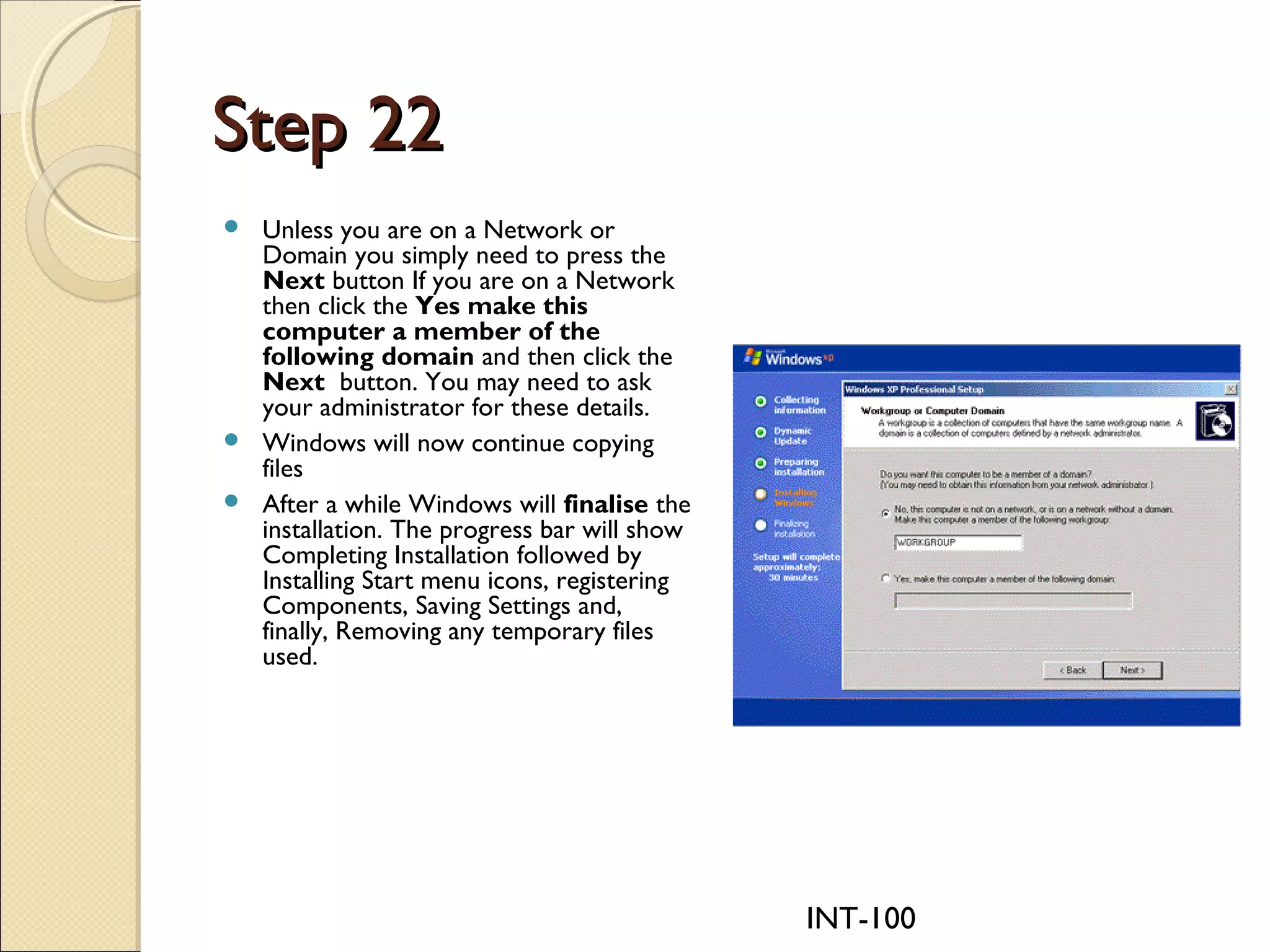
 Unless you are on a Network or
Domain you simply need to press the
Next button If you are on a Network
then click the Yes make this
computer a member of the
following domain and then click the
Next  button. You may need to ask
your administrator for these details.
 Windows will now continue copying
files
 After a while Windows will finalise the
installation. The progress bar will show
Completing Installation followed by
Installing Start menu icons, registering
Components, Saving Settings and,
finally, Removing any temporary files
used.
INT-100
Step 23Step 23
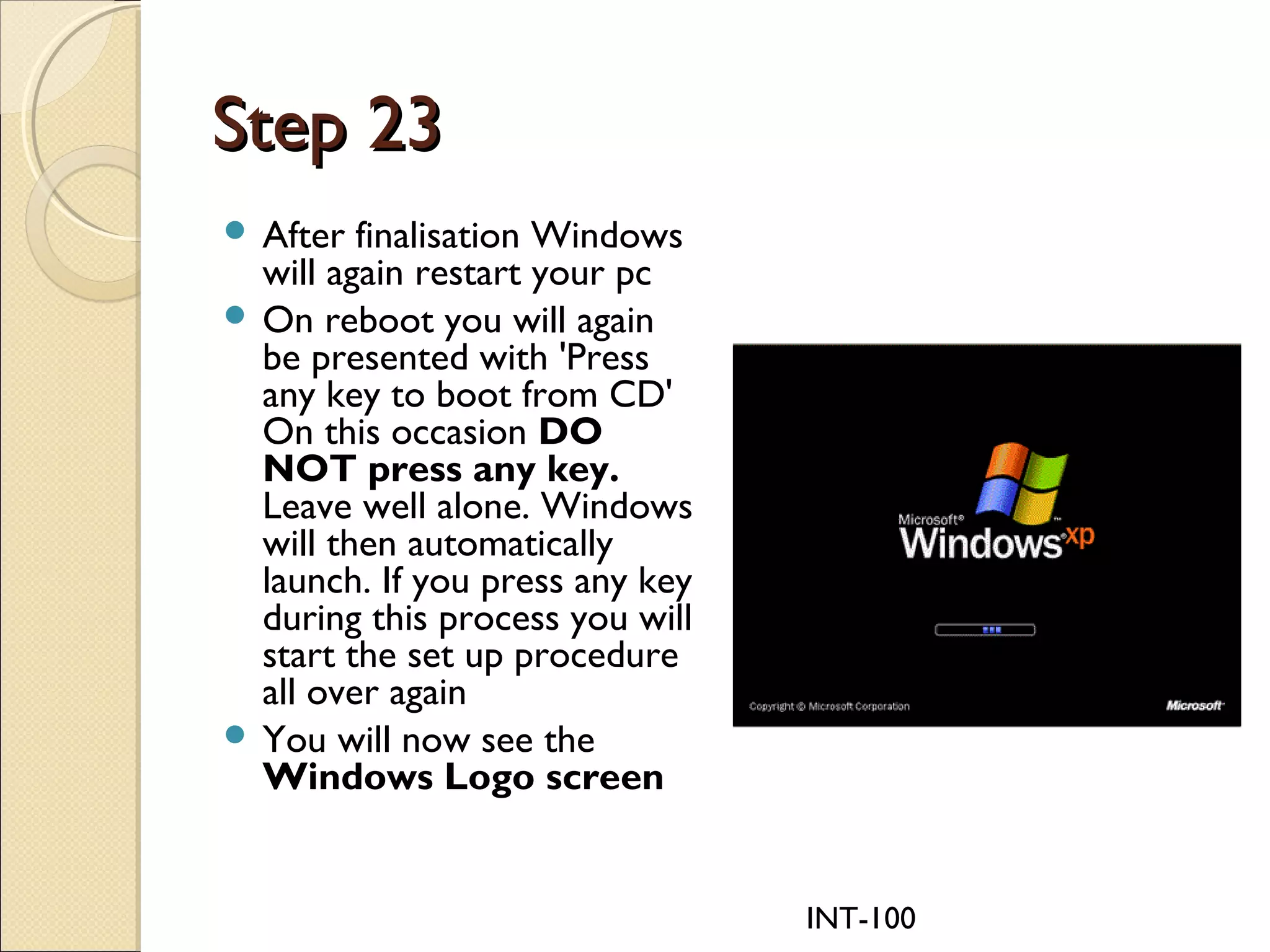
 After finalisation Windows
will again restart your pc
 On reboot you will again
be presented with 'Press
any key to boot from CD'
On this occasion DO
NOT press any key.
Leave well alone. Windows
will then automatically
launch. If you press any key
during this process you will
start the set up procedure
all over again
 You will now see the
Windows Logo screen
INT-100
Step 24Step 24
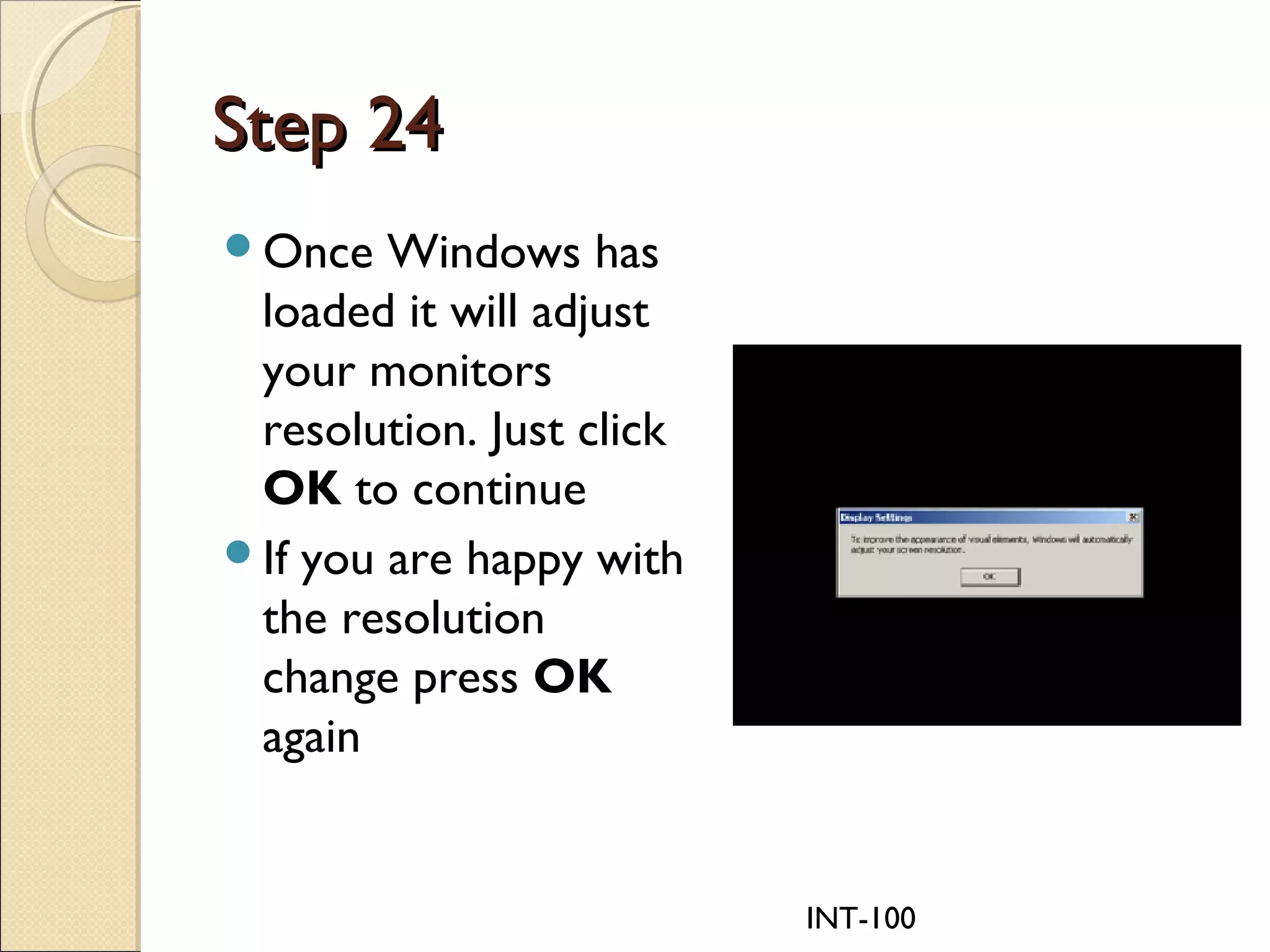
Once Windows has
loaded it will adjust
your monitors
resolution. Just click
OK to continue
If you are happy with
the resolution
change press OK
again
INT-100
Step 25Step 25
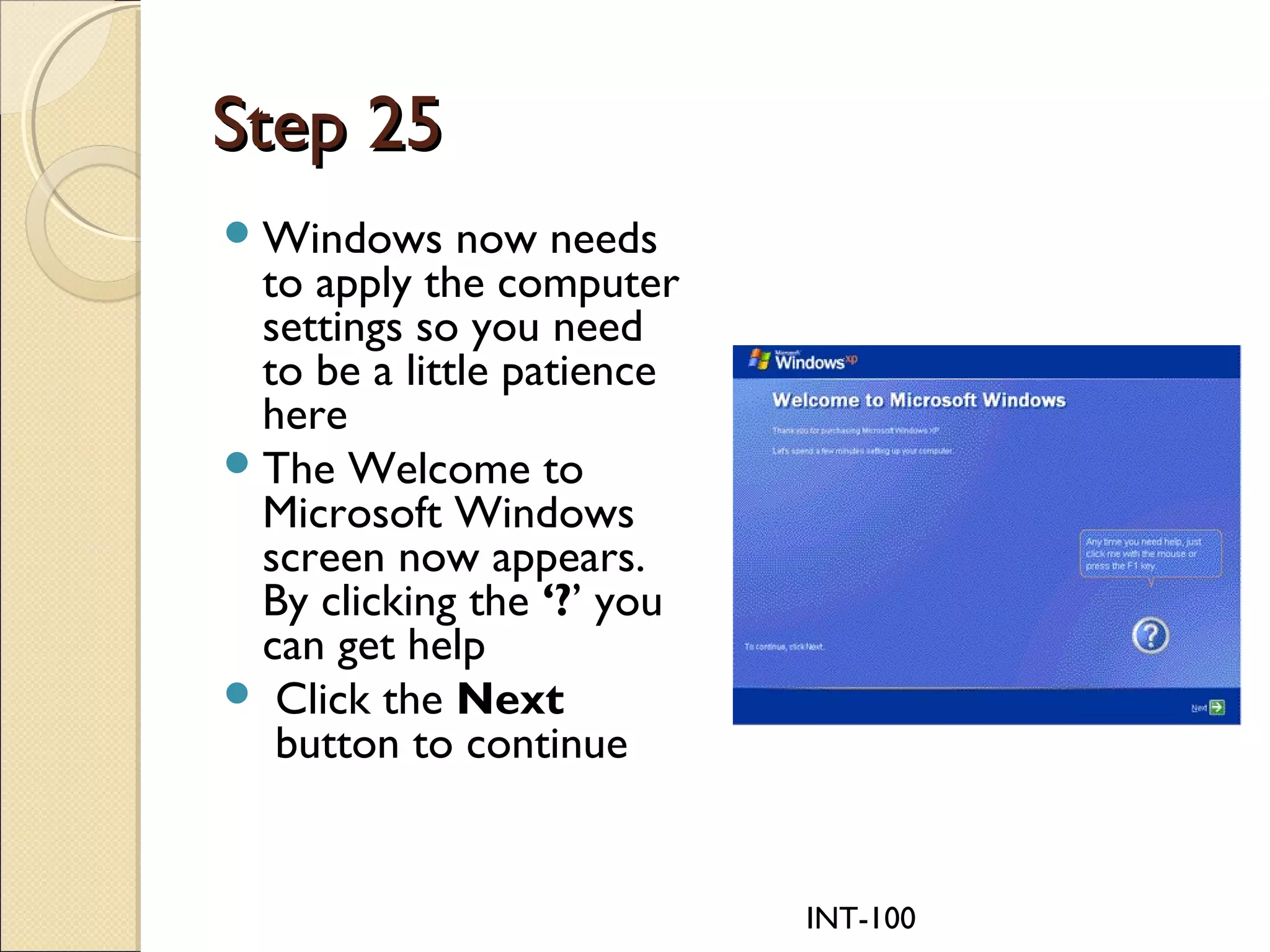
Windows now needs
to apply the computer
settings so you need
to be a little patience
here
The Welcome to
Microsoft Windows
screen now appears.
By clicking the ‘?’ you
can get help
 Click the Next
 button to continue
INT-100
Step 26Step 26
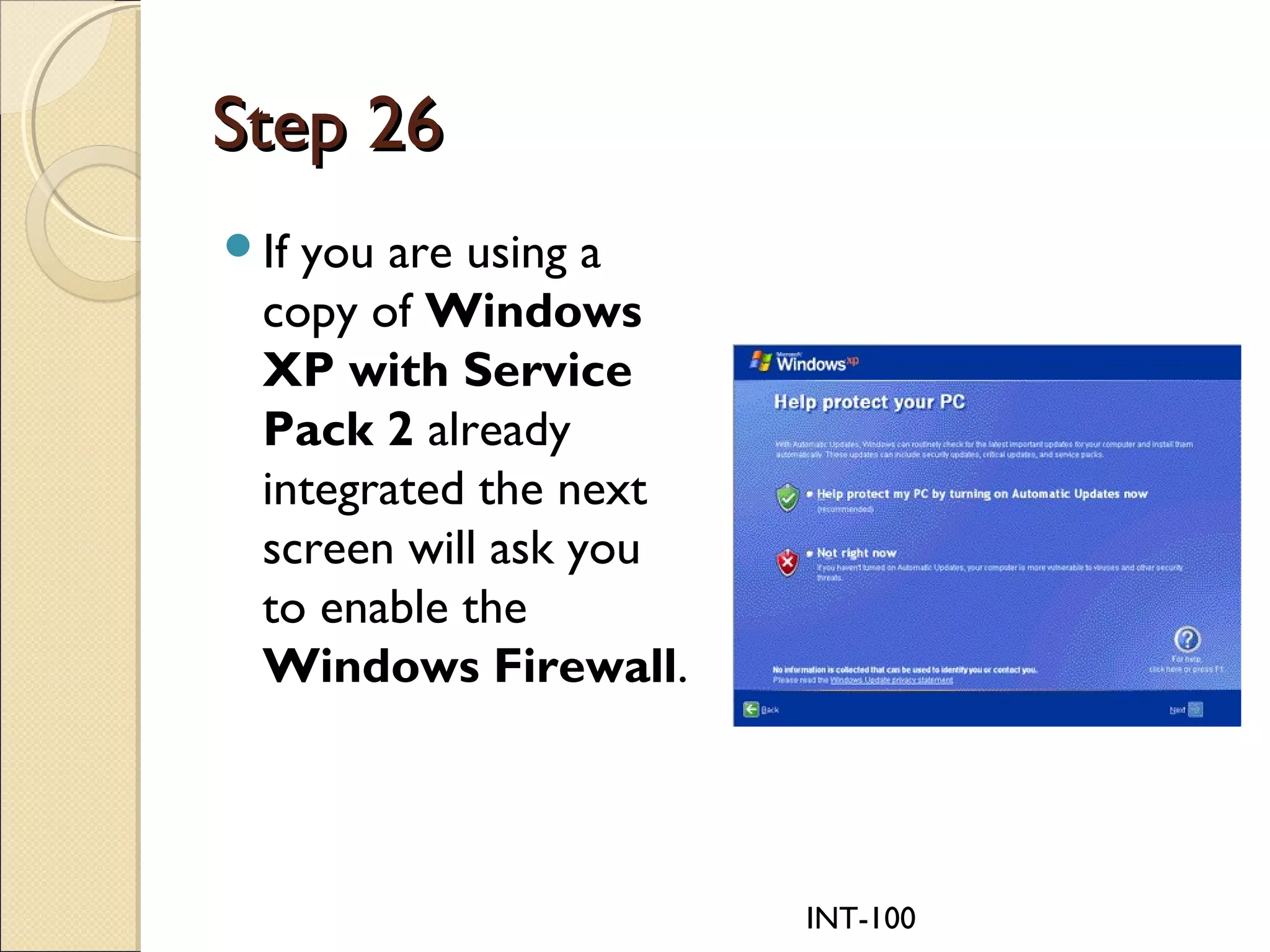
If you are using a
copy of Windows
XP with Service
Pack 2 already
integrated the next
screen will ask you
to enable the
Windows Firewall.
INT-100
Step 27Step 27
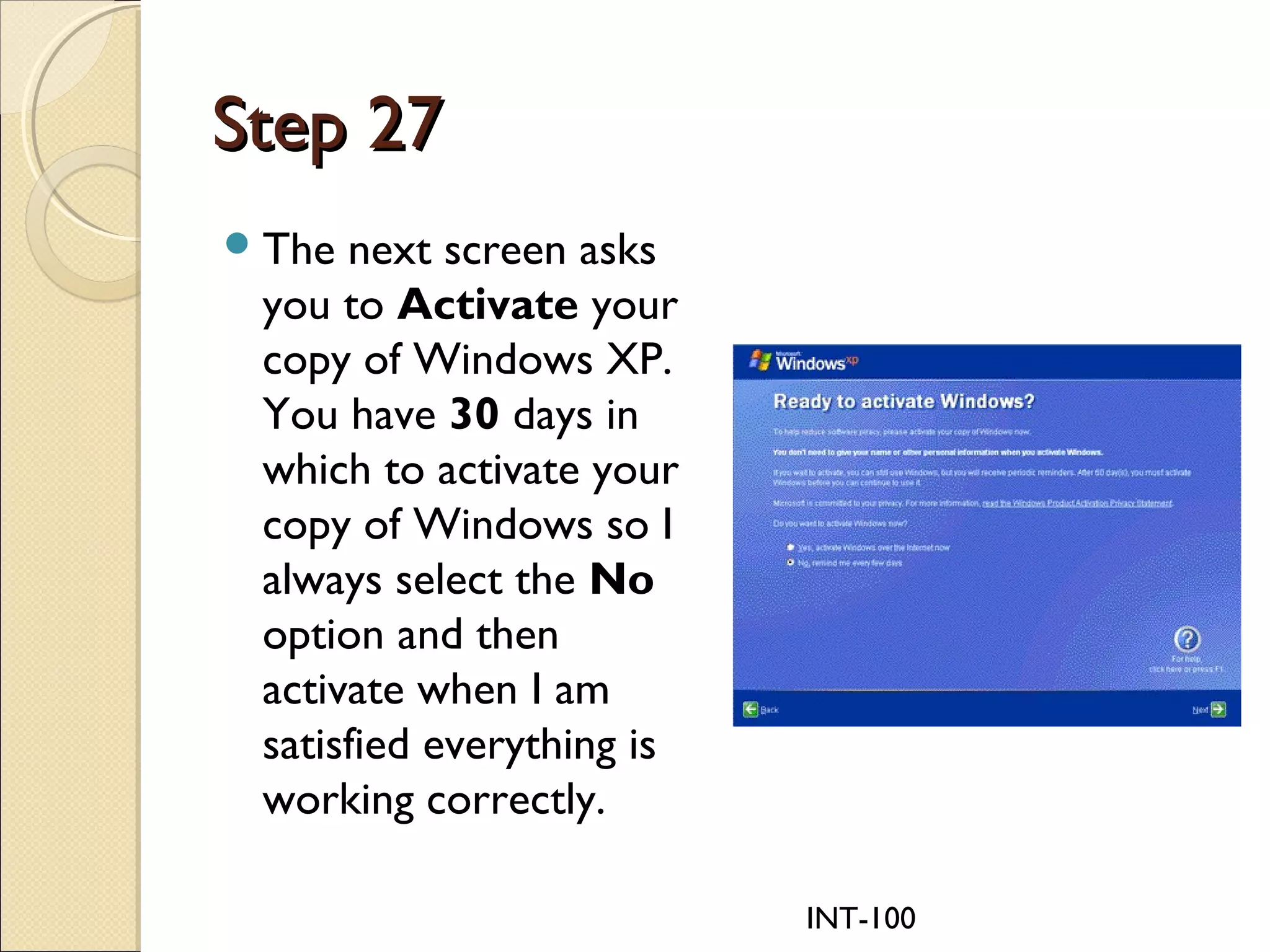
The next screen asks
you to Activate your
copy of Windows XP.
You have 30 days in
which to activate your
copy of Windows so I
always select the No
option and then
activate when I am
satisfied everything is
working correctly.
INT-100
Step 28Step 28
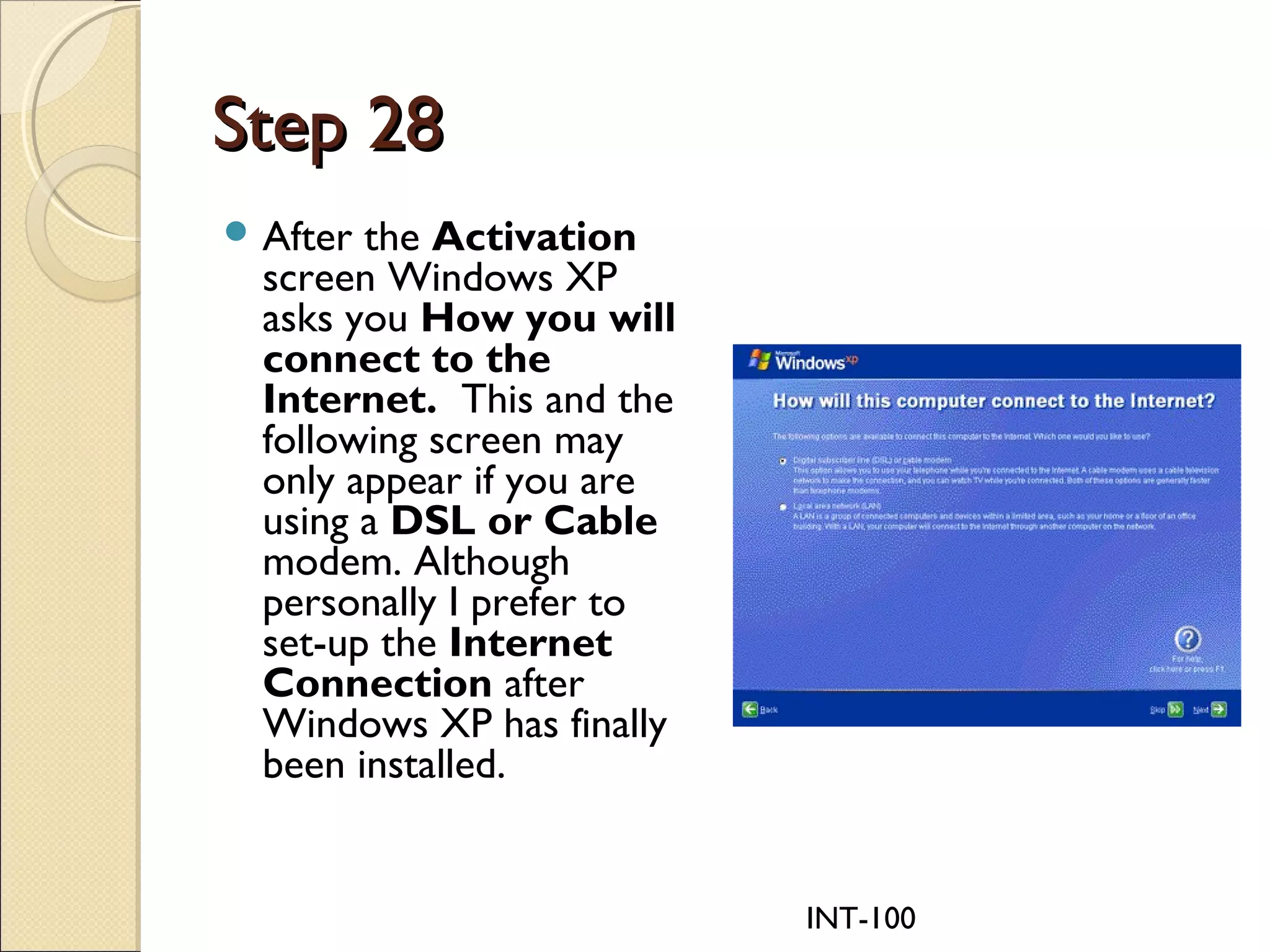
 After the Activation
screen Windows XP
asks you How you will
connect to the
Internet.  This and the
following screen may
only appear if you are
using a DSL or Cable
modem. Although
personally I prefer to
set-up the Internet
Connection after
Windows XP has finally
been installed.
INT-100
Step 29Step 29
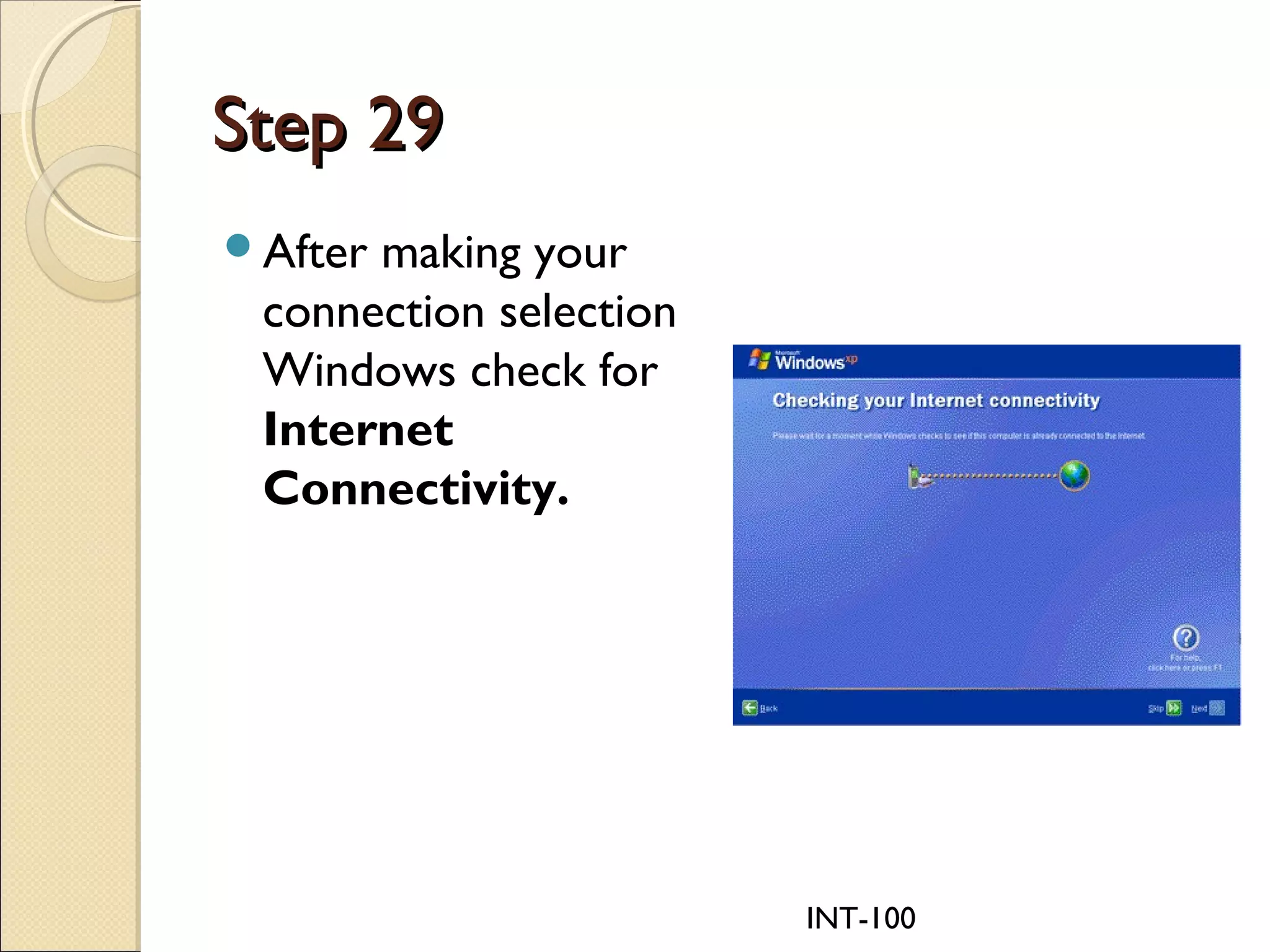
After making your
connection selection
Windows check for
Internet
Connectivity.
INT-100
Step 30Step 30
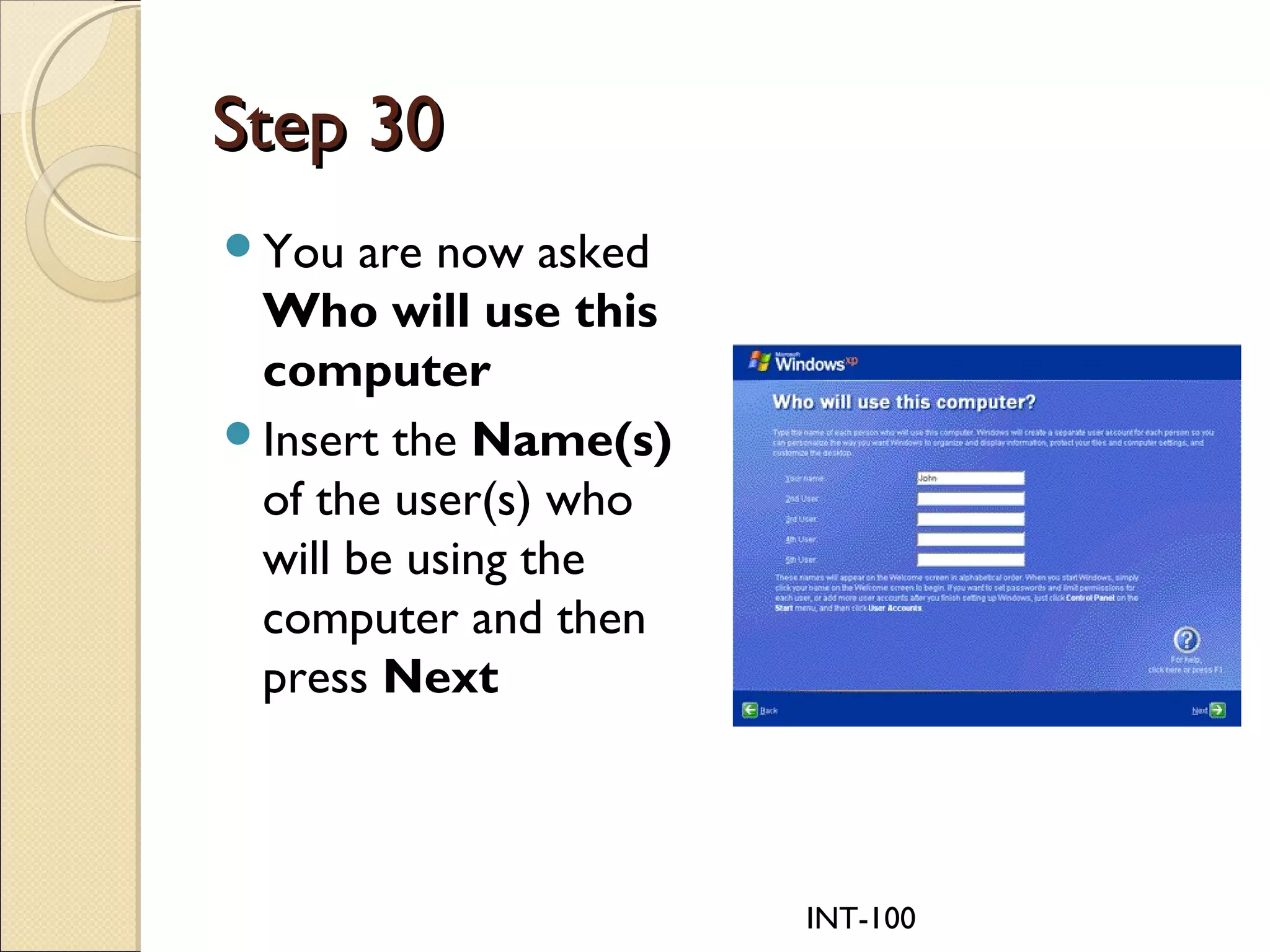
You are now asked
Who will use this
computer
Insert the Name(s)
of the user(s) who
will be using the
computer and then
press Next
INT-100
Step 31Step 31
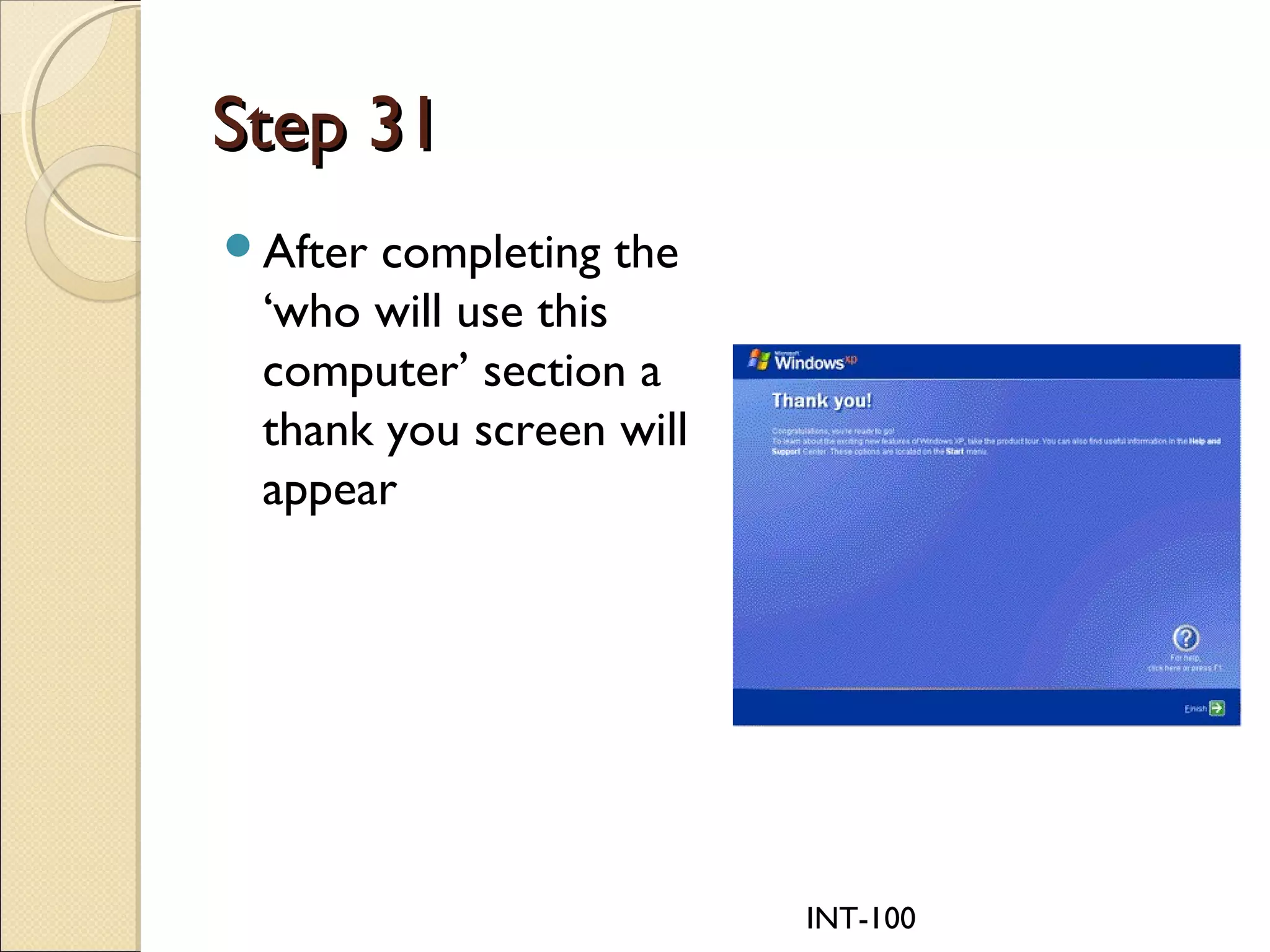
After completing the
‘who will use this
computer’ section a
thank you screen will
appear
INT-100
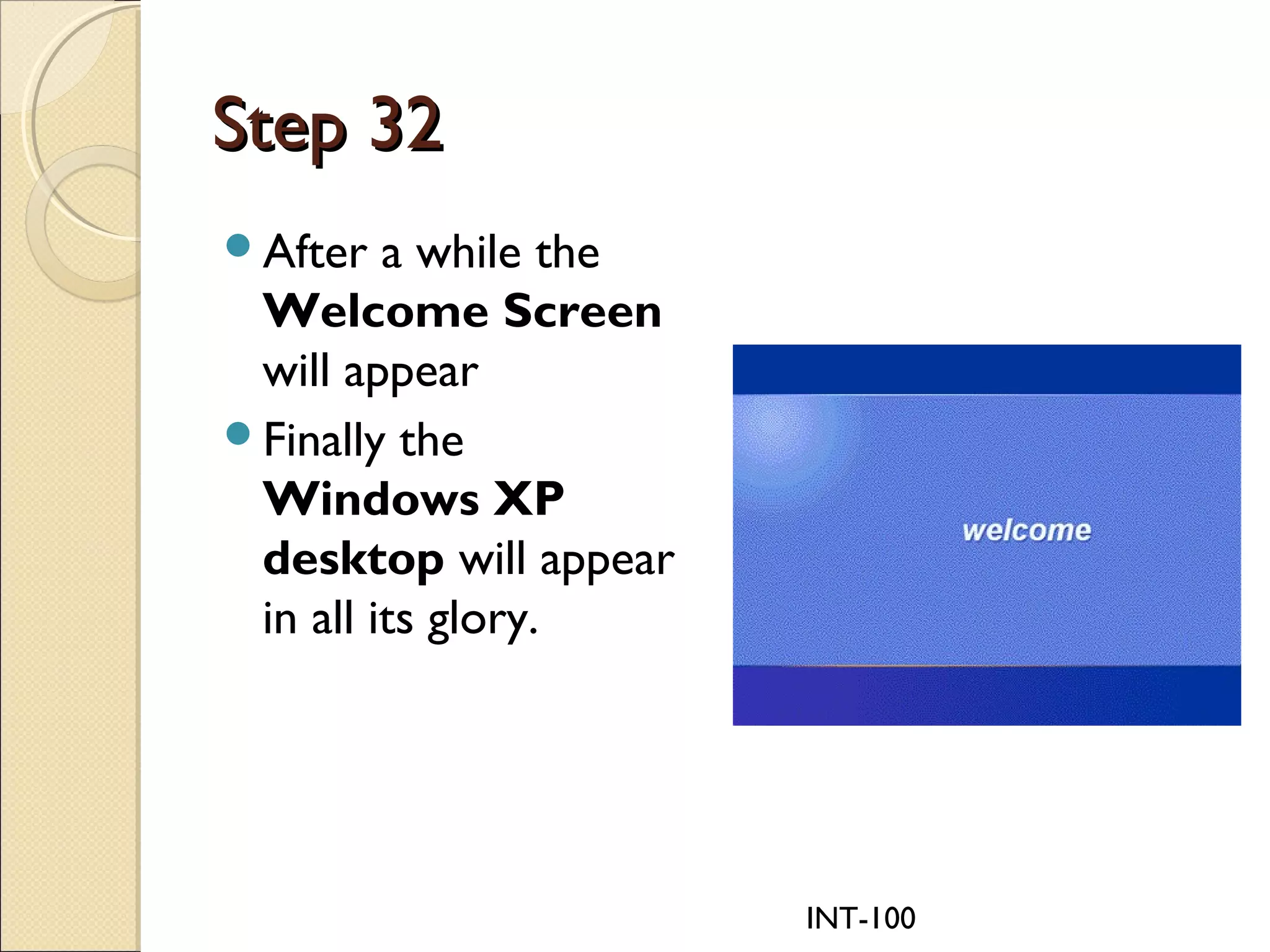
Step 32Step 32
After a while the
Welcome Screen
will appear
Finally the
Windows XP
desktop will appear
in all its glory.

12705 installing xp (2)

  • 1.
    INT-100 INSTALLING WINDOWS XPINSTALLINGWINDOWS XP  Installing/Re-installing Windows XP is a relatively straightforward process providing you have everything you need to hand.  To start, you need the following. Windows XP CD Windows XP CD Product Code Number Any relevant drivers - this is not always the case as XP does have many drivers. However, it may be necessary to update the driver that XP initially installs. Be particularly careful with Modem drivers.  Make sure that your PC can boot from your CD-ROM
  • 2.
    INT-100 Step 1Step 1 Boot up your pc. During the initial boot cycle insert the Windows XP CD into your CD-ROM  You will see on your screen 'Press any key to boot from CD‘  At this stage press either Enter or any other key  Set up will now automatically inspect your computer's hardware configuration
  • 3.
    INT-100 Step 2Step 2 After set up has checked your hardware a blue screen will appear with the words 'Windows set up' in the top left hand corner.  At this stage, should you have a RAID, SCSI or SATA drive, you will have the option of pressing F6 to install the third party drivers for this hardware. If you do not have any of this hardware installed on your pc there is no need to press F6. XP will now start loading files into memory.
  • 4.
    INT-100 Step 3Step 3 Afterall the files have been loaded into memory the Welcome To Set Up Window appears To begin installing XP Press Enter
  • 5.
    INT-100 Step 4Step 4 The next screen to appear is the EULA (End user Licence Agreement) Press F8 to accept the licence or ESC if you don't want to accept the licence agreement and want to terminate the install.  After agreeing to the licence agreement set up searches your hard drive for any partitions
  • 6.
    INT-100 Step 5Step 5 The next screen shows all the partitions on your hard drive. You may have just one or several depending upon whether you have created partitions prior to installing Windows XP  You can select the partition you want to install XP on.  Once you have selected the partition press Enter
  • 7.
    INT-100 Step 6Step 6 The next window will offer to format the partition for you. If the partition is already formatted the option will be 'leave file format as it is.' If it hasn't been previously formatted then you will have the option to either:  Format the partition using the NTFS file system (Quick)         Format the partition using the FAT file system (Quick)         Format the partition using the NTFS file system         Format the partition using the FAT files system  It is recommended that you use the NTFS file system so select 'Format the partition using the NTFS file system'
  • 8.
    INT-100 Step 7Step 7 Setup will now begin to format your hard drive
  • 9.
    INT-100 Step 8Step 8 Oncethe drive has been formatted windows set up will start copying files to memory
  • 10.
    INT-100 Step 9Step 9 Once the copying has been completed windows initialises your configuration and then proceeds to reboot your machine Your system will now reboot
  • 11.
    INT-100 Step 10Step 10 On reboot you will again be presented with 'Press any key to boot from CD' On this occasion DO NOT press any key. Leave well alone. Windows will then automatically launch. If you press any key during this process you will start the set up procedure all over again.  You will now see the Windows XP Graphical interface as windows loads  Note If your copy of XP does not include Service Pack 2 the Logo will look slightly different to the one illustrated below in as much as it will display Windows XP Home or Professional. As soon as you upgrade to Service Pack 2  (SP2) the Home/Professional branding will be removed.
  • 12.
    INT-100 Step 11Step 11 Atthe next screen Windows will begin copying files to your hard drive
  • 13.
    INT-100 Step 12Step 12 Asthe files are installed on your hard drive you will be asked to select various options. The first to launch is the Regional and Language Options window.
  • 14.
    INT-100 Step 13Step 13 Clickthe Customise button to select your Country standards, language, etc. Click OK when you are satisfied with your selections
  • 15.
    INT-100 Step 14Step 14 Afteryou have completed that return to the original Regional and language Options window and click the Details button From here you can set the default keyboard language. Click OK when finished Now click the Next button
  • 16.
    INT-100 Step 15Step 15 Thenext window asks for your name and company. Fill this in with the relevant details After completing the name and company dialogue boxes press Next
  • 17.
    INT-100 Step 16Step 16 Now you are presented with the Product code number screen  Insert your product code numbers in the relevant boxes. Take your time here, as inserting the wrong number, will cause an error.  After inserting the product code number press Next
  • 18.
    INT-100 Step 17Step 17 Your next screen is the Computer and Administrator password screen  XP usually inserts a computer name but you can change it if you want something different.  Next insert the Administrator password (you don't need to do this for XP Home Edition) and then confirm the password in the next dialogue box.  Click Next to continue
  • 19.
    INT-100 Step 18Step 18 Ifyou have a Dial Up Modem installed you will now be asked for the Country and area code information. Fill this in as necessary and press Next. Do Not worry if the Dial Up Modem screen doesn't appear during set-up. Personally I much prefer to set-up the Internet Connection after Windows XP has completed it's installation.
  • 20.
    INT-100 Step 19Step 19 TheDate and Time Setting windows now appears. Select your Time Zone from the drop down time zone list and XP will make the other adjustments Finally click the Next button
  • 21.
    INT-100 Step 20Step 20 Windowsnow starts to install the Networking part of the operating system Assuming you have a Networking Card installed the Networking Settings window will now pop up
  • 22.
    INT-100 Step 21Step 21 TheTypical Settings Option should already be selected so simply press the Next button
  • 23.
    INT-100 Step 22Step 22 Unless you are on a Network or Domain you simply need to press the Next button If you are on a Network then click the Yes make this computer a member of the following domain and then click the Next  button. You may need to ask your administrator for these details.  Windows will now continue copying files  After a while Windows will finalise the installation. The progress bar will show Completing Installation followed by Installing Start menu icons, registering Components, Saving Settings and, finally, Removing any temporary files used.
  • 24.
    INT-100 Step 23Step 23 After finalisation Windows will again restart your pc  On reboot you will again be presented with 'Press any key to boot from CD' On this occasion DO NOT press any key. Leave well alone. Windows will then automatically launch. If you press any key during this process you will start the set up procedure all over again  You will now see the Windows Logo screen
  • 25.
    INT-100 Step 24Step 24 OnceWindows has loaded it will adjust your monitors resolution. Just click OK to continue If you are happy with the resolution change press OK again
  • 26.
    INT-100 Step 25Step 25 Windowsnow needs to apply the computer settings so you need to be a little patience here The Welcome to Microsoft Windows screen now appears. By clicking the ‘?’ you can get help  Click the Next  button to continue
  • 27.
    INT-100 Step 26Step 26 Ifyou are using a copy of Windows XP with Service Pack 2 already integrated the next screen will ask you to enable the Windows Firewall.
  • 28.
    INT-100 Step 27Step 27 Thenext screen asks you to Activate your copy of Windows XP. You have 30 days in which to activate your copy of Windows so I always select the No option and then activate when I am satisfied everything is working correctly.
  • 29.
    INT-100 Step 28Step 28 After the Activation screen Windows XP asks you How you will connect to the Internet.  This and the following screen may only appear if you are using a DSL or Cable modem. Although personally I prefer to set-up the Internet Connection after Windows XP has finally been installed.
  • 30.
    INT-100 Step 29Step 29 Aftermaking your connection selection Windows check for Internet Connectivity.
  • 31.
    INT-100 Step 30Step 30 Youare now asked Who will use this computer Insert the Name(s) of the user(s) who will be using the computer and then press Next
  • 32.
    INT-100 Step 31Step 31 Aftercompleting the ‘who will use this computer’ section a thank you screen will appear
  • 33.
    INT-100 Step 32Step 32 Aftera while the Welcome Screen will appear Finally the Windows XP desktop will appear in all its glory.