How to Create Windows 10 Bootable
USB Drive from ISO
Windows 10 is available for Windows 7
and Windows 8.1 users as a free
available on USB drives. In case you
don’t have Windows 10 USB drive, this
tutorial will provide you step by step
instruction involved in creating your
own bootable USB drive of Windows
10.
Things you will require
• Windows 10 ISO Image. If you don’t have ISO
• Archiving tools like Winrar and 7-zip
• USB Flash Drive – the minimum size is 8GB for
64-bit version and 4GB for a 32-bit version.
You can expect good results if you use USB
3.0. It will take very less time in installing
Windows on your machine in comparison of
2.0 USB drives.
Keep in Mind
If you’re running licensed copy of Windows 7
and Windows 8.1. Try to upgrade to Windows 10
via Windows Update for first time to activate
free copy of Windows 10. If you performed
clean install of Windows 10 without upgrading,
the key which you will enter during the setup
will not activate your free copy of Windows 10.
Create Windows 10 Bootable USB
Drive from ISO using Command
Prompt
1. Connect your USB drive to computer or
laptop. Create backup of your data because
the process will erase all the data.
Note: Unplug any external hard disk if its
connected to your computer
2. Launch Command Prompt as Administrator.
For that, you can search for command prompt in
taskbar search box. Alternatively, launch WMIX
menu by making right-click on Start button and
select Command Prompt (Admin)
When UAC screen pop-up, click Yes to continue.
Note: You must launch the Command Prompt as
administrator to get rid of errors.
3. Connect your USB drive to computer or
laptop. Create backup of your data because
the process will erase all the data.
Note: Unplug any external hard disk if its
connected to your computer
4. In command prompt
type DISKPART and hit enter. It will
open the disk partitioning software.
5. After that type, LIST DISK and hit enter. It will
get you list of all the storage devices connected
to your computer or laptop
From the list, you need to find out the one
which you’re using. You can easily find by
checking the file size. In my case its Disk 2
6. Now you need to select the USB drive. For
that, you need to use Select Disk X command
and hit enter. For example, in my case, disk
number of my USB drive is 2. So command will
be Select Disk 2. In your case, it can be Select
Disk 1.
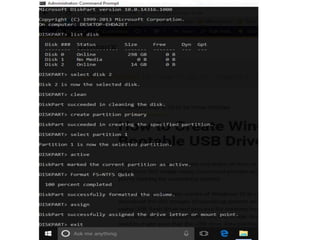
• After that, you need to execute the following
command back to back:
• CLEAN
(press enter key)
• CREATE PARTITION PRIMARY
(press enter key)
• SELECT PARTITION 1
(press enter key)
• ACTIVE
(press enter key)
• FORMAT FS=NTFS QUICK
If you computer or laptop support UEFI,
format your USB drive using FORMAT
FS=FAT32
• (press enter key)
• ASSIGN
(press enter key)
• EXIT
(press enter key)
At this point, the command prompt
part is done. Now you need to
extract all the files of Windows 10
ISO image.
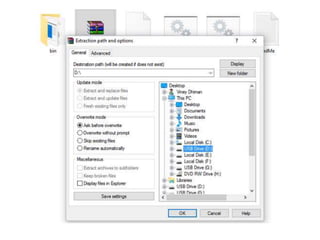
7. Now you need to extract all the
files of Windows 10 ISO image. For
that head over to the folder where
you placed the ISO image. Extract
all the files using any archiving tool
into USB drive. It will take 5-10
minutes.
In case, your archiving tool won’t
provide you option to directly
extract files into the USB drive. You
can extract the files separately and
then copy and paste into USB
drive.
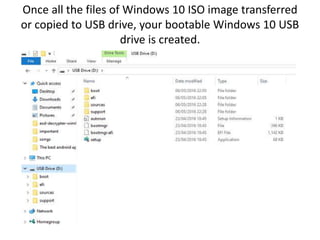
Once all the files of Windows 10 ISO image transferred
or copied to USB drive, your bootable Windows 10 USB
drive is created.
Try out this easy to follow tutorial on how
to create Windows 10 bootable USB drive
from ISO using Command prompt. Let us
know in the comment if you face any issue.

How to create windows 10 bootable usb drive from iso using Command Prompt

  • 1.
    How to CreateWindows 10 Bootable USB Drive from ISO
  • 2.
    Windows 10 isavailable for Windows 7 and Windows 8.1 users as a free available on USB drives. In case you don’t have Windows 10 USB drive, this tutorial will provide you step by step instruction involved in creating your own bootable USB drive of Windows 10.
  • 3.
    Things you willrequire • Windows 10 ISO Image. If you don’t have ISO • Archiving tools like Winrar and 7-zip • USB Flash Drive – the minimum size is 8GB for 64-bit version and 4GB for a 32-bit version. You can expect good results if you use USB 3.0. It will take very less time in installing Windows on your machine in comparison of 2.0 USB drives.
  • 4.
    Keep in Mind Ifyou’re running licensed copy of Windows 7 and Windows 8.1. Try to upgrade to Windows 10 via Windows Update for first time to activate free copy of Windows 10. If you performed clean install of Windows 10 without upgrading, the key which you will enter during the setup will not activate your free copy of Windows 10.
  • 5.
    Create Windows 10Bootable USB Drive from ISO using Command Prompt
  • 6.
    1. Connect yourUSB drive to computer or laptop. Create backup of your data because the process will erase all the data. Note: Unplug any external hard disk if its connected to your computer
  • 7.
    2. Launch CommandPrompt as Administrator. For that, you can search for command prompt in taskbar search box. Alternatively, launch WMIX menu by making right-click on Start button and select Command Prompt (Admin) When UAC screen pop-up, click Yes to continue. Note: You must launch the Command Prompt as administrator to get rid of errors.
  • 8.
    3. Connect yourUSB drive to computer or laptop. Create backup of your data because the process will erase all the data. Note: Unplug any external hard disk if its connected to your computer
  • 9.
    4. In commandprompt type DISKPART and hit enter. It will open the disk partitioning software.
  • 11.
    5. After thattype, LIST DISK and hit enter. It will get you list of all the storage devices connected to your computer or laptop From the list, you need to find out the one which you’re using. You can easily find by checking the file size. In my case its Disk 2
  • 12.
    6. Now youneed to select the USB drive. For that, you need to use Select Disk X command and hit enter. For example, in my case, disk number of my USB drive is 2. So command will be Select Disk 2. In your case, it can be Select Disk 1.
  • 13.
    • After that,you need to execute the following command back to back: • CLEAN (press enter key) • CREATE PARTITION PRIMARY (press enter key) • SELECT PARTITION 1 (press enter key) • ACTIVE (press enter key)
  • 14.
    • FORMAT FS=NTFSQUICK If you computer or laptop support UEFI, format your USB drive using FORMAT FS=FAT32 • (press enter key) • ASSIGN (press enter key) • EXIT (press enter key)
  • 15.
    At this point,the command prompt part is done. Now you need to extract all the files of Windows 10 ISO image.
  • 16.
    7. Now youneed to extract all the files of Windows 10 ISO image. For that head over to the folder where you placed the ISO image. Extract all the files using any archiving tool into USB drive. It will take 5-10 minutes.
  • 18.
    In case, yourarchiving tool won’t provide you option to directly extract files into the USB drive. You can extract the files separately and then copy and paste into USB drive.
  • 19.
    Once all thefiles of Windows 10 ISO image transferred or copied to USB drive, your bootable Windows 10 USB drive is created.
  • 20.
    Try out thiseasy to follow tutorial on how to create Windows 10 bootable USB drive from ISO using Command prompt. Let us know in the comment if you face any issue.