
FUNCTIONS OF MANAGEMENT
NATURE AND SCOPE
Features of Management Process
Management process is characterized by the
following features:
• Social Process
• Continuous Process
• Universal
• Interrelated
• Composite
Social Process
The entire management process is
regarded as a social process as the
success of all organizational efforts
depends upon the willing co-operation
of people
Continuous Process
The process of management is on going
and continuous. Managers continuously
take up one or the other function.
Management cycle is repeated over and
over again.
Universal
• Management functions are universal
in the sense that a manager has to
perform them irrespective of the size
and nature of the organization. Each
manger performs the same functions
regardless of his rank or position in the
organization.
Interrelated
Managerial functions are contained
within each other. The performance of
the next function does not start only
when the earlier function is finished.
Various functions are taken together.
Composite
All Managerial functions are composite
and integrated. There cannot be any
sequence which can be strictly followed
for performing various functions. The
sequential concept may be true in a
newly started business where functions
may follow a particular sequence but
the same will not apply to a going
concern.
CLASSIFICATION OF MANAGEMENT FUNCTIONS
Henry Fayol, the pioneer of
management process approach gave
• Planning
• Organizing
• Commanding
• Co-coordinating and
• Controlling as functions of
management.
Luther Gullick used the word POSDCORB to describe
functions such as
Planning (P)
Organizing (O),
Staffing (S),
Directing (D) ,
Controlling (CO),
Reporting (R) and
Budgeting (B),
Koontz and O Donnel adopted
managerial functions as planning, organizing,
staffing, directing and controlling.
Earnest dale has included innovation and
representation to the earlier mentioned functions
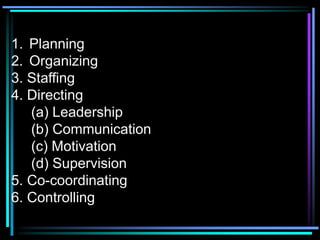
1. Planning
2. Organizing
3. Staffing
4. Directing
(a) Leadership
(b) Communication
(c) Motivation
(d) Supervision
5. Co-coordinating
6. Controlling
PLANNING
Planning is a basic managerial function,.
Planning helps in defining the course of
action to be followed for achieving various
organizational objectives. It is a decision in
advance, what to do, when to do, how to do
and who will do a particular task. Planning is
a process which involves thinking before
doing.
According to Terry, “Planning is the
selecting and relating of facts and the
making and using assumptions regarding
the future in the visualization and
formulation of proposed activities
believed necessary to achieve desired
results.
Planning is a process of looking ahead.
The primary object of planning is to
achieve better results. It involves the
selection of organizational objectives and
developing polices procedures,
programmes, budgets and strategies.
Planning is a continuous process that
takes place at all levels of management.
The process of planning involves
• Gathering Information
• Laying down objectives
• Developing Planning premises
• Examining alternative courses of action
• Evaluation of action patterns
• Reviewing limitations
• Implementation of planning
ORGANIZING
The function of organizing is to
1. arrange,
2. Guide,
3. coordinating,
4. direct and
5. control
the activities of other factors of
production, Viz, men, material, money and
machines so as to accomplish the objectives of
the enterprise,.
Louis A. Allen describes organization
as the process of identifying and
grouping work to be performed,
defining and delegating responsibility
and authority and establishing
relationships for the purpose of
enabling people to work most
effectively together in accomplishing
objectives
PROCESS OF ORGANIZATION INVOLVES
• To identifying the work to be
performed
• To classify or group the work
• To assign these groups of activities or
work to individuals
• To delegate authority and fix
responsibility
• To Co-ordinate these authority-
responsibility relationships of various
activities.
Though they are many types of organizations but
generally three types of organizations are in
vogue:
1.Line Organization
2.Functional Organization and
3.Line and staff organization.
STAFFING
The function involves manning the positions
created by organization process. It is
concerned with human resources of an
organization.
In the words of Koontz and O Donnel,
Staffing is filling, keeping filled positions in
the organization structure through defining
work-force requirements, appraising,
selecting compensating training
STAFFING CONSISTING OF:
• Manpower planning i.e.., assessing
manpower requirements in terms of
quantity and quality
• Recruitment, selection and training
• Placement of man power
• Development, promotion, transfer and
appraisal
• Determination of employee
remuneration.
DIRECTING
Directing is concerned with carrying out
the desired plans. It initiates organized
and planned action and ensures
effective performance by subordinates
towards the accomplishment of group
activities. Direction is called
management in action. In other words
of George R. Terry, Direction is moving
to action and supplying simulative
power to the group after planning.
MAIN ACTIVITES INVOLVED IN
DIRECTING:
• Leadership
• Communication
• Motivation and
• Supervision
LEADERSHIP
A manager has to issue orders and
instructions and guide and counsel his
subordinated in their work with a view to
improve their perform mace and achieve
enterprise objectives.
Leadership is the ability to build up
confidence and zeal among people and to
create an urge in them, to be led. To be
successful leader, a manager must possess
the qualities of foresight, drive initiative,
self confidence and personal integrity.
COMMUNICATION
Communication constitutes a very important function of
management. It is said to be the number one problem of
management today. It is an established fact that managers
spend 75 to 90 per cent of their working time in
communicating with others
Thus, communicating means sharing of ideas in common.
The essence of communicating is getting the receiver and
they sender turned together for a particular message. It
refers to the exchange of ideas feelings, emotions and
knowledge and information between two or more persons.
Nothing happens in management till communication takes
place.
MOTIVATION
The term motivation is derived from the word’
motive’ which means a need, or an emotion
that prompts an individual into action
motivation is the psychological process of
creating urge on the subordinates to do
certain things or behave in the desire manner.
It is a very important function of
management. The importance of motivation
can be realized from the fact that
performance of a worker depends upon his
ability and the motivation.
SUPERVISION
Supervision refers to the job of overseeing
subordinates at work
to ensure maximum utilization of
resources to get the required and
directed work done and
to correct the subordinates whenever
they go wrong.
CO-ORDINATION
Coordination - is one of the most
important functions of management.
- It is essential to
channelize the activities of various
individuals in the organization for the
achievement of common goals.
Coordination creates a team spirit
and helps in achieving goals through
collective efforts.
- It is the orderly arrangement of
group effort to provide unity of action
in the pursuit of common objectives.
CO-ORDINATION AND CO-OPERATION
Co-ordination is much wider term then
co-operation.
Co-operation indicates the willingness of
individuals to help each other.
- It is and attitude of a group of
people and is largely the result of
voluntary action.
Co-ordination, on the other hand is a
conscious managerial effort which is the
result of a deliberate action.
CONTROLLING
Controlling can be defined as “determining
what is being accomplished that is
evaluating the performance, if necessary,
applying corrective measures so that the
performances take place according to plans.
Control is essential for achieving objectives of
an enterprise. The planning of various activities
does not ensure automatic implementation of
policies.
Control is the process which enables
management to get its policies implemented
and take corrective actions if performance is
not according to the pre-determined standards.
1 a. functions of management

1 a. functions of management

  • 1.
  • 2.
    Features of ManagementProcess Management process is characterized by the following features: • Social Process • Continuous Process • Universal • Interrelated • Composite
  • 3.
    Social Process The entiremanagement process is regarded as a social process as the success of all organizational efforts depends upon the willing co-operation of people
  • 4.
    Continuous Process The processof management is on going and continuous. Managers continuously take up one or the other function. Management cycle is repeated over and over again.
  • 5.
    Universal • Management functionsare universal in the sense that a manager has to perform them irrespective of the size and nature of the organization. Each manger performs the same functions regardless of his rank or position in the organization.
  • 6.
    Interrelated Managerial functions arecontained within each other. The performance of the next function does not start only when the earlier function is finished. Various functions are taken together.
  • 7.
    Composite All Managerial functionsare composite and integrated. There cannot be any sequence which can be strictly followed for performing various functions. The sequential concept may be true in a newly started business where functions may follow a particular sequence but the same will not apply to a going concern.
  • 8.
    CLASSIFICATION OF MANAGEMENTFUNCTIONS Henry Fayol, the pioneer of management process approach gave • Planning • Organizing • Commanding • Co-coordinating and • Controlling as functions of management.
  • 9.
    Luther Gullick usedthe word POSDCORB to describe functions such as Planning (P) Organizing (O), Staffing (S), Directing (D) , Controlling (CO), Reporting (R) and Budgeting (B), Koontz and O Donnel adopted managerial functions as planning, organizing, staffing, directing and controlling. Earnest dale has included innovation and representation to the earlier mentioned functions
  • 10.
    1. Planning 2. Organizing 3.Staffing 4. Directing (a) Leadership (b) Communication (c) Motivation (d) Supervision 5. Co-coordinating 6. Controlling
  • 11.
    PLANNING Planning is abasic managerial function,. Planning helps in defining the course of action to be followed for achieving various organizational objectives. It is a decision in advance, what to do, when to do, how to do and who will do a particular task. Planning is a process which involves thinking before doing.
  • 12.
    According to Terry,“Planning is the selecting and relating of facts and the making and using assumptions regarding the future in the visualization and formulation of proposed activities believed necessary to achieve desired results.
  • 13.
    Planning is aprocess of looking ahead. The primary object of planning is to achieve better results. It involves the selection of organizational objectives and developing polices procedures, programmes, budgets and strategies. Planning is a continuous process that takes place at all levels of management.
  • 14.
    The process ofplanning involves • Gathering Information • Laying down objectives • Developing Planning premises • Examining alternative courses of action • Evaluation of action patterns • Reviewing limitations • Implementation of planning
  • 15.
    ORGANIZING The function oforganizing is to 1. arrange, 2. Guide, 3. coordinating, 4. direct and 5. control the activities of other factors of production, Viz, men, material, money and machines so as to accomplish the objectives of the enterprise,.
  • 16.
    Louis A. Allendescribes organization as the process of identifying and grouping work to be performed, defining and delegating responsibility and authority and establishing relationships for the purpose of enabling people to work most effectively together in accomplishing objectives
  • 17.
    PROCESS OF ORGANIZATIONINVOLVES • To identifying the work to be performed • To classify or group the work • To assign these groups of activities or work to individuals • To delegate authority and fix responsibility • To Co-ordinate these authority- responsibility relationships of various activities.
  • 18.
    Though they aremany types of organizations but generally three types of organizations are in vogue: 1.Line Organization 2.Functional Organization and 3.Line and staff organization.
  • 19.
    STAFFING The function involvesmanning the positions created by organization process. It is concerned with human resources of an organization. In the words of Koontz and O Donnel, Staffing is filling, keeping filled positions in the organization structure through defining work-force requirements, appraising, selecting compensating training
  • 20.
    STAFFING CONSISTING OF: •Manpower planning i.e.., assessing manpower requirements in terms of quantity and quality • Recruitment, selection and training • Placement of man power • Development, promotion, transfer and appraisal • Determination of employee remuneration.
  • 21.
    DIRECTING Directing is concernedwith carrying out the desired plans. It initiates organized and planned action and ensures effective performance by subordinates towards the accomplishment of group activities. Direction is called management in action. In other words of George R. Terry, Direction is moving to action and supplying simulative power to the group after planning.
  • 22.
    MAIN ACTIVITES INVOLVEDIN DIRECTING: • Leadership • Communication • Motivation and • Supervision
  • 23.
    LEADERSHIP A manager hasto issue orders and instructions and guide and counsel his subordinated in their work with a view to improve their perform mace and achieve enterprise objectives. Leadership is the ability to build up confidence and zeal among people and to create an urge in them, to be led. To be successful leader, a manager must possess the qualities of foresight, drive initiative, self confidence and personal integrity.
  • 24.
    COMMUNICATION Communication constitutes avery important function of management. It is said to be the number one problem of management today. It is an established fact that managers spend 75 to 90 per cent of their working time in communicating with others Thus, communicating means sharing of ideas in common. The essence of communicating is getting the receiver and they sender turned together for a particular message. It refers to the exchange of ideas feelings, emotions and knowledge and information between two or more persons. Nothing happens in management till communication takes place.
  • 25.
    MOTIVATION The term motivationis derived from the word’ motive’ which means a need, or an emotion that prompts an individual into action motivation is the psychological process of creating urge on the subordinates to do certain things or behave in the desire manner. It is a very important function of management. The importance of motivation can be realized from the fact that performance of a worker depends upon his ability and the motivation.
  • 26.
    SUPERVISION Supervision refers tothe job of overseeing subordinates at work to ensure maximum utilization of resources to get the required and directed work done and to correct the subordinates whenever they go wrong.
  • 27.
    CO-ORDINATION Coordination - isone of the most important functions of management. - It is essential to channelize the activities of various individuals in the organization for the achievement of common goals.
  • 28.
    Coordination creates ateam spirit and helps in achieving goals through collective efforts. - It is the orderly arrangement of group effort to provide unity of action in the pursuit of common objectives.
  • 29.
    CO-ORDINATION AND CO-OPERATION Co-ordinationis much wider term then co-operation. Co-operation indicates the willingness of individuals to help each other. - It is and attitude of a group of people and is largely the result of voluntary action. Co-ordination, on the other hand is a conscious managerial effort which is the result of a deliberate action.
  • 30.
    CONTROLLING Controlling can bedefined as “determining what is being accomplished that is evaluating the performance, if necessary, applying corrective measures so that the performances take place according to plans. Control is essential for achieving objectives of an enterprise. The planning of various activities does not ensure automatic implementation of policies. Control is the process which enables management to get its policies implemented and take corrective actions if performance is not according to the pre-determined standards.

Editor's Notes

  • #16  Every business enterprises needs the services of a number of persons to look after its different aspects. The management sets up the objectives or goals to be achieved by its personnel. The energy of every individual is channelized to achieve the enterprise objectives.
  • #27  Supervision is another element of directing function of management. After issuing instructions, the manager or the supervisor of management has to see that all given instructions are carried out. This is the aim of supervision.
  • #28 Every department or section is given a target to be achieved and they should concentrate only on their work and should not bother about the work of other organs.