Human Resources
Administration in Education
Compensation
Variables Affecting Compensation
Performance
“The evaluation of performance is
concerned with a basic question:
‘Did you get the job done?’ ”
Variables Affecting Compensation
Continued
• Effort
• Merit Pay
• A merit pay system will be ineffective unless it has the
following components:
1.Effective teacher evaluation procedures.
2.Training programs for management and supervisory
personnel who will implement the plan.
3.School board and management commitment to the plan
in time and resources.
4.Staff involvement in developing the program.
Variables Affecting Compensation
Continued
• Merit Pay cont.
1. Teacher acceptance and satisfaction
2. Adequate financing
3. Merit pay for all who meet the criteria
4. Plausible, fair, and equitable performance criteria
5. Valid and verifiable measures of results
6. Objectivity and consistency in applying assessment
measures
7. Increased student learning promoted
Variables Affecting Compensation
Continued
• Seniority
• Skills
• Job Requirements
Types of Compensation
• Intrinsic
– Participation in Policy Making
– Discretion
– Responsibility
– Professional Development
Types of Compensation
Continued
• Extrinsic and Direct
– Salary
– Merit Pay
– Overtime and Sick Leave
Types of Compensation
Continued
• Extrinsic and Indirect
– Holiday and Vacation Leave
– Services
– Insurance Programs
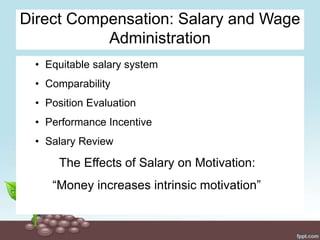
Direct Compensation: Salary and Wage
Administration
• Equitable salary system
• Comparability
• Position Evaluation
• Performance Incentive
• Salary Review
The Effects of Salary on Motivation:
“Money increases intrinsic motivation”
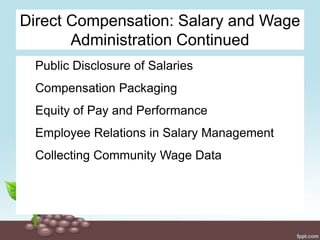
Direct Compensation: Salary and Wage
Administration Continued
Public Disclosure of Salaries
Compensation Packaging
Equity of Pay and Performance
Employee Relations in Salary Management
Collecting Community Wage Data
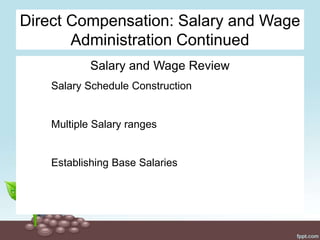
Direct Compensation: Salary and Wage
Administration Continued
Salary and Wage Review
Salary Schedule Construction
Multiple Salary ranges
Establishing Base Salaries
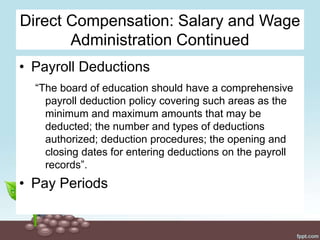
Direct Compensation: Salary and Wage
Administration Continued
• Payroll Deductions
“The board of education should have a comprehensive
payroll deduction policy covering such areas as the
minimum and maximum amounts that may be
deducted; the number and types of deductions
authorized; deduction procedures; the opening and
closing dates for entering deductions on the payroll
records”.
• Pay Periods
Direct Compensation: Salary and Wage
Administration Continued
Principles for Presenting Recommendations to the
School Board
The Fiscal Condition of the School District
The Administrative Organization of the School District
Employee Unions and Associations
Salary Recommendation Procedures
Direct Compensation: Salary and Wage
Administration Continued
Small Business Job Protection Act of
1996:
• Commonly referred to as “Minimum Wage
Law”
• Budgets must be adjusted to compensate
for the required increase in wages.
Indirect Compensation: Fringe Benefits
Administration
Types of Fringe Benefits
Benefits Required by Law: social security premiums, state
retirement insurance, unemployment compensation, and
workers’ compensation
Voluntary Fringe Benefits: insurance programs, time away
from job, and services
Managed Health Care: school districts must employ case
management specialist or contract with a company
specializing in third party health care administration
Indirect Compensation: Fringe Benefits
Administration Continued
Health Insurance Portability Act of 1996
“The law addresses the needs of approximately 25
million Americans who are denied health
insurance coverage because of an illness or who
cannot change jobs because they, their spouse, or
their dependents would be denied insurance
coverage because of a preexisting medical
condition such as diabetes.”
Medical Savings Accounts: employees choose the
physician, hospitals, and treatments. Major
illnesses are paid by the districts’ insurance while
money withdrawn from MSA pays for minor costs.
Indirect Compensation: Fringe Benefits
Administration Continued
Procuring Health Care and Related
Insurance
The Insurance Agent and Broker: While the
broker is not under contract to any specific
agency, the agent acts on behalf of the
company
Selecting Insurance Companies: It is essential to
check their performance and financial solvency
with well-established rating firms
Indirect Compensation: Fringe Benefits
Administration Continued
Health Risks in the Workplace
Three categories of health risks for school
employees:
1. Facility environmental risks
2. Violence
3. Risk of contracting infectious disease
Indirect Compensation: Fringe Benefits
Administration Continued
Crisis Event Management
• Crisis occur because of a variety of situations:
• Accidents
• Misconduct
• Natural disasters
• Technology malevolence
• Violence

21. compensation and wages

  • 1.
    Human Resources Administration inEducation Compensation
  • 2.
    Variables Affecting Compensation Performance “Theevaluation of performance is concerned with a basic question: ‘Did you get the job done?’ ”
  • 3.
    Variables Affecting Compensation Continued •Effort • Merit Pay • A merit pay system will be ineffective unless it has the following components: 1.Effective teacher evaluation procedures. 2.Training programs for management and supervisory personnel who will implement the plan. 3.School board and management commitment to the plan in time and resources. 4.Staff involvement in developing the program.
  • 4.
    Variables Affecting Compensation Continued •Merit Pay cont. 1. Teacher acceptance and satisfaction 2. Adequate financing 3. Merit pay for all who meet the criteria 4. Plausible, fair, and equitable performance criteria 5. Valid and verifiable measures of results 6. Objectivity and consistency in applying assessment measures 7. Increased student learning promoted
  • 5.
    Variables Affecting Compensation Continued •Seniority • Skills • Job Requirements
  • 6.
    Types of Compensation •Intrinsic – Participation in Policy Making – Discretion – Responsibility – Professional Development
  • 7.
    Types of Compensation Continued •Extrinsic and Direct – Salary – Merit Pay – Overtime and Sick Leave
  • 8.
    Types of Compensation Continued •Extrinsic and Indirect – Holiday and Vacation Leave – Services – Insurance Programs
  • 9.
    Direct Compensation: Salaryand Wage Administration • Equitable salary system • Comparability • Position Evaluation • Performance Incentive • Salary Review The Effects of Salary on Motivation: “Money increases intrinsic motivation”
  • 10.
    Direct Compensation: Salaryand Wage Administration Continued Public Disclosure of Salaries Compensation Packaging Equity of Pay and Performance Employee Relations in Salary Management Collecting Community Wage Data
  • 11.
    Direct Compensation: Salaryand Wage Administration Continued Salary and Wage Review Salary Schedule Construction Multiple Salary ranges Establishing Base Salaries
  • 12.
    Direct Compensation: Salaryand Wage Administration Continued • Payroll Deductions “The board of education should have a comprehensive payroll deduction policy covering such areas as the minimum and maximum amounts that may be deducted; the number and types of deductions authorized; deduction procedures; the opening and closing dates for entering deductions on the payroll records”. • Pay Periods
  • 13.
    Direct Compensation: Salaryand Wage Administration Continued Principles for Presenting Recommendations to the School Board The Fiscal Condition of the School District The Administrative Organization of the School District Employee Unions and Associations Salary Recommendation Procedures
  • 14.
    Direct Compensation: Salaryand Wage Administration Continued Small Business Job Protection Act of 1996: • Commonly referred to as “Minimum Wage Law” • Budgets must be adjusted to compensate for the required increase in wages.
  • 15.
    Indirect Compensation: FringeBenefits Administration Types of Fringe Benefits Benefits Required by Law: social security premiums, state retirement insurance, unemployment compensation, and workers’ compensation Voluntary Fringe Benefits: insurance programs, time away from job, and services Managed Health Care: school districts must employ case management specialist or contract with a company specializing in third party health care administration
  • 16.
    Indirect Compensation: FringeBenefits Administration Continued Health Insurance Portability Act of 1996 “The law addresses the needs of approximately 25 million Americans who are denied health insurance coverage because of an illness or who cannot change jobs because they, their spouse, or their dependents would be denied insurance coverage because of a preexisting medical condition such as diabetes.” Medical Savings Accounts: employees choose the physician, hospitals, and treatments. Major illnesses are paid by the districts’ insurance while money withdrawn from MSA pays for minor costs.
  • 17.
    Indirect Compensation: FringeBenefits Administration Continued Procuring Health Care and Related Insurance The Insurance Agent and Broker: While the broker is not under contract to any specific agency, the agent acts on behalf of the company Selecting Insurance Companies: It is essential to check their performance and financial solvency with well-established rating firms
  • 18.
    Indirect Compensation: FringeBenefits Administration Continued Health Risks in the Workplace Three categories of health risks for school employees: 1. Facility environmental risks 2. Violence 3. Risk of contracting infectious disease
  • 19.
    Indirect Compensation: FringeBenefits Administration Continued Crisis Event Management • Crisis occur because of a variety of situations: • Accidents • Misconduct • Natural disasters • Technology malevolence • Violence