1
Industrial robots
Outlines :
● Manipulator components
● Robot control systems
● End Effectors
● Industrial robot applications
● Robot programming language
2
Industrial Robot Defined
A general-purpose, programmable machine
possessing certain anthropomorphic characteristics

Hazardous work environments

Repetitive work cycle

Consistency and accuracy

Difficult handling task for humans

Multishift operations

Re-programmable, flexible

Interfaced to other computer systems
3
Manipulator components
 Manipulator consists of joints
and links
 Joints provide relative motion
 Links are rigid members between
joints
 Various joint types: linear and rotary
 Each joint provides a “degree-of-
freedom”
 Most robots possess five or six
degrees-of-freedom
 Robot manipulator consists of
two sections:
 Body-and-arm – for positioning of
objects in the robot's work volume
 Wrist assembly – for orientation of
objects
Base
Link0
Joint1
Link2
Link3Joint3
End of Arm
Link1
Joint2
4
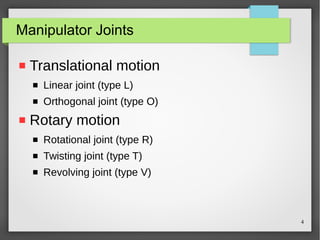
Manipulator Joints
 Translational motion
 Linear joint (type L)
 Orthogonal joint (type O)
 Rotary motion
 Rotational joint (type R)
 Twisting joint (type T)
 Revolving joint (type V)
5
Polar Coordinate Body-and-Arm Assembly
 Notation scheme (TRL):
6
Cylindrical Body-and-Arm Assembly
 Notation scheme (TLO) :
7
Cartesian Coordinate
Body-and-Arm Assembly
 Notation scheme (LOO):
8
Jointed-Arm Robot
 Notation scheme (TRR) :
9
SCARA Robot
 Notation scheme (VRO):
 Stands for Selectivity
Compliant Assembly
Robot Arm
10
11
Wrist Configurations
 Wrist assembly is attached to end-of-arm
 End effector is attached to wrist assembly
 Function of wrist assembly is to orient end effector
 Body-and-arm determines global position of end effector
 Two or three degrees of freedom:
 Roll
 Pitch
 Yaw
 Notation : (RRT)
12
Grippers and Tools
13
Joint Drive Systems
 Electric
 Uses electric motors to actuate individual joints
 Preferred drive system in today's robots
 Hydraulic
 Uses hydraulic pistons and rotary vane actuators
Noted for their high power and lift capacity
 Pneumatic
 Typically limited to smaller robots and simple
material transfer applications
14
Industrial Robot Control System
 Limited sequence control
 Playback with point-to-point control
 Playback with continuous path control
 Intelligent control
15
Industrial Robot Control System
 Limited sequence control
 pick-and-place operations using
mechanical stops to set positions.
 These robots do not require any sort of
programming, and just uses the
manipulator to perform the operation.
 every joint can only travel to the
intense limits .
16
Industrial Robot Control System
 Playback Robots with Point to Point Control
 They can be programmed (taught) to move from a point
within the work envelope to another point within the
work envelope.
 Application: machine loading and unloading
applications as well as more-complex applications, such
as spot welding and assembly .
17
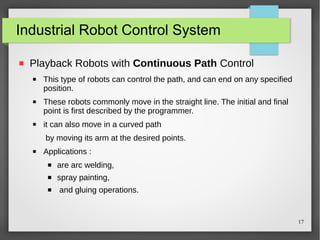
Industrial Robot Control System
 Playback Robots with Continuous Path Control
 This type of robots can control the path, and can end on any specified
position.
 These robots commonly move in the straight line. The initial and final
point is first described by the programmer.
 it can also move in a curved path
by moving its arm at the desired points.
 Applications :
 are arc welding,
 spray painting,
 and gluing operations.
18
Industrial Robot Control System
 Intelligent control
 The intelligent control robot is capable of
performing some of the functions and
tasks carried out by human beings.
 It can detect changes in the work
environment by means of sensory
perception.
 It is equipped with a variety of sensors
providing visual (computer vision) and
tactile (touching) capabilities to respond
instantly to variable situations.
19
Industrial Robot Applications
 Material handling applications
 Material transfer – pick-and-place, palletizing
 Machine loading and/or unloading
 Processing operations
 Welding
 Spray coating
 Cutting and grinding
 Assembly and inspection
20
Robotic Arc-Welding Cell
 Robot performs flux-
cored arc welding
(FCAW) operation at one
workstation while fitter
changes parts at the
other workstation
21
Robot programming
 Type of Robot Programming
 Joint level programming
 basic actions are positions (and possibly movements)
 joint angles in the case of rotational joints .
 linear positions in the case of linear or prismatic joints.
 Robot-level programming
 the basic actions are positions and orientations (and perhaps trajectories) of Pe and
the frame of reference attached to it.
 High-level programming
 Object-level programming
 Task-level programming
22
Robot programming methods
 Typically performed using one of the following
 On line
 teach pendant
 lead through programming
 Off line
 robot programming languages
 task level programming
23
Robot programming methods
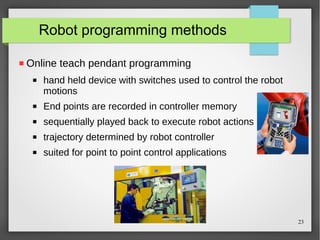
 Online teach pendant programming
 hand held device with switches used to control the robot
motions
 End points are recorded in controller memory
 sequentially played back to execute robot actions
 trajectory determined by robot controller
 suited for point to point control applications
24
Robot programming methods
 Lead Through Programming
 lead the robot physically through the required sequence
of motions
 trajectory and endpoints are recorded, using a sampling
routine which records points at 60-80 times a second
 when played back results in a smooth continuous
motion
 large memory requirements
25
Robot programming methods
 On-Line/Teach Box
 Advantage:
 Easy
 No special programming skills or training
 Can specify other conditions on robot movements
(type of trajectory to use – line, arc)
 Disadvantages:
 Potential dangerous (motors are on)
26
27
 Off-line Programming
 Programs can be developed without needing to use the robot
 The sequence of operations and robot movements can be optimized or easily
improved
 Previously developed and tested procedures and subroutines can be used
 Existing CAD data can be incorporated-the dimensions of parts and the geometric
relationships between them, for example.
 Programs can be tested and evaluated using simulation techniques, though this
can never remove the need to do final testing of the program using the real robot
 Programs can more easily be maintained and modified
 Programs can more be easily properly documented and commented.
28

Industrial robots

  • 1.
    1 Industrial robots Outlines : ●Manipulator components ● Robot control systems ● End Effectors ● Industrial robot applications ● Robot programming language
  • 2.
    2 Industrial Robot Defined Ageneral-purpose, programmable machine possessing certain anthropomorphic characteristics  Hazardous work environments  Repetitive work cycle  Consistency and accuracy  Difficult handling task for humans  Multishift operations  Re-programmable, flexible  Interfaced to other computer systems
  • 3.
    3 Manipulator components  Manipulatorconsists of joints and links  Joints provide relative motion  Links are rigid members between joints  Various joint types: linear and rotary  Each joint provides a “degree-of- freedom”  Most robots possess five or six degrees-of-freedom  Robot manipulator consists of two sections:  Body-and-arm – for positioning of objects in the robot's work volume  Wrist assembly – for orientation of objects Base Link0 Joint1 Link2 Link3Joint3 End of Arm Link1 Joint2
  • 4.
    4 Manipulator Joints  Translationalmotion  Linear joint (type L)  Orthogonal joint (type O)  Rotary motion  Rotational joint (type R)  Twisting joint (type T)  Revolving joint (type V)
  • 5.
    5 Polar Coordinate Body-and-ArmAssembly  Notation scheme (TRL):
  • 6.
  • 7.
  • 8.
  • 9.
    9 SCARA Robot  Notationscheme (VRO):  Stands for Selectivity Compliant Assembly Robot Arm
  • 10.
  • 11.
    11 Wrist Configurations  Wristassembly is attached to end-of-arm  End effector is attached to wrist assembly  Function of wrist assembly is to orient end effector  Body-and-arm determines global position of end effector  Two or three degrees of freedom:  Roll  Pitch  Yaw  Notation : (RRT)
  • 12.
  • 13.
    13 Joint Drive Systems Electric  Uses electric motors to actuate individual joints  Preferred drive system in today's robots  Hydraulic  Uses hydraulic pistons and rotary vane actuators Noted for their high power and lift capacity  Pneumatic  Typically limited to smaller robots and simple material transfer applications
  • 14.
    14 Industrial Robot ControlSystem  Limited sequence control  Playback with point-to-point control  Playback with continuous path control  Intelligent control
  • 15.
    15 Industrial Robot ControlSystem  Limited sequence control  pick-and-place operations using mechanical stops to set positions.  These robots do not require any sort of programming, and just uses the manipulator to perform the operation.  every joint can only travel to the intense limits .
  • 16.
    16 Industrial Robot ControlSystem  Playback Robots with Point to Point Control  They can be programmed (taught) to move from a point within the work envelope to another point within the work envelope.  Application: machine loading and unloading applications as well as more-complex applications, such as spot welding and assembly .
  • 17.
    17 Industrial Robot ControlSystem  Playback Robots with Continuous Path Control  This type of robots can control the path, and can end on any specified position.  These robots commonly move in the straight line. The initial and final point is first described by the programmer.  it can also move in a curved path by moving its arm at the desired points.  Applications :  are arc welding,  spray painting,  and gluing operations.
  • 18.
    18 Industrial Robot ControlSystem  Intelligent control  The intelligent control robot is capable of performing some of the functions and tasks carried out by human beings.  It can detect changes in the work environment by means of sensory perception.  It is equipped with a variety of sensors providing visual (computer vision) and tactile (touching) capabilities to respond instantly to variable situations.
  • 19.
    19 Industrial Robot Applications Material handling applications  Material transfer – pick-and-place, palletizing  Machine loading and/or unloading  Processing operations  Welding  Spray coating  Cutting and grinding  Assembly and inspection
  • 20.
    20 Robotic Arc-Welding Cell Robot performs flux- cored arc welding (FCAW) operation at one workstation while fitter changes parts at the other workstation
  • 21.
    21 Robot programming  Typeof Robot Programming  Joint level programming  basic actions are positions (and possibly movements)  joint angles in the case of rotational joints .  linear positions in the case of linear or prismatic joints.  Robot-level programming  the basic actions are positions and orientations (and perhaps trajectories) of Pe and the frame of reference attached to it.  High-level programming  Object-level programming  Task-level programming
  • 22.
    22 Robot programming methods Typically performed using one of the following  On line  teach pendant  lead through programming  Off line  robot programming languages  task level programming
  • 23.
    23 Robot programming methods Online teach pendant programming  hand held device with switches used to control the robot motions  End points are recorded in controller memory  sequentially played back to execute robot actions  trajectory determined by robot controller  suited for point to point control applications
  • 24.
    24 Robot programming methods Lead Through Programming  lead the robot physically through the required sequence of motions  trajectory and endpoints are recorded, using a sampling routine which records points at 60-80 times a second  when played back results in a smooth continuous motion  large memory requirements
  • 25.
    25 Robot programming methods On-Line/Teach Box  Advantage:  Easy  No special programming skills or training  Can specify other conditions on robot movements (type of trajectory to use – line, arc)  Disadvantages:  Potential dangerous (motors are on)
  • 26.
  • 27.
    27  Off-line Programming Programs can be developed without needing to use the robot  The sequence of operations and robot movements can be optimized or easily improved  Previously developed and tested procedures and subroutines can be used  Existing CAD data can be incorporated-the dimensions of parts and the geometric relationships between them, for example.  Programs can be tested and evaluated using simulation techniques, though this can never remove the need to do final testing of the program using the real robot  Programs can more easily be maintained and modified  Programs can more be easily properly documented and commented.
  • 28.