Introduction to Robotics   Prof A S Rao Robotics & CAD/CAM Laboratory  Mechanical Engineering Department  VEERMATA JIJABAI TECHNOLOGICAL INSTITUTE MUMBAI-400019
Outline What is Robotics Robot Coordinates Laws of Robotics Robot Reference Frames  What is a Robot Programming Modes Classification Robot Characteristics Robot Components Robot Workspace Robot DOF Robot languages Robot Joints Robot Applications
What is Robotics: Robotics is an interdisciplinary subject that benefits from mechanical engineering, electrical and electronic engineering, computer science, biology and many other disciplines. Robotics is defined as that branch of engineering which deals with the study of different types of robots, their simulations, their designs, their constructions, operations, performance etc. Robotics is a form of Industrial Automation and is a technology with a future and a technology for the future
What is a Robot : When we compare a crane attached to a utility or towing vehicle and robot manipulator which  appears to be very similar because : Both posses a number of links attached serially to each other with joints In both the systems, the hand of the manipulator can be moved in space and be placed in any desired location with in the workspace of the system Each one is controlled by a central controller which controls the actuators However one is called a robot and the other a manipulator (i.e. a crane) The fundamental difference between the two is that the crane is controlled by a human who operates and controls the actuators, whereas a robot manipulator is controlled by a computer that runs a program.
What is a Robot : Definition : The Automatic progrmmable machines which does the required  job  through various programmed motions According to RIA: A robot is a reprogrammable multifunctional manipulator designed to move various objects, tools, materials or specialized devices through variable programmed motions for the performance of variety of tasks  Law of Japan states that a robot is “All purpose machine equipped with a memory device (for handling) capable of replacing human labour for the automatic performance of tasks”  Robert Schilling defines a robot as “a software controlled mechanical device that uses sensors to guide one or more of its end effectors through various programmed motions in a work space in order to manipulate physical objects”
Classification of Robots: Drive Technology  Work Envelope/Coordinate Geometry Motion Control Methods
I. Drive Technology: Motors are part of any robot system they produce spatial displacement and control axis motions of the robot.  Based on power used to drive the joints of the robot the 3 drive technologies are : Electrical drive technology Hydraulic drive technology Pneumatic drive technology
1. Electrical drive technology: Most Robotic manipulators today use electric drives in the form of either D.C.Servomotors  or D.C.Stepped motors D.C.Servomotors : More controllability for precision work (neat/precise) D.C.Stepped motors : Load carrying capacity is large Applications : PCB Assembly IC manufacture, etc
2. Hydraulic drive technology: Robotic manipulator which uses oil/liquid/gel as a drive technology. We use it for very heavy load carrying capacity purpose. Limitation : Cleanliness will not be maintained Applications:  In steel industry for carrying molten steel Automobile industry
3. Pneumatic drive technology: It is used as  at the gripper for manipulating delicate objects,  e.g. used in glass industry. The robot operates from compressed air and they are activated tools. Limitation: Built in compliance of air, i.e. air can be compressed, creates noise while operation.  Application: Used in pick and place operations in glass industry
II. Work Envelope/Coordinate Geometry : Work Envelope is defined as locus of points in 3 Dimensional space that can be reached by the wrist of robot. It consists of Rotary/Revolute motion about an axis and Translation motion along an axis (i.e. linear/sliding/prismatic/translate)
III. Motion Control Methods : Point to Point motion :  The discrete points are specified, the tool moves in a sequence of discrete points in the workspace.  Continuous or Controlled path motion :  The end effector must follow a prescribed path in 3D space and speed of motion along the path may vary  Examples :  PTP :  Spot welding, Loading & Unloading, Pick and Place, etc. CP :  Spray painting, Arc welding, Grinding, etc.
Robot Components : Main components are : Manipulator :  Main body (Links, Joints etc) End effector :  Welding Torch, Paint spray gun etc Actuators :  servo motors,stepper motors,cylinders etc Sensors :  Vision, Touch, Speech synthesizers etc Controller :  receives data from PC and controls the actuators Processor:  calculates motions of joints@speeds Software :  OS, Appliaction s/w
Degree of Freedom (DOF) : The no. of independent movements a robot can perform in 3D space. (or) Direction in which a robot moves when a particular joint is activated To  fully place the object in space and also orientate it as desired we need to have six DOF. A system with seven DOF does not have unique solution i.e Robot mounted on conveyor belt or mobile platform In 3.5 DoF, 3 DoF are along X,Y,Z axes, and  1/2 DoF for not fully controlled movement like fully extended or retracted position of pneumatic cylinder
Robot Joints :  Robots may have types of joints like,  Linear (Prismatic):  Either hydraulic or pneumatic cylinder, used in Gantry, cylindrical or similar configurations Rotary (Revolute) :  Most such joints electrically driven either by servomotors or stepper motors Spherical :   They posses multiple DOF ,difficult to control they are not commonly used except in research work.
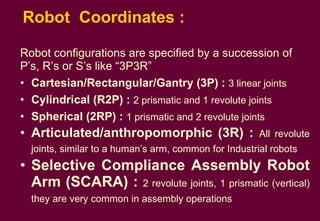
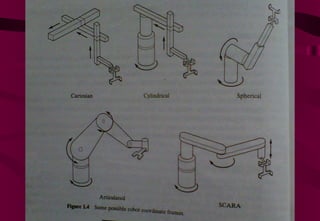
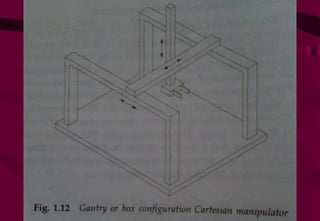
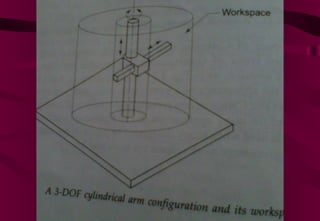
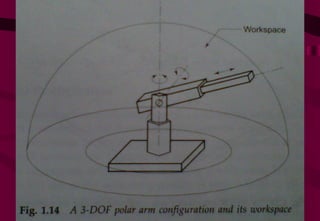
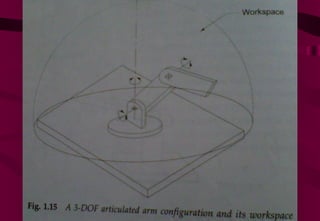
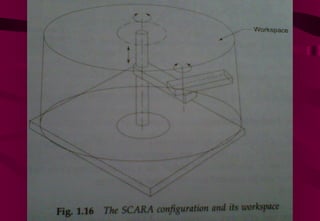
Robot  Coordinates :  Robot configurations are specified by a succession of  P’s, R’s or S’s like “3P3R”  Cartesian/Rectangular/Gantry (3P) :  3 linear joints Cylindrical (R2P) :  2 prismatic and 1 revolute joints Spherical (2RP) :   1 prismatic and 2 revolute joints Articulated/anthropomorphic (3R) :   All revolute joints, similar to a human’s arm, common for Industrial robots Selective Compliance Assembly Robot Arm (SCARA) :   2 revolute joints, 1 prismatic (vertical) they are very common in assembly operations


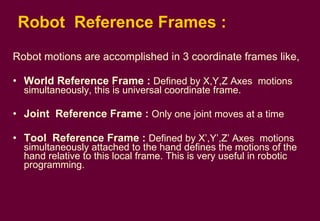
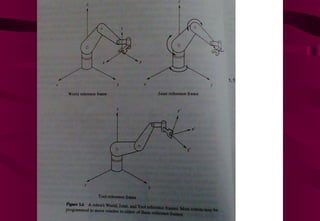
Robot motions are accomplished in 3 coordinate frames like, World Reference Frame :  Defined by X,Y,Z Axes  motions simultaneously, this is universal coordinate frame. Joint  Reference Frame :  Only one joint moves at a time Tool  Reference Frame :  Defined by X’,Y’,Z’ Axes  motions simultaneously attached to the hand defines the motions of the hand relative to this local frame. This is very useful in robotic programming. Robot  Reference Frames :
 
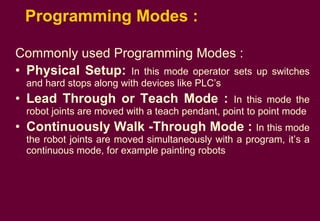
Programming Modes :  Commonly used Programming Modes : Physical Setup:  In this mode operator sets up switches and hard stops along with devices like PLC’s Lead Through or Teach Mode :  In this mode the robot joints are moved with a teach pendant, point to point mode Continuously Walk -Through Mode :   In this mode the robot joints are moved simultaneously with a program, it’s a continuous   mode, for example painting robots
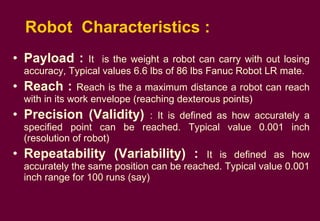
Robot  Characteristics : Payload :  It  is the weight a robot can carry with out losing accuracy, Typical values 6.6 lbs of 86 lbs Fanuc Robot LR mate.  Reach :  Reach is the a maximum distance a robot can reach with in its work envelope (reaching dexterous points)  Precision (Validity)  : It is defined as how accurately a specified point can be reached. Typical value 0.001 inch (resolution of robot)  Repeatability (Variability) :   It is defined as how accurately the same position can be reached. Typical value 0.001 inch range for 100 runs (say)
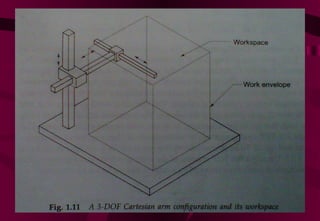
Robot WorkSpace : Depending on their configuration and size of their links and joints robot can reach a collection of points called a WorkSpace Shape of WS depends on each robot characteristics WS may be found by moving each joint through its range of motions Typical WS are Cartesian,Cylindrical, Spherical,Articulated etc
Robot Languages : Many robot languages are based on Cobol, Basic, C and Fortran etc Other languages are unique and at different level from machine level to high level languages. High level languages are either interpreter based or compiler based Interpreter based languages execute one line of the program at time such as VAL ®  and AML ®  , so debugging is easier Compiler based languages execute whole program at time such as AL ®  and so debugging is difficult
Robot Applications : Machine Loading Pick and Place operations Welding Painting Inspection and testing Assembly operations Manufacturing like drilling, deburring, cutting etc. Surveillance Medical applications Hazardous environments Underwater,space, and remote locations
Text  Books : Fundamentals of Robotics - T.C. Manjunath Robotics and Control - R.K.Mittal/I J Nagrath Introduction to Robotics - Saeed B. Niku Introduction to Robotics - John J CRAIG Robotics - Ashitava Ghosal Reference Books :

Industrial Robotics Chap 01 Fundamentals

  • 1.
    Introduction to Robotics Prof A S Rao Robotics & CAD/CAM Laboratory Mechanical Engineering Department VEERMATA JIJABAI TECHNOLOGICAL INSTITUTE MUMBAI-400019
  • 2.
    Outline What isRobotics Robot Coordinates Laws of Robotics Robot Reference Frames What is a Robot Programming Modes Classification Robot Characteristics Robot Components Robot Workspace Robot DOF Robot languages Robot Joints Robot Applications
  • 3.
    What is Robotics:Robotics is an interdisciplinary subject that benefits from mechanical engineering, electrical and electronic engineering, computer science, biology and many other disciplines. Robotics is defined as that branch of engineering which deals with the study of different types of robots, their simulations, their designs, their constructions, operations, performance etc. Robotics is a form of Industrial Automation and is a technology with a future and a technology for the future
  • 4.
    What is aRobot : When we compare a crane attached to a utility or towing vehicle and robot manipulator which appears to be very similar because : Both posses a number of links attached serially to each other with joints In both the systems, the hand of the manipulator can be moved in space and be placed in any desired location with in the workspace of the system Each one is controlled by a central controller which controls the actuators However one is called a robot and the other a manipulator (i.e. a crane) The fundamental difference between the two is that the crane is controlled by a human who operates and controls the actuators, whereas a robot manipulator is controlled by a computer that runs a program.
  • 5.
    What is aRobot : Definition : The Automatic progrmmable machines which does the required job through various programmed motions According to RIA: A robot is a reprogrammable multifunctional manipulator designed to move various objects, tools, materials or specialized devices through variable programmed motions for the performance of variety of tasks Law of Japan states that a robot is “All purpose machine equipped with a memory device (for handling) capable of replacing human labour for the automatic performance of tasks” Robert Schilling defines a robot as “a software controlled mechanical device that uses sensors to guide one or more of its end effectors through various programmed motions in a work space in order to manipulate physical objects”
  • 6.
    Classification of Robots:Drive Technology Work Envelope/Coordinate Geometry Motion Control Methods
  • 7.
    I. Drive Technology:Motors are part of any robot system they produce spatial displacement and control axis motions of the robot. Based on power used to drive the joints of the robot the 3 drive technologies are : Electrical drive technology Hydraulic drive technology Pneumatic drive technology
  • 8.
    1. Electrical drivetechnology: Most Robotic manipulators today use electric drives in the form of either D.C.Servomotors or D.C.Stepped motors D.C.Servomotors : More controllability for precision work (neat/precise) D.C.Stepped motors : Load carrying capacity is large Applications : PCB Assembly IC manufacture, etc
  • 9.
    2. Hydraulic drivetechnology: Robotic manipulator which uses oil/liquid/gel as a drive technology. We use it for very heavy load carrying capacity purpose. Limitation : Cleanliness will not be maintained Applications: In steel industry for carrying molten steel Automobile industry
  • 10.
    3. Pneumatic drivetechnology: It is used as at the gripper for manipulating delicate objects, e.g. used in glass industry. The robot operates from compressed air and they are activated tools. Limitation: Built in compliance of air, i.e. air can be compressed, creates noise while operation. Application: Used in pick and place operations in glass industry
  • 11.
    II. Work Envelope/CoordinateGeometry : Work Envelope is defined as locus of points in 3 Dimensional space that can be reached by the wrist of robot. It consists of Rotary/Revolute motion about an axis and Translation motion along an axis (i.e. linear/sliding/prismatic/translate)
  • 12.
    III. Motion ControlMethods : Point to Point motion : The discrete points are specified, the tool moves in a sequence of discrete points in the workspace. Continuous or Controlled path motion : The end effector must follow a prescribed path in 3D space and speed of motion along the path may vary Examples : PTP : Spot welding, Loading & Unloading, Pick and Place, etc. CP : Spray painting, Arc welding, Grinding, etc.
  • 13.
    Robot Components :Main components are : Manipulator : Main body (Links, Joints etc) End effector : Welding Torch, Paint spray gun etc Actuators : servo motors,stepper motors,cylinders etc Sensors : Vision, Touch, Speech synthesizers etc Controller : receives data from PC and controls the actuators Processor: calculates motions of joints@speeds Software : OS, Appliaction s/w
  • 14.
    Degree of Freedom(DOF) : The no. of independent movements a robot can perform in 3D space. (or) Direction in which a robot moves when a particular joint is activated To fully place the object in space and also orientate it as desired we need to have six DOF. A system with seven DOF does not have unique solution i.e Robot mounted on conveyor belt or mobile platform In 3.5 DoF, 3 DoF are along X,Y,Z axes, and 1/2 DoF for not fully controlled movement like fully extended or retracted position of pneumatic cylinder
  • 15.
    Robot Joints : Robots may have types of joints like, Linear (Prismatic): Either hydraulic or pneumatic cylinder, used in Gantry, cylindrical or similar configurations Rotary (Revolute) : Most such joints electrically driven either by servomotors or stepper motors Spherical : They posses multiple DOF ,difficult to control they are not commonly used except in research work.
  • 16.
    Robot Coordinates: Robot configurations are specified by a succession of P’s, R’s or S’s like “3P3R” Cartesian/Rectangular/Gantry (3P) : 3 linear joints Cylindrical (R2P) : 2 prismatic and 1 revolute joints Spherical (2RP) : 1 prismatic and 2 revolute joints Articulated/anthropomorphic (3R) : All revolute joints, similar to a human’s arm, common for Industrial robots Selective Compliance Assembly Robot Arm (SCARA) : 2 revolute joints, 1 prismatic (vertical) they are very common in assembly operations
  • 17.
  • 18.
  • 19.
  • 20.
  • 21.
  • 22.
  • 23.
  • 24.
    Robot motions areaccomplished in 3 coordinate frames like, World Reference Frame : Defined by X,Y,Z Axes motions simultaneously, this is universal coordinate frame. Joint Reference Frame : Only one joint moves at a time Tool Reference Frame : Defined by X’,Y’,Z’ Axes motions simultaneously attached to the hand defines the motions of the hand relative to this local frame. This is very useful in robotic programming. Robot Reference Frames :
  • 25.
  • 26.
    Programming Modes : Commonly used Programming Modes : Physical Setup: In this mode operator sets up switches and hard stops along with devices like PLC’s Lead Through or Teach Mode : In this mode the robot joints are moved with a teach pendant, point to point mode Continuously Walk -Through Mode : In this mode the robot joints are moved simultaneously with a program, it’s a continuous mode, for example painting robots
  • 27.
    Robot Characteristics: Payload : It is the weight a robot can carry with out losing accuracy, Typical values 6.6 lbs of 86 lbs Fanuc Robot LR mate. Reach : Reach is the a maximum distance a robot can reach with in its work envelope (reaching dexterous points) Precision (Validity) : It is defined as how accurately a specified point can be reached. Typical value 0.001 inch (resolution of robot) Repeatability (Variability) : It is defined as how accurately the same position can be reached. Typical value 0.001 inch range for 100 runs (say)
  • 28.
    Robot WorkSpace :Depending on their configuration and size of their links and joints robot can reach a collection of points called a WorkSpace Shape of WS depends on each robot characteristics WS may be found by moving each joint through its range of motions Typical WS are Cartesian,Cylindrical, Spherical,Articulated etc
  • 29.
    Robot Languages :Many robot languages are based on Cobol, Basic, C and Fortran etc Other languages are unique and at different level from machine level to high level languages. High level languages are either interpreter based or compiler based Interpreter based languages execute one line of the program at time such as VAL ® and AML ® , so debugging is easier Compiler based languages execute whole program at time such as AL ® and so debugging is difficult
  • 30.
    Robot Applications :Machine Loading Pick and Place operations Welding Painting Inspection and testing Assembly operations Manufacturing like drilling, deburring, cutting etc. Surveillance Medical applications Hazardous environments Underwater,space, and remote locations
  • 31.
    Text Books: Fundamentals of Robotics - T.C. Manjunath Robotics and Control - R.K.Mittal/I J Nagrath Introduction to Robotics - Saeed B. Niku Introduction to Robotics - John J CRAIG Robotics - Ashitava Ghosal Reference Books :

Editor's Notes

  • #2 RP is an automatic process for manufacturing parts, tools and even assemblies directly from their CAD models without the use of any cutters, tools or fixtures specific to the geometry of the object and without any human intervention anywhere in the process. The idle time of a CNC machine is mainly due to the waiting for the NC programs which are prepared by humans. Therefore, the process of art-to-part is really not fully automatic in CNC. Therefore, RP is increasingly becoming an attractive alternative to CNC since it is more automatic than the CNC machines. It is one of the time compression techniques as it cuts down product development and productionizing cycle times. Therefore, it is an effective tool where time to market matters. As far as its construction is concerned, it is also a CNC machine. The only difference is that it is an additive process presently. Today’s RP machines are 2.5 axis machines. To meet the requirements of advanced slicing strategies, 5 axis RP machines are under various stages of developments at various parts of the world. Therefore, it is an appropriate topic for discussion in this forum.
  • #4 Open also OptiLOM, MIT review, Thermo RP
  • #5 Open also OptiLOM, MIT review, Thermo RP
  • #6 Having physical part helps us feel the design by touching. EARLY DETECTION OF DESIGN FLAWS EVALUATION OF MORE DESIGN ALTERNATIVES IN THE GIVEN TIME
  • #7 Open also OptiLOM, MIT review, Thermo RP
  • #14 Open also OptiLOM, MIT review, Thermo RP
  • #17 Open also OptiLOM, MIT review, Thermo RP
  • #25 Open also OptiLOM, MIT review, Thermo RP
  • #28 Open also OptiLOM, MIT review, Thermo RP
  • #29 Open also OptiLOM, MIT review, Thermo RP
  • #30 Open also OptiLOM, MIT review, Thermo RP