ROBOT CONTROLLERS AND MOTION CONTROL OF ROBOTS
Presented by
Hiran Gabriel
ROBOT CONTROLLERS
• The controller is the robot's brain and controls
the robot's movements. It's usually a computer of some type which is
used to store information about the robot and the work environment
and to store and execute programs which operate the robot.
ROBOT CONTROLLERS
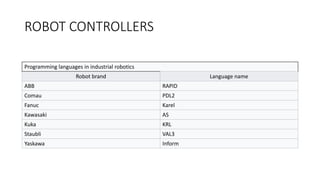
Programming languages in industrial robotics
Robot brand Language name
ABB RAPID
Comau PDL2
Fanuc Karel
Kawasaki AS
Kuka KRL
Staubli VAL3
Yaskawa Inform
MOTION CONTROL SYSTEMS
• Motion control is a sub-field of automation, encompassing
the systems or sub-systems involved in moving parts of machines in
a controlled manner. Typically the position or velocity of machines
are controlled using some type of device such as a hydraulic pump,
linear actuator, or electric motor, generally a servo.
CONTROL FUNCTIONS
• Velocity control.
• Position (point-to-point) control: There are several methods for
computing a motion trajectory. These are often based on the velocity
profiles of a move.
• Pressure or Force control.
• Impedance Control: This type of control is suitable for environment
interaction and object manipulation, such as in robotics.
• Electronic gearing
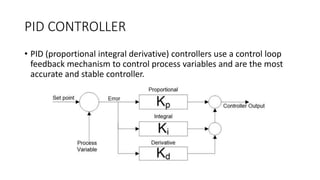
PID CONTROLLER
• PID (proportional integral derivative) controllers use a control loop
feedback mechanism to control process variables and are the most
accurate and stable controller.
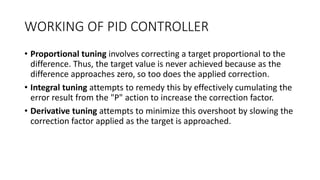
WORKING OF PID CONTROLLER
• Proportional tuning involves correcting a target proportional to the
difference. Thus, the target value is never achieved because as the
difference approaches zero, so too does the applied correction.
• Integral tuning attempts to remedy this by effectively cumulating the
error result from the "P" action to increase the correction factor.
• Derivative tuning attempts to minimize this overshoot by slowing the
correction factor applied as the target is approached.
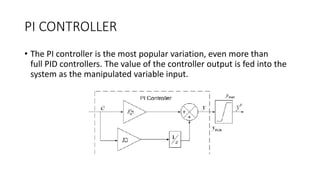
PI CONTROLLER
• The PI controller is the most popular variation, even more than
full PID controllers. The value of the controller output is fed into the
system as the manipulated variable input.
WORKING OF PI CONTROLLER
• Proportional just acts as a multiplicating factor to error signal and
gives output.
• Integrator stores a certain value depending on the difference
between reference that we want as output.
TYPES OF ROBOT CONTROL
• Point-to-point (PTP) control robot
• Continuous path control robot
• Controlled path robot
POINT-TO-POINT CONTROL ROBOT
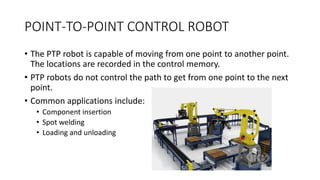
• The PTP robot is capable of moving from one point to another point.
The locations are recorded in the control memory.
• PTP robots do not control the path to get from one point to the next
point.
• Common applications include:
• Component insertion
• Spot welding
• Loading and unloading
CONTINUOUS PATH CONTROLLED ROBOT
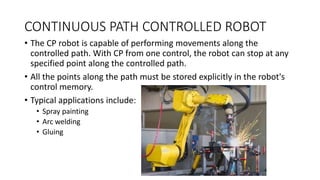
• The CP robot is capable of performing movements along the
controlled path. With CP from one control, the robot can stop at any
specified point along the controlled path.
• All the points along the path must be stored explicitly in the robot's
control memory.
• Typical applications include:
• Spray painting
• Arc welding
• Gluing
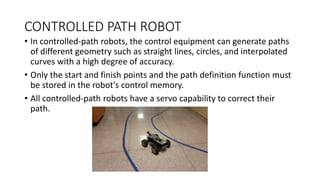
CONTROLLED PATH ROBOT
• In controlled-path robots, the control equipment can generate paths
of different geometry such as straight lines, circles, and interpolated
curves with a high degree of accuracy.
• Only the start and finish points and the path definition function must
be stored in the robot's control memory.
• All controlled-path robots have a servo capability to correct their
path.
REFERENCES
• https://prime.jsc.nasa.gov/ROV/systems.html
• https://en.wikipedia.org/wiki/Robot_software
• https://en.wikipedia.org/wiki/Motion_control
• https://www.omega.com/prodinfo/pid-controllers.html
• https://apmonitor.com/pdc/index.php/Main/ProportionalIntegralCon
trol
• https://www.quora.com/What-is-the-working-principle-of-a-PI-
proportional-integral-controller
• https://www.brainkart.com/article/Four-types-of-robot-
control_5131/

Robot control

  • 1.
    ROBOT CONTROLLERS ANDMOTION CONTROL OF ROBOTS Presented by Hiran Gabriel
  • 2.
    ROBOT CONTROLLERS • Thecontroller is the robot's brain and controls the robot's movements. It's usually a computer of some type which is used to store information about the robot and the work environment and to store and execute programs which operate the robot.
  • 3.
    ROBOT CONTROLLERS Programming languagesin industrial robotics Robot brand Language name ABB RAPID Comau PDL2 Fanuc Karel Kawasaki AS Kuka KRL Staubli VAL3 Yaskawa Inform
  • 4.
    MOTION CONTROL SYSTEMS •Motion control is a sub-field of automation, encompassing the systems or sub-systems involved in moving parts of machines in a controlled manner. Typically the position or velocity of machines are controlled using some type of device such as a hydraulic pump, linear actuator, or electric motor, generally a servo.
  • 5.
    CONTROL FUNCTIONS • Velocitycontrol. • Position (point-to-point) control: There are several methods for computing a motion trajectory. These are often based on the velocity profiles of a move. • Pressure or Force control. • Impedance Control: This type of control is suitable for environment interaction and object manipulation, such as in robotics. • Electronic gearing
  • 6.
    PID CONTROLLER • PID(proportional integral derivative) controllers use a control loop feedback mechanism to control process variables and are the most accurate and stable controller.
  • 7.
    WORKING OF PIDCONTROLLER • Proportional tuning involves correcting a target proportional to the difference. Thus, the target value is never achieved because as the difference approaches zero, so too does the applied correction. • Integral tuning attempts to remedy this by effectively cumulating the error result from the "P" action to increase the correction factor. • Derivative tuning attempts to minimize this overshoot by slowing the correction factor applied as the target is approached.
  • 8.
    PI CONTROLLER • ThePI controller is the most popular variation, even more than full PID controllers. The value of the controller output is fed into the system as the manipulated variable input.
  • 9.
    WORKING OF PICONTROLLER • Proportional just acts as a multiplicating factor to error signal and gives output. • Integrator stores a certain value depending on the difference between reference that we want as output.
  • 10.
    TYPES OF ROBOTCONTROL • Point-to-point (PTP) control robot • Continuous path control robot • Controlled path robot
  • 11.
    POINT-TO-POINT CONTROL ROBOT •The PTP robot is capable of moving from one point to another point. The locations are recorded in the control memory. • PTP robots do not control the path to get from one point to the next point. • Common applications include: • Component insertion • Spot welding • Loading and unloading
  • 12.
    CONTINUOUS PATH CONTROLLEDROBOT • The CP robot is capable of performing movements along the controlled path. With CP from one control, the robot can stop at any specified point along the controlled path. • All the points along the path must be stored explicitly in the robot's control memory. • Typical applications include: • Spray painting • Arc welding • Gluing
  • 13.
    CONTROLLED PATH ROBOT •In controlled-path robots, the control equipment can generate paths of different geometry such as straight lines, circles, and interpolated curves with a high degree of accuracy. • Only the start and finish points and the path definition function must be stored in the robot's control memory. • All controlled-path robots have a servo capability to correct their path.
  • 14.
    REFERENCES • https://prime.jsc.nasa.gov/ROV/systems.html • https://en.wikipedia.org/wiki/Robot_software •https://en.wikipedia.org/wiki/Motion_control • https://www.omega.com/prodinfo/pid-controllers.html • https://apmonitor.com/pdc/index.php/Main/ProportionalIntegralCon trol • https://www.quora.com/What-is-the-working-principle-of-a-PI- proportional-integral-controller • https://www.brainkart.com/article/Four-types-of-robot- control_5131/