CHAPTER 1: 
INTRODUCTION TO INDUSTRIAL ROBOTS 
AUTOMATION
Learning Outcomes: 
Upon completion this chapter, student should be 
able:- 
1. Define the robots automation 
2. State the advantages and disadvantages of robots 
automation 
3. List six types of robot automation 
4. Explain the robots automation in production 
system
Contents 
1. Introduction of robots automation 
2. Advantages and disadvantages of robot automation 
3. Types of robots automation 
4. Robot automation in production system
Introduction of Robots Automation 
 Robot is a machine that can be programmed to 
perform a variety of jobs 
 Can range from simple machines to highly complex, 
computer-controlled devices 
 Three Law of robotics: 
 A robot may not injure a human being or through 
inaction, allow a human being to come harm 
 Robot must be obey the orders given it by human beings 
except where such order would conflict with the first law 
 Robot must protect its own existence as long as such 
protection does not conflict with first and second law
 For a machine to qualify as a robot, it usually needs 
these 5 parts: 
i. Controller 
ii. Manipulator 
iii. Actuator 
iv. End Effectors 
v. Sensor
Controller 
 Connected to a computer 
 Controller function as the brain of the robot 
 Controller also allows the robot to be networked to 
other systems. 
 Robot have controller that are run by programme set of 
instruction written in code.
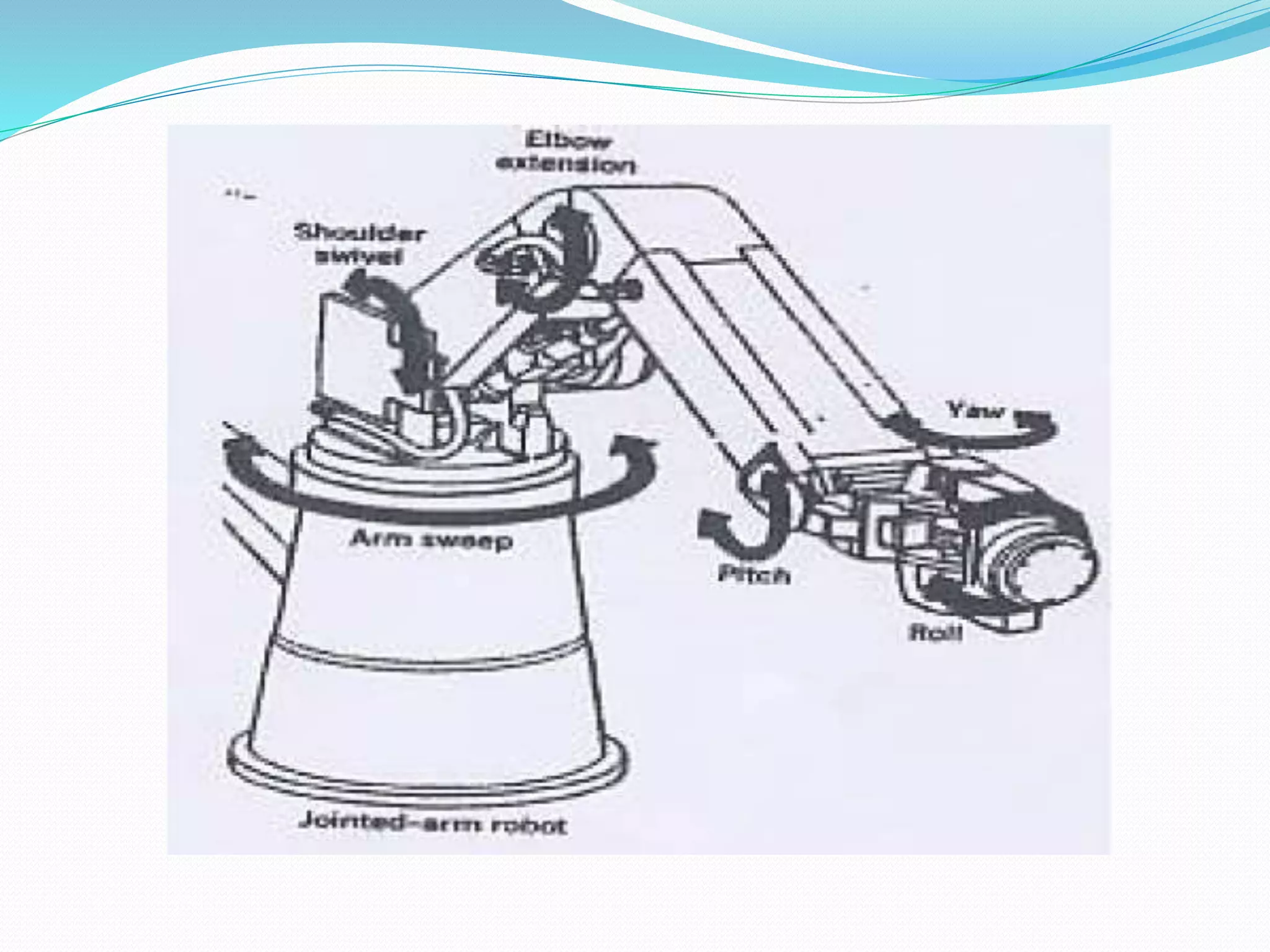
Manipulator 
 Robot arm come in all shapes and size 
 The arm is the part of the robot that positions the end-effector 
and sensors 
 Many resemble human arm and have shoulder, elbow, 
wrist, even fingers 
 A simple robot arm with 3 degrees of freedom could 
move 3 way; up and down, left and right, forward and 
backward.
Actuator 
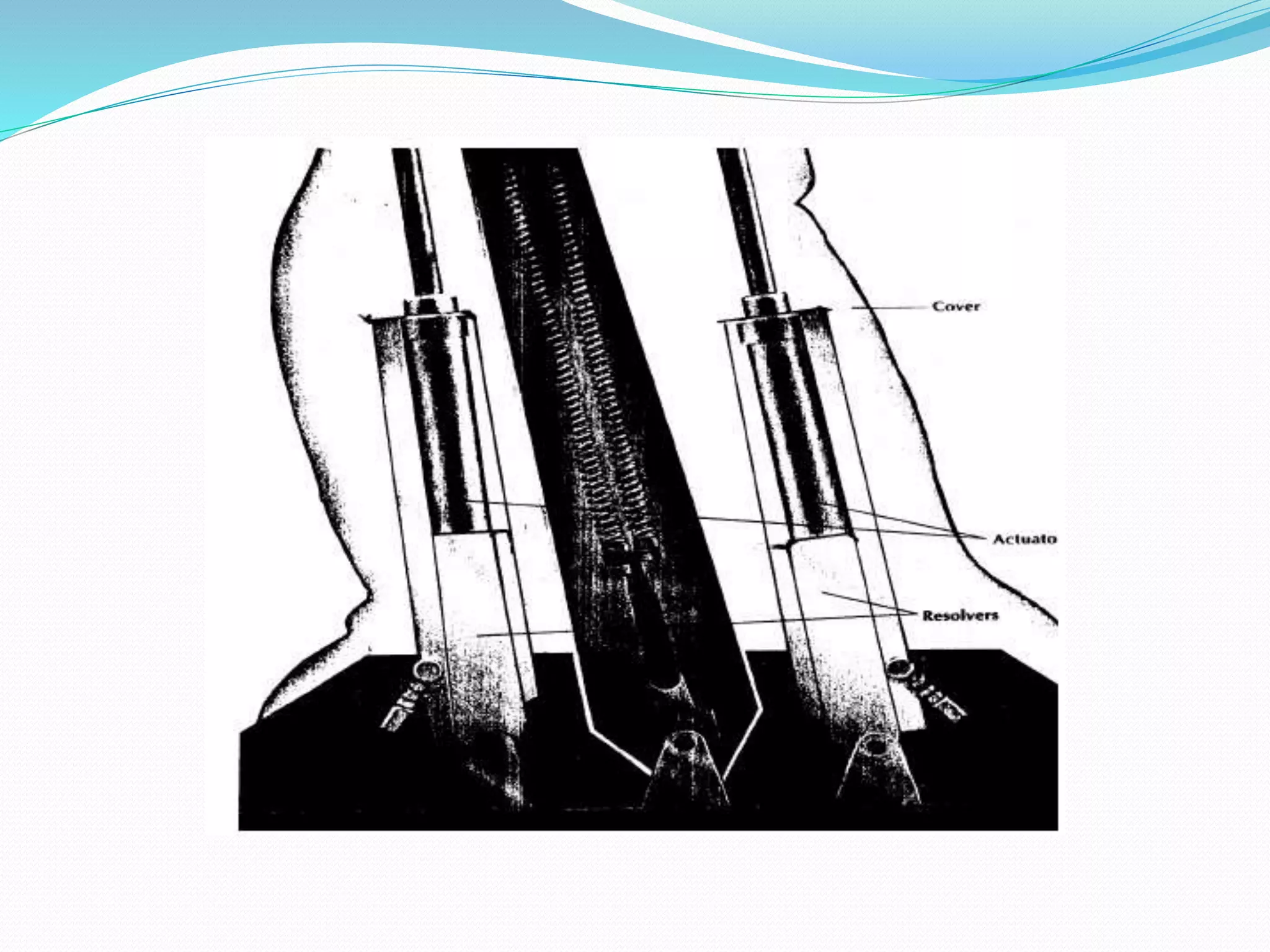
 actuator is a mechanism used to drive the processor to 
allow it to move to a predetermined point. 
 consists of components such as pneumatic and 
hydraulic cylinders, pneumatic and hydraulic rotary 
motor, and the electric motor. 
 robot position also depends on the combination of 
these components. 
 The robot has a simple movement is driven by a 
mechanical system that uses a cam.
End -Effector 
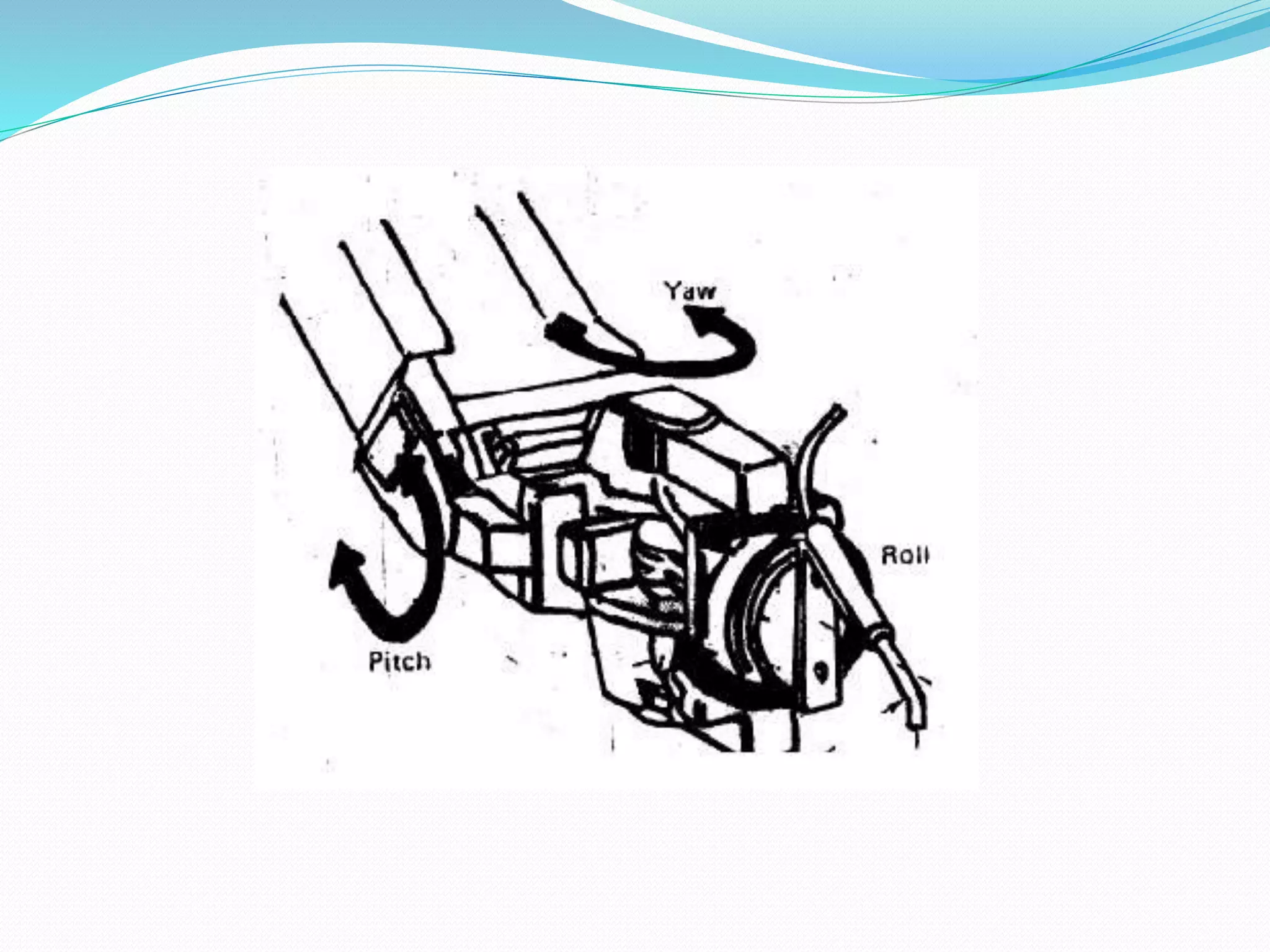
 Connected to the robot arm. 
 It could be a tool such as a gripper, a vacuum pump, 
hook, scoop and etc. 
 Some robots can change end-effectors and be 
programmed for a different task. 
 If robot has more than one arm, there can be more 
than one end-effector on the same robot.
Sensor 
 Sensor can provide feedback to the control systems 
and give the robots more flexibility 
 Sensor such as visual sensor are useful in the building 
of more accurate and intelligent robots 
 Sensor can be classified as follows: 
 Position sensor 
 Range sensor 
 Velocity sensor 
 Proximity sensor
Power Sources For Robots 
 There are basically three types of power sources for 
robot: 
 Hydraulic drive 
 Electric drive 
 Pneumatic drive
Hydraulic drive 
 Provide fast movements 
 Preferred for moving heavy part 
 Preferred to be used in expressive environments 
 Occupy large space area 
 There is a danger of oil leak to the shop floor
Electric drive 
 Slower movement compare to the hydraulic robots 
 Good for small and medium size robots 
 Better positioning accuracy and repeatability 
 Stepper motor drive: open loop control 
 DC motor drive: closed loop control 
 Cleaner environment 
 The most used type of drive in industry
Pneumatic drive 
 Preferred for smaller robots 
 Less expensive than electric or hydraulic robots 
 Suitable for relatively less degrees of freedom design 
 Suitable for simple pick and place application 
 Relatively cheaper
The Robot Movements 
 The basic movements required for motion of most 
industrial robots are: 
 Rotational movement – enable robot to place its arm 
in any direction on a horizontal plane 
 Radial movement – enables robot to move its end-effector 
radials to reach distant points 
 Vertical movement – enables robot to take its end-effector 
to different heights
The Robot Joints 
Prismatic 
Joints 
Revolute 
Joints 
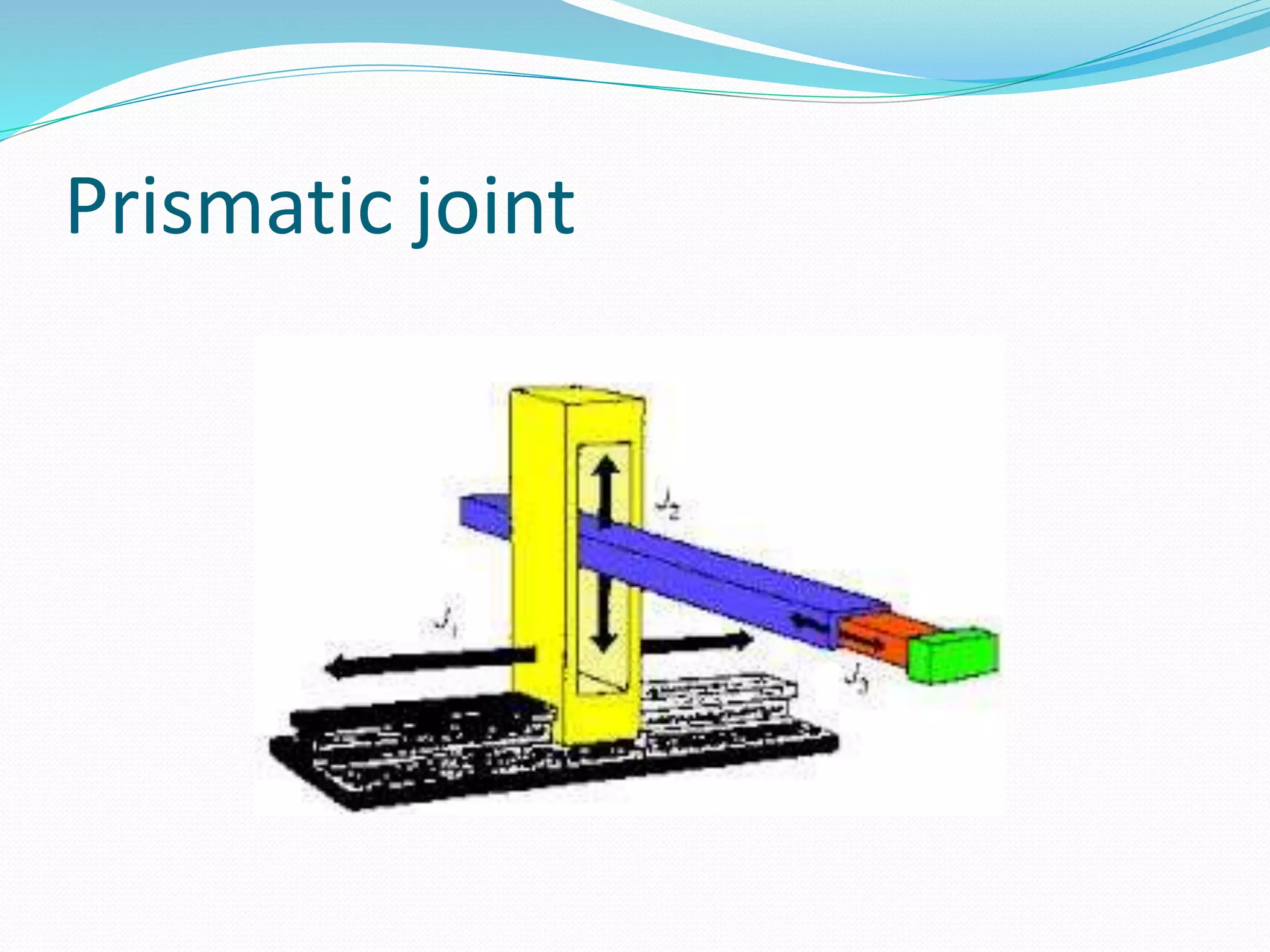
•In a prismatic joints, also 
known as a sliding or 
linear joint (L) 
•The link are generally 
parallel to one 
• In a revolute joints permit 
only angular motion 
between link 
• Their variations include: 
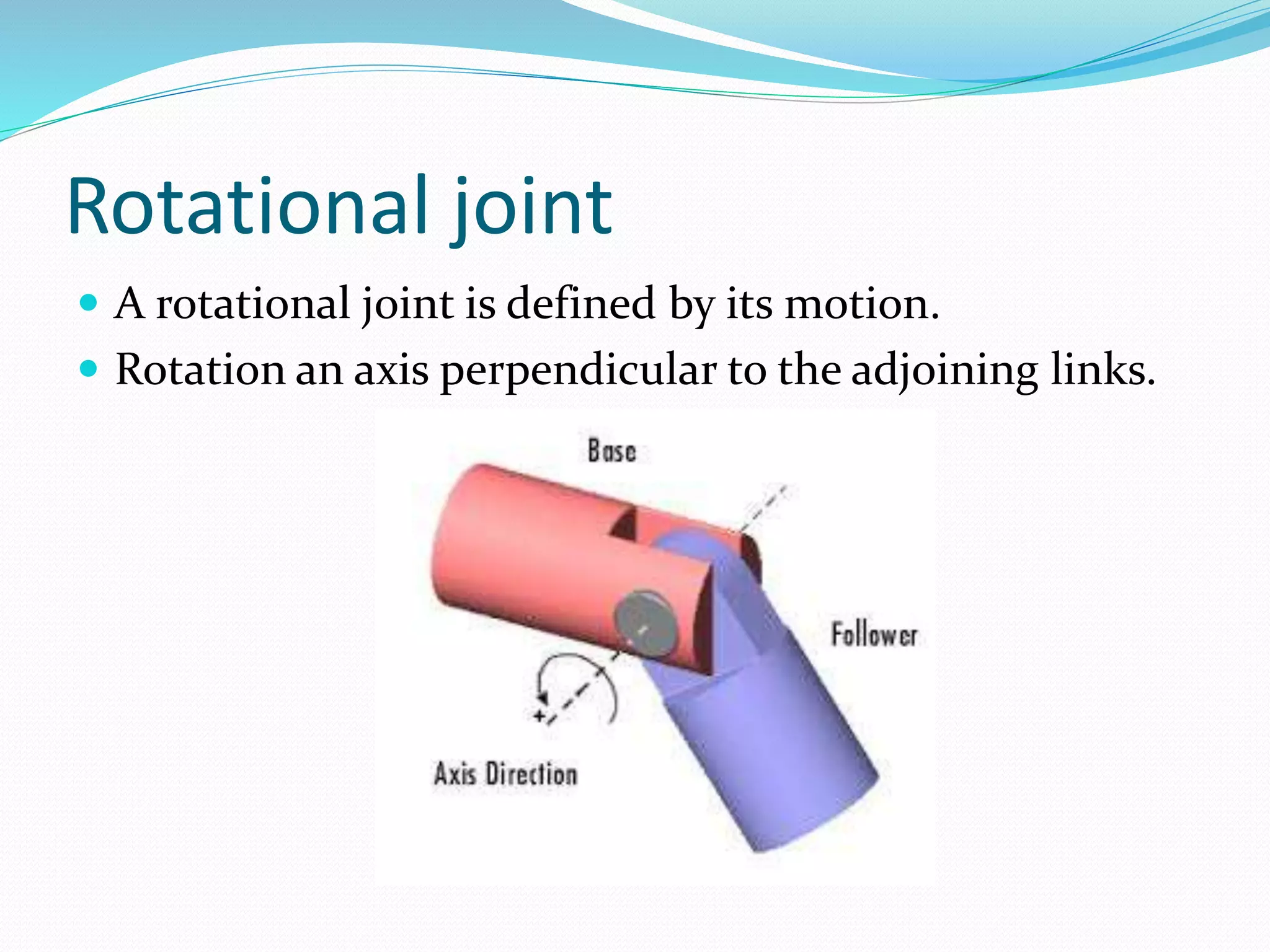
• Rotational joint (R) 
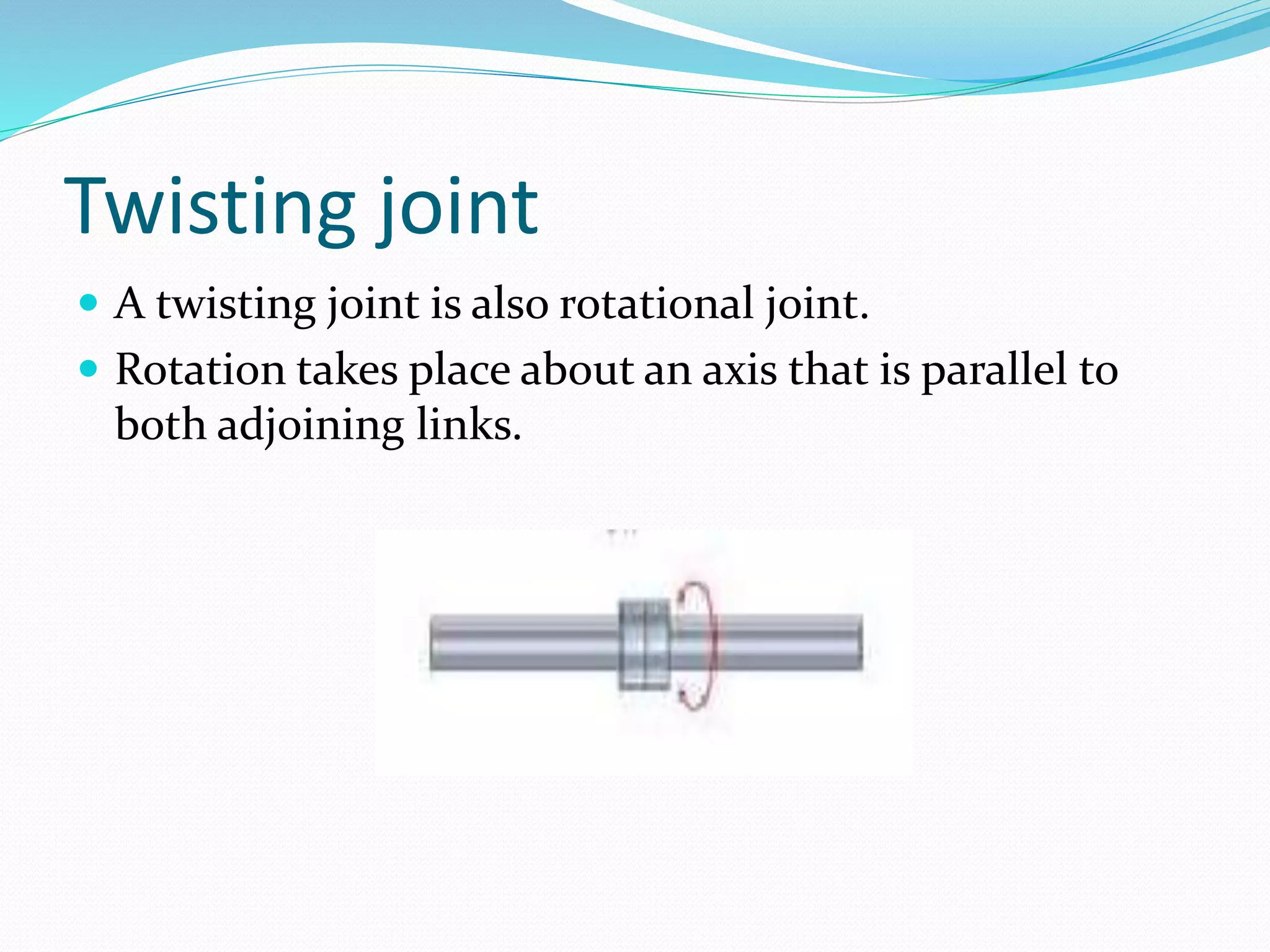
• Twisting joint (T) 
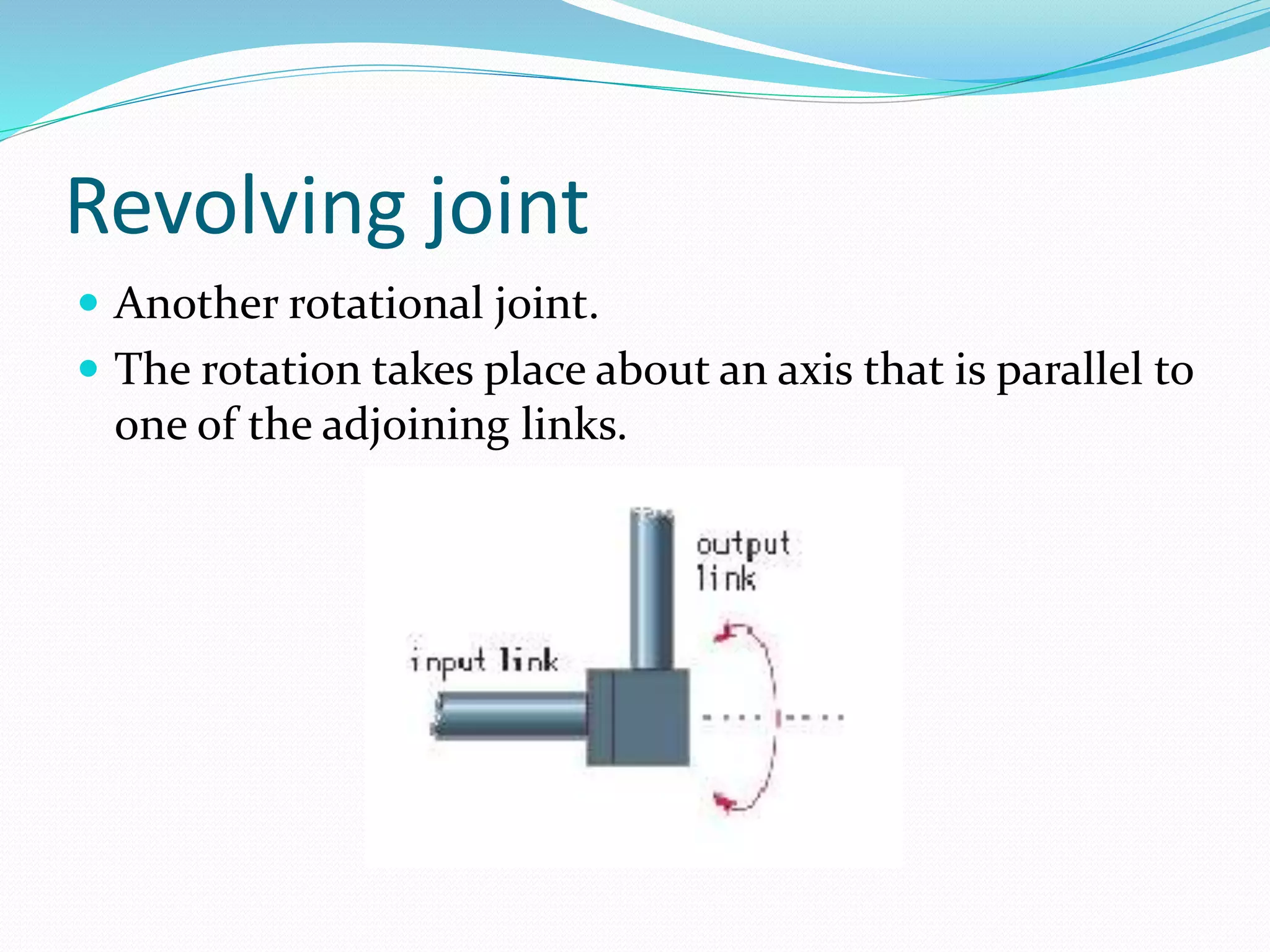
• Revolving joint (V)
Prismatic joint
Rotational joint 
 A rotational joint is defined by its motion. 
 Rotation an axis perpendicular to the adjoining links.
Twisting joint 
 A twisting joint is also rotational joint. 
 Rotation takes place about an axis that is parallel to 
both adjoining links.
Revolving joint 
 Another rotational joint. 
 The rotation takes place about an axis that is parallel to 
one of the adjoining links.
Advantages and disadvantages 
Advantages: 
 Robot never get sick or 
need rest 
 When the task required 
would be dangerous for a 
person, robot can do the 
work instead 
 Robot can work repetitive 
and unrewarding 
Disadvantages: 
 Not creative or innovative 
 Do not think independently 
 Do not make complicated 
decisions 
 Do not learn from mistakes 
 Do not adapt quickly to 
changes in their 
surroundings
Types Of Robots Automation 
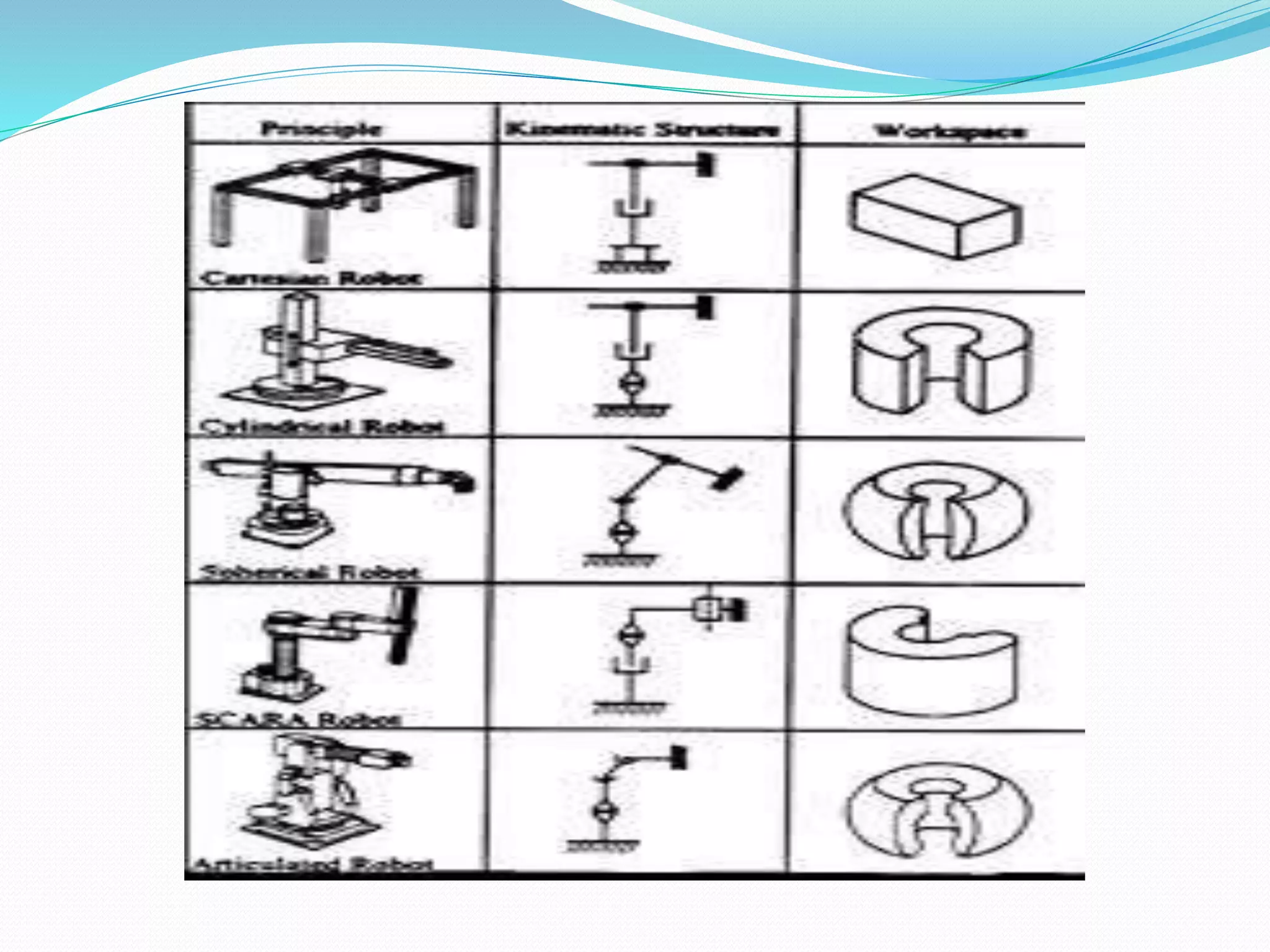
There are 6 types of robot : 
 Cartesian/Gantry Robot 
 Cylindrical Robot 
 Spherical/Polar Robot 
 SCARA Robot 
 Articulated Robot 
 Parallel Robot
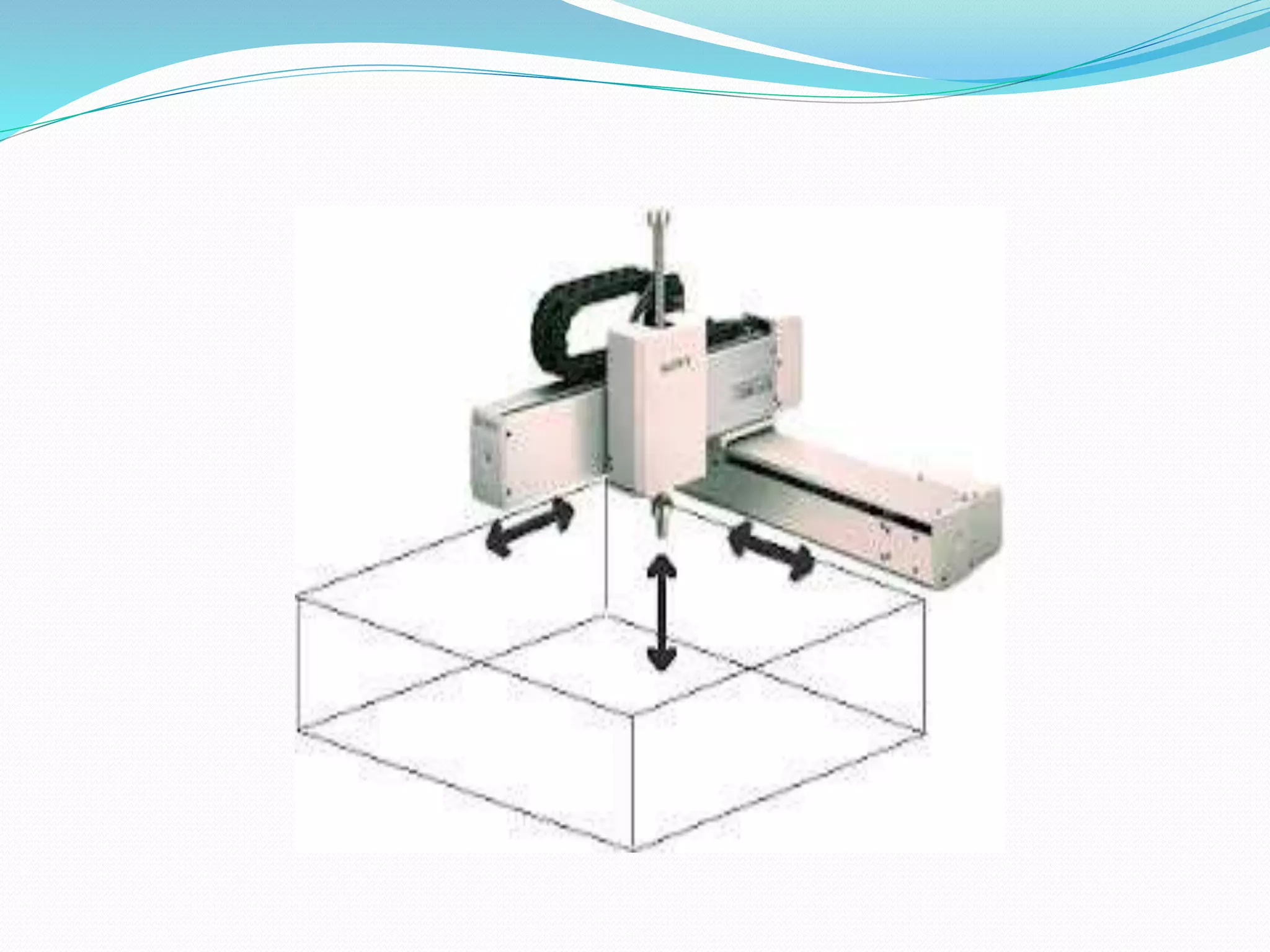
Cartesian Robot 
 It used for pick and place work, application of sealant, 
assembly operation, handling machine tools and arc 
welding 
 This arm robot has three prismatic joints, whose axes 
are coincident with a Cartesian coordinator 
 X =horizontal, left and right motions 
 Y = vertical, up and down motions 
 Z = horizontal, forward and backward motions
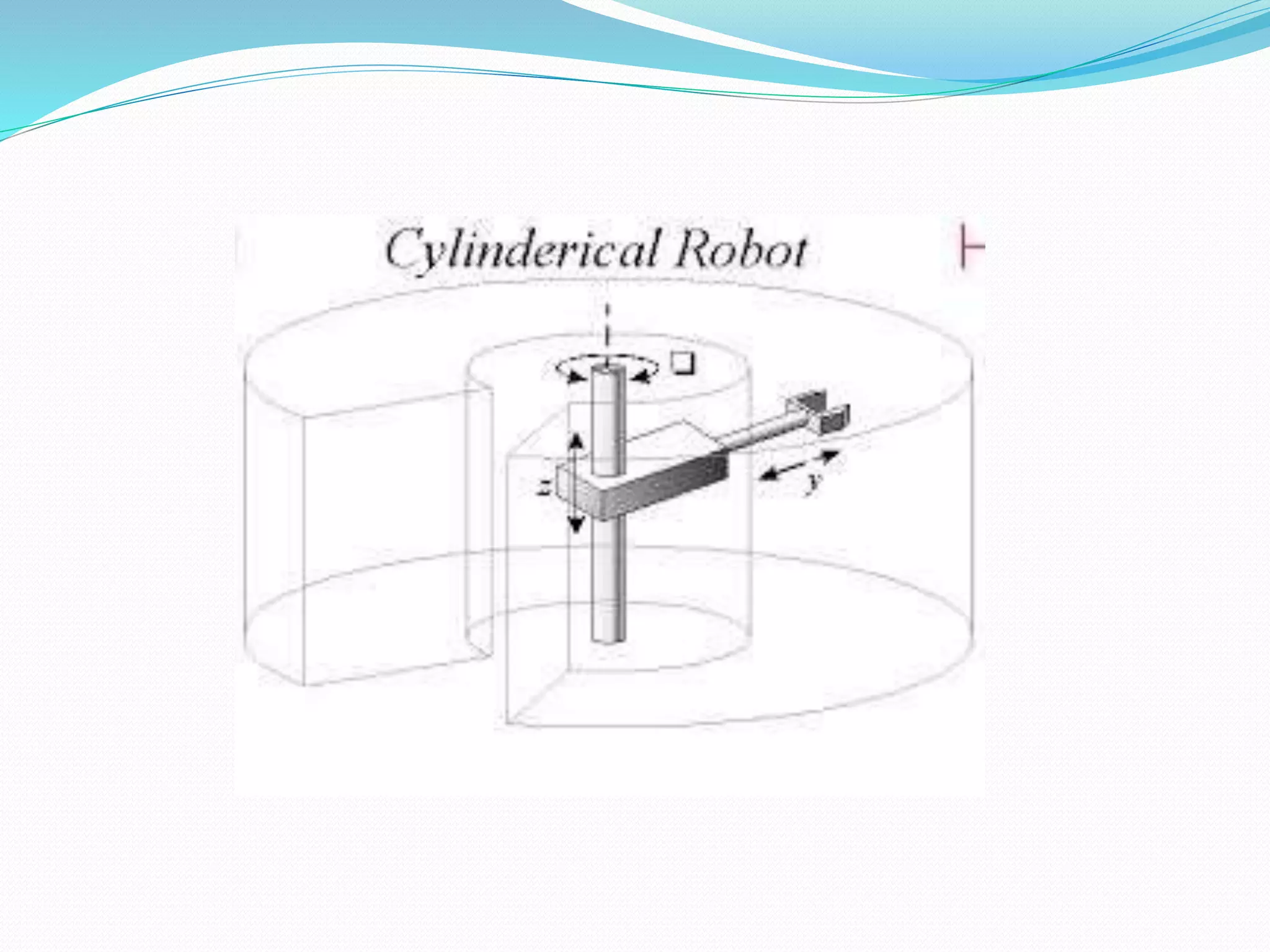
Cylindrical Robot 
 It used for assembly operations, handling at machine 
tools, spot welding and handling at die-casting 
machines 
 This robot axes form a cylindrical coordinate system 
 X = horizontal rotation of 360°, left and right motions 
 Y = vertical, up and down motions 
 Z = horizontal, forward and backward motions
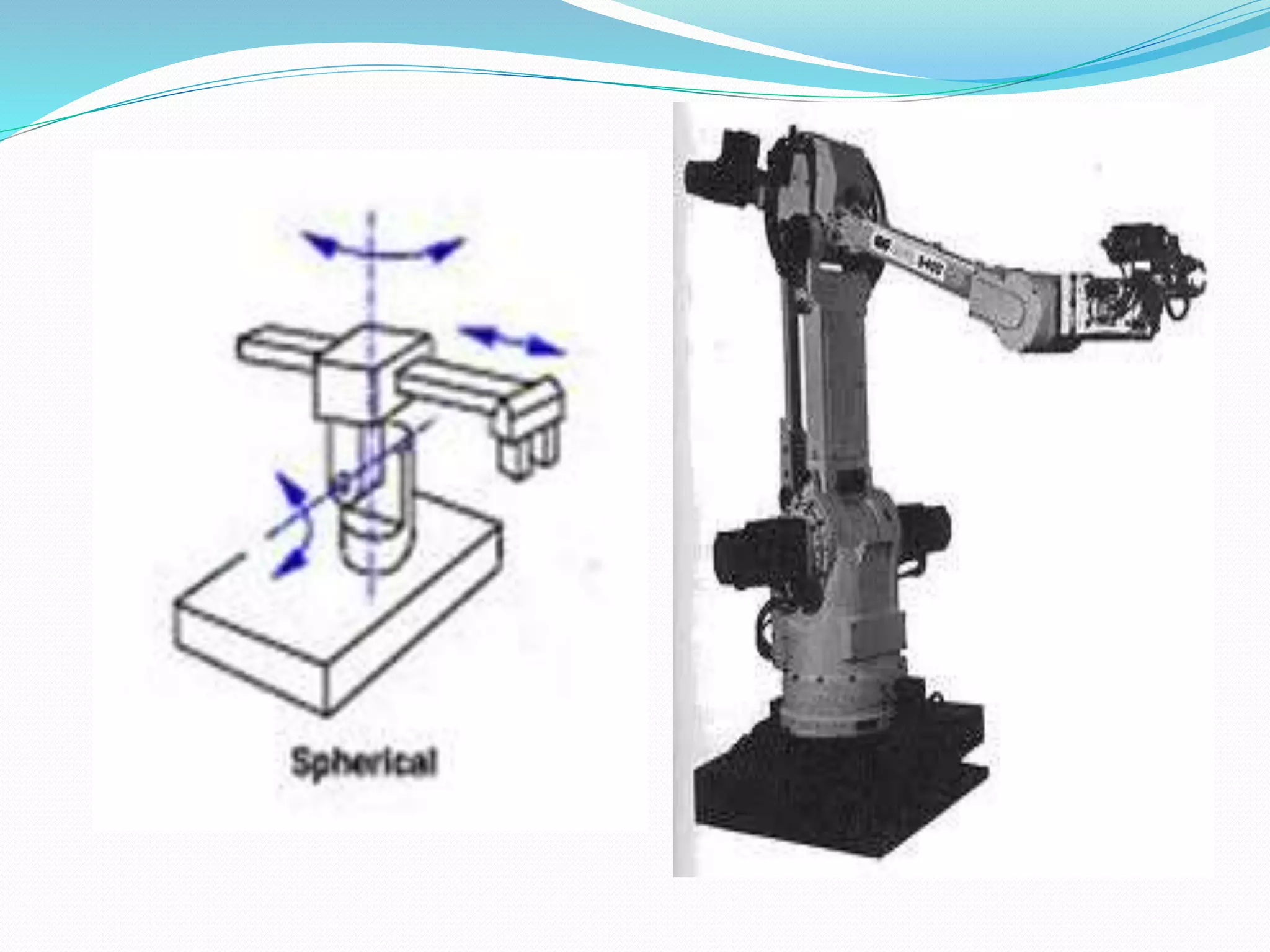
Spherical/Polar Robot 
 Used for handling at machine tools, spot welding, die-casting, 
fettling machines, gas welding and arc 
welding. 
 Robot axes form a polar coordinate system. 
 X = horizontal rotation of 360°, left and right motions 
 Y = vertical rotation of 270°, up and down motions 
 Z = horizontal, forward and backward motions
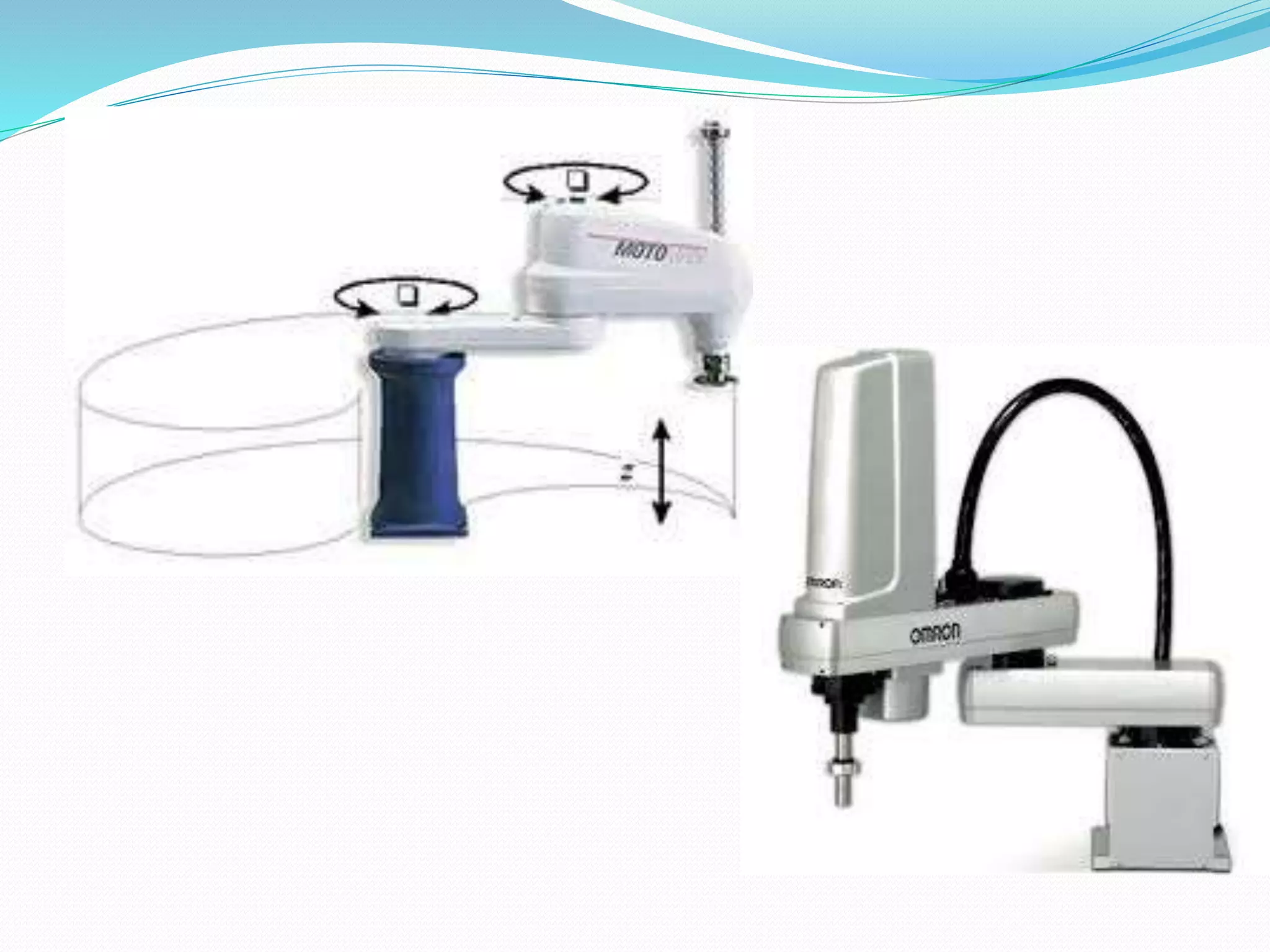
SCARA Robot 
 SCARA (Selective Compliant Assembly Robot Arm) 
 Used for pick and place work, application of sealant, 
assembly operations and handling machine tools 
 This robot has 2 parallel rotary joints to provide 
compliance in a plane
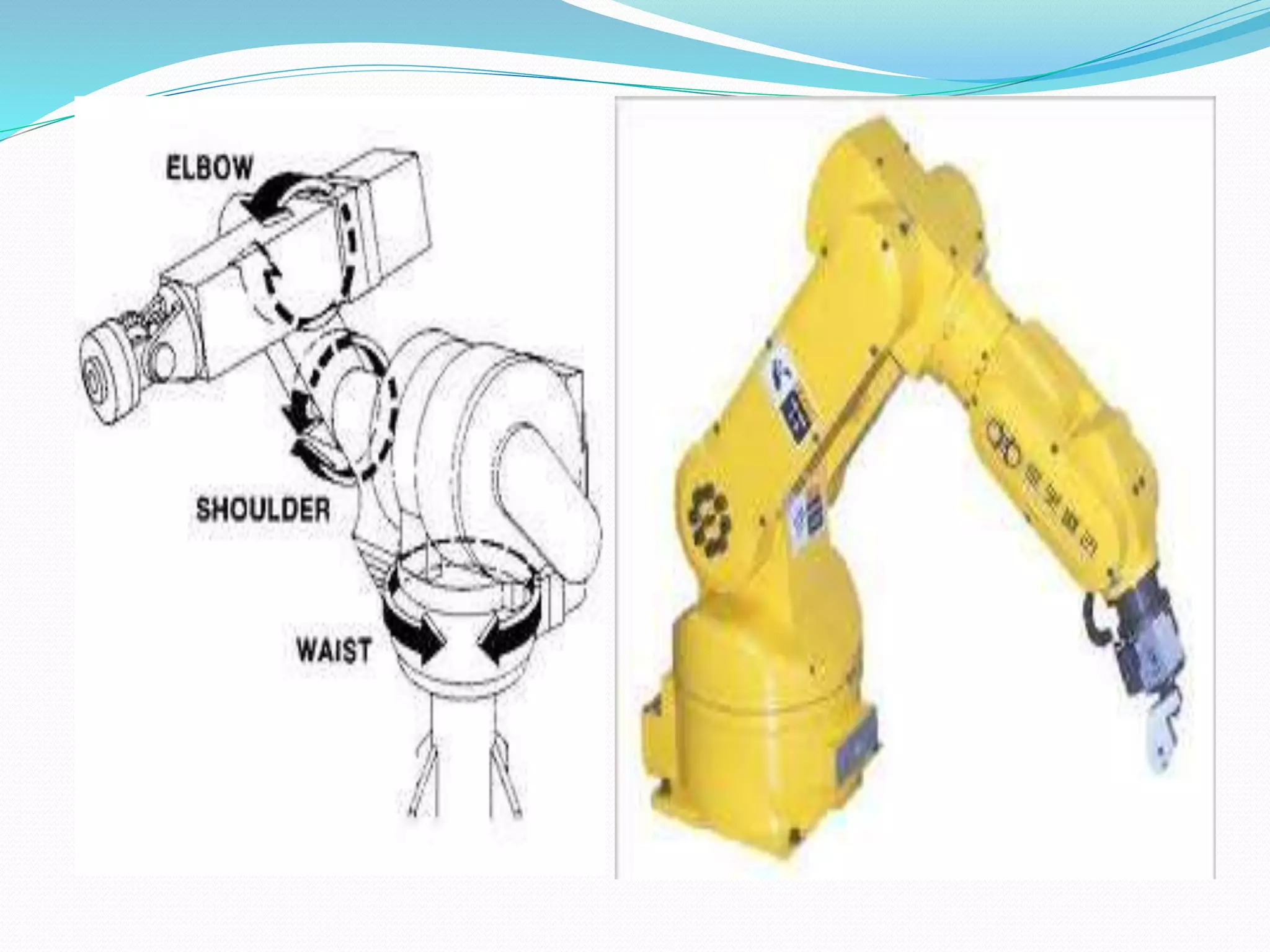
Articulated Robot 
 Used for assembly operations, die-casting, fettling 
machines, gas welding, arc welding and spray painting 
 This robot arm has at least 3 rotary joints 
 X = horizontal rotation of 360° left and right motions 
 Y = vertical rotation of 270°, up and down motions 
 Z = horizontal & vertical rotation of 90° to 180°, forward 
and backward motions
Parallel Robot 
 This robot is used for mobile platform handling 
cockpit flight simulators 
 This robot arm has concurrent prismatic or rotary 
joints
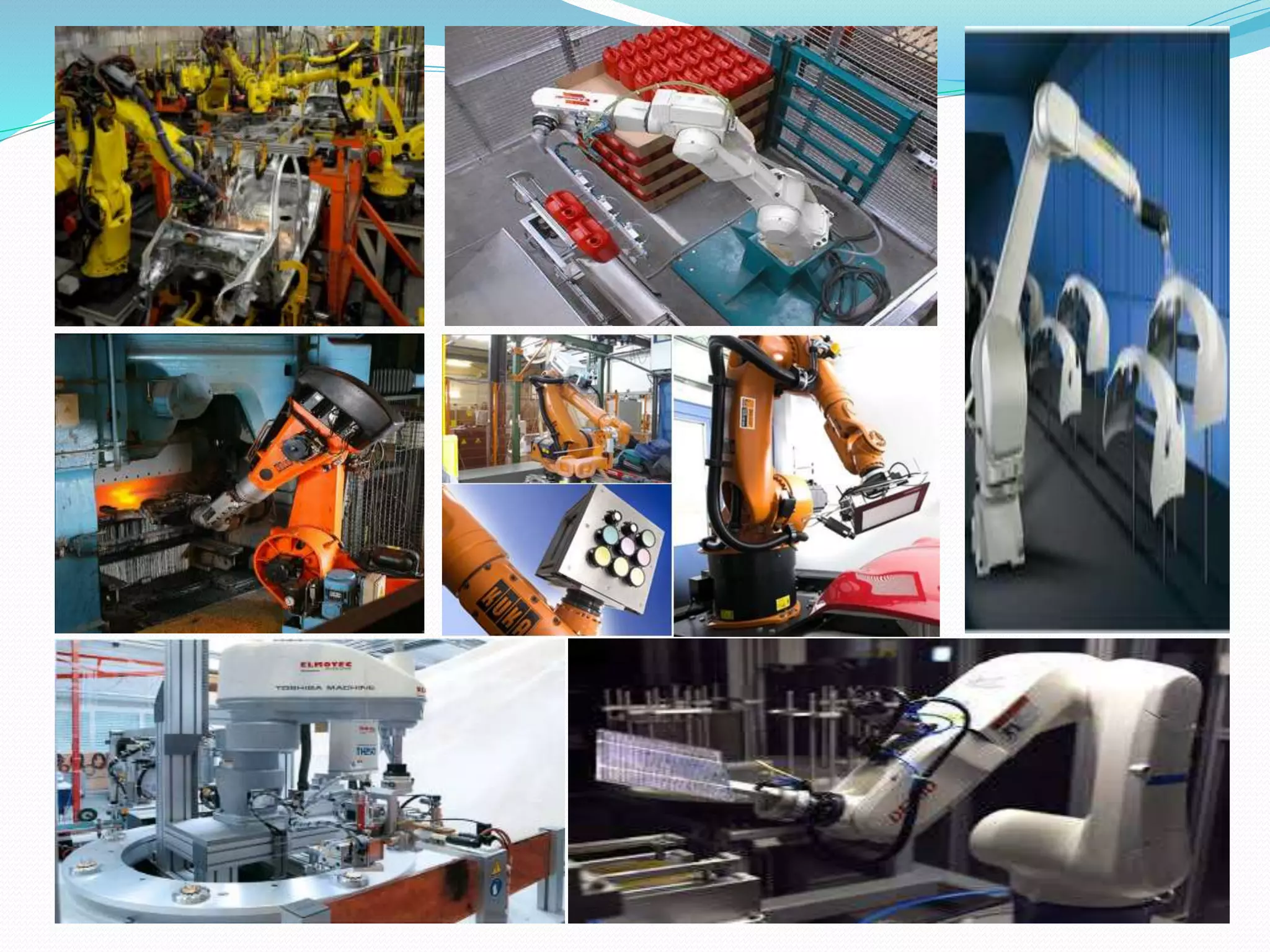
Application Robot Automation in 
production system 
 Welding 
 Spray painting 
 Assembly 
 Palletizing and Material Handling 
 Semiconductor industry
Chapter 1 Intro to industrial robot automation (2)

Chapter 1 Intro to industrial robot automation (2)

  • 1.
    CHAPTER 1: INTRODUCTIONTO INDUSTRIAL ROBOTS AUTOMATION
  • 2.
    Learning Outcomes: Uponcompletion this chapter, student should be able:- 1. Define the robots automation 2. State the advantages and disadvantages of robots automation 3. List six types of robot automation 4. Explain the robots automation in production system
  • 3.
    Contents 1. Introductionof robots automation 2. Advantages and disadvantages of robot automation 3. Types of robots automation 4. Robot automation in production system
  • 4.
    Introduction of RobotsAutomation  Robot is a machine that can be programmed to perform a variety of jobs  Can range from simple machines to highly complex, computer-controlled devices  Three Law of robotics:  A robot may not injure a human being or through inaction, allow a human being to come harm  Robot must be obey the orders given it by human beings except where such order would conflict with the first law  Robot must protect its own existence as long as such protection does not conflict with first and second law
  • 5.
     For amachine to qualify as a robot, it usually needs these 5 parts: i. Controller ii. Manipulator iii. Actuator iv. End Effectors v. Sensor
  • 6.
    Controller  Connectedto a computer  Controller function as the brain of the robot  Controller also allows the robot to be networked to other systems.  Robot have controller that are run by programme set of instruction written in code.
  • 7.
    Manipulator  Robotarm come in all shapes and size  The arm is the part of the robot that positions the end-effector and sensors  Many resemble human arm and have shoulder, elbow, wrist, even fingers  A simple robot arm with 3 degrees of freedom could move 3 way; up and down, left and right, forward and backward.
  • 9.
    Actuator  actuatoris a mechanism used to drive the processor to allow it to move to a predetermined point.  consists of components such as pneumatic and hydraulic cylinders, pneumatic and hydraulic rotary motor, and the electric motor.  robot position also depends on the combination of these components.  The robot has a simple movement is driven by a mechanical system that uses a cam.
  • 11.
    End -Effector Connected to the robot arm.  It could be a tool such as a gripper, a vacuum pump, hook, scoop and etc.  Some robots can change end-effectors and be programmed for a different task.  If robot has more than one arm, there can be more than one end-effector on the same robot.
  • 13.
    Sensor  Sensorcan provide feedback to the control systems and give the robots more flexibility  Sensor such as visual sensor are useful in the building of more accurate and intelligent robots  Sensor can be classified as follows:  Position sensor  Range sensor  Velocity sensor  Proximity sensor
  • 14.
    Power Sources ForRobots  There are basically three types of power sources for robot:  Hydraulic drive  Electric drive  Pneumatic drive
  • 15.
    Hydraulic drive Provide fast movements  Preferred for moving heavy part  Preferred to be used in expressive environments  Occupy large space area  There is a danger of oil leak to the shop floor
  • 16.
    Electric drive Slower movement compare to the hydraulic robots  Good for small and medium size robots  Better positioning accuracy and repeatability  Stepper motor drive: open loop control  DC motor drive: closed loop control  Cleaner environment  The most used type of drive in industry
  • 17.
    Pneumatic drive Preferred for smaller robots  Less expensive than electric or hydraulic robots  Suitable for relatively less degrees of freedom design  Suitable for simple pick and place application  Relatively cheaper
  • 18.
    The Robot Movements  The basic movements required for motion of most industrial robots are:  Rotational movement – enable robot to place its arm in any direction on a horizontal plane  Radial movement – enables robot to move its end-effector radials to reach distant points  Vertical movement – enables robot to take its end-effector to different heights
  • 19.
    The Robot Joints Prismatic Joints Revolute Joints •In a prismatic joints, also known as a sliding or linear joint (L) •The link are generally parallel to one • In a revolute joints permit only angular motion between link • Their variations include: • Rotational joint (R) • Twisting joint (T) • Revolving joint (V)
  • 20.
  • 21.
    Rotational joint A rotational joint is defined by its motion.  Rotation an axis perpendicular to the adjoining links.
  • 22.
    Twisting joint A twisting joint is also rotational joint.  Rotation takes place about an axis that is parallel to both adjoining links.
  • 23.
    Revolving joint Another rotational joint.  The rotation takes place about an axis that is parallel to one of the adjoining links.
  • 24.
    Advantages and disadvantages Advantages:  Robot never get sick or need rest  When the task required would be dangerous for a person, robot can do the work instead  Robot can work repetitive and unrewarding Disadvantages:  Not creative or innovative  Do not think independently  Do not make complicated decisions  Do not learn from mistakes  Do not adapt quickly to changes in their surroundings
  • 25.
    Types Of RobotsAutomation There are 6 types of robot :  Cartesian/Gantry Robot  Cylindrical Robot  Spherical/Polar Robot  SCARA Robot  Articulated Robot  Parallel Robot
  • 26.
    Cartesian Robot It used for pick and place work, application of sealant, assembly operation, handling machine tools and arc welding  This arm robot has three prismatic joints, whose axes are coincident with a Cartesian coordinator  X =horizontal, left and right motions  Y = vertical, up and down motions  Z = horizontal, forward and backward motions
  • 28.
    Cylindrical Robot It used for assembly operations, handling at machine tools, spot welding and handling at die-casting machines  This robot axes form a cylindrical coordinate system  X = horizontal rotation of 360°, left and right motions  Y = vertical, up and down motions  Z = horizontal, forward and backward motions
  • 30.
    Spherical/Polar Robot Used for handling at machine tools, spot welding, die-casting, fettling machines, gas welding and arc welding.  Robot axes form a polar coordinate system.  X = horizontal rotation of 360°, left and right motions  Y = vertical rotation of 270°, up and down motions  Z = horizontal, forward and backward motions
  • 32.
    SCARA Robot SCARA (Selective Compliant Assembly Robot Arm)  Used for pick and place work, application of sealant, assembly operations and handling machine tools  This robot has 2 parallel rotary joints to provide compliance in a plane
  • 34.
    Articulated Robot Used for assembly operations, die-casting, fettling machines, gas welding, arc welding and spray painting  This robot arm has at least 3 rotary joints  X = horizontal rotation of 360° left and right motions  Y = vertical rotation of 270°, up and down motions  Z = horizontal & vertical rotation of 90° to 180°, forward and backward motions
  • 36.
    Parallel Robot This robot is used for mobile platform handling cockpit flight simulators  This robot arm has concurrent prismatic or rotary joints
  • 38.
    Application Robot Automationin production system  Welding  Spray painting  Assembly  Palletizing and Material Handling  Semiconductor industry