Operation of industrial Robots
& their Application
Assignment # 4
That is an assignment of Material Handling that contains operation of Industrial robots along with it
types and application in modern day industry.
1/6/2016
SUBMITTED BY:
MUDDASSAR LATIF AWAN (BSMT01123085)
SUBMITTED TO:
Mr. ARSHAD CHOUDRY
Industrial Robots
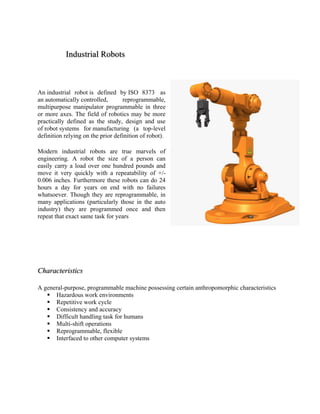
An industrial robot is defined by ISO 8373 as
an automatically controlled, reprogrammable,
multipurpose manipulator programmable in three
or more axes. The field of robotics may be more
practically defined as the study, design and use
of robot systems for manufacturing (a top-level
definition relying on the prior definition of robot).
Modern industrial robots are true marvels of
engineering. A robot the size of a person can
easily carry a load over one hundred pounds and
move it very quickly with a repeatability of +/-
0.006 inches. Furthermore these robots can do 24
hours a day for years on end with no failures
whatsoever. Though they are reprogrammable, in
many applications (particularly those in the auto
industry) they are programmed once and then
repeat that exact same task for years
Characteristics
A general-purpose, programmable machine possessing certain anthropomorphic characteristics
 Hazardous work environments
 Repetitive work cycle
 Consistency and accuracy
 Difficult handling task for humans
 Multi-shift operations
 Reprogrammable, flexible
 Interfaced to other computer systems
Operation of Robots
Industrial robots are programmable, multi-
function manipulators designed to automate
tasks such as welding or the movement of
materials through variable programmed
motions. Robots are capable of performing a
wide variety of tasks and are an integral part of
automated manufacturing systems.
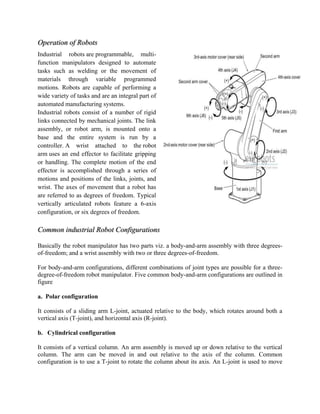
Industrial robots consist of a number of rigid
links connected by mechanical joints. The link
assembly, or robot arm, is mounted onto a
base and the entire system is run by a
controller. A wrist attached to the robot
arm uses an end effector to facilitate gripping
or handling. The complete motion of the end
effector is accomplished through a series of
motions and positions of the links, joints, and
wrist. The axes of movement that a robot has
are referred to as degrees of freedom. Typical
vertically articulated robots feature a 6-axis
configuration, or six degrees of freedom.
Common industrial Robot Configurations
Basically the robot manipulator has two parts viz. a body-and-arm assembly with three degrees-
of-freedom; and a wrist assembly with two or three degrees-of-freedom.
For body-and-arm configurations, different combinations of joint types are possible for a three-
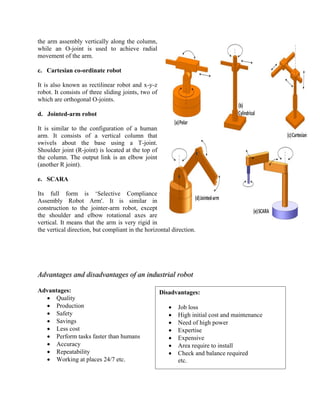
degree-of-freedom robot manipulator. Five common body-and-arm configurations are outlined in
figure
a. Polar configuration
It consists of a sliding arm L-joint, actuated relative to the body, which rotates around both a
vertical axis (T-joint), and horizontal axis (R-joint).
b. Cylindrical configuration
It consists of a vertical column. An arm assembly is moved up or down relative to the vertical
column. The arm can be moved in and out relative to the axis of the column. Common
configuration is to use a T-joint to rotate the column about its axis. An L-joint is used to move
the arm assembly vertically along the column,
while an O-joint is used to achieve radial
movement of the arm.
c. Cartesian co-ordinate robot
It is also known as rectilinear robot and x-y-z
robot. It consists of three sliding joints, two of
which are orthogonal O-joints.
d. Jointed-arm robot
It is similar to the configuration of a human
arm. It consists of a vertical column that
swivels about the base using a T-joint.
Shoulder joint (R-joint) is located at the top of
the column. The output link is an elbow joint
(another R joint).
e. SCARA
Its full form is ‘Selective Compliance
Assembly Robot Arm'. It is similar in
construction to the jointer-arm robot, except
the shoulder and elbow rotational axes are
vertical. It means that the arm is very rigid in
the vertical direction, but compliant in the horizontal direction.
Advantages and disadvantages of an industrial robot
Advantages:
 Quality
 Production
 Safety
 Savings
 Less cost
 Perform tasks faster than humans
 Accuracy
 Repeatability
 Working at places 24/7 etc.
Disadvantages:
 Job loss
 High initial cost and maintenance
 Need of high power
 Expertise
 Expensive
 Area require to install
 Check and balance required
etc.
Application
Industrial robots have been in use for about 50 years. The first industrial robot was used for
material handling in General Motors facilities. Nowadays, many different applications can be
done by robots. But which ones are the most popular? Here are the top 5 applications for
industrial robots:
1) Robotic handling operations (38%)
2) Robotic Welding (29%)
3) Robotic Assembly (10%)
4) Robotic Dispensing (4%)
5) Robotic Processing (2%)
Other applications are
 Domestic or household robots
 Medical robots
 Service robots
 Military robots
 Entertainment robots
 Hobby and competition robots
References
http://14hmj.qataracademy.wikispaces.net/Advantages+and+Disadvantages+of+Robots
https://www.robots.com/blog/viewing/advantages-and-disadvantages-of-automating-with-industrial-
robots
http://www.learnaboutrobots.com/industrial.htm
https://en.wikipedia.org/wiki/Industrial_robot
http://www.allonrobots.com/types-of-robots.html
http://nptel.ac.in/courses/112103174/module7/lec5/3.html
Composed by: Muddassar Awan
Muddassarlatifawan@gmail.com

Industrial robots

  • 1.
    Operation of industrialRobots & their Application Assignment # 4 That is an assignment of Material Handling that contains operation of Industrial robots along with it types and application in modern day industry. 1/6/2016 SUBMITTED BY: MUDDASSAR LATIF AWAN (BSMT01123085) SUBMITTED TO: Mr. ARSHAD CHOUDRY
  • 2.
    Industrial Robots An industrialrobot is defined by ISO 8373 as an automatically controlled, reprogrammable, multipurpose manipulator programmable in three or more axes. The field of robotics may be more practically defined as the study, design and use of robot systems for manufacturing (a top-level definition relying on the prior definition of robot). Modern industrial robots are true marvels of engineering. A robot the size of a person can easily carry a load over one hundred pounds and move it very quickly with a repeatability of +/- 0.006 inches. Furthermore these robots can do 24 hours a day for years on end with no failures whatsoever. Though they are reprogrammable, in many applications (particularly those in the auto industry) they are programmed once and then repeat that exact same task for years Characteristics A general-purpose, programmable machine possessing certain anthropomorphic characteristics  Hazardous work environments  Repetitive work cycle  Consistency and accuracy  Difficult handling task for humans  Multi-shift operations  Reprogrammable, flexible  Interfaced to other computer systems
  • 3.
    Operation of Robots Industrialrobots are programmable, multi- function manipulators designed to automate tasks such as welding or the movement of materials through variable programmed motions. Robots are capable of performing a wide variety of tasks and are an integral part of automated manufacturing systems. Industrial robots consist of a number of rigid links connected by mechanical joints. The link assembly, or robot arm, is mounted onto a base and the entire system is run by a controller. A wrist attached to the robot arm uses an end effector to facilitate gripping or handling. The complete motion of the end effector is accomplished through a series of motions and positions of the links, joints, and wrist. The axes of movement that a robot has are referred to as degrees of freedom. Typical vertically articulated robots feature a 6-axis configuration, or six degrees of freedom. Common industrial Robot Configurations Basically the robot manipulator has two parts viz. a body-and-arm assembly with three degrees- of-freedom; and a wrist assembly with two or three degrees-of-freedom. For body-and-arm configurations, different combinations of joint types are possible for a three- degree-of-freedom robot manipulator. Five common body-and-arm configurations are outlined in figure a. Polar configuration It consists of a sliding arm L-joint, actuated relative to the body, which rotates around both a vertical axis (T-joint), and horizontal axis (R-joint). b. Cylindrical configuration It consists of a vertical column. An arm assembly is moved up or down relative to the vertical column. The arm can be moved in and out relative to the axis of the column. Common configuration is to use a T-joint to rotate the column about its axis. An L-joint is used to move
  • 4.
    the arm assemblyvertically along the column, while an O-joint is used to achieve radial movement of the arm. c. Cartesian co-ordinate robot It is also known as rectilinear robot and x-y-z robot. It consists of three sliding joints, two of which are orthogonal O-joints. d. Jointed-arm robot It is similar to the configuration of a human arm. It consists of a vertical column that swivels about the base using a T-joint. Shoulder joint (R-joint) is located at the top of the column. The output link is an elbow joint (another R joint). e. SCARA Its full form is ‘Selective Compliance Assembly Robot Arm'. It is similar in construction to the jointer-arm robot, except the shoulder and elbow rotational axes are vertical. It means that the arm is very rigid in the vertical direction, but compliant in the horizontal direction. Advantages and disadvantages of an industrial robot Advantages:  Quality  Production  Safety  Savings  Less cost  Perform tasks faster than humans  Accuracy  Repeatability  Working at places 24/7 etc. Disadvantages:  Job loss  High initial cost and maintenance  Need of high power  Expertise  Expensive  Area require to install  Check and balance required etc.
  • 5.
    Application Industrial robots havebeen in use for about 50 years. The first industrial robot was used for material handling in General Motors facilities. Nowadays, many different applications can be done by robots. But which ones are the most popular? Here are the top 5 applications for industrial robots: 1) Robotic handling operations (38%) 2) Robotic Welding (29%) 3) Robotic Assembly (10%) 4) Robotic Dispensing (4%) 5) Robotic Processing (2%) Other applications are  Domestic or household robots  Medical robots  Service robots  Military robots  Entertainment robots  Hobby and competition robots References http://14hmj.qataracademy.wikispaces.net/Advantages+and+Disadvantages+of+Robots https://www.robots.com/blog/viewing/advantages-and-disadvantages-of-automating-with-industrial- robots http://www.learnaboutrobots.com/industrial.htm https://en.wikipedia.org/wiki/Industrial_robot http://www.allonrobots.com/types-of-robots.html http://nptel.ac.in/courses/112103174/module7/lec5/3.html Composed by: Muddassar Awan Muddassarlatifawan@gmail.com