O’Hara Gómez Mauramati ~ Estela Sevilla Andújar
Paula Gómez Juárez ~ Ana María Lozano Juárez
INDUSTRIAL
ROBOTS
What we’re going to talk?
Definition of a
robot
Robot
components
Types of industrial
robots
Bibliography
What is
a
ROBOT?
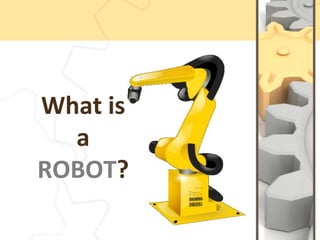
The word robot was invented in the 20th century
and comes from the Czech word robota.
A machine capable of carrying out a complex
series of actions
automatically, programmable, that is to say, a
machine resembling a human being and able to
replicate certain human movements and
functions automatically.
What is a robot?
A robot consists of
electric, electronic and
mechanical.
The Robots are very good for
certain functions, because
unlike humans never get
tired, or fatigued and can
work in dangerous
conditions, without air and
without the easily distracted.
What is a robot?
Parts of
a
ROBOT
Parts of a robot
Robot arms:
Robots arms can vary in size and shape. The robot arm is
the part that permit that the robot can move freely. With
the robot arm, the shoulder, elbow and wrist move and
twist to the exact position. A simple robot with three
degrees of freedom can move in three ways: up &
down, left & right, and forward & backward.
Sensors:
Sensors allow the robot to receive feedback about its
environment. The sensor collects information and sends it
to the robot controlled. One use of these sensors is to keep
two robots that work closely together from bumping into
each other. Sensors can also assist end parts by adjusting
for part variances. Vision sensors allow a robot to
differentiate between items to choose and items to ignore.
Parts of a robot
The end part:
The end part connects to the robot's arm and
functions as a fingers of a hand. This part comes
in direct contact with the material the robot is
manipulating. Some variations of an effector are
a gripper, a vacuum pump, magnets, and welding
torches.
The controller:
The controller is the "brain“ of the robot and
allows the parts of the robot to operate together.
The controller gives instructions written in code
called a program.
Parts of a robot
The drive:
The drive is the engine that moves the
articulations into their designated positions. The
joints are the sections between the parts of the
robot. The following types of units are:
hydraulic, electric, or pneumatic.
o Hydraulic drive systems give a robot great
speed and strength.
o Electric system provides a robot with less
speed and strength.
o Pneumatic drive systems are used for smaller
robots that have fewer axes of movement.
Types of
industrial
ROBOTS
Types of industrial robots
A type of robotic arm
that has prismatic joints
only. The linear
movement of the joints
gives the Cartesian
robot a highly rigid
structure that allows it
to lift heavy objects.
Cartesian Robot
Types of industrial robots
Used for assembly operations, handling at
machine tools, spot welding, and handling at die-
casting machines. It's a robot whose axes form a
cylindrical coordinate system.
Cylindrical Robot
Types of industrial robots
Used for handling at machine tools, spot
welding, die-casting, fettling machines, gas
welding and arc welding. It's a robot whose axes
form a polar coordinate system.
Spherical / Polar Robot
Types of industrial robots
Used for pick and place
work, application of
sealant, assembly
operations and
handling machine
tools. It's a robot which
has two parallel rotary
joints to provide
compliance in a plane.
Scara Robot
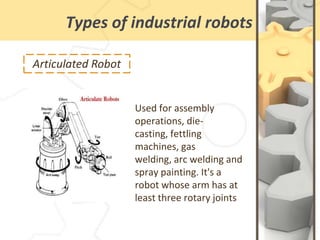
Types of industrial robots
Used for assembly
operations, die-
casting, fettling
machines, gas
welding, arc welding and
spray painting. It's a
robot whose arm has at
least three rotary joints
Articulated Robot
Types of industrial robots
One use is a mobile
platform handling
cockpit flight
simulators. It's a
robot whose arms
have concurrent
prismatic or rotary
joints.
Parallel robot
Video
Bibliography
http://www.robotics.utexas.edu/rrg/learn_more/low_ed/types/in
dustrial.html
http://www.welding-technology-machines.info/welding-
robots/industrial-robots.htm
http://www.robotbasics.com/robot-components
http://www.robots.com/faq.php?question=robot+parts
http://inventors.about.com/od/roboticsrobots/a/RobotDefinition.
htm
http://oxforddictionaries.com/definition/robot

Industrial robots

  • 1.
    O’Hara Gómez Mauramati~ Estela Sevilla Andújar Paula Gómez Juárez ~ Ana María Lozano Juárez INDUSTRIAL ROBOTS
  • 2.
    What we’re goingto talk? Definition of a robot Robot components Types of industrial robots Bibliography
  • 3.
  • 4.
    The word robotwas invented in the 20th century and comes from the Czech word robota. A machine capable of carrying out a complex series of actions automatically, programmable, that is to say, a machine resembling a human being and able to replicate certain human movements and functions automatically. What is a robot?
  • 5.
    A robot consistsof electric, electronic and mechanical. The Robots are very good for certain functions, because unlike humans never get tired, or fatigued and can work in dangerous conditions, without air and without the easily distracted. What is a robot?
  • 6.
  • 7.
    Parts of arobot Robot arms: Robots arms can vary in size and shape. The robot arm is the part that permit that the robot can move freely. With the robot arm, the shoulder, elbow and wrist move and twist to the exact position. A simple robot with three degrees of freedom can move in three ways: up & down, left & right, and forward & backward. Sensors: Sensors allow the robot to receive feedback about its environment. The sensor collects information and sends it to the robot controlled. One use of these sensors is to keep two robots that work closely together from bumping into each other. Sensors can also assist end parts by adjusting for part variances. Vision sensors allow a robot to differentiate between items to choose and items to ignore.
  • 8.
    Parts of arobot The end part: The end part connects to the robot's arm and functions as a fingers of a hand. This part comes in direct contact with the material the robot is manipulating. Some variations of an effector are a gripper, a vacuum pump, magnets, and welding torches. The controller: The controller is the "brain“ of the robot and allows the parts of the robot to operate together. The controller gives instructions written in code called a program.
  • 9.
    Parts of arobot The drive: The drive is the engine that moves the articulations into their designated positions. The joints are the sections between the parts of the robot. The following types of units are: hydraulic, electric, or pneumatic. o Hydraulic drive systems give a robot great speed and strength. o Electric system provides a robot with less speed and strength. o Pneumatic drive systems are used for smaller robots that have fewer axes of movement.
  • 10.
  • 11.
    Types of industrialrobots A type of robotic arm that has prismatic joints only. The linear movement of the joints gives the Cartesian robot a highly rigid structure that allows it to lift heavy objects. Cartesian Robot
  • 12.
    Types of industrialrobots Used for assembly operations, handling at machine tools, spot welding, and handling at die- casting machines. It's a robot whose axes form a cylindrical coordinate system. Cylindrical Robot
  • 13.
    Types of industrialrobots Used for handling at machine tools, spot welding, die-casting, fettling machines, gas welding and arc welding. It's a robot whose axes form a polar coordinate system. Spherical / Polar Robot
  • 14.
    Types of industrialrobots Used for pick and place work, application of sealant, assembly operations and handling machine tools. It's a robot which has two parallel rotary joints to provide compliance in a plane. Scara Robot
  • 15.
    Types of industrialrobots Used for assembly operations, die- casting, fettling machines, gas welding, arc welding and spray painting. It's a robot whose arm has at least three rotary joints Articulated Robot
  • 16.
    Types of industrialrobots One use is a mobile platform handling cockpit flight simulators. It's a robot whose arms have concurrent prismatic or rotary joints. Parallel robot
  • 17.
  • 18.