Automated Guided Vehicles (AGVs) improve efficiency and reduce costs in manufacturing and warehousing by transporting materials autonomously. Various types of AGVs, such as driverless trains, pallet trucks, and unit load carriers, utilize different navigation systems including wired, guide tape, and laser target. The technology has evolved since its inception in the 1950s, and AGVs are now integral to modern logistical operations across multiple industries.
CONTENTS
Introduction.
Historyof AGV’S.
Working of AGV.
What is AGV ?
Types of AGV’s.
Why consider AGV’s.
Types of navigations in AGV’s.
Applications of AGV’s.
Next gen. AGVs.
3.
Introduction
AGVs increase efficiencyand reduce costs by
helping to automate a manufacturing facility or
warehouse.
AGVs can carry loads or tow objects behind
them in trailers. The trailers can be used to move
raw materials or finished product. The AGV can
also store objects on a bed. some AGVs use fork
lifts to lift objects for storage. AGVs are employed
in nearly every industry, including, paper, metals,
newspaper and general manufacturing.
4.
An AGV canalso be called a laser guided
vehicle(LGV) or self-guided vehicle (SGV). In
Germany the technology is also called Fahrerlose
Transport system (FTS) and in Sweden Forarlosa
trucker.
AGVs are available in a variety of models and can
be used to move products on an assembly line,
transport goods throughout a plant or warehouse.
5.
History of AGV’S
Thefirst AGV was brought to market in the 1950s, by
Barrett Electronics of Northbrook, and at the time it
was simply a tow truck that followed a wire in the floor
instead of a rail. over the years the technology has
become more sophisticated and today automated vehicles
are mainly Laser navigated ex: LGV.
In an automated process, LGVs are programmed to
communicate with other robots to ensure product is moved
smoothly through the warehouse, whether it is being
stored for future use or sent directly to shipping areas.
Today the AGV plays an important role in the design of
new factories and warehouses.
6.
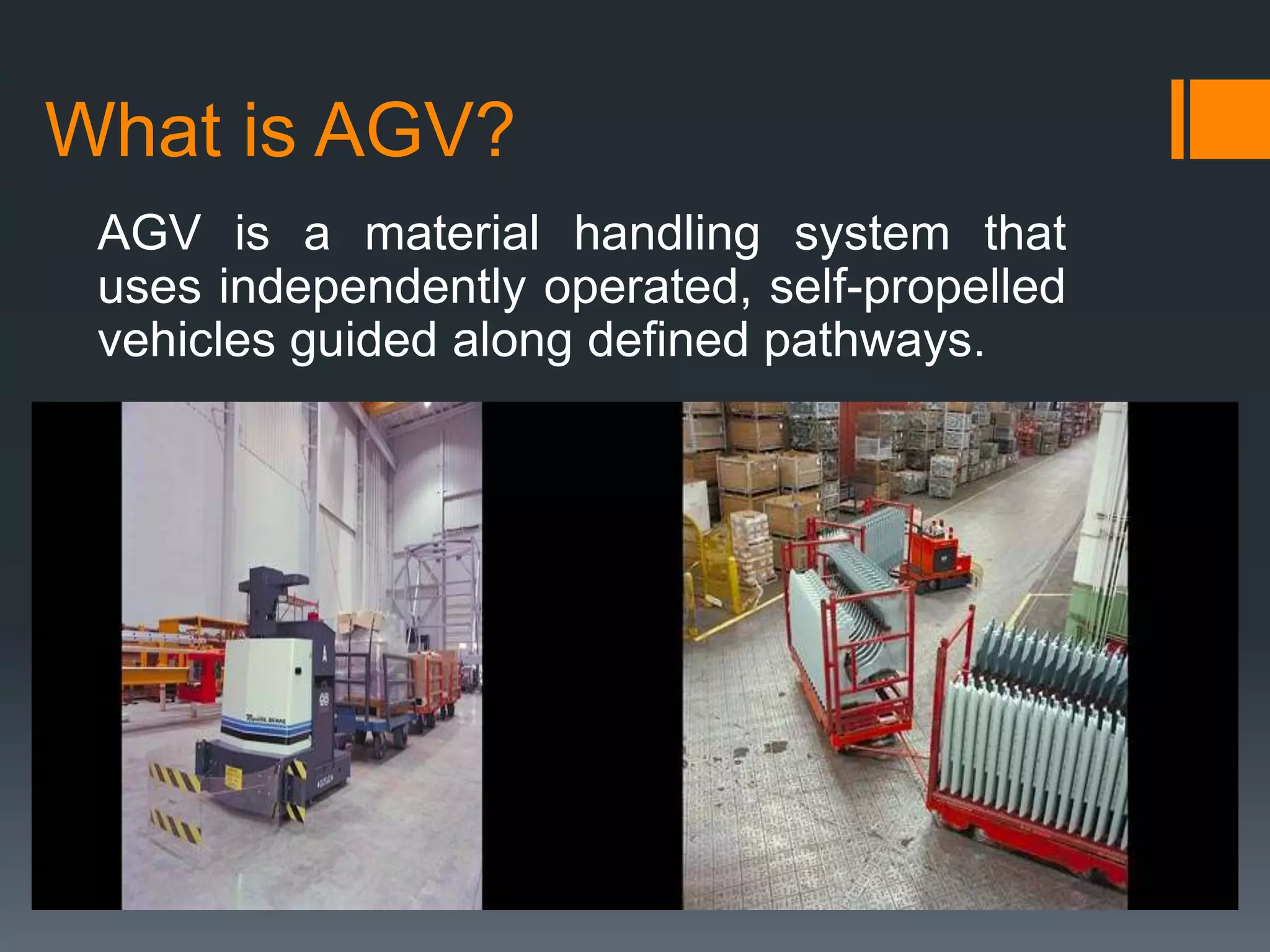
What is AGV?
AGVis a material handling system that
uses independently operated, self-propelled
vehicles guided along defined pathways.
7.
System Features
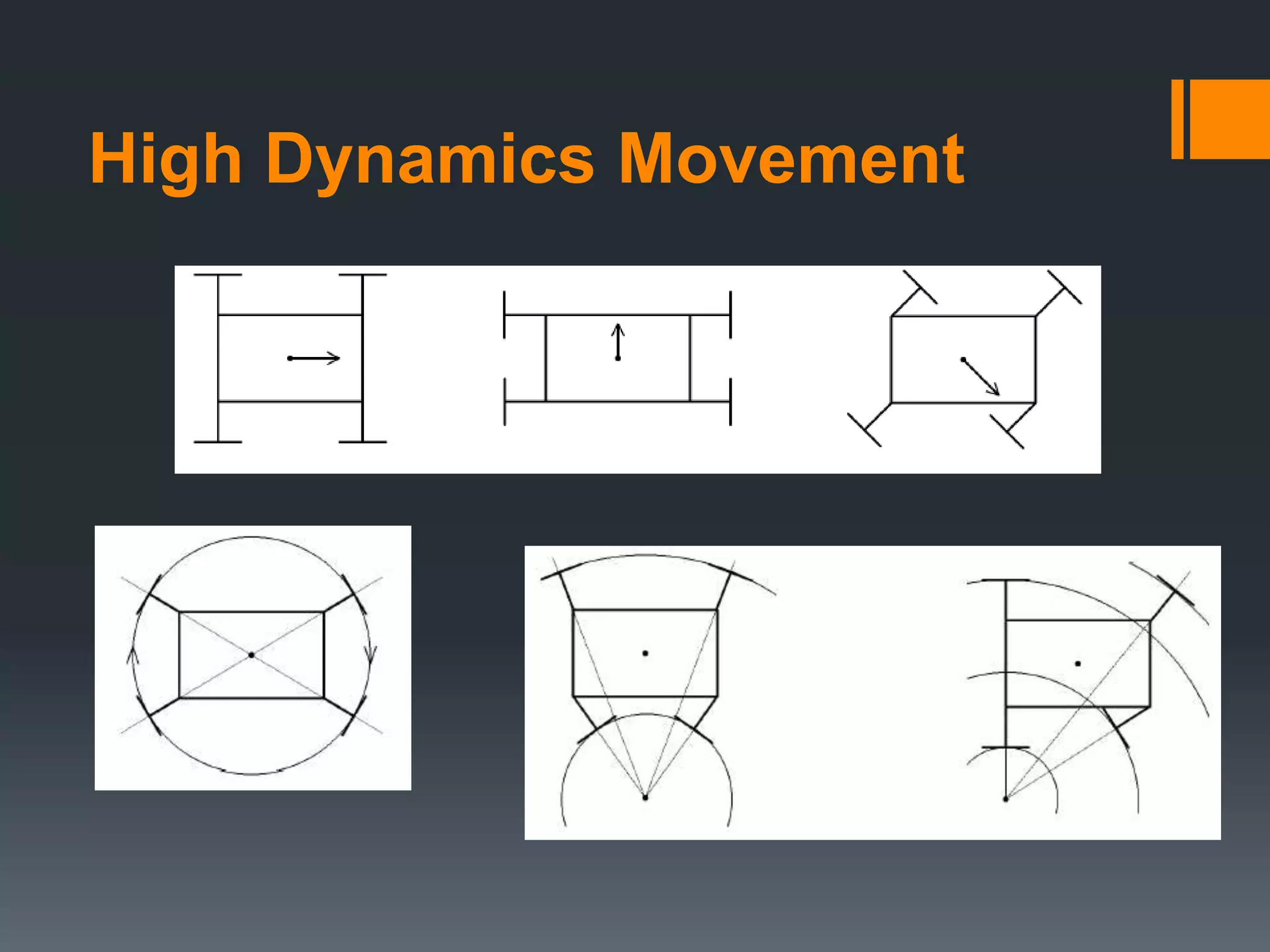
Highdynamic operation
Innovative steering method
Robust design
CAN Bus system communication
Speed control separately for each wheel
Angular position control separately for each axle
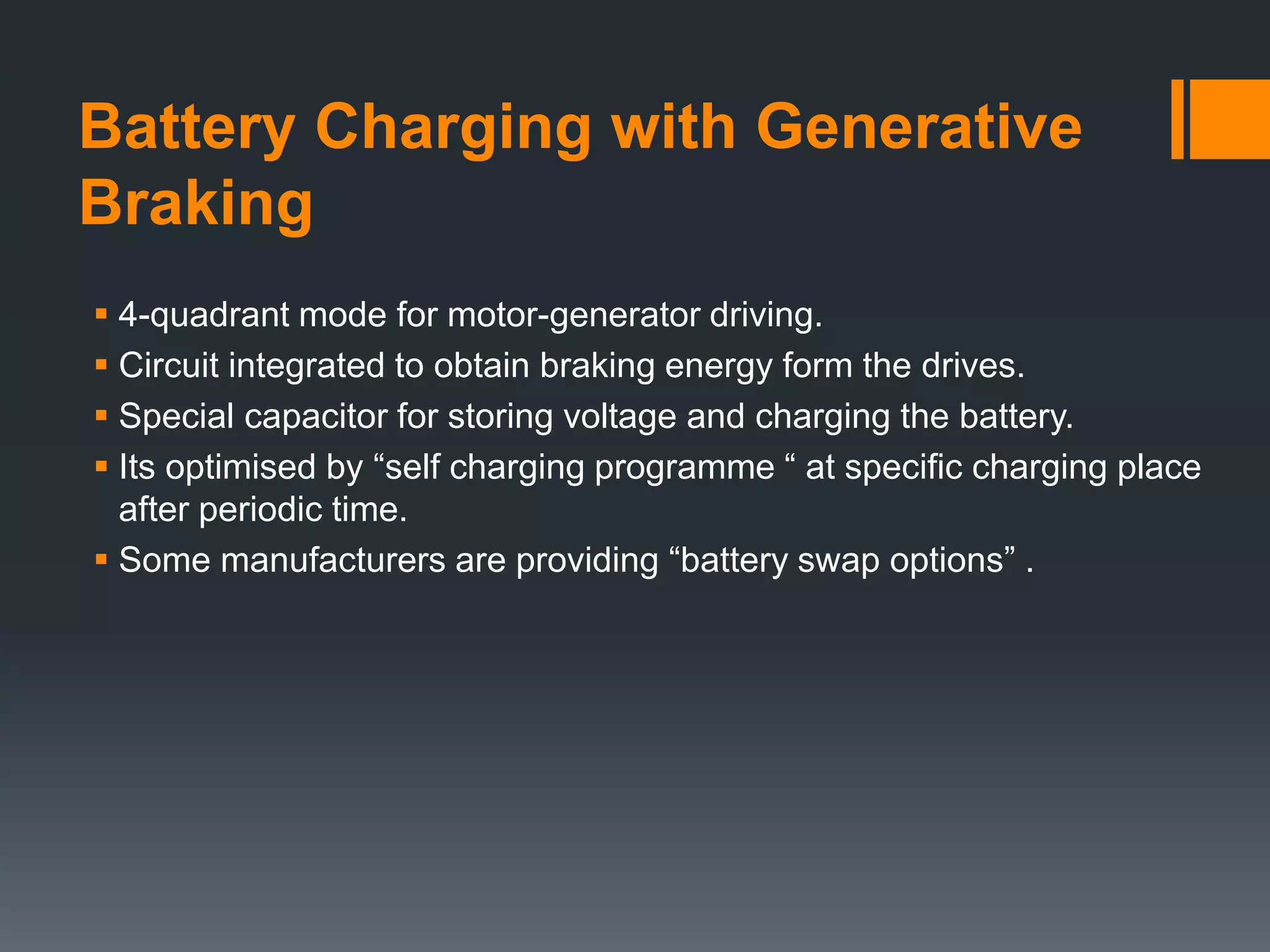
Low energy consumption by self charging
8.
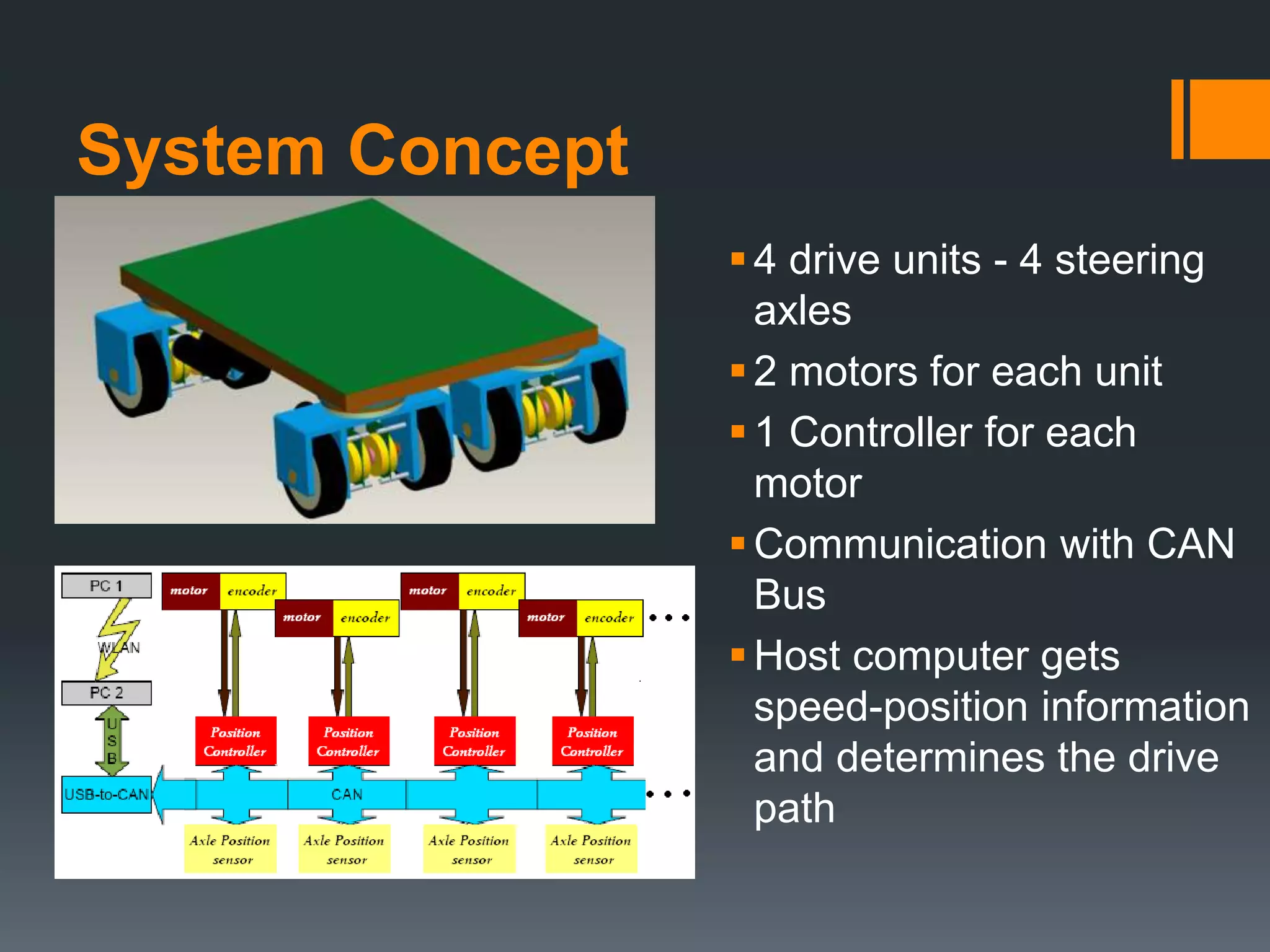
System Concept
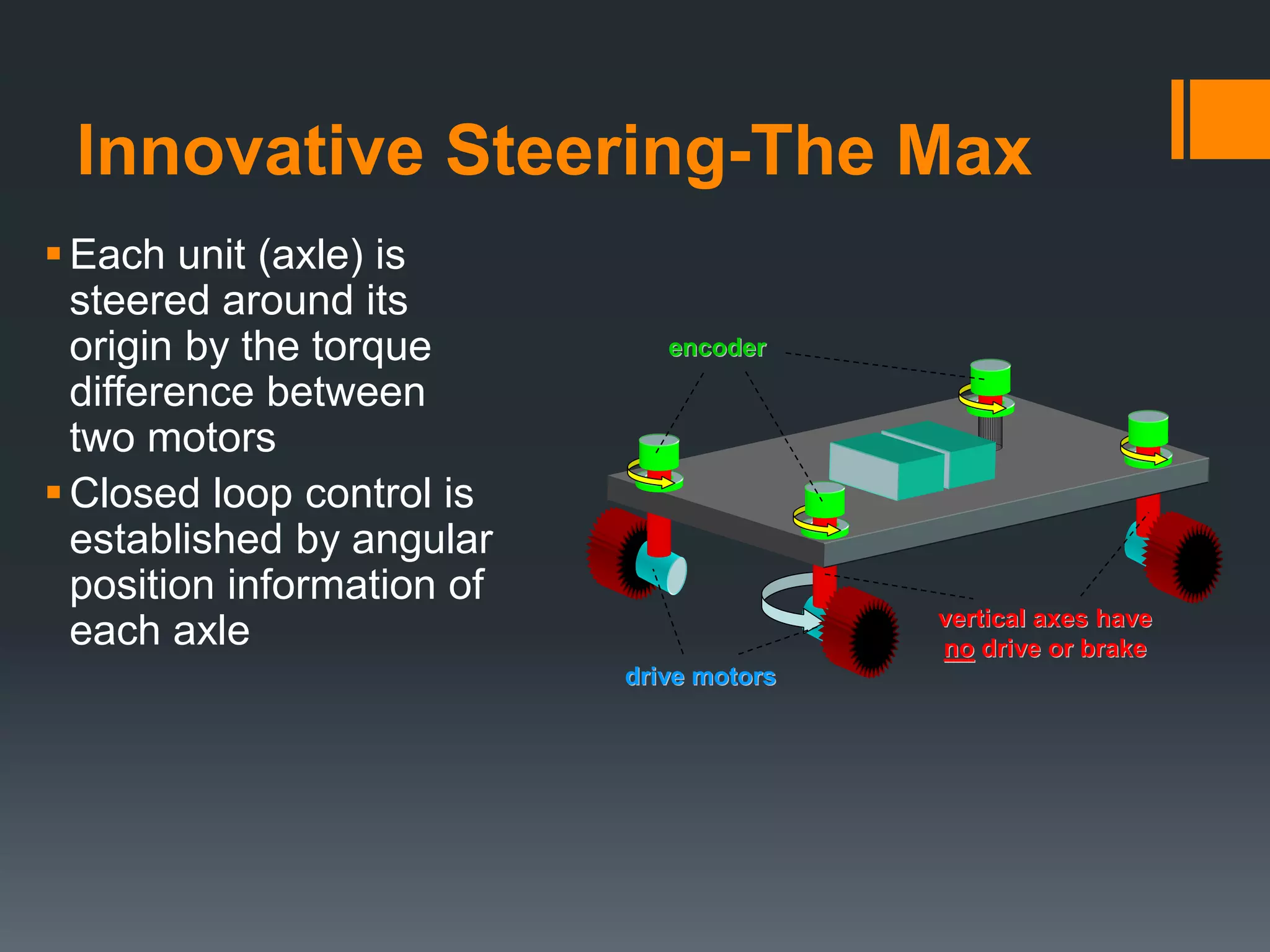
4 driveunits - 4 steering
axles
2 motors for each unit
1 Controller for each
motor
Communication with CAN
Bus
Host computer gets
speed-position information
and determines the drive
path
9.
Innovative Steering-The Max
Eachunit (axle) is
steered around its
origin by the torque
difference between
two motors
Closed loop control is
established by angular
position information of
each axle
drivedrive motorsmotors
encoderencoder
verticalvertical axesaxes havehave
nono drivedrive oror brakebrake
Battery Charging withGenerative
Braking
4-quadrant mode for motor-generator driving.
Circuit integrated to obtain braking energy form the drives.
Special capacitor for storing voltage and charging the battery.
Its optimised by “self charging programme “ at specific charging place
after periodic time.
Some manufacturers are providing “battery swap options” .
12.
Types of AGV’S
Driverless trains
AGV’s pallet trucks
Unit load carriers
13.
Driverless trains:-
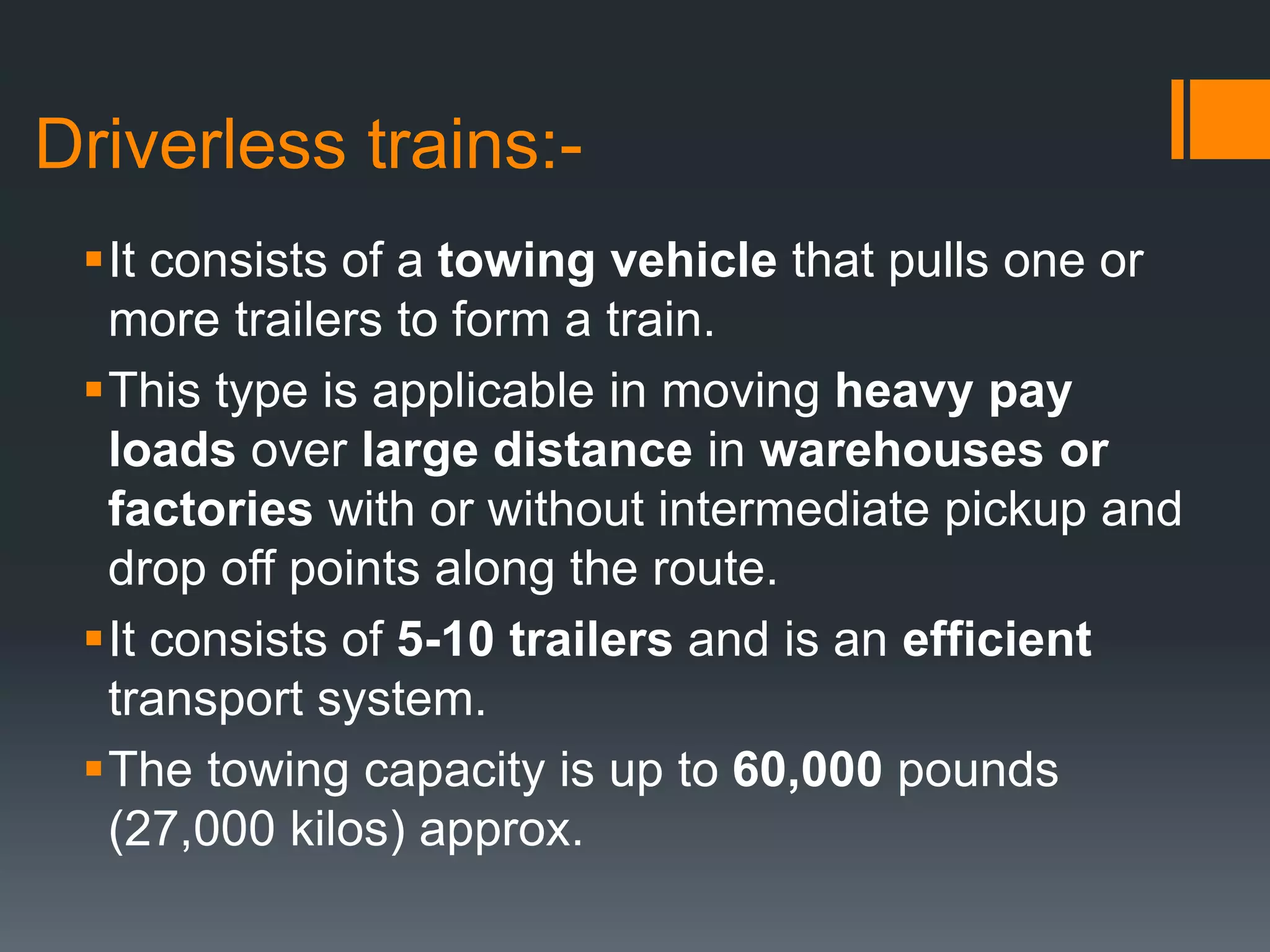
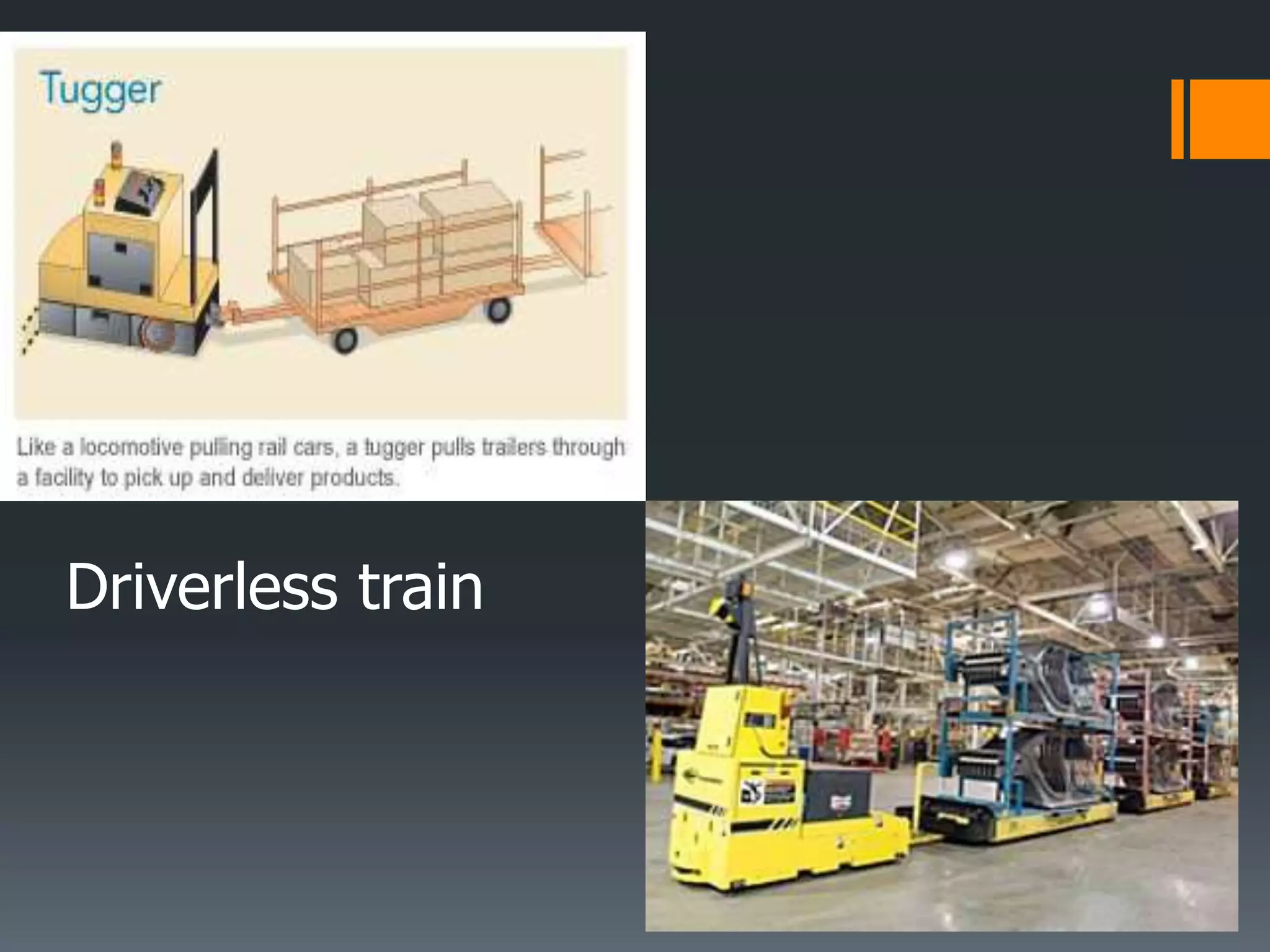
It consistsof a towing vehicle that pulls one or
more trailers to form a train.
This type is applicable in moving heavy pay
loads over large distance in warehouses or
factories with or without intermediate pickup and
drop off points along the route.
It consists of 5-10 trailers and is an efficient
transport system.
The towing capacity is up to 60,000 pounds
(27,000 kilos) approx.
AGV Pallet Trucks:-
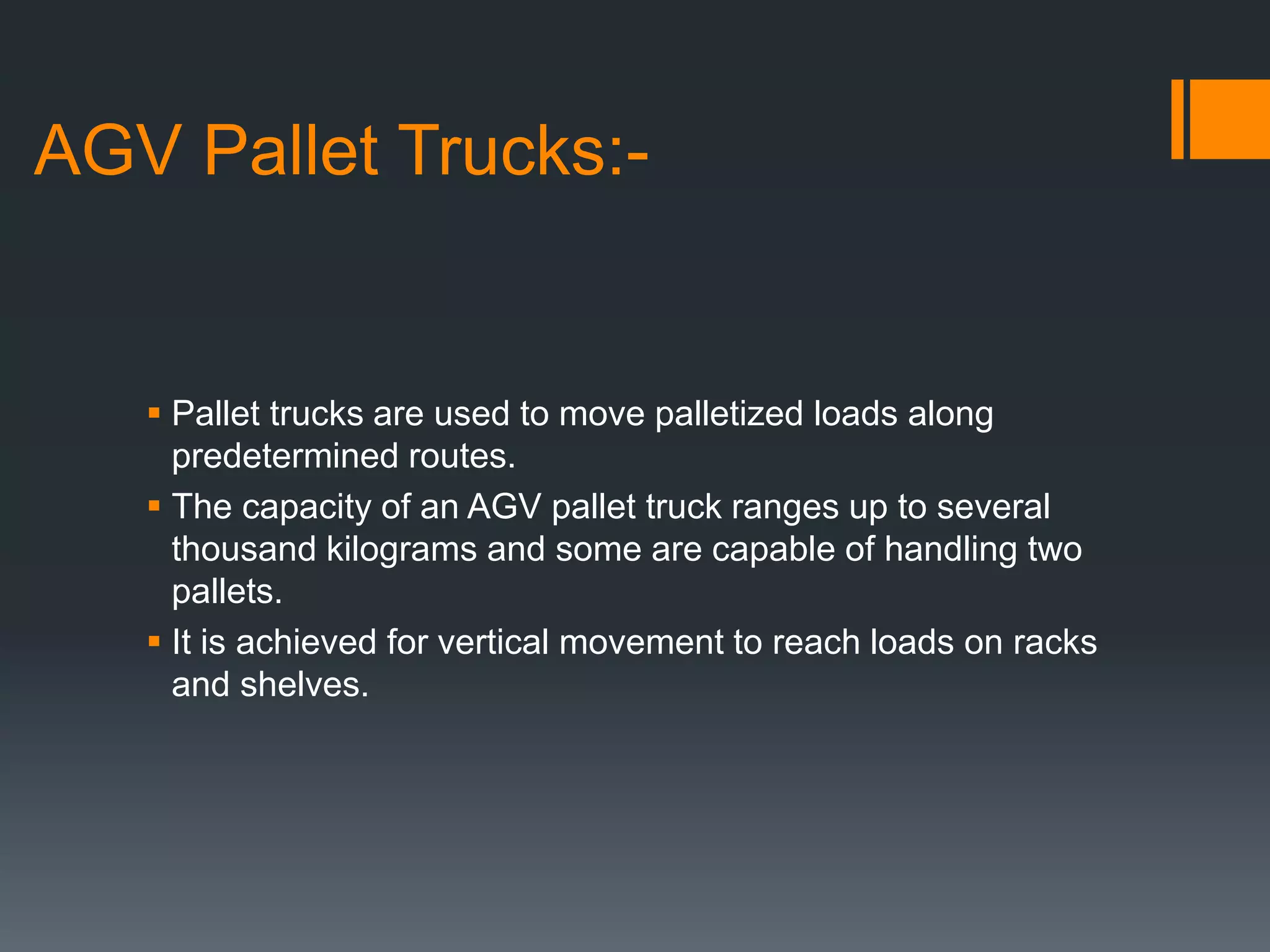
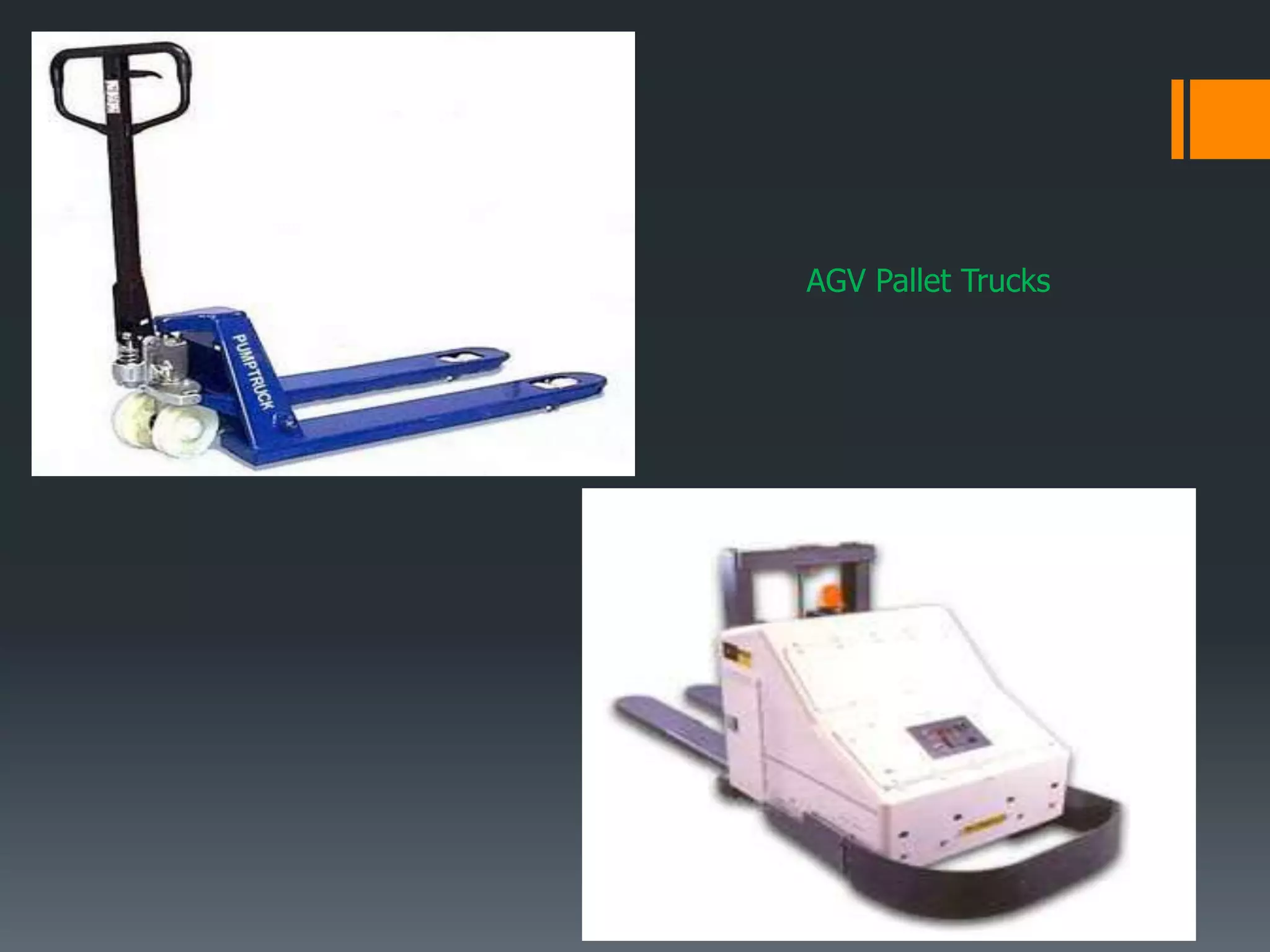
Pallet trucks are used to move palletized loads along
predetermined routes.
The capacity of an AGV pallet truck ranges up to several
thousand kilograms and some are capable of handling two
pallets.
It is achieved for vertical movement to reach loads on racks
and shelves.
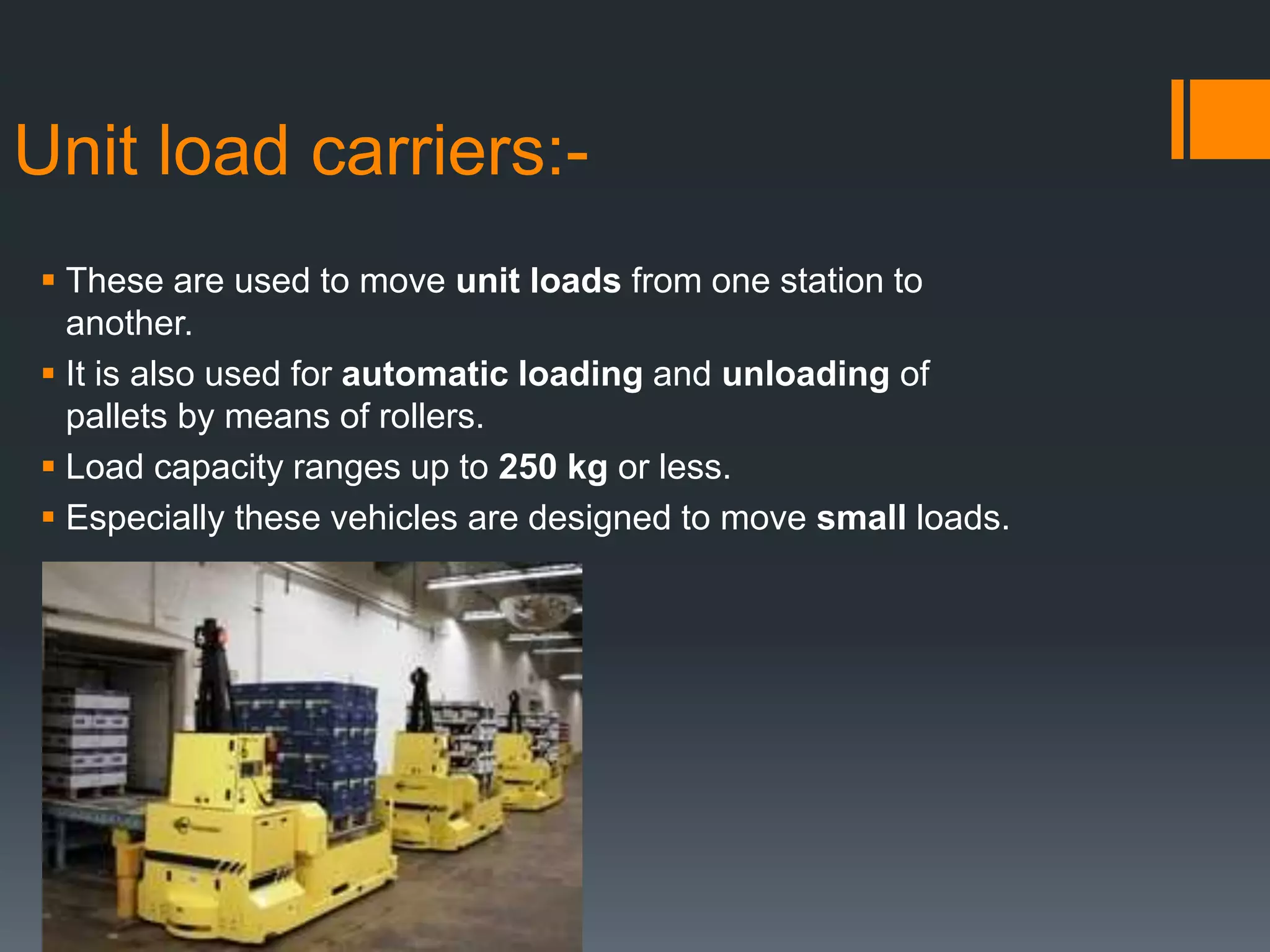
Unit load carriers:-
These are used to move unit loads from one station to
another.
It is also used for automatic loading and unloading of
pallets by means of rollers.
Load capacity ranges up to 250 kg or less.
Especially these vehicles are designed to move small loads.
18.
Why consider AGVs?
Reduces the labor cost.
Flexible.
Intelligent.
Less time consuming.
Can significantly reduce production & warehouse costs.
Transforming the materials handling industry.
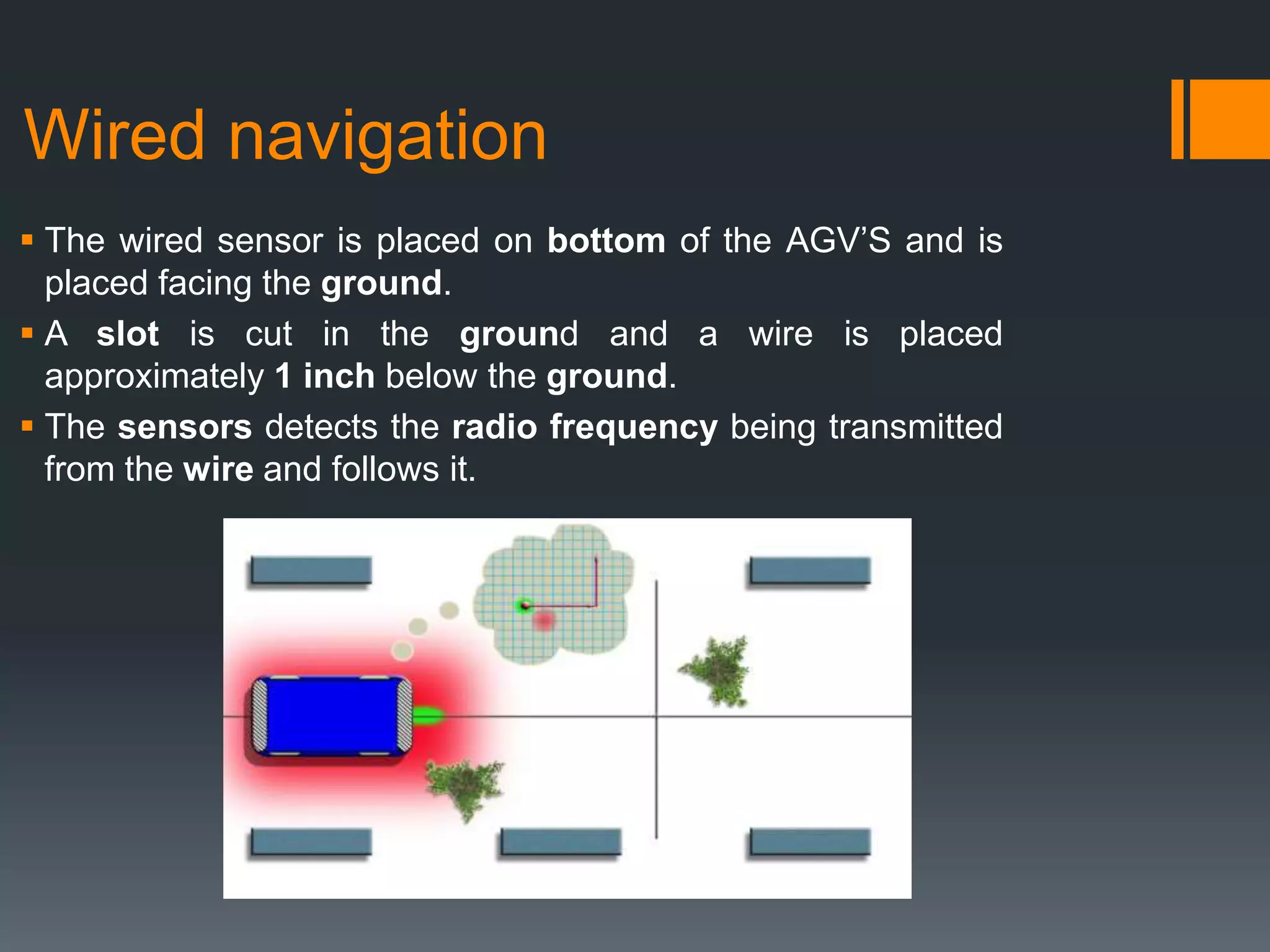
Wired navigation
Thewired sensor is placed on bottom of the AGV’S and is
placed facing the ground.
A slot is cut in the ground and a wire is placed
approximately 1 inch below the ground.
The sensors detects the radio frequency being transmitted
from the wire and follows it.
21.
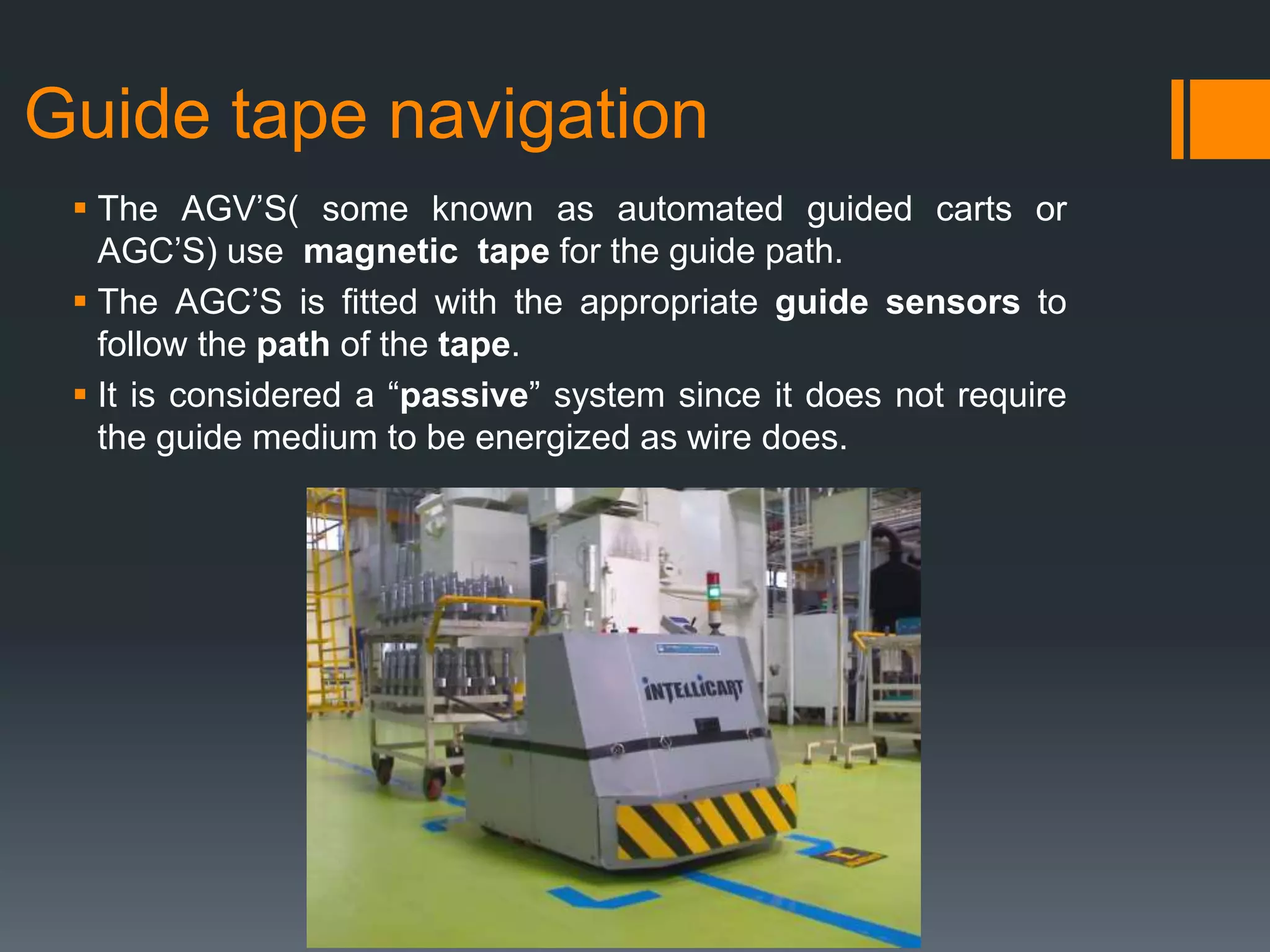
Guide tape navigation
The AGV’S( some known as automated guided carts or
AGC’S) use magnetic tape for the guide path.
The AGC’S is fitted with the appropriate guide sensors to
follow the path of the tape.
It is considered a “passive” system since it does not require
the guide medium to be energized as wire does.
22.
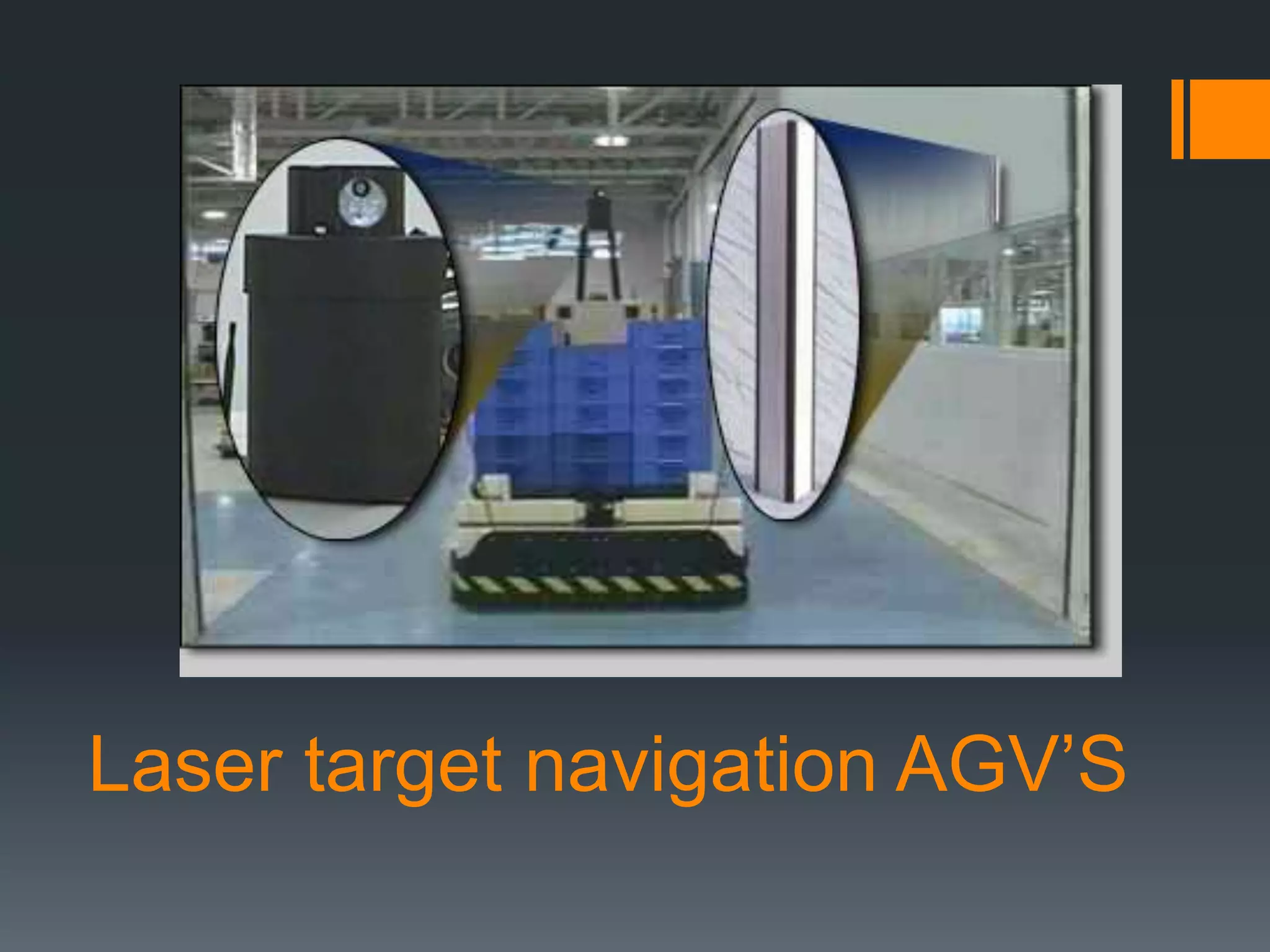
Laser target navigation
The AGV’S carry’s a laser transmitter and receiver on a
rotating turret.
The laser is sent off then received again the angle and
distances are automatically calculated and stored into
AGV’S memory.
The AGV’S has reflector map stored in memory and can
correct its position based on errors between the expected
and received measurements.
It can then navigate to a destination target using the
constantly updating position.
Common AGV Applications
AutomatedGuided Vehicles can be used in a
wide variety of applications to transport many
different types of material including pallets, rolls,
racks, carts, and containers.
Raw Material Handling:-
AGVs are commonly used to transport raw
materials such as paper, steel, rubber, metal,
and plastic.
25.
Work-in-Process Movement:-
Work-in-Process movementis one of the first
applications where automated guided vehicles
were used, and includes the repetitive movement
of materials throughout the manufacturing
process.
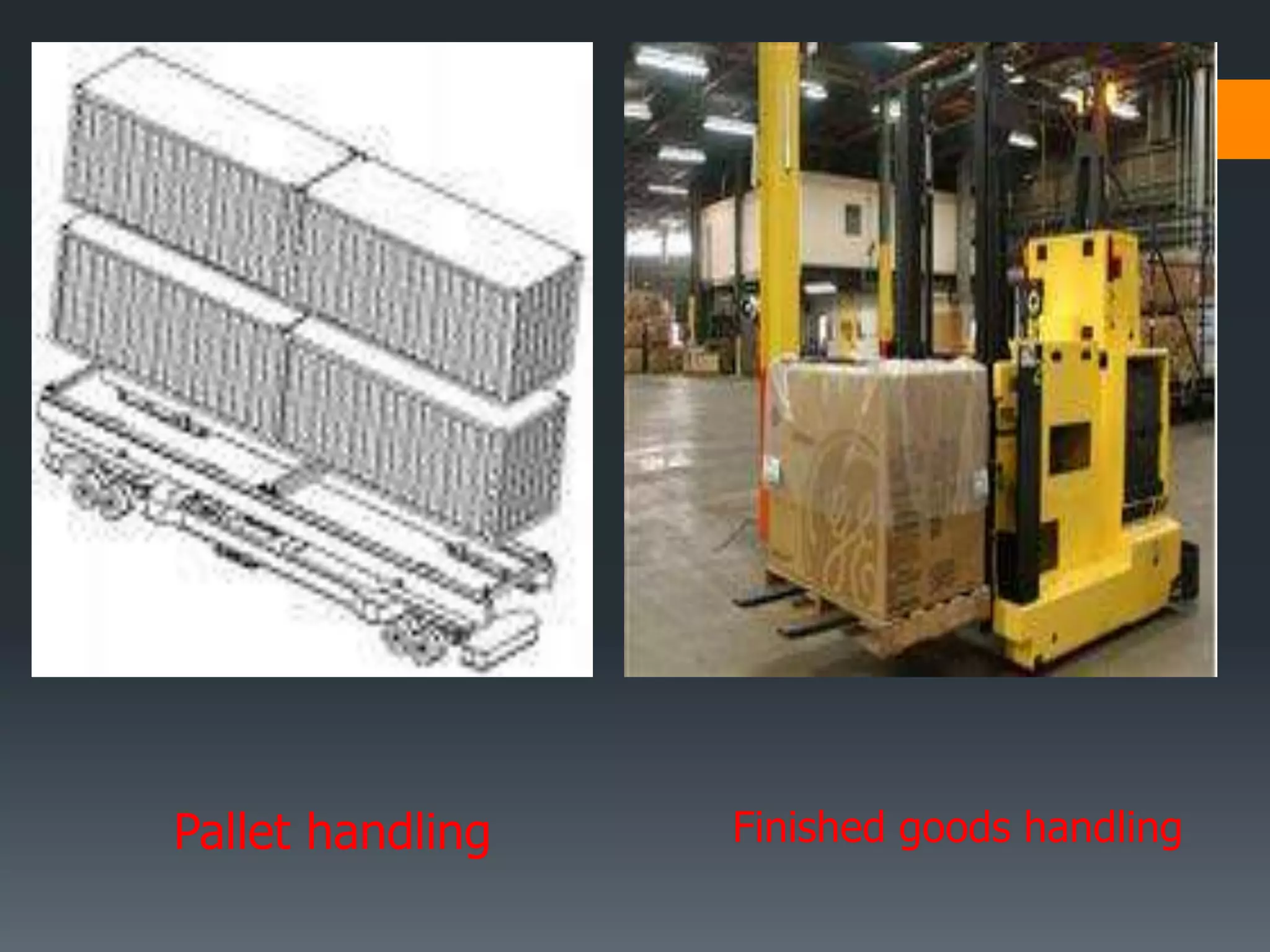
Pallet Handling:-
Pallet handling is an extremely popular
application for AGVs as repetitive movement of
pallets is very common in manufacturing and
distribution facilities.
26.
Finished Product Handling:-
Movingfinished goods from manufacturing
to storage or shipping is the final movement of
materials before they are delivered to
customers. These movements often require the
gentlest material handling because the products
are complete and subject to damage from rough
handling.
Next generation AGVsystems in “Automobile”
• Projects like “google car” are assuring us the next big “auto guided vehicles”
coming in automobile sector.
• “Audi has recently tested their “A7” remotely on self-driving mode till 560 miles.
• “Chevrolet is providing 4G (LTE) connectivity in their vehicles for faster
“Navigations” & for updating the “OS” of their “infotainment”.
• Volvo is providing “apple’s IOS “as infotainment for their all 2015 models.