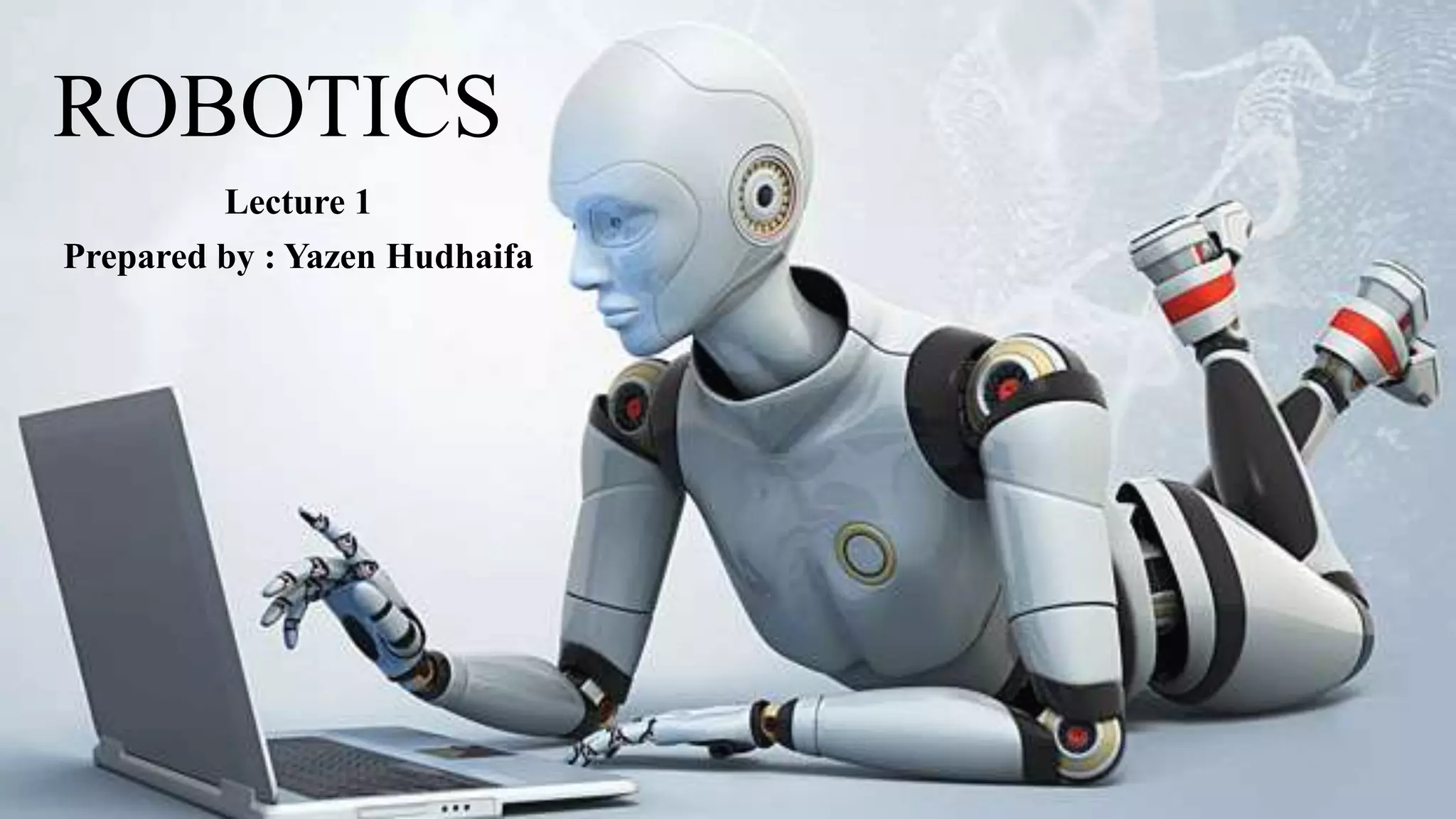
ROBOTICS
Lecture 1
Prepared by : Yazen Hudhaifa
Difference between ‘’Robot ‘’ & ‘’Robotics’’
Robot : It is a machine that carries out a complex series of action
automatically or without human interference,
especially one has been programmed by computer.
Robotics : The branch of technology that deals with the design,
construction, operation, and application of robots.
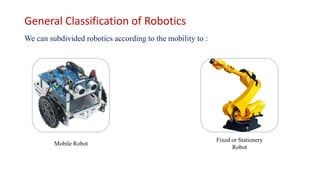
General Classification of Robotics
We can subdivided robotics according to the mobility to :
Mobile Robot
Fixed or Stationery
Robot
Industrial Robot
An automatically controlled , reprogrammable , multipurpose manipulator
programmable in three or more axes, which can be either fixed in place or mobile
for use in industrial automation applications.
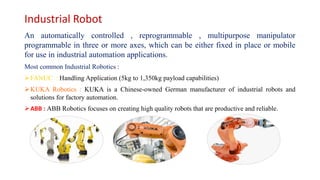
Most common Industrial Robotics :
FANUC : Handling Application (5kg to 1,350kg payload capabilities)
KUKA Robotics : KUKA is a Chinese-owned German manufacturer of industrial robots and
solutions for factory automation.
ABB : ABB Robotics focuses on creating high quality robots that are productive and reliable.
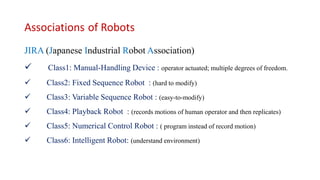
Associations of Robots
JIRA (Japanese Industrial Robot Association)
 Class1: Manual-Handling Device : operator actuated; multiple degrees of freedom.
 Class2: Fixed Sequence Robot : (hard to modify)
 Class3: Variable Sequence Robot : (easy-to-modify)
 Class4: Playback Robot : (records motions of human operator and then replicates)
 Class5: Numerical Control Robot : ( program instead of record motion)
 Class6: Intelligent Robot: (understand environment)
Associations of Robots
RIA (Robotics Institute of America)
 Variable Sequence Robot(Class3)
 Playback Robot (Class4)
 Numerical Control Robot (Class5)
 Intelligent Robot (Class6)
Associations of Robots
AFR (Association FranÇaise de Robotique)
Type A: Manual Handling Devices/ tele-robotics
Type B: Automatic Handling Devices/ predetermined cycles
Type C: Programmable, Servo controlled robot, continuous point-to-point
trajectories
Type D: Same type with C, but it can acquire information.
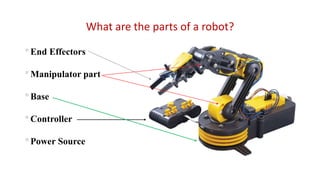
What are the parts of a robot?
•End Effectors
•Manipulator part
•Base
•Controller
•Power Source
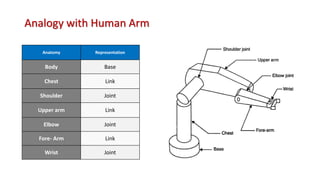
Analogy with Human Arm
Anatomy Representation
Body Base
Chest Link
Shoulder Joint
Upper arm Link
Elbow Joint
Fore- Arm Link
Wrist Joint
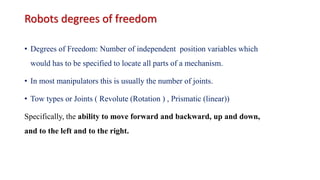
Robots degrees of freedom
• Degrees of Freedom: Number of independent position variables which
would has to be specified to locate all parts of a mechanism.
• In most manipulators this is usually the number of joints.
• Tow types or Joints ( Revolute (Rotation ) , Prismatic (linear))
Specifically, the ability to move forward and backward, up and down,
and to the left and to the right.
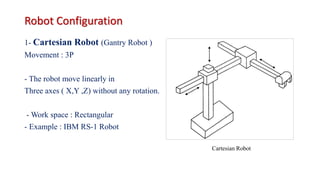
Robot Configuration
1- Cartesian Robot (Gantry Robot )
Movement : 3P
- The robot move linearly in
Three axes ( X,Y ,Z) without any rotation.
- Work space : Rectangular
- Example : IBM RS-1 Robot
Cartesian Robot
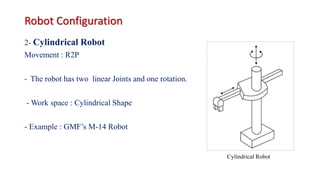
Robot Configuration
2- Cylindrical Robot
Movement : R2P
- The robot has two linear Joints and one rotation.
- Work space : Cylindrical Shape
- Example : GMF’s M-14 Robot
Cylindrical Robot
Robot Configuration
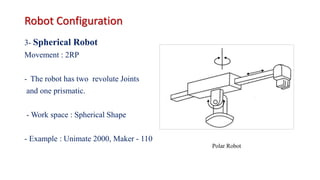
3- Spherical Robot
Movement : 2RP
- The robot has two revolute Joints
and one prismatic.
- Work space : Spherical Shape
- Example : Unimate 2000, Maker - 110
Polar Robot
Robot Configuration
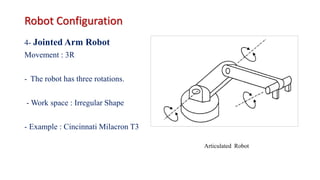
4- Jointed Arm Robot
Movement : 3R
- The robot has three rotations.
- Work space : Irregular Shape
- Example : Cincinnati Milacron T3
Articulated Robot
Robot Configuration
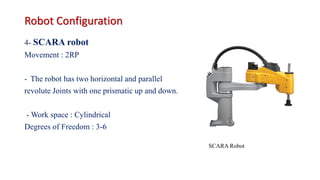
4- SCARA robot
Movement : 2RP
- The robot has two horizontal and parallel
revolute Joints with one prismatic up and down.
- Work space : Cylindrical
Degrees of Freedom : 3-6
SCARA Robot
Robot Configuration video
Robot specification
1- Payload: the rated load carrying capacity of an industrial robot is defined by its
weight of the object or the tool held by the gripper.
2- Repeatability: the accuracy of the robot to repeat the predefined position
repeatedly. Estimated error should be adjusted through the software .
3- Precision: the reach of a position is defined by the resolution of the actuators and
feed back systems. The robot precision is given in terms of length units.
4- Reach: the lengths of the lengths of the robot links which is useful to determine
the work envelop.
What tasks can the robot do ?
• Material handling
• Material transfer
• Machine loading and/or unloading
• Spot welding
• Continuous arc welding
• Spray coating
• Assembly
• Inspection
Common websites of robotics shopping
• RobotShop: http://www.robotshop.com/uk/
(Founded in 2003, they specialize in robotics technology and offer a wide range of
products and services in this sector. We operate globally and our head office is
located in Mirabel, Quebec, Canada.)
• ACTIVE ROBOT : http://www.active-robots.com/
• Robot Worx : https://www.robots.com/
(RobotWorx focuses on quality automation solutions at a lower price. Throughout
the years, we have provided high-quality customized integration for a large variety
of robotic applications. We offer new or reconditioned industrial robots, work cells
and parts.)

Introduction to Robotics

  • 1.
  • 2.
    Difference between ‘’Robot‘’ & ‘’Robotics’’ Robot : It is a machine that carries out a complex series of action automatically or without human interference, especially one has been programmed by computer. Robotics : The branch of technology that deals with the design, construction, operation, and application of robots.
  • 3.
    General Classification ofRobotics We can subdivided robotics according to the mobility to : Mobile Robot Fixed or Stationery Robot
  • 4.
    Industrial Robot An automaticallycontrolled , reprogrammable , multipurpose manipulator programmable in three or more axes, which can be either fixed in place or mobile for use in industrial automation applications. Most common Industrial Robotics : FANUC : Handling Application (5kg to 1,350kg payload capabilities) KUKA Robotics : KUKA is a Chinese-owned German manufacturer of industrial robots and solutions for factory automation. ABB : ABB Robotics focuses on creating high quality robots that are productive and reliable.
  • 5.
    Associations of Robots JIRA(Japanese Industrial Robot Association)  Class1: Manual-Handling Device : operator actuated; multiple degrees of freedom.  Class2: Fixed Sequence Robot : (hard to modify)  Class3: Variable Sequence Robot : (easy-to-modify)  Class4: Playback Robot : (records motions of human operator and then replicates)  Class5: Numerical Control Robot : ( program instead of record motion)  Class6: Intelligent Robot: (understand environment)
  • 6.
    Associations of Robots RIA(Robotics Institute of America)  Variable Sequence Robot(Class3)  Playback Robot (Class4)  Numerical Control Robot (Class5)  Intelligent Robot (Class6)
  • 7.
    Associations of Robots AFR(Association FranÇaise de Robotique) Type A: Manual Handling Devices/ tele-robotics Type B: Automatic Handling Devices/ predetermined cycles Type C: Programmable, Servo controlled robot, continuous point-to-point trajectories Type D: Same type with C, but it can acquire information.
  • 8.
    What are theparts of a robot? •End Effectors •Manipulator part •Base •Controller •Power Source
  • 9.
    Analogy with HumanArm Anatomy Representation Body Base Chest Link Shoulder Joint Upper arm Link Elbow Joint Fore- Arm Link Wrist Joint
  • 10.
    Robots degrees offreedom • Degrees of Freedom: Number of independent position variables which would has to be specified to locate all parts of a mechanism. • In most manipulators this is usually the number of joints. • Tow types or Joints ( Revolute (Rotation ) , Prismatic (linear)) Specifically, the ability to move forward and backward, up and down, and to the left and to the right.
  • 11.
    Robot Configuration 1- CartesianRobot (Gantry Robot ) Movement : 3P - The robot move linearly in Three axes ( X,Y ,Z) without any rotation. - Work space : Rectangular - Example : IBM RS-1 Robot Cartesian Robot
  • 12.
    Robot Configuration 2- CylindricalRobot Movement : R2P - The robot has two linear Joints and one rotation. - Work space : Cylindrical Shape - Example : GMF’s M-14 Robot Cylindrical Robot
  • 13.
    Robot Configuration 3- SphericalRobot Movement : 2RP - The robot has two revolute Joints and one prismatic. - Work space : Spherical Shape - Example : Unimate 2000, Maker - 110 Polar Robot
  • 14.
    Robot Configuration 4- JointedArm Robot Movement : 3R - The robot has three rotations. - Work space : Irregular Shape - Example : Cincinnati Milacron T3 Articulated Robot
  • 15.
    Robot Configuration 4- SCARArobot Movement : 2RP - The robot has two horizontal and parallel revolute Joints with one prismatic up and down. - Work space : Cylindrical Degrees of Freedom : 3-6 SCARA Robot
  • 16.
  • 17.
    Robot specification 1- Payload:the rated load carrying capacity of an industrial robot is defined by its weight of the object or the tool held by the gripper. 2- Repeatability: the accuracy of the robot to repeat the predefined position repeatedly. Estimated error should be adjusted through the software . 3- Precision: the reach of a position is defined by the resolution of the actuators and feed back systems. The robot precision is given in terms of length units. 4- Reach: the lengths of the lengths of the robot links which is useful to determine the work envelop.
  • 18.
    What tasks canthe robot do ? • Material handling • Material transfer • Machine loading and/or unloading • Spot welding • Continuous arc welding • Spray coating • Assembly • Inspection
  • 19.
    Common websites ofrobotics shopping • RobotShop: http://www.robotshop.com/uk/ (Founded in 2003, they specialize in robotics technology and offer a wide range of products and services in this sector. We operate globally and our head office is located in Mirabel, Quebec, Canada.) • ACTIVE ROBOT : http://www.active-robots.com/ • Robot Worx : https://www.robots.com/ (RobotWorx focuses on quality automation solutions at a lower price. Throughout the years, we have provided high-quality customized integration for a large variety of robotic applications. We offer new or reconditioned industrial robots, work cells and parts.)