ME8099 ROBOTICS
Presented by,
Mr. Abilash S
Assistant Professor
Department of Mechanical Engineering
UNIT I FUNDAMENTALS OF ROBOT
Robot – Definition
• A machine that looks and acts like a human being.
• An efficient but insensitive person
• An automatic apparatus.
– Something guided by automatic controls.
E.g. remote control
• A computer whose main function is to produce
motion.
An industrial robot is a programmable,
multi-functional manipulator designed to move
materials, parts, tools, or special devices through
variable programmed motions for the performance
of a variety of tasks”
Robotics History
 The term “robot” was derived from Czech word
“robota”.
 “robota” means labourer or worker.
 Karel Capek used the term in his play “Rossum's
Universal Robots”.
 Isaac Asimov coined the term “Robotics” and
postulated the three laws of robotics.
Three Laws of Robotics
 A robot may not injure a human being or through
inaction, allow a human being to come to harm.
 A robot must obey the orders given to it by
human beings except where such orders would
conflict with the First Law.
 A robot must protect its own existence as long as
such protection does not conflict with the First or
Second Law.
Robot System
 A robotic arm with actuators
 End effector
 Sensors
 Control computer system
 Communication peripherals
 Power supply
Robotic Arm
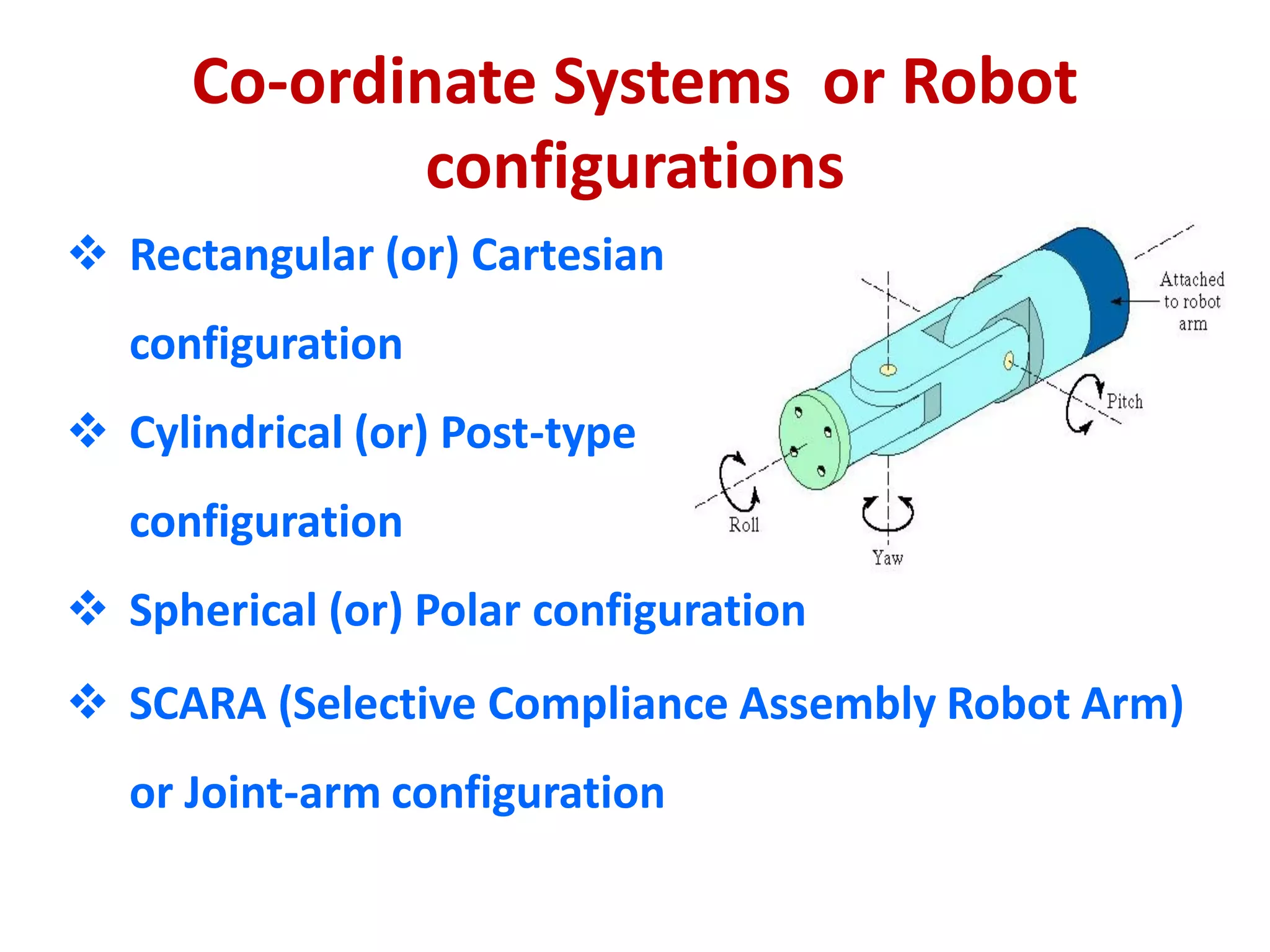
Wrist Motion
 Yaw – Rotary motion executed about 𝑧 axis.
Causes movement in left and right directions.
 Pitch – Rotary motion executed about 𝑦 axis.
Causes movement in up and down directions.
 Roll – Rotary motion executed about 𝑥 axis.
Robot Specification – Physical
Mechanical
• Robot configuration
• Number of axes of movement
•Floor space required for
mounting
• Weight
• Physical dimensions
• Physical details
Power
• Power drive system
• Power/services requirements
Control
 Programming method
 Type of control system
 External sensors
supported
 Program backing
storage device
 Memory size
Co-ordinate Systems or Robot
configurations
 Rectangular (or) Cartesian
configuration
 Cylindrical (or) Post-type
configuration
 Spherical (or) Polar configuration
 SCARA (Selective Compliance Assembly Robot Arm)
or Joint-arm configuration
Work Envelope
Robot Work Envelope or Reach
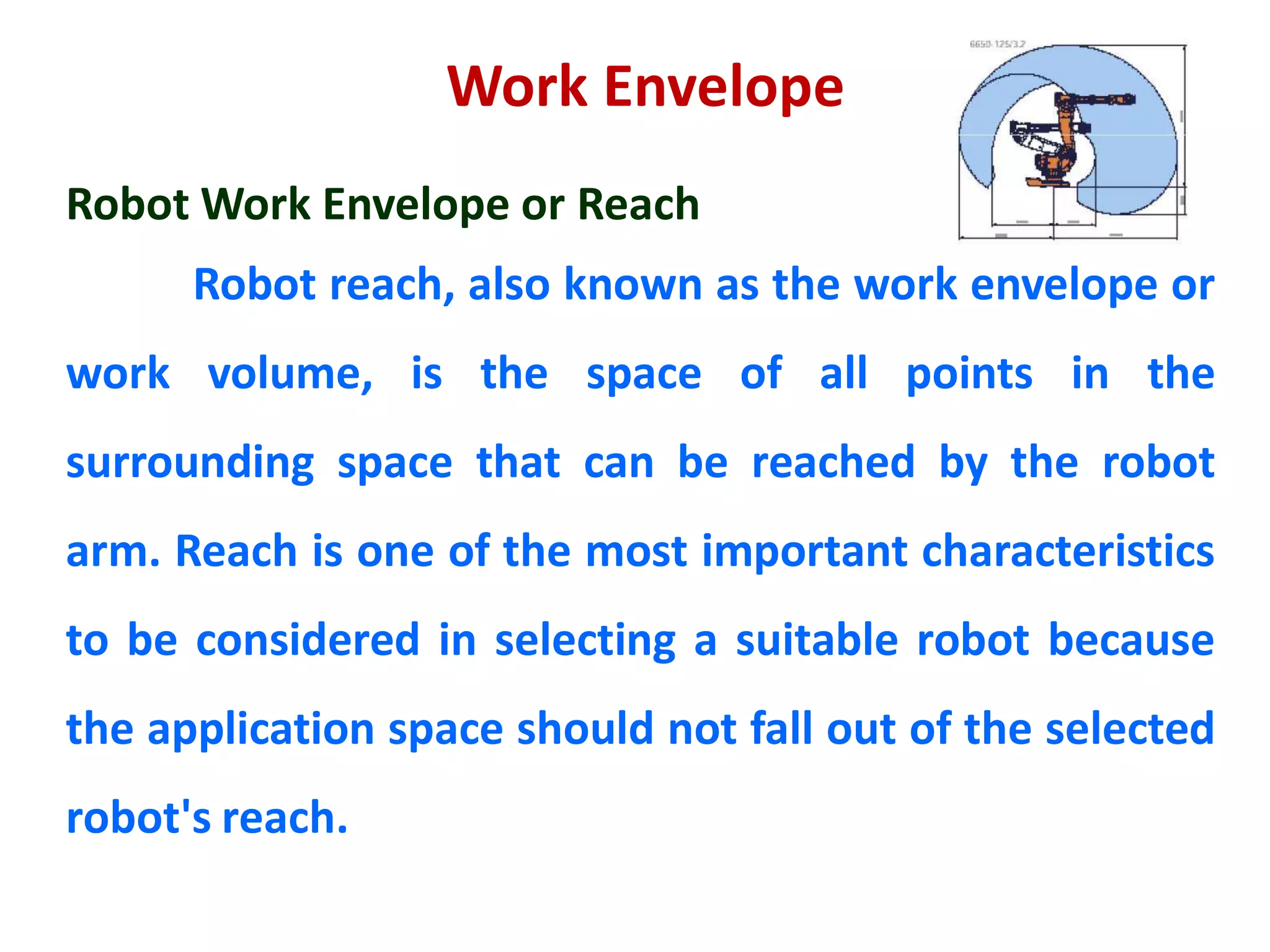
Robot reach, also known as the work envelope or
work volume, is the space of all points in the
surrounding space that can be reached by the robot
arm. Reach is one of the most important characteristics
to be considered in selecting a suitable robot because
the application space should not fall out of the selected
robot's reach.
Work Envelope
 For a Cartesian configuration the reach is a rectangular-
type space.
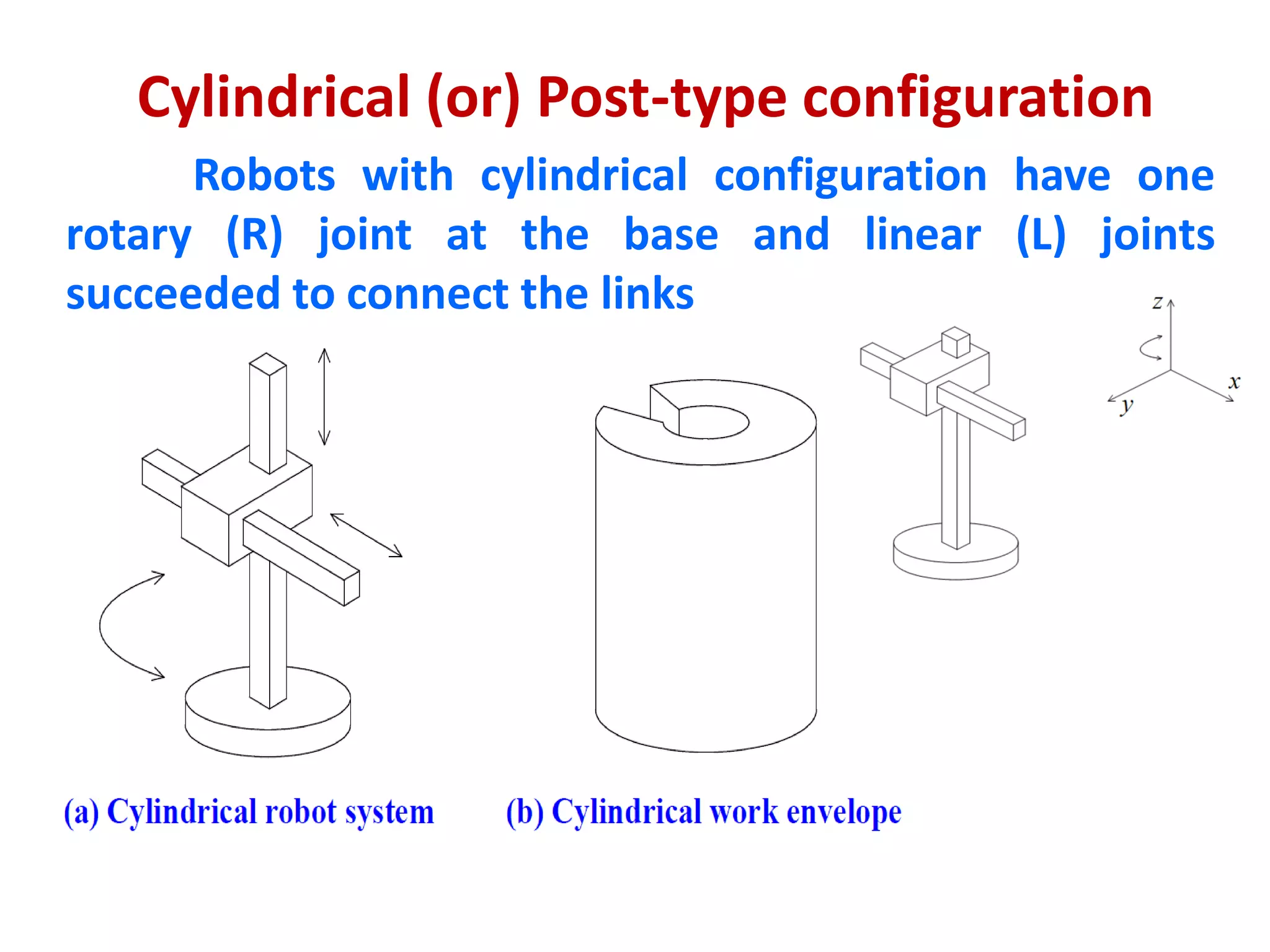
 For a cylindrical configuration the reach is a hollow
cylindrical space.
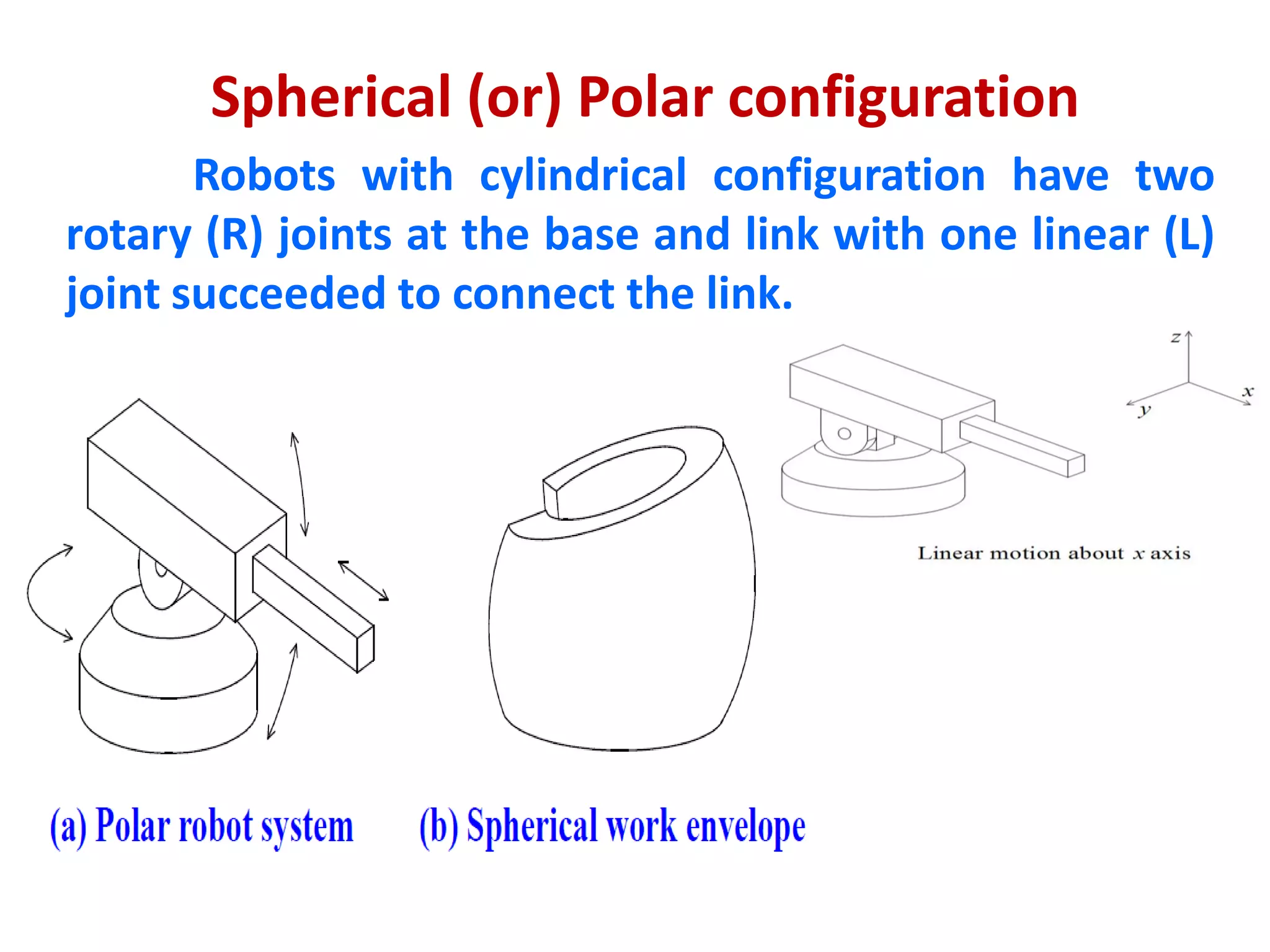
 For a polar configuration the reach is part of a hollow
spherical shape.
 Robot reach for a jointed-arm configuration does not have
a specific shape
 The work envelop is described by the surface of the work
space.
Rectangular (or) Cartesian configuration
Robots with Cartesian configurations consist of
links connected by linear joints (L). Gantry robots are
Cartesian robots (LLL).
Cylindrical (or) Post-type configuration
Robots with cylindrical configuration have one
rotary (R) joint at the base and linear (L) joints
succeeded to connect the links
Spherical (or) Polar configuration
Robots with cylindrical configuration have two
rotary (R) joints at the base and link with one linear (L)
joint succeeded to connect the link.
Pendulum Robot System
SCARA (Selective Compliance Assembly Robot
Arm) or Joint-arm configuration
The jointed-arm is a combination of cylindrical and
articulated configurations. The arm of the robot is
connected to the base with a twisting joint. The links in
the arm are connected by rotary joints. Many
commercially available robots have this configuration
Robot configurations
Configuration Advantages Disadvantages
Cartesian
coordinates
3 linear axes, easy to visualize,
rigid structure, easy to program
Can only reach front of itself,
requires large floor space, axes
hard to seal
Cylindrical
coordinates
2 linear axes +1 rotating, can
reach all around itself, reach
and height axes rigid,
rotational axis easy to seal
Can’t reach above itself, base
rotation axis as less rigid, linear
axes is hard to seal, won’t reach
around obstacles
SCARA
coordinates
1 linear + 2 rotating axes,
height axis is rigid, large work
area for floor space
2 ways to reach point, difficult to
program off-line, highly
complex arm
Spherical
coordinates
1 linear + 2 rotating axes, long
horizontal reach
Can’t reach around obstacles,
short vertical reach
Revolute
coordinates
3 rotating axes can reach above
or below obstacles, largest work
area for least floor space
Difficult to program off-line, 2
or 4 ways to reach a point, most
complex manipulator
Robot Motion and Trajectories
Robot Motion
 Point to point motion – The path has no importance.
 Continuous path motion – The path taken is very important.
Trajectories
 Path taken by the robot end effector within the work
volume is known as trajectory.
 Trajectory planning.
 Joint interpolated trajectory planning.
 Cartesian path trajectory planning.
Robot Classification
 Classification based on intelligence level
 Classification based on servo control system
 Classification based on drive systems
 Classification based on geometric configuration of the arm
 Miscellaneous types
Classification Based on Intelligence
Level
 Sequence control robots – Fixed sequence and Variable
sequence control robots
 Playback robots – Point to point and continuous path robots
 Numerically controlled robots
 Servo control robots – Hydraulic and electric robots. Uses
closed loop control system
 Non servo control robots – Pneumatic robots. Uses open
loop control system
Classification Based on Servo Control
System
Classification Based on Drive Systems
 Pneumatic robots – light load, cheaper, no accurate
positioning, light weight mechanism.
 Hydraulic robots – heavy load, expensive, firm and rigid
positioning, bulky mechanism.
 Electric robots – medium load, accurate positioning, easily
controlled by electronic controllers, light weight
mechanism.
Classification Based on Geometric
Configuration of the Arm
 Cartesian coordinate robots
 Polar coordinate robots
 Cylindrical robots
 Articulated or Jointed arm robots
 Pendulum robots
 Spine robots
 Multiple arm robots
Robot Specifications
 Accuracy, resolution, repeatability, speed and payload.
 Number of degrees of freedom.
 Geometric configuration of the manipulator.
 Maximum and Minimum reach.
 Type of Drive system.
 Type of Control system.
Robot Specifications
 Programming method.
 Memory capacity.
 Supported communication protocols and interface ports.
 Input power supply requirements.
 Total robot weight and installing procedures.
Degrees of Freedom
 Degrees of freedom (DOF) is defined as the ability of a
joint to produce linear or rotary movement when
actuated.
 Number of DOF for a robot is equal to the number of
joint axes in the robotic arm.
The Robotic Joints
A robot joint is a mechanism that permits relative
movement between parts of a robot arm. The joints of a
robot are designed to enable the robot to move its end-
effector along a path from one position to another as
desired.
Robotic Joints Notation
Robot Parts and Functions
 Controller: Every robot is connected to a computer, which
keeps the pieces of the arm working together. This
computer is known as the controller. The controller
functions as the "brain" of the robot.
 Arm: Robot arms come in all shapes and sizes. The arm is
the part of the robot that positions the endaffector and
sensors to do their pre-programmed business.
 Drive: The drive is the "engine" that drives the links (the
sections between the joints into their desired position.
Without a drive, a robot would just sit there, which is not
often helpful
Robot Parts and Functions
 End-Effector: The end-effector is the "hand" connected to
the robot's arm. It is often different from a human hand -
it could be a tool such as a gripper, a vacuum pump,
tweezers, scalpel, blowtorch - just about anything that
helps it do its job.
 Sensor: Most robots of today are nearly deaf and blind.
Sensors can provide some limited feedback to the robot
so it can do its job. The sensor sends information, in the
form of electronic signals back to the controller
Robot Parts and Functions
 End-Effector: The end-effector is the "hand" connected to
the robot's arm. It is often different from a human hand -
it could be a tool such as a gripper, a vacuum pump,
tweezers, scalpel, blowtorch - just about anything that
helps it do its job.
 Sensor: Most robots of today are nearly deaf and blind.
Sensors can provide some limited feedback to the robot
so it can do its job. The sensor sends information, in the
form of electronic signals back to the controller
Need for Robots
 Consistent production quality.
 High production quantity.
 Can be employed at hazardous places.
 Improvement in productivity, minimal Material wastage,
reduced work in Progress and faster through put times.
 Highly flexible to accommodate product Design changes.
Need for Robots
 Working conditions are improved.
 Occupational safety for workers is achieved.
 Higher load carrying capacity.
 Available at all times.
 Manufactures can stay ahead in the market with state of
the art robotic production facilities.
Applications of Robot
With different payload capability, reach and design,
articulate robots are designed to employ in the following
applications:
 Arc welding
 Spot welding
 Assembly
 cleaning/spraying
 Cutting
 Deburring
 Die casting
 Gluing/sealing
Applications of Robot
• Grinding/Polishing
• Injection moulding
• Machine tending
• Material handling
• Packing
• Palletizing
• Picking
• Pre-machining
• Press brake tending
Disadvantages of Robots
 High initial investment.
 Inventory of endeffectors should be maintained.
 Expensive spares and accessories.
 Needs skilled personnel for programming.
 Increases the risk of human unemployment.
THANK YOU

ROBOTICS.pdf

  • 1.
    ME8099 ROBOTICS Presented by, Mr.Abilash S Assistant Professor Department of Mechanical Engineering
  • 4.
    UNIT I FUNDAMENTALSOF ROBOT Robot – Definition • A machine that looks and acts like a human being. • An efficient but insensitive person • An automatic apparatus. – Something guided by automatic controls. E.g. remote control • A computer whose main function is to produce motion. An industrial robot is a programmable, multi-functional manipulator designed to move materials, parts, tools, or special devices through variable programmed motions for the performance of a variety of tasks”
  • 5.
    Robotics History  Theterm “robot” was derived from Czech word “robota”.  “robota” means labourer or worker.  Karel Capek used the term in his play “Rossum's Universal Robots”.  Isaac Asimov coined the term “Robotics” and postulated the three laws of robotics.
  • 6.
    Three Laws ofRobotics  A robot may not injure a human being or through inaction, allow a human being to come to harm.  A robot must obey the orders given to it by human beings except where such orders would conflict with the First Law.  A robot must protect its own existence as long as such protection does not conflict with the First or Second Law.
  • 7.
    Robot System  Arobotic arm with actuators  End effector  Sensors  Control computer system  Communication peripherals  Power supply
  • 8.
  • 9.
    Wrist Motion  Yaw– Rotary motion executed about 𝑧 axis. Causes movement in left and right directions.  Pitch – Rotary motion executed about 𝑦 axis. Causes movement in up and down directions.  Roll – Rotary motion executed about 𝑥 axis.
  • 10.
    Robot Specification –Physical Mechanical • Robot configuration • Number of axes of movement •Floor space required for mounting • Weight • Physical dimensions • Physical details Power • Power drive system • Power/services requirements Control  Programming method  Type of control system  External sensors supported  Program backing storage device  Memory size
  • 11.
    Co-ordinate Systems orRobot configurations  Rectangular (or) Cartesian configuration  Cylindrical (or) Post-type configuration  Spherical (or) Polar configuration  SCARA (Selective Compliance Assembly Robot Arm) or Joint-arm configuration
  • 12.
    Work Envelope Robot WorkEnvelope or Reach Robot reach, also known as the work envelope or work volume, is the space of all points in the surrounding space that can be reached by the robot arm. Reach is one of the most important characteristics to be considered in selecting a suitable robot because the application space should not fall out of the selected robot's reach.
  • 13.
    Work Envelope  Fora Cartesian configuration the reach is a rectangular- type space.  For a cylindrical configuration the reach is a hollow cylindrical space.  For a polar configuration the reach is part of a hollow spherical shape.  Robot reach for a jointed-arm configuration does not have a specific shape  The work envelop is described by the surface of the work space.
  • 14.
    Rectangular (or) Cartesianconfiguration Robots with Cartesian configurations consist of links connected by linear joints (L). Gantry robots are Cartesian robots (LLL).
  • 15.
    Cylindrical (or) Post-typeconfiguration Robots with cylindrical configuration have one rotary (R) joint at the base and linear (L) joints succeeded to connect the links
  • 16.
    Spherical (or) Polarconfiguration Robots with cylindrical configuration have two rotary (R) joints at the base and link with one linear (L) joint succeeded to connect the link.
  • 17.
  • 18.
    SCARA (Selective ComplianceAssembly Robot Arm) or Joint-arm configuration The jointed-arm is a combination of cylindrical and articulated configurations. The arm of the robot is connected to the base with a twisting joint. The links in the arm are connected by rotary joints. Many commercially available robots have this configuration
  • 19.
    Robot configurations Configuration AdvantagesDisadvantages Cartesian coordinates 3 linear axes, easy to visualize, rigid structure, easy to program Can only reach front of itself, requires large floor space, axes hard to seal Cylindrical coordinates 2 linear axes +1 rotating, can reach all around itself, reach and height axes rigid, rotational axis easy to seal Can’t reach above itself, base rotation axis as less rigid, linear axes is hard to seal, won’t reach around obstacles SCARA coordinates 1 linear + 2 rotating axes, height axis is rigid, large work area for floor space 2 ways to reach point, difficult to program off-line, highly complex arm Spherical coordinates 1 linear + 2 rotating axes, long horizontal reach Can’t reach around obstacles, short vertical reach Revolute coordinates 3 rotating axes can reach above or below obstacles, largest work area for least floor space Difficult to program off-line, 2 or 4 ways to reach a point, most complex manipulator
  • 20.
    Robot Motion andTrajectories Robot Motion  Point to point motion – The path has no importance.  Continuous path motion – The path taken is very important. Trajectories  Path taken by the robot end effector within the work volume is known as trajectory.  Trajectory planning.  Joint interpolated trajectory planning.  Cartesian path trajectory planning.
  • 21.
    Robot Classification  Classificationbased on intelligence level  Classification based on servo control system  Classification based on drive systems  Classification based on geometric configuration of the arm  Miscellaneous types
  • 22.
    Classification Based onIntelligence Level  Sequence control robots – Fixed sequence and Variable sequence control robots  Playback robots – Point to point and continuous path robots  Numerically controlled robots  Servo control robots – Hydraulic and electric robots. Uses closed loop control system  Non servo control robots – Pneumatic robots. Uses open loop control system Classification Based on Servo Control System
  • 23.
    Classification Based onDrive Systems  Pneumatic robots – light load, cheaper, no accurate positioning, light weight mechanism.  Hydraulic robots – heavy load, expensive, firm and rigid positioning, bulky mechanism.  Electric robots – medium load, accurate positioning, easily controlled by electronic controllers, light weight mechanism.
  • 24.
    Classification Based onGeometric Configuration of the Arm  Cartesian coordinate robots  Polar coordinate robots  Cylindrical robots  Articulated or Jointed arm robots  Pendulum robots  Spine robots  Multiple arm robots
  • 25.
    Robot Specifications  Accuracy,resolution, repeatability, speed and payload.  Number of degrees of freedom.  Geometric configuration of the manipulator.  Maximum and Minimum reach.  Type of Drive system.  Type of Control system.
  • 26.
    Robot Specifications  Programmingmethod.  Memory capacity.  Supported communication protocols and interface ports.  Input power supply requirements.  Total robot weight and installing procedures.
  • 27.
    Degrees of Freedom Degrees of freedom (DOF) is defined as the ability of a joint to produce linear or rotary movement when actuated.  Number of DOF for a robot is equal to the number of joint axes in the robotic arm.
  • 28.
    The Robotic Joints Arobot joint is a mechanism that permits relative movement between parts of a robot arm. The joints of a robot are designed to enable the robot to move its end- effector along a path from one position to another as desired.
  • 29.
  • 30.
    Robot Parts andFunctions  Controller: Every robot is connected to a computer, which keeps the pieces of the arm working together. This computer is known as the controller. The controller functions as the "brain" of the robot.  Arm: Robot arms come in all shapes and sizes. The arm is the part of the robot that positions the endaffector and sensors to do their pre-programmed business.  Drive: The drive is the "engine" that drives the links (the sections between the joints into their desired position. Without a drive, a robot would just sit there, which is not often helpful
  • 31.
    Robot Parts andFunctions  End-Effector: The end-effector is the "hand" connected to the robot's arm. It is often different from a human hand - it could be a tool such as a gripper, a vacuum pump, tweezers, scalpel, blowtorch - just about anything that helps it do its job.  Sensor: Most robots of today are nearly deaf and blind. Sensors can provide some limited feedback to the robot so it can do its job. The sensor sends information, in the form of electronic signals back to the controller
  • 32.
    Robot Parts andFunctions  End-Effector: The end-effector is the "hand" connected to the robot's arm. It is often different from a human hand - it could be a tool such as a gripper, a vacuum pump, tweezers, scalpel, blowtorch - just about anything that helps it do its job.  Sensor: Most robots of today are nearly deaf and blind. Sensors can provide some limited feedback to the robot so it can do its job. The sensor sends information, in the form of electronic signals back to the controller
  • 33.
    Need for Robots Consistent production quality.  High production quantity.  Can be employed at hazardous places.  Improvement in productivity, minimal Material wastage, reduced work in Progress and faster through put times.  Highly flexible to accommodate product Design changes.
  • 34.
    Need for Robots Working conditions are improved.  Occupational safety for workers is achieved.  Higher load carrying capacity.  Available at all times.  Manufactures can stay ahead in the market with state of the art robotic production facilities.
  • 35.
    Applications of Robot Withdifferent payload capability, reach and design, articulate robots are designed to employ in the following applications:  Arc welding  Spot welding  Assembly  cleaning/spraying  Cutting  Deburring  Die casting  Gluing/sealing
  • 36.
    Applications of Robot •Grinding/Polishing • Injection moulding • Machine tending • Material handling • Packing • Palletizing • Picking • Pre-machining • Press brake tending
  • 37.
    Disadvantages of Robots High initial investment.  Inventory of endeffectors should be maintained.  Expensive spares and accessories.  Needs skilled personnel for programming.  Increases the risk of human unemployment.
  • 38.