
Implementing peer
feedback: potentials and
challenges
David Carless
HKU, November 23, 2016
http://davidcarless.edu.hku.hk/
The University of Hong Kong
Overview
1. Feedback processes
2. Peer feedback rationales
3. Our recent research
4. Challenges & Implications
The University of Hong Kong
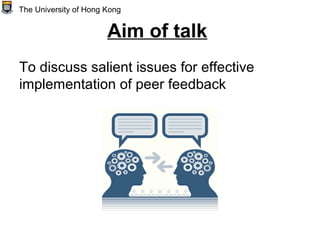
Aim of talk
To discuss salient issues for effective
implementation of peer feedback
The University of Hong Kong
SITUATING FEEDBACK
The University of Hong Kong
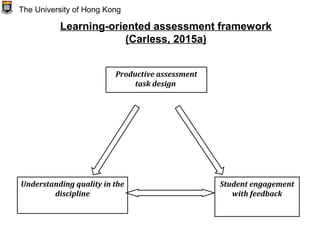
Productive assessment
task design
Understanding quality in the
discipline
Student engagement
with feedback
Learning-oriented assessment framework
(Carless, 2015a)
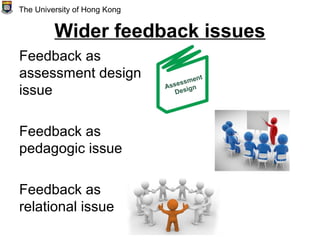
Wider feedback issues
Feedback as
assessment design
issue
Feedback as
pedagogic issue
Feedback as
relational issue
The University of Hong Kong
Dialogic feedback
Feedback needs to generate dialogue
The University of Hong Kong
Key aim of feedback
To enhance student
ability to self-monitor
their work in
progress
The University of Hong Kong
Sustainable feedback
Students generating & using feedback from
peers, self (or teachers) as part of self-
regulated learning
(Carless et al., 2011)
The University of Hong Kong
INTRODUCING
PEER FEEDBACK
The University of Hong Kong
Defining peer feedback (PF)
“A communication process through which
learners enter into dialogues related to
performance & standards” (Liu & Carless,
2006, p. 280)
peer review: (Nicol et al., 2014)
peer response: (Liu & Hansen, 2002)
The University of Hong Kong
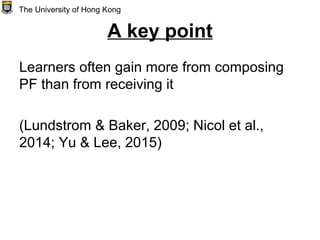
A key point
Learners often gain more from composing
PF than from receiving it
(Lundstrom & Baker, 2009; Nicol et al.,
2014; Yu & Lee, 2015)
The University of Hong Kong
RATIONALE FOR PEER
FEEDBACK
The University of Hong Kong
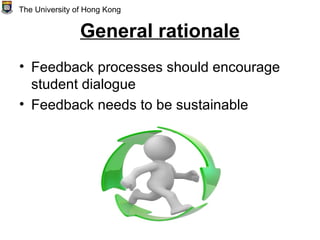
General rationale
• Feedback processes should encourage
student dialogue
• Feedback needs to be sustainable
The University of Hong Kong
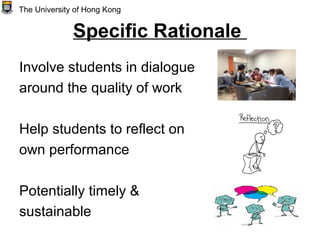
Specific Rationale
Involve students in dialogue
around the quality of work
Help students to reflect on
own performance
Potentially timely &
sustainable
The University of Hong Kong
Technology-enabled PF
LMS
PeerMark
Web 2.0
The University of Hong Kong
FOUR KEY STUDIES
The University of Hong Kong
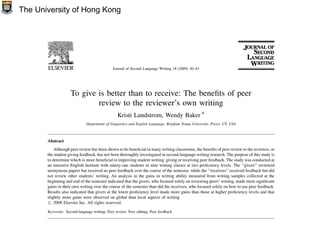
1. To give is better than to receive
Students taught to give PF, improved writing
more than students taught to use PF
Explanation: You review in your own ZPD
but may not receive in your ZPD
(Lundstrom & Baker, 2009)
The University of Hong Kong
2. Higher order thinking
• Composing PF is cognitively engaging:
- Applying criteria
- Diagnosing problems
- Suggesting solutions
(Nicol et al., 2014)
The University of Hong Kong
3. Varying response to PF
Not all students buy in to PF
Gains from reading others’ texts
Passive involvement
(Yu & Lee, 2015)
The University of Hong Kong
4. Feedback on PF
• Receivers of PF gave feedback to
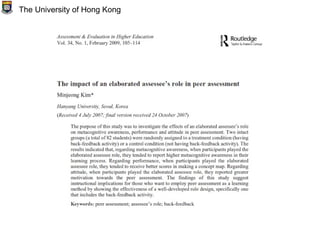
providers (Kim, 2009)
• Enhanced motivation & performance
The University of Hong Kong
OUR RECENT RESEARCH
The University of Hong Kong
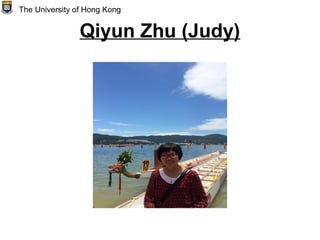
Qiyun Zhu (Judy)
The University of Hong Kong
Context
Year 1 university EFL class
200 students, 5 teachers
Peer review of writing
Sustained observations, interviews
The University of Hong Kong
Preparation
No or minimal training
PF sheet / guiding questions
The University of Hong Kong
Selected positive findings
• Written peer feedback then
oral dialogue
• Timeliness, immediacy,
negotiation
The University of Hong Kong
Selected negative findings
• Partner not enthusiastic, perfunctory
• Comments were vague & general
• Teacher should explain how to complete
the feedback form
The University of Hong Kong
Implications
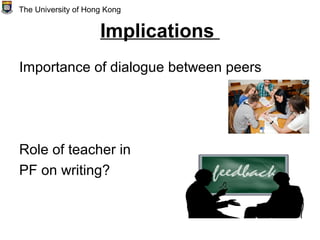
Importance of dialogue between peers
Role of teacher in
PF on writing?
The University of Hong Kong
Yueting Xu (Tracey)
The University of Hong Kong
Context
Year 1 university EFL class
57 students, 1 ‘excellent’ teacher
PF on oral presentations
Sustained observations, interviews
The University of Hong Kong
Preparation
• PF & wider aims of university study
• Discussed video of OP
• Introduced criteria, esp. content
• Modelled giving PF
The University of Hong Kong
Positive findings
Students more engaged
Enhanced audience awareness
Focused on content
Facilitates teacher feedback
on PF
The University of Hong Kong
Challenges
• Reticence & uncertainty at outset
• Comments inaudible or difficult to
understand
• Not easy to get students to be critical
The University of Hong Kong
Implications
• ‘Only true friends could be cruelly honest’
• Need for both cognitive scaffolding &
social-affective support
(Xu & Carless, 2016)
The University of Hong Kong
PEER FEEDBACK CHALLENGES
The University of Hong Kong
Discussion
In your view/experience, what are the
major challenges in carrying out PF?
And how might they be tackled?
The University of Hong Kong
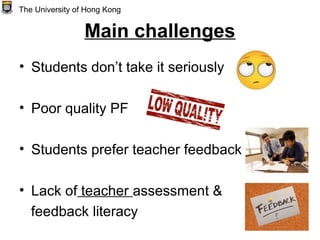
Main challenges
• Students don’t take it seriously
• Poor quality PF
• Students prefer teacher feedback
• Lack of teacher assessment &
feedback literacy
The University of Hong Kong
Implications
The University of Hong Kong
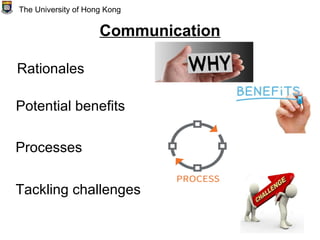
Communication
Rationales
The University of Hong Kong
Potential benefits
Processes
Tackling challenges
The role of trust
Feedback is a social and relational act:
Importance of trust (Carless, 2013)
The University of Hong Kong
Recommended PF practice
• Sell rationale & benefits to students
• Communicate gains for ‘giver’
• Provide modeling & support
• Encourage collaborative climate
The University of Hong Kong
References
Carless, D. (2013). Trust and its role in facilitating dialogic feedback. In D. Boud & L. Molloy (Eds.), Feedback in Higher
and Professional Education: Understanding it and doing it well (pp. 90-103). London: Routledge.
Carless, D. (2015a). Exploring learning-oriented assessment processes. Higher Education, 69(6), 963-976.
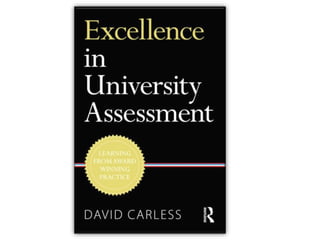
Carless, D. (2015b). Excellence in University Assessment: learning from award-winning teachers. London:
Routledge.
Carless, D., Salter, D., Yang, M., & Lam, J. (2011). Developing sustainable feedback practices. Studies in Higher
Education, 36 (4) 395-407.
Kim, M. (2009). The impact of an elaborated assessee’s role in peer assessment. Assessment & Evaluation in Higher
Education, 34(1), 105-114
Liu, J., & Hansen, J. G. (2002). Peer response in second language writing classrooms. Michigan: University of
Michigan Press.
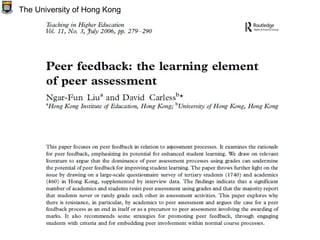
Liu, N.F. & Carless, D. (2006) Peer feedback: the learning element of peer assessment, Teaching in Higher Education,
11 (3), 279-290.
Lundstrom, K., & Baker, K. (2009). To give is better than to receive: The benefits of peer review to the reviewer’s
own writing. Journal of Second Language Writing, 18(1), 30-43.
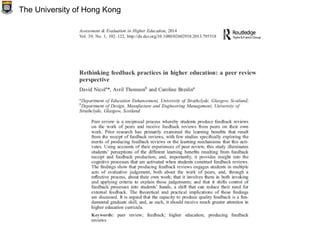
Nicol, D., Thomson, A., & Breslin, C. (2014). Rethinking feedback practices in higher education: a peer review
perspective. Assessment & Evaluation in Higher Education, 39(1), 102–122.
Xu, Y. & Carless, D. (2016). ‘Only true friends could be cruelly honest’: cognitive scaffolding and social-affective
support in teacher feedback literacy, Assessment & Evaluation in Higher Education, DOI:
10.1080/02602938.2016.1226759.
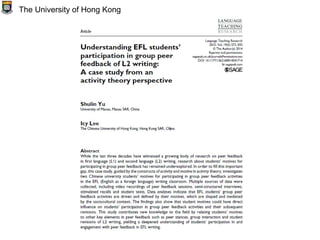
Yu, S., & Lee, I. (2015). Understanding EFL students’ participation in group peer feedback of L2 writing: A case
study from an activity theory perspective. Language Teaching Research, 19(5), 572-593.
The University of Hong Kong
QUESTIONS
COMMENTS
The University of Hong Kong
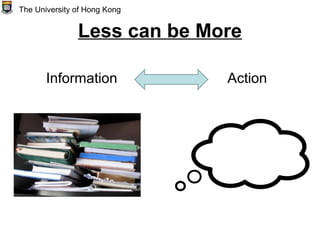
Less can be More
Information Action
The University of Hong Kong
Closing feedback loops
It’s only feedback
if students take
some action
The University of Hong Kong
Sustainable feedback defined
“Active student participation in dialogic
activities in which students generate and
use feedback from peers, self or others as
part of an ongoing process of developing
capacities as autonomous self-regulating
learners” (Carless, 2013b)
The University of Hong Kong
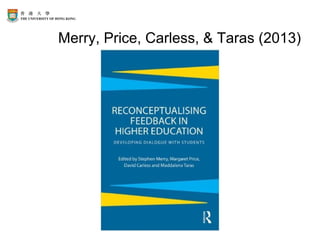
Merry, Price, Carless, & Taras (2013)
The University of Hong Kong

Implementing peer feedback

  • 1.
    Implementing peer feedback: potentialsand challenges David Carless HKU, November 23, 2016 http://davidcarless.edu.hku.hk/ The University of Hong Kong
  • 2.
    Overview 1. Feedback processes 2.Peer feedback rationales 3. Our recent research 4. Challenges & Implications The University of Hong Kong
  • 3.
    Aim of talk Todiscuss salient issues for effective implementation of peer feedback The University of Hong Kong
  • 4.
  • 5.
    The University ofHong Kong Productive assessment task design Understanding quality in the discipline Student engagement with feedback Learning-oriented assessment framework (Carless, 2015a)
  • 6.
    Wider feedback issues Feedbackas assessment design issue Feedback as pedagogic issue Feedback as relational issue The University of Hong Kong
  • 7.
    Dialogic feedback Feedback needsto generate dialogue The University of Hong Kong
  • 8.
    Key aim offeedback To enhance student ability to self-monitor their work in progress The University of Hong Kong
  • 9.
    Sustainable feedback Students generating& using feedback from peers, self (or teachers) as part of self- regulated learning (Carless et al., 2011) The University of Hong Kong
  • 10.
  • 11.
  • 12.
    Defining peer feedback(PF) “A communication process through which learners enter into dialogues related to performance & standards” (Liu & Carless, 2006, p. 280) peer review: (Nicol et al., 2014) peer response: (Liu & Hansen, 2002) The University of Hong Kong
  • 13.
    A key point Learnersoften gain more from composing PF than from receiving it (Lundstrom & Baker, 2009; Nicol et al., 2014; Yu & Lee, 2015) The University of Hong Kong
  • 14.
    RATIONALE FOR PEER FEEDBACK TheUniversity of Hong Kong
  • 15.
    General rationale • Feedbackprocesses should encourage student dialogue • Feedback needs to be sustainable The University of Hong Kong
  • 16.
    Specific Rationale Involve studentsin dialogue around the quality of work Help students to reflect on own performance Potentially timely & sustainable The University of Hong Kong
  • 17.
  • 18.
    FOUR KEY STUDIES TheUniversity of Hong Kong
  • 19.
  • 20.
    1. To giveis better than to receive Students taught to give PF, improved writing more than students taught to use PF Explanation: You review in your own ZPD but may not receive in your ZPD (Lundstrom & Baker, 2009) The University of Hong Kong
  • 21.
  • 22.
    2. Higher orderthinking • Composing PF is cognitively engaging: - Applying criteria - Diagnosing problems - Suggesting solutions (Nicol et al., 2014) The University of Hong Kong
  • 23.
  • 24.
    3. Varying responseto PF Not all students buy in to PF Gains from reading others’ texts Passive involvement (Yu & Lee, 2015) The University of Hong Kong
  • 25.
  • 26.
    4. Feedback onPF • Receivers of PF gave feedback to providers (Kim, 2009) • Enhanced motivation & performance The University of Hong Kong
  • 27.
    OUR RECENT RESEARCH TheUniversity of Hong Kong
  • 28.
    Qiyun Zhu (Judy) TheUniversity of Hong Kong
  • 29.
    Context Year 1 universityEFL class 200 students, 5 teachers Peer review of writing Sustained observations, interviews The University of Hong Kong
  • 30.
    Preparation No or minimaltraining PF sheet / guiding questions The University of Hong Kong
  • 31.
    Selected positive findings •Written peer feedback then oral dialogue • Timeliness, immediacy, negotiation The University of Hong Kong
  • 32.
    Selected negative findings •Partner not enthusiastic, perfunctory • Comments were vague & general • Teacher should explain how to complete the feedback form The University of Hong Kong
  • 33.
    Implications Importance of dialoguebetween peers Role of teacher in PF on writing? The University of Hong Kong
  • 34.
    Yueting Xu (Tracey) TheUniversity of Hong Kong
  • 35.
    Context Year 1 universityEFL class 57 students, 1 ‘excellent’ teacher PF on oral presentations Sustained observations, interviews The University of Hong Kong
  • 36.
    Preparation • PF &wider aims of university study • Discussed video of OP • Introduced criteria, esp. content • Modelled giving PF The University of Hong Kong
  • 37.
    Positive findings Students moreengaged Enhanced audience awareness Focused on content Facilitates teacher feedback on PF The University of Hong Kong
  • 38.
    Challenges • Reticence &uncertainty at outset • Comments inaudible or difficult to understand • Not easy to get students to be critical The University of Hong Kong
  • 39.
    Implications • ‘Only truefriends could be cruelly honest’ • Need for both cognitive scaffolding & social-affective support (Xu & Carless, 2016) The University of Hong Kong
  • 40.
    PEER FEEDBACK CHALLENGES TheUniversity of Hong Kong
  • 41.
    Discussion In your view/experience,what are the major challenges in carrying out PF? And how might they be tackled? The University of Hong Kong
  • 42.
    Main challenges • Studentsdon’t take it seriously • Poor quality PF • Students prefer teacher feedback • Lack of teacher assessment & feedback literacy The University of Hong Kong
  • 43.
  • 44.
    Communication Rationales The University ofHong Kong Potential benefits Processes Tackling challenges
  • 45.
    The role oftrust Feedback is a social and relational act: Importance of trust (Carless, 2013) The University of Hong Kong
  • 46.
    Recommended PF practice •Sell rationale & benefits to students • Communicate gains for ‘giver’ • Provide modeling & support • Encourage collaborative climate The University of Hong Kong
  • 48.
    References Carless, D. (2013).Trust and its role in facilitating dialogic feedback. In D. Boud & L. Molloy (Eds.), Feedback in Higher and Professional Education: Understanding it and doing it well (pp. 90-103). London: Routledge. Carless, D. (2015a). Exploring learning-oriented assessment processes. Higher Education, 69(6), 963-976. Carless, D. (2015b). Excellence in University Assessment: learning from award-winning teachers. London: Routledge. Carless, D., Salter, D., Yang, M., & Lam, J. (2011). Developing sustainable feedback practices. Studies in Higher Education, 36 (4) 395-407. Kim, M. (2009). The impact of an elaborated assessee’s role in peer assessment. Assessment & Evaluation in Higher Education, 34(1), 105-114 Liu, J., & Hansen, J. G. (2002). Peer response in second language writing classrooms. Michigan: University of Michigan Press. Liu, N.F. & Carless, D. (2006) Peer feedback: the learning element of peer assessment, Teaching in Higher Education, 11 (3), 279-290. Lundstrom, K., & Baker, K. (2009). To give is better than to receive: The benefits of peer review to the reviewer’s own writing. Journal of Second Language Writing, 18(1), 30-43. Nicol, D., Thomson, A., & Breslin, C. (2014). Rethinking feedback practices in higher education: a peer review perspective. Assessment & Evaluation in Higher Education, 39(1), 102–122. Xu, Y. & Carless, D. (2016). ‘Only true friends could be cruelly honest’: cognitive scaffolding and social-affective support in teacher feedback literacy, Assessment & Evaluation in Higher Education, DOI: 10.1080/02602938.2016.1226759. Yu, S., & Lee, I. (2015). Understanding EFL students’ participation in group peer feedback of L2 writing: A case study from an activity theory perspective. Language Teaching Research, 19(5), 572-593. The University of Hong Kong
  • 49.
  • 50.
    Less can beMore Information Action The University of Hong Kong
  • 51.
    Closing feedback loops It’sonly feedback if students take some action The University of Hong Kong
  • 52.
    Sustainable feedback defined “Activestudent participation in dialogic activities in which students generate and use feedback from peers, self or others as part of an ongoing process of developing capacities as autonomous self-regulating learners” (Carless, 2013b) The University of Hong Kong
  • 53.
    Merry, Price, Carless,& Taras (2013)
  • 54.