Assessment and feedback for
learning: Beyond closed book
exams
@CarlessDavid
University of Hong Kong,
June 9, 2021
Imperial College London
The University of Hong Kong
Overview
1. Assessment functions
2. Examinations, learning & alternatives
3. Feedback possibilities
4. Implications
The University of Hong Kong
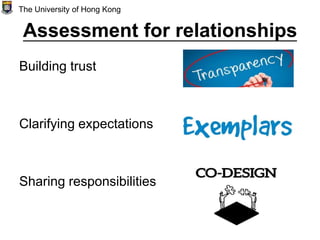
Assessment for relationships
Building trust
Clarifying expectations
Sharing responsibilities
The University of Hong Kong
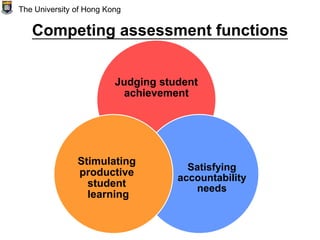
Competing assessment functions
The University of Hong Kong
Judging student
achievement
Satisfying
accountability
needs
Stimulating
productive
student
learning
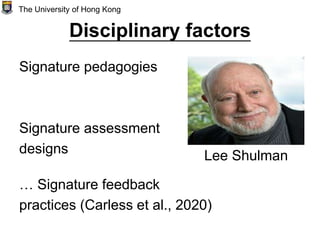
Disciplinary factors
Signature pedagogies
Signature assessment
designs
… Signature feedback
practices (Carless et al., 2020)
The University of Hong Kong
Lee Shulman
WAYS FORWARD FOR
EXAMINATIONS
The University of Hong Kong
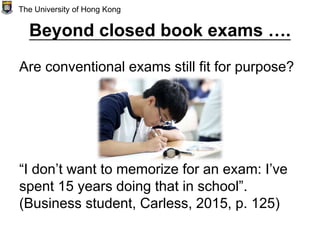
Beyond closed book exams ….
Are conventional exams still fit for purpose?
“I don’t want to memorize for an exam: I’ve
spent 15 years doing that in school”.
(Business student, Carless, 2015, p. 125)
The University of Hong Kong
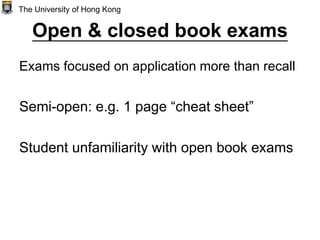
Open & closed book exams
Exams focused on application more than recall
Semi-open: e.g. 1 page “cheat sheet”
Student unfamiliarity with open book exams
The University of Hong Kong
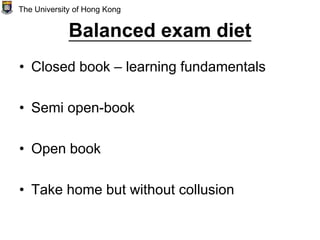
Balanced exam diet
• Closed book – learning fundamentals
• Semi open-book
• Open book
• Take home but without collusion
The University of Hong Kong
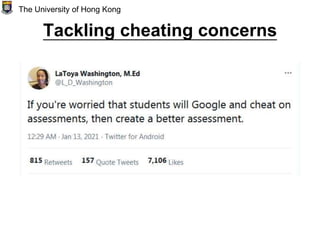
Tackling cheating concerns
The University of Hong Kong
TWO-STAGE EXAMS
The University of Hong Kong
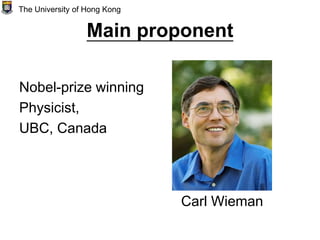
Main proponent
Nobel-prize winning
Physicist,
UBC, Canada
The University of Hong Kong
Carl Wieman
Procedures
Stage 1. Students complete the exam
individually (80-90% weighting)
Stage 2. Students re-do (part of) the exam in
groups submitting one answer sheet (10-
20% weighting)
The University of Hong Kong
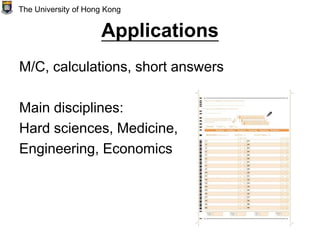
Applications
M/C, calculations, short answers
Main disciplines:
Hard sciences, Medicine,
Engineering, Economics
The University of Hong Kong
Outcomes
• Positive student response
• Improved achievement when working
collaboratively
(Levy, Svoronos & Klinger, 2018)
BUT ……..
The University of Hong Kong
ALTERNATIVE
ASSESSMENT DESIGNS
The University of Hong Kong
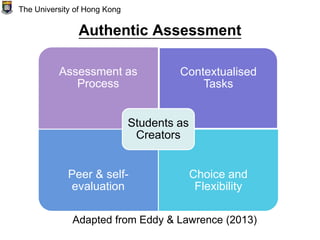
Authentic Assessment
Adapted from Eddy & Lawrence (2013)
The University of Hong Kong
Assessment as
Process
Contextualised
Tasks
Peer & self-
evaluation
Choice and
Flexibility
Students as
Creators
Oral assessment
Oral assessment as alternative to exams
Students generally well-prepared
Teachers can adjust to students’ levels
Differentiates students’ capacities
Some practical challenges
The University of Hong Kong
Oral assessment example
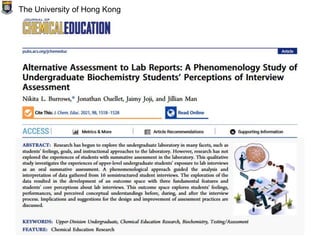
Biochemistry lab reports
F2F interaction promotes higher-order
thinking
Increased student accountability
(Burrows et al., 2021)
The University of Hong Kong
Assessed video presentations
Students record a 5 minute oral presentation
and upload for assessment
E.g. Talk about a course topic that has most
personal meaning for you & explain why
The University of Hong Kong
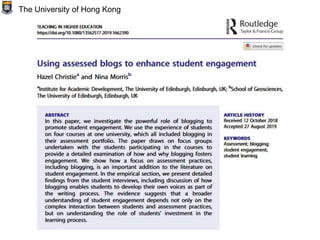
Blogs as assessment
• Process
• Reflections
• Students as communicators more than
receivers of knowledge
(Christie & Morris, 2019)
The University of Hong Kong
Vlogs as assessment
Short personal responses
Peer feedback
Summative written and/or oral reflection
The University of Hong Kong
Assessment design principles
• Iterative sequences of worthwhile tasks
• E.g. 2-3 tasks for a 10/20 week course
• Or cumulative task: eportfolio, blog, vlog
The University of Hong Kong
Pause for comments
• Possibilities
• Challenges
• Sharing
• Queries
The University of Hong Kong
FEEDBACK DESIGNS
The University of Hong Kong
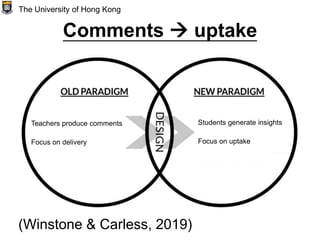
Comments  uptake
The University of Hong Kong
Teachers produce comments
Focus on delivery
Students generate insights
Focus on uptake
(Winstone & Carless, 2019)
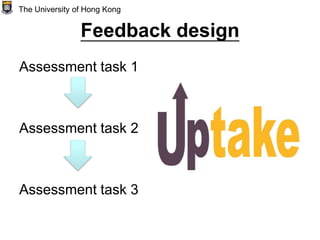
Feedback design
Assessment task 1
Assessment task 2
Assessment task 3
The University of Hong Kong
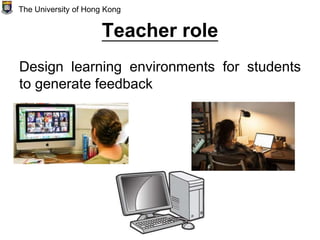
Teacher role
Design learning environments for students
to generate feedback
The University of Hong Kong
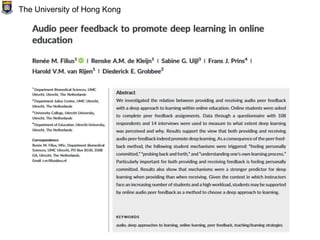
Audio peer feedback
Feeling personally committed
Understanding own learning processes
Comparing own work with that of peers
(Filius et al., 2019)
The University of Hong Kong
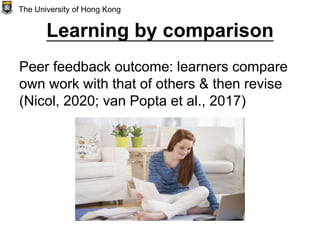
Learning by comparison
Peer feedback outcome: learners compare
own work with that of others & then revise
(Nicol, 2020; van Popta et al., 2017)
The University of Hong Kong
Enhanced implementation of PF
• Scaffolding & coaching
• Selling benefits
• Modelling
• Multiple reviews e.g. trios
• Leveraging comparisons
• Opportunities for dialogue then revision
The University of Hong Kong
Summary
The University of Hong Kong
Assessment design principles
1. Assessment integrated with instruction &
ILOs
2. Encourage deep approaches to learning
3. Spread student effort
4. Mirror real-life uses of the discipline
5. Design for feedback interaction
The University of Hong Kong
References
Bengtsson, L. (2019). Take-home exams in higher education: A systematic review. Education
Sciences, 9, 267. https://doi.org/10.3390/educsci9040267
Burrows, N.L., Ouellet, J., Joji, J., & Man, J. (2021). Alternative assessment to lab reports: A
phenomenology study of undergraduate biochemistry students’ perceptions of interview
assessment. Journal of Chemical Education, 98(5), 1518-1528.
https://doi.org/10.1021/acs.jchemed.1c00150
Carless, D. (2015). Excellence in University Assessment. London: Routledge.
Carless, D., To, J., Kwan, C. & Kwok, J., (2020). Disciplinary perspectives on feedback practices:
Towards signature feedback practices. Teaching in Higher Education.
https://doi.org/10.1080/13562517.2020.1863355
Cooke, J.E., Weir, L., & Clarkston, B. (2019). Retention following two-stage collaborative exams
depends on timing and student performance. CBE-Life Sciences Education, 18(2), 12.
https://dx.doi.org/10.1187%2Fcbe.17-07-0137
Durning, S.J., Dong, T., Ratcliffe, T., Schuwirth, L., Artino Jr., A.R., Boulet, J.R., & Eva, K. (2016).
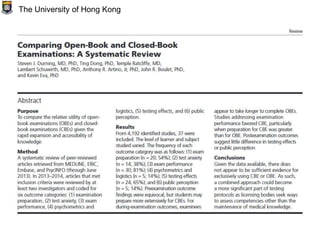
Comparing open-book and closed-book examinations: A systematic review. Academic Medicine,
91(4), 583-599. https://doi.org/10.1097/acm.0000000000000977
Eddy, P.L., & Lawrence, A. (2013). Wikis as platforms for authentic assessment. Innovative Higher
Education, 38(4), 253-265. https://doi.org/10.1007/s10755-012-9239-7
Efu, S.I. (2019). Exams as learning tools: A comparison of traditional and collaborative assessment in
higher education. College Teaching, 67, 73-83. https://doi.org/10.1080/87567555.2018.1531282
The University of Hong Kong
References (continued)
Filius, R., de Kleijn, R., Uijl, S., Prins, F., van Rijen, H., & Grobbee, D. (2019). Audio peer feedback to
promote deep learning in online education. Journal of Computer Assisted Learning, 35(5), 607-
619. https://onlinelibrary.wiley.com/doi/full/10.1111/jcal.12363
Gilley, B.H., & Clarkston, B. (2014). Collaborative testing: Evidence of learning in a controlled in-class
study of undergraduate students. Research and Teaching, 43(3), 83-91.
https://doi.org/10.2505%2F4%2Fjcst14_043_03_83
Jang, H., Lasry, N., Miller, K., & Mazur, E. (2017). Collaborative exams: Cheating? Or Learning?
American Journal of Physics, 85, 223-227. https://doi.org/10.1119/1.4974744
Johanns, B., Dinkens, A., & Moore, J. (2017). A systematic review comparing open-book and closed-
book examinations: Evaluating effects on development of critical thinking skills. Nurse Education in
Practice, 27, 89-94. https://doi.org/10.1016/j.nepr.2017.08.018
Levy, D., Svoronos T. & Klinger, M. (2018). Two-stage examinations: Can examinations be more
formative experiences? Active Learning in Higher Education. doi:10.1177/1469787418801668
Nicol, D. (2020) The power of internal feedback: Exploiting natural comparison processes.
Assessment & Evaluation in Higher Education. https://doi.org/10.1080/02602938.2020.1823314
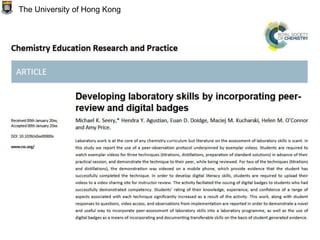
Seery, M.K., Agustian, H.Y., Doidge, E.D., Kucharski, M.M., O’Connor, H.M., & Price, A. (2017).
Developing laboratory skills by incorporating peer-review and digital badges. Chemistry Education
Research and Practice, 18, 403-419. https://doi.org/10.1039/C7RP00003K
Winstone, N., & Carless, D. (2019). Designing effective feedback processes in higher education: A
learning-focused approach. London: Routledge.
The University of Hong Kong
QUESTIONS
&
COMMENTS
The University of Hong Kong
Two-stage exams in action
2 minute video on two-stage exams
https://www.youtube.com/watch?v=ZVFwQzl
VFy0
The University of Hong Kong
Connected program-based assessment
Judicious balance of continuity & variety of
assessment tasks
Enabling familiarity with expectations
Latent learning from previous feedback
The University of Hong Kong

Assessment and feedback for learning: Beyond closed book exams

  • 1.
    Assessment and feedbackfor learning: Beyond closed book exams @CarlessDavid University of Hong Kong, June 9, 2021 Imperial College London The University of Hong Kong
  • 2.
    Overview 1. Assessment functions 2.Examinations, learning & alternatives 3. Feedback possibilities 4. Implications The University of Hong Kong
  • 3.
    Assessment for relationships Buildingtrust Clarifying expectations Sharing responsibilities The University of Hong Kong
  • 4.
    Competing assessment functions TheUniversity of Hong Kong Judging student achievement Satisfying accountability needs Stimulating productive student learning
  • 5.
    Disciplinary factors Signature pedagogies Signatureassessment designs … Signature feedback practices (Carless et al., 2020) The University of Hong Kong Lee Shulman
  • 6.
    WAYS FORWARD FOR EXAMINATIONS TheUniversity of Hong Kong
  • 7.
    Beyond closed bookexams …. Are conventional exams still fit for purpose? “I don’t want to memorize for an exam: I’ve spent 15 years doing that in school”. (Business student, Carless, 2015, p. 125) The University of Hong Kong
  • 8.
    Open & closedbook exams Exams focused on application more than recall Semi-open: e.g. 1 page “cheat sheet” Student unfamiliarity with open book exams The University of Hong Kong
  • 9.
  • 10.
    Balanced exam diet •Closed book – learning fundamentals • Semi open-book • Open book • Take home but without collusion The University of Hong Kong
  • 11.
    Tackling cheating concerns TheUniversity of Hong Kong
  • 12.
  • 13.
  • 14.
    Main proponent Nobel-prize winning Physicist, UBC,Canada The University of Hong Kong Carl Wieman
  • 15.
    Procedures Stage 1. Studentscomplete the exam individually (80-90% weighting) Stage 2. Students re-do (part of) the exam in groups submitting one answer sheet (10- 20% weighting) The University of Hong Kong
  • 16.
    Applications M/C, calculations, shortanswers Main disciplines: Hard sciences, Medicine, Engineering, Economics The University of Hong Kong
  • 17.
    Outcomes • Positive studentresponse • Improved achievement when working collaboratively (Levy, Svoronos & Klinger, 2018) BUT …….. The University of Hong Kong
  • 18.
  • 19.
    Authentic Assessment Adapted fromEddy & Lawrence (2013) The University of Hong Kong Assessment as Process Contextualised Tasks Peer & self- evaluation Choice and Flexibility Students as Creators
  • 20.
    Oral assessment Oral assessmentas alternative to exams Students generally well-prepared Teachers can adjust to students’ levels Differentiates students’ capacities Some practical challenges The University of Hong Kong
  • 21.
  • 22.
    Oral assessment example Biochemistrylab reports F2F interaction promotes higher-order thinking Increased student accountability (Burrows et al., 2021) The University of Hong Kong
  • 23.
    Assessed video presentations Studentsrecord a 5 minute oral presentation and upload for assessment E.g. Talk about a course topic that has most personal meaning for you & explain why The University of Hong Kong
  • 24.
  • 25.
    Blogs as assessment •Process • Reflections • Students as communicators more than receivers of knowledge (Christie & Morris, 2019) The University of Hong Kong
  • 26.
    Vlogs as assessment Shortpersonal responses Peer feedback Summative written and/or oral reflection The University of Hong Kong
  • 27.
    Assessment design principles •Iterative sequences of worthwhile tasks • E.g. 2-3 tasks for a 10/20 week course • Or cumulative task: eportfolio, blog, vlog The University of Hong Kong
  • 28.
    Pause for comments •Possibilities • Challenges • Sharing • Queries The University of Hong Kong
  • 29.
  • 30.
    Comments  uptake TheUniversity of Hong Kong Teachers produce comments Focus on delivery Students generate insights Focus on uptake (Winstone & Carless, 2019)
  • 31.
    Feedback design Assessment task1 Assessment task 2 Assessment task 3 The University of Hong Kong
  • 32.
    Teacher role Design learningenvironments for students to generate feedback The University of Hong Kong
  • 33.
  • 34.
    Audio peer feedback Feelingpersonally committed Understanding own learning processes Comparing own work with that of peers (Filius et al., 2019) The University of Hong Kong
  • 35.
    Learning by comparison Peerfeedback outcome: learners compare own work with that of others & then revise (Nicol, 2020; van Popta et al., 2017) The University of Hong Kong
  • 36.
    Enhanced implementation ofPF • Scaffolding & coaching • Selling benefits • Modelling • Multiple reviews e.g. trios • Leveraging comparisons • Opportunities for dialogue then revision The University of Hong Kong
  • 37.
  • 38.
    Assessment design principles 1.Assessment integrated with instruction & ILOs 2. Encourage deep approaches to learning 3. Spread student effort 4. Mirror real-life uses of the discipline 5. Design for feedback interaction The University of Hong Kong
  • 39.
    References Bengtsson, L. (2019).Take-home exams in higher education: A systematic review. Education Sciences, 9, 267. https://doi.org/10.3390/educsci9040267 Burrows, N.L., Ouellet, J., Joji, J., & Man, J. (2021). Alternative assessment to lab reports: A phenomenology study of undergraduate biochemistry students’ perceptions of interview assessment. Journal of Chemical Education, 98(5), 1518-1528. https://doi.org/10.1021/acs.jchemed.1c00150 Carless, D. (2015). Excellence in University Assessment. London: Routledge. Carless, D., To, J., Kwan, C. & Kwok, J., (2020). Disciplinary perspectives on feedback practices: Towards signature feedback practices. Teaching in Higher Education. https://doi.org/10.1080/13562517.2020.1863355 Cooke, J.E., Weir, L., & Clarkston, B. (2019). Retention following two-stage collaborative exams depends on timing and student performance. CBE-Life Sciences Education, 18(2), 12. https://dx.doi.org/10.1187%2Fcbe.17-07-0137 Durning, S.J., Dong, T., Ratcliffe, T., Schuwirth, L., Artino Jr., A.R., Boulet, J.R., & Eva, K. (2016). Comparing open-book and closed-book examinations: A systematic review. Academic Medicine, 91(4), 583-599. https://doi.org/10.1097/acm.0000000000000977 Eddy, P.L., & Lawrence, A. (2013). Wikis as platforms for authentic assessment. Innovative Higher Education, 38(4), 253-265. https://doi.org/10.1007/s10755-012-9239-7 Efu, S.I. (2019). Exams as learning tools: A comparison of traditional and collaborative assessment in higher education. College Teaching, 67, 73-83. https://doi.org/10.1080/87567555.2018.1531282 The University of Hong Kong
  • 40.
    References (continued) Filius, R.,de Kleijn, R., Uijl, S., Prins, F., van Rijen, H., & Grobbee, D. (2019). Audio peer feedback to promote deep learning in online education. Journal of Computer Assisted Learning, 35(5), 607- 619. https://onlinelibrary.wiley.com/doi/full/10.1111/jcal.12363 Gilley, B.H., & Clarkston, B. (2014). Collaborative testing: Evidence of learning in a controlled in-class study of undergraduate students. Research and Teaching, 43(3), 83-91. https://doi.org/10.2505%2F4%2Fjcst14_043_03_83 Jang, H., Lasry, N., Miller, K., & Mazur, E. (2017). Collaborative exams: Cheating? Or Learning? American Journal of Physics, 85, 223-227. https://doi.org/10.1119/1.4974744 Johanns, B., Dinkens, A., & Moore, J. (2017). A systematic review comparing open-book and closed- book examinations: Evaluating effects on development of critical thinking skills. Nurse Education in Practice, 27, 89-94. https://doi.org/10.1016/j.nepr.2017.08.018 Levy, D., Svoronos T. & Klinger, M. (2018). Two-stage examinations: Can examinations be more formative experiences? Active Learning in Higher Education. doi:10.1177/1469787418801668 Nicol, D. (2020) The power of internal feedback: Exploiting natural comparison processes. Assessment & Evaluation in Higher Education. https://doi.org/10.1080/02602938.2020.1823314 Seery, M.K., Agustian, H.Y., Doidge, E.D., Kucharski, M.M., O’Connor, H.M., & Price, A. (2017). Developing laboratory skills by incorporating peer-review and digital badges. Chemistry Education Research and Practice, 18, 403-419. https://doi.org/10.1039/C7RP00003K Winstone, N., & Carless, D. (2019). Designing effective feedback processes in higher education: A learning-focused approach. London: Routledge. The University of Hong Kong
  • 41.
  • 42.
  • 43.
    Two-stage exams inaction 2 minute video on two-stage exams https://www.youtube.com/watch?v=ZVFwQzl VFy0 The University of Hong Kong
  • 44.
    Connected program-based assessment Judiciousbalance of continuity & variety of assessment tasks Enabling familiarity with expectations Latent learning from previous feedback The University of Hong Kong
  • 45.