
Supporting the development
of student feedback literacy
David Carless
University of Hong Kong
@CarlessDavid
October 13, 2021
TEL, University of Sussex
The University of Hong Kong
Overview
1. Key feedback challenges
2. Feedback literacy
3. Productive feedback designs
4. Digital possibilities
5. Summary & Implications
The University of Hong Kong
CHALLENGES THAT FEEDBACK
LITERACY MIGHT ADDRESS
The University of Hong Kong
Key feedback challenges
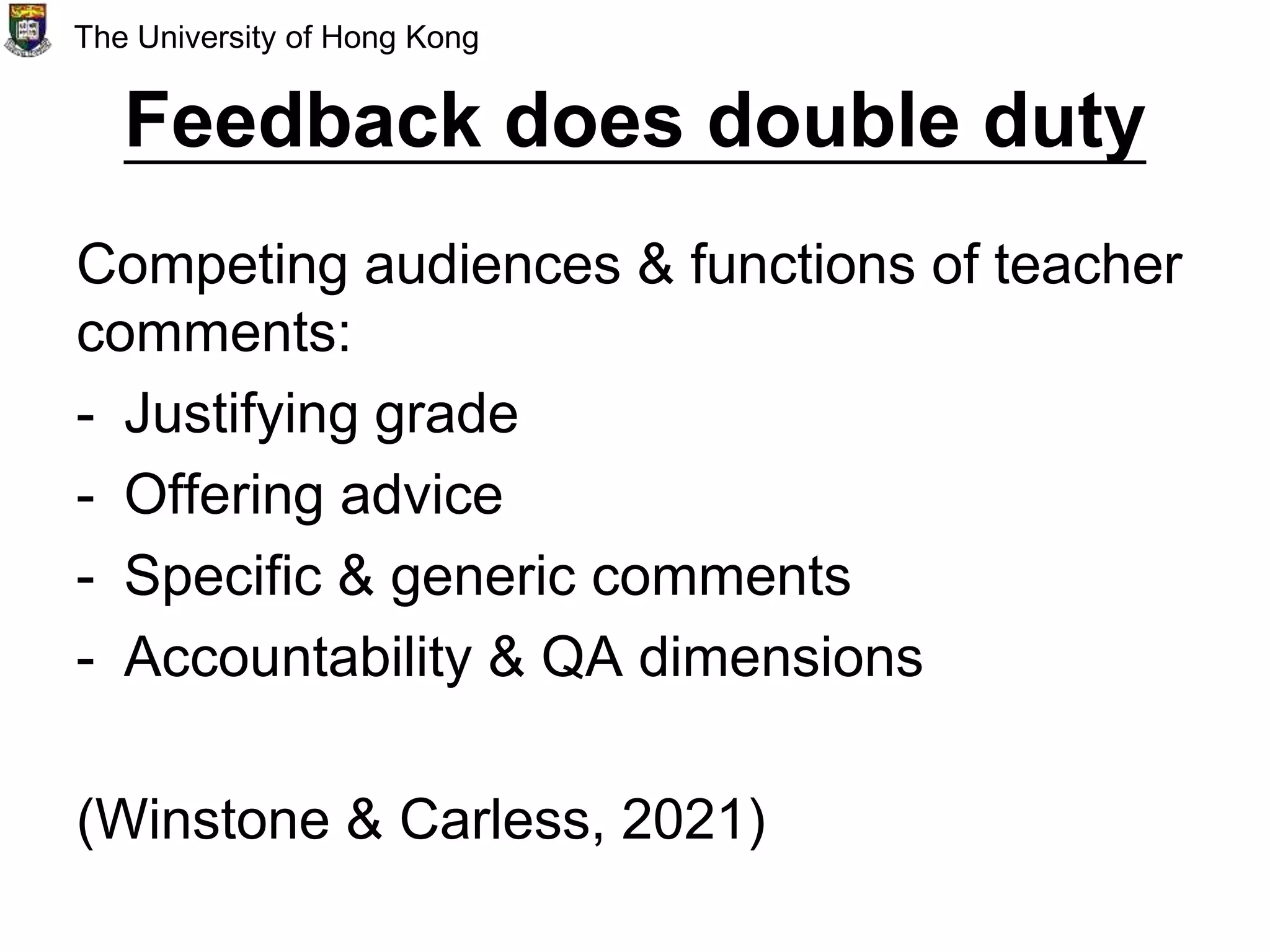
1. Unidirectional feedback as telling
2. Timing of feedback
The University of Hong Kong
Feedback does double duty
Competing audiences & functions of teacher
comments:
- Justifying grade
- Offering advice
- Specific & generic comments
- Accountability & QA dimensions
(Winstone & Carless, 2021)
The University of Hong Kong
Paradigm shift
From teachers delivering comments
To what learners do: self-generated
feedback; using inputs
The University of Hong Kong
Delivery  uptake
The University of Hong Kong
Teachers produce comments
Focus on delivery
Students generate insights
Focus on uptake
(Carless, 2015; Winstone & Carless, 2019)
Constructive feedback processes
Enable students to compare work-in-
progress with that of others (Nicol, 2020)
Within the curriculum & timed for uptake
(e.g. Harland et al. 2017; Pitt & Carless,
2021)
The University of Hong Kong
THE ROLE OF FEEDBACK
LITERACY
The University of Hong Kong
Defining student feedback literacy
Understandings, capacities & dispositions
needed to use feedback for improvement
(Carless & Boud, 2018).
The University of Hong Kong
Student feedback literacy
The University of Hong Kong
Making
Judgments
Appreciating
Feedback
Managing
Affect
Taking Action
(Carless & Boud, 2018)
Defining teacher feedback literacy
Knowledge & expertise to design feedback
processes for student uptake
(Carless & Winstone, 2020)
The University of Hong Kong
(Carless & Winstone, 2020)
Shared responsibilities
All parties need to understand the common
enterprise of feedback processes; & extend
feedback literacy further (Boud & Dawson,
2021)
The University of Hong Kong
FEEDBACK DESIGNS
The University of Hong Kong
Feedback designs
Shift from the provision of comments to the
design of learning environments
(Boud & Molloy, 2013)
The University of Hong Kong
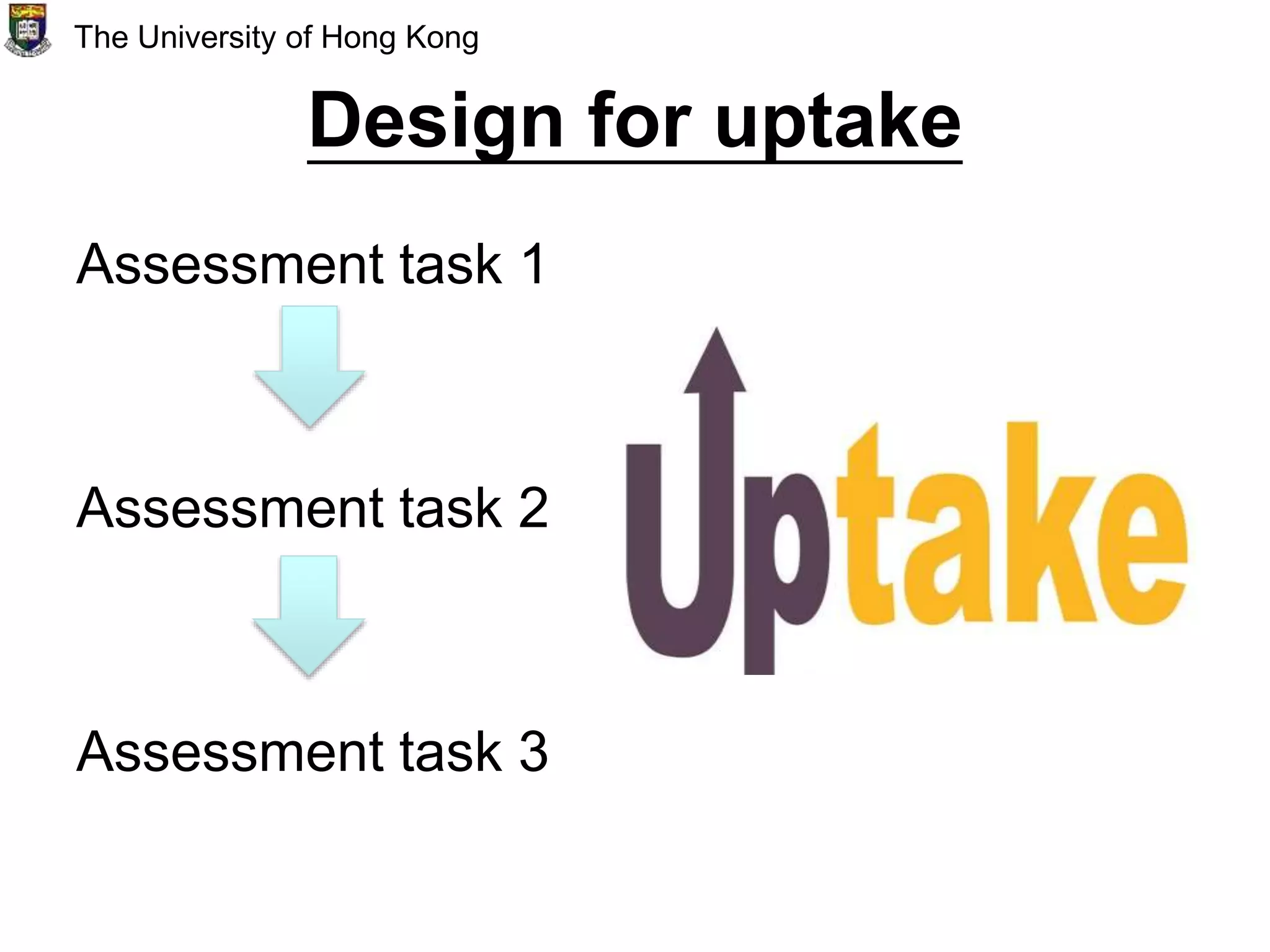
Design for uptake
Assessment task 1
Assessment task 2
Assessment task 3
The University of Hong Kong
Teacher role
Design learning environments for students
to generate feedback
The University of Hong Kong
Audio peer feedback
Feeling personally committed
Understanding own learning processes
Comparing own work with that of peers
(Filius et al., 2019)
The University of Hong Kong
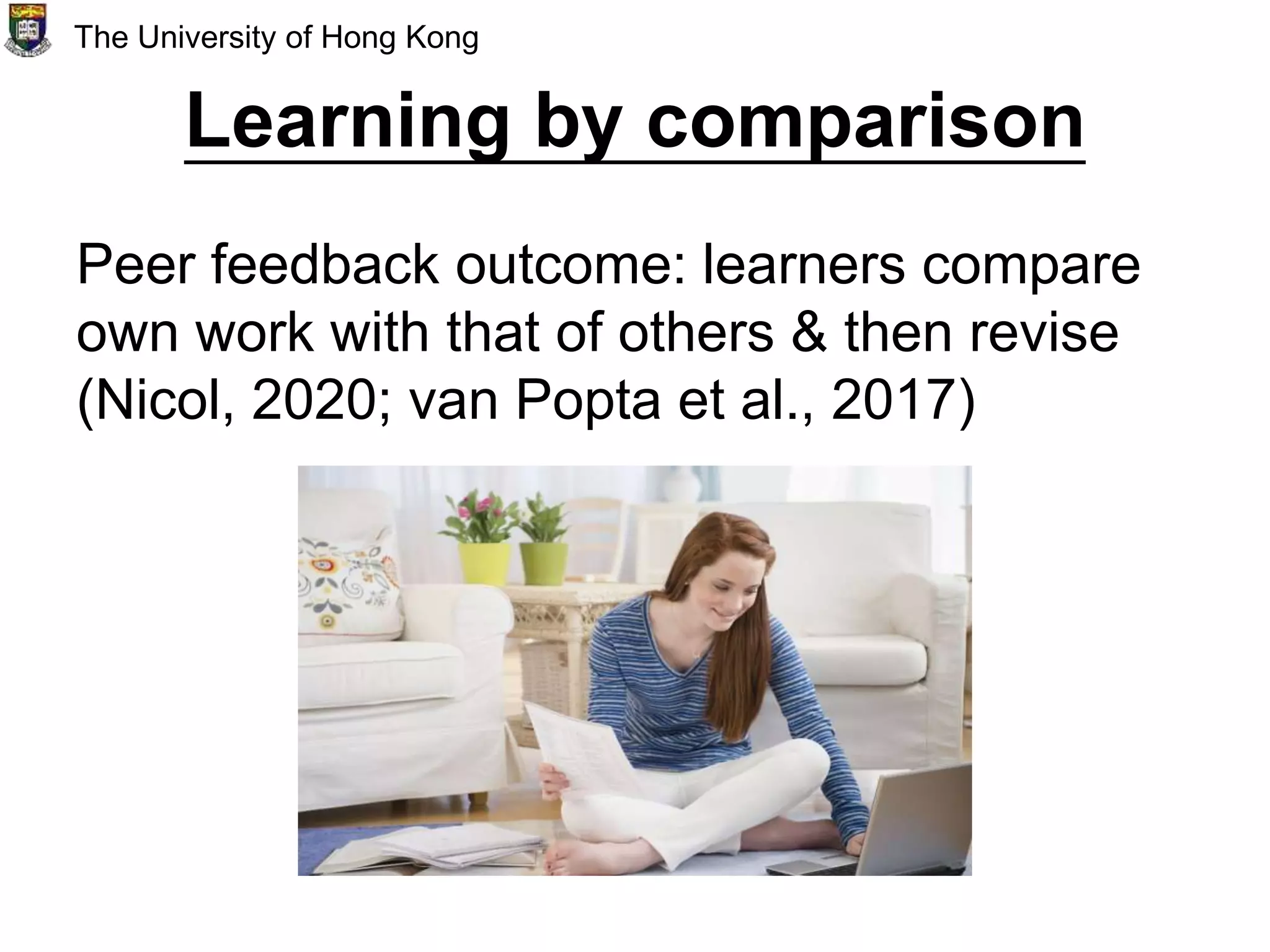
Learning by comparison
Peer feedback outcome: learners compare
own work with that of others & then revise
(Nicol, 2020; van Popta et al., 2017)
The University of Hong Kong
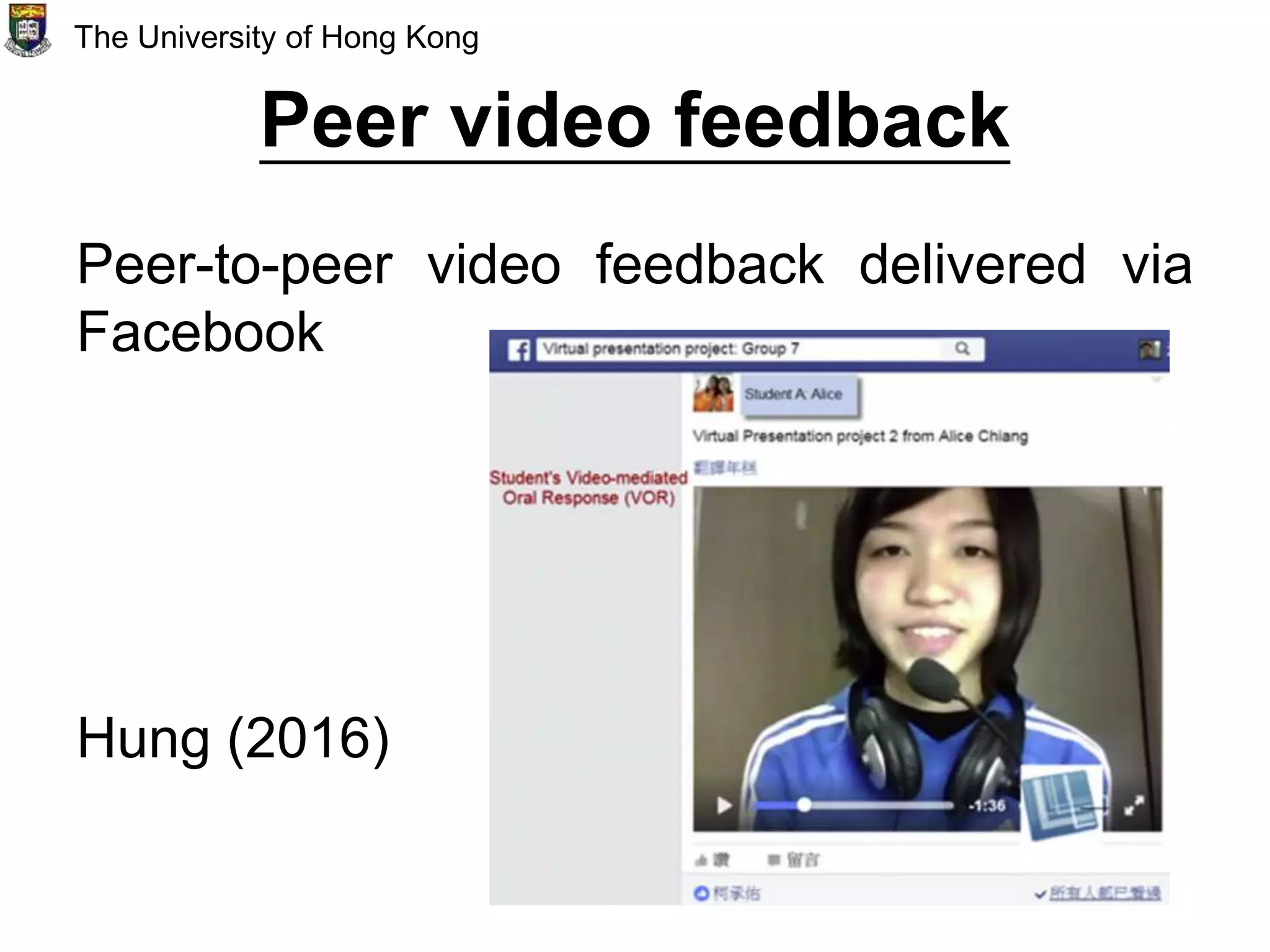
Peer video feedback
Peer-to-peer video feedback delivered via
Facebook
Hung (2016)
The University of Hong Kong
Audio/video feedback modes
Enable rapport &
nuance
You can talk faster, & more personally, than
you can write
The University of Hong Kong
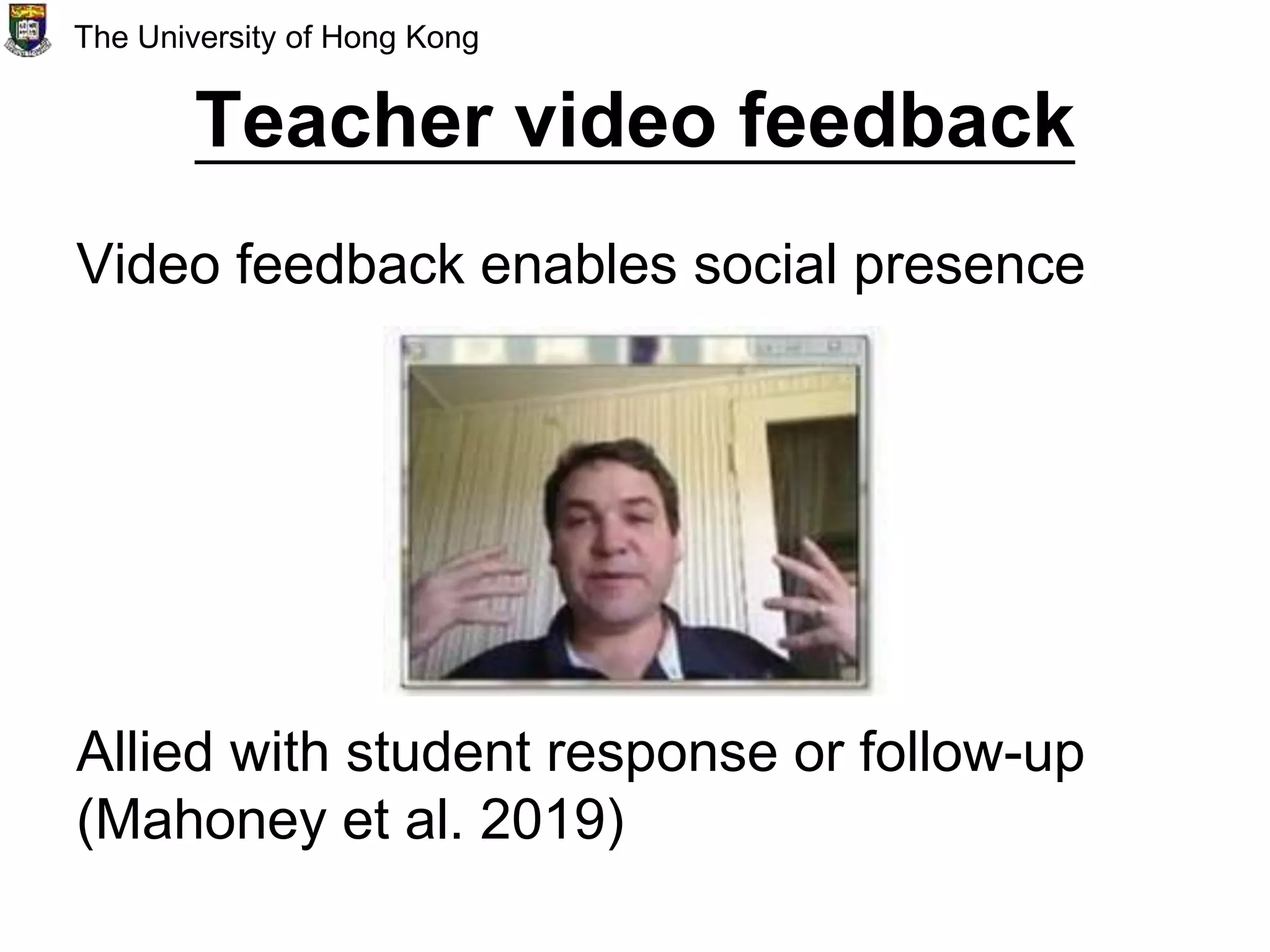
Teacher video feedback
Video feedback enables social presence
Allied with student response or follow-up
(Mahoney et al. 2019)
The University of Hong Kong
Screencasting
Digital recording of users’ screen combined
with voice narration e.g.
Screencasting & re-drafting on Google Docs
(Wood, 2020)
The University of Hong Kong
Digital feedback principles
• Students evaluating quality
• Students generating feedback
• Students responding to inputs
• Using inputs in ongoing/future work
The University of Hong Kong
Thoughts so far …?
Sharing, questions, comments
The University of Hong Kong
Summary, implications &
future directions
The University of Hong Kong
Designing for uptake
• Opportunities for sharing work-in-progress
• Careful sequencing of work & tasks
• Students generating and using feedback
• Enabling positive student experiences of
feedback processes
The University of Hong Kong
Disciplines & feedback
• Enhancing disciplinary feedback modes
• Signature feedback practices: fundamental to
the discipline (Carless et al. 2020)
The University of Hong Kong
Discipline-specific feedback literacies
Embedding the development of discipline-
specific feedback literacies within the
curriculum
(Winstone, Balloo & Carless, 2020)
The University of Hong Kong
Shared feedback literacy
Learning designs or program designs to
enable the mutual development of teacher &
student feedback literacy
The University of Hong Kong
Feedback requests
Learners seeking information about their
own work for the purposes of improvement
The University of Hong Kong
I want feedback
on…
Reflective feedback request
1. The strengths are …
2. The aspects for development are …
3. I would like feedback on …
(Winstone & Carless, 2019)
The University of Hong Kong
References
Boud, D. & Dawson, P. (2021). What feedback literate teachers do: An empirically-derived competency framework.
Assessment & Evaluation in Higher Education
Boud, D. & Molloy, E. (2013). Rethinking models of feedback for learning: The challenge of design. Assessment &
Evaluation in Higher Education, 38(6), 698-712.
Carless, D. (2015). Excellence in University Assessment. London: Routledge.
Carless, D. & Boud, D. (2018). The development of student feedback literacy: Enabling uptake of feedback.
Assessment & Evaluation in Higher Education, 43(8), 1315-1325. doi:10.1080/02602938.2018.1463354.
Carless, D., To, J., Kwan, C. & Kwok, J., (2020). Disciplinary perspectives on feedback practices: Towards signature
feedback practices. Teaching in Higher Education. https://doi.org/10.1080/13562517.2020.1863355.
Carless, D. & N. Winstone (2020). Teacher feedback literacy and its interplay with student feedback literacy, Teaching
in Higher Education. doi:10.1080/13562517.2020.1782372
Chong, S. W. (2021). Reconsidering student feedback literacy from an ecological perspective. Assessment &
Evaluation in Higher Education, 46(1), 92-104.
Dawson, P., D. Carless, and P. P. W. Lee. (2021) Authentic feedback: Supporting learners to engage in disciplinary
feedback practices. Assessment and Evaluation in Higher Education, 46(2), 286-296.
Filius, R., R. de Kleijn, S. Uijl, F. Prins, H. van Rijen & D. Grobbee (2019). Audio peer feedback to promote deep
learning in online education. Journal of Computer Assisted Learning.
https://onlinelibrary.wiley.com/doi/full/10.1111/jcal.12363
Gravett, K. (2020). Feedback literacies as sociomaterial practice. Critical Studies in Education. doi:
10.1080/17508487.2020.1747099
Harland, T., Wald, N., & Randhawa, H. (2017). Student peer review: Enhancing formative feedback with a rebuttal.
Assessment & Evaluation in Higher Education, 42(5), 801-811.
Hung, S.-T.A. (2016). Enhancing feedback provision through multimodal video technology. Computers & Education, 98,
90-101.
The University of Hong Kong
References (continued)
Maas, C. (2017). Perceptions of Multimodal Learner-Driven Feedback in EAP. Writing and Pedagogy, 9(3), 487-516.
Mahoney, P., S. Macfarlane, and R. Ajjawi. (2019). A Qualitative Synthesis of Video Feedback in Higher
Education.Teaching in Higher Education 24 (2): 157-179. doi:10.1080/13562517.2018.1471457
Matthews, K., Tai, J., Enright, E., Carless, D., Rafferty, C. & Winstone, N. (2021). Transgressing the boundaries of
‘students as partners’ and ‘feedback’ discourse communities to advance democratic education. Teaching in Higher
Education https://doi.org/10.1080/13562517.2021.1903854
Nicol, D. (2020) The power of internal feedback: Exploiting natural comparison processes. Assessment & Evaluation in
Higher Education. https://doi.org/10.1080/02602938.2020.1823314
Pitt, E. & Carless, D. (2021). Signature feedback practices in the creative arts: Integrating feedback within the
curriculum. Assessment & Evaluation in Higher Education, https://doi.org/10.1080/02602938.2021.1980769.
Van Popta, E. et al. (2017). Exploring the value of peer feedback in online learning for the provider. Educational
Research Review, 20, 24-34. https://doi.org/10.1016/j.edurev.2016.10.003
Winstone, N., Balloo, K. & Carless, D. (2020). Discipline-specific feedback literacies: A framework for curriculum
design. Higher Education. https://doi.org/10.1007/s10734-020-00632-0
Winstone, N. and Carless, D. (2019). Designing effective feedback processes in higher education: A learning-focused
approach. London: Routledge.
Winstone, N., & Carless, D. (2021). Who is feedback for? The influence of accountability and quality assurance
agendas on the enactment of feedback processes. Assessment in Education
https://doi.org/10.1080/0969594X.2021.1926221
Wood, J. (2020). A dialogic technology-mediated model of feedback uptake and literacy. Assessment & Evaluation in
Higher Education.
The University of Hong Kong
THANK YOU
The University of Hong Kong
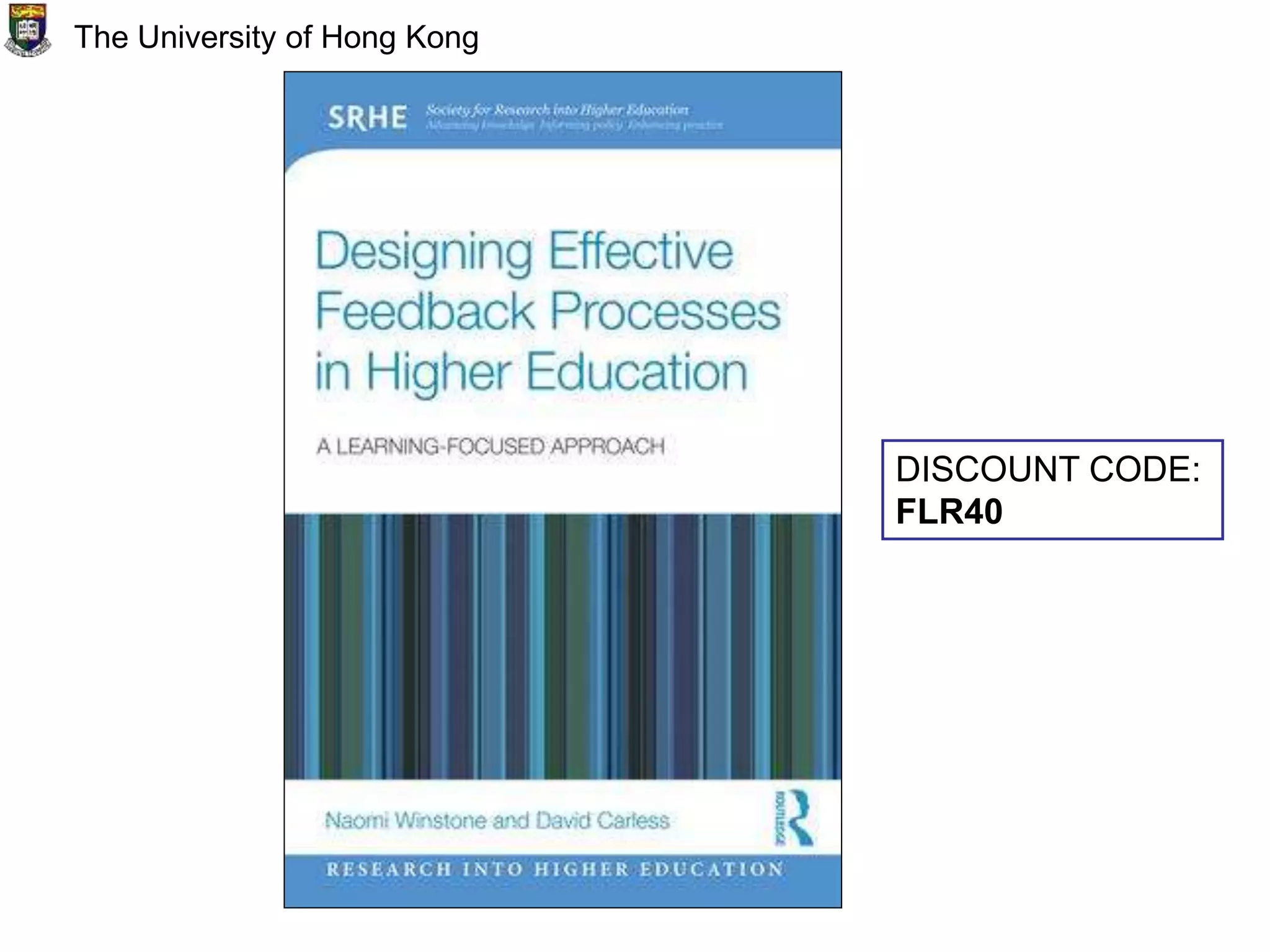
DISCOUNT CODE:
FLR40
Implementing peer feedback
• Scaffolding & coaching
• Selling benefits of peer feedback
• Multiple reviews e.g. trios
• Leveraging comparisons
The University of Hong Kong
Feedback requests
• Learners eliciting comments on areas of
interest
• Expressing preferences on modes of
feedback
• Stating preference for more critical or
more encouraging feedback
(cf. Maas, 2017)
The University of Hong Kong
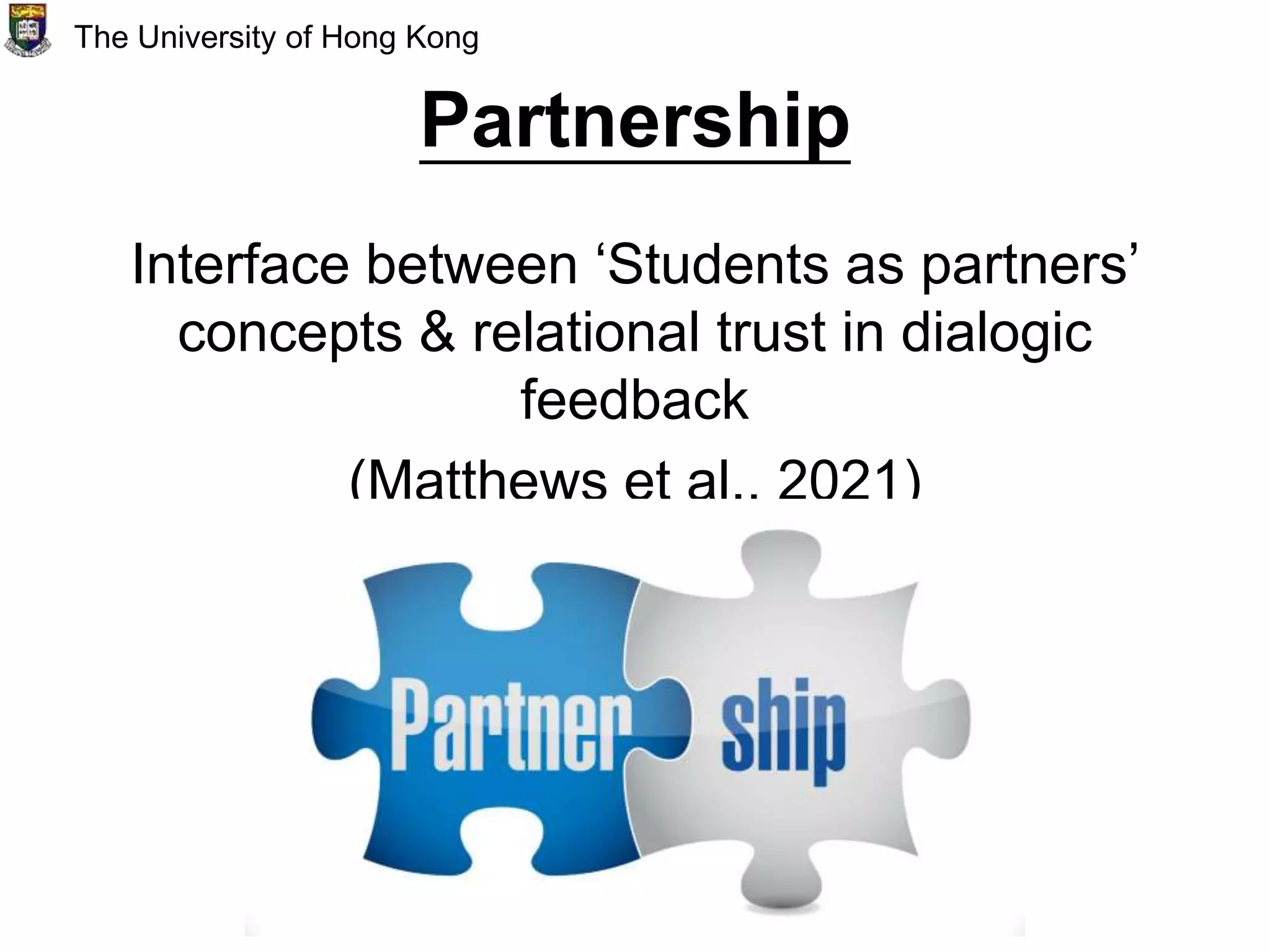
Partnership
Interface between ‘Students as partners’
concepts & relational trust in dialogic
feedback
(Matthews et al., 2021)
The University of Hong Kong
Authentic feedback
Processes resembling the feedback
practices of the discipline, profession or
workplace
(Dawson, Carless & Lee, 2021)
The University of Hong Kong
Learning theories deployed
Social constructivism (Carless & Boud,
2018; Winstone & Carless, 2019)
Sociocultural theory (Chong, 2020;
Esterhazy, 2018)
Sociomaterialism (Gravett, 2020)
The University of Hong Kong
Critiques of feedback literacy
Assumes more agency than students (&
teachers) may possess (Gravett 2020)
Might be construed as a deficit model of
students (or teachers)
What is the definition & scope of ‘literacies’?
The University of Hong Kong

Supporting the development of student feedback literacy

  • 1.
    Supporting the development ofstudent feedback literacy David Carless University of Hong Kong @CarlessDavid October 13, 2021 TEL, University of Sussex The University of Hong Kong
  • 2.
    Overview 1. Key feedbackchallenges 2. Feedback literacy 3. Productive feedback designs 4. Digital possibilities 5. Summary & Implications The University of Hong Kong
  • 3.
    CHALLENGES THAT FEEDBACK LITERACYMIGHT ADDRESS The University of Hong Kong
  • 4.
    Key feedback challenges 1.Unidirectional feedback as telling 2. Timing of feedback The University of Hong Kong
  • 5.
    Feedback does doubleduty Competing audiences & functions of teacher comments: - Justifying grade - Offering advice - Specific & generic comments - Accountability & QA dimensions (Winstone & Carless, 2021) The University of Hong Kong
  • 6.
    Paradigm shift From teachersdelivering comments To what learners do: self-generated feedback; using inputs The University of Hong Kong
  • 7.
    Delivery  uptake TheUniversity of Hong Kong Teachers produce comments Focus on delivery Students generate insights Focus on uptake (Carless, 2015; Winstone & Carless, 2019)
  • 8.
    Constructive feedback processes Enablestudents to compare work-in- progress with that of others (Nicol, 2020) Within the curriculum & timed for uptake (e.g. Harland et al. 2017; Pitt & Carless, 2021) The University of Hong Kong
  • 9.
    THE ROLE OFFEEDBACK LITERACY The University of Hong Kong
  • 10.
    Defining student feedbackliteracy Understandings, capacities & dispositions needed to use feedback for improvement (Carless & Boud, 2018). The University of Hong Kong
  • 11.
    Student feedback literacy TheUniversity of Hong Kong Making Judgments Appreciating Feedback Managing Affect Taking Action (Carless & Boud, 2018)
  • 12.
    Defining teacher feedbackliteracy Knowledge & expertise to design feedback processes for student uptake (Carless & Winstone, 2020) The University of Hong Kong
  • 13.
  • 14.
    Shared responsibilities All partiesneed to understand the common enterprise of feedback processes; & extend feedback literacy further (Boud & Dawson, 2021) The University of Hong Kong
  • 15.
  • 16.
    Feedback designs Shift fromthe provision of comments to the design of learning environments (Boud & Molloy, 2013) The University of Hong Kong
  • 17.
    Design for uptake Assessmenttask 1 Assessment task 2 Assessment task 3 The University of Hong Kong
  • 18.
    Teacher role Design learningenvironments for students to generate feedback The University of Hong Kong
  • 19.
  • 20.
    Audio peer feedback Feelingpersonally committed Understanding own learning processes Comparing own work with that of peers (Filius et al., 2019) The University of Hong Kong
  • 21.
    Learning by comparison Peerfeedback outcome: learners compare own work with that of others & then revise (Nicol, 2020; van Popta et al., 2017) The University of Hong Kong
  • 22.
    Peer video feedback Peer-to-peervideo feedback delivered via Facebook Hung (2016) The University of Hong Kong
  • 23.
    Audio/video feedback modes Enablerapport & nuance You can talk faster, & more personally, than you can write The University of Hong Kong
  • 24.
    Teacher video feedback Videofeedback enables social presence Allied with student response or follow-up (Mahoney et al. 2019) The University of Hong Kong
  • 25.
    Screencasting Digital recording ofusers’ screen combined with voice narration e.g. Screencasting & re-drafting on Google Docs (Wood, 2020) The University of Hong Kong
  • 26.
    Digital feedback principles •Students evaluating quality • Students generating feedback • Students responding to inputs • Using inputs in ongoing/future work The University of Hong Kong
  • 27.
    Thoughts so far…? Sharing, questions, comments The University of Hong Kong
  • 28.
    Summary, implications & futuredirections The University of Hong Kong
  • 29.
    Designing for uptake •Opportunities for sharing work-in-progress • Careful sequencing of work & tasks • Students generating and using feedback • Enabling positive student experiences of feedback processes The University of Hong Kong
  • 30.
    Disciplines & feedback •Enhancing disciplinary feedback modes • Signature feedback practices: fundamental to the discipline (Carless et al. 2020) The University of Hong Kong
  • 31.
    Discipline-specific feedback literacies Embeddingthe development of discipline- specific feedback literacies within the curriculum (Winstone, Balloo & Carless, 2020) The University of Hong Kong
  • 32.
    Shared feedback literacy Learningdesigns or program designs to enable the mutual development of teacher & student feedback literacy The University of Hong Kong
  • 33.
    Feedback requests Learners seekinginformation about their own work for the purposes of improvement The University of Hong Kong I want feedback on…
  • 34.
    Reflective feedback request 1.The strengths are … 2. The aspects for development are … 3. I would like feedback on … (Winstone & Carless, 2019) The University of Hong Kong
  • 35.
    References Boud, D. &Dawson, P. (2021). What feedback literate teachers do: An empirically-derived competency framework. Assessment & Evaluation in Higher Education Boud, D. & Molloy, E. (2013). Rethinking models of feedback for learning: The challenge of design. Assessment & Evaluation in Higher Education, 38(6), 698-712. Carless, D. (2015). Excellence in University Assessment. London: Routledge. Carless, D. & Boud, D. (2018). The development of student feedback literacy: Enabling uptake of feedback. Assessment & Evaluation in Higher Education, 43(8), 1315-1325. doi:10.1080/02602938.2018.1463354. Carless, D., To, J., Kwan, C. & Kwok, J., (2020). Disciplinary perspectives on feedback practices: Towards signature feedback practices. Teaching in Higher Education. https://doi.org/10.1080/13562517.2020.1863355. Carless, D. & N. Winstone (2020). Teacher feedback literacy and its interplay with student feedback literacy, Teaching in Higher Education. doi:10.1080/13562517.2020.1782372 Chong, S. W. (2021). Reconsidering student feedback literacy from an ecological perspective. Assessment & Evaluation in Higher Education, 46(1), 92-104. Dawson, P., D. Carless, and P. P. W. Lee. (2021) Authentic feedback: Supporting learners to engage in disciplinary feedback practices. Assessment and Evaluation in Higher Education, 46(2), 286-296. Filius, R., R. de Kleijn, S. Uijl, F. Prins, H. van Rijen & D. Grobbee (2019). Audio peer feedback to promote deep learning in online education. Journal of Computer Assisted Learning. https://onlinelibrary.wiley.com/doi/full/10.1111/jcal.12363 Gravett, K. (2020). Feedback literacies as sociomaterial practice. Critical Studies in Education. doi: 10.1080/17508487.2020.1747099 Harland, T., Wald, N., & Randhawa, H. (2017). Student peer review: Enhancing formative feedback with a rebuttal. Assessment & Evaluation in Higher Education, 42(5), 801-811. Hung, S.-T.A. (2016). Enhancing feedback provision through multimodal video technology. Computers & Education, 98, 90-101. The University of Hong Kong
  • 36.
    References (continued) Maas, C.(2017). Perceptions of Multimodal Learner-Driven Feedback in EAP. Writing and Pedagogy, 9(3), 487-516. Mahoney, P., S. Macfarlane, and R. Ajjawi. (2019). A Qualitative Synthesis of Video Feedback in Higher Education.Teaching in Higher Education 24 (2): 157-179. doi:10.1080/13562517.2018.1471457 Matthews, K., Tai, J., Enright, E., Carless, D., Rafferty, C. & Winstone, N. (2021). Transgressing the boundaries of ‘students as partners’ and ‘feedback’ discourse communities to advance democratic education. Teaching in Higher Education https://doi.org/10.1080/13562517.2021.1903854 Nicol, D. (2020) The power of internal feedback: Exploiting natural comparison processes. Assessment & Evaluation in Higher Education. https://doi.org/10.1080/02602938.2020.1823314 Pitt, E. & Carless, D. (2021). Signature feedback practices in the creative arts: Integrating feedback within the curriculum. Assessment & Evaluation in Higher Education, https://doi.org/10.1080/02602938.2021.1980769. Van Popta, E. et al. (2017). Exploring the value of peer feedback in online learning for the provider. Educational Research Review, 20, 24-34. https://doi.org/10.1016/j.edurev.2016.10.003 Winstone, N., Balloo, K. & Carless, D. (2020). Discipline-specific feedback literacies: A framework for curriculum design. Higher Education. https://doi.org/10.1007/s10734-020-00632-0 Winstone, N. and Carless, D. (2019). Designing effective feedback processes in higher education: A learning-focused approach. London: Routledge. Winstone, N., & Carless, D. (2021). Who is feedback for? The influence of accountability and quality assurance agendas on the enactment of feedback processes. Assessment in Education https://doi.org/10.1080/0969594X.2021.1926221 Wood, J. (2020). A dialogic technology-mediated model of feedback uptake and literacy. Assessment & Evaluation in Higher Education. The University of Hong Kong
  • 37.
  • 38.
    The University ofHong Kong DISCOUNT CODE: FLR40
  • 39.
    Implementing peer feedback •Scaffolding & coaching • Selling benefits of peer feedback • Multiple reviews e.g. trios • Leveraging comparisons The University of Hong Kong
  • 40.
    Feedback requests • Learnerseliciting comments on areas of interest • Expressing preferences on modes of feedback • Stating preference for more critical or more encouraging feedback (cf. Maas, 2017) The University of Hong Kong
  • 41.
    Partnership Interface between ‘Studentsas partners’ concepts & relational trust in dialogic feedback (Matthews et al., 2021) The University of Hong Kong
  • 42.
    Authentic feedback Processes resemblingthe feedback practices of the discipline, profession or workplace (Dawson, Carless & Lee, 2021) The University of Hong Kong
  • 43.
    Learning theories deployed Socialconstructivism (Carless & Boud, 2018; Winstone & Carless, 2019) Sociocultural theory (Chong, 2020; Esterhazy, 2018) Sociomaterialism (Gravett, 2020) The University of Hong Kong
  • 44.
    Critiques of feedbackliteracy Assumes more agency than students (& teachers) may possess (Gravett 2020) Might be construed as a deficit model of students (or teachers) What is the definition & scope of ‘literacies’? The University of Hong Kong
  • 45.