


Developing feedback as
dialogue
David Carless
University of Hong Kong
June 2015
The University of Hong Kong
Overview
1. Introduction to my research
2. Feedback as part of a bigger picture
3. Feedback as dialogue
4. Issues & Implications
The University of Hong Kong
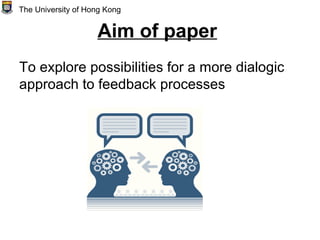
Aim of paper
To explore possibilities for a more dialogic
approach to feedback processes
The University of Hong Kong
INTRODUCING MY
RESEARCH INTO FEEDBACK
The University of Hong Kong
Differing perceptions
Study 1. Questionnaire data from 460 staff &
1740 students
+ qualitative data from BEd Students
Key finding: Differing perceptions of staff &
students towards feedback (Carless, 2006)
The University of Hong Kong
Sustainable feedback
Study 2. Interviews with 10 award-winning
teachers from 10 different Faculties
Key finding. Conventional & sustainable
feedback orientations (Carless et al. 2011)
The University of Hong Kong
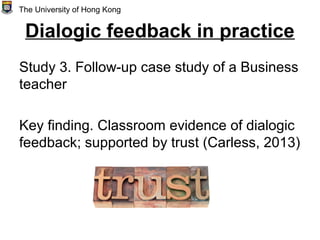
Dialogic feedback in practice
Study 3. Follow-up case study of a Business
teacher
Key finding. Classroom evidence of dialogic
feedback; supported by trust (Carless, 2013)
The University of Hong Kong
Exploring assessment practice
Study 4. Multiple disciplines.
Award-winning teachers
Analyzing learning-oriented assessment in
Architecture, History, Law, Geology &
Business (Carless, 2015)
The University of Hong Kong
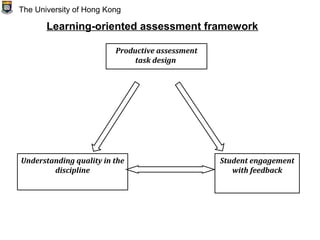
Productive assessment
task design
Understanding quality in the
discipline
Student engagement
with feedback
Learning-oriented assessment framework
SITUATING FEEDBACK
The University of Hong Kong
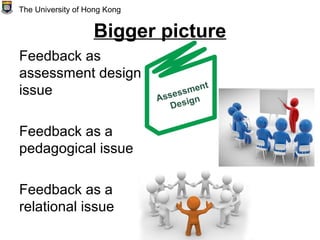
Bigger picture
Feedback as
assessment design
issue
Feedback as a
pedagogical issue
Feedback as a
relational issue
The University of Hong Kong
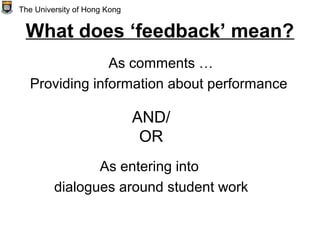
What does ‘feedback’ mean?
As entering into
dialogues around student work
The University of Hong Kong
As comments …
Providing information about performance
AND/
OR
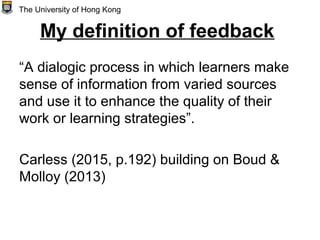
My definition of feedback
“A dialogic process in which learners make
sense of information from varied sources
and use it to enhance the quality of their
work or learning strategies”.
Carless (2015, p.192) building on Boud &
Molloy (2013)
The University of Hong Kong
 
 
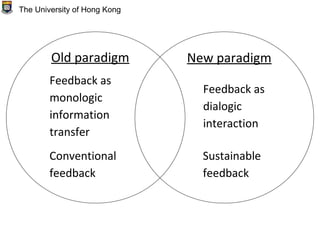
Old paradigm New paradigm
Feedback as 
monologic 
information 
transfer 
Feedback as 
dialogic 
interaction 
Conventional 
feedback 
Sustainable 
feedback 
Key aim of feedback
To enhance student
ability to self-monitor
their work in
progress
The University of Hong Kong
FEEDBACK AS DIALOGUE
The University of Hong Kong
Dialogic feedback principles
• Process rather than product
• Negotiation & clarification
• Leading to action or reflection
• Peers as active source of feedback
• Inner dialogue, internal feedback
The University of Hong Kong
Dialogic feedback in practice
1. Teacher-facilitated dialogic feedback
2. Technology-facilitated dialogic feedback
3. Peer feedback and internal feedback
(Nicol, 2010)
The University of Hong Kong
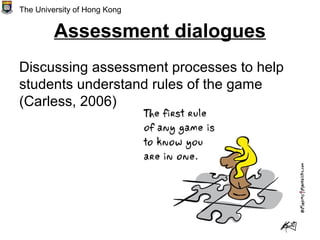
Assessment dialogues
Discussing assessment processes to help
students understand rules of the game
(Carless, 2006)
The University of Hong Kong
Analyzing exemplars
Learning to apply criteria; make judgments
about samples; & suggest how they can be
improved (e.g. Hendry et al., 2011)
The University of Hong Kong
Exemplars & feedback
Analysis of exemplars can support students
in decoding teacher feedback (Handley &
Williams 2011; To & Carless, 2015)
The University of Hong Kong
Connoisseurship
Dialogue around exemplars can support
students in developing a nose for quality
The University of Hong Kong
Encouragement or critique?
Honest but constructive feedback
The University of Hong Kong
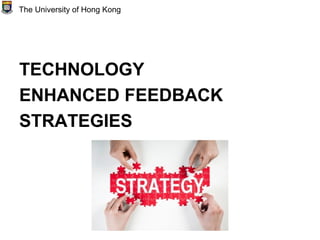
TECHNOLOGY
ENHANCED FEEDBACK
STRATEGIES
The University of Hong Kong
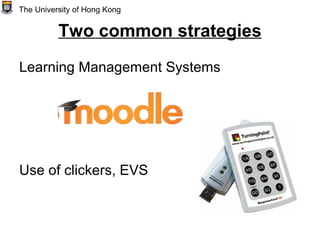
Two common strategies
Learning Management Systems
Use of clickers, EVS
The University of Hong Kong
Use of Facebook
More attractive to students than Moodle
(Deng & Tavares, 2013)
History students uploaded drafts of work in
progress & received peer feedback
(Carless, 2015)
The University of Hong Kong
Assessed blog
Business case: participation grade (30-40%)
including class & blog contribution
“Having a grading allocation … gives some
life to the blog” (Carless, 2015, p. 124)
Integrate online discussion with classroom
activities
The University of Hong Kong
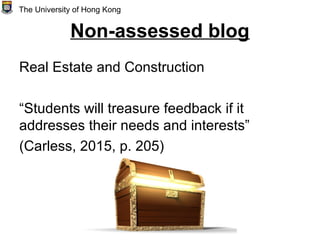
Non-assessed blog
Real Estate and Construction
“Students will treasure feedback if it
addresses their needs and interests”
(Carless, 2015, p. 205)
The University of Hong Kong
Audio feedback
Providing recorded verbal commentary
(instead of written feedback?)
The University of Hong Kong
STUDENT ROLE IN SEEKING,
GENERATING & USING
FEEDBACK
The University of Hong Kong
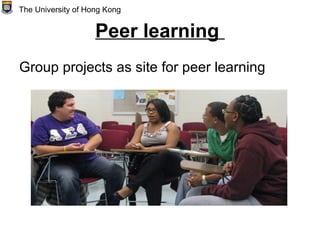
Peer learning
Group projects as site for peer learning
The University of Hong Kong
Peer feedback
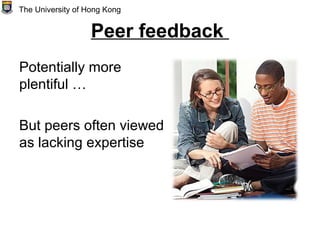
Potentially more
plentiful …
But peers often viewed
as lacking expertise
The University of Hong Kong
To give is better than to receive
Providing feedback more cognitively engaging
(e.g. Nicol et al., 2014)
The University of Hong Kong
Using peer feedback
Students better at giving peer feedback than
using ‘good’ peer feedback
Students need support in how to use
feedback
(Walker, 2015)
The University of Hong Kong
Sustainable feedback
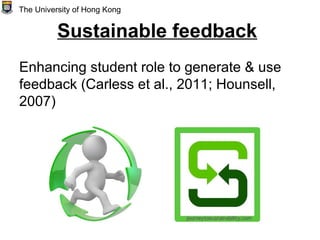
Enhancing student role to generate & use
feedback (Carless et al., 2011; Hounsell,
2007)
The University of Hong Kong
Sustainable feedback
‘High-value’ feedback with impact beyond
immediate task
Guidance & feedback within learning
activities (Hounsell, 2007; Hounsell et al.
2008)
The University of Hong Kong
SELECTED FEEDBACK ISSUES
AND CHALLENGES
The University of Hong Kong
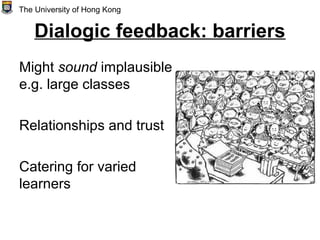
Dialogic feedback: barriers
Might sound implausible
e.g. large classes
Relationships and trust
Catering for varied
learners
The University of Hong Kong
Confusion over purposes
Student & staff confusions over purposes of
feedback and what it can achieve (Price et
al., 2010)
The University of Hong Kong
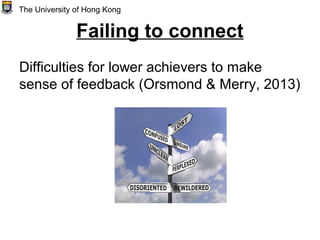
Failing to connect
Difficulties for lower achievers to make
sense of feedback (Orsmond & Merry, 2013)
The University of Hong Kong
Implications
The University of Hong Kong
Closing feedback loops
It’s only feedback
if students take
some action
The University of Hong Kong
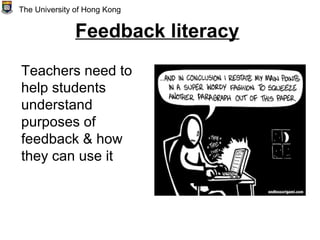
Feedback literacy
Teachers need to
help students
understand
purposes of
feedback & how
they can use it
The University of Hong Kong
Policy implication
Need for further development in the
assessment (for learning) literacy of
university teachers (cf. Price et al., 2012)
The University of Hong Kong
Care and trust
Feedback is a social and relational act:
Care (Sutton, 2012)
Trust (Carless, 2009, 2013)
The University of Hong Kong
Good feedback practice
Integration of feedback, task design &
student self-evaluation;
Timely dialogues around student work: in-
class, online or peer feedback;
Development of student self-regulation
within sustainable feedback
The University of Hong Kong
Ongoing research
1. Dialogic use of exemplars
2. Longitudinal study of how students
process & use feedback
The University of Hong Kong
THANK YOU
The University of Hong Kong
Theoretical underpinnings?
Dialogic pedagogy?
Academic literacies?
Social justice?
Bakhtin, Ron Barnett, Martin Buber,
Nicholas Burbules, Freire, Rommetweit,
Socrates?
The University of Hong Kong
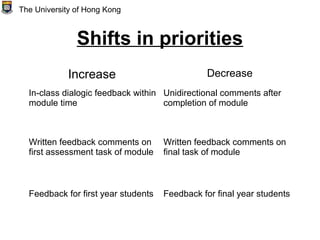
Shifts in priorities
The University of Hong Kong
Increase Decrease
In-class dialogic feedback within
module time
Unidirectional comments after
completion of module
Written feedback comments on
first assessment task of module
Written feedback comments on
final task of module
Feedback for first year students Feedback for final year students
Sustainable feedback defined
“Active student participation in dialogic
activities in which students generate and
use feedback from peers, self or others as
part of an ongoing process of developing
capacities as autonomous self-regulating
learners” (Carless, 2013b)
The University of Hong Kong
Audio feedback: pros
• Viewed positively by students (Lunt &
Curran, 2010)
• Shows concern; permits nuanced
feedback or detail (Savin-Baden, 2010)
• May resemble a dialogue (Nicol, 2010)
The University of Hong Kong
Audio feedback: cons
• ‘Moderate’ impact on student learning
(Gould & Day, 2013)
• Undesirable if replacing face-to-face
interaction (Lunt & Curran, 2010)
• Workload? (Hennessy & Forester, 2014)
The University of Hong Kong

Developing feedback as dialogue

  • 1.
    Developing feedback as dialogue DavidCarless University of Hong Kong June 2015 The University of Hong Kong
  • 2.
    Overview 1. Introduction tomy research 2. Feedback as part of a bigger picture 3. Feedback as dialogue 4. Issues & Implications The University of Hong Kong
  • 3.
    Aim of paper Toexplore possibilities for a more dialogic approach to feedback processes The University of Hong Kong
  • 4.
    INTRODUCING MY RESEARCH INTOFEEDBACK The University of Hong Kong
  • 5.
    Differing perceptions Study 1.Questionnaire data from 460 staff & 1740 students + qualitative data from BEd Students Key finding: Differing perceptions of staff & students towards feedback (Carless, 2006) The University of Hong Kong
  • 6.
    Sustainable feedback Study 2.Interviews with 10 award-winning teachers from 10 different Faculties Key finding. Conventional & sustainable feedback orientations (Carless et al. 2011) The University of Hong Kong
  • 7.
    Dialogic feedback inpractice Study 3. Follow-up case study of a Business teacher Key finding. Classroom evidence of dialogic feedback; supported by trust (Carless, 2013) The University of Hong Kong
  • 8.
    Exploring assessment practice Study4. Multiple disciplines. Award-winning teachers Analyzing learning-oriented assessment in Architecture, History, Law, Geology & Business (Carless, 2015) The University of Hong Kong
  • 10.
    The University ofHong Kong Productive assessment task design Understanding quality in the discipline Student engagement with feedback Learning-oriented assessment framework
  • 11.
  • 12.
    Bigger picture Feedback as assessmentdesign issue Feedback as a pedagogical issue Feedback as a relational issue The University of Hong Kong
  • 13.
    What does ‘feedback’mean? As entering into dialogues around student work The University of Hong Kong As comments … Providing information about performance AND/ OR
  • 14.
    My definition offeedback “A dialogic process in which learners make sense of information from varied sources and use it to enhance the quality of their work or learning strategies”. Carless (2015, p.192) building on Boud & Molloy (2013) The University of Hong Kong
  • 15.
    The University ofHong Kong     Old paradigm New paradigm Feedback as  monologic  information  transfer  Feedback as  dialogic  interaction  Conventional  feedback  Sustainable  feedback 
  • 16.
    Key aim offeedback To enhance student ability to self-monitor their work in progress The University of Hong Kong
  • 17.
    FEEDBACK AS DIALOGUE TheUniversity of Hong Kong
  • 18.
    Dialogic feedback principles •Process rather than product • Negotiation & clarification • Leading to action or reflection • Peers as active source of feedback • Inner dialogue, internal feedback The University of Hong Kong
  • 19.
    Dialogic feedback inpractice 1. Teacher-facilitated dialogic feedback 2. Technology-facilitated dialogic feedback 3. Peer feedback and internal feedback (Nicol, 2010) The University of Hong Kong
  • 20.
    Assessment dialogues Discussing assessmentprocesses to help students understand rules of the game (Carless, 2006) The University of Hong Kong
  • 21.
    Analyzing exemplars Learning toapply criteria; make judgments about samples; & suggest how they can be improved (e.g. Hendry et al., 2011) The University of Hong Kong
  • 22.
    Exemplars & feedback Analysisof exemplars can support students in decoding teacher feedback (Handley & Williams 2011; To & Carless, 2015) The University of Hong Kong
  • 23.
    Connoisseurship Dialogue around exemplarscan support students in developing a nose for quality The University of Hong Kong
  • 24.
    Encouragement or critique? Honestbut constructive feedback The University of Hong Kong
  • 25.
  • 26.
    Two common strategies LearningManagement Systems Use of clickers, EVS The University of Hong Kong
  • 27.
    Use of Facebook Moreattractive to students than Moodle (Deng & Tavares, 2013) History students uploaded drafts of work in progress & received peer feedback (Carless, 2015) The University of Hong Kong
  • 28.
    Assessed blog Business case:participation grade (30-40%) including class & blog contribution “Having a grading allocation … gives some life to the blog” (Carless, 2015, p. 124) Integrate online discussion with classroom activities The University of Hong Kong
  • 29.
    Non-assessed blog Real Estateand Construction “Students will treasure feedback if it addresses their needs and interests” (Carless, 2015, p. 205) The University of Hong Kong
  • 30.
    Audio feedback Providing recordedverbal commentary (instead of written feedback?) The University of Hong Kong
  • 31.
    STUDENT ROLE INSEEKING, GENERATING & USING FEEDBACK The University of Hong Kong
  • 32.
    Peer learning Group projectsas site for peer learning The University of Hong Kong
  • 33.
    Peer feedback Potentially more plentiful… But peers often viewed as lacking expertise The University of Hong Kong
  • 34.
    To give isbetter than to receive Providing feedback more cognitively engaging (e.g. Nicol et al., 2014) The University of Hong Kong
  • 35.
    Using peer feedback Studentsbetter at giving peer feedback than using ‘good’ peer feedback Students need support in how to use feedback (Walker, 2015) The University of Hong Kong
  • 36.
    Sustainable feedback Enhancing studentrole to generate & use feedback (Carless et al., 2011; Hounsell, 2007) The University of Hong Kong
  • 37.
    Sustainable feedback ‘High-value’ feedbackwith impact beyond immediate task Guidance & feedback within learning activities (Hounsell, 2007; Hounsell et al. 2008) The University of Hong Kong
  • 38.
    SELECTED FEEDBACK ISSUES ANDCHALLENGES The University of Hong Kong
  • 39.
    Dialogic feedback: barriers Mightsound implausible e.g. large classes Relationships and trust Catering for varied learners The University of Hong Kong
  • 40.
    Confusion over purposes Student& staff confusions over purposes of feedback and what it can achieve (Price et al., 2010) The University of Hong Kong
  • 41.
    Failing to connect Difficultiesfor lower achievers to make sense of feedback (Orsmond & Merry, 2013) The University of Hong Kong
  • 42.
  • 43.
    Closing feedback loops It’sonly feedback if students take some action The University of Hong Kong
  • 44.
    Feedback literacy Teachers needto help students understand purposes of feedback & how they can use it The University of Hong Kong
  • 45.
    Policy implication Need forfurther development in the assessment (for learning) literacy of university teachers (cf. Price et al., 2012) The University of Hong Kong
  • 46.
    Care and trust Feedbackis a social and relational act: Care (Sutton, 2012) Trust (Carless, 2009, 2013) The University of Hong Kong
  • 47.
    Good feedback practice Integrationof feedback, task design & student self-evaluation; Timely dialogues around student work: in- class, online or peer feedback; Development of student self-regulation within sustainable feedback The University of Hong Kong
  • 48.
    Ongoing research 1. Dialogicuse of exemplars 2. Longitudinal study of how students process & use feedback The University of Hong Kong
  • 49.
  • 50.
    Theoretical underpinnings? Dialogic pedagogy? Academicliteracies? Social justice? Bakhtin, Ron Barnett, Martin Buber, Nicholas Burbules, Freire, Rommetweit, Socrates? The University of Hong Kong
  • 51.
    Shifts in priorities TheUniversity of Hong Kong Increase Decrease In-class dialogic feedback within module time Unidirectional comments after completion of module Written feedback comments on first assessment task of module Written feedback comments on final task of module Feedback for first year students Feedback for final year students
  • 52.
    Sustainable feedback defined “Activestudent participation in dialogic activities in which students generate and use feedback from peers, self or others as part of an ongoing process of developing capacities as autonomous self-regulating learners” (Carless, 2013b) The University of Hong Kong
  • 53.
    Audio feedback: pros •Viewed positively by students (Lunt & Curran, 2010) • Shows concern; permits nuanced feedback or detail (Savin-Baden, 2010) • May resemble a dialogue (Nicol, 2010) The University of Hong Kong
  • 54.
    Audio feedback: cons •‘Moderate’ impact on student learning (Gould & Day, 2013) • Undesirable if replacing face-to-face interaction (Lunt & Curran, 2010) • Workload? (Hennessy & Forester, 2014) The University of Hong Kong
  • 55.

Editor's Notes

  • #34 http://pixgood.com/2-students-talking.html
  • #35 http://i811.photobucket.com/albums/zz31/angelsofhope_picture/Kinder/r8w2fc.jpg
  • #40 http://morecaucusnyc.org/2014/05/18/the-uft-contract-and-class-size-50-years-of-stagnation/