Assessment for digital futures
Professor David Carless,
@CarlessDavid
University of Hong Kong,
Quality Insights Digital Conference,
February 24, 2021
The University of Hong Kong
Overview
1. Virtues & assessment
2. Assessment functions
3. Digital assessment designs
4. Feedback & feedback literacy
5. Implications & problematizations
The University of Hong Kong
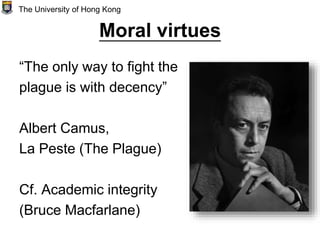
Moral virtues
“The only way to fight the
plague is with decency”
Albert Camus,
La Peste (The Plague)
Cf. Academic integrity
(Bruce Macfarlane)
The University of Hong Kong
Assessment for relationships
Rebuilding the social & relational
Building trust
Offering flexibility
Clarifying expectations
The University of Hong Kong
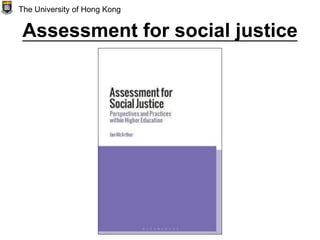
Assessment for social justice
The University of Hong Kong
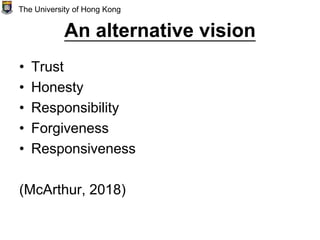
An alternative vision
• Trust
• Honesty
• Responsibility
• Forgiveness
• Responsiveness
(McArthur, 2018)
The University of Hong Kong
ASSESSMENT FUNCTIONS
The University of Hong Kong
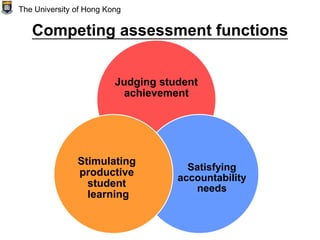
Competing assessment functions
The University of Hong Kong
Judging student
achievement
Satisfying
accountability
needs
Stimulating
productive
student
learning
The University of Hong Kong
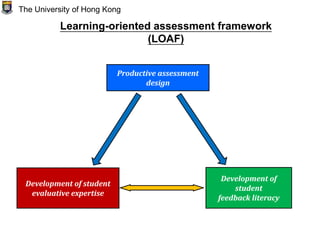
Productive assessment
design
Development of student
evaluative expertise
Development of
student
feedback literacy
Learning-oriented assessment framework
(LOAF)
1. DIGITAL ASSESSMENT
DESIGNS
The University of Hong Kong
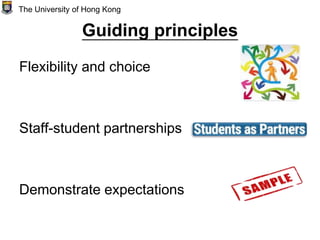
Guiding principles
Flexibility and choice
Staff-student partnerships
Demonstrate expectations
The University of Hong Kong
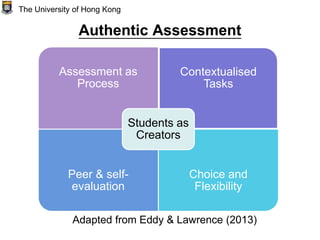
Authentic Assessment
Adapted from Eddy & Lawrence (2013)
The University of Hong Kong
Assessment as
Process
Contextualised
Tasks
Peer & self-
evaluation
Choice and
Flexibility
Students as
Creators
Authenticity to students’ lives
Assessment resonating with students’ daily
experiences
Social media
The University of Hong Kong
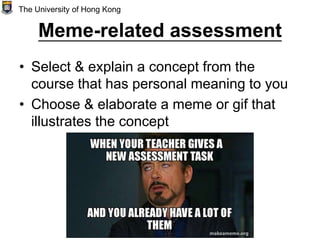
Meme-related assessment
• Select & explain a concept from the
course that has personal meaning to you
• Choose & elaborate a meme or gif that
illustrates the concept
The University of Hong Kong
YouTube related assignment
• Identify & curate YouTube content relevant
to a selected course concept
• Explain choice & added value
The University of Hong Kong
Assessed video presentations
Students record a 5 minute oral presentation
and upload for assessment
E.g. Talk about a course topic that has most
personal meaning for you & explain why
Oral assessment as alternative to exams
The University of Hong Kong
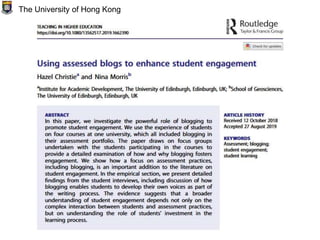
Blogs as assessment
• Process
• Reflections
• Students as communicators more than
receivers of knowledge
(Christie & Morris, 2019)
The University of Hong Kong
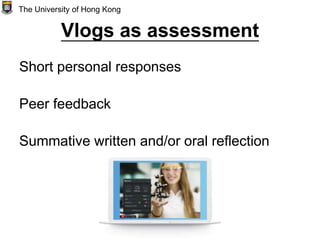
Vlogs as assessment
Short personal responses
Peer feedback
Summative written and/or oral reflection
The University of Hong Kong
Chemistry vlog example
Students summarize a concept
Provide example problems
Elaborate real-life applications
@DrKucukkal
The University of Hong Kong
Assessment design principles
• Iterative sequences of worthwhile tasks
• Related to real-life
• Students creating new knowledge
The University of Hong Kong
Digital assessment
“A digital assignment can live on. It can be
iterative, public, risky and multi-voiced.”
(Ross, Bayne & Lamb, 2019, p. 26)
The University of Hong Kong
2. EVALUATIVE EXPERTISE
The University of Hong Kong
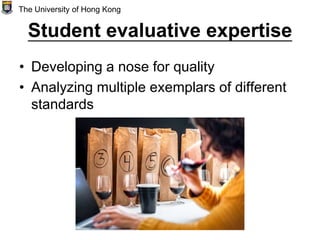
Student evaluative expertise
• Developing a nose for quality
• Analyzing multiple exemplars of different
standards
The University of Hong Kong
Analyzing digital exemplars
• Students develop outline or draft
• Exemplars of different quality shared
• Asynchronous discussion
• Students compare exemplars to own work
The University of Hong Kong
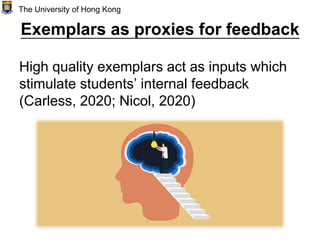
Exemplars as proxies for feedback
High quality exemplars act as inputs which
stimulate students’ internal feedback
(Carless, 2020; Nicol, 2020)
The University of Hong Kong
3. FEEDBACK LITERACY
The University of Hong Kong
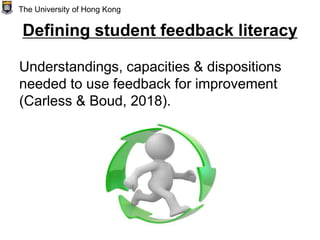
Defining student feedback literacy
Understandings, capacities & dispositions
needed to use feedback for improvement
(Carless & Boud, 2018).
The University of Hong Kong
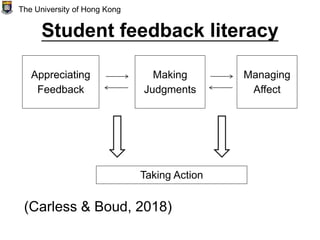
Student feedback literacy
The University of Hong Kong
Making
Judgments
Appreciating
Feedback
Managing
Affect
Taking Action
(Carless & Boud, 2018)
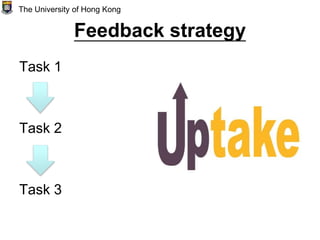
Feedback strategy
Task 1
Task 2
Task 3
The University of Hong Kong
Audio/video feedback modes
Enable rapport &
nuance
You can talk faster than you can write
The University of Hong Kong
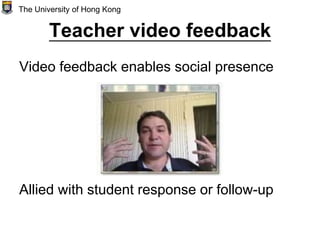
Teacher video feedback
Video feedback enables social presence
Allied with student response or follow-up
The University of Hong Kong
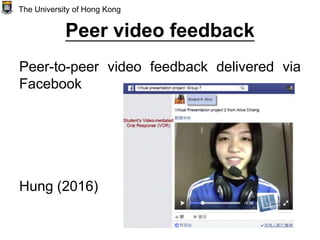
Peer video feedback
Peer-to-peer video feedback delivered via
Facebook
Hung (2016)
The University of Hong Kong
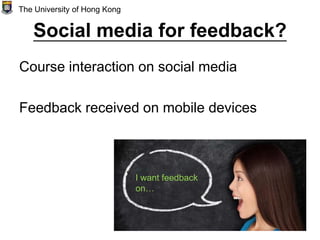
Social media for feedback?
Course interaction on social media
Feedback received on mobile devices
The University of Hong Kong
I want feedback
on…
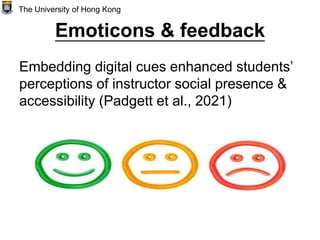
Emoticons & feedback
Embedding digital cues enhanced students’
perceptions of instructor social presence &
accessibility (Padgett et al., 2021)
The University of Hong Kong
Implications
The University of Hong Kong
Innovation conundrum
Innovative assessment might be fun in the
eyes of the teacher but for us it is more like
hard work. Sometimes they don’t give much
guidance and it is like ‘sort it out yourself.’
(Student informant, Carless, 2019)
The University of Hong Kong
Connected program-based assessment
Judicious balance of continuity & variety of
assessment tasks
Enabling familiarity with expectations
Latent learning from previous feedback
The University of Hong Kong
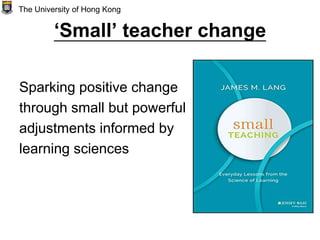
‘Small’ teacher change
Sparking positive change
through small but powerful
adjustments informed by
learning sciences
The University of Hong Kong
Small change assessment example
Enable students to practice sub-skills
required for an assessment task
E.g.
• Drafting paragraphs
• Preparing slides
Lang (2016) chapter 5
The University of Hong Kong
Change needs courage
Overcoming challenges
Doing what is good for students
Quality not just QA
The University of Hong Kong
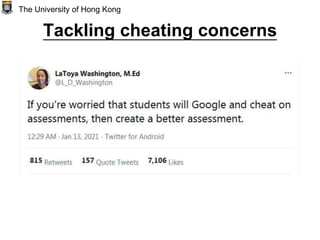
Tackling cheating concerns
The University of Hong Kong
Summary
Assessment for relationships
Assessment for authenticity
Assessment for meaningful creation
Assessment for connectivity
The University of Hong Kong
References
Carless, D. (2015a). Excellence in University Assessment. London: Routledge.
Carless, D. (2015b). Exploring learning-oriented assessment processes. Higher Education, 69(6), 963-
976.
Carless, D. (2019). Feedback loops and the longer-term: Towards feedback spirals. Assessment and
Evaluation in Higher Education, 44(5), 705-714. https://doi.org/10.1080/02602938.2018.1531108
Carless, D. (2020). From teacher transmission of information to student feedback literacy: Activating
the learner role in feedback processes. Active Learning in Higher Education.
https://doi.org/10.1177/1469787420945845
Carless, D. & Boud, D. (2018). The development of student feedback literacy: Enabling uptake of
feedback. Assessment & Evaluation in Higher Education.
https://doi.org/10.1080/02602938.2018.1463354.
Carless, D. & N. Winstone (2020). Teacher feedback literacy and its interplay with student feedback
literacy. Teaching in Higher Education. https://doi.org/10.1080/13562517.2020.1782372
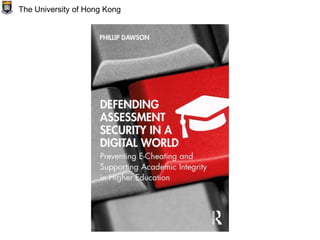
Dawson, P. (2021). Defending assessment security in a digital world. London: Routledge.
Eddy, P.L., & Lawrence, A. (2013). Wikis as platforms for authentic assessment. Innovative Higher
Education, 38(4), 253-265.
Hung, S.-T.A. (2016). Enhancing feedback provision through multimodal video technology. Computers
& Education, 98, 90-101.
Lang, J. M. (2016). Small teaching: Everyday lessons from the science of learning. San Francisco:
Jossey-Bass
The University of Hong Kong
References (continued)
Liu, C. (2018). Social media as a student response system: New evidence on learning impact.
Research in Learning Technology, 26, 1-29.
Mahoney, P., Macfarlane, S., & Ajjawi, R. (2019). A qualitative synthesis of video feedback in higher
education. Teaching in Higher Education, 24(2), 157-179.
McArthur, J. (2018). Assessment for social justice: Perspectives and practices within higher education.
London: Bloomsbury Academic.
Nicol, D. (2020) The power of internal feedback: Exploiting natural comparison processes.
Assessment & Evaluation in Higher Education. https://doi.org/10.1080/02602938.2020.1823314
Padgett, C., Moffitt, R., & Grieve, R. (2021). More than words: Using digital cues to enhance student
perceptions of online assignment feedback. The Internet and Higher Education.
https://doi.org/10.1016/j.iheduc.2020.100789
Ross, J., Bayne, S., Lamb, J (2019). Critical approaches to valuing digital education: learning
with and from the Manifesto for Teaching Online. Digital Culture & Education, 11(1), 22-35.
Tang, Y., & K.F. Hew. (2017). Using Twitter for education: Beneficial or simply a waste of time?
Computers & Education, 106, 97-118.
To, J. (2021). Using learner-centred feedback design to promote students’ engagement with feedback.
Higher Education Research and Development.
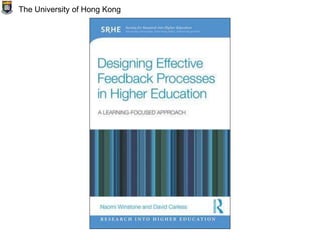
Winstone, N., & Carless, D. (2019). Designing effective feedback processes in higher education: A
learning-focused approach. London: Routledge.
The University of Hong Kong
QUESTIONS
&
COMMENTS
The University of Hong Kong
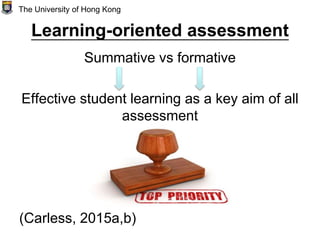
Learning-oriented assessment
Summative vs formative
Effective student learning as a key aim of all
assessment
(Carless, 2015a,b)
The University of Hong Kong
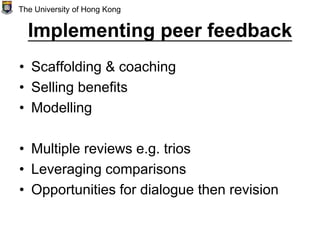
Implementing peer feedback
• Scaffolding & coaching
• Selling benefits
• Modelling
• Multiple reviews e.g. trios
• Leveraging comparisons
• Opportunities for dialogue then revision
The University of Hong Kong
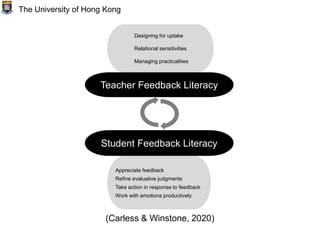
(Carless & Winstone, 2020)
The University of Hong Kong
Designing for uptake
Relational sensitivities
Managing practicalities
Teacher Feedback Literacy
Student Feedback Literacy
Appreciate feedback
Refine evaluative judgments
Take action in response to feedback
Work with emotions productively
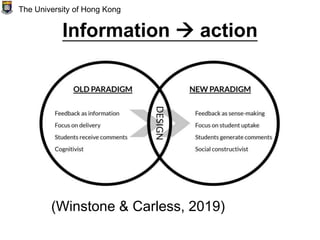
Information  action
(Winstone & Carless, 2019)
The University of Hong Kong
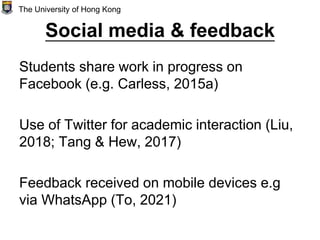
Social media & feedback
Students share work in progress on
Facebook (e.g. Carless, 2015a)
Use of Twitter for academic interaction (Liu,
2018; Tang & Hew, 2017)
Feedback received on mobile devices e.g
via WhatsApp (To, 2021)
The University of Hong Kong
Transforming assessment
The University of Hong Kong

Assessment for digital futures

  • 1.
    Assessment for digitalfutures Professor David Carless, @CarlessDavid University of Hong Kong, Quality Insights Digital Conference, February 24, 2021 The University of Hong Kong
  • 2.
    Overview 1. Virtues &assessment 2. Assessment functions 3. Digital assessment designs 4. Feedback & feedback literacy 5. Implications & problematizations The University of Hong Kong
  • 3.
    Moral virtues “The onlyway to fight the plague is with decency” Albert Camus, La Peste (The Plague) Cf. Academic integrity (Bruce Macfarlane) The University of Hong Kong
  • 4.
    Assessment for relationships Rebuildingthe social & relational Building trust Offering flexibility Clarifying expectations The University of Hong Kong
  • 5.
    Assessment for socialjustice The University of Hong Kong
  • 6.
    An alternative vision •Trust • Honesty • Responsibility • Forgiveness • Responsiveness (McArthur, 2018) The University of Hong Kong
  • 7.
  • 8.
    Competing assessment functions TheUniversity of Hong Kong Judging student achievement Satisfying accountability needs Stimulating productive student learning
  • 9.
    The University ofHong Kong Productive assessment design Development of student evaluative expertise Development of student feedback literacy Learning-oriented assessment framework (LOAF)
  • 10.
    1. DIGITAL ASSESSMENT DESIGNS TheUniversity of Hong Kong
  • 11.
    Guiding principles Flexibility andchoice Staff-student partnerships Demonstrate expectations The University of Hong Kong
  • 12.
    Authentic Assessment Adapted fromEddy & Lawrence (2013) The University of Hong Kong Assessment as Process Contextualised Tasks Peer & self- evaluation Choice and Flexibility Students as Creators
  • 14.
    Authenticity to students’lives Assessment resonating with students’ daily experiences Social media The University of Hong Kong
  • 15.
    Meme-related assessment • Select& explain a concept from the course that has personal meaning to you • Choose & elaborate a meme or gif that illustrates the concept The University of Hong Kong
  • 16.
    YouTube related assignment •Identify & curate YouTube content relevant to a selected course concept • Explain choice & added value The University of Hong Kong
  • 17.
    Assessed video presentations Studentsrecord a 5 minute oral presentation and upload for assessment E.g. Talk about a course topic that has most personal meaning for you & explain why Oral assessment as alternative to exams The University of Hong Kong
  • 18.
  • 19.
    Blogs as assessment •Process • Reflections • Students as communicators more than receivers of knowledge (Christie & Morris, 2019) The University of Hong Kong
  • 20.
    Vlogs as assessment Shortpersonal responses Peer feedback Summative written and/or oral reflection The University of Hong Kong
  • 21.
    Chemistry vlog example Studentssummarize a concept Provide example problems Elaborate real-life applications @DrKucukkal The University of Hong Kong
  • 22.
    Assessment design principles •Iterative sequences of worthwhile tasks • Related to real-life • Students creating new knowledge The University of Hong Kong
  • 23.
    Digital assessment “A digitalassignment can live on. It can be iterative, public, risky and multi-voiced.” (Ross, Bayne & Lamb, 2019, p. 26) The University of Hong Kong
  • 24.
    2. EVALUATIVE EXPERTISE TheUniversity of Hong Kong
  • 25.
    Student evaluative expertise •Developing a nose for quality • Analyzing multiple exemplars of different standards The University of Hong Kong
  • 26.
    Analyzing digital exemplars •Students develop outline or draft • Exemplars of different quality shared • Asynchronous discussion • Students compare exemplars to own work The University of Hong Kong
  • 27.
    Exemplars as proxiesfor feedback High quality exemplars act as inputs which stimulate students’ internal feedback (Carless, 2020; Nicol, 2020) The University of Hong Kong
  • 28.
    3. FEEDBACK LITERACY TheUniversity of Hong Kong
  • 29.
    Defining student feedbackliteracy Understandings, capacities & dispositions needed to use feedback for improvement (Carless & Boud, 2018). The University of Hong Kong
  • 30.
    Student feedback literacy TheUniversity of Hong Kong Making Judgments Appreciating Feedback Managing Affect Taking Action (Carless & Boud, 2018)
  • 31.
    Feedback strategy Task 1 Task2 Task 3 The University of Hong Kong
  • 32.
    Audio/video feedback modes Enablerapport & nuance You can talk faster than you can write The University of Hong Kong
  • 33.
    Teacher video feedback Videofeedback enables social presence Allied with student response or follow-up The University of Hong Kong
  • 34.
    Peer video feedback Peer-to-peervideo feedback delivered via Facebook Hung (2016) The University of Hong Kong
  • 35.
    Social media forfeedback? Course interaction on social media Feedback received on mobile devices The University of Hong Kong I want feedback on…
  • 36.
    Emoticons & feedback Embeddingdigital cues enhanced students’ perceptions of instructor social presence & accessibility (Padgett et al., 2021) The University of Hong Kong
  • 37.
  • 38.
  • 39.
    Innovation conundrum Innovative assessmentmight be fun in the eyes of the teacher but for us it is more like hard work. Sometimes they don’t give much guidance and it is like ‘sort it out yourself.’ (Student informant, Carless, 2019) The University of Hong Kong
  • 40.
    Connected program-based assessment Judiciousbalance of continuity & variety of assessment tasks Enabling familiarity with expectations Latent learning from previous feedback The University of Hong Kong
  • 41.
    ‘Small’ teacher change Sparkingpositive change through small but powerful adjustments informed by learning sciences The University of Hong Kong
  • 42.
    Small change assessmentexample Enable students to practice sub-skills required for an assessment task E.g. • Drafting paragraphs • Preparing slides Lang (2016) chapter 5 The University of Hong Kong
  • 43.
    Change needs courage Overcomingchallenges Doing what is good for students Quality not just QA The University of Hong Kong
  • 44.
    Tackling cheating concerns TheUniversity of Hong Kong
  • 45.
  • 46.
    Summary Assessment for relationships Assessmentfor authenticity Assessment for meaningful creation Assessment for connectivity The University of Hong Kong
  • 47.
    References Carless, D. (2015a).Excellence in University Assessment. London: Routledge. Carless, D. (2015b). Exploring learning-oriented assessment processes. Higher Education, 69(6), 963- 976. Carless, D. (2019). Feedback loops and the longer-term: Towards feedback spirals. Assessment and Evaluation in Higher Education, 44(5), 705-714. https://doi.org/10.1080/02602938.2018.1531108 Carless, D. (2020). From teacher transmission of information to student feedback literacy: Activating the learner role in feedback processes. Active Learning in Higher Education. https://doi.org/10.1177/1469787420945845 Carless, D. & Boud, D. (2018). The development of student feedback literacy: Enabling uptake of feedback. Assessment & Evaluation in Higher Education. https://doi.org/10.1080/02602938.2018.1463354. Carless, D. & N. Winstone (2020). Teacher feedback literacy and its interplay with student feedback literacy. Teaching in Higher Education. https://doi.org/10.1080/13562517.2020.1782372 Dawson, P. (2021). Defending assessment security in a digital world. London: Routledge. Eddy, P.L., & Lawrence, A. (2013). Wikis as platforms for authentic assessment. Innovative Higher Education, 38(4), 253-265. Hung, S.-T.A. (2016). Enhancing feedback provision through multimodal video technology. Computers & Education, 98, 90-101. Lang, J. M. (2016). Small teaching: Everyday lessons from the science of learning. San Francisco: Jossey-Bass The University of Hong Kong
  • 48.
    References (continued) Liu, C.(2018). Social media as a student response system: New evidence on learning impact. Research in Learning Technology, 26, 1-29. Mahoney, P., Macfarlane, S., & Ajjawi, R. (2019). A qualitative synthesis of video feedback in higher education. Teaching in Higher Education, 24(2), 157-179. McArthur, J. (2018). Assessment for social justice: Perspectives and practices within higher education. London: Bloomsbury Academic. Nicol, D. (2020) The power of internal feedback: Exploiting natural comparison processes. Assessment & Evaluation in Higher Education. https://doi.org/10.1080/02602938.2020.1823314 Padgett, C., Moffitt, R., & Grieve, R. (2021). More than words: Using digital cues to enhance student perceptions of online assignment feedback. The Internet and Higher Education. https://doi.org/10.1016/j.iheduc.2020.100789 Ross, J., Bayne, S., Lamb, J (2019). Critical approaches to valuing digital education: learning with and from the Manifesto for Teaching Online. Digital Culture & Education, 11(1), 22-35. Tang, Y., & K.F. Hew. (2017). Using Twitter for education: Beneficial or simply a waste of time? Computers & Education, 106, 97-118. To, J. (2021). Using learner-centred feedback design to promote students’ engagement with feedback. Higher Education Research and Development. Winstone, N., & Carless, D. (2019). Designing effective feedback processes in higher education: A learning-focused approach. London: Routledge. The University of Hong Kong
  • 49.
  • 50.
    Learning-oriented assessment Summative vsformative Effective student learning as a key aim of all assessment (Carless, 2015a,b) The University of Hong Kong
  • 51.
    Implementing peer feedback •Scaffolding & coaching • Selling benefits • Modelling • Multiple reviews e.g. trios • Leveraging comparisons • Opportunities for dialogue then revision The University of Hong Kong
  • 52.
    (Carless & Winstone,2020) The University of Hong Kong Designing for uptake Relational sensitivities Managing practicalities Teacher Feedback Literacy Student Feedback Literacy Appreciate feedback Refine evaluative judgments Take action in response to feedback Work with emotions productively
  • 53.
    Information  action (Winstone& Carless, 2019) The University of Hong Kong
  • 54.
    Social media &feedback Students share work in progress on Facebook (e.g. Carless, 2015a) Use of Twitter for academic interaction (Liu, 2018; Tang & Hew, 2017) Feedback received on mobile devices e.g via WhatsApp (To, 2021) The University of Hong Kong
  • 55.