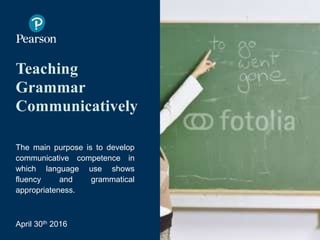
Teaching
Grammar
Communicatively
The main purpose is to develop
communicative competence in
which language use shows
fluency and grammatical
appropriateness.
April 30th 2016
Image by Ruben Alvarado)
OBJECTIVE
To give participants some strategies and
activities to make the teaching of
grammar interesting and meaningful for
their students to develop communicative
competence.
2
Teaching Grammar Communicatively
OUTCOME
At the end of this session participants will
demonstrate understanding of teaching
grammar communicatively by drafting a
lesson planning for a specific piece of
grammar they’ll want to teach children.
3Communicative Grammar
Teaching Grammar Communicatively
2:00 - 4:30 p.m.
Sharing your experience with grammar.
Experiencing communicately grammar oriented
lessons
Learning about communicative grammar
(inductevely)
Coffee break: 4:30 - 4:55 p.m.
4:55 to 7:00 p.m
Let’s recap and learn a bit of theory
Complete a lesson planing form about one of the
sample classes.
Microteaching criteria.
4
SESSION 4TH AGENDA
Sharing your
experience about
grammar
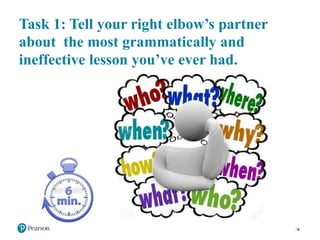
Task 1: Tell your right elbow’s partner
about the most grammatically and
ineffective lesson you’ve ever had.
6
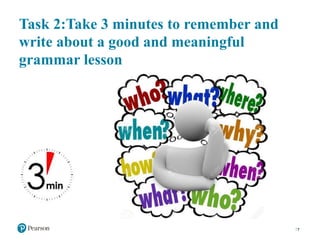
Task 2:Take 3 minutes to remember and
write about a good and meaningful
grammar lesson
7
Communicatively-Grammar-
Based Sample Lessons
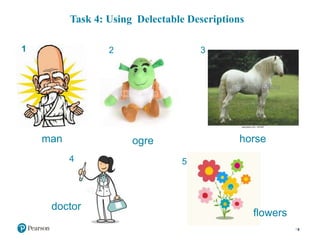
Task 4: Using Delectable Descriptions
9
1 2
man ogre
3
horse
4
doctor
5
flowers
Suggest a list of adjectives to describe qualities,
and write them on the board.
Describe each one of the pictures with two, three,
four or five adjectives from the list.
Read out their descriptions to the class.
Generate a humorous debate on whether the
descriptions match the pictures.
With a set of attributive adjectives organize them all
to describe the picture.
Find the correct position for the adjectives.
10
11
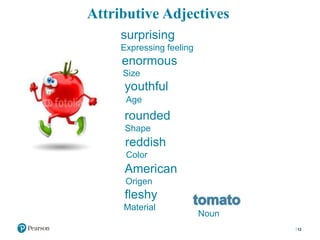
Attributive Adjectives
12
surprising
Expressing feeling
enormous
Size
youthful
Age
rounded
Shape
reddish
Color
American
Origen
fleshy
Material
Noun
SILLY SENTENCES GAME
Pair Work: Using five cards, make sentences in several
ways.
A game of 54 cards divided into four categories:
adjectives, nouns, verbs, and conjunctions.
Each card has a color-coded to help you organize the
cards according to parts of speech.
You have to make sentences by using more than two
adjectives for one or two nouns.
13
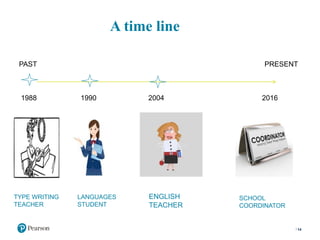
A time line
PAST PRESENT
1988 1990 2004 2016
14
TYPE WRITING
TEACHER
LANGUAGES
STUDENT
ENGLISH
TEACHER
SCHOOL
COORDINATOR
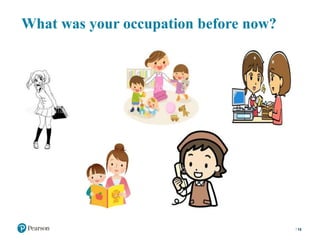
What was your occupation before now?
15
What were you before now?
Look at your pics and complete
16
You before now
________________________________________
________________________________________
________________________________________
You in the present
________________________________________
________________________________________
________________________________________
Let’s think about
previous lessons
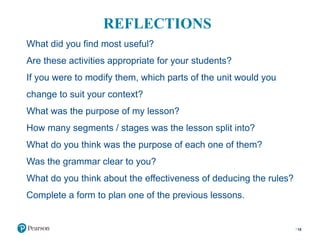
REFLECTIONS
What did you find most useful?
Are these activities appropriate for your students?
If you were to modify them, which parts of the unit would you
change to suit your context?
What was the purpose of my lesson?
How many segments / stages was the lesson split into?
What do you think was the purpose of each one of them?
Was the grammar clear to you?
What do you think about the effectiveness of deducing the rules?
Complete a form to plan one of the previous lessons.
18
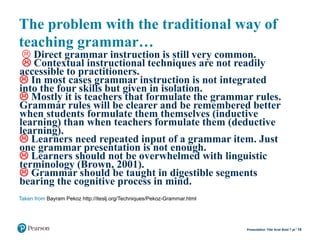
The problem with the traditional way of
teaching grammar…
 Direct grammar instruction is still very common.
 Contextual instructional techniques are not readily
accessible to practitioners.
 In most cases grammar instruction is not integrated
into the four skills but given in isolation.
 Mostly it is teachers that formulate the grammar rules.
Grammar rules will be clearer and be remembered better
when students formulate them themselves (inductive
learning) than when teachers formulate them (deductive
learning).
 Learners need repeated input of a grammar item. Just
one grammar presentation is not enough.
 Learners should not be overwhelmed with linguistic
terminology (Brown, 2001).
 Grammar should be taught in digestible segments
bearing the cognitive process in mind.
19Presentation Title Arial Bold 7 pt
Taken from Bayram Pekoz http://iteslj.org/Techniques/Pekoz-Grammar.html
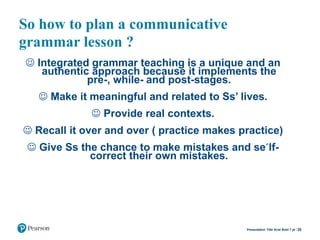
So how to plan a communicative
grammar lesson ?
 Integrated grammar teaching is a unique and an
authentic approach because it implements the
pre-, while- and post-stages.
 Make it meaningful and related to Ss’ lives.
 Provide real contexts.
 Recall it over and over ( practice makes practice)
 Give Ss the chance to make mistakes and se´lf-
correct their own mistakes.
20Presentation Title Arial Bold 7 pt
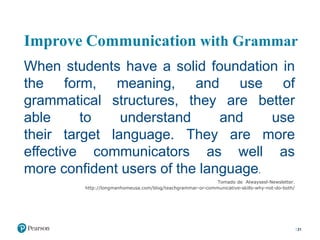
Improve Communication with Grammar
When students have a solid foundation in
the form, meaning, and use of
grammatical structures, they are better
able to understand and use
their target language. They are more
effective communicators as well as
more confident users of the language.
Tomado de Alwaysesl-Newsletter.
http://longmanhomeusa.com/blog/teachgrammar-or-communicative-skills-why-not-do-both/
21
Now…Over to you
A practical exercise
Task 2: Plan a lesson of 30 minutes to
teach 5 year-olds
This is pair work
Prepare to present your planner to the class
23Presentation Title Arial Bold 7 pt
Helpful links about this topic.
ENGLISH LANGUAGE TEACHING (ELT/ESL/ELL)
http://longmanhomeusa.com/blog/teachgrammar-or-communicative-skills-why-not-do-
both/
ORELT Open Resources for English Language Teaching Module 6 – Communicative
Grammar
http://www.colorelt.org/sites/default/files/module_attachments/ORELT--
Module%206_Modified_0.pdf
Communicative Activities
http://www.cambridge.org/grammarandbeyond/communicative-activities
24
Teaching grammar communicatively.

Teaching grammar communicatively.

  • 1.
    Teaching Grammar Communicatively The main purposeis to develop communicative competence in which language use shows fluency and grammatical appropriateness. April 30th 2016 Image by Ruben Alvarado)
  • 2.
    OBJECTIVE To give participantssome strategies and activities to make the teaching of grammar interesting and meaningful for their students to develop communicative competence. 2
  • 3.
    Teaching Grammar Communicatively OUTCOME Atthe end of this session participants will demonstrate understanding of teaching grammar communicatively by drafting a lesson planning for a specific piece of grammar they’ll want to teach children. 3Communicative Grammar
  • 4.
    Teaching Grammar Communicatively 2:00- 4:30 p.m. Sharing your experience with grammar. Experiencing communicately grammar oriented lessons Learning about communicative grammar (inductevely) Coffee break: 4:30 - 4:55 p.m. 4:55 to 7:00 p.m Let’s recap and learn a bit of theory Complete a lesson planing form about one of the sample classes. Microteaching criteria. 4 SESSION 4TH AGENDA
  • 5.
  • 6.
    Task 1: Tellyour right elbow’s partner about the most grammatically and ineffective lesson you’ve ever had. 6
  • 7.
    Task 2:Take 3minutes to remember and write about a good and meaningful grammar lesson 7
  • 8.
  • 9.
    Task 4: UsingDelectable Descriptions 9 1 2 man ogre 3 horse 4 doctor 5 flowers
  • 10.
    Suggest a listof adjectives to describe qualities, and write them on the board. Describe each one of the pictures with two, three, four or five adjectives from the list. Read out their descriptions to the class. Generate a humorous debate on whether the descriptions match the pictures. With a set of attributive adjectives organize them all to describe the picture. Find the correct position for the adjectives. 10
  • 11.
  • 12.
  • 13.
    SILLY SENTENCES GAME PairWork: Using five cards, make sentences in several ways. A game of 54 cards divided into four categories: adjectives, nouns, verbs, and conjunctions. Each card has a color-coded to help you organize the cards according to parts of speech. You have to make sentences by using more than two adjectives for one or two nouns. 13
  • 14.
    A time line PASTPRESENT 1988 1990 2004 2016 14 TYPE WRITING TEACHER LANGUAGES STUDENT ENGLISH TEACHER SCHOOL COORDINATOR
  • 15.
    What was youroccupation before now? 15
  • 16.
    What were youbefore now? Look at your pics and complete 16 You before now ________________________________________ ________________________________________ ________________________________________ You in the present ________________________________________ ________________________________________ ________________________________________
  • 17.
  • 18.
    REFLECTIONS What did youfind most useful? Are these activities appropriate for your students? If you were to modify them, which parts of the unit would you change to suit your context? What was the purpose of my lesson? How many segments / stages was the lesson split into? What do you think was the purpose of each one of them? Was the grammar clear to you? What do you think about the effectiveness of deducing the rules? Complete a form to plan one of the previous lessons. 18
  • 19.
    The problem withthe traditional way of teaching grammar…  Direct grammar instruction is still very common.  Contextual instructional techniques are not readily accessible to practitioners.  In most cases grammar instruction is not integrated into the four skills but given in isolation.  Mostly it is teachers that formulate the grammar rules. Grammar rules will be clearer and be remembered better when students formulate them themselves (inductive learning) than when teachers formulate them (deductive learning).  Learners need repeated input of a grammar item. Just one grammar presentation is not enough.  Learners should not be overwhelmed with linguistic terminology (Brown, 2001).  Grammar should be taught in digestible segments bearing the cognitive process in mind. 19Presentation Title Arial Bold 7 pt Taken from Bayram Pekoz http://iteslj.org/Techniques/Pekoz-Grammar.html
  • 20.
    So how toplan a communicative grammar lesson ?  Integrated grammar teaching is a unique and an authentic approach because it implements the pre-, while- and post-stages.  Make it meaningful and related to Ss’ lives.  Provide real contexts.  Recall it over and over ( practice makes practice)  Give Ss the chance to make mistakes and se´lf- correct their own mistakes. 20Presentation Title Arial Bold 7 pt
  • 21.
    Improve Communication withGrammar When students have a solid foundation in the form, meaning, and use of grammatical structures, they are better able to understand and use their target language. They are more effective communicators as well as more confident users of the language. Tomado de Alwaysesl-Newsletter. http://longmanhomeusa.com/blog/teachgrammar-or-communicative-skills-why-not-do-both/ 21
  • 22.
    Now…Over to you Apractical exercise
  • 23.
    Task 2: Plana lesson of 30 minutes to teach 5 year-olds This is pair work Prepare to present your planner to the class 23Presentation Title Arial Bold 7 pt
  • 24.
    Helpful links aboutthis topic. ENGLISH LANGUAGE TEACHING (ELT/ESL/ELL) http://longmanhomeusa.com/blog/teachgrammar-or-communicative-skills-why-not-do- both/ ORELT Open Resources for English Language Teaching Module 6 – Communicative Grammar http://www.colorelt.org/sites/default/files/module_attachments/ORELT-- Module%206_Modified_0.pdf Communicative Activities http://www.cambridge.org/grammarandbeyond/communicative-activities 24

Editor's Notes

  • #7  Students have 3 minutes each to share about their bad experienes with grammar lessons , they’ll have to answer questions like the ones in the picture, the idea is to make them reflecta bout the patterns of innefctive ways of teaching grammar, at the end with all the info given to the question what were these lessons like, the teacher writes on the board the charcteristic of ineffective grammar lessons.
  • #8  Students have 3 minutes each to share about their bad experienes with grammar lessons , they’ll have to answer questions like the ones in the picture, the idea is to make them reflecta bout the patterns of innefctive ways of teaching grammar, at the end with all the info given to the question what were these lessons like, the teacher writes on the board the charcteristic of ineffective grammar lessons.
  • #17 Play the song
  • #20 Let T-S work first in groups of three and then sahere their answers with the class.
  • #21 Let T-S work first in groups of three and then sahere their answers with the class.
  • #24 Let T-S work first in groups of three and then sahere their answers with the class.