University of Cambridge
Sept 18, 2020
Professor David Carless
@CarlessDavid
University of Hong Kong
Creating learning environments for
self-generated feedback to thrive
| 2
Overview
1. Feedback that makes a difference
2. Student peer review
3. Video feedback
4. Online feedback principles/practices
5. Enhancing feedback seeking
| 3
Cambridge supervisions
Students’ experienced Cambridge supervisions
as including:
• Impression management
• Appearing intelligent
• Emotions & anxiety
• Power
(Gaston & Duschinsky, 2020)
| 4
Potential Inputs
Self
Teachers Peers
Materials
| 5
Feedback as telling is overrated
“Learners do not always learn
much purely from being told,
even when they are told
repeatedly in the kindest
possible way”
(Sadler, 2015, p. 16)
| 6
Key feedback principle
What the learner does is even
more important than what the
teacher does
Teacher role is to design learning opportunities
| 7
What is ‘feedback’?
Learners making sense of performance-relevant
information from various sources and using this
evidence to enhance their work
(Henderson et al., 2019)
| 8
A key theme
Productive learning occurs when learners
compare their own work with that of multiple
other attempts at a similar task
| 9
Implementation strategies
1. Student peer review (peer feedback)
2. Analysis of exemplars of different quality
(Carless, 2020)
| 10
EXAMPLE
Ecology Undergraduate Programme, University
of Otago, NZ
Peer review as planned part of all core courses
| 11
| 12
Peer review + response
Research proposal assessment task
Anonymous peer review (two staff & two
students)
Revise and respond (rebut) addressing the four
peer reviews
| 13
Benefits
With support and structure, students contributed
well to peer learning
Students developed capacities in critical
evaluation
Peer review as fundamental of a research-
based curriculum
| 14
Student peer review rationale
Being exposed to a body of related work
Enabling comparison between own production
and that of peers
(Nicol, 2019, 2020)
| 15
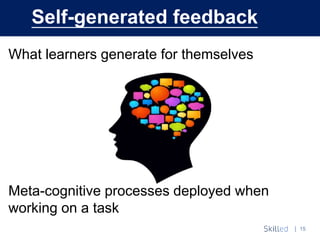
Self-generated feedback
What learners generate for themselves
Meta-cognitive processes deployed when
working on a task
| 16
Key steps
1. Students attempt task;
2. Students review multiple other attempts;
3. Students compose peer feedback;
4. Students revise their own work.
| 17
Recommended practice
• Sell rationale & benefits to students
• Provide modeling & coaching
• Give & receive multiple peer reviews
• Encourage collaborative climate
| 18
Problems are our friends
Actively confront challenges
Avoidance of genuine problems is the enemy of
productive change
(Fullan, 1993)
Yes, but…
| 19
Key challenges
• Students don’t buy in
• Overconfident students
• Poor quality peer feedback
• Convergent task – risks of copying
• Lack of opportunity to revise
• Contextual & disciplinary factors
• “I tried it once & it didn’t work”
| 20
Thoughts so far …?
Sharing of experiences, comments,
challenges …
| 21
THE CASE OF VIDEO
FEEDBACK
| 22
Teacher video feedback
Video feedback enables social presence
Rapport Nuance
| 23
Transmission + some pzazz
Teacher video feedback risks perpetuating a
transmission approach, albeit in a novel guise
(Mahoney, Macfarlane & Ajjawi, 2019)
| 24
Video feedback Issues
Length ….?
Generic or individual?
One-way or student response?
Potential for interactivity
| 25
Peer video feedback
Peer-to-peer video feedback
delivered via Facebook
Hung (2016)
| 26
Video vs written
Peer video feedback vs peer written feedback
Peer video feedback more effective in improving
target performance (Ge, 2019)
| 27
ONLINE LEARNING
| 28
Emergency remote teaching
Moving beyond content transmission
Rebuilding the social & relational
| 29
Key online principles
• Pedagogy, technology, context;
• Social and relational interaction;
• Active learner roles
| 30
Pedagogy
• Avoiding content overload
• Reducing one-way transmission (of feedback)
• Activating students
| 31
The relational dimension
• Technology & social presence;
• Supportiveness & sensitivity;
• Zoom affordances as well as barriers
| 32
Active student roles
• Generating, processing and using feedback
• Feedback as partnership
| 33
FEEDBACK SEEKING
| 34
Feedback seeking
Learners intentionally seeking information about
their own work for the purposes of improvement
I want feedback
on…
| 35
Interactive coversheet
Invite students to state what feedback they want
(Bloxham & Campbell, 2010)
| 36
Variation 1
Students complete the following prompt:
“I would most like feedback on ….”
| 37
Variation 2
1. The strengths are …
2. The aspects for development are …
3. I would like feedback on …
| 38
Variation 3
“The previous feedback that I have used to
strengthen this assignment is ….”
(Barton et al. 2016)
| 39
Planning for Action
How might we move forward in our
teaching in the light of today’s
discussion?
| 40
Conclusion
| 41
Key recommendations
Student peer review & self-generated feedback
Pedagogy interlinked with technology
Active student involvement
Social presence, care & trust
| 42
Resources to support teaching in 2020-21
https://www.yammer.com/cam.ac.uk/
https://www.cctl.cam.ac.uk/teaching-2020-21
| 43
References
Barton, K. L., Schofield, S. J., McAleer, S., & Ajjawi, R. (2016). Translating evidence-based guidelines to
improve feedback practices: The interact case study. BMC Medical Education, 16(1). doi:10.1186/s12909-
016-0562-z
Bloxham, S. & Campbell. L. (2010). Generating dialogue in assessment feedback: Exploring the use of
interactive cover sheets. Assessment & Evaluation in Higher Education, 35(3), 291-300.
Carless, D. (2020). From teacher transmission of information to student feedback literacy: Activating the
learner role in feedback processes. Active Learning in Higher Education.
https://doi.org/10.1177/1469787420945845
Carless, D. and Boud, D. (2018). The development of student feedback literacy: Enabling uptake of feedback.
Assessment and Evaluation in Higher Education, 43(8), 1315-1325.
https://doi.org/10.1080/02602938.2018.1463354.
Förster, M., Weiser, C., & Maur, A. (2018). How feedback provided by voluntary electronic quizzes affects
learning outcomes of university students in large classes. Computers & Education, 121, 100-114.
Fullan, M. (1993). Change Forces. London: Falmer.
Gaston, A., & Duschinsky, R. (2020). Students’ experiences of the Cambridge supervision system:
Performance, pedagogy and power. British Journal of Sociology of Education.
https://doi.org/10.1080/01425692.2020.1806038
Ge, Z.-G. (2019). Exploring the effect of video feedback from unknown peers on e-learners’ English-Chinese
translation performance. Computer Assisted Language Learning.
https://doi.org/10.1080/09588221.2019.1677721
| 44
References (continued)
Harland, T., N. Wald, and H. Randhawa. 2017. “Student Peer Review: Enhancing Formative Feedback with a
Rebuttal.” Assessment and Evaluation in Higher Education 42 (5): 801-811.
doi:10.1080/02602938.2016.1194368
Henderson, M., Ajjawi, R., Boud, D., & Molloy, E. (2019). Identifying feedback that has impact. In M.
Henderson, R. Ajjawi, D. Boud, & E. Molloy (Eds.), The impact of feedback in higher education (pp.15-34).
London: Palgrave.
Hung, S.-T. A. (2016). Enhancing feedback provision through multimodal video technology. Computers &
Education, 98, 90-101.
Mahoney, P., S. Macfarlane, and R. Ajjawi. (2019). A Qualitative Synthesis of Video Feedback in Higher
Education.”Teaching in Higher Education 24 (2): 157-179. doi:10.1080/13562517.2018.1471457
Nicol, D. (2019) Reconceptualising feedback as an internal not an external process. Italian Journal of
Educational Research. Available at: https://ojs.pensamultimedia.it/index.php/sird/article/view/3270
Nicol, D. (2020) The Power of Internal Feedback: Exploiting natural comparison processes. Assessment &
Evaluation in Higher Education
Nicol, D., Thomson, A., & Breslin, C. (2014). Rethinking feedback practices in higher education: A peer review
perspective. Assessment & Evaluation in Higher Education, 39(1), 102-122.
Sadler, D.R. (2015). Backwards assessment explanations: Implications for teaching and assessment practice.
In D. Lebler et al. (Eds.), Assessment in music education: From policy to practice (pp.9-19). Cham:
Springer.
Winstone, N., & D. Carless. (2019). Designing Effective Feedback Processes in Higher Education: A Learning-
Focused Approach. London: Routledge.
Exemplars implementation (1)
The University of Hong Kong
Divergent
Assessment task
Students
prepare
outline or draft
Students review
drafts of 2-3
classmates
Peer review &
discussion
Teacher-led
dialogue
Student
revisions
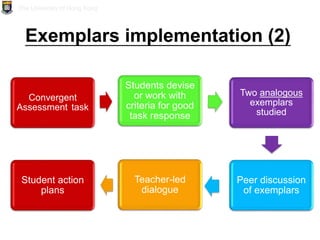
Exemplars implementation (2)
The University of Hong Kong
Convergent
Assessment task
Students devise
or work with
criteria for good
task response
Two analogous
exemplars
studied
Peer discussion
of exemplars
Teacher-led
dialogue
Student action
plans
| 47
Cumulative peer review
Need for multiple cumulative experiences of
peer review during a programme
(Harland et al., 2017).
| 48
Online quizzes
• Quizzes with instant automated feedback
• Hints rather than just correct answers
(Förster et al., 2018)
| 49
Student feedback literacy defined
Understandings, capacities & dispositions to
make the most of feedback opportunities
(Carless & Boud, 2018)
| 50
Student feedback literacy framework
Making
Judgments
Appreciating
Feedback
Managing
Affect
Taking Action
(Carless & Boud, 2018)
| 51
| 52
| 53

Creating learning environments for self-generated feedback to thrive

  • 1.
    University of Cambridge Sept18, 2020 Professor David Carless @CarlessDavid University of Hong Kong Creating learning environments for self-generated feedback to thrive
  • 2.
    | 2 Overview 1. Feedbackthat makes a difference 2. Student peer review 3. Video feedback 4. Online feedback principles/practices 5. Enhancing feedback seeking
  • 3.
    | 3 Cambridge supervisions Students’experienced Cambridge supervisions as including: • Impression management • Appearing intelligent • Emotions & anxiety • Power (Gaston & Duschinsky, 2020)
  • 4.
  • 5.
    | 5 Feedback astelling is overrated “Learners do not always learn much purely from being told, even when they are told repeatedly in the kindest possible way” (Sadler, 2015, p. 16)
  • 6.
    | 6 Key feedbackprinciple What the learner does is even more important than what the teacher does Teacher role is to design learning opportunities
  • 7.
    | 7 What is‘feedback’? Learners making sense of performance-relevant information from various sources and using this evidence to enhance their work (Henderson et al., 2019)
  • 8.
    | 8 A keytheme Productive learning occurs when learners compare their own work with that of multiple other attempts at a similar task
  • 9.
    | 9 Implementation strategies 1.Student peer review (peer feedback) 2. Analysis of exemplars of different quality (Carless, 2020)
  • 10.
    | 10 EXAMPLE Ecology UndergraduateProgramme, University of Otago, NZ Peer review as planned part of all core courses
  • 11.
  • 12.
    | 12 Peer review+ response Research proposal assessment task Anonymous peer review (two staff & two students) Revise and respond (rebut) addressing the four peer reviews
  • 13.
    | 13 Benefits With supportand structure, students contributed well to peer learning Students developed capacities in critical evaluation Peer review as fundamental of a research- based curriculum
  • 14.
    | 14 Student peerreview rationale Being exposed to a body of related work Enabling comparison between own production and that of peers (Nicol, 2019, 2020)
  • 15.
    | 15 Self-generated feedback Whatlearners generate for themselves Meta-cognitive processes deployed when working on a task
  • 16.
    | 16 Key steps 1.Students attempt task; 2. Students review multiple other attempts; 3. Students compose peer feedback; 4. Students revise their own work.
  • 17.
    | 17 Recommended practice •Sell rationale & benefits to students • Provide modeling & coaching • Give & receive multiple peer reviews • Encourage collaborative climate
  • 18.
    | 18 Problems areour friends Actively confront challenges Avoidance of genuine problems is the enemy of productive change (Fullan, 1993) Yes, but…
  • 19.
    | 19 Key challenges •Students don’t buy in • Overconfident students • Poor quality peer feedback • Convergent task – risks of copying • Lack of opportunity to revise • Contextual & disciplinary factors • “I tried it once & it didn’t work”
  • 20.
    | 20 Thoughts sofar …? Sharing of experiences, comments, challenges …
  • 21.
    | 21 THE CASEOF VIDEO FEEDBACK
  • 22.
    | 22 Teacher videofeedback Video feedback enables social presence Rapport Nuance
  • 23.
    | 23 Transmission +some pzazz Teacher video feedback risks perpetuating a transmission approach, albeit in a novel guise (Mahoney, Macfarlane & Ajjawi, 2019)
  • 24.
    | 24 Video feedbackIssues Length ….? Generic or individual? One-way or student response? Potential for interactivity
  • 25.
    | 25 Peer videofeedback Peer-to-peer video feedback delivered via Facebook Hung (2016)
  • 26.
    | 26 Video vswritten Peer video feedback vs peer written feedback Peer video feedback more effective in improving target performance (Ge, 2019)
  • 27.
  • 28.
    | 28 Emergency remoteteaching Moving beyond content transmission Rebuilding the social & relational
  • 29.
    | 29 Key onlineprinciples • Pedagogy, technology, context; • Social and relational interaction; • Active learner roles
  • 30.
    | 30 Pedagogy • Avoidingcontent overload • Reducing one-way transmission (of feedback) • Activating students
  • 31.
    | 31 The relationaldimension • Technology & social presence; • Supportiveness & sensitivity; • Zoom affordances as well as barriers
  • 32.
    | 32 Active studentroles • Generating, processing and using feedback • Feedback as partnership
  • 33.
  • 34.
    | 34 Feedback seeking Learnersintentionally seeking information about their own work for the purposes of improvement I want feedback on…
  • 35.
    | 35 Interactive coversheet Invitestudents to state what feedback they want (Bloxham & Campbell, 2010)
  • 36.
    | 36 Variation 1 Studentscomplete the following prompt: “I would most like feedback on ….”
  • 37.
    | 37 Variation 2 1.The strengths are … 2. The aspects for development are … 3. I would like feedback on …
  • 38.
    | 38 Variation 3 “Theprevious feedback that I have used to strengthen this assignment is ….” (Barton et al. 2016)
  • 39.
    | 39 Planning forAction How might we move forward in our teaching in the light of today’s discussion?
  • 40.
  • 41.
    | 41 Key recommendations Studentpeer review & self-generated feedback Pedagogy interlinked with technology Active student involvement Social presence, care & trust
  • 42.
    | 42 Resources tosupport teaching in 2020-21 https://www.yammer.com/cam.ac.uk/ https://www.cctl.cam.ac.uk/teaching-2020-21
  • 43.
    | 43 References Barton, K.L., Schofield, S. J., McAleer, S., & Ajjawi, R. (2016). Translating evidence-based guidelines to improve feedback practices: The interact case study. BMC Medical Education, 16(1). doi:10.1186/s12909- 016-0562-z Bloxham, S. & Campbell. L. (2010). Generating dialogue in assessment feedback: Exploring the use of interactive cover sheets. Assessment & Evaluation in Higher Education, 35(3), 291-300. Carless, D. (2020). From teacher transmission of information to student feedback literacy: Activating the learner role in feedback processes. Active Learning in Higher Education. https://doi.org/10.1177/1469787420945845 Carless, D. and Boud, D. (2018). The development of student feedback literacy: Enabling uptake of feedback. Assessment and Evaluation in Higher Education, 43(8), 1315-1325. https://doi.org/10.1080/02602938.2018.1463354. Förster, M., Weiser, C., & Maur, A. (2018). How feedback provided by voluntary electronic quizzes affects learning outcomes of university students in large classes. Computers & Education, 121, 100-114. Fullan, M. (1993). Change Forces. London: Falmer. Gaston, A., & Duschinsky, R. (2020). Students’ experiences of the Cambridge supervision system: Performance, pedagogy and power. British Journal of Sociology of Education. https://doi.org/10.1080/01425692.2020.1806038 Ge, Z.-G. (2019). Exploring the effect of video feedback from unknown peers on e-learners’ English-Chinese translation performance. Computer Assisted Language Learning. https://doi.org/10.1080/09588221.2019.1677721
  • 44.
    | 44 References (continued) Harland,T., N. Wald, and H. Randhawa. 2017. “Student Peer Review: Enhancing Formative Feedback with a Rebuttal.” Assessment and Evaluation in Higher Education 42 (5): 801-811. doi:10.1080/02602938.2016.1194368 Henderson, M., Ajjawi, R., Boud, D., & Molloy, E. (2019). Identifying feedback that has impact. In M. Henderson, R. Ajjawi, D. Boud, & E. Molloy (Eds.), The impact of feedback in higher education (pp.15-34). London: Palgrave. Hung, S.-T. A. (2016). Enhancing feedback provision through multimodal video technology. Computers & Education, 98, 90-101. Mahoney, P., S. Macfarlane, and R. Ajjawi. (2019). A Qualitative Synthesis of Video Feedback in Higher Education.”Teaching in Higher Education 24 (2): 157-179. doi:10.1080/13562517.2018.1471457 Nicol, D. (2019) Reconceptualising feedback as an internal not an external process. Italian Journal of Educational Research. Available at: https://ojs.pensamultimedia.it/index.php/sird/article/view/3270 Nicol, D. (2020) The Power of Internal Feedback: Exploiting natural comparison processes. Assessment & Evaluation in Higher Education Nicol, D., Thomson, A., & Breslin, C. (2014). Rethinking feedback practices in higher education: A peer review perspective. Assessment & Evaluation in Higher Education, 39(1), 102-122. Sadler, D.R. (2015). Backwards assessment explanations: Implications for teaching and assessment practice. In D. Lebler et al. (Eds.), Assessment in music education: From policy to practice (pp.9-19). Cham: Springer. Winstone, N., & D. Carless. (2019). Designing Effective Feedback Processes in Higher Education: A Learning- Focused Approach. London: Routledge.
  • 45.
    Exemplars implementation (1) TheUniversity of Hong Kong Divergent Assessment task Students prepare outline or draft Students review drafts of 2-3 classmates Peer review & discussion Teacher-led dialogue Student revisions
  • 46.
    Exemplars implementation (2) TheUniversity of Hong Kong Convergent Assessment task Students devise or work with criteria for good task response Two analogous exemplars studied Peer discussion of exemplars Teacher-led dialogue Student action plans
  • 47.
    | 47 Cumulative peerreview Need for multiple cumulative experiences of peer review during a programme (Harland et al., 2017).
  • 48.
    | 48 Online quizzes •Quizzes with instant automated feedback • Hints rather than just correct answers (Förster et al., 2018)
  • 49.
    | 49 Student feedbackliteracy defined Understandings, capacities & dispositions to make the most of feedback opportunities (Carless & Boud, 2018)
  • 50.
    | 50 Student feedbackliteracy framework Making Judgments Appreciating Feedback Managing Affect Taking Action (Carless & Boud, 2018)
  • 51.
  • 52.
  • 53.