Engaging and assessing students
through short-written responses
David Carless
HKU, Dec 1, 2015
The University of Hong Kong
Overview
1. Teaching and assessment context
2. Examples
3. Perceived benefits & challenges
4. Alternative possibilities
5. Implications
Teaching context
Master of Education
English Language Curriculum & Assessment module
Participants = English language teachers from primary
and secondary schools
Class size - 28
The University of Hong Kong
Short written response tasks,
10%Regular classroom participation,
15%
Oral Presentation,
25%
Written assignment, 50%
Module assessment tasks
The University of Hong Kong
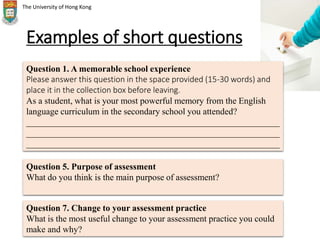
Examples of short questions
Question 1. A memorable school experience
Please answer this question in the space provided (15-30 words) and
place it in the collection box before leaving.
As a student, what is your most powerful memory from the English
language curriculum in the secondary school you attended?
_________________________________________________________
_________________________________________________________
_________________________________________________________
Question 5. Purpose of assessment
What do you think is the main purpose of assessment?
Question 7. Change to your assessment practice
What is the most useful change to your assessment practice you could
make and why?
The University of Hong Kong
18
15
7
6
5
4
1 1 1
0
2
4
6
8
10
12
14
16
18
20
Reportbackinnextsession(Q5purposeofassessment)
The University of Hong Kong
SamplestudentresponsetoQ5
The primary aim of assessment is to identify students’ merits
and demerits so that they will be aware of the standards of
excellence and make efforts to improve themselves.
Question 5. Purpose of assessment
What do you think is the main purpose of assessment?
The University of Hong Kong
Improving teacher feedback
7
Increasing peer feedback
6
Introducing new classroom
assessment activities
8
Developing reflective
students
4
Reportback(Q7Changingassessmentpractices)
The University of Hong Kong
I should spend more time following up what my students do
after I give them feedback, to see if they take my advice or
meet any difficulties.
SamplestudentresponsetoQ7
Question 7. Change to your assessment practice
What is the most useful change to your assessment practice you could
make and why?
The University of Hong Kong
Perceived benefits
Value of short written responses
• pave the way for learning next topic
• do some preparation
• stimulate thinking / reflection
Preparation
Conciseness
Follow-up
The University of Hong Kong
Challenges
• Clarity of expectations
• Student use of iPhones
Questions which invite personal responses generally preferable.
The need for frequent communication about processes and
expectations in assessment
The University of Hong Kong
Possible alternatives
Use Moodle to post answers
Clickers
Workload
The overall grading workload partly shifted from end
of module to during its implementation
The University of Hong Kong
Grading issues
Finding a pragmatic path:
- Grading vs learning
- Analytic vs holistic
The University of Hong Kong
Wider Implications
The University of Hong Kong
Assessment design
One large task at end vs multiple cumulative tasks
Spreading student effort/sustained engagement
The University of Hong Kong
Assessing participation
Promotes student engagement
Enhances classroom atmosphere
Hard to assess reliably …
… So assess clearly defined oral & written
contributions through well-designed criteria
The University of Hong Kong
Student view of Innovation
• Students do not seem to welcome or reject innovative
assessment per se;
• It depends on:
• the characteristics of the innovation;
• how persuasively the rationales are communicated;
• student trust in teacher
The University of Hong Kong
Managing Innovation
• Enhancing student learning processes
• Benefits of starting small
• Insufficient to state rationale and
guidelines merely at outset
The University of Hong Kong
The end, or is it a beginning?
Would it be possible to use short written responses
in your class?
References
Carless, D. & J. Zhou (2015). Starting small in
assessment change: Short in-class written responses
Assessment and Evaluation in Higher Education,
http:// dx.doi.org/10.1080/02602938.2015.1068272
Carless, D. (2015). Excellence in University
Assessment: Learning from award-winning practice.
London: Routledge.
The University of Hong Kong

Short written responses

  • 1.
    Engaging and assessingstudents through short-written responses David Carless HKU, Dec 1, 2015 The University of Hong Kong
  • 2.
    The University ofHong Kong Overview 1. Teaching and assessment context 2. Examples 3. Perceived benefits & challenges 4. Alternative possibilities 5. Implications
  • 3.
    Teaching context Master ofEducation English Language Curriculum & Assessment module Participants = English language teachers from primary and secondary schools Class size - 28 The University of Hong Kong
  • 4.
    The University ofHong Kong Short written response tasks, 10%Regular classroom participation, 15% Oral Presentation, 25% Written assignment, 50% Module assessment tasks
  • 5.
    The University ofHong Kong Examples of short questions Question 1. A memorable school experience Please answer this question in the space provided (15-30 words) and place it in the collection box before leaving. As a student, what is your most powerful memory from the English language curriculum in the secondary school you attended? _________________________________________________________ _________________________________________________________ _________________________________________________________ Question 5. Purpose of assessment What do you think is the main purpose of assessment? Question 7. Change to your assessment practice What is the most useful change to your assessment practice you could make and why?
  • 6.
    The University ofHong Kong 18 15 7 6 5 4 1 1 1 0 2 4 6 8 10 12 14 16 18 20 Reportbackinnextsession(Q5purposeofassessment)
  • 7.
    The University ofHong Kong SamplestudentresponsetoQ5 The primary aim of assessment is to identify students’ merits and demerits so that they will be aware of the standards of excellence and make efforts to improve themselves. Question 5. Purpose of assessment What do you think is the main purpose of assessment?
  • 8.
    The University ofHong Kong Improving teacher feedback 7 Increasing peer feedback 6 Introducing new classroom assessment activities 8 Developing reflective students 4 Reportback(Q7Changingassessmentpractices)
  • 9.
    The University ofHong Kong I should spend more time following up what my students do after I give them feedback, to see if they take my advice or meet any difficulties. SamplestudentresponsetoQ7 Question 7. Change to your assessment practice What is the most useful change to your assessment practice you could make and why?
  • 10.
    The University ofHong Kong Perceived benefits Value of short written responses • pave the way for learning next topic • do some preparation • stimulate thinking / reflection Preparation Conciseness Follow-up
  • 11.
    The University ofHong Kong Challenges • Clarity of expectations • Student use of iPhones Questions which invite personal responses generally preferable. The need for frequent communication about processes and expectations in assessment
  • 12.
    The University ofHong Kong Possible alternatives Use Moodle to post answers Clickers
  • 13.
    Workload The overall gradingworkload partly shifted from end of module to during its implementation The University of Hong Kong
  • 14.
    Grading issues Finding apragmatic path: - Grading vs learning - Analytic vs holistic The University of Hong Kong
  • 15.
  • 16.
    Assessment design One largetask at end vs multiple cumulative tasks Spreading student effort/sustained engagement The University of Hong Kong
  • 17.
    Assessing participation Promotes studentengagement Enhances classroom atmosphere Hard to assess reliably … … So assess clearly defined oral & written contributions through well-designed criteria The University of Hong Kong
  • 18.
    The University ofHong Kong Student view of Innovation • Students do not seem to welcome or reject innovative assessment per se; • It depends on: • the characteristics of the innovation; • how persuasively the rationales are communicated; • student trust in teacher
  • 19.
    The University ofHong Kong Managing Innovation • Enhancing student learning processes • Benefits of starting small • Insufficient to state rationale and guidelines merely at outset
  • 20.
    The University ofHong Kong The end, or is it a beginning? Would it be possible to use short written responses in your class?
  • 21.
    References Carless, D. &J. Zhou (2015). Starting small in assessment change: Short in-class written responses Assessment and Evaluation in Higher Education, http:// dx.doi.org/10.1080/02602938.2015.1068272 Carless, D. (2015). Excellence in University Assessment: Learning from award-winning practice. London: Routledge. The University of Hong Kong