STUDENT ENGAGEMENT
Mary Ann Reilly
2012
SITUATING OUR WORK
    Richard Elmore (2008) says there are only three
     ways to improve student learning at scale:

1.    Raise the level of content that students are
      taught.
2.    Increase the teachers’ skill & knowledge that
      they bring to teaching of that content.
3.    Increase the level of students’ active learning
      (engagement) of the content.
OUR FOCUS
    Richard Elmore (2008) says there are only three
     ways to improve student learning at scale:
1.    Raise the level of content that students are
      taught.
2.    Increase the teachers’ skill & knowledge that
      they bring to teaching of that content.
3.    Increase the level of students’ active learning
      (engagement) of the content.
ELMORE…
 What predicts performance is not what teachers
  do, but what the students are actually doing.
 Students must know what they are expected to
  do, but also how they are expected to do it, and
  what knowledge and skills they need to learn
  how to do it well.
 It is also vital to have students know why they
  should want to do the work. Itshould have value
  and meaning to the student.
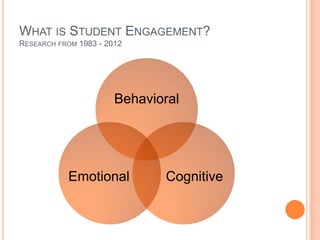
WHAT IS STUDENT ENGAGEMENT?
RESEARCH FROM 1983 - 2012


                       Behavioral


           Emotional          Cognitive
BEHAVIORAL ENGAGEMENT
   Student Engagement initially defined by observable
    behaviors such as:
     participation,
     time on task,
     involvement in academic, social, or extracurricular
      activities (Brophy 1983; Natriello 1984).


   Crucial for achieving positive academic outcomes
    and preventing dropping out (Connell and Wellborn
    1990; Finn 1989).
EMOTIONAL ENGAGEMENT
   Emotional or affective aspects: feelings of
    belonging, enjoyment, and attachment (Connell
    1990; Finn 1989).

   Focuses on the extent of positive (and negative)
    reactions to
    teachers, classmates, academics, and school.

   Creates student ties to the institution and
    influence students’ willingness to work (Connell
    and Wellborn 1990; Finn 1989).
COGNITIVE ENGAGEMENT
   Student’s investment in learning:

       being thoughtful and purposeful in the approach to
        school tasks,

       being willing to exert the effort necessary to
        comprehend complex ideas or master difficult
        skills,

       Using deep rather than superficial strategies
        (Fredricks, Blumenfeld, and Paris 2004)

       Self-regulating (Miller et al. 1996).
FINDINGS FROM STEINBERG, BROWN
&DORNBUSCH (1996)
   50% of high school students reported that their
    classes were boring.

   33% reported ‘surviving school’ by ‘goofing off’ with
    friends.


   From Steinberg, L.D., Brown, B.B., &Dornbusch, S. M. (1996). Beyond the classroom:
    Why school reform has failed and what parents need to do. NY: Simon & Schuster.
HOW HS STUDENTS SPEND TIME AT SCHOOL *
    Activity                                     Percentage of Time
    Doing Individual Work                        23%
    Listening to Lectures                        21%
    Taking Exams                                 13%
    Taking Notes                                 10%
    In Discussion                                9%
    Watching TV or Video                         7%
    Doing Homework or Studying                   7%
    Doing Group of Lab Work                      6%
    Other Activities (Watching demos,            4%
    Giving presentations)
    Talking with Teacher Individually            Less than 1%


 From Shernoff, D.J., Csikszentmihalyi, M., Schneider, B., &Shernoff, E.S. (2003). Student engagement
    in high school classrooms from the perspective of Flow Theory. School Psychology Quarterly, 18,
    (2), 158-176.
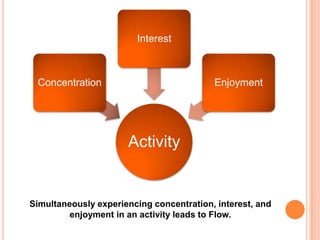
Interest


 Concentration                            Enjoyment


                      Activity


Simultaneously experiencing concentration, interest, and
         enjoyment in an activity leads to Flow.
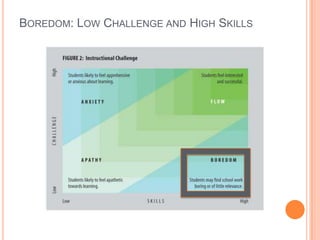
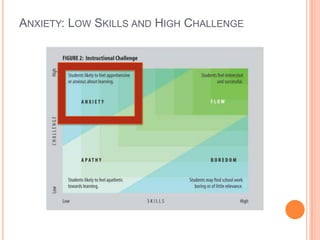
APATHY: LOW CHALLENGE AND LOW SKILLS
BOREDOM: LOW CHALLENGE AND HIGH SKILLS
ANXIETY: LOW SKILLS AND HIGH CHALLENGE
FLOW: HIGH CHALLENGE AND HIGH SKILLS
PRESENCE OF FLOW ON LEARNING

     Condition                                  Percentage of Time Students
                                                Attended to Instruction


     Flow                                       73%

     Apathy                                     42%

     Anxiety                                    70%

     Relaxation/Boredom                         58%


   From Shernoff, D.J., Csikszentmihalyi, M., Schneider, B., &Shernoff, E.S. (2003). Student
    engagement in high school classrooms from the perspective of Flow Theory. School
    Psychology Quarterly, 18, (2), 158-176.
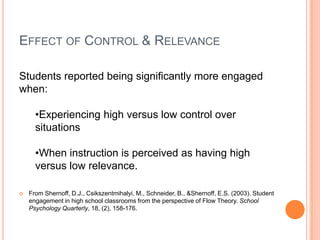
EFFECT OF CONTROL & RELEVANCE

Students reported being significantly more engaged
when:

      •Experiencing high versus low control over
      situations

      •When instruction is perceived as having high
      versus low relevance.

   From Shernoff, D.J., Csikszentmihalyi, M., Schneider, B., &Shernoff, E.S. (2003). Student
    engagement in high school classrooms from the perspective of Flow Theory. School
    Psychology Quarterly, 18, (2), 158-176.
PAYING ATTENTION
Activity                                                       Percentage of Time
                                                               Students Say they Pay
                                                               Attention

Taking an Exam                                                 83%
Doing Individual Work                                          78%
Participating in Group Work                                    75%
Listening to Teacher Lecture                                   65%
Watching TV/Video                                              57%


From Shernoff, D.J., Csikszentmihalyi, M., Schneider, B., &Shernoff, E.S. (2003). Student
engagement in high school classrooms from the perspective of Flow Theory. School
Psychology Quarterly, 18, (2), 158-176.
HIGH
                                                                ENGAGEMENT


                                                              Individual &
                                                              Group Work

                        Lecture, TV, Test

Low
Engagement
From Shernoff, D.J., Csikszentmihalyi, M., Schneider, B., &Shernoff, E.S. (2003). Student
engagement in high school classrooms from the perspective of Flow Theory. School
Psychology Quarterly, 18, (2), 158-176.
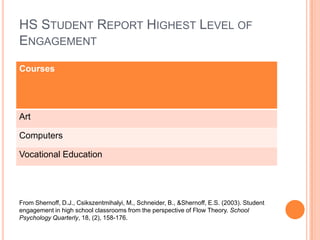
HS STUDENT REPORT HIGHEST LEVEL OF
ENGAGEMENT
Courses


Art

Computers

Vocational Education


From Shernoff, D.J., Csikszentmihalyi, M., Schneider, B., &Shernoff, E.S. (2003). Student
engagement in high school classrooms from the perspective of Flow Theory. School
Psychology Quarterly, 18, (2), 158-176.
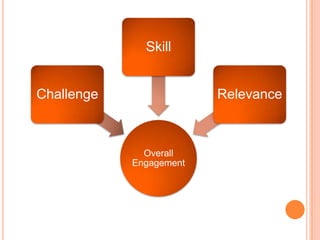
Skill


Challenge                Relevance


              Overall
            Engagement
WORKS CITED
   Brophy, J .(1983). Conceptualizing student motivation. Educational Psychologist, 18, 200–215.
   Connell, J.P. (1990). Context ,self, and action: A Motivational analysis of self-system processes across
    life-span. In D. Cicchetto (ed.), The self in transition: Infancy to childhood. Chicago: University of
    Chicago.
   Finn, J. D. (1989). Withdrawing from school. Review of Educational Research, 59, 117–142.
   Fredricks, J. A., Blumenfeld, P. C., Friedel, J., and Paris, A. (2005). School engagement. In K. A. Moore
    and L. Lippman (Eds.), What do children need to flourish?: conceptualizing and measuring indicators of
    positive development. New York: Kluwer Academic/Plenum Press.
   Miller, R. B., Greene, B. A., Montalvo, G. P., Ravindran, B., and Nichols, J. D. (1996). Engagement in
    academic work: the role of learning goals, future consequences, pleasing others, and perceived ability.
    Contemporary Educational Psychology, 21, 388–422.
   National Research Council and Institute of Medicine. (2004). Engaging schools: fostering high school
    students’ motivation to learn. Committee on Increasing High School Students’ Engagement and
    Motivation to Learn. Board on Children, Youth, and Families, Division of Behavioral and Social Science
    and Education. Washington, DC: The National Academy Press.
   Natriello, G. (1984). Problems in the evaluation of students and student disengagement for secondary
    schools. Journal of Research and Development in Education, 17, 14–24.
   Shernoff, D.J., Csikszentmihalyi, M., Schneider, B., &Shernoff, E.S. (2003). Student engagement in high
    school classrooms from the perspective of Flow Theory. School Psychology Quarterly, 18, (2), 158-176.
   Steinberg, L.D., Brown, B.B., &Dornbusch, S. M. (1996). Beyond the classroom: Why school reform has
    failed and what parents need to do. NY: Simon & Schuster.

Student engagement

  • 1.
  • 2.
    SITUATING OUR WORK  Richard Elmore (2008) says there are only three ways to improve student learning at scale: 1. Raise the level of content that students are taught. 2. Increase the teachers’ skill & knowledge that they bring to teaching of that content. 3. Increase the level of students’ active learning (engagement) of the content.
  • 3.
    OUR FOCUS  Richard Elmore (2008) says there are only three ways to improve student learning at scale: 1. Raise the level of content that students are taught. 2. Increase the teachers’ skill & knowledge that they bring to teaching of that content. 3. Increase the level of students’ active learning (engagement) of the content.
  • 4.
    ELMORE…  What predictsperformance is not what teachers do, but what the students are actually doing.  Students must know what they are expected to do, but also how they are expected to do it, and what knowledge and skills they need to learn how to do it well.  It is also vital to have students know why they should want to do the work. Itshould have value and meaning to the student.
  • 5.
    WHAT IS STUDENTENGAGEMENT? RESEARCH FROM 1983 - 2012 Behavioral Emotional Cognitive
  • 6.
    BEHAVIORAL ENGAGEMENT  Student Engagement initially defined by observable behaviors such as:  participation,  time on task,  involvement in academic, social, or extracurricular activities (Brophy 1983; Natriello 1984).  Crucial for achieving positive academic outcomes and preventing dropping out (Connell and Wellborn 1990; Finn 1989).
  • 7.
    EMOTIONAL ENGAGEMENT  Emotional or affective aspects: feelings of belonging, enjoyment, and attachment (Connell 1990; Finn 1989).  Focuses on the extent of positive (and negative) reactions to teachers, classmates, academics, and school.  Creates student ties to the institution and influence students’ willingness to work (Connell and Wellborn 1990; Finn 1989).
  • 8.
    COGNITIVE ENGAGEMENT  Student’s investment in learning:  being thoughtful and purposeful in the approach to school tasks,  being willing to exert the effort necessary to comprehend complex ideas or master difficult skills,  Using deep rather than superficial strategies (Fredricks, Blumenfeld, and Paris 2004)  Self-regulating (Miller et al. 1996).
  • 9.
    FINDINGS FROM STEINBERG,BROWN &DORNBUSCH (1996)  50% of high school students reported that their classes were boring.  33% reported ‘surviving school’ by ‘goofing off’ with friends.  From Steinberg, L.D., Brown, B.B., &Dornbusch, S. M. (1996). Beyond the classroom: Why school reform has failed and what parents need to do. NY: Simon & Schuster.
  • 10.
    HOW HS STUDENTSSPEND TIME AT SCHOOL * Activity Percentage of Time Doing Individual Work 23% Listening to Lectures 21% Taking Exams 13% Taking Notes 10% In Discussion 9% Watching TV or Video 7% Doing Homework or Studying 7% Doing Group of Lab Work 6% Other Activities (Watching demos, 4% Giving presentations) Talking with Teacher Individually Less than 1% From Shernoff, D.J., Csikszentmihalyi, M., Schneider, B., &Shernoff, E.S. (2003). Student engagement in high school classrooms from the perspective of Flow Theory. School Psychology Quarterly, 18, (2), 158-176.
  • 11.
    Interest Concentration Enjoyment Activity Simultaneously experiencing concentration, interest, and enjoyment in an activity leads to Flow.
  • 12.
    APATHY: LOW CHALLENGEAND LOW SKILLS
  • 13.
    BOREDOM: LOW CHALLENGEAND HIGH SKILLS
  • 14.
    ANXIETY: LOW SKILLSAND HIGH CHALLENGE
  • 15.
    FLOW: HIGH CHALLENGEAND HIGH SKILLS
  • 16.
    PRESENCE OF FLOWON LEARNING Condition Percentage of Time Students Attended to Instruction Flow 73% Apathy 42% Anxiety 70% Relaxation/Boredom 58%  From Shernoff, D.J., Csikszentmihalyi, M., Schneider, B., &Shernoff, E.S. (2003). Student engagement in high school classrooms from the perspective of Flow Theory. School Psychology Quarterly, 18, (2), 158-176.
  • 17.
    EFFECT OF CONTROL& RELEVANCE Students reported being significantly more engaged when: •Experiencing high versus low control over situations •When instruction is perceived as having high versus low relevance.  From Shernoff, D.J., Csikszentmihalyi, M., Schneider, B., &Shernoff, E.S. (2003). Student engagement in high school classrooms from the perspective of Flow Theory. School Psychology Quarterly, 18, (2), 158-176.
  • 18.
    PAYING ATTENTION Activity Percentage of Time Students Say they Pay Attention Taking an Exam 83% Doing Individual Work 78% Participating in Group Work 75% Listening to Teacher Lecture 65% Watching TV/Video 57% From Shernoff, D.J., Csikszentmihalyi, M., Schneider, B., &Shernoff, E.S. (2003). Student engagement in high school classrooms from the perspective of Flow Theory. School Psychology Quarterly, 18, (2), 158-176.
  • 19.
    HIGH ENGAGEMENT Individual & Group Work Lecture, TV, Test Low Engagement From Shernoff, D.J., Csikszentmihalyi, M., Schneider, B., &Shernoff, E.S. (2003). Student engagement in high school classrooms from the perspective of Flow Theory. School Psychology Quarterly, 18, (2), 158-176.
  • 20.
    HS STUDENT REPORTHIGHEST LEVEL OF ENGAGEMENT Courses Art Computers Vocational Education From Shernoff, D.J., Csikszentmihalyi, M., Schneider, B., &Shernoff, E.S. (2003). Student engagement in high school classrooms from the perspective of Flow Theory. School Psychology Quarterly, 18, (2), 158-176.
  • 21.
    Skill Challenge Relevance Overall Engagement
  • 22.
    WORKS CITED  Brophy, J .(1983). Conceptualizing student motivation. Educational Psychologist, 18, 200–215.  Connell, J.P. (1990). Context ,self, and action: A Motivational analysis of self-system processes across life-span. In D. Cicchetto (ed.), The self in transition: Infancy to childhood. Chicago: University of Chicago.  Finn, J. D. (1989). Withdrawing from school. Review of Educational Research, 59, 117–142.  Fredricks, J. A., Blumenfeld, P. C., Friedel, J., and Paris, A. (2005). School engagement. In K. A. Moore and L. Lippman (Eds.), What do children need to flourish?: conceptualizing and measuring indicators of positive development. New York: Kluwer Academic/Plenum Press.  Miller, R. B., Greene, B. A., Montalvo, G. P., Ravindran, B., and Nichols, J. D. (1996). Engagement in academic work: the role of learning goals, future consequences, pleasing others, and perceived ability. Contemporary Educational Psychology, 21, 388–422.  National Research Council and Institute of Medicine. (2004). Engaging schools: fostering high school students’ motivation to learn. Committee on Increasing High School Students’ Engagement and Motivation to Learn. Board on Children, Youth, and Families, Division of Behavioral and Social Science and Education. Washington, DC: The National Academy Press.  Natriello, G. (1984). Problems in the evaluation of students and student disengagement for secondary schools. Journal of Research and Development in Education, 17, 14–24.  Shernoff, D.J., Csikszentmihalyi, M., Schneider, B., &Shernoff, E.S. (2003). Student engagement in high school classrooms from the perspective of Flow Theory. School Psychology Quarterly, 18, (2), 158-176.  Steinberg, L.D., Brown, B.B., &Dornbusch, S. M. (1996). Beyond the classroom: Why school reform has failed and what parents need to do. NY: Simon & Schuster.