Assessment possibilities
David Carless
University of Hong Kong,
#UQFAN,
February 12, 2020
University of Queensland
The University of Hong Kong
Overview
Three assessment possibilities:
• two-stage exams
• short assessed responses
• cumulative peer review & rebuttal
The University of Hong Kong
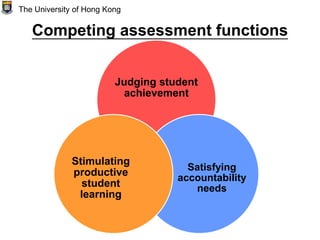
Competing assessment functions
The University of Hong Kong
Judging student
achievement
Satisfying
accountability
needs
Stimulating
productive
student
learning
Research process
The University of Hong Kong
Classroom observations
Interviews with teachers & students
TWO-STAGE EXAMS
The University of Hong Kong
Procedures
Stage 1. Students complete the exam
individually (80-90% weighting)
Stage 2. Students re-do (part of) the exam in
groups submitting one answer sheet (10-
20% weighting)
The University of Hong Kong
Applications
M/C, calculations, short answers
Main disciplines:
‘Hard’ sciences, Medicine,
Engineering, Economics,
Linguistics …
The University of Hong Kong
Main proponent
Nobel-prize winning
Physicist,
UBC, Canada
The University of Hong Kong
Carl Wieman
Outcomes
• Positive student response
• Improved achievement when working
collaboratively
(Levy, Svoronos & Klinger, 2018)
The University of Hong Kong
Pause for comments
• Possibilities
• Challenges
• Queries
The University of Hong Kong
Law: Same-day exam feedback
Oral debriefing immediately after exam,
supplemented by online discussion
The University of Hong Kong
SHORT WRITTEN
RESPONSES
Making History course
• Foundation level, year 1, 110 students
The University of Hong Kong
History Assessment
Fieldwork report (30%): Museum visit
Individual project (40%)
Participation (30%):
tutorial participation 15%
short weekly written responses 15%
The University of Hong Kong
Short in-class written responses
20-30 word weekly
answers on
topic for next class
The University of Hong Kong
Sample short answer questions
1. What are the essential qualities of a good
museum?
2. How might thinking historically help us
realize a better future?
3. Is History a science or an art? Explain
your answer.
The University of Hong Kong
My implementation
Master of Education
English Language Curriculum & Assessment
module
Participants = English language teachers
from primary and secondary schools
The University of Hong Kong
Sample question & response (1)
Question 5. Purpose of assessment
What do you think is the main purpose of
assessment?
The primary aim of assessment is to
identify students’ merits and demerits
so that they will be aware of the
standards of excellence and make
efforts to improve themselves.
The University of Hong Kong
Question 7. Change to your assessment practice
What is the most useful change to your assessment
practice you could make and why?
I should spend more time following up
what my students do after I give them
feedback, to see if they take my advice
or meet any difficulties.
The University of Hong Kong
Sample question & response (2)
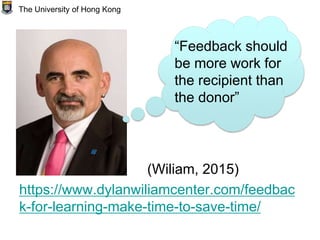
(Wiliam, 2015)
https://www.dylanwiliamcenter.com/feedbac
k-for-learning-make-time-to-save-time/
The University of Hong Kong
“Feedback should
be more work for
the recipient than
the donor”
Perceived benefits
The University of Hong Kong
• Paves the way for learning next topic
• Encourages some student preparation
• Stimulates thinking & reflection
(Carless & Zhou, 2015)
Implications
Promotes student engagement but difficult
to assess
Learning tool more than an assessment
method
Various technology-enabled alternatives
The University of Hong Kong
Pause for comments
• Possibilities
• Challenges
• Queries
The University of Hong Kong
PEER REVIEW
The University of Hong Kong
Key issues
• Training & coaching for peer review
• Sustained experiences of peer review
• Multiple peer reviewers e.g. trios rather
than peers
The University of Hong Kong
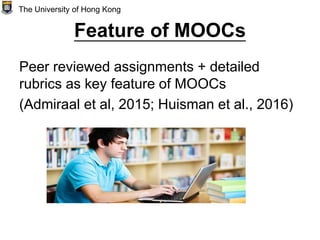
Feature of MOOCs
Peer reviewed assignments + detailed
rubrics as key feature of MOOCs
(Admiraal et al, 2015; Huisman et al., 2016)
The University of Hong Kong
Potential good practice
Students did 5 peer reviews then self-
evaluated own work
Multiple raters to mitigate variance in
judgments (Hew, 2016)
The University of Hong Kong
EFFECTIVE MOOCS
Composing peer feedback
Providing feedback more cognitively engaging
than receiving feedback (e.g. Nicol et al., 2014)
The University of Hong Kong
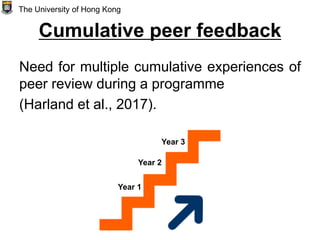
Cumulative peer feedback
Need for multiple cumulative experiences of
peer review during a programme
(Harland et al., 2017).
Year 1
Year 2
Year 3
The University of Hong Kong
Peer review + rebuttal
Research proposal assessment task
Anonymous peer review by two staff & two
students
Rebuttal letter addressing the four peer
reviews
(Harland et al., 2017).
The University of Hong Kong
Pause for comments
• Possibilities
• Challenges
• Queries
The University of Hong Kong
Conclusions
The University of Hong Kong
Assessment design principles
1. Assessment integrated with instruction & ILOs
2. Encourage deep approaches to learning
3. Spread student effort
4. Mirror real-life uses of the discipline
5. Design for feedback interaction
6. Support students in appreciating quality
7. Flexibility & choice
8. Integrated & coherent
The University of Hong Kong
Learning-oriented assessment
A major priority in all assessment should be
to promote effective student learning
processes (Carless, 2015)
The University of Hong Kong
THANK YOU
The University of Hong Kong
Two-stage exams in action
2 minute video on two-stage exams
https://www.youtube.com/watch?v=ZVFwQzl
VFy0
The University of Hong Kong
Productive assessment
task design
Student self-evaluative
capacities
Student engagement
with feedback
Learning-oriented assessment framework
References
Admiraal, W., Huisman, B., & Pilli, O. (2015). Assessment in massive open
online courses. The Electronic Journal of e-Learning, 13(4), 207-216.
Carless, D. (2015). Exploring learning-oriented assessment processes. Higher
Education, 69(6), 963-976.
Carless, D. (2015). Excellence in University Assessment: Learning from award-
winning practice. London: Routledge.
Carless, D. & J. Zhou (2015). Starting small in assessment change: Short in-
class written responses Assessment and Evaluation in Higher Education,
http:// dx.doi.org/10.1080/02602938.2015.1068272
Harland, T., Wald, N., & Randhawa, H. (2017). Student peer review: Enhancing
formative feedback with a rebuttal. Assessment & Evaluation in Higher
Education, 42(5), 801-811.
The University of Hong Kong
References (continued)
Hew, K. F. (2016). Promoting engagement in online courses: What strategies
can we learn from three highly rated MOOCS. British Journal of Educational
Technology, 47(2), 320-341.
Huisman, B., Admiraal, W., Pilli, L., van de Ven, M., & Saab, N. (2016). Peer
assessment in MOOCs: The relationship between peer reviewers’ ability
and authors’ essay performance. British Journal of Educational Technology.
Doi: 10.1111/bjet.12520
Levy, D., Svoronos T. & Klinger, M. (2018). Two-stage examinations: Can
examinations be more formative experiences? Active Learning in Higher
Education. doi:10.1177/1469787418801668
Nicol, D., Thomson, A., & Breslin, C. (2014). Rethinking feedback practices in
higher education: a peer review perspective. Assessment & Evaluation in
Higher Education, 39(1), 102–122.
The University of Hong Kong

Assessment possibilities

  • 1.
    Assessment possibilities David Carless Universityof Hong Kong, #UQFAN, February 12, 2020 University of Queensland The University of Hong Kong
  • 2.
    Overview Three assessment possibilities: •two-stage exams • short assessed responses • cumulative peer review & rebuttal The University of Hong Kong
  • 3.
    Competing assessment functions TheUniversity of Hong Kong Judging student achievement Satisfying accountability needs Stimulating productive student learning
  • 4.
    Research process The Universityof Hong Kong Classroom observations Interviews with teachers & students
  • 6.
  • 7.
    Procedures Stage 1. Studentscomplete the exam individually (80-90% weighting) Stage 2. Students re-do (part of) the exam in groups submitting one answer sheet (10- 20% weighting) The University of Hong Kong
  • 8.
    Applications M/C, calculations, shortanswers Main disciplines: ‘Hard’ sciences, Medicine, Engineering, Economics, Linguistics … The University of Hong Kong
  • 9.
    Main proponent Nobel-prize winning Physicist, UBC,Canada The University of Hong Kong Carl Wieman
  • 10.
    Outcomes • Positive studentresponse • Improved achievement when working collaboratively (Levy, Svoronos & Klinger, 2018) The University of Hong Kong
  • 11.
    Pause for comments •Possibilities • Challenges • Queries The University of Hong Kong
  • 12.
    Law: Same-day examfeedback Oral debriefing immediately after exam, supplemented by online discussion The University of Hong Kong
  • 13.
    The University ofHong Kong SHORT WRITTEN RESPONSES
  • 14.
    Making History course •Foundation level, year 1, 110 students The University of Hong Kong
  • 15.
    History Assessment Fieldwork report(30%): Museum visit Individual project (40%) Participation (30%): tutorial participation 15% short weekly written responses 15% The University of Hong Kong
  • 16.
    Short in-class writtenresponses 20-30 word weekly answers on topic for next class The University of Hong Kong
  • 17.
    Sample short answerquestions 1. What are the essential qualities of a good museum? 2. How might thinking historically help us realize a better future? 3. Is History a science or an art? Explain your answer. The University of Hong Kong
  • 18.
    My implementation Master ofEducation English Language Curriculum & Assessment module Participants = English language teachers from primary and secondary schools The University of Hong Kong
  • 19.
    Sample question &response (1) Question 5. Purpose of assessment What do you think is the main purpose of assessment? The primary aim of assessment is to identify students’ merits and demerits so that they will be aware of the standards of excellence and make efforts to improve themselves. The University of Hong Kong
  • 20.
    Question 7. Changeto your assessment practice What is the most useful change to your assessment practice you could make and why? I should spend more time following up what my students do after I give them feedback, to see if they take my advice or meet any difficulties. The University of Hong Kong Sample question & response (2)
  • 21.
    (Wiliam, 2015) https://www.dylanwiliamcenter.com/feedbac k-for-learning-make-time-to-save-time/ The Universityof Hong Kong “Feedback should be more work for the recipient than the donor”
  • 22.
    Perceived benefits The Universityof Hong Kong • Paves the way for learning next topic • Encourages some student preparation • Stimulates thinking & reflection (Carless & Zhou, 2015)
  • 23.
    Implications Promotes student engagementbut difficult to assess Learning tool more than an assessment method Various technology-enabled alternatives The University of Hong Kong
  • 24.
    Pause for comments •Possibilities • Challenges • Queries The University of Hong Kong
  • 25.
  • 26.
    Key issues • Training& coaching for peer review • Sustained experiences of peer review • Multiple peer reviewers e.g. trios rather than peers The University of Hong Kong
  • 27.
    Feature of MOOCs Peerreviewed assignments + detailed rubrics as key feature of MOOCs (Admiraal et al, 2015; Huisman et al., 2016) The University of Hong Kong
  • 28.
    Potential good practice Studentsdid 5 peer reviews then self- evaluated own work Multiple raters to mitigate variance in judgments (Hew, 2016) The University of Hong Kong EFFECTIVE MOOCS
  • 29.
    Composing peer feedback Providingfeedback more cognitively engaging than receiving feedback (e.g. Nicol et al., 2014) The University of Hong Kong
  • 30.
    Cumulative peer feedback Needfor multiple cumulative experiences of peer review during a programme (Harland et al., 2017). Year 1 Year 2 Year 3 The University of Hong Kong
  • 31.
    Peer review +rebuttal Research proposal assessment task Anonymous peer review by two staff & two students Rebuttal letter addressing the four peer reviews (Harland et al., 2017). The University of Hong Kong
  • 32.
    Pause for comments •Possibilities • Challenges • Queries The University of Hong Kong
  • 33.
  • 34.
    Assessment design principles 1.Assessment integrated with instruction & ILOs 2. Encourage deep approaches to learning 3. Spread student effort 4. Mirror real-life uses of the discipline 5. Design for feedback interaction 6. Support students in appreciating quality 7. Flexibility & choice 8. Integrated & coherent The University of Hong Kong
  • 35.
    Learning-oriented assessment A majorpriority in all assessment should be to promote effective student learning processes (Carless, 2015) The University of Hong Kong
  • 36.
  • 37.
    Two-stage exams inaction 2 minute video on two-stage exams https://www.youtube.com/watch?v=ZVFwQzl VFy0 The University of Hong Kong
  • 38.
    The University ofHong Kong Productive assessment task design Student self-evaluative capacities Student engagement with feedback Learning-oriented assessment framework
  • 39.
    References Admiraal, W., Huisman,B., & Pilli, O. (2015). Assessment in massive open online courses. The Electronic Journal of e-Learning, 13(4), 207-216. Carless, D. (2015). Exploring learning-oriented assessment processes. Higher Education, 69(6), 963-976. Carless, D. (2015). Excellence in University Assessment: Learning from award- winning practice. London: Routledge. Carless, D. & J. Zhou (2015). Starting small in assessment change: Short in- class written responses Assessment and Evaluation in Higher Education, http:// dx.doi.org/10.1080/02602938.2015.1068272 Harland, T., Wald, N., & Randhawa, H. (2017). Student peer review: Enhancing formative feedback with a rebuttal. Assessment & Evaluation in Higher Education, 42(5), 801-811. The University of Hong Kong
  • 40.
    References (continued) Hew, K.F. (2016). Promoting engagement in online courses: What strategies can we learn from three highly rated MOOCS. British Journal of Educational Technology, 47(2), 320-341. Huisman, B., Admiraal, W., Pilli, L., van de Ven, M., & Saab, N. (2016). Peer assessment in MOOCs: The relationship between peer reviewers’ ability and authors’ essay performance. British Journal of Educational Technology. Doi: 10.1111/bjet.12520 Levy, D., Svoronos T. & Klinger, M. (2018). Two-stage examinations: Can examinations be more formative experiences? Active Learning in Higher Education. doi:10.1177/1469787418801668 Nicol, D., Thomson, A., & Breslin, C. (2014). Rethinking feedback practices in higher education: a peer review perspective. Assessment & Evaluation in Higher Education, 39(1), 102–122. The University of Hong Kong
  • 41.

Editor's Notes

  • #30 http://i811.photobucket.com/albums/zz31/angelsofhope_picture/Kinder/r8w2fc.jpg