Why we
need to read
aloud
@DavidDidau
Chiltern TSA
Tuesday 26th May 2020
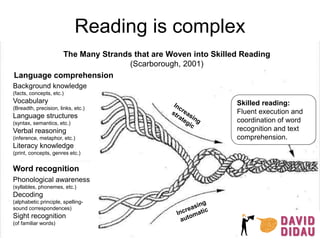
Reading is complex
Skilled reading:
Fluent execution and
coordination of word
recognition and text
comprehension.
The Many Strands that are Woven into Skilled Reading
(Scarborough, 2001)
Word recognition
Phonological awareness
(syllables, phonemes, etc.)
Decoding
(alphabetic principle, spelling-
sound correspondences)
Sight recognition
(of familiar words)
Language comprehension
Background knowledge
(facts, concepts, etc.)
Vocabulary
(Breadth, precision, links, etc.)
Language structures
(syntax, semantics, etc.)
Verbal reasoning
(inference, metaphor, etc.)
Literacy knowledge
(print, concepts, genres etc.)
There is no correlation between ‘word
recognition’ skills and intelligence
If there was, we would need to find evidence of the following
propositions:
1. that the pattern of information-processing skills that underlie the
reading deficits of low-IQ poor readers is different from the
information-processing skills that underlie the reading deficits of
high-IQ poor readers
2. that the neuroanatomical differences that underlie the cognitive
deficits of these two groups are different
3. that low- and high-IQ poor readers require different treatments to
remediate their reading problems
4. that there is differential etiology in the two groups based on
different heritability of the component deficits.
Stanovich (2005): “there is a wealth of evidence regarding [these propositions]
that is largely negative”.
So, what does cause reading
difficulty?
• Glue ear?
– “It’s estimated that one in five children around the age
of two will be affected by glue ear at any given time,
and about 8 in every 10 children will have had glue
ear at least once by the time they’re 10 years old.”
www.nhs.uk
• Visual problems?
– Maybe 1 in 5 children with undiagnosed visual issues
Optometry Today
• English orthography?
Seymour, Aro & Erskine (2003)
What’s going wrong?
Errors in word reading at
the end of first year of
instruction
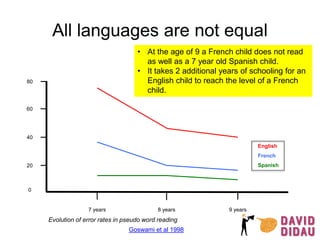
All languages are not equal
7 years 8 years 9 years
20
40
60
80
English
French
Spanish
Goswami et al 1998
• At the age of 9 a French child does not read
as well as a 7 year old Spanish child.
• It takes 2 additional years of schooling for an
English child to reach the level of a French
child.
Evolution of error rates in pseudo word reading
0
The importance of fluency
They gradually ascended for half a mile
then found themselves at the top of a
considerable eminence where the
wood ceased theand eye was instantly
caught by Pemberley House situated on
the opposite side of the valley , into
which the road with some abruptness
wound.
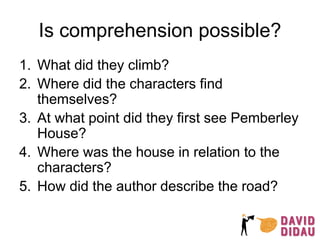
Is comprehension possible?
1. What did they climb?
2. Where did the characters find
themselves?
3. At what point did they first see Pemberley
House?
4. Where was the house in relation to the
characters?
5. How did the author describe the road?
Comprehension depends on reading
speed
They gradually ascended for
half a mile then found
themselves at the top of a
considerable eminence
where the wood ceased and
the eye was instantly caught
by Pemberley House situated
on the opposite side of the
valley, into which the road
with some abruptness
wound.
1. What did they climb?
2. Where did the
characters find
themselves?
3. At what point did they
first see Pemberley
House?
4. Where was the house
in relation to the
characters?
5. How did the author
describe the road?
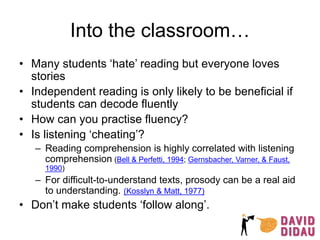
Into the classroom…
• Many students ‘hate’ reading but everyone loves
stories
• Independent reading is only likely to be beneficial if
students can decode fluently
• How can you practise fluency?
• Is listening ‘cheating’?
– Reading comprehension is highly correlated with listening
comprehension (Bell & Perfetti, 1994; Gernsbacher, Varner, & Faust,
1990)
– For difficult-to-understand texts, prosody can be a real aid
to understanding. (Kosslyn & Matt, 1977)
• Don’t make students ‘follow along’.
Episodic
buffer
Visuo-spatial
sketchpad
Phonological
loop
Episodic LTM
Visual
semantics
Language
Working memory model
Fluid components
Crystallised components
Central executive
Baddeley, Working Memory: Theories,
Models, and Controversies (2011)
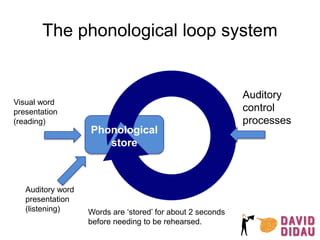
The phonological loop system
Phonological
store
Auditory
control
processes
Auditory word
presentation
(listening)
Visual word
presentation
(reading)
Words are ‘stored’ for about 2 seconds
before needing to be rehearsed.
The silent voice
• ‘Silent’ reading is pretty recent
– “…his eyes scanned the page and his heart
sought out the meaning, but his voice was
silent and his tongue was still. Anyone could
approach him freely and guests were not
commonly announced, so that often, when we
came to visit him, we found him reading like
this in silence, for he never read aloud.
Augustine, Confessions Book Six, Chapter Three
• Silence may be an illusion:
– We all subvocalise
– Prosody adds meaning
St Ambrose – 340 - 397 CE
Rubenstein, Lewis & Rubenstein, 1971; Colheart et al., 1977;
Seidenberg et al., 1996; Ferrand, 2001 (Chapter 4)
Are you reading ‘aloud’?
Lolita, light of my life,
fire of my loins. My sin,
my soul. Lo-lee-ta: the
tip of the tongue taking
a trip of three steps
down the palate to tap,
at three, on the teeth.
Lo. Lee. Ta.
Nabokov, Lolita
• Which should be our goal?
–Exam success
–Fluent readers
• Reading fluency benefits everyone in the
system but committing lesson time to
reading fluency tends not to benefit
individual teachers.
Reading makes you smarter
Below
expected level
%
At
expected level
%
Above
expected level
%
Very much 2.4 63.5 34.2
Quite a lot 4.2 83.5 12.3
A bit 17.4 75.8 6.8
Not at all 37 54.9 8.1
Enjoyment of reading and reading attainment in 2012 (n=13,710)
Reading makes you cleverer
Below
expected
level %
At
expected
level %
Above
expected
level %
Every day 3.7 68.3 26.1
A few times a week 7.1 81.7 11.2
About once a week 13.6 78.4 8
A few times a month 14.1 78.8 7.1
About once a month 18.9 72.2 8.9
Rarely 25.1 67 7.9
Never 36.2 58.3 5.4
Reading frequency and reading attainment in 2012 (n=13,710)
Knowledge and reading
• The more you read, the more you know
• How can we get children who cannot
decode fluently to read independently?
• The promise of ‘just reading’.
Westbrook et al 2019
Key Messages
1. There’s no correlation between
decoding and intelligence
2. Reading fluency is perhaps the most
pressing issue in schools
3. Comprehension depends on
background knowledge
4. Everyone loves stories
5. Being read to can help make kids
cleverer.
@DavidDidau
learningspy.co.uk
ddidau@gmail.com
“It is so easy to be wrong – and to persist in
being wrong – when the costs of being wrong
are paid by others.” Thomas Sowell

Reading aloud

  • 1.
    Why we need toread aloud @DavidDidau Chiltern TSA Tuesday 26th May 2020
  • 2.
    Reading is complex Skilledreading: Fluent execution and coordination of word recognition and text comprehension. The Many Strands that are Woven into Skilled Reading (Scarborough, 2001) Word recognition Phonological awareness (syllables, phonemes, etc.) Decoding (alphabetic principle, spelling- sound correspondences) Sight recognition (of familiar words) Language comprehension Background knowledge (facts, concepts, etc.) Vocabulary (Breadth, precision, links, etc.) Language structures (syntax, semantics, etc.) Verbal reasoning (inference, metaphor, etc.) Literacy knowledge (print, concepts, genres etc.)
  • 3.
    There is nocorrelation between ‘word recognition’ skills and intelligence If there was, we would need to find evidence of the following propositions: 1. that the pattern of information-processing skills that underlie the reading deficits of low-IQ poor readers is different from the information-processing skills that underlie the reading deficits of high-IQ poor readers 2. that the neuroanatomical differences that underlie the cognitive deficits of these two groups are different 3. that low- and high-IQ poor readers require different treatments to remediate their reading problems 4. that there is differential etiology in the two groups based on different heritability of the component deficits. Stanovich (2005): “there is a wealth of evidence regarding [these propositions] that is largely negative”.
  • 4.
    So, what doescause reading difficulty? • Glue ear? – “It’s estimated that one in five children around the age of two will be affected by glue ear at any given time, and about 8 in every 10 children will have had glue ear at least once by the time they’re 10 years old.” www.nhs.uk • Visual problems? – Maybe 1 in 5 children with undiagnosed visual issues Optometry Today • English orthography?
  • 5.
    Seymour, Aro &Erskine (2003) What’s going wrong? Errors in word reading at the end of first year of instruction
  • 6.
    All languages arenot equal 7 years 8 years 9 years 20 40 60 80 English French Spanish Goswami et al 1998 • At the age of 9 a French child does not read as well as a 7 year old Spanish child. • It takes 2 additional years of schooling for an English child to reach the level of a French child. Evolution of error rates in pseudo word reading 0
  • 7.
    The importance offluency They gradually ascended for half a mile then found themselves at the top of a considerable eminence where the wood ceased theand eye was instantly caught by Pemberley House situated on the opposite side of the valley , into which the road with some abruptness wound.
  • 8.
    Is comprehension possible? 1.What did they climb? 2. Where did the characters find themselves? 3. At what point did they first see Pemberley House? 4. Where was the house in relation to the characters? 5. How did the author describe the road?
  • 9.
    Comprehension depends onreading speed They gradually ascended for half a mile then found themselves at the top of a considerable eminence where the wood ceased and the eye was instantly caught by Pemberley House situated on the opposite side of the valley, into which the road with some abruptness wound. 1. What did they climb? 2. Where did the characters find themselves? 3. At what point did they first see Pemberley House? 4. Where was the house in relation to the characters? 5. How did the author describe the road?
  • 10.
    Into the classroom… •Many students ‘hate’ reading but everyone loves stories • Independent reading is only likely to be beneficial if students can decode fluently • How can you practise fluency? • Is listening ‘cheating’? – Reading comprehension is highly correlated with listening comprehension (Bell & Perfetti, 1994; Gernsbacher, Varner, & Faust, 1990) – For difficult-to-understand texts, prosody can be a real aid to understanding. (Kosslyn & Matt, 1977) • Don’t make students ‘follow along’.
  • 11.
    Episodic buffer Visuo-spatial sketchpad Phonological loop Episodic LTM Visual semantics Language Working memorymodel Fluid components Crystallised components Central executive Baddeley, Working Memory: Theories, Models, and Controversies (2011)
  • 12.
    The phonological loopsystem Phonological store Auditory control processes Auditory word presentation (listening) Visual word presentation (reading) Words are ‘stored’ for about 2 seconds before needing to be rehearsed.
  • 13.
    The silent voice •‘Silent’ reading is pretty recent – “…his eyes scanned the page and his heart sought out the meaning, but his voice was silent and his tongue was still. Anyone could approach him freely and guests were not commonly announced, so that often, when we came to visit him, we found him reading like this in silence, for he never read aloud. Augustine, Confessions Book Six, Chapter Three • Silence may be an illusion: – We all subvocalise – Prosody adds meaning St Ambrose – 340 - 397 CE Rubenstein, Lewis & Rubenstein, 1971; Colheart et al., 1977; Seidenberg et al., 1996; Ferrand, 2001 (Chapter 4)
  • 14.
    Are you reading‘aloud’? Lolita, light of my life, fire of my loins. My sin, my soul. Lo-lee-ta: the tip of the tongue taking a trip of three steps down the palate to tap, at three, on the teeth. Lo. Lee. Ta. Nabokov, Lolita
  • 15.
    • Which shouldbe our goal? –Exam success –Fluent readers • Reading fluency benefits everyone in the system but committing lesson time to reading fluency tends not to benefit individual teachers.
  • 16.
    Reading makes yousmarter Below expected level % At expected level % Above expected level % Very much 2.4 63.5 34.2 Quite a lot 4.2 83.5 12.3 A bit 17.4 75.8 6.8 Not at all 37 54.9 8.1 Enjoyment of reading and reading attainment in 2012 (n=13,710)
  • 18.
    Reading makes youcleverer Below expected level % At expected level % Above expected level % Every day 3.7 68.3 26.1 A few times a week 7.1 81.7 11.2 About once a week 13.6 78.4 8 A few times a month 14.1 78.8 7.1 About once a month 18.9 72.2 8.9 Rarely 25.1 67 7.9 Never 36.2 58.3 5.4 Reading frequency and reading attainment in 2012 (n=13,710)
  • 19.
    Knowledge and reading •The more you read, the more you know • How can we get children who cannot decode fluently to read independently? • The promise of ‘just reading’. Westbrook et al 2019
  • 20.
    Key Messages 1. There’sno correlation between decoding and intelligence 2. Reading fluency is perhaps the most pressing issue in schools 3. Comprehension depends on background knowledge 4. Everyone loves stories 5. Being read to can help make kids cleverer.
  • 21.
    @DavidDidau learningspy.co.uk ddidau@gmail.com “It is soeasy to be wrong – and to persist in being wrong – when the costs of being wrong are paid by others.” Thomas Sowell

Editor's Notes

  • #21  ----- Meeting Notes (05/09/2014 10:34) -----